


 |
市場調查報告書
商品編碼
2114000
工業用燃氣渦輪機:市場佔有率分析、產業趨勢與統計、成長預測(2026-2031)Industrial Gas Turbine - Market Share Analysis, Industry Trends & Statistics, Growth Forecasts (2026 - 2031) |
||||||

※ 本網頁內容可能與最新版本有所差異。詳細情況請與我們聯繫。
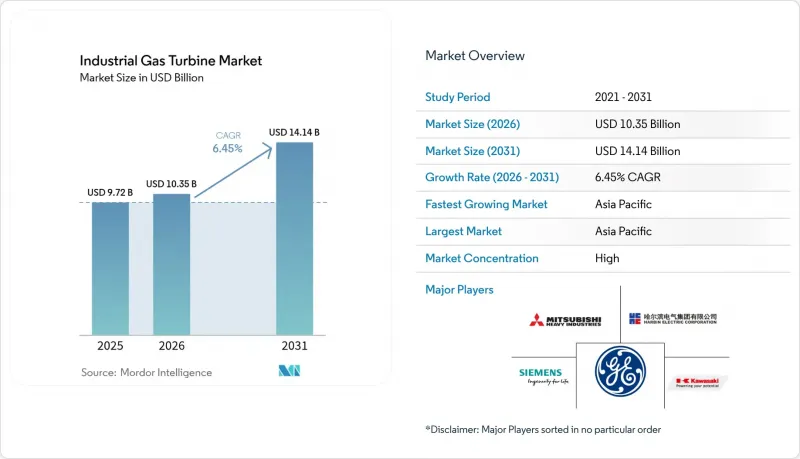
據 Mordor Intelligence 稱,工業燃氣渦輪機市場預計到 2026 年價值 103.5 億美元,高於 2025 年的 97.2 億美元,預計到 2031 年將達到 141.4 億美元。
預計 2026 年至 2031 年的複合年成長率為 6.45%。
本報告按容量(1-40 MW、41-120 MW、121-300 MW 和 300 MW 以上)、框架類型(航空衍生型和重型)、循環(簡單循環和聯合循環)、應用(電力公司、石油和天然氣、工業汽電共生、船舶和其他)以及地區(北美、歐洲、亞太地區分類以及石油和天然氣、工業熱電聯產、船舶和其他)以及地區(北美、歐洲、亞太地區分類和地區分類。
全球工業燃氣渦輪機市場趨勢與洞察
新興經濟體電力需求增加
奈及利亞1,350兆瓦的燃氣發電廠、越南計畫在2035年建成84吉瓦液化天然氣發電裝置容量,以及坦尚尼亞首座聯合循環發電廠,都顯示開發中國家正快速轉向更清潔的燃氣技術,以滿足工業化帶來的消費激增。美國國際發展金融公司(IDFC)等出口信貸機構和多邊金融機構正在支持這些項目的資金籌措,撒哈拉以南非洲地區的燃氣渦輪機訂單也在加速成長。與煤炭相比,燃氣渦輪機發電量成長更快,顆粒物排放量更低,因此區域政策制定者將其視為補充可再生能源的可行選擇。
電力公司發電結構中煤炭向天然氣的轉型
電力公司報告稱,以高效能聯合循環發電廠取代燃煤電廠,利用現有基礎設施,與新建設相比,二氧化碳排放量最多可減少70%,資本成本降低30%。在廣東省惠州市等亞洲項目中,目前正在安裝可摻氫10%的9HA級燃氣渦輪機,並已製定了100%摻氫藍圖。這確保了國家脫碳政策與電網可靠性的兼容性。自2010年以來,煤炭向天然氣的轉型已累積減少了5億噸二氧化碳排放,凸顯了這項轉型在應對氣候變遷方面的關鍵意義。
可再生能源成本低於天然氣。
自2010年以來,太陽能發電成本已大幅下降90%,達到0.044美元/度。此外,到2023年,81%的新增可再生能源在價格方面將優於石化燃料替代替代能源。在電網服務優質的地區,發電容量的靈活調節能力維持了聯合循環發電廠的競爭力。因此,燃氣渦輪機發電廠正從基本負載轉向靈活的峰值響應電源,這需要進行設計改進以適應快速的運行週期。
細分市場分析
到2025年,300兆瓦以上的燃氣渦輪機將佔據工業燃氣渦輪機市場佔有率的50.10%,其高資本效率和碳捕獲能力備受青睞。泰國旗艦聯合循環發電廠是一座5,300兆瓦的燃氣渦輪電廠,採用8台M701JAC機組,充分展現了這些大型燃氣渦輪機的規模經濟效益。同時,120-300兆瓦級燃氣渦輪機是成長最快的細分市場,年複合成長率達9.42%,正為模組化發電、微電網和分散式發電提供支援。這些項目與氣候適應型電網策略和分階段投資模式完美契合。由於供應鏈的限制,超大型燃氣渦輪機的產能將持續到2031年,促使客戶轉向前置作業時間更短、運輸物流更簡單的中型燃氣渦輪機。
原始設備製造商(OEM)正不斷改進兩類燃氣渦輪機的燃燒系統,透過升級燃燒器和控制軟體,他們最初的目標是實現50%的氫基燃燒,並正在探索未來實現100%氫基燃燒的途徑。隨著各國政府鼓勵快速部署低碳發電能力,中型工業燃氣渦輪機的市場規模預計將顯著擴大。
2025年,大型機組的銷售額將佔總銷售額的69.20%,凸顯了其在基本負載發電領域長達數十年的生命週期。最新的HL平台在聯合循環模式下的效率已超過64%。源自航空引擎的機組僅佔總銷售額的30.80%,其成長主要受10-50兆瓦級機組的需求驅動,這些機組能夠在幾分鐘內完成冷啟動,預計到2031年,其複合年成長率將達到8.2%。例如,LM2500XPRESS機組可將建造時間縮短40%,並可從一開始就使用35%的綠色氫氣作為運作。大型供應商正透過輔助撬裝設備的模組化和減少停機時間來應對這項挑戰,從而縮小與航空引擎的總擁有成本(TCO)差距。
區域分析
在煤炭向天然氣轉型、持續的都市化以及政府主導的投資推動下,亞太地區預計到2025年將佔全球燃氣渦輪機銷售額的45.60%。中國的舟山氫能計畫和越南84吉瓦液化天然氣藍圖象徵各國在不損害能源安全的前提下,致力於實現快速脫碳的政策承諾。印度天然氣管道基礎設施的建設以及澳洲強制性的尖峰電廠部署進一步推動了該地區的需求。亞太地區工業燃氣渦輪機市場是全球最大的市場,預計該地區將以6.75%的複合年成長率成長。
在北美,成熟的燃氣渦輪機透過資料中心汽電共生(CHP) 和可再生能源專案持續應用。杜克能源公司訂購多達 11 台美國製造的 7HA 燃氣渦輪機,反映了強勁的國內需求和各州的積極努力。在歐洲,人們對氫能相容和碳捕獲技術的興趣日益濃厚,EnBW 在斯圖加特-明斯特的安裝計畫就體現了這一點。在中東,「2030 願景」計劃促成了沙烏地阿拉伯和阿拉伯聯合大公國的吉瓦級競標,天然氣在這些國家繼續發揮戰略性的過渡燃料作用。在非洲,多個項目備受關注,其中包括奈及利亞一座 1350 兆瓦的發電廠,該電廠將滿足該國 11% 的電力需求。在南美洲,高效率的複合循環發電廠正選擇性地部署,巴西則致力於確保可調節的發電能力,以穩定其以水力發電為主的電網。
其他好處:
- Excel格式的市場預測(ME)表
- 3個月的分析師支持
目錄
第1章:引言
- 研究假設和市場定義
- 調查範圍
第2章:調查方法
第3章執行摘要
第4章 市場狀況
- 市場概覽
- 市場促進因素
- 新興國家電力需求增加
- 電力公司發電結構從煤炭轉向天然氣
- 平衡可再生能源所需的柔軟性
- 資料中心熱電聯產設施快速擴張
- 氫能相容型工業設備維修
- 用於應對氣候變遷的移動式模組化渦輪機
- 市場限制因素
- 可再生能源成本低於天然氣。
- 天然氣價格波動
- 對天然氣相關出口徵收碳邊境調節稅
- 鍛造和高溫合金供應鏈中的瓶頸
- 供應鏈分析
- 監理情勢
- 技術趨勢(氫能、氨能、碳捕獲、利用與封存)
- 波特五力模型
第5章 市場規模與成長預測
- 按產能
- 1~40 MW
- 41~120 MW
- 121~300 MW
- 300兆瓦或以上
- 按框架類型
- 航空衍生性商品
- 重負
- 循環
- 簡單迴圈
- 複合循環
- 透過使用
- 電力公司
- 石油和天然氣
- 工業熱電聯產
- 船舶和其他
- 按地區
- 北美洲
- 美國
- 加拿大
- 墨西哥
- 歐洲
- 德國
- 英國
- 法國
- 義大利
- 西班牙
- 俄羅斯
- 其他歐洲國家
- 亞太地區
- 中國
- 印度
- 日本
- 韓國
- 東南亞國協
- 澳洲
- 其他亞太國家
- 南美洲
- 阿根廷
- 巴西
- 其他南美國家
- 中東和非洲
- 沙烏地阿拉伯
- 阿拉伯聯合大公國
- 南非
- 其他中東和非洲國家
- 北美洲
第6章 競爭情勢
- 市場集中度
- 策略趨勢(併購、聯盟、購電協議)
- 市場佔有率分析(主要公司的市場排名和佔有率)
- 公司簡介
- GE Vernova(General Electric)
- Siemens Energy
- Mitsubishi Power
- Ansaldo Energia
- Harbin Electric
- Bharat Heavy Electricals
- Kawasaki Heavy Industries
- Solar Turbines(Caterpillar)
- MAN Energy Solutions
- MTU Aero/Vericor
- Baker Hughes
- Rolls-Royce Power Systems
- Doosan Enerbility
- Shanghai Electric
- Capstone Green Energy
- OPRA Turbines
- Triveni Turbines
- Alstom(GE Gas Power heritage)
- Elliott Group
- Centrax Industries
第7章 市場機會與未來展望
According to Mordor Intelligence, industrial gas turbine market size in 2026 is estimated at USD 10.35 billion, growing from 2025 value of USD 9.72 billion with 2031 projections showing USD 14.14 billion, growing at 6.45% CAGR over 2026-2031.
This report is Segmented by Capacity (1 To 40 MW, 41 To 120 MW, 121 To 300 MW, and Above 300 MW), Frame Type (Aero-Derivative and Heavy-Duty), Cycle (Simple Cycle and Combined Cycle), Application (Power Utilities, Oil and Gas, Industrial CHP, and Marine and Others), and Geography (North America, Europe, Asia Pacific, South America, and Middle East and Africa).
Global Industrial Gas Turbine Market Trends and Insights
Rising Power Demand in Emerging Economies
Nigeria's 1,350 MW plant, Vietnam's plan for 84 GW of LNG-based capacity by 2035, and Tanzania's first combined-cycle facility illustrate how developing nations leapfrog to cleaner gas technology to meet industrialization-driven consumption spikes. Export-credit agencies and multilateral lenders, such as the U.S. International Development Finance Corporation, underpin project bankability, accelerating turbine orders across sub-Saharan Africa. Given their fast-ramp capability and lower particulate emissions compared to coal, regional policymakers view gas turbines as pragmatic complements to renewables.
Coal-to-Gas Shift in Utility Generation Mix
Utilities replacing coal with high-efficiency combined-cycle plants report up to 70% CO2 reductions and capital cost savings of 30% versus greenfield builds by reusing existing infrastructure. Asian projects such as Guangdong Huizhou deploy 9HA-class turbines capable of 10% hydrogen blends today, with roadmaps to 100%, aligning national decarbonization policies with grid reliability. Cumulative coal-to-gas conversions have already averted 500 million t of CO2 since 2010, underscoring the transition's climate significance.
Renewables' LCOE Under-Cutting Gas
Solar PV costs have plummeted by 90% since 2010 to USD 0.044/kWh, and 81% of new renewables outperform fossil alternatives in price in 2023. Dispatchable value keeps combined-cycle plants competitive where grid services command a premium. Gas turbines, therefore, pivot from baseload to flexible peakers, demanding design upgrades for rapid cycling.
Other drivers and restraints analyzed in the detailed report include:
- Renewable-Balancing Flexibility Needs
- Data-Center CHP Build-Out Surge
- Natural-Gas Price Volatility
For complete list of drivers and restraints, kindly check the Table Of Contents.
Segment Analysis
Above-300 MW machines accounted for 50.10% of the industrial gas turbine market share in 2025, favored for their capital efficiency and readiness for carbon capture. A flagship 5,300 MW Thai complex using eight M701JAC units illustrates the scale benefits of these giants. In parallel, the 120-300 MW class, the fastest-growing segment at a 9.42% CAGR, caters to modular power schemes, microgrids, and distributed generation. Such projects align perfectly with climate-resilient grid strategies and staged investment models. Supply chain limitations constrain ultralarge frame production slots until 2031, driving customers toward the mid-range, where lead times are shorter and shipment logistics simpler.
OEMs continuously refine combustion systems for both classes, initially targeting 50% hydrogen blends and pathways to 100% by upgrading burners and control software. The mid-range units' industrial gas turbine market size is projected to expand significantly as governments incentivize the rapid deployment of low-carbon capacity.
Heavy-duty configurations secured 69.20% of 2025 revenue, a testament to their multidecade lifecycle in baseload service. Efficiency now exceeds 64% in combined-cycle mode with the latest HL platforms. Aero-derivative packages, which account for just 30.80% of revenue, are expected to expand at an 8.2% CAGR through 2031, driven by demand for 10-50 MW blocks that can cold-start in minutes. LM2500XPRESS units, for instance, shave construction schedules by 40% and accept 35% green hydrogen from day one. Heavy-duty vendors address this by modularizing auxiliary skids and shortening outage windows, thereby narrowing the total-cost-of-ownership gaps with the aero-fleet.
Complete Report Scope:
- By Capacity
- 1 to 40 MW
- 41 to 120 MW
- 121 to 300 MW
- Above 300 MW
- By Frame Type
- Aero-derivative
- Heavy-duty
- By Cycle
- Simple Cycle
- Combined Cycle
- By Application
- Power Utilities
- Oil and Gas
- Industrial CHP
- Marine and Others
- By Geography
- North America
- United States
- Canada
- Mexico
- Europe
- Germany
- United Kingdom
- France
- Italy
- Spain
- Russia
- Rest of Europe
- Asia Pacific
- China
- India
- Japan
- South Korea
- ASEAN Countries
- Australia
- Rest of Asia Pacific
- South America
- Argentina
- Brazil
- Rest of South America
- Middle East and Africa
- Saudi Arabia
- United Arab Emirates
- South Africa
- Rest of Middle East and Africa
- North America
Geography Analysis
The Asia-Pacific region accounted for 45.60% of global revenue in 2025, driven by coal-to-gas transitions, relentless urbanization, and state-backed investment. China's hydrogen-ready Zhoushan project and Vietnam's 84 GW LNG roadmap exemplify policy commitment to swift decarbonization without compromising energy security. India's upgrading of gas pipeline infrastructure and Australia's peaking-plant mandates further reinforce regional appetite. The Asia-Pacific's industrial gas turbine market is the world's largest and is projected to grow at a 6.75% CAGR in the region.
North America's mature fleet continues to expand through data center CHP and renewable projects. Duke Energy's booking of up to 11 American-made 7HA turbines speaks to robust domestic demand, heavy states. Europe's focus has shifted to hydrogen readiness and carbon-capture-enabled technologies, as seen in EnBW's Stuttgart-Munster installation. In the Middle East, Vision 2030 initiatives translate into multigigawatt tenders in Saudi Arabia and the UAE, where natural gas remains a strategic bridge fuel. Africa showcases several projects, such as Nigeria's 1,350 MW plant, which will supply 11% of the nation's demand. South America selectively adds high-efficiency combined-cycle stations, with Brazil emphasizing dispatchable capacity to firm its hydro-dominant grid.
- GE Vernova (General Electric)
- Siemens Energy
- Mitsubishi Power
- Ansaldo Energia
- Harbin Electric
- Bharat Heavy Electricals
- Kawasaki Heavy Industries
- Solar Turbines (Caterpillar)
- MAN Energy Solutions
- MTU Aero / Vericor
- Baker Hughes
- Rolls-Royce Power Systems
- Doosan Enerbility
- Shanghai Electric
- Capstone Green Energy
- OPRA Turbines
- Triveni Turbines
- Alstom (GE Gas Power heritage)
- Elliott Group
- Centrax Industries
Additional Benefits:
- The market estimate (ME) sheet in Excel format
- 3 months of analyst support
TABLE OF CONTENTS
1 Introduction
- 1.1 Study Assumptions & Market Definition
- 1.2 Scope of the Study
2 Research Methodology
3 Executive Summary
4 Market Landscape
- 4.1 Market Overview
- 4.2 Market Drivers
- 4.2.1 Rising power demand in emerging economies
- 4.2.2 Coal-to-gas shift in utility generation mix
- 4.2.3 Renewable-balancing flexibility needs
- 4.2.4 Data-center CHP build-out surge
- 4.2.5 Hydrogen-ready industrial retrofits
- 4.2.6 Mobile modular turbines for climate-resilient grids
- 4.3 Market Restraints
- 4.3.1 Renewables LCOE under-cutting gas
- 4.3.2 Natural-gas price volatility
- 4.3.3 Carbon-border tariffs on gas-based exports
- 4.3.4 Forging & super-alloy supply-chain bottlenecks
- 4.4 Supply-Chain Analysis
- 4.5 Regulatory Landscape
- 4.6 Technological Outlook (Hydrogen, Ammonia, CCUS)
- 4.7 Porter's Five Forces
- 4.7.1 Bargaining Power of Suppliers
- 4.7.2 Bargaining Power of Buyers
- 4.7.3 Threat of New Entrants
- 4.7.4 Threat of Substitutes
- 4.7.5 Competitive Rivalry
5 Market Size & Growth Forecasts
- 5.1 By Capacity
- 5.1.1 1 to 40 MW
- 5.1.2 41 to 120 MW
- 5.1.3 121 to 300 MW
- 5.1.4 Above 300 MW
- 5.2 By Frame Type
- 5.2.1 Aero-derivative
- 5.2.2 Heavy-duty
- 5.3 By Cycle
- 5.3.1 Simple Cycle
- 5.3.2 Combined Cycle
- 5.4 By Application
- 5.4.1 Power Utilities
- 5.4.2 Oil and Gas
- 5.4.3 Industrial CHP
- 5.4.4 Marine and Others
- 5.5 By Geography
- 5.5.1 North America
- 5.5.1.1 United States
- 5.5.1.2 Canada
- 5.5.1.3 Mexico
- 5.5.2 Europe
- 5.5.2.1 Germany
- 5.5.2.2 United Kingdom
- 5.5.2.3 France
- 5.5.2.4 Italy
- 5.5.2.5 Spain
- 5.5.2.6 Russia
- 5.5.2.7 Rest of Europe
- 5.5.3 Asia Pacific
- 5.5.3.1 China
- 5.5.3.2 India
- 5.5.3.3 Japan
- 5.5.3.4 South Korea
- 5.5.3.5 ASEAN Countries
- 5.5.3.6 Australia
- 5.5.3.7 Rest of Asia Pacific
- 5.5.4 South America
- 5.5.4.1 Argentina
- 5.5.4.2 Brazil
- 5.5.4.3 Rest of South America
- 5.5.5 Middle East and Africa
- 5.5.5.1 Saudi Arabia
- 5.5.5.2 United Arab Emirates
- 5.5.5.3 South Africa
- 5.5.5.4 Rest of Middle East and Africa
- 5.5.1 North America
6 Competitive Landscape
- 6.1 Market Concentration
- 6.2 Strategic Moves (M&A, Partnerships, PPAs)
- 6.3 Market Share Analysis (Market Rank/Share for key companies)
- 6.4 Company Profiles (includes Global level Overview, Market level overview, Core Segments, Financials as available, Strategic Information, Products & Services, and Recent Developments)
- 6.4.1 GE Vernova (General Electric)
- 6.4.2 Siemens Energy
- 6.4.3 Mitsubishi Power
- 6.4.4 Ansaldo Energia
- 6.4.5 Harbin Electric
- 6.4.6 Bharat Heavy Electricals
- 6.4.7 Kawasaki Heavy Industries
- 6.4.8 Solar Turbines (Caterpillar)
- 6.4.9 MAN Energy Solutions
- 6.4.10 MTU Aero / Vericor
- 6.4.11 Baker Hughes
- 6.4.12 Rolls-Royce Power Systems
- 6.4.13 Doosan Enerbility
- 6.4.14 Shanghai Electric
- 6.4.15 Capstone Green Energy
- 6.4.16 OPRA Turbines
- 6.4.17 Triveni Turbines
- 6.4.18 Alstom (GE Gas Power heritage)
- 6.4.19 Elliott Group
- 6.4.20 Centrax Industries
7 Market Opportunities & Future Outlook
- 7.1 White-space & Unmet-need Assessment


