


 |
市場調查報告書
商品編碼
2113889
歐洲指紋感測器:市場佔有率分析、產業趨勢與統計及成長預測(2026-2031 年)Europe Fingerprint Sensor - Market Share Analysis, Industry Trends & Statistics, Growth Forecasts (2026 - 2031) |
||||||

※ 本網頁內容可能與最新版本有所差異。詳細情況請與我們聯繫。
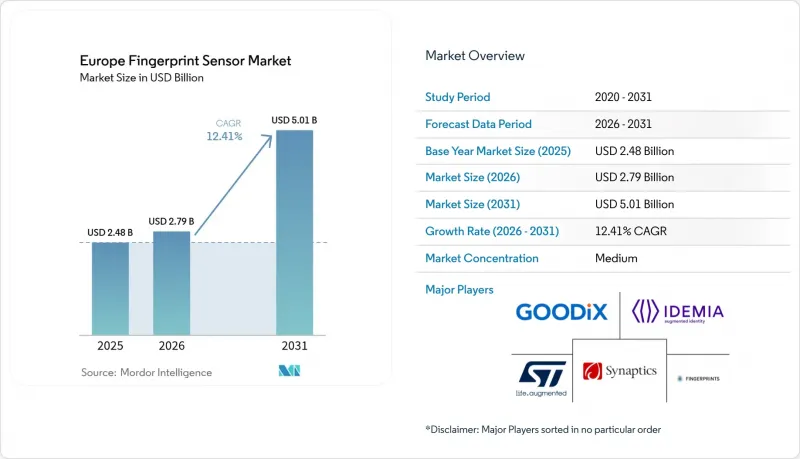
根據 Mordor Intelligence 預測,歐洲指紋感測器市場規模將從 2025 年的 24.8 億美元成長到 2026 年的 27.9 億美元,然後在 2031 年達到 50.1 億美元,2026 年至 2031 年的複合年成長率為 12.41%。
本報告按感測器類型(光學、電容式等)、應用領域(智慧型手機、平板電腦、筆記型電腦等)、終端用戶產業(軍事和國防、家用電子電器等)、感測器安裝位置(前置、後置等)以及國家(德國、英國、法國等)進行分類。市場預測以美元計價。
歐洲指紋感應器市場趨勢與洞察
家用電子電器中生物識別的擴展
主流智慧型手機製造商正在OLED面板下方整合大面積超音波感測區域,即使手指潮濕也能實現一鍵註冊,同時保持無邊框顯示效果。高通的「3D Sonic Max」和匯頂科技-vivo的原型產品可在300毫秒內完成身份驗證,進一步拉大了與傳統電容式組件的性能差距。智慧型手機、平板電腦和智慧型手錶之間的硬體通用使得廠商能夠分攤研發成本,從而加快了生物識別組件在中階設備中的普及速度,遠超以往。梅賽德斯-奔馳等汽車製造商正在將這些模組整合到方向盤和車門立柱中,將目標市場擴展到個人電子產品之外。由於每個感測器都控制著行動支付、駕駛員檔案和共享汽車鑰匙等高級功能的存取權限,即使在宏觀經濟低迷時期,組件的搭載率仍然保持強勁。
歐洲監管機構採取措施加強電子身分識別和電子護照計劃
修訂後的歐盟第910/2014號法規強制要求新ID卡採用雙指紋註冊,這導致保加利亞、葡萄牙和其他一些領先國家出現了採購熱潮。這些項目均參考了ISO/IEC 19794-2標準,透過簡化成員國的核准流程,使擁有預先認證演算法和硬體的供應商受益。愛沙尼亞的電子居民計畫已擴展至超過12萬個數位身分證件,五年一次的定期續約機制穩定了業務收益。隨著跨境錢包互通性的日益成熟,小規模的政府部門也擴大採用類似的規範以確保相互認可,從而形成良性循環,推動了整個歐洲指紋感測器市場的銷售成長。
與臉部認證和虹膜辨識方法的競爭
新冠疫情期間,對非接觸式技術的需求激增,促使企業以低於500歐元的價格,在門禁系統和轉盤上加裝臉部認證讀取器。這比指紋辨識套件(包括安裝成本)便宜得多。然而,與自願指紋掃描相比,持續的臉部認證需要遵守《一般資料保護規則》(GDPR),該規範對使用者同意和資料最小化提出了更嚴格的要求,並需要進行額外的資料保護影響評估。因此,許多設施管理人員正在採用雙系統方案:在受監管區域保留高度可靠的指紋識別,而在大廳等場所則使用臉部認證作為便捷功能。這種雙系統並存的模式限制了指紋辨識的完全取代,但仍減緩了歐洲指紋感應器市場傳統門禁控制領域的銷售成長。
細分市場分析
到2025年,電容式指紋辨識器將維持34.72%的最大市場佔有率。這要歸功於其成熟的模具技術、豐富的封裝選擇和穩定的良率,使其適用於對價格敏感的智慧型手機和平板電腦。相較之下,超音波感測器的複合年成長率(CAGR)為13.12%,這得益於其能夠透過厚度達4毫米的OLED玻璃捕捉影像,以及其生物特徵檢測功能,從而有效防止欺騙攻擊。性能的提升使得OEM廠商能夠在不影響解鎖速度的前提下,將防水智慧型手機推向市場,進而支撐歐洲高階指紋辨識器市場。光學感測器在邊境自助終端等需要更高法醫學解析度的取證設備中仍有需求,但其較厚的模組限制了其在輕薄穿戴裝置中的應用。熱敏感測器則用於必須能夠承受灰塵、油污和戶外潮濕環境的堅固耐用的工業自助終端。儘管應用領域較為小眾,但熱敏感測器的應用帶來了可觀的單位利潤率,並有助於緩解其他行業平均售價(ASP)的下滑。
歐洲指紋感測器市場在成本和規格方面持續呈現兩極化趨勢。隨著良率的提升和新型6吋面板的整合,模組成本下降,預計超音波晶片將在2026年至2027年間被中階行動電話廣泛採用。電容式指紋感測器製造商則透過晶圓級晶片封裝(WLCSP)和人工智慧影像重建技術,在不犧牲精度的前提下減少矽晶圓面積,從而保護其現有基本客群。因此,一種新的共存格局正在形成,每種感測方法都將在不同的垂直市場中佔據主導地位。具體而言,超音波指紋感應器將應用於銀行、高階智慧型手機和汽車;電容式指紋感應器將應用於量產電子產品;光學指紋感應器將應用於政府機構;而熱式指紋感應器則將應用於關鍵任務型工業應用情境。這將擴大歐洲指紋感測器市場中專業供應商的潛在收入規模。
預計到2025年,智慧型手機和平板電腦將佔總出貨量的43.22%,這主要得益於作業系統原生生物識別API,它們使終端用戶能夠輕鬆註冊指紋。然而,物聯網設備和其他應用領域預計將在2031年之前以14.23%的複合年成長率快速成長,這主要受智慧門鎖、連網恆溫器和工業閘道等需要安全本地存取的設備的需求驅動。歐洲智慧家庭整合商,例如ekey,已經在寒冷的阿爾卑斯山區部署了超過5萬套生物識別門禁系統,證明了其感測器即使在零下溫度下也能穩定工作。筆記型電腦在10-12%的穩定市場佔有率中保持領先地位,這得益於微軟的「Windows Hello」身份驗證以及企業強制實施的多因素身份驗證。
奧地利和荷蘭的開發人員正在試驗將門禁和支付功能整合到一張智慧卡中,這預示著未來智慧卡融合的趨勢:單一嵌入式指紋感應器可以支援多個應用程式,從而降低每個功能的成本。隨著智慧型手機普及率趨於穩定,這種多功能創新對於維持銷售成長至關重要。
其他好處:
- Excel格式的市場預測(ME)表
- 3個月的分析師支持
目錄
第1章:引言
- 研究假設和市場定義
- 調查範圍
第2章:調查方法
第3章執行摘要
第4章 市場狀況
- 市場概覽
- 市場促進因素
- 生物識別在家用電子電器的應用越來越廣泛。
- 歐洲加強電子身分證和電子護照項目的監管舉措
- 非接觸式支付和智慧卡的需求日益成長
- 將多模態生物識別融合技術整合到邊境管制自助終端中
- 超薄軟性感測器在穿戴式裝置和醫療保健設備中的應用。
- 歐盟的數位身分錢包計畫正在加速設備內部的標準化進程。
- 市場限制因素
- 與臉部認證和虹膜辨識技術的競爭
- 半導體元件短缺正在擾亂供應鏈。
- 「隱私設計」要求的日益嚴格使得邊緣加密變得更加複雜。
- 由於亞洲ODM公司帶來的商品化壓力,平均售價(ASP)下降。
- 產業價值鏈分析
- 監理情勢
- 技術展望
- 波特五力分析
- 宏觀經濟因素對市場的影響
第5章 市場規模與成長預測
- 依感測器類型
- 光學
- 電容式
- 熱的
- 超音波
- 透過使用
- 智慧型手機和平板電腦
- 筆記型電腦
- 智慧卡
- 物聯網設備和其他應用
- 按最終用戶行業分類
- 軍事/國防
- 家用電子產品
- 銀行、金融服務和保險(BFSI)
- 政府
- 其他終端用戶產業
- 感測器放置位置
- 前置式
- 後置式
- 側裝式
- 顯示螢幕
- 國家
- 德國
- 英國
- 法國
- 義大利
- 西班牙
- 荷蘭
- 瑞典
- 其他歐洲國家
第6章 競爭情勢
- 市場集中度
- 策略趨勢
- 市佔率分析
- 公司簡介
- Fingerprint Cards AB
- STMicroelectronics NV
- Synaptics Incorporated
- Guangdong Goodix Technology Co., Ltd.
- IDEMIA France SAS
- Egis Technology Inc.
- IDEX Biometrics ASA
- TDK Corporation
- Next Biometrics Group ASA
- Dermalog Identification Systems GmbH
- Gemalto NV(Thales Group)
- NuData Security, A Mastercard Company
- Jenetric GmbH
- Precise Biometrics AB
- Suprema Inc.
- Qualcomm Technologies, Inc.
- Apple Inc.
- Samsung Electronics Co., Ltd.
- NEC Corporation
- BIO-key International, Inc.
第7章 市場機會與未來展望
According to Mordor Intelligence, the European fingerprint sensor market size is expected to grow from USD 2.48 billion in 2025 to USD 2.79 billion in 2026 and is forecast to reach USD 5.01 billion by 2031 at 12.41% CAGR over 2026-2031.
This report is Segmented by Sensor Type (Optical, Capacitive, and More), Application (Smartphones and Tablets, Laptops, and More), End-User Industry (Military and Defence, Consumer Electronics, and More), Sensor Placement (Front-Mounted, Rear-Mounted, and More), and Country (Germany, United Kingdom, France, and More). The Market Forecasts are Provided in Terms of Value (USD).
Europe Fingerprint Sensor Market Trends and Insights
Rising adoption of biometric authentication in consumer electronics
Flagship handset makers are embedding larger ultrasonic sensing areas beneath OLED panels, enabling one-tap enrollment even with wet fingers while preserving bezel-free displays. Qualcomm's 3D Sonic Max and Goodix-Vivo prototypes authenticate in under 300 ms, reinforcing a performance gap versus legacy capacitive parts. Hardware commonality in smartphones, tablets, and smartwatches enables vendors to amortize R&D costs, pushing biometric components into mid-tier devices sooner than in prior cycles. Automotive brands, such as Mercedes-Benz, have incorporated these modules into steering wheels and door pillars, extending the addressable volume beyond personal electronics. Because each installed sensor forms a gating mechanism for premium features such as mobile payments, driver profiles, and car-sharing keys, component attach rates remain resilient even during macroeconomic softness.
Regulatory push for stronger eID and ePassport programs in Europe
Revised EU Regulation 910/2014 obligations require dual fingerprint enrollment for new ID cards, prompting procurement waves across Bulgaria, Portugal, and other early movers. The programs reference ISO/IEC 19794-2 templates, rewarding suppliers with pre-certified algorithms and hardware that simplify member-state approval cycles. Estonia's e-Residency expansion already exceeds 120,000 digital IDs, providing a recurring replacement cycle every five years that locks in service revenue. As cross-border wallet interoperability matures, ministries in smaller countries are gravitating toward similar specs to ensure mutual recognition, forming a feedback loop that boosts volumes across the full European fingerprint sensor market.
Competition from face and iris recognition modalities
Contactless preferences that surged during COVID-19 prompted enterprises to retrofit doors and turnstiles with facial readers costing below EUR 500 per endpoint, substantially less than fingerprint-based kits after installation labor. Yet GDPR compliance imposes stricter consent and data minimization demands on continuous facial capture versus voluntary fingerprint scans, triggering extra data-protection-impact assessments. As a result, many facility managers adopt a dual system whereby fingerprint remains the high-assurance factor for regulated zones, while face serves as a convenience factor for the lobby. This coexistence limits full displacement but still trims unit sales growth in traditional access-control corridors of the European fingerprint sensor market.
Other drivers and restraints analyzed in the detailed report include:
- Growing demand for contactless payments and smartcards
- Integration of multimodal biometric fusion in border-control kiosks
- Semiconductor component shortages disrupting supply chains
For complete list of drivers and restraints, kindly check the Table Of Contents.
Segment Analysis
Capacitive devices retained the lion's share at 34.72% in 2025, reflecting mature tooling, broad package options, and stable yields that suit price-sensitive smartphones and tablets. In contrast, ultrasonic sensors are scaling at a 13.12% CAGR, leveraging their ability to image through up to 4 mm of OLED glass while rejecting spoof attempts via liveness detection. This performance upgrade enables original equipment manufacturers to market waterproof phones without compromising unlock speed, thereby supporting the European fingerprint sensor market's premium tier. Optical sensors remain in demand for enhanced forensic-image resolution in border kiosks, yet their thicker module height limits their usage in slim wearables. Thermal-based parts serve ruggedized industrial kiosks that must survive dust, grease, and outdoor moisture; although niche, these deployments carry superior unit margins that cushion vendors against ASP erosion elsewhere.
The European fingerprint sensor market continues to bifurcate along cost and specification lines. Ultrasonic dice are expected to migrate into mid-range handsets between 2026 and 2027 as yield learning curves and new 6-inch panel integrations lower module costs. Capacitive makers defend their installed base with wafer-level chip-scale packaging and AI-enhanced image reconstruction, which shrinks silicon area without compromising accuracy. The net result is a coexistence scenario in which each sensing modality commands distinct verticals: ultrasonic for banking, premium phones, and automotive; capacitive for mass-market electronics; optical for government; and thermal for mission-critical industrial use cases, thereby broadening the Europe fingerprint sensor market addressable revenue pool for specialized suppliers.
Smartphones and tablets accounted for 43.22% of 2025 shipments, supported by operating-system-native biometric APIs that make fingerprint enrollment seamless for end-users. However, the IoT devices and other applications bucket is forecast to expand at a rapid 14.23% CAGR through 2031, driven by smart locks, connected thermostats, and industrial gateways that require secure local access. European smart-home integrators such as ekey have already installed more than 50,000 biometric door systems in Alpine climates, validating sensor ruggedness at sub-zero temperatures. Laptops remain a steady 10-12% slice of demand, anchored by Microsoft's Windows Hello certification and enterprise multifactor mandates.
Developers in Austria and the Netherlands are trialing combined door-access and payment functionality on a single smart card, signaling a future convergence where one embedded fingerprint die supports multiple applets, thereby lowering per-function costs. Such multi-role innovation is crucial for sustaining unit growth when smartphone attachment rates plateau.
Complete Report Scope:
- By Sensor Type
- Optical
- Capacitive
- Thermal
- Ultrasonic
- By Application
- Smartphones and Tablets
- Laptops
- Smartcards
- IoT Devices and Other Applications
- By End-user Industry
- Military and Defence
- Consumer Electronics
- Banking, Financial Services and Insurance (BFSI)
- Government
- Other End-user Industries
- By Sensor Placement
- Front-mounted
- Rear-mounted
- Side-mounted
- In-display
- By Country
- Germany
- United Kingdom
- France
- Italy
- Spain
- Netherlands
- Sweden
- Rest of Europe
List of Companies Covered in this Report:
- Fingerprint Cards AB
- STMicroelectronics NV
- Synaptics Incorporated
- Guangdong Goodix Technology Co., Ltd.
- IDEMIA France SAS
- Egis Technology Inc.
- IDEX Biometrics ASA
- TDK Corporation
- Next Biometrics Group ASA
- Dermalog Identification Systems GmbH
- Gemalto NV (Thales Group)
- NuData Security, A Mastercard Company
- Jenetric GmbH
- Precise Biometrics AB
- Suprema Inc.
- Qualcomm Technologies, Inc.
- Apple Inc.
- Samsung Electronics Co., Ltd.
- NEC Corporation
- BIO-key International, Inc.
Additional Benefits:
- The market estimate (ME) sheet in Excel format
- 3 months of analyst support
TABLE OF CONTENTS
1 INTRODUCTION
- 1.1 Study Assumptions and Market Definition
- 1.2 Scope of the Study
2 RESEARCH METHODOLOGY
3 EXECUTIVE SUMMARY
4 MARKET LANDSCAPE
- 4.1 Market Overview
- 4.2 Market Drivers
- 4.2.1 Rising adoption of biometric authentication in consumer electronics
- 4.2.2 Regulatory push for stronger eID and ePassport programs in Europe
- 4.2.3 Growing demand for contactless payments and smartcards
- 4.2.4 Integration of multimodal biometric fusion in border-control kiosks
- 4.2.5 Emergence of ultra-thin flexible sensors for wearables and healthcare devices
- 4.2.6 EU Digital Identity Wallet initiative accelerating on-device standardization
- 4.3 Market Restraints
- 4.3.1 Competition from face and iris recognition modalities
- 4.3.2 Semiconductor component shortages disrupting supply chains
- 4.3.3 Heightened privacy-by-design requirements complicating edge encryption
- 4.3.4 Declining ASPs amid commoditisation pressure from Asian ODMs
- 4.4 Industry Value Chain Analysis
- 4.5 Regulatory Landscape
- 4.6 Technological Outlook
- 4.7 Porter's Five Forces Analysis
- 4.7.1 Bargaining Power of Suppliers
- 4.7.2 Bargaining Power of Buyers
- 4.7.3 Threat of New Entrants
- 4.7.4 Threat of Substitutes
- 4.7.5 Intensity of Competitive Rivalry
- 4.8 Impact of Macroeconomic Factors on the Market
5 MARKET SIZE AND GROWTH FORECASTS (VALUES)
- 5.1 By Sensor Type
- 5.1.1 Optical
- 5.1.2 Capacitive
- 5.1.3 Thermal
- 5.1.4 Ultrasonic
- 5.2 By Application
- 5.2.1 Smartphones and Tablets
- 5.2.2 Laptops
- 5.2.3 Smartcards
- 5.2.4 IoT Devices and Other Applications
- 5.3 By End-user Industry
- 5.3.1 Military and Defence
- 5.3.2 Consumer Electronics
- 5.3.3 Banking, Financial Services and Insurance (BFSI)
- 5.3.4 Government
- 5.3.5 Other End-user Industries
- 5.4 By Sensor Placement
- 5.4.1 Front-mounted
- 5.4.2 Rear-mounted
- 5.4.3 Side-mounted
- 5.4.4 In-display
- 5.5 By Country
- 5.5.1 Germany
- 5.5.2 United Kingdom
- 5.5.3 France
- 5.5.4 Italy
- 5.5.5 Spain
- 5.5.6 Netherlands
- 5.5.7 Sweden
- 5.5.8 Rest of Europe
6 COMPETITIVE LANDSCAPE
- 6.1 Market Concentration
- 6.2 Strategic Moves
- 6.3 Market Share Analysis
- 6.4 Company Profiles (includes Global level Overview, Market level overview, Core Segments, Financials as available, Strategic Information, Market Rank/Share for key companies, Products and Services, and Recent Developments)
- 6.4.1 Fingerprint Cards AB
- 6.4.2 STMicroelectronics NV
- 6.4.3 Synaptics Incorporated
- 6.4.4 Guangdong Goodix Technology Co., Ltd.
- 6.4.5 IDEMIA France SAS
- 6.4.6 Egis Technology Inc.
- 6.4.7 IDEX Biometrics ASA
- 6.4.8 TDK Corporation
- 6.4.9 Next Biometrics Group ASA
- 6.4.10 Dermalog Identification Systems GmbH
- 6.4.11 Gemalto NV (Thales Group)
- 6.4.12 NuData Security, A Mastercard Company
- 6.4.13 Jenetric GmbH
- 6.4.14 Precise Biometrics AB
- 6.4.15 Suprema Inc.
- 6.4.16 Qualcomm Technologies, Inc.
- 6.4.17 Apple Inc.
- 6.4.18 Samsung Electronics Co., Ltd.
- 6.4.19 NEC Corporation
- 6.4.20 BIO-key International, Inc.
7 MARKET OPPORTUNITIES AND FUTURE OUTLOOK
- 7.1 White-space and Unmet-need Assessment

 矽基指紋感應器市場:依產品類型、應用、最終用戶、國家及地區分類-全球產業分析、市場規模、市場佔有率及2026年至2033年預測。
 指紋感應器:市場佔有率分析、產業趨勢與統計、成長預測(2026-2031)
 指紋感應器市場:全球預測,2026-2032年
 全球指紋感應器市場:按感測器技術、類型、技術、最終用途和地區分類-預測至2032年
 指紋感應器市場規模、佔有率、趨勢和預測:按類型、技術、應用和地區分類,2026-2034年
 指紋感應器市場:按類型、技術、產業和地區分類矽基指紋感測器市場:按感測器類型、嵌入式類型、應用、最終用戶和銷售管道分類-2026-2032年全球市場預測
 指紋感應器市場分析及預測(至2035年):依類型、產品類型、技術、組件、應用、最終用戶、模組、功能及安裝類型分類
 2026年全球指紋感應器市場報告
 指紋感應器市場 - 全球產業規模、佔有率、趨勢、機會、預測:按類型、技術、應用、地區和競爭格局分類,2021-2031年