


 |
市場調查報告書
商品編碼
2113876
行動裝置使用者身分驗證服務:市場佔有率分析、產業趨勢與統計及成長預測(2026-2031 年)Mobile Devices User Authentication Services - Market Share Analysis, Industry Trends & Statistics, Growth Forecasts (2026 - 2031) |
||||||

※ 本網頁內容可能與最新版本有所差異。詳細情況請與我們聯繫。
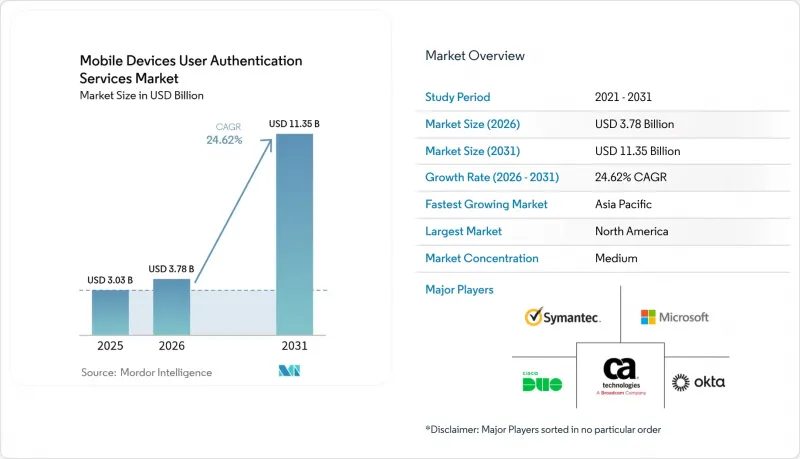
根據 Mordor Intelligence 預測,行動裝置使用者驗證服務的市場規模預計將從 2025 年的 30.3 億美元成長到 2026 年的 37.8 億美元,然後從 2026 年到 2031 年以 24.62% 的複合年成長,到 2031 年達到 113.5 億美元。
本報告依身分驗證類型(密碼和PIN碼、雙因素認證、其他)、部署模式(雲端身分驗證服務、本地部署、其他)、身分驗證管道(簡訊驗證碼、推播通知、其他)、企業規模(中小企業、大型企業)、最終用戶產業(銀行、金融服務和保險、消費性電子和電子商務、其他)以及地區進行細分。市場預測以美元計價。
全球行動裝置用戶身份驗證服務市場趨勢及洞察。
行動優先型公司採用無密碼和 WebAuthn 標準
70% 的組織機構計劃實施或已經實施了無密碼身份驗證,這表明 WebAuthn 正在改變安全標準。現有平台(例如 Microsoft Entra ID)的原生支援使得密碼金鑰功能能夠直接整合到裝置硬體中,從而消除共用金鑰的風險,並簡化使用者體驗。消費者對密碼金鑰的認知度已從三年前的 39% 上升到 2025 年的 57%,這表明組織機構已準備好將其用於大規模遷移。隨著銀行、航空公司和旅遊入口網站採用符合 FIDO 標準的流程,預計這一趨勢將在 2025 年進一步加速,使無密碼身分驗證成為高價值行動交易的主流身分驗證方法。能夠集中管理跨平台憑證轉移的供應商預計將在行動裝置用戶身份驗證服務市場中佔據主導地位。
金融科技和行動銀行(符合 SCA 標準)的蓬勃發展正在推動 MFA 的普及。
歐洲銀行管理局 (EBA) 發布指南,指出用於解鎖設備的生物識別將不再被視為獨立的強客戶認證 (SCA),這加速了多因素認證的普及。發卡機構被迫建構多層檢驗系統,將生物識別、所有權因素和動態風險檢查結合。提案的支付服務指示 3 (PSD3) 將進一步禁止僅使用行動裝置的認證流程,迫使銀行採用帶外認證方法。這一趨勢對相鄰的數位商務領域產生了顯著的溢出效應,電子商務、叫車服務和零工平台紛紛採用銀行層面的控制措施,以滿足消費者信任和監管統一的要求。這種需求的整合推動了金融和準金融生態系統中行動裝置使用者認證服務市場兩位數的成長。
電信業者在細分區域內出現的簡訊驗證碼延遲和失敗問題。
全球在簡訊驗證碼(SMS OTP)上的支出超過16億美元。然而,在多家業者經營的市場,簡訊驗證碼的送達率低於企業可接受的水平,導致購物車遺棄率上升和登入失敗。新加坡、印度和美國的監管機構計劃在2025年前逐步淘汰簡訊驗證碼,因此引入替代方案迫在眉睫。美國國家標準與技術研究院(NIST)已不再推薦簡訊作為安全的身份驗證方式,而Coinbase等大型交易所也證實,95%的帳戶盜用事件是由SIM卡交換攻擊造成的。雖然遷移成本可能暫時阻礙中小企業的轉型,但推播通知和密碼驗證成本的下降表明,從長遠來看,這一障礙很可能會消失。
細分市場分析
到2025年,多因素身份驗證(MFA)將佔銷售額的55.30%,在早期抵禦憑證盜竊方面發揮關鍵作用。目前,無密碼身份驗證正以25.20%的複合年成長率成長,這主要得益於平台級FIDO支援和用戶對金鑰意識的提高。預計到2031年,行動裝置無密碼流程用戶身份驗證服務的市場規模將達到46.2億美元,幾乎是2025年基數的兩倍。雖然硬體安全金鑰目前仍屬於小眾市場,但它們滿足了通訊和國防領域的高可靠性需求,隨著單位經濟效益的提升,其成長率正以兩位數的速度成長。行為身份驗證和被動身份驗證透過增加持續檢驗來減少使用者提示,從而滿足零信任要求。將硬體金鑰與不可見的行為身分驗證層結合的供應商,在爭取企業提升銷售預算方面佔優勢。
雖然指紋辨識、臉部認證和語音配對佔據了生物識別的大部分市場佔有率,但隨著行為辨識模型被整合到現有的行動SDK中,其發展速度正在加快。號碼匹配和設備信譽分析減輕了多因素認證(MFA)的負擔,但也存在攻擊者可能利用的漏洞。這些趨勢共同作用,正在重新定位行動裝置使用者認證服務市場,使其不再只是查核點,而是成為提供無縫數位體驗的手段,從而增強了企業在董事會層面進行投資的商業理由。
受SaaS快速部署和彈性擴展優勢的推動,基於雲端的身份驗證服務(身份驗證即服務)預計到2025年將佔總收入的59.10%。混合(邊緣+雲端)方案正以22.10%的複合年成長率成長,受監管產業在利用雲端身分創新技術的同時,也確保了資料居住需求。部署微軟混合Kerberos信任模型的組織已證明,在透過本機目錄和雲端點驗證本機Windows Hello憑證時,延遲更低,操作一致性更高。預計到2031年,本地架構在行動裝置用戶身份驗證服務市場的佔有率將降至14.75%以下,但在資料主權法規仍然嚴格的地區,其佔有率可能仍將保持穩定。
混合部署與遷移浪潮同步進行。企業首先遷移簡單的 Web 工作負載,然後整合雲端原生 FIDO仲介,並將傳統的本地主機身份驗證保留到最終淘汰為止。這種分階段遷移能夠保障整合商未來數年的業務收益,並延長平均合約期限。供應商透過提供貫穿整個信任層面的主導式編配,在最大限度地降低客戶「系統重裝」風險的同時,加強了與客戶的關係。
區域分析
預計到2025年,北美將佔該行業特定收入的37.40%,這主要得益於網路安全和基礎設施安全局(CISA)的「零信任成熟度模型」等監管促進因素,該模型提倡持續檢驗。半數美國公司已經實施了某種形式的無密碼身份驗證,為後進企業加速採用該技術提供了參考基礎。供應商積極進入市場,微軟、Okta和Ubico等公司樹立了行業標桿,而一些參與企業於特定領域的公司則在行為分析方面處於領先地位。公共部門契約,特別是國防部2027會計年度的授權,提供了長期需求前景,並刺激了相關私營部門機構的溢出採購。因此,行動裝置用戶身份驗證服務市場雖然競爭依然激烈,但隨著零信任計畫的擴展,仍有成長空間。
亞洲是成長最快的地區,預計到2031年複合年成長率將達到27.90%,這主要得益於智慧型手機的普及和政府主導的數位身分計畫。中國原始設備製造商(OEM)整合先進的生物識別感測器,結合印度基於Aadhaar的支付生態系統,正在產生大量的身份驗證處理需求。儘管東協五國的資料隱私法規仍在不斷完善,但電子政府和數位銀行的發展正在進一步推動這一趨勢,帶來成長的同時也帶來了複雜性。電信業者支援的SIM卡身分驗證API正在填補頻寬有限地區的基礎設施空白,擴大行動裝置使用者身分驗證服務的潛在需求,同時也將電信集團更深層地融入價值鏈中。
在歐洲,嚴格遵守《一般資料保護規則》(GDPR)與快速採用強客戶認證(SCA)之間存在著平衡。歐洲銀行管理局(EBA)關於數位錢包的澄清提高了整體商業交易中多因素認證的要求,並提供了其他行業可以效仿的指南。預計即將訂定的PSD3法規可能會禁止僅限行動裝置的交易流程,這將使擁有能夠逐步增強動態認證因素的編配引擎的供應商獲得優勢。北歐國家由於較早採用數位身分方案,展現出最高的採用率,而英國、德國和法國則隨著其開放銀行和電子身分框架的成熟而穩定成長。即將推出的歐盟數位身分錢包的跨境協調預計將開闢新的應用場景,並使歐洲繼續保持其在行動裝置用戶身份驗證服務市場中高盈利且合規的地位。
其他好處
- Excel格式的市場預測(ME)表
- 3個月的分析師支持
目錄
第1章:引言
- 調查結果
- 研究的先決條件
- 調查範圍
第2章:調查方法
第3章執行摘要
第4章 市場狀況
- 市場概覽
- 市場促進因素
- 行動優先型公司採用無密碼和 WebAuthn 標準
- 金融科技和行動銀行(符合 SCA 標準)的蓬勃發展正在推動多因素身份驗證 (MFA) 的普及。
- 亞洲中階智慧型手機生物識別硬體的普及現狀
- 支援新興市場電信業者的基於SIM卡的身份驗證API
- 全球監管要求(PSD2、CCPA、HIPAA)正在推高認證方面的支出。
- 企業級零信任安全架構正在加速行動身分驗證工具的普及。
- 市場限制因素
- 電信業者在細分區域內出現的簡訊驗證碼延遲和失敗問題。
- GDPR下生物識別資料隱私問題的擔憂
- 傳統行動應用程式對中小企業而言整合成本高昂
- 專有行動身分驗證 SDK 之間的互通性差距
- 價值供應鏈分析
- 技術展望
- 投資分析
- 波特五力模型
第5章 市場規模與成長預測
- 按身份驗證類型
- 密碼和PIN碼
- 雙因素認證
- 多因素身份驗證
- 生物識別
- 行為認證/被動認證
- 基於風險的上下文認證
- 軟令牌認證應用程式
- 硬體安全金鑰/FIDO令牌
- 部署模式
- 基於雲端的身份驗證服務(身份驗證即服務)
- 現場
- 混合(邊緣+雲)
- 通過認證通道
- SMS OTP
- 推播通知
- 應用內生物識別API
- SIM卡/靜默行動網路認證
- 電子郵件驗證碼/魔法鏈接
- 按公司規模
- 中小企業(員工人數少於1000人)
- 大公司
- 按最終用戶行業分類
- BFSI
- 家用電器和電子商務
- 政府/公共部門
- 通訊和資訊科技服務
- 醫療保健和生命科學
- 工業IoT
- 教育和數位學習
- 旅遊與飯店
- 按地區
- 北美洲
- 美國
- 加拿大
- 墨西哥
- 南美洲
- 巴西
- 阿根廷
- 其他南美國家
- 歐洲
- 北歐的
- 瑞典
- 挪威
- 芬蘭
- 德國
- 英國
- 法國
- 義大利
- 西班牙
- 其他歐洲國家
- 北歐的
- 亞太地區
- 中國
- 印度
- 日本
- 韓國
- ASEAN-5
- 澳洲
- 紐西蘭
- 其他亞太國家
- 中東
- GCC
- 沙烏地阿拉伯
- 阿拉伯聯合大公國
- 土耳其
- 以色列
- 其他中東國家
- GCC
- 非洲
- 南非
- 奈及利亞
- 肯亞
- 其他非洲地區
- 北美洲
第6章 競爭情勢
- 市場集中度
- 策略趨勢
- 市佔率分析
- 公司簡介
- Symantec Corporation
- Broadcom Inc.(CA Technologies)
- Cisco Systems Inc.(Duo Security)
- Microsoft Corporation
- Okta Inc.
- Thales Group(Gemalto)
- RSA Security LLC(Dell Technologies)
- OneSpan Inc.
- Entrust Corporation
- HID Global Corporation
- IDEMIA
- NEC Corporation
- Ping Identity Holding Corp.
- ForgeRock Inc.
- Authy(Twilio Inc.)
- Yubico AB
- Trustwave Holdings Inc.
- Micro Focus International plc
- Google LLC
- IBM Corporation
- Nexus Group
- SecurEnvoy Ltd.
- Aware Inc.
- Fujitsu Limited
第7章 市場機會與未來展望
According to Mordor Intelligence, the mobile devices user authentication services market size is expected to grow from USD 3.03 billion in 2025 to USD 3.78 billion in 2026 and is forecast to reach USD 11.35 billion by 2031 at 24.62% CAGR over 2026-2031.
This report is Segmented by Authentication Type (Passwords and PINs, Two-Factor Authentication, and More), Deployment Mode (Cloud-Based, On-Premise, and More), Authentication Channel (SMS OTP, Push Notification, and More), Enterprise Size (SMEs, Large Enterprises), End-User Vertical (BFSI, Consumer Electronics, and More), and by Geography. The Market Forecasts are Provided in Terms of Value (USD).
Global Mobile Devices User Authentication Services Market Trends and Insights
Adoption of Passwordless and WebAuthn Standards Across Mobile-First Enterprises
Seventy percent of organisations either plan to adopt or have already introduced passwordless authentication, illustrating how WebAuthn shifts the security baseline. Native support from platform incumbents such as Microsoft Entra ID embeds passkey functionality directly into device hardware, eradicating shared-secret risk while simplifying user journeys. Consumer familiarity with passkeys rose to 57% in 2025, up from 39% three years earlier, signalling readiness for large-scale transition.Momentum will intensify as banks, airlines and travel portals adopt FIDO-compliant flows in 2025, confirming passwordless as a mainstream control for high-value mobile transactions. Vendors able to orchestrate cross-platform credential mobility stand to win disproportionate share in the mobile devices user authentication services market.
Surge in FinTech and Mobile Banking (SCA Compliance) Driving MFA Roll-outs
European Banking Authority guidance ruling out device-unlock biometrics as a standalone SCA accelerates multi-factor adoption, forcing issuers to build layered verification that combines biometrics, possession factors, and dynamic risk checks. The expected PSD3 proposal will further prohibit mobile-only flows, prompting banks to embed out-of-band authenticators. Spillover into adjacent digital commerce is material; e-commerce, ride-hailing, and gig-work platforms adopt banking-grade controls to satisfy consumer trust and regulatory parity. These converging demands underpin double-digit growth in the mobile devices user authentication services market across financial and quasi-financial ecosystems.
SMS OTP Latency and Failure in Carrier-Fragmented Regions
Global spend on SMS OTP exceeds USD 1.6 billion even though delivery rates fall below enterprise thresholds in multi-operator markets, triggering cart abandonment and failed logins. Regulators in Singapore, India and the United States aim to retire SMS OTP by 2025, amplifying urgency for alternatives. NIST now discourages SMS as a secure factor, while leading exchanges such as Coinbase confirm that 95% of account takeovers leveraged SIM-swap attacks. Transition costs may temporarily restrain small businesses, but declining push notification and passkey expenses neutralise the barrier over time.
Other drivers and restraints analyzed in the detailed report include:
- Mid-Range Smartphone Biometric Hardware Penetration in Asia
- Enterprise Zero-Trust Security Architecture Accelerating Mobile Authenticator Adoption
- Biometric Data Privacy Concerns under GDPR
For complete list of drivers and restraints, kindly check the Table Of Contents.
Segment Analysis
MFA dominated revenue with 55.30% in 2025, reflecting early defences against credential theft. Passwordless now sets the growth pace at 25.20% CAGR, powered by platform-level FIDO support and rising passkey familiarity. The mobile devices user authentication services market size for passwordless flows is projected to reach USD 4.62 billion by 2031, nearly doubling its 2025 base. Hardware security keys, while niche, address high-assurance needs in telecom and defence, expanding at double-digit rates as unit economics improve. Behavioural and passive authentication add continuous verification, reducing user prompts and aligning with zero-trust mandates. Vendors marrying hardware keys with invisible behavioural layers are well-positioned to capture enterprise up-sell budgets.
Fingerprints, facial recognition, and voice match account for the bulk of biometric adoption, yet behaviour-centric models grow faster by embedding in existing mobile SDKs. Number matching and device reputation analytics reduce MFA fatigue, closing an exploit path that attackers manipulate. The combination of these trends repositions the mobile devices user authentication services market as an enabler of seamless digital experience rather than a checkpoint, strengthening the business case for board-level investment
Cloud Authentication-as-a-Service delivered 59.10% revenue in 2025, driven by rapid SaaS roll-outs and elastic scaling advantages. The hybrid edge-plus-cloud option grows at 22.10% CAGR as regulated industries safeguard data residency while using cloud identity innovation. Organisations deploying Microsoft's hybrid Kerberos trust model demonstrate latency reductions and policy coherence when authenticating local Windows Hello credentials through both on-premises directory and cloud endpoint. The mobile devices user authentication services market share for on-premise architectures will slide below 14.75% by 2031, yet it persists wherever sovereign data mandates remain strict.
Hybrid adoption follows migration waves: firms lift simple web workloads first, then layer cloud-native FIDO brokers, leaving heritage mainframe authentications on-site until retirement. This staged transition sustains multi-year service revenue for integrators and lengthens average contract duration. Vendors offering policy-driven orchestration across trust planes achieve stickier relationships while minimising rip-and-replace risk for clients.
Complete Report Scope:
- By Authentication Type
- Passwords and PINs
- Two-Factor Authentication
- Multi-Factor Authentication
- Biometric Authentication
- Behavioral and Passive Authentication
- Risk-Based / Contextual Authentication
- Soft Tokens and Authenticator Apps
- Hardware Security Keys / FIDO Tokens
- By Deployment Mode
- Cloud-Based Authentication as-a-Service
- On-Premise
- Hybrid (Edge + Cloud)
- By Authentication Channel
- SMS OTP
- Push Notification
- In-App Biometric API
- SIM / Silent Mobile Network Authentication
- Email OTP / Magic Link
- By Enterprise Size
- SMEs (< 1,000 Employees)
- Large Enterprises
- By End-user Vertical
- BFSI
- Consumer Electronics and E-Commerce
- Government and Public Sector
- Telecommunications and IT Services
- Healthcare and Life Sciences
- Manufacturing and Industrial IoT
- Education and eLearning
- Travel and Hospitality
- By Geography
- North America
- United States
- Canada
- Mexico
- South America
- Brazil
- Argentina
- Rest of South America
- Europe
- Nordics
- Sweden
- Norway
- Finland
- Germany
- United Kingdom
- France
- Italy
- Spain
- Rest of Europe
- Nordics
- APAC
- China
- India
- Japan
- South Korea
- ASEAN-5
- Australia
- New Zealand
- Rest of APAC
- Middle East
- GCC
- Saudi Arabia
- UAE
- Turkey
- Israel
- Rest of Middle East
- GCC
- Africa
- South Africa
- Nigeria
- Kenya
- Rest of Africa
- North America
Geography Analysis
North America generated 37.40% of 2025 sectoral revenue, anchored by regulatory catalysts like the Cybersecurity and Infrastructure Security Agency Zero Trust Maturity Model that champions continuous verification. Half of U.S. enterprises have already deployed some form of passwordless authentication, creating a reference base that accelerates late-mover adoption. Vendor presence is dense, with Microsoft, Okta, and Yubico shaping standards while niche players pioneer behaviour analytics. Public-sector contracts, notably the Department of Defense FY27 mandate, provide long-term volume visibility and drive spill-over purchases in adjacent civilian agencies. The mobile devices user authentication services market, therefore, remains highly competitive yet expandable as zero-trust programmes scale.
Asia is the fastest-growing theatre at 27.90% CAGR through 2031, propelled by smartphone ubiquity and government digital identity schemes. Chinese OEM integration of advanced biometric sensors combined with India's Aadhaar-linked payments ecosystem creates massive authentication throughput. ASEAN-5 markets add incremental momentum via e-government and digital banking roll-outs, even though data privacy legislation is still maturing, injecting both growth and complexity. Carrier-backed SIM authentication APIs fill infrastructure gaps in low-bandwidth geographies, enlarging the addressable demand for the mobile devices user authentication services market while embedding telecom groups deeper into the value chain.
Europe balances strict GDPR compliance with rapid SCA uptake. The European Banking Authority's clarification on digital wallets elevates multi-factor requirements across commerce and sets a playbook that other verticals can emulate. Anticipated PSD3 rules will forbid mobile-only flows, favouring vendors with orchestration engines capable of dynamic factor step-ups. Northern Europe demonstrates highest penetration due to early digital identity schemes, while the United Kingdom, Germany and France post robust growth as Open Banking and eID frameworks mature. Cross-border harmonisation under the forthcoming EU Digital Identity Wallet will unlock new use cases, maintaining Europe as a lucrative yet compliance-heavy segment of the mobile devices user authentication services market.
- Symantec Corporation
- Broadcom Inc. (CA Technologies)
- Cisco Systems Inc. (Duo Security)
- Microsoft Corporation
- Okta Inc.
- Thales Group (Gemalto)
- RSA Security LLC (Dell Technologies)
- OneSpan Inc.
- Entrust Corporation
- HID Global Corporation
- IDEMIA
- NEC Corporation
- Ping Identity Holding Corp.
- ForgeRock Inc.
- Authy (Twilio Inc.)
- Yubico AB
- Trustwave Holdings Inc.
- Micro Focus International plc
- Google LLC
- IBM Corporation
- Nexus Group
- SecurEnvoy Ltd.
- Aware Inc.
- Fujitsu Limited
Additional Benefits:
- The market estimate (ME) sheet in Excel format
- 3 months of analyst support
TABLE OF CONTENTS
1 INTRODUCTION
- 1.1 Study Deliverables
- 1.2 Study Assumptions
- 1.3 Scope of the Study
2 RESEARCH METHODOLOGY
3 EXECUTIVE SUMMARY
4 MARKET LANDSCAPE
- 4.1 Market Overview
- 4.2 Market Drivers
- 4.2.1 Adoption of Passwordless and WebAuthn Standards Across Mobile-First Enterprises
- 4.2.2 Surge in FinTech and Mobile Banking (SCA Compliance) Driving MFA Roll-outs
- 4.2.3 Mid-Range Smartphone Biometric Hardware Penetration in Asia
- 4.2.4 Carrier-Backed SIM-Based Authentication APIs in Emerging Markets
- 4.2.5 Global Regulatory Mandates (PSD2, CCPA, HIPAA) Boosting Authentication Spend
- 4.2.6 Enterprise Zero-Trust Security Architecture Accelerating Mobile Authenticator Adoption
- 4.3 Market Restraints
- 4.3.1 SMS OTP Latency and Failure in Carrier-Fragmented Regions
- 4.3.2 Biometric Data Privacy Concerns under GDPR
- 4.3.3 High Integration Cost for Legacy SME Mobile Applications
- 4.3.4 Interoperability Gaps among Proprietary Mobile Auth SDKs
- 4.4 Value / Supply-Chain Analysis
- 4.5 Technological Outlook
- 4.6 Investment Analysis
- 4.7 Porter's Five Forces
- 4.7.1 Threat of New Entrants
- 4.7.2 Bargaining Power of Buyers
- 4.7.3 Bargaining Power of Suppliers
- 4.7.4 Threat of Substitutes
- 4.7.5 Intensity of Competitive Rivalry
5 MARKET SIZE AND GROWTH FORECASTS (VALUE)
- 5.1 By Authentication Type
- 5.1.1 Passwords and PINs
- 5.1.2 Two-Factor Authentication
- 5.1.3 Multi-Factor Authentication
- 5.1.4 Biometric Authentication
- 5.1.5 Behavioral and Passive Authentication
- 5.1.6 Risk-Based / Contextual Authentication
- 5.1.7 Soft Tokens and Authenticator Apps
- 5.1.8 Hardware Security Keys / FIDO Tokens
- 5.2 By Deployment Mode
- 5.2.1 Cloud-Based Authentication as-a-Service
- 5.2.2 On-Premise
- 5.2.3 Hybrid (Edge + Cloud)
- 5.3 By Authentication Channel
- 5.3.1 SMS OTP
- 5.3.2 Push Notification
- 5.3.3 In-App Biometric API
- 5.3.4 SIM / Silent Mobile Network Authentication
- 5.3.5 Email OTP / Magic Link
- 5.4 By Enterprise Size
- 5.4.1 SMEs (< 1,000 Employees)
- 5.4.2 Large Enterprises
- 5.5 By End-user Vertical
- 5.5.1 BFSI
- 5.5.2 Consumer Electronics and E-Commerce
- 5.5.3 Government and Public Sector
- 5.5.4 Telecommunications and IT Services
- 5.5.5 Healthcare and Life Sciences
- 5.5.6 Manufacturing and Industrial IoT
- 5.5.7 Education and eLearning
- 5.5.8 Travel and Hospitality
- 5.6 By Geography
- 5.6.1 North America
- 5.6.1.1 United States
- 5.6.1.2 Canada
- 5.6.1.3 Mexico
- 5.6.2 South America
- 5.6.2.1 Brazil
- 5.6.2.2 Argentina
- 5.6.2.3 Rest of South America
- 5.6.3 Europe
- 5.6.3.1 Nordics
- 5.6.3.1.1 Sweden
- 5.6.3.1.2 Norway
- 5.6.3.1.3 Finland
- 5.6.3.2 Germany
- 5.6.3.3 United Kingdom
- 5.6.3.4 France
- 5.6.3.5 Italy
- 5.6.3.6 Spain
- 5.6.3.7 Rest of Europe
- 5.6.3.1 Nordics
- 5.6.4 APAC
- 5.6.4.1 China
- 5.6.4.2 India
- 5.6.4.3 Japan
- 5.6.4.4 South Korea
- 5.6.4.5 ASEAN-5
- 5.6.4.6 Australia
- 5.6.4.7 New Zealand
- 5.6.4.8 Rest of APAC
- 5.6.5 Middle East
- 5.6.5.1 GCC
- 5.6.5.1.1 Saudi Arabia
- 5.6.5.1.2 UAE
- 5.6.5.2 Turkey
- 5.6.5.3 Israel
- 5.6.5.4 Rest of Middle East
- 5.6.5.1 GCC
- 5.6.6 Africa
- 5.6.6.1 South Africa
- 5.6.6.2 Nigeria
- 5.6.6.3 Kenya
- 5.6.6.4 Rest of Africa
- 5.6.1 North America
6 COMPETITIVE LANDSCAPE
- 6.1 Market Concentration
- 6.2 Strategic Moves
- 6.3 Market Share Analysis
- 6.4 Company Profiles {(includes Global Level Overview, Market Level Overview, Core Segments, Financials as available, Strategic Information, Market Rank/Share for key companies, Products and Services, Recent Developments)}
- 6.4.1 Symantec Corporation
- 6.4.2 Broadcom Inc. (CA Technologies)
- 6.4.3 Cisco Systems Inc. (Duo Security)
- 6.4.4 Microsoft Corporation
- 6.4.5 Okta Inc.
- 6.4.6 Thales Group (Gemalto)
- 6.4.7 RSA Security LLC (Dell Technologies)
- 6.4.8 OneSpan Inc.
- 6.4.9 Entrust Corporation
- 6.4.10 HID Global Corporation
- 6.4.11 IDEMIA
- 6.4.12 NEC Corporation
- 6.4.13 Ping Identity Holding Corp.
- 6.4.14 ForgeRock Inc.
- 6.4.15 Authy (Twilio Inc.)
- 6.4.16 Yubico AB
- 6.4.17 Trustwave Holdings Inc.
- 6.4.18 Micro Focus International plc
- 6.4.19 Google LLC
- 6.4.20 IBM Corporation
- 6.4.21 Nexus Group
- 6.4.22 SecurEnvoy Ltd.
- 6.4.23 Aware Inc.
- 6.4.24 Fujitsu Limited
7 MARKET OPPORTUNITIES AND FUTURE OUTLOOK
- 7.1 White-Space and Unmet-Need Assessment

 行動用戶身分驗證市場規模、佔有率和成長分析:按解決方案、身分驗證方法、部署類型、組織規模、應用程式、產業和地區分類-2026-2033 年產業預測
 2026年全球用戶身份驗證解決方案市場報告2026年全球行動用戶認證市場報告
 行動用戶身份驗證市場:按身份驗證技術、身份驗證因素、最終用戶和部署模式分類——2026-2032年全球預測
 全球行動用戶認證市場規模、佔有率、趨勢和成長分析報告(2026-2034)
 行動用戶身份驗證市場 - 全球產業規模、佔有率、趨勢、機會和預測:按身份驗證方法、部署模式、組織規模、地區和競爭格局分類,2021-2031 年