


 |
市場調查報告書
商品編碼
2113837
歐洲飼料用抗氧化劑:市場佔有率分析、行業趨勢和統計數據以及成長預測(2026-2031 年)Europe Feed Antioxidants - Market Share Analysis, Industry Trends & Statistics, Growth Forecasts (2026 - 2031) |
||||||

※ 本網頁內容可能與最新版本有所差異。詳細情況請與我們聯繫。
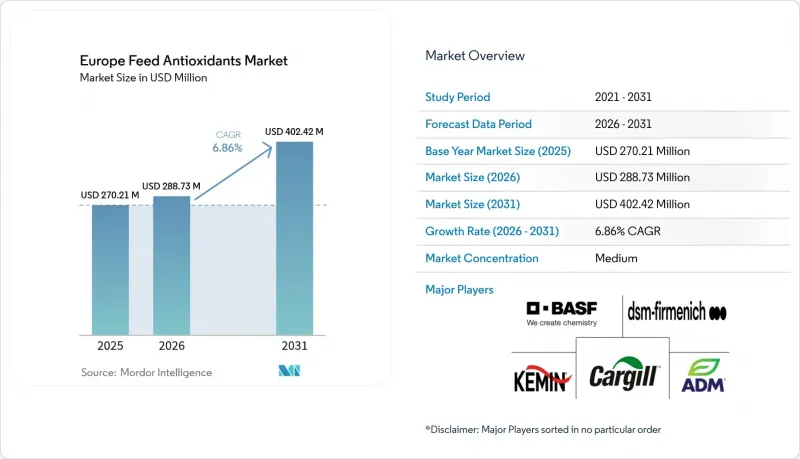
據 Mordor Intelligence 稱,2025 年歐洲飼料抗氧化劑市值為 2.7021 億美元,預計到 2031 年將達到 4.0242 億美元,而 2026 年為 2.8873 億美元,預測期內(2026-2031 年)的複合年成長率為 6.86%。
本報告按動物類型(家禽、豬、反芻動物、水產養殖及其他動物類型)、類型(BHA、BHT、乙氧喹及其他)、形態(乾粉、液體)和地區(英國、德國、法國、西班牙、俄羅斯及其他歐洲國家)進行細分。市場預測以價值(美元)和數量(噸)表示。
歐洲飼料抗氧化劑市場的趨勢與洞察
東歐和南歐家禽肉產量迅速成長
東歐家禽業的擴張顯著提升了對飼料保鮮解決方案的需求,波蘭於2024年投資興建了大規模生產設施,正崛起為該地區的生產中心。在保加利亞和羅馬尼亞,向大規模一體化營運的轉型正在推進,這規範了抗氧化劑的採購流程,並使能夠提供大量且品質穩定的供應商更具優勢。這種地域集中使得飼料生產商能夠協商基本契約,從而在確保供應穩定的同時降低單位抗氧化劑的成本。歐盟委員會為蛋白質自給自足所做的努力,進一步加速了國內家禽生產,降低了對進口肉品的依賴,並創造了對本地生產的飼料添加劑的持續需求。
歐洲加強對黴菌毒素的監管將促進抗氧化防腐劑的使用。
歐洲食品安全局 (EFSA) 分階段收緊黴菌毒素基準值,已將抗氧化防腐劑從“可選成分”提升為“必需飼料成分”,尤其是在處理對水分敏感的原料的企業中。 EFSA 目前正努力製定動物飼料中 PFAS 的具有法律約束力的基準值,這進一步加大了合規壓力,有利於擁有全面污染檢測方案的抗氧化劑供應商。合規要求的日益複雜也加速了缺乏大規模檢測和文件編制資源的中小型飼料生產商之間的整合。
由於有機畜牧養殖系統的快速普及,對合成物質的使用有所限制。
有機畜牧業認證要求嚴格限制合成抗氧化劑的使用,隨著有機生產在歐洲市場的擴張,市場區隔正在出現,這抑制了對傳統防腐劑的需求。根據歐洲環境政策研究所 (IEEP) 2024 年的一項分析,向有機農業轉型初期,成本將以每年 20% 至 66% 的速度成長,因此農民們正在轉型期間尋求經濟高效的天然防腐劑替代品。同時擁有傳統農業和有機農業基本客群的飼料生產商,擴大選擇維持獨立的生產線,以避免可能損害其有機認證資格的交叉污染問題。
細分市場分析
到2025年,家禽業將佔歐洲飼料抗氧化劑市場的39.25%,成為最大的細分市場。波蘭和羅馬尼亞的綜合家禽養殖戶採用富含天然酚類的發酵飼料來改善腸道健康並延長出口產品的保存期限,推動了市場持續成長。儘管規模較小,但水產養殖業是成長最快的領域,複合年成長率達8.93%,這將推動歐洲飼料抗氧化劑市場到2031年對水產養殖專用抗氧化劑的需求。儘管由於非洲豬瘟防控的生物安全成本,豬肉產業的抗氧化劑使用量有所調整,但仍保持穩定。此外,抗氧化劑也被用於反芻動物的複合飼料中,以保護高脂肪乳牛飼料。
在其他動物性食品領域,例如寵物食品,優質化植物來源混合物正日益受到青睞,這些混合物還能起到增味劑的作用。歐洲食品安全局 (EFSA) 的統一添加劑應用系統確保家禽、水產和伴侶動物飼料都符合嚴格的功效和安全標準。因此,擁有跨動物物種技術專長的供應商在歐洲飼料抗氧化劑市場中保持著跨領域的影響力。
其他好處
- Excel格式的市場預測(ME)表
- 3個月的分析師支持
目錄
第1章:引言
- 研究假設和市場定義
- 調查範圍
第2章:調查方法
第3章執行摘要
第4章 市場狀況
- 市場概覽
- 市場促進因素
- 東歐和南歐家禽肉產量迅速成長
- 歐洲加強對黴菌毒素的監管將促進抗氧化防腐劑的使用。
- 產業轉向使用標有「天然來源」的飼料添加劑
- 北歐國家綜合水產養殖叢集的發展
- 循環經濟的興起,使食品副產品作為飼料發揮了價值。
- 利用人工智慧驅動的飼料廠自動化技術最佳化抗氧化劑用量。
- 市場限制因素
- 由於有機畜牧養殖系統的快速普及,對合成物質的使用有所限制。
- 乙氧喹重新授權存在監管方面的不確定性。
- 通貨膨脹導致飼料成本下降,給添加劑預算帶來了壓力。
- 缺乏針對小規模農戶的經證實的投資報酬率數據
- 監理情勢
- 技術展望
- 波特五力分析
第5章 市場規模與成長預測
- 依動物類型
- 家禽
- 豬
- 反芻動物
- 水產養殖
- 其他動物類型
- 按類型
- BHA
- BHT
- 乙氧喹
- 其他
- 按形式
- 乾燥
- 液體
- 按地區
- 英國
- 德國
- 法國
- 西班牙
- 俄羅斯
- 其他歐洲國家
第6章 競爭情勢
- 市場集中度
- 策略趨勢
- 市佔率分析
- 公司簡介
- Archer Daniels Midland Company
- BASF SE
- DSM-Firmenich AG
- Cargill Inc.
- Alltech Inc.
- Nutreco NV(SHV Holdings)
- Kemin Industries
- Bluestar Adisseo Nutrition Group Limited
- Novus International Inc.(Mitsui & Co./Nippon Soda)
- Impextraco NV
- Perstorp Holding AB(PETRONAS Chemicals Group)
- International Flavors & Fragrances Inc.(IFF)
- AB Vista Ltd.(AB Agri/Associated British Foods)
- Camlin Fine Sciences Ltd.
第7章 市場機會與未來展望
According to Mordor Intelligence, the Europe feed antioxidants market size was valued at USD 270.21 million in 2025 and estimated to grow from USD 288.73 million in 2026 to reach USD 402.42 million by 2031, at a CAGR of 6.86% during the forecast period (2026-2031).
This report is Segmented by Animal Type (Poultry, Swine, Ruminant, Aquaculture, Other Animal Types), Type (BHA, BHT, Ethoxyquin, Others), Form (Dry, Liquid), and Geography (United Kingdom, Germany, France, Spain, Russia, Rest of Europe). The Market Forecasts are Provided in Terms of Value (USD) and Volume (Metric Tons).
Europe Feed Antioxidants Market Trends and Insights
Surging poultry meat production in Eastern and Southern Europe
Eastern European poultry expansion has created substantial demand for feed preservation solutions, with Poland emerging as a regional production powerhouse following significant capacity investments in 2024. The shift toward larger, integrated operations in Bulgaria and Romania has standardized antioxidant procurement practices, favoring suppliers who can deliver consistent quality at scale. This geographic concentration enables feed mills to negotiate volume-based contracts that reduce per-unit antioxidant costs while ensuring supply security. The European Commission's protein self-sufficiency initiatives have further accelerated domestic poultry production, reducing reliance on imported meat products and creating sustained demand for locally manufactured feed additives .
Tightening Europe's limits on mycotoxins is driving antioxidant preservative use
The European Food Safety Authority's progressive tightening of mycotoxin limits has elevated antioxidant preservatives from optional to essential feed components, particularly for operations handling moisture-sensitive ingredients. EFSA's ongoing work to establish enforceable PFAS limits in animal feed has created additional compliance pressures that favor antioxidant suppliers with comprehensive contamination testing protocols. The complexity of compliance requirements has also accelerated consolidation among smaller feed manufacturers who lack resources for extensive testing and documentation.
Rapid adoption of organic livestock systems limiting synthetics
Organic livestock certification requirements strictly limit synthetic antioxidant use, creating market segmentation that constrains traditional preservative demand as organic production expands across European markets. The Institute for European Environmental Policy's 2024 analysis reveals that organic transition costs initially increase by 20-66% annually, with farmers seeking cost-effective natural preservation alternatives during the conversion period. Feed manufacturers serving mixed conventional and organic customer bases increasingly maintain separate production lines to avoid cross-contamination issues that could compromise organic certification status.
Other drivers and restraints analyzed in the detailed report include:
- Industry shift toward natural-label feed additives
- Growth of integrated aquaculture clusters in Nordic countries
- Regulatory uncertainty around ethoxyquin re-authorization
For complete list of drivers and restraints, kindly check the Table Of Contents.
Segment Analysis
Poultry held 39.25% of the Europe feed antioxidants market share in 2025, the largest slice of the Europe feed antioxidants market. Growth continues as integrated growers in Poland and Romania seek shelf-life assurance for exports and adopt fermented feedstuffs rich in natural phenolics to improve gut health. Aquaculture, though smaller, grows fastest at a 8.93% CAGR, boosting specialized marine antioxidants in the Europe feed antioxidants market size through 2031. Swine adoption stays steady despite African Swine Fever biosecurity spending diverting some budgets, while ruminant formulations bank on antioxidants to protect high-fat dairy rations.
Other animal segments, such as pet food, see a premiumization lift of botanical blends that double as flavor enhancers. EFSA's unified additive dossier system ensures poultry, aquatic, and companion animal feeds alike meet stringent efficacy and safety benchmarks. Suppliers with multi-species technical expertise thus retain cross-segment clout within the Europe feed antioxidants market.
Complete Report Scope:
- By Animal Type
- Poultry
- Swine
- Ruminant
- Aquaculture
- Other Animal Types
- By Type
- BHA
- BHT
- Ethoxyquin
- Others
- By Form
- Dry
- Liquid
- By Geography
- United Kingdom
- Germany
- France
- Spain
- Russia
- Rest of Europe
List of Companies Covered in this Report:
- Archer Daniels Midland Company
- BASF SE
- DSM-Firmenich AG
- Cargill Inc.
- Alltech Inc.
- Nutreco N.V. (SHV Holdings)
- Kemin Industries
- Bluestar Adisseo Nutrition Group Limited
- Novus International Inc. (Mitsui & Co. / Nippon Soda)
- Impextraco NV
- Perstorp Holding AB (PETRONAS Chemicals Group)
- International Flavors & Fragrances Inc.(IFF)
- AB Vista Ltd. (AB Agri / Associated British Foods)
- Camlin Fine Sciences Ltd.
Additional Benefits:
- The market estimate (ME) sheet in Excel format
- 3 months of analyst support
TABLE OF CONTENTS
1 Introduction
- 1.1 Study Assumptions and Market Definition
- 1.2 Scope of the Study
2 Research Methodology
3 Executive Summary
4 Market Landscape
- 4.1 Market Overview
- 4.2 Market Drivers
- 4.2.1 Surging poultry meat production in Eastern and Southern Europe
- 4.2.2 Tightening Europe's limits on mycotoxins is driving antioxidant preservative use
- 4.2.3 Industry shift toward natural-label feed additives
- 4.2.4 Growth of integrated aquaculture clusters in Nordic countries
- 4.2.5 Rise of circular-economy valorization of food by-products into feed
- 4.2.6 AI-enabled feed-mill automation optimizing antioxidant dosing
- 4.3 Market Restraints
- 4.3.1 Rapid adoption of organic livestock systems limiting synthetics
- 4.3.2 Regulatory uncertainty around ethoxyquin re-authorization
- 4.3.3 Inflation-led feed cost-cutting curbing additive budgets
- 4.3.4 Limited proven ROI data for smallholder farmers
- 4.4 Regulatory Landscape
- 4.5 Technological Outlook
- 4.6 Porter's Five Forces Analysis
- 4.6.1 Threat of New Entrants
- 4.6.2 Bargaining Power of Buyers
- 4.6.3 Bargaining Power of Suppliers
- 4.6.4 Threat of Substitutes
- 4.6.5 Intensity of Competitive Rivalry
5 Market Size and Growth Forecasts (Value and Volume)
- 5.1 By Animal Type
- 5.1.1 Poultry
- 5.1.2 Swine
- 5.1.3 Ruminant
- 5.1.4 Aquaculture
- 5.1.5 Other Animal Types
- 5.2 By Type
- 5.2.1 BHA
- 5.2.2 BHT
- 5.2.3 Ethoxyquin
- 5.2.4 Others
- 5.3 By Form
- 5.3.1 Dry
- 5.3.2 Liquid
- 5.4 By Geography
- 5.4.1 United Kingdom
- 5.4.2 Germany
- 5.4.3 France
- 5.4.4 Spain
- 5.4.5 Russia
- 5.4.6 Rest of Europe
6 Competitive Landscape
- 6.1 Market Concentration
- 6.2 Strategic Moves
- 6.3 Market Share Analysis
- 6.4 Company Profiles (includes Global level Overview, Market level Overview, Core Segments, Financials as Available, Strategic Information, Market Rank/Share, Products and Services, Recent Developments)
- 6.4.1 Archer Daniels Midland Company
- 6.4.2 BASF SE
- 6.4.3 DSM-Firmenich AG
- 6.4.4 Cargill Inc.
- 6.4.5 Alltech Inc.
- 6.4.6 Nutreco N.V. (SHV Holdings)
- 6.4.7 Kemin Industries
- 6.4.8 Bluestar Adisseo Nutrition Group Limited
- 6.4.9 Novus International Inc. (Mitsui & Co. / Nippon Soda)
- 6.4.10 Impextraco NV
- 6.4.11 Perstorp Holding AB (PETRONAS Chemicals Group)
- 6.4.12 International Flavors & Fragrances Inc.(IFF)
- 6.4.13 AB Vista Ltd. (AB Agri / Associated British Foods)
- 6.4.14 Camlin Fine Sciences Ltd.
7 Market Opportunities and Future Outlook

 乙氧喹市場:全球市場預測,2026-2032年飼料抗氧化劑市場:全球市場預測(按產品類型、目標動物、劑型、通路和最終用戶分類),2026-2032年
 中東和非洲飼料用抗氧化劑:市場佔有率分析、行業趨勢和統計數據以及成長預測(2026-2031 年)
 乙氧喹市場規模、佔有率和成長分析:按產品形式、主要應用、銷售管道、分銷通路和地區分類-2026-2033年產業預測
 乙氧喹市場:依產品類型、終端用戶產業及地區分類
 乙氧喹市場分析及預測(至2035年):依類型、產品、應用、最終用戶、劑型、原料、功能、技術、製程、安裝類型分類
 飼料抗氧化劑市場:規模、佔有率、成長、類型/應用的全球市場分析、區域洞察,2026-2034年預測
 飼料抗氧化劑市場-全球產業規模、佔有率、趨勢、機會和預測,按類型(天然、合成)、按牲畜、按形式、按地區和競爭細分,2020-2030 年飼料抗氧化劑市場規模(按類型、來源、牲畜、區域範圍和預測)