


 |
市場調查報告書
商品編碼
2099426
中東和非洲飼料用抗氧化劑:市場佔有率分析、行業趨勢和統計數據以及成長預測(2026-2031 年)Middle East and Africa Feed Antioxidants - Market Share Analysis, Industry Trends & Statistics, Growth Forecasts (2026 - 2031) |
||||||

※ 本網頁內容可能與最新版本有所差異。詳細情況請與我們聯繫。
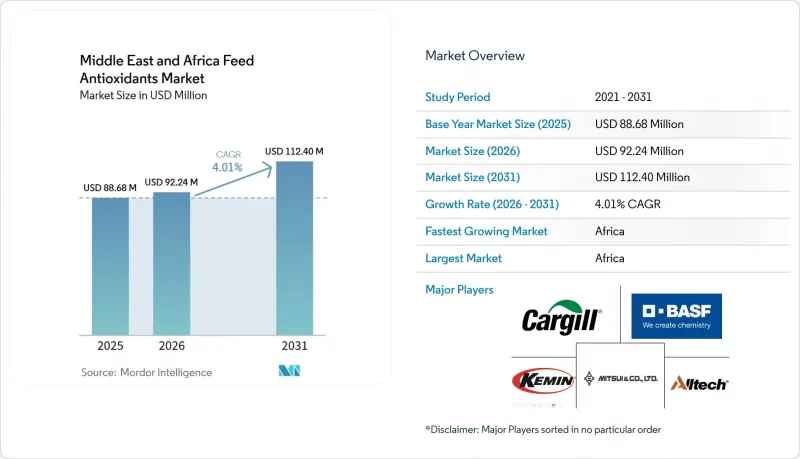
據 Mordor Intelligence 稱,中東和非洲飼料抗氧化劑市場預計將從 2025 年的 8,868 萬美元和 2026 年的 9,224 萬美元成長到 2031 年的 1.124 億美元,2026 年至 2031 年的複合年成長率為 4.01%。
本報告按添加劑(BHA、BHT 等)、動物種類(反芻動物、家禽等)和地區(中東和非洲)進行細分。市場預測以價值(美元)和數量(公噸)表示。
中東及非洲飼料抗氧化劑市場趨勢及洞察
商業家禽和肉雞產量增加
根據統計數據,沙烏地阿拉伯2024年肉雞產量將達到130萬噸,這反映了該國大規模的商業家禽業及其帶來的巨大飼料需求。美國農業部的報告指出,埃及仍是主要的家禽生產國,預計到2024年,埃及將加工約19.9億隻家禽,禽肉產量將達到約250萬噸。這些生產系統需要大量飼料、更嚴格的庫存控制以及成品飼料的穩定性,因此抗氧化劑的使用與商業規模密切相關。中東和非洲的飼料抗氧化劑市場正受益於這一趨勢,因為有組織的家禽養殖業的成長創造了對添加劑的穩定需求,而不是零星購買。政府主導的糧食安全計畫進一步推動了這項需求,因為飼料消費量的成長不僅是由於短期零售需求,也與政府支持的生產目標相符。隨著家禽養殖體係日益集中化,在儲存和運輸過程中保護飼料油的需求將繼續支撐中東和非洲的飼料抗氧化劑市場。
高溫儲存和運輸環境下飼料保存期限所面臨的壓力。
全部區域的高溫環境增加了飼料原料(尤其是脂肪)脂質氧化的風險,因為飼料在經過露天場地、港口和非溫控倉儲設施時更容易發生氧化。這些操作條件使得抗氧化劑成為商業飼料廠的標準配方要求,尤其是在沿岸地區和北非。當飼料依賴進口穀物、油脂和蛋白粉時,這個問題更為突出,因為這些原料在加工前需要長時間運輸。這些物理限制難以透過改變處理方式來解決,並持續支撐著中東和非洲對飼料抗氧化劑的穩定需求。即使是減少了抗氧化劑用量的飼料廠,仍然面臨著與飼料酸敗、飼料下降和保存期限縮短相關的商業性成本。因此,氣候和物流條件持續維持中東和非洲飼料抗氧化劑市場的穩定需求。
合成抗氧化劑使用方面的監管不確定性
歐盟拒絕批准乙氧喹的使用,雖然中東和非洲全部區域的監管規定並不統一,但這項決定已對飼料抗氧化劑的使用法規環境產生了更廣泛的影響。奈及利亞的監管指令規定,2025年禁止在肉類動物飼料中使用乙氧喹,加劇了特定市場的合規壓力。摩洛哥也已正式製定了動物飼料的品質、安全和標籤標準,將於2024年生效,這表明該地區部分地區對飼料添加劑的監管正在日益嚴格。雖然這些變化不會使合成抗氧化劑退出中東和非洲的飼料抗氧化劑市場,但會增加供應商在註冊、配方變更和產品系列規劃方面的成本。擁有出口相關分銷管道的買家可能還需要預測監管變化,並在當地法規更新之前調整對某些傳統產品的需求。因此,中東和非洲飼料抗氧化劑市場面臨的限制因素更源於特定市場的合規風險,而非最近的區域性禁令。
細分市場分析
截至2025年,檸檬酸是市面上最大的副添加劑,佔38.4%的市佔率。其市場地位源自於其作為多功能添加劑的廣泛應用,檸檬酸能夠螯合金屬離子以增強抗氧化性能,提高飼料穩定性,並延長家禽、反芻動物、水產養殖和複合飼料的保存期限。檸檬酸與合成和天然抗氧化劑系統的廣泛相容性,以及其成本效益和監管批准,為其在商業飼料生產中的廣泛應用奠定了基礎。 BHA、BHT和乙氧喹繼續佔據主要的抗氧化劑市場,其中BHT常與BHA聯合使用,以提高氧化穩定性,同時保持飼料配方的成本效益。乙氧喹在水產養殖飼料中富含多元多不飽和脂肪酸的魚粉的保藏方面也繼續發揮關鍵作用,而其他抗氧化劑,包括TBHQ(叔丁基對苯二酚)和特種混合物,則繼續滿足特定配方需求。
生育酚是成長最快的添加劑子類別,預計2026年至2031年將以4.1%的複合年成長率成長。這一成長主要受監管合規需求驅動,南非和埃及等出口型生產商正轉向生產不含乙氧喹啉的配方,以滿足歐盟和海灣合作理事會(GCC)等高階市場的需求。這種轉變使得生育醇從「高階選項」轉變為某些飼料配方中更常見的採購要求。沒食子酸丙酯在複合水產飼料的應用日益廣泛,亞洲供應商的供應也得到改善。 2025年發表在《動物營養》雜誌上的一項研究進一步證實了生育酚的效用,顯示其除了基本的保脂特性外,還具有抗氧化、抗發炎和促進生長等功效。
其他好處:
- Excel格式的市場預測(ME)表
- 3個月的分析師支持
目錄
第1章:引言
- 研究假設和市場定義
- 調查範圍
- 調查方法
第2章:本報告的內容
第3章:執行摘要和主要發現
第4章:主要產業趨勢
- 飼養的動物數量
- 家禽
- 反芻動物
- 豬
- 飼料生產
- 水產養殖
- 家禽
- 反芻動物
- 豬
- 法律規範
- 沙烏地阿拉伯
- 阿拉伯聯合大公國
- 南非
- 埃及
- 其他中東國家
- 其他非洲國家
- 市場促進因素
- 商業家禽和肉雞產量增加
- 高溫儲存和運輸條件下飼料保存期限面臨的挑戰。
- 在注重成本的飼料市場中,高性能合成抗氧化劑正在興起。
- 大型一體化家禽養殖戶飼料預混合料標準化推廣
- 黴菌毒素風險管理:加強複合飼料中的氧化控制
- 以出口為導向的肉類供應鏈提高了飼料品質的要求。
- 市場限制因素
- 合成抗氧化劑使用方面的監管不確定性
- 主要飼料添加劑原料的價格波動
- 飼料廠基礎設施的分散性限制了優質抗氧化劑的市場滲透率。
- 小規模飼料使用者技術知識水準較低
第5章 市場規模與成長預測
- 透過輔助添加劑
- 丁基Hydroxyanisole(BHA)
- 二丁基羥基甲苯(BHT)
- 檸檬酸
- 乙氧喹
- 沒食子酸丙酯
- 生育酚
- 其他抗氧化劑
- 動物
- 反芻動物
- 肉牛
- 乳牛
- 其他反芻動物
- 家禽
- 肉雞
- 產蛋母雞
- 其他家禽
- 豬
- 水產養殖
- 魚
- 蝦
- 其他養殖物種
- 其他動物
- 反芻動物
- 按地區
- 中東
- 沙烏地阿拉伯
- 阿拉伯聯合大公國
- 其他中東國家
- 非洲
- 南非
- 埃及
- 其他非洲國家
- 中東
第6章 競爭情勢
- 市場集中度
- 策略趨勢
- 市佔率分析
- 公司簡介
- BASF SE
- Cargill, Incorporated
- Kemin Industries, Inc.
- Alltech Inc.
- Novus International, Inc.(Mitsui & Co., Ltd. and Nippon Soda Co., Ltd.)
- Impextraco NV
- Solvay SA
- EW Nutrition GmbH(EW Group)
- Adisseo France SAS(Sinochem Holdings Corporation Ltd.)
- De Heus Animal Nutrition
- Phibro Animal Health Corporation
- Perstorp Holding AB(Publ.)(PETRONAS Chemicals Group Berhad)
- Layn Natural Ingredients Corp(Guilin Layn Natural Ingredients Corp)
- Pancosma SA(Archer-Daniels-Midland)
- Bioiberica SAU
- DSM-Firmenich AG
- Nutreco NV
第7章飼料添加劑公司執行長面臨的主要策略挑戰
According to Mordor Intelligence, the Middle East and Africa feed antioxidants market size is projected to grow from USD 88.68 million in 2025 and USD 92.24 million in 2026 to USD 112.40 million by 2031, registering a CAGR of 4.01% between 2026 and 2031.
This report is Segmented by Sub-Additive (BHA, BHT, and More), by Animal Type (Ruminant, Poultry, and More), and by Geography (Middle East and Africa). The Market Forecasts are Provided in Terms of Value (USD) and Volume (Metric Tons).
Middle East and Africa Feed Antioxidants Market Trends and Insights
Rising Commercial Poultry and Broiler Output
According to the Ministry of Statistics data, Saudi Arabia produced 1.3 million metric tons of broiler meat in 2024, reflecting the country's large commercial poultry sector and substantial feed consumption requirements. USDA report said Egypt remained a major poultry producer, with nearly 1.99 billion birds processed and poultry meat output of approximately 2.5 million metric tons in 2024. These production systems require large feed batches, tighter inventory management, and greater finished-feed stability, which keeps antioxidant use closely tied to commercial scale. The Middle East and Africa feed antioxidants market benefits from this pattern, as organized poultry growth generates consistent additive demand rather than sporadic purchasing. Government-backed food security programs further support this demand, since feed consumption rises in line with supported production targets rather than short-term retail demand alone. As poultry systems become more intensive, the need to protect feed fats during storage and transportation will continue to support the Middle East and Africa feed antioxidants market.
Feed Shelf-Life Pressure in Hot Storage and Transport Conditions
High ambient temperatures across the region increase the risk of lipid oxidation in fat-containing feed ingredients, particularly when feed moves through open yards, ports, and non-climate-controlled storage facilities. This operating environment makes oxidation control a standard formulation requirement for commercial mills, especially in the Gulf and North Africa. The problem is more pronounced when feed relies on imported grains, oils, and protein meals that spend extended periods in transit before milling. These physical constraints are difficult to address through handling changes alone, providing consistent support for the Middle East and Africa feed antioxidants market. Mills that reduce antioxidant use still face the commercial costs of rancidity, reduced feed quality, and shorter storage windows. As a result, climate and logistics conditions continue to sustain a steady base of demand across the Middle East and Africa feed antioxidants market.
Regulatory Uncertainty Around Synthetic Antioxidant Usage
The EU's denial of authorization for ethoxyquin has altered the broader regulatory context around feed antioxidant use, even though rules are not uniform across the Middle East and Africa region. Nigeria's regulatory directive banning ethoxyquin in 2025 in feed for food-producing animals adds market-specific compliance pressure. Morocco also formalized animal feed quality, safety, and labeling standards in 2024, indicating that feed additive governance is tightening in parts of the region. These changes do not remove synthetic antioxidants from the Middle East and Africa feed antioxidants market, but they do increase registration, reformulation, and portfolio planning costs for suppliers. Buyers serving export-linked channels may also respond ahead of regulatory changes, shifting demand away from some legacy products before local rules are updated. The restraint facing the Middle East and Africa feed antioxidants market therefore stems less from an immediate regional ban and more from uneven compliance risk across markets.
Other drivers and restraints analyzed in the detailed report include:
- Shift Toward High-Performance Synthetic Antioxidants in Cost-Sensitive Feed Mills
- Expanding Feed Premix Standardization Among Large Integrators
- Price Volatility in Key Feed Additive Inputs
For complete list of drivers and restraints, kindly check the Table Of Contents.
Segment Analysis
Citric acid was the largest sub-additive in the market in 2025, with 38.4% share. Its position is attributed to its widespread use as a multifunctional additive that enhances antioxidant performance by chelating metal ions, improving feed stability, and extending shelf life across poultry, ruminant, aquaculture, and compound feed applications. Its broad compatibility with both synthetic and natural antioxidant systems, coupled with its cost-effectiveness and regulatory acceptance, has supported its extensive adoption across commercial feed manufacturing. BHA, BHT, and ethoxyquin continued to represent the major antioxidant segment, with BHT frequently used alongside BHA to improve oxidative stability while maintaining cost-efficient feed formulations. Ethoxyquin also remained important in preserving high-polyunsaturated fishmeal used in aquaculture feed, while other antioxidants, including TBHQ (tert-butylhydroquinone) and specialty blends, continued to serve niche formulation requirements.
Tocopherols were the fastest-growing sub-additive and are anticipated to expand at a 4.1% CAGR between 2026 and 2031. Growth is being supported by compliance-driven demand as export-oriented producers in South Africa and Egypt shift toward ethoxyquin-free formulations for European Union and premium GCC (Gulf Cooperation Council) channels. This shift is turning tocopherols from a premium choice into a more regular procurement requirement in some feed programs. Propyl gallate, supported by wider use in blended aquafeed formulations and improved availability from Asian suppliers. Research published in Animal Nutrition in 2025 further supported the case for tocopherols by demonstrating antioxidant, anti-inflammatory, and growth-related benefits beyond basic lipid preservation .
Complete Report Scope:
- By Sub-Additive
- Butylated Hydroxyanisole (BHA)
- Butylated Hydroxytoluene (BHT)
- Citric Acid
- Ethoxyquin
- Propyl Gallate
- Tocopherols
- Other Antioxidants
- By Animal
- Ruminants
- Beef Cattle
- Dairy Cattle
- Other Ruminants
- Poultry
- Broiler
- Layer
- Other Poultry Birds
- Swine
- Aquaculture
- Fish
- Shrimp
- Other Aquaculture Species
- Other Animals
- Ruminants
- By Geography
- Middle East
- Saudi Arabia
- United Arab Emirates
- Rest of Middle East
- Africa
- South Africa
- Egypt
- Rest of Africa
- Middle East
List of Companies Covered in this Report:
- BASF SE
- Cargill, Incorporated
- Kemin Industries, Inc.
- Alltech Inc.
- Novus International, Inc. (Mitsui & Co., Ltd. and Nippon Soda Co., Ltd.)
- Impextraco N.V.
- Solvay S.A.
- EW Nutrition GmbH (EW Group)
- Adisseo France S.A.S. (Sinochem Holdings Corporation Ltd.)
- De Heus Animal Nutrition
- Phibro Animal Health Corporation
- Perstorp Holding AB (Publ.) (PETRONAS Chemicals Group Berhad)
- Layn Natural Ingredients Corp (Guilin Layn Natural Ingredients Corp)
- Pancosma SA (Archer-Daniels-Midland)
- Bioiberica S.A.U.
- DSM-Firmenich AG
- Nutreco N.V.
Additional Benefits:
- The market estimate (ME) sheet in Excel format
- 3 months of analyst support
TABLE OF CONTENTS
1 INTRODUCTION
- 1.1 Study Assumptions and Market Definition
- 1.2 Scope of the Study
- 1.3 Research Methodology
2 REPORT OFFERS
3 EXECUTIVE SUMMARY AND KEY FINDINGS
4 KEY INDUSTRY TRENDS
- 4.1 Animal Headcount
- 4.1.1 Poultry
- 4.1.2 Ruminants
- 4.1.3 Swine
- 4.2 Feed Production
- 4.2.1 Aquaculture
- 4.2.2 Poultry
- 4.2.3 Ruminants
- 4.2.4 Swine
- 4.3 Regulatory Framework
- 4.3.1 Saudi Arabia
- 4.3.2 United Arab Emirates
- 4.3.3 South Africa
- 4.3.4 Egypt
- 4.3.5 Rest of Middle East
- 4.3.6 Rest of Africa
- 4.4 Market Drivers
- 4.4.1 Rising commercial poultry and broiler output
- 4.4.2 Feed shelf-life pressure in hot storage and transport conditions
- 4.4.3 Shift toward high-performance synthetic antioxidants in cost-sensitive feed
- 4.4.4 Expanding feed premix standardization among large integrators
- 4.4.5 Mycotoxin risk management increasing oxidation control in compound feed
- 4.4.6 Export-oriented meat supply chains raising feed quality requirements
- 4.5 Market Restraints
- 4.5.1 Regulatory uncertainty around synthetic antioxidant usage
- 4.5.2 Price volatility in key feed additive inputs
- 4.5.3 Fragmented feed mill base limiting premium antioxidant penetration
- 4.5.4 Low technical awareness among smallholder feed users
5 MARKET SIZE AND GROWTH FORECAST(VALUE AND VOLUME)
- 5.1 By Sub-Additive
- 5.1.1 Butylated Hydroxyanisole (BHA)
- 5.1.2 Butylated Hydroxytoluene (BHT)
- 5.1.3 Citric Acid
- 5.1.4 Ethoxyquin
- 5.1.5 Propyl Gallate
- 5.1.6 Tocopherols
- 5.1.7 Other Antioxidants
- 5.2 By Animal
- 5.2.1 Ruminants
- 5.2.1.1 Beef Cattle
- 5.2.1.2 Dairy Cattle
- 5.2.1.3 Other Ruminants
- 5.2.2 Poultry
- 5.2.2.1 Broiler
- 5.2.2.2 Layer
- 5.2.2.3 Other Poultry Birds
- 5.2.3 Swine
- 5.2.4 Aquaculture
- 5.2.4.1 Fish
- 5.2.4.2 Shrimp
- 5.2.4.3 Other Aquaculture Species
- 5.2.5 Other Animals
- 5.2.1 Ruminants
- 5.3 By Geography
- 5.3.1 Middle East
- 5.3.1.1 Saudi Arabia
- 5.3.1.2 United Arab Emirates
- 5.3.1.3 Rest of Middle East
- 5.3.2 Africa
- 5.3.2.1 South Africa
- 5.3.2.2 Egypt
- 5.3.2.3 Rest of Africa
- 5.3.1 Middle East
6 COMPETITIVE LANDSCAPE
- 6.1 Market Concentration
- 6.2 Strategic Moves
- 6.3 Market Share Analysis
- 6.4 Company Profiles (Includes Global Level Overview, Market Level Overview, Core Business Segments, Financials as available, Strategic Information, Market Rank/Share for key companies, Products and Services, and Recent Developments)
- 6.4.1 BASF SE
- 6.4.2 Cargill, Incorporated
- 6.4.3 Kemin Industries, Inc.
- 6.4.4 Alltech Inc.
- 6.4.5 Novus International, Inc. (Mitsui & Co., Ltd. and Nippon Soda Co., Ltd.)
- 6.4.6 Impextraco N.V.
- 6.4.7 Solvay S.A.
- 6.4.8 EW Nutrition GmbH (EW Group)
- 6.4.9 Adisseo France S.A.S. (Sinochem Holdings Corporation Ltd.)
- 6.4.10 De Heus Animal Nutrition
- 6.4.11 Phibro Animal Health Corporation
- 6.4.12 Perstorp Holding AB (Publ.) (PETRONAS Chemicals Group Berhad)
- 6.4.13 Layn Natural Ingredients Corp (Guilin Layn Natural Ingredients Corp)
- 6.4.14 Pancosma SA (Archer-Daniels-Midland)
- 6.4.15 Bioiberica S.A.U.
- 6.4.16 DSM-Firmenich AG
- 6.4.17 Nutreco N.V.
7 7. KEY STRATEGIC QUESTIONS FOR FEED ADDITIVE CEOS

 乙氧喹市場:全球市場預測,2026-2032年飼料抗氧化劑市場:全球市場預測(按產品類型、目標動物、劑型、通路和最終用戶分類),2026-2032年
 乙氧喹市場規模、佔有率和成長分析:按產品形式、主要應用、銷售管道、分銷通路和地區分類-2026-2033年產業預測
 乙氧喹市場:依產品類型、終端用戶產業及地區分類
 乙氧喹市場分析及預測(至2035年):依類型、產品、應用、最終用戶、劑型、原料、功能、技術、製程、安裝類型分類
 飼料抗氧化劑市場:規模、佔有率、成長、類型/應用的全球市場分析、區域洞察,2026-2034年預測
 飼料抗氧化劑市場-全球產業規模、佔有率、趨勢、機會和預測,按類型(天然、合成)、按牲畜、按形式、按地區和競爭細分,2020-2030 年飼料抗氧化劑市場規模(按類型、來源、牲畜、區域範圍和預測)