


 |
市場調查報告書
商品編碼
2113821
挖掘廢棄物管理服務:市場佔有率分析、行業趨勢和統計數據、成長預測(2026-2031 年)Drilling Waste Management Services - Market Share Analysis, Industry Trends & Statistics, Growth Forecasts (2026 - 2031) |
||||||

※ 本網頁內容可能與最新版本有所差異。詳細情況請與我們聯繫。
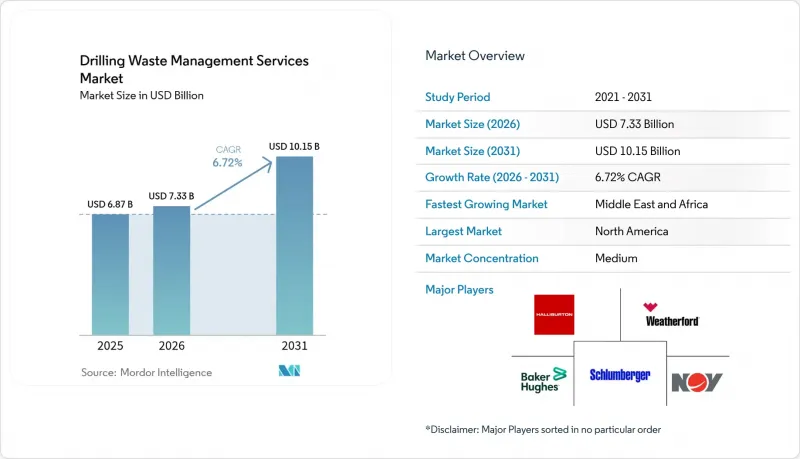
據 Mordor Intelligence 稱,鑽井廢棄物管理服務市場規模預計在 2026 年達到 73.3 億美元,高於 2025 年的 68.7 億美元,預計到 2031 年將達到 101.5 億美元。
預計從 2026 年到 2031 年,其複合年成長率將達到 6.72%。
本報告按廢棄物類型(鑽井和岩屑、廢鑽井液、生產水/其他探勘和生產 (E&P)廢棄物)、服務(固態分離、處理和處置、圍堵和處理、其他)、技術(熱脫附、鑽井和岩屑回注、其他)、部署地點(陸上、海上)和地區(北美、亞、中東和非洲、其他分類)進行分類。
全球鑽井廢棄物管理服務市場趨勢及洞察
全球加強排放法規
全球排放限制正在不斷加強,德克薩斯州40年來首次對其油田廢棄物法規進行了徹底改革,英國也強制要求從2025年4月起實施數位追蹤系統。美國環保署(EPA)的海洋法規現已禁止在距離海岸線3英里範圍內排放含油液體,並對非水性液體設定了嚴格的毒性比率。因此,海上作業者正致力於對鑽井碎屑進行船上處理和回注,以實現零排放。隨著監管機構擴大採用即時監測系統,企業需要投資先進的處理技術,而不是採用卡車運輸和傾倒的方式。隨著這些法規的逐步生效,市場對符合鑽井碎屑含油量嚴格標準的緊湊型熱脫附裝置的需求激增。
擴大深海和超深海鑽探活動
像雪佛龍公司在墨西哥灣的20,000磅/平方英寸(psi)錨油田項目這樣的項目表明,複雜的油井會增加廢棄物的數量。在超深水鑽井中使用高性能鑽井液會產生更多受污染的鑽井材料,這些材料無法被陸上掩埋接收。營運商正在透過改造鑽井船,加裝熱機械清洗系統來處理數千噸海上油氣,從而最大限度地減少停機時間。結合了解吸和泥漿處理的綜合廢棄物管理平台可以降低物流成本,並符合零排放標準。隨著巴西、挪威和美國墨西哥灣新的深水油田開發案獲得批准,擁有可攜式海上系統的服務供應商正在獲得利潤豐厚的合約。
鑽井鑽機數量和資本投資週期的波動
鑽井廢棄物管理服務的需求會隨著鑽機的運作狀況而波動。沙烏地阿美取消了20份2024年的自升式鑽機租賃契約,導致中東地區鑽機需求增速從4%降至1%,迫使承包商停用模組化可拆卸設備。服務供應商面臨運作流壓力,因為即使在經濟衰退時期,他們也必須維護昂貴的熱處理設備。大型公司透過部署可在不同油田間快速轉移的撬裝式系統來規避風險,但當運轉率低於60%時,物流成本就會上升。不確定的日租金前景使得新設備的資金籌措變得困難,導致設備更換週期延長。這些週期性壓力抑制了對先進技術的短期投資,並減緩了鑽井廢棄物管理服務市場的成長。
細分市場分析
預計到2025年,鑽井和鑽屑處理將佔鑽井廢棄物管理服務市場佔有率的57.25%,這主要歸因於鑽井和鑽屑處理在所有井型設計中的普遍存在,以及含油鑽屑處理要求複雜,無法直接排放。隨著鑽井深度的增加和鑽井和鑽屑處理後勤負擔的加重,水平井對振動篩、乾燥機和熱洗機的需求持續成長。同時,頁岩氣開發排放的鹽水遠多於固態廢棄物,導致生產用水量快速成長,預計2031年複合年成長率將達到7.67%。目前,鑽井和鑽屑處理以及水回收利用服務通常以打包形式提供,這反映了營運商希望透過單一聯繫點來明確責任。閉合迴路泥漿系統可以減少流體損失,但對回收斜面的處理需求不斷成長,這將擴大分配給液體處理平台的鑽井廢棄物管理服務市場規模。在預測期內,涵蓋鑽井和鑽屑處理以及水處理的綜合合約預計將佔據更大的市場佔有率,因為營運商更傾向於選擇能夠最佳化這兩類廢棄物處理的供應商。
水產量的激增推動了對移動式蒸發器和結晶器的投資,從而縮短了卡車運輸距離。在二疊紀盆地,電絮凝鑽機與熱濃縮器相結合,正在每個鑽井平台上進行測試和運行,最終實現了80%的廢物減量,並回收淡水用於已完成的建設。沙烏地阿拉伯正在進行一個類似的試點項目,旨在將水生產,這與該國的循環經濟願景相符。雖然鑽井和切割在噸位上仍然佔據主導地位,但隨著監管機構對注水井的密切監控,預計水產量密度將會增加。這將為專業流體處理公司創造鑽井廢棄物管理服務市場顯著成長的機會。
即使到了2025年,固態管理仍將佔41.35%,仍然是最大的細分市場,這反映了所有鑽井鑽機都必須安裝振動篩和離心包裝。然而,處理和處置細分市場成長最快,到2031年複合年成長率將達到8.28%,因為注重環境、社會和治理(ESG)的營運商傾向於選擇將廢棄物轉化為可再利用資源的解決方案。供應商目前正在將立式鑽井岩屑乾燥機與熱脫附功能整合,可回收高達95%的基礎油,並將每桶新鑽井泥漿的採購成本降低40至60美元。因此,分配給處理環節的鑽井廢棄物管理服務市場規模的成長速度超過了與封存相關的支出。服務公司透過策略性的掩埋和注入井容量提供可靠的處置解決方案,並頒發從搖籃到墳墓的合規證書,以滿足租賃方的要求。
在井群共用中央處理樞紐的情況下,封鎖和處理作業仍然至關重要。對於甲板空間有限的海上作業者而言,鑽井碎屑回注服務極具吸引力,從而推動了對高壓泥漿泵和永久隔離封隔器的特定需求。用於廢棄物追蹤的數位化SaaS正在興起,它作為一種「疊加」服務,整合了管理、處理和處置數據,使作業者能夠審核碳排放強度並產生永續發展報告。這種整合標誌著鑽井廢棄物管理服務產業從分散的服務交付模式轉向端到端平台模式的結構性。
區域分析
2025年,北美以37.65%的市佔率領先鑽井廢棄物管理服務市場,主要得益於該地區活躍的頁岩油氣開發。德克薩斯州對油田廢棄物管理條例進行了重大修訂,首次對鹽水注入量設定了限制,並對油坑的襯裡提出了新的要求。這些法規推動了對高容量水循環利用中心和移動式可拆卸設備的需求。二疊紀盆地生產用水的物流需求已超過美國五個州的總能耗,促進了電氣化管道網路和太陽能水處理設施的發展。該地區積極採用人工智慧驅動的流體處理軟體進行檢測,進一步推動了市場創新。
儘管鑽井鑽機數量下降,歐洲仍扮演著舉足輕重的角色。挪威的海洋廢棄物監測系統仍然是合規性的黃金標準,推動了北海所有升降式鑽井鑽機採用閉合迴路泥漿處理系統和熱脫附技術。英國將於2025年生效的數位化廢棄物追蹤義務要求對從生產到處置的整個過程進行記錄,從而為以數據為中心的服務模式拓展了收入來源。德國正在推廣可與含油鑽屑共燒的雙用途垃圾焚化發電發電廠,凸顯了鑽井廢棄物管理服務市場的循環經濟模式。
中東和非洲是成長最快的地區,預計到2031年複合年成長率將達到8.34%。沙烏地阿拉伯的目標是將掩埋的廢棄物再利用率提高到90%,並正在資助一個模組化可拆卸試點項目,用於回收合成泥漿。阿曼正在將此模式推廣到沙漠地區的叢集鑽井作業中,這些地區的卡車運輸距離超過300公里,證明了現場處理的成本效益。在奈米比亞和肯亞等非洲邊遠地區,對能夠適應基礎設施有限的可攜式圍堵和穩定設備的需求正在成長。這些趨勢為全部區域的鑽井廢棄物管理服務產業創造了大量專案儲備。
在以中國和印度主導的亞太地區,陸上探勘正在加速發展,各國的油井關閉法規也不斷收緊。然而,由於鑽井鑽機分佈分散以及資金限制,最尖端科技的應用進展緩慢。巴西是南美洲成長的核心,巴西石油公司(Petrobras)的深海鹽鹽層下油田開發項目採用了流體、水泥和廢棄物處理的一體化契約,這使得擁有解吸和化學回收(CRI)能力的大型服務公司受益。在所有地區,監管協調和ESG金融都在引導市場朝著標準化的零排放標準邁進。
其他好處
- Excel格式的市場預測(ME)表
- 3個月的分析師支持
目錄
第1章:引言
- 研究假設和市場定義
- 調查範圍
第2章:調查方法
第3章執行摘要
第4章 市場狀況
- 市場概覽
- 陸上和海上運作中鑽機數量的分析
- 市場促進因素
- 全球加強排放法規
- 擴大深海和超深海鑽探活動
- 頁岩氣繁榮導致北美地區大規模鑽探開採。
- 為「零浪費」專案提供與環境、社會和治理(ESG)掛鉤的融資
- 模組化熱脫附設備在中東和北非(MENA)地區的快速普及
- 碳氫化合物監管機構強制要求對廢棄物進行數位追蹤。
- 市場限制因素
- 鑽井鑽機數量和資本投資週期的波動
- 現場加工技術的高昂資本成本
- 透過封閉回路型鑽井液系統減少第三方供應量
- 歐洲陸上鑽井和鑽屑回注許可缺乏透明度
- 供應鏈分析
- 監理情勢
- 技術展望
- 波特五力模型
第5章 市場規模與成長預測
- 廢棄物類型
- 鑽孔和切割
- 用過的鑽井液
- 生產用水/其他探勘和生產(E&P)廢棄物
- 按服務
- 固態分離
- 隔離和處理
- 加工和處置
- 鑽探、切割和回注
- 其他
- 透過技術
- 熱脫附
- 生物修復和堆肥
- 穩定/固化
- 鑽孔和切割再注入(CRI)
- 脫水/真空轉移
- 按部署位置
- 陸上
- 離岸
- 按地區
- 北美洲
- 美國
- 加拿大
- 墨西哥
- 歐洲
- 德國
- 英國
- 挪威
- 俄羅斯
- 其他歐洲國家
- 亞太地區
- 中國
- 印度
- 日本
- 韓國
- ASEAN
- 其他亞太國家
- 南美洲
- 巴西
- 阿根廷
- 其他南美國家
- 中東和非洲
- 沙烏地阿拉伯
- 阿拉伯聯合大公國
- 卡達
- 南非
- 其他中東和非洲國家
- 北美洲
第6章 競爭情勢
- 市場集中度
- 策略趨勢(併購、聯盟、購電協議)
- 市場佔有率分析(主要公司的市場排名和市場佔有率)
- 公司簡介
- Schlumberger Ltd(SLB)
- Halliburton Company
- Baker Hughes Co.
- Weatherford International plc
- National Oilwell Varco Inc.
- TWMA Group Ltd
- SAR AS
- GN Solids Control
- Thermtech AS
- Newpark Resources Inc.
- Tervita Corp.
- Solids Control Services Ltd
- Eco-Logic Environmental Engineering Inc.
- Secure Energy Services Inc.
- Kosun Group
- Panther Fluids Management
- Scomi Group Bhd
- Derrick Equipment Company
- Ridgeline Canada Inc.
- STEP Oiltools
第7章 市場機會與未來展望
According to Mordor Intelligence, the drilling waste management services market size in 2026 is estimated at USD 7.33 billion, growing from 2025 value of USD 6.87 billion with 2031 projections showing USD 10.15 billion, growing at 6.72% CAGR over 2026-2031.
This report is Segmented by Waste Type (Drill Cuttings, Used Drilling Fluids, and Produced Water/Other E&P Wastes), Service (Solids Control, Treatment and Disposal, Containment and Handling, and More), Technology (Thermal Desorption, Cuttings Reinjection, and More), Location of Deployment (Onshore and Offshore), and Geography (North America, Asia-Pacific, Middle East and Africa, and More).
Global Drilling Waste Management Services Market Trends and Insights
Tightening Global Discharge Regulations
Worldwide discharge limits are intensifying as Texas implements its first overhaul of oilfield waste in four decades and the UK mandates a digital tracking system from April 2025. EPA offshore rules now prohibit the discharge of oil-based fluids within 3 miles of shore and impose strict toxicity ratios for non-aqueous fluids. Offshore operators, therefore, turn to onboard treatment and cuttings reinjection to achieve zero discharge. Regulators' wider use of real-time monitoring systems forces investment in advanced processing rather than truck-and-dump disposal. As these rules take hold, demand rises sharply for compact thermal desorption units that meet stringent oil-on-cuttings thresholds.
Growth in Deep-Water & Ultra-Deep-Water Drilling Activity
Projects such as Chevron's 20,000 psi Anchor field in the Gulf of Mexico demonstrate how complex wells multiply waste volumes. Ultra-deep campaigns rely on high-performance fluids, generating more contaminated cuttings that shore-based landfills cannot accept. Operators retrofit drillships with thermomechanical cleaners to process thousands of tonnes of oil and gas offshore, minimizing non-productive time. Integrated waste platforms that couple desorption with slurry-handling reduce logistics costs and meet zero-discharge standards. As Brazil, Norway, and the US Gulf sanction new deep-water fields, service providers with portable offshore systems secure premium contracts.
Volatile Rig-Count and Capex Cycles
Demand for drilling waste services swings with rig activity. Saudi Aramco's cancellation of 20 jack-up charters in 2024 reduced Middle East rig demand growth to 1% from 4% and forced contractors to idle modular desorption fleets. Service providers must maintain expensive thermal units even during downturns, straining cash flows. Large firms hedge by deploying skid-mounted systems that can relocate quickly between basins; however, logistics costs rise when utilization falls below 60%. Financing new equipment becomes challenging when day-rate visibility declines, thereby prolonging replacement cycles. This cyclical pressure reduces near-term investment in advanced technologies and tempers the drilling waste management services market.
Other drivers and restraints analyzed in the detailed report include:
- Shale Boom Driving High-Volume Cuttings in North America
- ESG-Linked Financing Favouring "Zero-Waste" Projects
- High Capital Cost of Onsite Treatment Technologies
For complete list of drivers and restraints, kindly check the Table Of Contents.
Segment Analysis
Drill cuttings commanded 57.25% of the drilling waste management services market share in 2025, thanks to their ubiquity across well designs and the complex oil-on-cuttings treatment requirements that prohibit direct discharge. Extended-reach horizontals generate longer footage and heavier cuttings logistics, sustaining demand for shakers, dryers, and thermal cleaners. The produced-water stream, meanwhile, is scaling faster at a 7.67% CAGR to 2031 as shale developments pump brine volumes that dwarf solid waste. Services now bundle cutting handling with water recycling contracts, reflecting operators' search for single-point accountability. Closed-loop mud systems reduce fluid losses but increase the need to process recovered slops, thereby boosting the drilling waste management services market size allocated to liquid treatment platforms. Over the forecast window, integrated contracts covering cuttings plus water are expected to capture a larger wallet share as operators favor vendors who optimize both waste categories.
The produced-water surge encourages investment in mobile evaporation and crystallizer units that reduce trucking miles. In the Permian, pads trial electro-coagulation rigs paired with thermal concentrators, cutting disposal volumes by 80% and reclaiming fresh water for completions. Similar pilots in Saudi Arabia target irrigation reuse, aligning with its circular economy vision. Although drill cutting remains dominant by tonnage value, the density of produced water is expected to rise as regulators scrutinize injection wells, positioning fluid-treatment specialists for premium growth within the drilling waste management services market.
Solids control remained the largest segment at 41.35% in 2025, reflecting the mandatory inclusion of shaker and centrifuge packages on every rig. Yet treatment and disposal are advancing fastest at an 8.28% CAGR to 2031 as ESG-focused operators favor solutions that transform waste into reusable resources. Vendors now integrate vertical cuttings dryers with thermal desorption to recover up to 95% of base oil, cutting new-mud purchases by USD 40-60 per barrel. The drilling waste management services market size allocated to treatment is therefore expanding more quickly than containment spending. Service companies provide disposal certainty through strategic landfill or injection well capacity, offering "cradle-to-grave" compliance certificates that meet the demands of lenders.
Containment and handling retain relevance where well clusters share central treatment hubs. Drill-cuttings reinjection services appeal to offshore operators constrained by deck space, driving niche demand for high-pressure slurry pumps and permanent isolation packers. Digital waste-tracking SaaS is emerging as an "overlay" service that stitches together control, treatment, and disposal data, enabling operators to audit carbon intensity and prepare sustainability reports. This convergence signals a structural migration from piecemeal offerings toward end-to-end platforms in the drilling waste management services industry.
Complete Report Scope:
- By Waste Type
- Drill Cuttings
- Used Drilling Fluids
- Produced Water/Other E&P Wastes
- By Service
- Solids Control
- Containment and Handling
- Treatment and Disposal
- Drill-Cuttings Reinjection
- Others
- By Technology
- Thermal Desorption
- Bioremediation and Composting
- Stabilisation/Solidification
- Cuttings Reinjection (CRI)
- Dewatering and Vacuum Transfer
- By Location of Deployment
- Onshore
- Offshore
- By Geography
- North America
- United States
- Canada
- Mexico
- Europe
- Germany
- United Kingdom
- Norway
- Russia
- Rest of Europe
- Asia-Pacific
- China
- India
- Japan
- South Korea
- ASEAN Countries
- Rest of Asia-Pacific
- South America
- Brazil
- Argentina
- Rest of South America
- Middle East and Africa
- Saudi Arabia
- United Arab Emirates
- Qatar
- South Africa
- Rest of Middle East and Africa
- North America
Geography Analysis
North America led the drilling waste management services market in 2025, with a 37.65% share, driven by the region's prolific shale activity. Texas's overhaul of oilfield-waste statutes introduces first-time limits on saltwater-injection volumes and new liner requirements for pits. These rules amplify demand for high-capacity water-recycling hubs and mobile desorption fleets. Produced-water logistics in the Permian already consume more energy than five US states, prompting the development of electrified pipeline networks and solar-powered treatment plants. The region's willingness to pilot AI-driven fluid-handling software further catalyzes market innovation.
Europe retains significant influence despite fewer rigs. Norway's offshore waste-monitoring regime remains the gold standard for compliance, driving adoption of closed-loop mud systems and thermal desorption on every North Sea jack-up. The United Kingdom's digital waste-tracking mandate, effective 2025, requires cradle-to-grave documentation, thereby extending the revenue for data-centric service models. Germany promotes dual-use waste-to-energy plants that accept oil-based cuttings for co-combustion, highlighting a circular economy within the drilling waste management services market.
Middle East and Africa represent the fastest-growing region, with an 8.34% CAGR through 2031. Saudi Arabia targets 90% landfill diversion and funds modular desorption pilots that reclaim synthetic muds. Oman extends the model to desert cluster drilling where trucking distances exceed 300 km, providing a cost case for onsite treatment. Africa's frontier plays in Namibia and Kenya create fresh demand for portable containment and stabilization units compatible with limited infrastructure. These dynamics establish a robust pipeline for the drilling waste management services industry across the MENA region.
Asia-Pacific, led by China and India, accelerates onshore exploration and tightens provincial well-closure rules; however, dispersed rig counts and capital constraints slow the deployment of premium technologies. South America's growth centers on Brazil, where Petrobras' deep-water pre-salt developments specify integrated fluids, cement, and waste contracts that reward major service houses with desorption and CRI capabilities. Across geographies, regulatory harmonization and ESG finance push the market toward standardized zero-discharge benchmarks.
- Schlumberger Ltd (SLB)
- Halliburton Company
- Baker Hughes Co.
- Weatherford International plc
- National Oilwell Varco Inc.
- TWMA Group Ltd
- SAR AS
- GN Solids Control
- Thermtech AS
- Newpark Resources Inc.
- Tervita Corp.
- Solids Control Services Ltd
- Eco-Logic Environmental Engineering Inc.
- Secure Energy Services Inc.
- Kosun Group
- Panther Fluids Management
- Scomi Group Bhd
- Derrick Equipment Company
- Ridgeline Canada Inc.
- STEP Oiltools
Additional Benefits:
- The market estimate (ME) sheet in Excel format
- 3 months of analyst support
TABLE OF CONTENTS
1 Introduction
- 1.1 Study Assumptions & Market Definition
- 1.2 Scope of the Study
2 Research Methodology
3 Executive Summary
4 Market Landscape
- 4.1 Market Overview
- 4.2 Onshore & Offshore Active Rig Count Analysis
- 4.3 Market Drivers
- 4.3.1 Tightening global discharge regulations
- 4.3.2 Growth in deep-water & ultra-deep-water drilling activity
- 4.3.3 Shale boom driving high-volume cuttings in North America
- 4.3.4 ESG-linked financing favouring "zero-waste" projects
- 4.3.5 Rapid adoption of modular thermal desorption units in MENA
- 4.3.6 Digital waste-tracking mandates by hydrocarbons regulators
- 4.4 Market Restraints
- 4.4.1 Volatile rig-count and capex cycles
- 4.4.2 High capital cost of onsite treatment technologies
- 4.4.3 Closed-loop drilling fluid systems reducing third-party volumes
- 4.4.4 Uncertain permitting for onshore cuttings reinjection in Europe
- 4.5 Supply-Chain Analysis
- 4.6 Regulatory Landscape
- 4.7 Technological Outlook
- 4.8 Porter's Five Forces
- 4.8.1 Bargaining Power of Suppliers
- 4.8.2 Bargaining Power of Buyers
- 4.8.3 Threat of New Entrants
- 4.8.4 Threat of Substitutes
- 4.8.5 Intensity of Competitive Rivalry
5 Market Size & Growth Forecasts
- 5.1 By Waste Type
- 5.1.1 Drill Cuttings
- 5.1.2 Used Drilling Fluids
- 5.1.3 Produced Water/Other E&P Wastes
- 5.2 By Service
- 5.2.1 Solids Control
- 5.2.2 Containment and Handling
- 5.2.3 Treatment and Disposal
- 5.2.4 Drill-Cuttings Reinjection
- 5.2.5 Others
- 5.3 By Technology
- 5.3.1 Thermal Desorption
- 5.3.2 Bioremediation and Composting
- 5.3.3 Stabilisation/Solidification
- 5.3.4 Cuttings Reinjection (CRI)
- 5.3.5 Dewatering and Vacuum Transfer
- 5.4 By Location of Deployment
- 5.4.1 Onshore
- 5.4.2 Offshore
- 5.5 By Geography
- 5.5.1 North America
- 5.5.1.1 United States
- 5.5.1.2 Canada
- 5.5.1.3 Mexico
- 5.5.2 Europe
- 5.5.2.1 Germany
- 5.5.2.2 United Kingdom
- 5.5.2.3 Norway
- 5.5.2.4 Russia
- 5.5.2.5 Rest of Europe
- 5.5.3 Asia-Pacific
- 5.5.3.1 China
- 5.5.3.2 India
- 5.5.3.3 Japan
- 5.5.3.4 South Korea
- 5.5.3.5 ASEAN Countries
- 5.5.3.6 Rest of Asia-Pacific
- 5.5.4 South America
- 5.5.4.1 Brazil
- 5.5.4.2 Argentina
- 5.5.4.3 Rest of South America
- 5.5.5 Middle East and Africa
- 5.5.5.1 Saudi Arabia
- 5.5.5.2 United Arab Emirates
- 5.5.5.3 Qatar
- 5.5.5.4 South Africa
- 5.5.5.5 Rest of Middle East and Africa
- 5.5.1 North America
6 Competitive Landscape
- 6.1 Market Concentration
- 6.2 Strategic Moves (M&A, Partnerships, PPAs)
- 6.3 Market Share Analysis (Market Rank/Share for key companies)
- 6.4 Company Profiles (includes Global level Overview, Market level overview, Core Segments, Financials as available, Strategic Information, Products & Services, and Recent Developments)
- 6.4.1 Schlumberger Ltd (SLB)
- 6.4.2 Halliburton Company
- 6.4.3 Baker Hughes Co.
- 6.4.4 Weatherford International plc
- 6.4.5 National Oilwell Varco Inc.
- 6.4.6 TWMA Group Ltd
- 6.4.7 SAR AS
- 6.4.8 GN Solids Control
- 6.4.9 Thermtech AS
- 6.4.10 Newpark Resources Inc.
- 6.4.11 Tervita Corp.
- 6.4.12 Solids Control Services Ltd
- 6.4.13 Eco-Logic Environmental Engineering Inc.
- 6.4.14 Secure Energy Services Inc.
- 6.4.15 Kosun Group
- 6.4.16 Panther Fluids Management
- 6.4.17 Scomi Group Bhd
- 6.4.18 Derrick Equipment Company
- 6.4.19 Ridgeline Canada Inc.
- 6.4.20 STEP Oiltools
7 Market Opportunities & Future Outlook
- 7.1 White-space & Unmet-Need Assessment

 鑽井廢棄物管理市場:依廢棄物類型、技術、鑽井方法、應用和最終用戶分類-2026-2032年全球市場預測
 2026年全球地下水管理市場報告
 挖掘廢棄物管理市場:按服務類型、應用和地區分類鑽井軟體市場:按解決方案和區域分類
 全球挖掘廢棄物管理市場規模、佔有率、趨勢和成長分析報告:2026-2034年
 挖掘廢棄物管理服務市場-全球產業規模、佔有率、趨勢、機會、預測:按服務、地點、廢棄物類型、地區和競爭格局分類,2021-2031年
 挖掘廢棄物管理市場規模、佔有率和成長分析(按類型、廢棄物排放、服務、應用和地區分類)—產業預測(2026-2033 年)
 固控鑽井廢棄物管理市場機會、成長促進因素、產業趨勢分析及預測(2026-2035年)地下水管理市場機會、成長促進因素、產業趨勢分析及預測(2026-2035年)
 全球鑽井廢棄物控制與處理市場