


 |
市場調查報告書
商品編碼
2113809
熱能儲存:市場佔有率分析、產業趨勢與統計、成長預測(2026-2031)Thermal Energy Storage - Market Share Analysis, Industry Trends & Statistics, Growth Forecasts (2026 - 2031) |
||||||

※ 本網頁內容可能與最新版本有所差異。詳細情況請與我們聯繫。
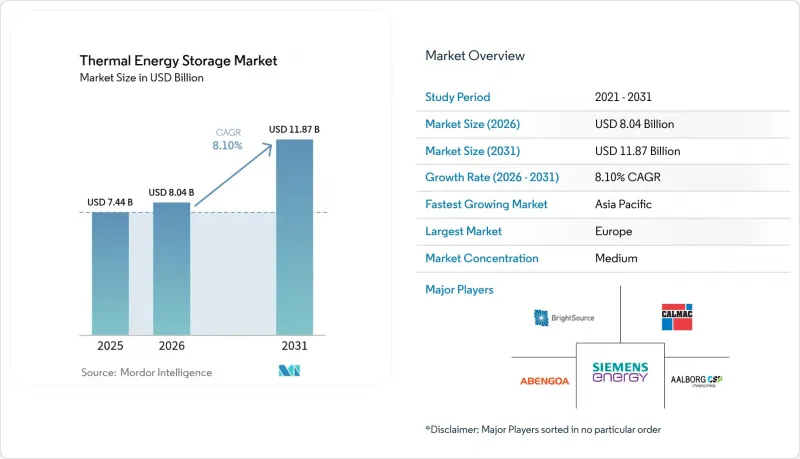
據 Mordor Intelligence 稱,到 2026 年,熱能儲存市場規模預計將達到 80.4 億美元,高於 2025 年的 74.4 億美元,預計到 2031 年將達到 118.7 億美元。
預計從 2026 年到 2031 年,其複合年成長率將達到 8.1%。
本報告按儲熱材料(熔鹽、相變材料、其他)、技術(顯熱儲熱、熱化學儲熱、其他)、應用(發電、工業過程熱、其他)、最終用戶(公共產業、商業和工業、住宅)以及地區(北美、歐洲、亞太地區、南美、中東和非洲)進行分類。
全球熱能儲存市場趨勢及洞察
整合熔鹽儲熱(TES)的聚光太陽能發電廠建設快速擴張,持續超過8小時
隨著中國4.8吉瓦聚光太陽能發電項目和印度5吉瓦規劃項目中強制要求配備8小時儲熱設施,熔鹽儲罐已成為受監管光伏發電的標準配置。金融機構現在將儲熱模組視為一種增值因素,這不僅有助於在容量市場中獲得收益,還能降低棄風減排風險。實現與燃氣發電高峰期相當的平準化能源成本(LCOE)使得全部區域出現了新的政府資助競標。工程總承包(EPC)公司正在推廣雙罐設計,這將進一步提升大型儲熱市場專案的資金籌措潛力,預計到2024年以後,電廠配套設施(BOP)成本將降低12%。 2027年後專案的可預見性提高,正在促進中國和印度國內鹽和合金供應鏈的發展,從而降低原物料採購風險。
對包含技術能源費用(TES)的可再生能源發電容量進行強制競標
加州的「清潔電力2030」框架和歐盟的《建築性能指令2024/1275》強制要求新建可再生能源資產,包括長期儲能,並給予配備熱能儲存(TES)的競標更高的競標分數。這些法規消除了發電和儲能採購方面的傳統區別,實現了企劃案融資一體化,優先考慮放電時間超過六小時的熱能儲存解決方案。在澳大利亞,提供慣性和電壓支援的熱能儲存專案在可再生能源區享有併網優先權,平均可減少一年的併網延遲。這項政策轉變顯著擴大了自2026年起公共產業競標中熱能儲存市場的潛在訂單容量。
大規模熔鹽儲槽需要大量資本投入
商業規模熔鹽發電廠的建造成本為每千瓦時15至25美元,這主要是由於使用了不銹鋼容器和耐腐蝕鹽混合物。由於營運經驗有限,貸款方仍持謹慎態度,迫使專案依賴高成本的股本,從而推高了融資門檻。美國能源局為2025年部署專案提供的3.05億美元貸款擔保顯示公共部門信心增強,但並未顯著縮小資金籌措差額。儘管原始設備製造商(OEM)正在探索使用預製儲罐模組和低鉻合金,這些技術預計在2027年前將資本支出降低20%,但短期經濟可行性仍然是部分熱能儲存市場競標的阻力。
細分市場分析
市場領導者繼續專注於熔鹽,預計到2025年,熔鹽將佔銷售額的45.40%。然而,相變材料(PCM)預計將以15.6%的複合年成長率成長,並佔據新裝置的大部分佔有率。緊湊型PCM可將安裝面積減少高達40%,使其更易於在商業設施中安裝,並進一步提高其在熱能儲存市場的滲透率。沙子和混凝土等固體介質也正在快速發展。芬蘭的一款1MW/100MWh的沙子儲能電池的功率轉換效率達到了44%,證實其能夠以低於10美元/kWh的成本儲存數天的能量。 PCM能夠有效地處理冷卻負荷,尤其是在商業建築的冰基系統中。另一方面,固體介質可以維持1000 度C以上的溫度,從而可以直接為工業製程供熱,而無需昂貴的熱交換器。隨著模組供應商擴大生產規模,預計到 2027 年,單位成本將達到與熔鹽相同的水平,這將加強熱能儲存市場中儲存材料之間的競爭平衡。
第二代熔鹽配方如今可承受高達 565 度C 的高溫,使鹽和顆粒混合系統的能量密度更接近熱化學儲熱系統。供應商目前提供與鹽供應合約捆綁的再生硝酸鹽原料,緩解了先前令買家望而卻步的價格波動。尤其是在歐洲,監管趨勢優先考慮低毒性材料,這意味著儘管水相變材料 (PCM) 的能量密度低於其他化學材料,但它們在暖通空調 (HVAC) 的尖峰用電調節應用中仍然佔據重要地位。總體而言,客戶的選擇正變得越來越受應用主導:PCM 被用於空間製冷的峰值需求,熔鹽被用於聚光太陽能發電 (CSP) 的基本負載,沙子被用於極端溫度條件下的工業爐,這拓寬了熱能存儲市場的選擇範圍。
由於顯熱技術(水箱、熔鹽罐、耐火磚等)性能可靠且易於操作維護,預計到2025年,其銷售額仍將佔總銷售額的73.20%。同時,熱化學系統體積密度是顯熱技術的三倍,幾乎沒有自放電,預計到2031年,其複合年成長率將達到17.1%,成為熱能儲存市場中成長最快的領域。目前,採用鹽水合物循環的試驗裝置容量已超過1兆瓦時,金屬氧化物氧化還原循環的放電測試時間也接近100小時。相較之下,採用生物基相變材料(PCM)的潛熱解決方案則彌補了複雜性方面的不足,其能量密度是顯熱技術的兩倍,且無需活性化學反應器。
考納斯理工大學的一項研究表明,可對現有建築物進行改造的地下熱化學儲能艙,無需獨立的儲罐基礎設施,從而降低了安裝成本。透過整合基於人工智慧的控制軟體,可以在可再生能源供應受限時最佳化充電,並提高能源套利和購熱合約的效益。隨著熱化學儲能供應商在目標溫度範圍內實現95%或更高的往返效率,EPC公司開始提供5-10兆瓦時模組的承包工程報價,這增強了商業化前景,並擴大了熱能儲存行業的規模。
區域分析
歐洲憑藉成熟的區域供熱系統、嚴格的碳排放政策和慷慨的熱力網路津貼,預計到2025年將佔全球收入的34.60%。德國30億歐元(33億美元)的現代化基金正在加速地下蓄熱技術的應用,而丹麥到2030年實現50%區域供熱覆蓋率的目標意味著對吉瓦時季節性倉儲設施的需求。在斯堪的斯堪地那維亞,由於夏季充足的陽光與冬季的熱負荷之間存在季節性不平衡,熱能儲存至關重要,這迫使網路營運商採購模組化的砂水坑式儲熱系統。由於建築性能標準的要求,長期蓄熱已被定位為關鍵基礎設施,採購流程正逐漸普及,地方政府公共產業領域的蓄熱市場也不斷擴張。
亞太地區預計將成為成長最快的地區,到2031年複合年成長率將達到13.4%,這主要得益於中國30吉瓦的熱能儲存目標以及印度集中式太陽熱能發電)。與進口系統相比,中國國內供應鏈已將熔鹽儲槽的成本降低了18%,進一步加劇了熱能儲存市場的價格競爭。澳洲的可再生能源區正在優先考慮將熱能儲存項目併入電網,而耐火磚電池在工業礦山的試點應用也進一步證明了其有效性。日本和韓國正致力於回收鋼鐵和石化聯合企業的高溫廢熱,並利用優惠的折舊免稅額方案來取代太陽能和儲存在進口液化天然氣(LNG)中的電網電力。
北美受益於《通膨控制法案》,該法案為合格的儲熱系統提供30%的投資稅額扣抵。加州的「清潔電力2030」計畫強制要求公用事業公司在新的太陽能發電競標中納入儲熱系統,而紐約州的「建築脫碳標準」則鼓勵在供暖系統維修中使用高密度儲能系統。美國能源局為大型專案提供的3.05億美元貸款擔保體現了聯邦政府的支持,降低了貸款機構的風險承受能力。資料中心營運商等工業需求者正在試點「沙電池」技術,將伺服器廢熱用於設施供暖,這表明需求側促進因素與公用事業公司的採購相輔相成,並擴大了儲熱市場的潛在基本客群。
其他好處
- Excel格式的市場預測(ME)表
- 3個月的分析師支持
目錄
第1章:引言
- 研究假設和市場定義
- 調查範圍
第2章:調查方法
第3章執行摘要
第4章 市場狀況
- 市場概覽
- 市場促進因素
- 整合熔鹽儲熱(TES)的聚光太陽能發電廠建設快速擴張,持續超過8小時
- 對包含技術能源費用(TES)的可再生能源發電容量進行強制競標
- 第四代區域供熱製冷網路的擴建
- 強制回收工業廢熱
- 儲能系統與電解槽的長期結合用於綠氫能
- 超高溫砂「熱電池」旨在實現成本低於每千瓦時10美元的低碳儲能系統(LCoS)。
- 市場限制因素
- 大規模熔鹽儲槽需要大量資本投入
- 低成本鋰離子電池與液流電池之間的競爭
- 計量滯後型儲能系統缺乏可融資的收入來源
- 高純度相變材料供應鏈瓶頸
- 供應鏈分析
- 監理情勢
- 技術展望
- 波特五力模型
第5章 市場規模與成長預測
- 按儲存材料
- 熔鹽
- 水/熱水
- 冰/冷水
- 相變材料(PCM)
- 固體介質(混凝土、沙子、磚塊)
- 其他
- 透過技術
- 顯熱儲存
- 潛熱儲存
- 熱化學儲熱
- 透過使用
- 發電(聚光太陽能發電,併網型)
- 區域供熱
- 工業製程熱
- 建築空調(HVAC)製冷
- 其他細分市場(尖峰用電調節、軍事應用等)
- 最終用戶
- 公共產業
- 商業和工業
- 住宅
- 按地區
- 北美洲
- 美國
- 加拿大
- 墨西哥
- 歐洲
- 德國
- 英國
- 法國
- 義大利
- 俄羅斯
- 其他歐洲國家
- 亞太地區
- 中國
- 印度
- 日本
- 韓國
- ASEAN
- 其他亞太國家
- 南美洲
- 巴西
- 阿根廷
- 其他南美國家
- 中東和非洲
- 沙烏地阿拉伯
- 阿拉伯聯合大公國
- 南非
- 埃及
- 其他中東和非洲國家
- 北美洲
第6章 競爭情勢
- 市場集中度
- 策略趨勢(併購、聯盟、購電協議)
- 市場佔有率分析(主要公司的市場排名和佔有率)
- 公司簡介
- Aalborg CSP A/S
- Abengoa SA(ENGIE CSP)
- BrightSource Energy Inc.
- Siemens Energy AG
- CALMAC Corp.
- EVAPCO Inc.
- SaltX Technology Holding AB
- Trane Technologies plc
- Rondo Energy
- Antora Energy
- Brenmiller Energy
- Hyme Energy
- Energy Nest(Aker Solutions)
- Malta Inc.
- Terrafore Technologies LLC
- Vantaa Energy Ltd.
- SR Energy
- Baltimore Aircoil Company(BAC)
- Burns & McDonnell
- Ice Energy
- Additional validated firms
第7章 市場機會與未來展望
According to Mordor Intelligence, thermal energy storage market size in 2026 is estimated at USD 8.04 billion, growing from 2025 value of USD 7.44 billion with 2031 projections showing USD 11.87 billion, growing at 8.1% CAGR over 2026-2031.
This report is Segmented by Storage Material (Molten Salt, Phase-Change Materials, and More), Technology (Sensible Heat Storage, Thermochemical Heat Storage, and More), Application (Power Generation, Industrial Process Heat, and More), End-User (Utilities, Commercial and Industrial, and Residential), and Geography (North America, Europe, Asia-Pacific, South America, and Middle East and Africa).
Global Thermal Energy Storage Market Trends and Insights
Rapid Build-Out of CSP Plants Integrating >=8-Hour Molten-Salt TES
Mandatory eight-hour storage rules in China's 4.8 GW CSP program and India's 5 GW pipeline have turned molten-salt tanks into standard equipment for dispatchable solar power. Lenders now treat the storage block as a revenue enhancer because it enables capacity-market earnings and reduces curtailment risk. Achieving levelized costs that rival gas-fired peakers has unlocked new sovereign-backed auctions across MENA. EPC firms are standardizing dual-tank designs, lowering balance-of-plant costs by 12% since 2024, further strengthening the bankability of large-scale thermal energy storage market projects. Pipeline visibility beyond 2027 fosters domestic salt and alloy supply chains in China and India, de-risking raw-material access.
Mandatory Renewable Capacity Auctions Bundling TES Adders
California's Clean Power 2030 framework and the EU's Building Performance Directive 2024/1275 require new renewable assets, including long-duration storage, awarding higher auction points to TES-equipped bids. These rules erase the prior split between generation and storage procurement, enabling unified project finance that favors thermal solutions once discharge windows exceed 6 hours. In Australia, renewable-energy zones grant grid-connection priority to thermal-storage projects that provide inertia and voltage support, trimming interconnection queuing delays by a year on average. The policy shift noticeably increases the thermal energy storage market's addressable capacity in utility solicitations announced for 2026 and beyond.
High Capex of Large-Scale Molten-Salt Tanks
Utility-scale molten-salt fields cost USD 15-25 per kWh, largely driven by stainless-steel containment and corrosion-resistant salt blends. Limited operating history keeps debt providers cautious, pushing projects toward higher-priced equity that inflates hurdle rates. The U.S. Department of Energy's USD 305 million loan guarantee for a 2025 deployment signals rising public-sector confidence but has yet to materially compress financing spreads. OEMs are exploring prefabricated tank modules and low-chrome alloys that could shave 20% off capex by 2027, yet short-term economics remain a headwind for some thermal energy storage market bids.
Other drivers and restraints analyzed in the detailed report include:
- Expansion of Fourth-Generation District Heating & Cooling Grids
- Industrial Waste-Heat Recovery Mandates
- Competition from Low-Cost Li-ion and Flow Batteries
For complete list of drivers and restraints, kindly check the Table Of Contents.
Segment Analysis
Market leaders continued to favor molten salt, which retained 45.40% revenue in 2025, yet phase-change materials (PCM) are projected to capture an outsized share of new installations by growing at 15.6% CAGR. Compact PCMs lower installation footprint by up to 40%, easing siting inside commercial facilities and pushing incremental penetration in the thermal energy storage market. Solid media such as sand or concrete advance quickly: Finland's 1 MW/100 MWh sand battery demonstrated 44% power-conversion efficiency, validating multi-day storage at sub-USD 10 per kWh. PCMs handle cooling loads effectively, especially in ice-based systems for commercial buildings. Meanwhile, solid media's ability to sustain >1,000 °C unlocks direct industrial process-heat delivery without costly heat exchangers. As module suppliers scale production, unit costs are forecast to converge with molten salt by 2027, strengthening competitive parity across storage materials inside the thermal energy storage market.
Second-generation molten-salt recipes now tolerate 565 °C, allowing hybrid salt-plus-particle systems to edge closer to thermo-chemical densities. Suppliers are bundling salt supply contracts with recycled nitrate feedstocks, mitigating price volatility that previously discouraged offtakers. Regulatory preference for low-toxicity materials, especially in Europe, keeps water-based PCMs relevant for HVAC peak-shaving even though their energy density lags other chemistries. Overall, customer selection is becoming application-driven: PCMs for space-cooling peaks, molten salt for CSP baseload, and sand for extreme-temperature industrial furnaces, widening option sets within the thermal energy storage market.
Sensible-heat technologies-water pits, molten-salt tanks, refractory bricks-retained 73.20% of 2025 revenue owing to proven performance and straightforward O&M. Yet thermochemical systems are forecast to register an 17.1% CAGR to 2031, the fastest within the thermal energy storage market, because they deliver three-fold higher volumetric density and negligible self-discharge. Pilot units based on salt-hydrate cycles now exceed 1 MWh, and metal-oxide redox loops are nearing 100-hour discharge tests. Contrastingly, latent-heat solutions using bio-based PCMs bridge the complexity gap by offering energy densities double those of sensible heat without active chemical reactors.
Research at Kaunas University of Technology showed soil-embedded thermochemical capsules that retrofit beneath existing buildings, eliminating separate tank infrastructure and cutting installed costs. The integration of AI-based control software optimizes charging when renewable curtailment surges, enhancing revenue stacking from energy-arbitrage plus heat-offtake contracts. As thermochemical vendors achieve >=95% round-trip efficiency in targeted temperature bands, EPC firms are beginning to quote turnkey pricing for 5-10 MWh blocks, reinforcing commercialization prospects and expanding the thermal energy storage industry footprint.
Complete Report Scope:
- By Storage Material
- Molten Salt
- Water/Hot-Water
- Ice/Chilled-Water
- Phase-Change Materials (PCM)
- Solid Media (Concrete, Sand, Brick)
- Others
- By Technology
- Sensible Heat Storage
- Latent Heat Storage
- Thermochemical Heat Storage
- By Application
- Power Generation (CSP, Grid-integrated)
- District Heating
- Industrial Process Heat
- Building HVAC Cooling
- Other Niche (Peak-shaving, Military, etc.)
- By End-User
- Utilities
- Commercial and Industrial
- Residential
- By Geography
- North America
- United States
- Canada
- Mexico
- Europe
- Germany
- United Kingdom
- France
- Italy
- Russia
- Rest of Europe
- Asia-Pacific
- China
- India
- Japan
- South Korea
- ASEAN Countries
- Rest of Asia-Pacific
- South America
- Brazil
- Argentina
- Rest of South America
- Middle East and Africa
- Saudi Arabia
- United Arab Emirates
- South Africa
- Egypt
- Rest of Middle East and Africa
- North America
Geography Analysis
Europe controlled 34.60% of global revenue in 2025 by exploiting mature district-energy systems, stringent carbon policies, and generous heat-network grants. Germany's EUR 3 billion (USD 3.3 billion) modernization fund accelerates pit-thermal-storage adoption, while Denmark's target for 50% district-heating coverage by 2030 implies multi-gigawatt-hour seasonal reservoirs. Scandinavia's seasonal mismatch between abundant summer solar and winter heat loads makes TES indispensable, pushing network operators to procure modular sand or water-pit systems. Building-performance mandates now label long-duration heat storage as critical infrastructure, mainstreaming procurement processes and expanding the thermal energy storage market across municipal utilities.
Asia-Pacific is the fastest-growing region with a 13.4% CAGR to 2031, buoyed by China's 30 GW storage target and India's CSP mandates that require eight-hour TES. Domestic supply chains in China reduce molten-salt tank costs by 18% compared with imported systems, sharpening price competitiveness in the thermal energy storage market. Australia's renewable-energy zones award expedited grid interconnection to projects bundling TES, and pilot approvals for firebrick batteries in industrial mines add proof points. Japan and South Korea focus on high-temperature waste-heat capture in steel and petrochemical complexes, leveraging favorable depreciation schemes to replace imported LNG with stored solar or grid electricity.
North America benefits from the Inflation Reduction Act, which provides a 30% investment-tax credit for qualified thermal storage. California's Clean Power 2030 plan mandates TES in new utility solar solicitations, and New York's building decarbonization codes push high-density storage for space-heating retrofits. The U.S. Department of Energy's USD 305 million loan guarantee to a large-scale project signaled federal support that eases lender risk perceptions. Industrial off-takers such as data-center operators trial sand batteries to recycle server waste heat into facility heating, illustrating a demand-side driver that complements utility procurements and broadens the thermal energy storage market addressable base.
- Aalborg CSP A/S
- Abengoa SA (ENGIE CSP)
- BrightSource Energy Inc.
- Siemens Energy AG
- CALMAC Corp.
- EVAPCO Inc.
- SaltX Technology Holding AB
- Trane Technologies plc
- Rondo Energy
- Antora Energy
- Brenmiller Energy
- Hyme Energy
- Energy Nest (Aker Solutions)
- Malta Inc.
- Terrafore Technologies LLC
- Vantaa Energy Ltd.
- SR Energy
- Baltimore Aircoil Company (BAC)
- Burns & McDonnell
- Ice Energy
- Additional validated firms
Additional Benefits:
- The market estimate (ME) sheet in Excel format
- 3 months of analyst support
TABLE OF CONTENTS
1 Introduction
- 1.1 Study Assumptions & Market Definition
- 1.2 Scope of the Study
2 Research Methodology
3 Executive Summary
4 Market Landscape
- 4.1 Market Overview
- 4.2 Market Drivers
- 4.2.1 Rapid build-out of CSP plants integrating over 8-h molten-salt TES
- 4.2.2 Mandatory renewable capacity auctions bundling TES adders
- 4.2.3 Expansion of fourth-generation district heating & cooling grids
- 4.2.4 Industrial waste-heat recovery mandates
- 4.2.5 Coupling long-duration TES with green-hydrogen electrolyzers
- 4.2.6 Super-hot-sand "thermal batteries" targeting Below US$10 /kWh LCoS
- 4.3 Market Restraints
- 4.3.1 High capex of large-scale molten-salt tanks
- 4.3.2 Competition from low-cost Li-ion and flow batteries
- 4.3.3 Absence of bankable revenue stacks for behind-the-meter TES
- 4.3.4 Supply-chain bottlenecks for high-purity phase-change materials
- 4.4 Supply-Chain Analysis
- 4.5 Regulatory Landscape
- 4.6 Technological Outlook
- 4.7 Porter's Five Forces
- 4.7.1 Bargaining Power of Suppliers
- 4.7.2 Bargaining Power of Buyers
- 4.7.3 Threat of New Entrants
- 4.7.4 Threat of Substitutes
- 4.7.5 Intensity of Competitive Rivalry
5 Market Size & Growth Forecasts
- 5.1 By Storage Material
- 5.1.1 Molten Salt
- 5.1.2 Water/Hot-Water
- 5.1.3 Ice/Chilled-Water
- 5.1.4 Phase-Change Materials (PCM)
- 5.1.5 Solid Media (Concrete, Sand, Brick)
- 5.1.6 Others
- 5.2 By Technology
- 5.2.1 Sensible Heat Storage
- 5.2.2 Latent Heat Storage
- 5.2.3 Thermochemical Heat Storage
- 5.3 By Application
- 5.3.1 Power Generation (CSP, Grid-integrated)
- 5.3.2 District Heating
- 5.3.3 Industrial Process Heat
- 5.3.4 Building HVAC Cooling
- 5.3.5 Other Niche (Peak-shaving, Military, etc.)
- 5.4 By End-User
- 5.4.1 Utilities
- 5.4.2 Commercial and Industrial
- 5.4.3 Residential
- 5.5 By Geography
- 5.5.1 North America
- 5.5.1.1 United States
- 5.5.1.2 Canada
- 5.5.1.3 Mexico
- 5.5.2 Europe
- 5.5.2.1 Germany
- 5.5.2.2 United Kingdom
- 5.5.2.3 France
- 5.5.2.4 Italy
- 5.5.2.5 Russia
- 5.5.2.6 Rest of Europe
- 5.5.3 Asia-Pacific
- 5.5.3.1 China
- 5.5.3.2 India
- 5.5.3.3 Japan
- 5.5.3.4 South Korea
- 5.5.3.5 ASEAN Countries
- 5.5.3.6 Rest of Asia-Pacific
- 5.5.4 South America
- 5.5.4.1 Brazil
- 5.5.4.2 Argentina
- 5.5.4.3 Rest of South America
- 5.5.5 Middle East and Africa
- 5.5.5.1 Saudi Arabia
- 5.5.5.2 United Arab Emirates
- 5.5.5.3 South Africa
- 5.5.5.4 Egypt
- 5.5.5.5 Rest of Middle East and Africa
- 5.5.1 North America
6 Competitive Landscape
- 6.1 Market Concentration
- 6.2 Strategic Moves (M&A, Partnerships, PPAs)
- 6.3 Market Share Analysis (Market Rank/Share for key companies)
- 6.4 Company Profiles (includes Global level Overview, Market level overview, Core Segments, Financials as available, Strategic Information, Products & Services, and Recent Developments)
- 6.4.1 Aalborg CSP A/S
- 6.4.2 Abengoa SA (ENGIE CSP)
- 6.4.3 BrightSource Energy Inc.
- 6.4.4 Siemens Energy AG
- 6.4.5 CALMAC Corp.
- 6.4.6 EVAPCO Inc.
- 6.4.7 SaltX Technology Holding AB
- 6.4.8 Trane Technologies plc
- 6.4.9 Rondo Energy
- 6.4.10 Antora Energy
- 6.4.11 Brenmiller Energy
- 6.4.12 Hyme Energy
- 6.4.13 Energy Nest (Aker Solutions)
- 6.4.14 Malta Inc.
- 6.4.15 Terrafore Technologies LLC
- 6.4.16 Vantaa Energy Ltd.
- 6.4.17 SR Energy
- 6.4.18 Baltimore Aircoil Company (BAC)
- 6.4.19 Burns & McDonnell
- 6.4.20 Ice Energy
- 6.4.21 Additional validated firms
7 Market Opportunities & Future Outlook
- 7.1 White-space & Unmet-need Assessment

 熱能儲存市場規模、佔有率及成長預測(2026-2032)
 熱能儲存市場:2026-2032年全球市場預測(按技術類型、儲存材料、溫度範圍、儲存方法、應用和最終用戶分類)全球熱能儲存(TES)市場(2026-2036 年)
 熱能儲存市場預測至2034年—按儲存材料、容量、技術、應用、最終用戶和地區分類的全球分析
 熱能儲存市場報告:按熱能儲存方法、技術、材料、應用、最終用途和地區分類(2026-2034 年)熱能能源儲存系統市場預測:至 2034 年—按儲存材料、安裝類型、技術、應用、最終用戶和地區分類的全球分析
 2026年全球熱能儲存市場報告溫躍層儲能市場:按技術類型、應用、儲能時長和系統配置分類的全球預測(2026-2032年)全球熱能儲存市場規模、佔有率、趨勢和成長分析報告(2026-2034年)熱能儲存市場規模、佔有率、成長及全球產業分析:依技術、材料、應用、終端用戶和地區劃分的洞察與預測(2026-2034 年)