


 |
市場調查報告書
商品編碼
2113744
北美微型混合動力汽車:市場佔有率分析、行業趨勢和統計數據以及成長預測(2026-2031 年)North America Micro Hybrid Vehicles - Market Share Analysis, Industry Trends & Statistics, Growth Forecasts (2026 - 2031) |
||||||

※ 本網頁內容可能與最新版本有所差異。詳細情況請與我們聯繫。
2025 年北美微型混合動力汽車市場價值 42.4 億美元,預計從 2026 年的 47.6 億美元成長到 2031 年的 84.9 億美元,預測期(2026-2031 年)的複合年成長率預計為 12.28%。
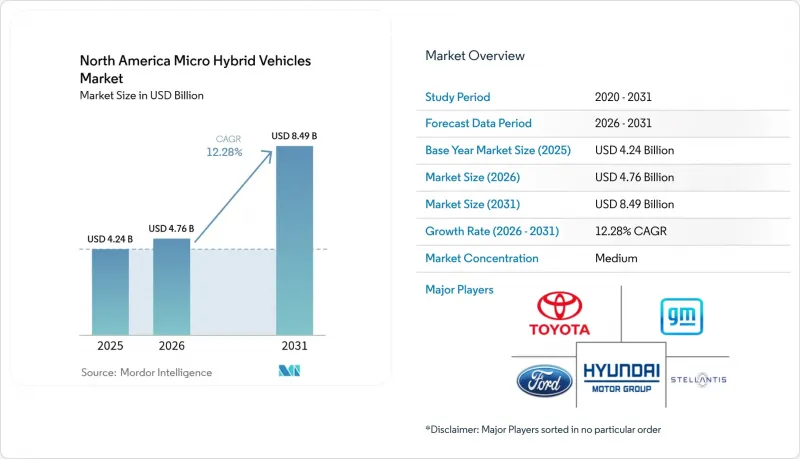
本報告按容量類型(12V 微混、24V 微混、其他)、電池類型(鉛酸電池、鋰離子電池、其他)、車輛類型(乘用車、輕型商用車、其他)、最終用戶(原廠配套車輛、售後/車隊改裝)和國家(例如美國)進行細分。市場預測以貨幣價值(美元)和銷售(單位)兩種形式呈現。
北美微型混合動力汽車市場趨勢與洞察
更嚴格的燃油經濟性標準和溫室氣體排放標準將促進微型混合動力汽車。
美國環保署 (EPA) 的多污染物排放標準要求車隊二氧化碳排放量到 2032 年降至 85 克/英里,幾乎是 2026 年水準的一半。同時,美國國家公路交通安全管理局 (NHTSA) 的 CAFE 法規要求到 2031 年燃油效率達到約 50.4 英里/加侖。汽車製造商將 48V 輕度混合動力系統視為滿足法規要求的直接途徑,因為它們可以顯著提高燃油經濟性,可以與現有的內燃機 (ICE) 平台整合,並保持盈利。福特計劃在 2030 年為其所有剩餘的內燃機車型推出混合模式,而最初專注於電動車的通用汽車也宣布將從 2027 年開始推出插電式混合動力汽車。該計劃的進度安排與 2027 年至 2032 年的分階段推廣計劃相吻合,使汽車製造商能夠在定期更新車型的同時實現投資多元化。
OEM廠商快速採用48V輕混架構
汽車製造商快速採用48V系統是技術成熟度和監管要求共同作用的結果。特斯拉決定逐步淘汰12V組件並採用48V線束,這標誌著汽車產業正朝著更輕的線束和更低的電阻損耗發展。大陸集團指出,48V皮帶驅動啟動發電機可將二氧化碳排放量減少高達15%,並且還可以驅動電動渦輪增壓器和能量回收煞車系統。博格華納和法雷奧等一級供應商已獲得多年契約,為計劃於2028年前推出的平台提供48V電機和電力電子設備,這表明汽車製造商傾向於採用模組化策略,該策略可以從基本的啟停功能擴展到支持高級駕駛輔助系統(ADAS)。
與傳統的 12V 自動啟動/停止系統相比,額外成本較高。
一套48V輕混系統比標準的12V啟動/停止系統每輛車的成本大約高出800到1500美元。這相當於美國平均售價的2%到4%。儘管該系統終身燃油節省成本可能超過600美元,但仍有40%的受訪買家表示初始成本是最大的障礙。雖然預計到2027年,規模經濟和零件通用將使系統成本降低20%到30%,但短期價格敏感度仍然是該系統廣泛應用的主要障礙。
細分市場分析
2025年,48V車型將佔據北美微混合動力汽車市場63.45%的佔有率,預計2031年將維持13.4%的複合年成長率。 48V皮帶驅動式啟動發電機可在無需遵守高壓安全法規的情況下提供10-20kW的功率,使其成為尋求快速提升效率的原始設備製造商(OEM)的理想選擇。特斯拉放棄12V線路的做法預示著進一步標準化的可能性,而低壓連接器標準的引入也正在解決平台相容性問題。 12V車型仍然具有吸引力,尤其是在售後改裝領域,尤其適合成本績效的車型。同時,24V解決方案正被用於需要更高功率輸出且不宜採用48V架構的專用商用車輛。
此外,48V 供電方案無需進行重大重新設計即可為電動增壓器、主動懸吊和轉向輔助系統供電,從而實現面向未來的車輛設計,並可容納更多高級駕駛輔助系統 (ADAS) 功能。透過在內燃機 (ICE)、輕混動力 (MHEV) 和未來的插電式混合動力 (PHEV) 平台上實現組件通用,供應商可以攤提模具成本,並更快地投入量產。隨著越來越多的汽車製造商 (OEM) 統一其電氣基礎設施,預計在預測期內,48V 系統的價格將與 12V 啟動停止系統持平,這將進一步鞏固該細分市場在北美微混合動力汽車市場的主導地位。
鉛酸電池技術憑藉成熟的回收體系和低廉的每千瓦時成本,預計到2025年將佔據72.55%的市場佔有率。 AGM和EFB兩種類型的電池均具有更高的充電接受能力和循環壽命穩定性,使其適用於高頻啟動停止循環。鋰離子電池15.75%的複合年成長率表明,在電芯價格持續下降的推動下,市場正迅速轉型為48V高功率應用。然而,對供應穩定性和原料價格波動的擔憂抑制了其短期內的普及。
一項結合超級電容和鉛酸電池的混合電容器專案正處於評估階段,預計可實現快速充電,從而支援能量回收煞車。 Clarios 等供應商正在對這些化學成分進行試驗,以在鋰離子電池日趨成熟之際,保持鉛酸電池的競爭力。因此,預計北美微型混合動力汽車市場將形成一個多元化的電池市場,在成本、能量密度和採購風險方面實現平衡。
其他好處:
- Excel格式的市場預測(ME)表
- 3個月的分析師支持
目錄
第1章:引言
- 研究假設和市場定義
- 調查範圍
第2章:調查方法
第3章執行摘要
第4章 市場狀況
- 市場概覽
- 市場促進因素
- 更嚴格的CAFE標準和溫室氣體(GHG)排放標準
- OEM廠商快速採用48V輕混架構
- 48V 電源網路無需高壓電池組即可處理 ADAS 的電力負載。
- 消費者轉向燃油效率更高的皮卡車和SUV
- 先進AGM/EFB鉛酸電池成本降低曲線
- 對來自美國和墨西哥的電池供應給予優惠待遇將縮短前置作業時間。
- 市場限制因素
- 與傳統的 12V 自動啟動/停止系統相比,額外成本較高。
- 鋰離子電池供應緊張可能會對研發預算造成壓力。
- 消費者對「微型混合動力車」的價值提案認知度低
- 美國缺乏全國性的 48V 元件維修和售後服務體系。
- 價值供應鏈分析
- 監理情勢
- 技術展望
- 波特五力模型
第5章 市場規模與成長預測
- 按容量類型
- 12V微型混合動力
- 24V微型混合動力
- 48V 微型混合動力
- 依電池類型
- 鉛酸蓄電池(AGM/EFB)
- 鋰離子電池(LFP、LTO、NMC)
- 其他
- 車輛類型
- 搭乘用車
- 輕型商用車
- 中型和重型商用車輛
- 最終用戶
- 配備原廠設備的車輛
- 售後/車隊改裝
- 國家
- 美國
- 加拿大
- 其他北美國家
第6章 競爭情勢
- 市場集中度
- 策略趨勢
- 市佔率分析
- 公司簡介
- Toyota Motor Corporation
- Ford Motor Company
- Stellantis NV
- General Motors Company
- Hyundai Motor Group(Hyundai, Kia)
- BMW Group
- Daimler AG(Mercedes-Benz)
- Volkswagen AG
- Nissan Motor Co.
- Honda Motor Co.
- Kia Motors Corporation
- Subaru Corporation
- Mazda Motor Corporation
- Magna International Inc.
- BorgWarner Inc.
- Valeo SA
- Continental AG
- Robert Bosch GmbH
第7章 市場機會與未來展望
According to Mordor Intelligence, the North America micro-hybrid vehicles market size was valued at USD 4.24 billion in 2025 and estimated to grow from USD 4.76 billion in 2026 to reach USD 8.49 billion by 2031, at a CAGR of 12.28% during the forecast period (2026-2031).
This report is Segmented by Capacity Type (12 V Micro-Hybrid, 24 V Micro-Hybrid, and More), Battery Type (Lead-Acid, Lithium-Ion, and More), Vehicle Type (Passenger Cars, Light Commercial Vehicles, and More), by End-User (OEM-Fitted Vehicles and Aftermarket/Fleet Retrofit), and Country (United States and More). The Market Forecasts are Provided in Terms of Value (USD) and Volume (Units).
North America Micro Hybrid Vehicles Market Trends and Insights
Stricter CAFE and GHG standards drive micro-hybrid adoption
The Environmental Protection Agency's Multi-Pollutant Emissions Standards require fleet CO2 emissions to fall to 85 g/mi by 2032, nearly halving 2026 levels, while NHTSA's CAFE rules demand roughly 50.4 mpg by 2031 . Automakers view 48V mild-hybrids as an immediate route to compliance because they deliver double-digit efficiency gains, integrate with existing ICE platforms, and maintain profitability. Ford plans hybrid variants across all remaining ICE nameplates by 2030, and GM has announced plug-in hybrids starting in 2027 after earlier EV-only ambitions. Program timing aligns well with the 2027-2032 phase-in schedule, letting OEMs spread investment over normal model updates.
Rapid OEM rollout of 48 V mild-hybrid architectures
The speed at which automakers are adopting 48 V systems reflects a confluence of technology readiness and regulatory necessity. Tesla's decision to eliminate 12 V components in favor of 48 V wiring exemplifies the shift toward lighter harnesses and lower resistive losses. Continental notes that a 48 V belt-starter generator can trim tailpipe CO2 by up to 15% and power electric turbochargers and regenerative braking. Tier-1 suppliers such as BorgWarner and Valeo have secured multi-year contracts for 48 V e-motors and power electronics on platforms launching through 2028, indicating that OEMs favor a modular strategy that scales from basic stop-start to ADAS support.
High incremental cost vs. legacy 12 V stop-start
A 48 V mild-hybrid adds roughly USD 800-1,500 per vehicle over a standard 12 V stop-start system, equal to 2-4% of an average U.S. transaction price. Forty percent of surveyed buyers cite upfront cost as the biggest barrier, even though lifetime fuel savings can exceed USD 600. Economies of scale and broader parts commonality are expected to trim system costs 20-30% by 2027, but short-term price sensitivity still curbs uptake.
Other drivers and restraints analyzed in the detailed report include:
- 48 V power net enables ADAS power loads without HV packs
- Consumer shift to fuel-efficient pickups and SUVs
- Tightening lithium-ion supply may crowd R&D budgets
For complete list of drivers and restraints, kindly check the Table Of Contents.
Segment Analysis
The 48 V class represented 63.45% of the North America micro-hybrid vehicles market share in 2025 and is projected to record a 13.4% CAGR through 2031. Because a 48 V belt-starter generator delivers 10-20 kW without triggering high-voltage safety rules, OEMs view it as the sweet spot for quick efficiency gains. Tesla's blueprint to retire 12 V wiring reinforces a likely standardization path, while the Low-Voltage Connector Standard removes cross-platform headaches. The 12 V segment still appeals to value-oriented models, especially in aftermarket retrofits. Meanwhile, 24 V solutions serve specialized commercial assets that need slightly higher power but cannot justify a 48 V architecture.
The 48 V pathway also future-proofs vehicles for additional ADAS content because it can power electric superchargers, active suspension, and steering boosts without major redesign. Parts commonality across ICE, MHEV, and future PHEV platforms lets suppliers amortize tooling costs and reach volume quicker. As more OEMs unify electrical backbones, price parity with 12 V stop-start is likely within the forecast horizon, strengthening the segment's leadership in the North America micro-hybrid vehicles market.
Lead-acid technologies held a 72.55% share in 2025, underpinned by mature recycling systems and a low cost per kilowatt-hour. AGM and EFB variants offer enhanced charge acceptance and life-cycle stability suited to high-frequency start-stop cycles. Lithium-ion's 15.75% CAGR signals a swift shift for more power-intensive 48 V functions as cell prices continue to moderate, but supply security concerns and raw-material volatility temper short-term penetration.
Hybrid capacitor projects that blend supercapacitors with lead-acid are under evaluation, promising rapid charge delivery that supports regenerative braking. Clarios and other suppliers are piloting these chemistries to keep lead-acid relevant even as lithium-ion matures. The net result is a diversified battery landscape that balances cost, energy density, and sourcing risk across the North America micro-hybrid vehicles market size.
Complete Report Scope:
- By Capacity Type
- 12 V Micro-hybrid
- 24 V Micro-hybrid
- 48 V Micro-hybrid
- By Battery Type
- Lead-acid (AGM/EFB)
- Lithium-ion (LFP, LTO, NMC)
- Others
- By Vehicle Type
- Passenger Cars
- Light Commercial Vehicles
- Medium and Heavy Commercial Vehicles
- By End-User
- OEM-fitted Vehicles
- Aftermarket/Fleet Retrofit
- By Country
- United States
- Canada
- Rest of North America
List of Companies Covered in this Report:
- Toyota Motor Corporation
- Ford Motor Company
- Stellantis N.V.
- General Motors Company
- Hyundai Motor Group (Hyundai, Kia)
- BMW Group
- Daimler AG (Mercedes-Benz)
- Volkswagen AG
- Nissan Motor Co.
- Honda Motor Co.
- Kia Motors Corporation
- Subaru Corporation
- Mazda Motor Corporation
- Magna International Inc.
- BorgWarner Inc.
- Valeo SA
- Continental AG
- Robert Bosch GmbH
Additional Benefits:
- The market estimate (ME) sheet in Excel format
- 3 months of analyst support
TABLE OF CONTENTS
1 Introduction
- 1.1 Study Assumptions & Market Definition
- 1.2 Scope of the Study
2 Research Methodology
3 Executive Summary
4 Market Landscape
- 4.1 Market Overview
- 4.2 Market Drivers
- 4.2.1 Stricter CAFE and GHG standards
- 4.2.2 Rapid OEM rollout of 48 V mild-hybrid architectures
- 4.2.3 48 V power net enables ADAS power loads without HV packs
- 4.2.4 Consumer shift to fuel-efficient pick-ups and SUVs
- 4.2.5 Cost-down curve of advanced AGM/EFB lead-acid batteries
- 4.2.6 US-Mexico battery-supply incentives shorten lead-times
- 4.3 Market Restraints
- 4.3.1 High incremental cost vs. legacy 12 V stop-start
- 4.3.2 Tightening lithium-ion supply may crowd R&D budgets
- 4.3.3 Limited consumer awareness of "micro-hybrid" value proposition
- 4.3.4 Absence of US-wide 48 V component repair/after-sales ecosystem
- 4.4 Value/Supply-Chain Analysis
- 4.5 Regulatory Landscape
- 4.6 Technological Outlook
- 4.7 Porter's Five Forces
- 4.7.1 Threat of New Entrants
- 4.7.2 Bargaining Power of Buyers
- 4.7.3 Bargaining Power of Suppliers
- 4.7.4 Threat of Substitutes
- 4.7.5 Intensity of Competitive Rivalry
5 Market Size & Growth Forecasts (Value (USD) and Volume (Units))
- 5.1 By Capacity Type
- 5.1.1 12 V Micro-hybrid
- 5.1.2 24 V Micro-hybrid
- 5.1.3 48 V Micro-hybrid
- 5.2 By Battery Type
- 5.2.1 Lead-acid (AGM/EFB)
- 5.2.2 Lithium-ion (LFP, LTO, NMC)
- 5.2.3 Others
- 5.3 By Vehicle Type
- 5.3.1 Passenger Cars
- 5.3.2 Light Commercial Vehicles
- 5.3.3 Medium and Heavy Commercial Vehicles
- 5.4 By End-User
- 5.4.1 OEM-fitted Vehicles
- 5.4.2 Aftermarket/Fleet Retrofit
- 5.5 By Country
- 5.5.1 United States
- 5.5.2 Canada
- 5.5.3 Rest of North America
6 Competitive Landscape
- 6.1 Market Concentration
- 6.2 Strategic Moves
- 6.3 Market Share Analysis
- 6.4 Company Profiles (includes Global Level Overview, Market Level Overview, Core Segments, Financials as Available, Strategic Information, Market Rank/Share for Key Companies, Products and Services, SWOT Analysis, and Recent Developments)
- 6.4.1 Toyota Motor Corporation
- 6.4.2 Ford Motor Company
- 6.4.3 Stellantis N.V.
- 6.4.4 General Motors Company
- 6.4.5 Hyundai Motor Group (Hyundai, Kia)
- 6.4.6 BMW Group
- 6.4.7 Daimler AG (Mercedes-Benz)
- 6.4.8 Volkswagen AG
- 6.4.9 Nissan Motor Co.
- 6.4.10 Honda Motor Co.
- 6.4.11 Kia Motors Corporation
- 6.4.12 Subaru Corporation
- 6.4.13 Mazda Motor Corporation
- 6.4.14 Magna International Inc.
- 6.4.15 BorgWarner Inc.
- 6.4.16 Valeo SA
- 6.4.17 Continental AG
- 6.4.18 Robert Bosch GmbH
7 Market Opportunities & Future Outlook
- 7.1 White-space & Unmet-need Assessment

 2026年全球非道路混合動力汽車市場報告
 混合動力汽車市場:2026-2032年全球市場預測(按組件、電池容量、車輛類型、驅動系統、最終用戶和銷售管道)微型混合動力汽車市場:2026-2032 年全球市場預測,按車輛類型、燃料類型、組件類型、額定功率、應用和銷售管道。混合動力汽車市場:2026-2032年全球市場預測(依動力傳動系統類型、混合動力架構、電壓等級、燃料類型、車身類型、驅動方式、價格範圍、最終用戶和銷售管道)
 混合動力汽車市場分析及至2035年預測:類型、組件、應用、最終用戶、車輛類型、混合動力技術、動力傳動系統模式
 混合動力汽車市場:按混合動力類型、車型和地區分類
 混合動力汽車市場規模、佔有率、成長及全球產業分析:按類型、應用和地區分類的洞察,2026-2034 年預測
 混合動力汽車:市場佔有率分析、產業趨勢與統計、成長預測(2026-2031)全球混合動力汽車市場規模、佔有率、趨勢和成長分析報告(2026-2034)
 日本混合動力汽車市場規模、佔有率、趨勢和預測:按混合動力汽車型、車輛類型和地區分類,2026-2034年