


 |
市場調查報告書
商品編碼
2043837
混合動力汽車:市場佔有率分析、產業趨勢與統計、成長預測(2026-2031)Hybrid Vehicle - Market Share Analysis, Industry Trends & Statistics, Growth Forecasts (2026 - 2031) |
||||||

※ 本網頁內容可能與最新版本有所差異。詳細情況請與我們聯繫。
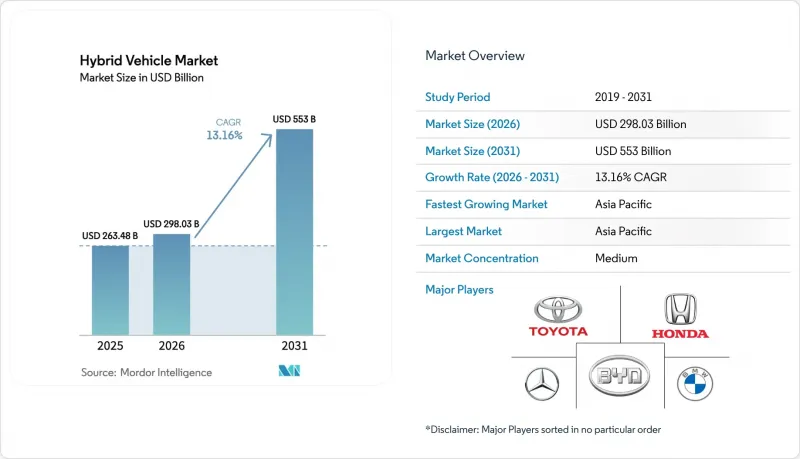
預計混合動力汽車市場將從 2025 年的 2,634.8 億美元成長到 2026 年的 2,980.3 億美元,到 2031 年達到 5,530 億美元,在預測期(2026-2031 年)內複合年成長率為 13.16%。
更嚴格的全球溫室氣體排放法規、更低的電池成本以及多元化的動力傳動系統策略正在推動需求成長,同時也保護汽車製造商免受電氣化進程不確定性的影響。電池組成本的下降以及鼓勵純電續航里程的政策激勵措施,使得插電式混合動力汽車成為成長最快的細分市場。相較之下,傳統混合動力汽車由於對充電基礎設施的需求極低,仍保持著領先的銷售地位。雖然永磁馬達仍然佔據主導地位,但隨著製造商降低對稀土元素供應風險的依賴,感應馬達也正在獲得越來越多的市場佔有率。磷酸鐵鋰電池因其在成本、安全性和循環壽命方面的出色平衡,如今已成為大多數混合動力汽車的最佳選擇。老牌日本製造商正努力保持其技術優勢,同時面臨來自中國品牌的日益激烈的競爭,這些中國品牌利用其自主電池生產能力來提升價格競爭力。
全球混合動力汽車市場趨勢與洞察
到 2027 年,插電式混合動力汽車電池成本將達到可比水平,這將是一個轉捩點。
從中長期來看,汽車製造商正致力於大幅降低鋰離子電池組的成本。福特在最近的財報電話會議上透露,其F-150 PowerBoost電池組的成本同比大幅下降,並表示這得益於一項新的美國產氫氧化鋰採購合約。通用汽車(GM)計劃推出一款具有競爭力的插電式混合動力跨界車,此舉旨在克服以往的成本劣勢。豐田在其最新報告中指出,普銳斯Prime的電池成本(每度)已降至足以使其在降價後仍保持健康營業利潤率的水平。隨著電芯到電池組的整合技術快速發展、鈷含量降低以及磷酸鋰鐵(LFP)電池的廣泛應用,預計在下一個車型週期內,插電式混合動力汽車的售價將與汽油車持平。
加強全球 CAFE/GHG 法規和強制性零排放
更嚴格的法規是推動混合動力汽車普及的主要因素。美國環保署 (EPA) 正在製定嚴格的小型汽車排放標準,要求大幅降低車輛排放。此舉迫使製造商採用電動動力系統,否則將面臨巨額罰款。同時,歐洲計畫實施的法規要求車輛在所有環境條件下都必須符合實際排放氣體標準。這推動了輕度混合動力車(包括緊湊型車)的普及。在中國,雙軌制為每輛售出的插電式混合動力汽車提供豐厚的獎勵。這項獎勵允許汽車製造商抵消內燃機汽車的排放缺口。在加州,「先進清潔汽車 II」舉措,符合特定純電續航里程要求的插電式混合動力汽車可獲得零排放認證。這項要求不僅鼓勵提高電池容量,也為合規性提供了一定的靈活性。這些監管措施共同塑造了混合動力汽車市場,預計市場需求將持續到 2020 年代末期。
在都市區車隊營運中,純電動車的總擁有成本已達到相當水準。
在電費適中且車庫充電便利的都市區,從長遠來看,純電動貨車已被證明比插電式混合動力汽車更具成本效益。 2025年初,亞馬遜宣布計畫在幾年內逐步淘汰其插電式混合動力貨車,理由是其Rivian純電動車(BEV)的運作時間更長、維護成本更低。同樣,UPS也強調了純電動卡車在歐洲城市路線上的每英里成本顯著降低,這支持了整個行業在固定路線車隊中逐步淘汰插電式混合動力汽車的趨勢。在倫敦的超低排放氣體區(ULEZ),對未以零排放模式運行的混合動力汽車徵收每日費用,這削弱了純電動車的經濟優勢。隨著越來越多的城市實施類似措施,都市區車隊可能會完全跳過混合動力汽車,直接從柴油車過渡到純電動車。
細分市場分析
截至2025年,傳統混合動力車(ELEV)佔據了混合動力汽車市場41.37%的佔有率,但預計到2031年,插電式混合動力汽車的複合年成長率將達到13.17%。這項優勢源自於傳統混合動力汽車對充電的依賴性較低,這在公共充電站仍然稀缺的地區是一項決定性優勢。然而,插混合動力汽車正受益於更強力的政策激勵,電池成本也在穩步下降,使得汽車製造商能夠以與汽油車相近的價格銷售它們。比亞迪的「秦普DM-i」搭載18.3kWh磷酸鐵鋰電池組,純電續航里程可達55公里,而其在中國市場的售價卻低於傳統轎車。
由於都市區的低排放氣體法規推崇排放排放駕駛,車隊需求仍偏向插電式混合動力車。 Stellantis承諾在2026年將Wrangler 4xe的電池容量提升至21.5kWh,以滿足加州50英里純電續航里程的要求。輕度混合動力車目前已成為北美許多皮卡的標配,其燃油效率比全混合模式高出8-12%,價格卻低得多,從而更好地滿足了車隊的需求。然而,在充電基礎設施有限的地區,混合動力汽車仍可能佔據最大的市場。
在2025年的混合動力汽車市場中,乘用車佔了77.31%的市場佔有率,但輕型商用車是成長最快的細分市場,預計到2031年,其複合年成長率將達到13.24%。福特於2025年初在歐洲推出了Transit Custom插電式混合模式。該車型擁有適中的純電續航里程,在提供足夠總續航里程的同時,還能在城市地區實現排放配送。在德國,梅賽德斯-奔馳指出,其e-Sprinter混合模式的訂單顯著超過了純電動車(BEV)車型,這凸顯了車隊用戶希望避免因充電而造成的運作。同時,輕度混合動力系統也開始應用於中型和重型卡車,可在城際運輸過程中回收煞車能量,而不會影響負載容量。
到2020年代末,混合動力汽車在輕型商用車(LCV)市場的佔有率可能會縮小,尤其是在低排放氣體區法規從歐洲擴展到南美洲主要城市的情況下。雖然乘用混合動力汽車,特別是緊湊型跨界車,在亞太地區仍將保持一定的地位,但隨著都市區消費者轉向更經濟實惠的純電動車,其成長預計將會放緩。同時,商用貨車看重混合動力汽車提供的充電柔軟性,尤其是在都市區之間路線多樣、每日行駛里程波動較大的情況下。
區域分析
預計到2025年,亞太地區將佔據混合動力汽車市場38.73%的佔有率,並在2031年之前以13.21%的複合年成長率成長。近年來,在中國,插電式混合動力汽車的銷售量激增,這得益於鼓勵生產和銷售的支援政策以及主要製造商的競爭性定價策略。日本仍是全球最大的傳統混合動力汽車出口國,向東南亞、中東和拉丁美洲等主要市場供應產品。印度對混合動力汽車的稅收優惠政策縮小了其與柴油汽車的價格差距,從而顯著提高了混合動力汽車的註冊量。在韓國,政府對熱門插混合動力汽車的巨額補貼正在推動其普及。
在北美,隨著汽車製造商努力應對電池式電動車(BEV)帶來的不確定性,混合動力汽車的需求再次上升。在美國,混合動力汽車汽車銷量激增,主要製造商佔據市場主導地位。在加拿大,針對續航里程更長的插電式混合動力汽車的優惠政策延長,也支撐了熱門車款的需求。
相較之下,歐洲插電式混合動力汽車的註冊量正在下降,主要原因是關鍵市場停止補貼以及未來零排放信用政策的不確定性。在英國,對經濟型插電式混合動力車的補貼仍然減少,消費者的興趣正從高階混合動力汽車轉向主流跨界車。
在南美和中東,混合動力汽車的普及仍處於起步階段,但成長迅速。在巴西,混合動力汽車關稅的降低顯著提升了主流車型的市場佔有率。在阿拉伯聯合大公國,諸如免費停車和長途插電式混合動力汽車免繳通行費等優惠政策,正鼓勵豪華品牌推出符合這些要求的車款。沙烏地阿拉伯計劃在未來幾年內,將大量混合動力汽車作為政府用車,以落實其「2030願景」的永續性目標。儘管目前的銷量仍然相對較低,但隨著充電基礎設施的完善,這些舉措有望推動未來的需求成長。
其他好處:
- Excel格式的市場預測(ME)表
- 3個月的分析師支持
目錄
第1章:引言
- 研究假設和市場定義
- 調查範圍
第2章:調查方法
第3章執行摘要
第4章 市場狀況
- 市場概覽
- 市場促進因素
- 到 2027 年,插電式混合動力汽車電池成本將達到轉折點,與純電動車電池成本持平。
- 加強全球燃油經濟性和溫室氣體排放法規以及強制零排放
- 2024年起燃油價格將出現飆升和波動
- OEM的多面向碳排放策略(內燃機+純電動車+混合動力車)
- 輕型卡車48V架構標準化
- 在易受災害影響的地區,使用不依賴電網的緊急電源的例子
- 市場限制因素
- 實現都市區車隊中純電動車總擁有成本(TCO)與燃油車持平
- 永續開採的鎳和鈷短缺
- 由於對續航里程的擔憂,消費者的偏好正直接轉向純電動車。
- 回收廢棄鎳氫電池組的責任問題是一個迫切的挑戰。
- 價值/供應鏈分析
- 監理情勢
- 技術展望
- 波特五力模型
- 供應商的議價能力
- 買方的議價能力
- 新進入者的威脅
- 替代品的威脅
- 競爭公司之間的競爭
第5章 市場規模及成長預測(價值(美元)及數量(單位))
- 混合動力汽車類型
- 輕度雜交
- 混合動力電動車(HEV)
- 插電式混合動力車(PHEV)
- 車輛類型
- 搭乘用車
- 輕型商用車
- 中型和重型商用車輛
- 依馬達類型
- 永磁同步交流馬達(PMSM)
- 感應式(非同步)交流電機
- 開關式磁阻電動機(SRM)
- 軸流式馬達
- 依電池類型
- 鎳氫電池
- 磷酸鋰鐵電池
- 其他
- 按地區
- 北美洲
- 美國
- 加拿大
- 北美其他地區
- 南美洲
- 巴西
- 阿根廷
- 南美洲其他地區
- 歐洲
- 德國
- 英國
- 法國
- 義大利
- 西班牙
- 其他歐洲地區
- 亞太地區
- 中國
- 印度
- 日本
- 韓國
- 亞太其他地區
- 中東和非洲
- 阿拉伯聯合大公國
- 沙烏地阿拉伯
- 南非
- 土耳其
- 其他中東和非洲地區
- 北美洲
第6章 競爭情勢
- 市場集中度
- 策略趨勢
- 市佔率分析
- 公司簡介
- Toyota Motor Corporation
- Honda Motor Co., Ltd.
- Nissan Motor Co., Ltd.
- Hyundai Motor Company
- Kia Corporation
- Ford Motor Company
- General Motors Company
- Stellantis NV
- BMW AG
- Mercedes-Benz Group AG
- Volkswagen AG
- BYD Co., Ltd.
- SAIC Motor Corporation
- Geely Automobile Holdings Ltd.
- Renault SA
- AB Volvo
- Subaru Corporation
- Mazda Motor Corporation
- Mitsubishi Motors Corporation
第7章 市場機會與未來展望
The hybrid vehicle market size is expected to grow from USD 263.48 billion in 2025 to USD 298.03 billion in 2026, and is forecast to reach USD 553 billion by 2031, at a CAGR of 13.16% during the forecast period (2026-2031).
Tightening global greenhouse gas rules, falling battery costs, and multipathway powertrain strategies are simultaneously expanding demand and protecting automakers from an uncertain pace of electrification. Plug-in hybrids are the fastest-growing configuration due to declines in battery pack costs and policy credits that reward electric-only range. In contrast, conventional hybrids maintain volume leadership because they impose the lightest burden on charging infrastructure. Permanent-magnet motors still dominate, but induction architectures are gaining as manufacturers reduce exposure to rare-earth supply risks. Lithium-iron-phosphate chemistry is now the battery of choice in most hybrids because it strikes a balance between cost, safety, and cycle life. Competition is intensifying as Japanese incumbents defend engineering leads against Chinese brands that leverage in-house battery production to undercut prices.
Global Hybrid Vehicle Market Trends and Insights
Battery Cost-Parity Tipping Point for PHEVs by 2027
By the mid-term future, automakers are steering towards significantly lower lithium-ion pack costs. Ford, in its recent earnings call, revealed a substantial year-on-year drop in the F-150 PowerBoost pack cost, attributing the decline to the United States-sourced lithium-hydroxide contracts . General Motors has set its sights on introducing plug-in crossovers with a competitive price premium, a strategic move that would negate the cost penalty seen in earlier years. Toyota, in its latest report, affirmed that the Prius Prime's battery cost per kilowatt-hour has fallen to a level that allows the company to maintain a healthy operating margin despite price reductions . With rapid cell-to-pack integration, reduced cobalt content, and a surge in LFP usage, plug-in hybrids are on track to match the sticker prices of gasoline models in the upcoming cycle.
Stricter Global CAFE/GHG Norms & Zero-Emission Mandates
Regulatory tightening is the primary driver of the surge in hybrid adoption. The U.S. Environmental Protection Agency has set stringent light-duty standards for the near future, mandating significantly lower fleet emissions. This move pushes manufacturers to integrate electrified drivetrains or face hefty penalties. Meanwhile, Europe's upcoming regulations will require real-world emissions compliance under all ambient conditions. This has led to the adoption of mild-hybrids, even in compact cars. In China, the dual-credit scheme offers substantial incentives for each plug-in hybrid electric vehicle. This incentive enables OEMs to balance out their internal-combustion deficits . In California, the Advanced Clean Cars II initiative recognizes plug-in hybrids in zero-emission quotas, provided they meet a specific electric range requirement. This requirement is not only boosting battery sizes but also providing a buffer for compliance. Together, these regulatory measures are shaping the hybrid landscape, ensuring sustained demand through the end of the decade.
BEV Total-Cost-of-Ownership Parity Achieved in Urban Fleets
In cities with affordable electricity and depot charging, battery-electric vans are proving to be more cost-effective over the long term than their plug-in hybrid counterparts. In early 2025, Amazon announced plans to phase out its plug-in hybrid vans within a few years, citing that Rivian's battery-electric vehicles (BEVs) offer superior uptime and reduced maintenance costs. Similarly, UPS highlighted a significant reduction in the cost per mile for its all-electric trucks operating on European city routes, underscoring a broader industry trend away from plug-in hybrids for fleets with set routes. London's Ultra Low Emission Zone has introduced daily fees for hybrids not operating in a zero-emission mode, diminishing their financial advantage over BEVs. With more cities likely to adopt similar measures, urban fleets might leap directly from diesel to fully electric vehicles, bypassing hybrids altogether.
Other drivers and restraints analyzed in the detailed report include:
- Soaring Fuel-Price Volatility Post-2024
- OEM Multi-Pathway Carbon Strategies
- Scarcity of Sustainably Mined Nickel & Cobalt
For complete list of drivers and restraints, kindly check the Table Of Contents.
Segment Analysis
Traditional hybrid electric vehicles held 41.37% of the hybrid vehicle market share in 2025, whereas plug-in hybrids are on track to log a 13.17% CAGR to 2031. This leadership reflects the minimal charging dependency of standard hybrids, a decisive advantage in grids where public chargers remain scarce. Plug-in hybrids, however, benefit from larger policy credits, and their batteries are steadily dropping in cost, allowing OEMs to price them near gasoline trim levels. BYD's Qin Plus DM-i undersells conventional sedans in China, bundling a 55 km electric range with an 18.3 kWh LFP pack.
Fleet demand continues to skew toward plug-in hybrids, where urban low-emission rules reward zero-tailpipe operation. Stellantis is committed to expanding the Wrangler 4xe battery capacity to 21.5 kWh in 2026, thereby qualifying for California's 50-mile electric range rule. Mild hybrids, now standard on many North American pickups, strike a balance between fleet needs by offering 8-12% fuel savings at a fraction of the cost of full-hybrid models. However, HEVs will still account for the largest absolute volume in regions with limited charging infrastructure.
Passenger cars accounted for 77.31% of the hybrid vehicle market share in 2025; however, light commercial vehicles are the fastest-growing class, with a 13.24% CAGR through 2031. Ford rolled out its Transit Custom plug-in hybrid in Europe in early 2025. With a moderate electric range, the vehicle enables emission-free deliveries in city centers, while also offering a substantial total driving radius. In Germany, Mercedes-Benz noted that orders for its eSprinter hybrid significantly outpaced those for BEV variants, highlighting fleet preferences to sidestep charging downtimes. Meanwhile, medium and heavy trucks are now integrating mild-hybrid systems, capturing braking energy during intercity journeys without compromising payload capacity.
By the end of the decade, the hybrid vehicle market share for LCVs may dwindle, especially as low-emission zone regulations extend from Europe to major capitals in South America. While passenger-car hybrids, particularly compact crossovers, will continue to hold a foothold in the Asia Pacific, their growth is expected to slow as urban consumers shift towards more affordable BEVs. On the other hand, commercial vans value the fueling flexibility that hybrids offer, especially for their diverse urban-rural routes and varying daily mileage.
The Hybrid Vehicle Market Report is Segmented by Hybrid Vehicle Type (Mild-Hybrid and More), Vehicle Type (Passenger Cars, Light Commercial Vehicles, and Medium and Heavy Commercial Vehicles), Motor Type (PMSM, Induction AC Motor, and More), Battery Type (Nickel-Metal Hydride, Lithium-Iron Phosphate, and Others), and Geography. Market Forecasts are Provided in Value (USD) and Volume (Units).
Geography Analysis
Asia Pacific commanded 38.73% of the hybrid vehicle market share in 2025 and is projected to grow at a 13.21% CAGR through 2031. In recent years, China's sales of plug-in hybrids have surged, driven by supportive policies that incentivize production and sales, as well as competitive pricing strategies by leading manufacturers. Japan remains the world's leading exporter of conventional hybrids, serving key markets in Southeast Asia, the Middle East, and Latin America. Tax reductions on hybrid vehicles in India have narrowed the price gap with diesel vehicles, leading to a notable increase in hybrid vehicle registrations. In South Korea, national subsidies are providing substantial support to plug-in hybrid variants of popular models, boosting their adoption.
North America is witnessing a resurgence in hybrids as automakers address uncertainties surrounding battery-electric vehicles. Hybrid sales in the United States have grown significantly, with major players dominating the market. Canada has extended incentives for plug-in hybrids with longer electric ranges, sustaining demand for popular models.
In contrast, Europe has experienced a decline in plug-in hybrid registrations, mainly due to the withdrawal of subsidies in key markets and uncertainty surrounding future zero-emission credit policies. The United Kingdom has maintained a reduced grant for affordable plug-in vehicles, shifting consumer interest towards mainstream crossovers rather than premium hybrids.
While South America and the Middle East are still in the early stages of hybrid adoption, they are experiencing rapid growth. In Brazil, tariff reductions on hybrids have significantly boosted the market share of leading models. In the United Arab Emirates, incentives such as free parking and toll exemptions for plug-in hybrids with longer electric ranges have encouraged luxury brands to introduce models that comply with these requirements. Saudi Arabia, as part of its Vision 2030 sustainability goals, plans to procure a substantial number of hybrid vehicles for its government fleets in the coming years. Although current volumes remain relatively low, these initiatives are expected to drive future demand as charging infrastructure develops.
- Toyota Motor Corporation
- Honda Motor Co., Ltd.
- Nissan Motor Co., Ltd.
- Hyundai Motor Company
- Kia Corporation
- Ford Motor Company
- General Motors Company
- Stellantis N.V.
- BMW AG
- Mercedes-Benz Group AG
- Volkswagen AG
- BYD Co., Ltd.
- SAIC Motor Corporation
- Geely Automobile Holdings Ltd.
- Renault S.A.
- AB Volvo
- Subaru Corporation
- Mazda Motor Corporation
- Mitsubishi Motors Corporation
Additional Benefits:
- The market estimate (ME) sheet in Excel format
- 3 months of analyst support
TABLE OF CONTENTS
1 Introduction
- 1.1 Study Assumptions & Market Definition
- 1.2 Scope of the Study
2 Research Methodology
3 Executive Summary
4 Market Landscape
- 4.1 Market Overview
- 4.2 Market Drivers
- 4.2.1 Battery Cost-Parity Tipping Point For PHEVs By 2027
- 4.2.2 Stricter Global CAFE/GHG Norms & Zero-Emission Mandates
- 4.2.3 Soaring Fuel-Price Volatility Post-2024
- 4.2.4 OEM Multi-Pathway Carbon Strategies (ICE + BEV + HEV)
- 4.2.5 48-V Architecture Standardisation In Light Trucks
- 4.2.6 Grid-Independent Emergency-Power Use Case In Disaster-Prone Regions
- 4.3 Market Restraints
- 4.3.1 BEV Total-Cost-Of-Ownership Parity Achieved in Urban Fleets
- 4.3.2 Scarcity Of Sustainably Mined Nickel & Cobalt
- 4.3.3 Consumer Range-Anxiety Bias Shifting Straight To BEV
- 4.3.4 Looming End-Of-Life Recycling Liabilities for Ni-MH Packs
- 4.4 Value / Supply-Chain Analysis
- 4.5 Regulatory Landscape
- 4.6 Technological Outlook
- 4.7 Porter's Five Forces
- 4.7.1 Bargaining Power of Suppliers
- 4.7.2 Bargaining Power of Buyers
- 4.7.3 Threat of New Entrants
- 4.7.4 Threat of Substitutes
- 4.7.5 Competitive Rivalry
5 Market Size & Growth Forecasts (Value (USD) and Volume (Units))
- 5.1 By Hybrid Vehicle Type
- 5.1.1 Mild-Hybrid
- 5.1.2 Hybrid Electric Vehicle (HEV)
- 5.1.3 Plug-in Hybrid (PHEV)
- 5.2 By Vehicle Type
- 5.2.1 Passenger Cars
- 5.2.2 Light Commercial Vehicles
- 5.2.3 Medium and Heavy Commercial Vehicles
- 5.3 By Motor Type
- 5.3.1 Permanent Magnet Synchronous AC Motor (PMSM)
- 5.3.2 Induction (Asynchronous) AC Motor
- 5.3.3 Switched Reluctance Motor (SRM)
- 5.3.4 Axial-Flux Motor
- 5.4 By Battery Type
- 5.4.1 Nickel-Metal Hydride
- 5.4.2 Lithium-iron Phosphate Battery
- 5.4.3 Others
- 5.5 By Geography
- 5.5.1 North America
- 5.5.1.1 United States
- 5.5.1.2 Canada
- 5.5.1.3 Rest of North America
- 5.5.2 South America
- 5.5.2.1 Brazil
- 5.5.2.2 Argentina
- 5.5.2.3 Rest of South America
- 5.5.3 Europe
- 5.5.3.1 Germany
- 5.5.3.2 United Kingdom
- 5.5.3.3 France
- 5.5.3.4 Italy
- 5.5.3.5 Spain
- 5.5.3.6 Rest of Europe
- 5.5.4 Asia-Pacific
- 5.5.4.1 China
- 5.5.4.2 India
- 5.5.4.3 Japan
- 5.5.4.4 South Korea
- 5.5.4.5 Rest of Asia-Pacific
- 5.5.5 Middle East and Africa
- 5.5.5.1 United Arab Emirates
- 5.5.5.2 Saudi Arabia
- 5.5.5.3 South Africa
- 5.5.5.4 Turkey
- 5.5.5.5 Rest of Middle East and Africa
- 5.5.1 North America
6 Competitive Landscape
- 6.1 Market Concentration
- 6.2 Strategic Moves
- 6.3 Market Share Analysis
- 6.4 Company Profiles (Includes Global Level Overview, Market Level Overview, Core Segments, Financials as Available, Strategic Information, Market Rank/Share for Key Companies, Products and Services, SWOT Analysis, and Recent Developments)
- 6.4.1 Toyota Motor Corporation
- 6.4.2 Honda Motor Co., Ltd.
- 6.4.3 Nissan Motor Co., Ltd.
- 6.4.4 Hyundai Motor Company
- 6.4.5 Kia Corporation
- 6.4.6 Ford Motor Company
- 6.4.7 General Motors Company
- 6.4.8 Stellantis N.V.
- 6.4.9 BMW AG
- 6.4.10 Mercedes-Benz Group AG
- 6.4.11 Volkswagen AG
- 6.4.12 BYD Co., Ltd.
- 6.4.13 SAIC Motor Corporation
- 6.4.14 Geely Automobile Holdings Ltd.
- 6.4.15 Renault S.A.
- 6.4.16 AB Volvo
- 6.4.17 Subaru Corporation
- 6.4.18 Mazda Motor Corporation
- 6.4.19 Mitsubishi Motors Corporation
7 Market Opportunities & Future Outlook
- 7.1 White-space & Unmet-need Assessment

 混合動力汽車市場:2026-2032年全球市場預測(按組件、電池容量、車輛類型、驅動系統、最終用戶和銷售管道)微型混合動力汽車市場:2026-2032 年全球市場預測,按車輛類型、燃料類型、組件類型、額定功率、應用和銷售管道。混合動力汽車市場:2026-2032年全球市場預測(依動力傳動系統類型、混合動力架構、電壓等級、燃料類型、車身類型、驅動方式、價格範圍、最終用戶和銷售管道)
 混合動力汽車市場分析及至2035年預測:類型、組件、應用、最終用戶、車輛類型、混合動力技術、動力傳動系統模式
 混合動力汽車市場:按混合動力類型、車型和地區分類
 混合動力汽車市場規模、佔有率、成長及全球產業分析:按類型、應用和地區分類的洞察,2026-2034 年預測全球混合動力汽車市場規模、佔有率、趨勢和成長分析報告(2026-2034)
 日本混合動力汽車市場規模、佔有率、趨勢和預測:按混合動力汽車型、車輛類型和地區分類,2026-2034年
 全球混合動力汽車市場,2025-2029年
 微型混合動力汽車市場-全球產業規模、佔有率、趨勢、機會及預測(按電池類型、車輛類型、容量、地區和競爭格局分類,2021-2031年)