

 |
市場調查報告書
商品編碼
2113736
聚合物乳液:市場佔有率分析、產業趨勢與統計、成長預測(2026-2031)Polymer Emulsions - Market Share Analysis, Industry Trends & Statistics, Growth Forecasts (2026 - 2031) |
||||||

※ 本網頁內容可能與最新版本有所差異。詳細情況請與我們聯繫。
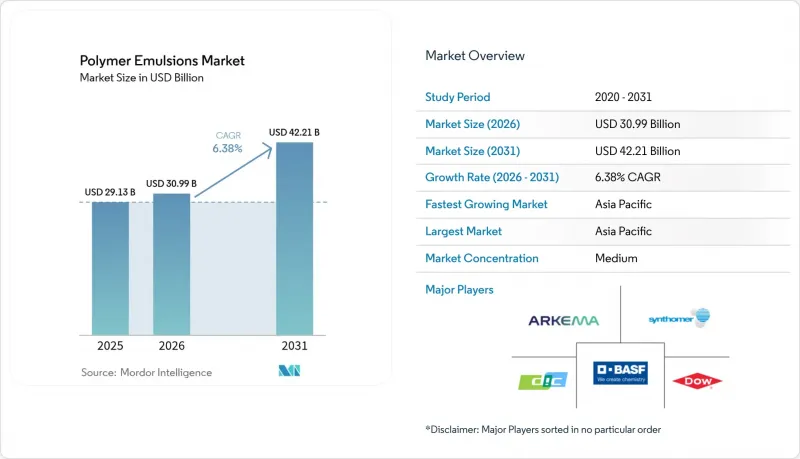
根據 Mordor Intelligence 預測,聚合物乳液市場規模將從 2025 年的 291.3 億美元成長到 2026 年的 309.9 億美元,然後在 2031 年達到 422.1 億美元,2026 年至 2031 年的複合年成長率為 6.38%。
本報告按產品類型(丙烯酸酯、苯乙烯-丁二烯(SB)乳膠等)、應用(油漆和塗料、黏合劑和地毯背襯等)、最終用戶產業(建築和施工、包裝等)、固態含量(高固態、中固態、低固態)和地區(亞太地區、北美、歐洲、南美、中東和非洲)對產業進行分類。
全球聚合物乳液市場趨勢與洞察
亞洲的建築熱潮推動了低VOC水性塗料的普及。
在亞洲特大城市,住宅和基礎建設正以前所未有的速度推進,推動了對符合嚴格排放標準的水性內外牆塗料的需求。中國最新的空氣品質計畫和印度修訂後的國家建築標準均建議使用VOC含量低於50克/公升的塗料,促使人們迅速放棄溶劑型醇酸樹脂塗料。製造商們正積極響應,推出丙烯酸乳膠塗料,例如蘭貝蒂的“ESACOTE AC 509”,該產品兼具耐腐蝕性和低氣味。健康和安全優勢、易於清潔以及降低工人接觸限值等優點,進一步增強了人們對這類塗料的青睞,形成了一個良性循環,超越了單純的法規遵從,鞏固了聚合物乳液市場的長期需求。
汽車原始設備製造商對環保、抗刮性的表面處理流程有需求。
目前,北美和歐洲的汽車組裝正在指定使用水性底漆、面漆和透明塗層套裝,以減少碳排放,同時保持與溶劑型系統相當的耐久性。配方師正在採用具有自交聯嵌段的聚氨酯-丙烯酸酯混合基體,以實現高硬度和抗刮性。太陽化學的「WATERSOL AC」系列塗料正是這項進步的體現,它不僅能提供高光澤度和耐細微刮痕性,還能將VOC(揮發性有機化合物)含量降低高達90%。隨著關鍵性能挑戰的解決,品牌所有者正在強調永續性,並加速全球汽車工廠的銷售量成長。
丁二烯和丙烯酸酯單體的價格波動很大。
原料價格的快速波動正給乳膠生產商的利潤率帶來壓力。這種趨勢在苯乙烯-丁二烯乳膠中尤其明顯,因為其價格與石腦油價格的波動密切相關。合約規格通常按季度調整,價格飆升時,供應商將面臨風險。各公司正試圖透過多元化原料來源和考慮引入糖基丙烯酸樹脂來穩定原料成本,但短期價格波動持續對盈利構成壓力,並可能導致資本投資的延遲。
細分市場分析
到2025年,丙烯酸樹脂將佔總產量的44.40%,當年銷售額將達到129.3億美元。憑藉其廣泛的兼容性、優異的耐候性和快速的法規核准等優勢,丙烯酸樹脂已鞏固其在裝飾塗料、密封劑和感壓標籤領域的標準平台地位。塞拉尼斯公司的EcoVAE系列產品兼具低氣味和A級耐擦洗性能,符合綠建築的要求。苯乙烯-丁二烯乳膠在紙張塗料和地毯背襯領域仍是經濟高效的選擇,但由於再生纖維品質的提升,其成長較為溫和。醋酸乙烯酯聚合物在石膏和膩子配方中保持著穩定的需求,這些產品對柔軟性要求較高。 「其他」類別包括矽改質乳液和生物基乳液,這些產品正在選擇性地拓展高利潤的細分市場,例如醫用薄膜。同時,聚氨酯分散體以6.78%的複合年成長率快速成長,這主要得益於其在高階汽車、軟包裝和特殊地板塗料等領域的應用。在這些應用中,其韌性、透明度和耐水解性使其較高的價格物有所值。總體而言,產品多元化正在支撐聚合物乳液市場的韌性。
降低碳含量的趨勢正在推動對無界面活性劑光聚合製程的投資,這種製程能夠抑制發泡並減少揮發性有機化合物(VOCs)的排放。實驗室研究表明,無需使用傳統的皂基體系即可獲得固態含量為55%的穩定晶格結構,這有望簡化監管合規和廢水處理流程。採用這些方法的供應商可望獲得先導溢價。隨著生物丙烯酸酯和糖基丁二烯的生產規模擴大,其整個生命週期的環境影響評分將進一步降低,從而與下游主要品牌的範圍3目標相一致,並強化推動聚合物乳液行業永續性的理念。
預計到2025年,塗料和塗層將佔總需求的45.70%,市場規模將達到133.1億美元。嚴格的VOC法規正在推動裝飾、防護和汽車系統向水性平台轉型。蘭貝蒂的「直接塗金屬」丙烯酸塗料在120微米的乾膜厚度下,其防腐蝕性能與溶劑型塗料相當,是性能等效性的典型例子,使其能夠在嚴苛環境下得到應用。隨著溶劑型丙烯酸塗料在軟包裝和建築膠帶中的逐步淘汰,黏合劑和地毯背襯的複合年成長率最高,達到6.95%。水性黏合劑現在能夠耐受冷凍和紫外線照射,從而擴展了其功能範圍。
儘管紙張和紙板產業呈現穩定成長態勢,但其內部正在發生質的轉變。採用多功能酸乙烯基酯的水性阻隔材料顯著提升了其防潮防油性能,使得聚乙烯擠出杯和托盤等產品能夠被單一材料結構所取代。紡織品、皮革以及用於新興3D列印領域的黏合劑則佔據了「其他」類別中的許多領域。在各個細分市場中,數位化配色和線上黏度控制系統正在降低批次間的差異,進一步鞏固水性樹脂的應用,並推動聚合物乳液市場的成長。
區域分析
預計到2025年,亞太地區將佔全球銷售額的40.85%(價值119億美元),並維持7.11%的複合年成長率直至2031年。中國、印度、印尼和越南的建築業蓬勃發展,推動了建築乳膠的快速消耗,而該地區的汽車製造商則開始採用抗刮性的水性面漆。跨國供應商在中國和越南等新興市場不斷提升產能,縮短了前置作業時間,並幫助買家避免了運費波動的影響。日本和韓國則專注於高性能細分市場,例如光學薄膜、導電塗料和環保皮革飾面,憑藉強大的國內研發能力,它們能夠獲得較高的定價權。
北美是全球第二大市場。在美國,水性塗料的普及推動了家居裝修、基礎設施和電動車製造等領域的成長。隨著市場對低氣味、快乾配方的需求不斷成長,供應商正在加速研發新一代丙烯酸-聚氨酯混合塗料。在加拿大,木材塗飾和包裝塗料的需求依然強勁。在墨西哥,家電和汽車組裝廠的快速擴張提振了當地需求,而近岸外包的趨勢(即塗料供應鏈南移)也促進了市場成長。
歐洲仍然是一個至關重要的市場,這主要得益於歐盟積極推行的溶劑減量法規。德國、法國、英國和義大利已推出國家級綠建築標準,以加速裝飾塗料和工業維護產品的轉型。歐盟禁止使用溶劑型層壓黏合劑,推動了水性化學品在軟包裝生產線中的快速應用。同時,由於VAM(揮發性有機化合物)生產週期性停產,原料供應受到限制,凸顯了人們對供應穩定性的擔憂,迫使加工商在東歐和中東地區尋求雙重採購管道。
儘管市場佔有率較小,但南美、中東和非洲的成長勢頭強勁。巴西受益於基礎設施和住宅建設項目,這些項目正在擴大乳膠砂漿的使用。中東正充分利用其原料優勢,沙烏地阿拉伯和阿拉伯聯合大公國新建的丙烯酸乳液工廠正在改變貿易格局,因為它們的產品出口到歐洲和亞洲。南非透過政府主導的道路和住宅計畫推動非洲的消費,這些計畫需要耐用、低VOC塗料。在這些新興全部區域,各國政府擴大參考世界衛生組織(WHO)的室內空氣品質指南,使當地法規與國際標準接軌,並確保對聚合物乳液的持續需求。
其他好處:
- Excel格式的市場預測(ME)表
- 3個月的分析師支持
目錄
第1章:引言
第2章:調查和市場定義的前提條件
- 調查範圍
- 調查方法
第3章執行摘要
第4章 市場狀況
- 市場概覽
- 市場促進因素
- 受亞洲建築業蓬勃發展的推動,低VOC水性塗料正日益受到青睞。
- 北美和歐洲汽車OEM廠商對環保耐刮擦的表面處理材料的需求。
- 歐盟禁止使用溶劑型黏合劑,推動了包裝乳化的廣泛應用。
- 擴大海灣合作理事會國家丙烯酸乳液工廠的產能
- 紡織和造紙業的使用量增加
- 市場限制因素
- 丁二烯和丙烯酸酯單體的價格波動
- 在嚴苛的使用條件下,其性能與溶劑型塗料相比存在差異。
- 歐洲增值管理(VAM)供應中斷
- 價值鏈分析
- 波特五力分析
- 供需分析
- 目前正在進行和計劃中的主要項目
- 貿易分析
- 目前供需狀況
第5章 市場規模與成長預測
- 依產品類型
- 丙烯酸纖維
- 苯乙烯-丁二烯(SB)乳膠
- 醋酸乙烯酯聚合物
- PVA均聚物
- 其他醋酸乙烯酯
- 聚氨酯(PU)分散體
- 其他
- 透過使用
- 油漆和塗料
- 黏合劑和地毯背襯
- 紙張和紙板
- 其他
- 按最終用戶行業分類
- 建築/施工
- 汽車和運輸業
- 包裝
- 木材/家具
- 紡織服裝
- 其他(化學品和一般製造業)
- 主要內容
- 高固態含量(55%或以上)
- 中等固態含量(45-55%)
- 低固態含量(低於45%)
- 地區
- 亞太地區
- 中國
- 印度
- 日本
- 韓國
- 其他亞太國家
- 北美洲
- 美國
- 加拿大
- 墨西哥
- 歐洲
- 德國
- 英國
- 法國
- 義大利
- 其他歐洲國家
- 南美洲
- 巴西
- 阿根廷
- 其他南美國家
- 中東和非洲
- 沙烏地阿拉伯
- 南非
- 其他中東和非洲國家
- 亞太地區
第6章 競爭情勢
- 市場集中度
- 策略性舉措(併購、合資、資金籌措)
- 市佔率分析
- 公司簡介
- 3M
- Allnex GmbH
- Akzo Nobel NV
- Arkema
- Asahi Kasei Corporation
- BASF
- Celanese Corporation
- Clariant
- Covestro AG
- DIC CORPORATION
- Dow
- Eastman Chemical Company
- Eni SpA
- Georgia-Pacific
- JSR Corporation
- Kamsons Polymer Limited
- Lamberti SpA
- Mallard Creek Polymers
- Polynt SpA
- Synthomer plc
- The Lubrizol Corporation
- Wacker Chemie AG
- ZEON CORPORATION
第7章 市場機會與未來展望
According to Mordor Intelligence, the polymer emulsions market size is expected to grow from USD 29.13 billion in 2025 to USD 30.99 billion in 2026 and is forecast to reach USD 42.21 billion by 2031 at 6.38% CAGR over 2026-2031.
This report Segments the Industry by Product Type (Acrylics, Styrene Butadiene (SB) Latex, and More), Application (Paints and Coatings, Adhesives and Carpet Backing, and More), End-User Industry (Building and Construction, Packaging, and More), Solid Content (High Solids, Medium Solids, and Low Solids), and Geography (Asia-Pacific, North America, Europe, South America, and Middle-East and Africa).
Global Polymer Emulsions Market Trends and Insights
Shift Toward Low-VOC Water-Borne Coatings Fueled by Asia's Construction Boom
Asian megacities continue to add housing and infrastructure at record pace, raising demand for water-based exterior and interior paints that comply with strict emission targets. China's latest air-quality plan and India's updated National Building Code promote coatings below 50 g VOC l-1, spurring rapid substitution of solvent alkyds. Manufacturers answer with acrylic latexes such as Lamberti's ESACOTE AC 509 that pair corrosion resistance with low odor. Health-and-safety benefits, easier cleanup, and fewer worker exposure limits reinforce preference for these systems, creating positive feedback that extends beyond pure compliance and cements long-term demand in the polymer emulsions market.
OEM Automotive Demand for Eco-Friendly Scratch-Resistant Finishes
Vehicle assemblers in North America and Europe now specify water-borne primer-surfacer and clear-coat packages that match solvent durability while cutting carbon footprints. Formulators employ hybrid polyurethane-acrylic matrices with self-cross-linking blocks to achieve hardness and mar resistance. Sun Chemical's WATERSOL AC line illustrates this progress with coatings that deliver high gloss and low micro-scratch while eliminating up to 90% VOCs. With mainstream performance hurdles removed, brand-owners market sustainability credentials, accelerating volume growth across global auto plants.
Volatile Butadiene and Acrylate Monomer Pricing
Rapid feedstock swings compress latex producer margins, especially for styrene-butadiene grades tied to fluctuating naphtha costs. Contract formulas rarely adjust faster than quarterly, exposing suppliers during spikes. Firms diversify procurement and explore sugar-based acrylics to stabilize input budgets, but near-term volatility continues to weigh on profitability and may delay capital upgrades.
Other drivers and restraints analyzed in the detailed report include:
- EU Bans on Solvent-Borne Adhesives Boosting Packaging Emulsion Uptake
- Increased Textile and Paper Industry Usage
- Performance Gap versus Solvent-Borne Coatings in Heavy-Duty Uses
For complete list of drivers and restraints, kindly check the Table Of Contents.
Segment Analysis
Acrylic resins controlled 44.40% of 2025 volume and generated USD 12.93 billion in 2025. The segment benefits from broad compatibility, solid weatherability, and rapid regulatory approvals, cementing its role as the default platform across decorative paints, sealants, and pressure-sensitive labels. Celanese's EcoVAE grades combine low odor with Class A scrub resistance, satisfying green-building schemes. Styrene-butadiene latex remains a cost-efficient choice for paper coating and carpet backing, though growth is modest as recycled fiber quality improves. Vinyl acetate polymers sustain steady demand in plaster and putty compounds where flexibility is essential. The "Others" cluster, including silicone-modified and bio-derived emulsions, expands selectively in high-margin niches such as medical films. Polyurethane dispersions, however, advance fastest at 6.78% CAGR, fueled by premium automotive, flexible packaging, and specialty floor-finish applications where toughness, clarity, and hydrolysis resistance justify higher prices. Collectively, product diversification anchors resilience in the polymer emulsions market.
The push for lower embodied carbon spurs investment in surfactant-free photoinitiated processes that tame foaming and cut VOCs. Laboratory work shows stable lattices at 55% solid without traditional soap systems, which can simplify compliance and effluent treatment. Suppliers integrating these methods stand to capture early-mover premiums. As bio-acrylic and sugar-route butadiene scale, life-cycle impact scores should fall further, aligning with scope-3 targets of major downstream brands and reinforcing the sustainability narrative driving the polymer emulsions industry.
Paints and coatings consumed 45.70% of 2025 demand, equal to USD 13.31 billion in 2025. Stringent VOC caps encourage conversion of decorative, protective, and automotive systems to water-borne platforms. Lamberti's direct-to-metal acrylic, which matches solvent corrosion protection at 120 µm dry film, exemplifies how performance parity unlocks heavy-duty adoption. Adhesives and carpet backing record the fastest 6.95% CAGR as flexible packaging and construction tapes phase out solvent acrylics. Water-borne pressure-sensitives now withstand freezer storage and UV exposure, broadening their function set.
Paper and paperboard remain steady but are undergoing qualitative change. Water-based barriers incorporating vinyl ester of Versatic acid improve moisture and oil resistance, allowing substitution of polyethylene-extruded cups and trays with single-material structures. Textile, leather, and emerging 3-D printing binders fill the diverse "Others" bucket. Across segments, digital color-matching and inline viscosity control systems reduce batch variability, further normalizing water-borne use and lifting the polymer emulsions market trajectory.
Complete Report Scope:
- By Product Type
- Acrylics
- Styrene-Butadiene (SB) Latex
- Vinyl Acetate Polymers
- PVA Homopolymer
- Other Vinyl Acetates
- Polyurethane (PU) Dispersions
- Others
- By Application
- Paints and Coatings
- Adhesives and Carpet Backing
- Paper and Paperboard
- Others
- By End-User Industry
- Building and Construction
- Automotive and Transportation
- Packaging
- Wood and Furniture
- Textile and Apparel
- Others (Chemicals and General Manufacturing)
- By Solid Content
- High Solids (more than 55 %)
- Medium Solids (45-55 %)
- Low Solids (less than 45 %)
- Geography
- Asia-Pacific
- China
- India
- Japan
- South Korea
- Rest of Asia-Pacific
- North America
- United States
- Canada
- Mexico
- Europe
- Germany
- United Kingdom
- France
- Italy
- Rest of Europe
- South America
- Brazil
- Argentina
- Rest of South America
- Middle East and Africa
- Saudi Arabia
- South Africa
- Rest of Middle East and Africa
- Asia-Pacific
Geography Analysis
Asia-Pacific commanded 40.85% of revenue in 2025, equivalent to USD 11.90 billion, and is projected to grow at 7.11% CAGR through 2031. Building booms in China, India, Indonesia, and Vietnam consume vast volumes of architectural latex, while regional automakers apply scratch-resistant water-borne topcoats. Capacity additions by multinational suppliers in China and emerging hubs such as Vietnam shorten lead times and shield buyers from freight swings. Japan and South Korea concentrate on high-performance niches-optical films, conductive coatings, and eco-friendly leather finishes-where domestic research and development depth secures premium pricing.
North America sits as the second-largest region. The United States drives water-borne adoption in remodeling, infrastructure, and EV manufacturing. Demand for low odor and rapid-dry formulations pushes suppliers to roll out next-generation acrylic-PU hybrids. Canada maintains healthy consumption in wood finishes and packaging grades. Mexico's fast-expanding appliance and automotive assembly plants lift local demand, aided by near-shoring trends that draw coatings supply chains southward.
Europe remains a pivotal market shaped by the EU's aggressive solvent-reduction mandates. Germany, France, the United Kingdom, and Italy implement national green-building codes that accelerate switch-overs in decorative paints and industrial maintenance products. The bloc's ban on solvent-borne laminating adhesives propels swift uptake of water-borne chemistries in flexible packaging lines. Meanwhile, feedstock constraints from periodic VAM outages underscore supply-security concerns, pushing converters to qualifying dual sourcing in Eastern Europe and the Middle East.
South America and the Middle East and Africa hold smaller shares yet exhibit notable momentum. Brazil benefits from infrastructure and housing programs that expand latex mortar use. The Middle East leverages feedstock advantage; new acrylic emulsion plants in Saudi Arabia and the UAE export to Europe and Asia, altering trade flows. South Africa anchors African consumption with government-backed road and housing projects that call for durable low-VOC coatings. Across these emerging regions, governments increasingly reference the World Health Organization indoor air guidelines, aligning local regulations with global norms and ensuring sustained demand for the polymer emulsions market.
- 3M
- Allnex GmbH
- Akzo Nobel N.V.
- Arkema
- Asahi Kasei Corporation
- BASF
- Celanese Corporation
- Clariant
- Covestro AG
- DIC CORPORATION
- Dow
- Eastman Chemical Company
- Eni S.p.A.
- Georgia-Pacific
- JSR Corporation
- Kamsons Polymer Limited
- Lamberti S.p.A.
- Mallard Creek Polymers
- Polynt S.p.A.
- Synthomer plc
- The Lubrizol Corporation
- Wacker Chemie AG
- ZEON CORPORATION
Additional Benefits:
- The market estimate (ME) sheet in Excel format
- 3 months of analyst support
TABLE OF CONTENTS
1 Introduction
2 Study Assumptions and Market Definition
- 2.1 Scope of the Study
- 2.2 Research Methodology
3 Executive Summary
4 Market Landscape
- 4.1 Market Overview
- 4.2 Market Drivers
- 4.2.1 Shift Toward Low-VOC Water-borne Coatings Fueled by Asia's Construction Boom
- 4.2.2 OEM Automotive Demand for Eco-Friendly Scratch-Resistant Finishes in North America and Europe
- 4.2.3 EU Bans on Solvent-Borne Adhesives Boosting Packaging Emulsion Uptake
- 4.2.4 Capacity Expansions of Acrylic Emulsion Plants in GCC Nations
- 4.2.5 Increased Textile and Paper Industry Usage
- 4.3 Market Restraints
- 4.3.1 Volatile Butadiene and Acrylate Monomer Pricing
- 4.3.2 Performance Gap vs. Solvent-borne Coatings in Heavy-Duty Uses
- 4.3.3 VAM Supply Disruptions in Europe
- 4.4 Value Chain Analysis
- 4.5 Porter's Five Forces Analysis
- 4.5.1 Bargaining Power of Suppliers
- 4.5.2 Bargaining Power of Buyers
- 4.5.3 Threat of New Entrants
- 4.5.4 Threat of Substitutes
- 4.5.5 Intensity of Rivalry
- 4.6 Supply and Demand Analysis
- 4.6.1 Major Current and Planned Projects
- 4.6.2 Trade Analysis
- 4.6.3 Current Supply and Demand Scenario
5 Market Size and Growth Forecasts (Value)
- 5.1 By Product Type
- 5.1.1 Acrylics
- 5.1.2 Styrene-Butadiene (SB) Latex
- 5.1.3 Vinyl Acetate Polymers
- 5.1.3.1 PVA Homopolymer
- 5.1.3.2 Other Vinyl Acetates
- 5.1.4 Polyurethane (PU) Dispersions
- 5.1.5 Others
- 5.2 By Application
- 5.2.1 Paints and Coatings
- 5.2.2 Adhesives and Carpet Backing
- 5.2.3 Paper and Paperboard
- 5.2.4 Others
- 5.3 By End-User Industry
- 5.3.1 Building and Construction
- 5.3.2 Automotive and Transportation
- 5.3.3 Packaging
- 5.3.4 Wood and Furniture
- 5.3.5 Textile and Apparel
- 5.3.6 Others (Chemicals and General Manufacturing)
- 5.4 By Solid Content
- 5.4.1 High Solids (more than 55 %)
- 5.4.2 Medium Solids (45-55 %)
- 5.4.3 Low Solids (less than 45 %)
- 5.5 Geography
- 5.5.1 Asia-Pacific
- 5.5.1.1 China
- 5.5.1.2 India
- 5.5.1.3 Japan
- 5.5.1.4 South Korea
- 5.5.1.5 Rest of Asia-Pacific
- 5.5.2 North America
- 5.5.2.1 United States
- 5.5.2.2 Canada
- 5.5.2.3 Mexico
- 5.5.3 Europe
- 5.5.3.1 Germany
- 5.5.3.2 United Kingdom
- 5.5.3.3 France
- 5.5.3.4 Italy
- 5.5.3.5 Rest of Europe
- 5.5.4 South America
- 5.5.4.1 Brazil
- 5.5.4.2 Argentina
- 5.5.4.3 Rest of South America
- 5.5.5 Middle East and Africa
- 5.5.5.1 Saudi Arabia
- 5.5.5.2 South Africa
- 5.5.5.3 Rest of Middle East and Africa
- 5.5.1 Asia-Pacific
6 Competitive Landscape
- 6.1 Market Concentration
- 6.2 Strategic Moves (Mergers and Acquisitions, JVs, Funding)
- 6.3 Market Share Analysis
- 6.4 Company Profiles (includes Global-level Overview, Market-level Overview, Core Segments, Financials, Strategic Information, Market Rank/Share, Products and Services, Recent Developments)
- 6.4.1 3M
- 6.4.2 Allnex GmbH
- 6.4.3 Akzo Nobel N.V.
- 6.4.4 Arkema
- 6.4.5 Asahi Kasei Corporation
- 6.4.6 BASF
- 6.4.7 Celanese Corporation
- 6.4.8 Clariant
- 6.4.9 Covestro AG
- 6.4.10 DIC CORPORATION
- 6.4.11 Dow
- 6.4.12 Eastman Chemical Company
- 6.4.13 Eni S.p.A.
- 6.4.14 Georgia-Pacific
- 6.4.15 JSR Corporation
- 6.4.16 Kamsons Polymer Limited
- 6.4.17 Lamberti S.p.A.
- 6.4.18 Mallard Creek Polymers
- 6.4.19 Polynt S.p.A.
- 6.4.20 Synthomer plc
- 6.4.21 The Lubrizol Corporation
- 6.4.22 Wacker Chemie AG
- 6.4.23 ZEON CORPORATION
7 Market Opportunities and Future Outlook
- 7.1 White-space and Unmet-Need Assessment
- 7.2 Emerging Market for Bio-based Emulsion Polymer


