

 |
市場調查報告書
商品編碼
2113367
北美聚合物乳液市場:市場佔有率分析、產業趨勢與統計及成長預測(2026-2031)North America Polymer Emulsion - Market Share Analysis, Industry Trends & Statistics, Growth Forecasts (2026 - 2031) |
||||||

※ 本網頁內容可能與最新版本有所差異。詳細情況請與我們聯繫。
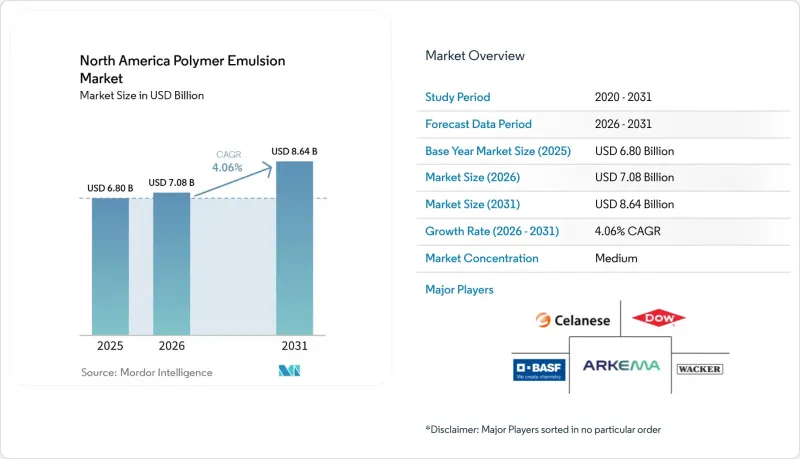
據 Mordor Intelligence 稱,2025 年北美聚合物乳液市值為 68 億美元,預計到 2031 年將達到 86.4 億美元,而 2026 年為 70.8 億美元,預測期(2026-2031 年)的複合年成長率為 4.06%。
本報告按產品類型(丙烯酸類、聚氨酯分散體、苯乙烯-丁二烯乳膠、醋酸乙烯酯、乙烯-醋酸乙烯酯共聚物、環氧乳液及其他產品類型)、應用領域(黏合劑和地毯背襯、紙張和紙板塗料等)以及地區(美國、加拿大、墨西哥、北美及其他地區)進行細分。市場預測以美元(USD)為單位。
北美聚合物乳液市場趨勢與洞察
過渡到低VOC水系統
嚴格的排放法規使水性分散體在合規成本方面比傳統溶劑技術更具優勢。加州50克/公升的VOC排放上限以及加拿大類似的法規限制了混配商,推動市場對丙烯酸酯類和新一代生物丙烯酸酯的需求。這些產品含有40%的經認證的可再生原料,可進一步減少「從搖籃到大門」的碳足跡達30%。工業塗料公司指出,易於清潔和更高的室內應用安全性是推動其發展的其他因素,預計這些促進因素的影響至少會持續到2020年代中期。
美國和加拿大的住宅主導粉刷需求旺盛
老化的住宅存量導致其維護週期不再受新建市場波動的影響。宣偉公司(剪切機-Williams)在2024年將國內建築塗料價格提高了5%,但銷量依然成長,顯示終端市場對價格具有彈性。預計2025年北美獨棟住宅開工量將再成長5%,其中大部分銷售量來自重新粉刷項目,而高性能乳膠漆的售價通常較高。在氣候寒冷的州,這種趨勢尤其明顯,因為在這些地區,塗料的抗凍融性能至關重要。
與粉末塗料和高固態樹脂的競爭
在家用電器和金屬家具行業,粉末塗料憑藉其不含揮發性有機化合物(VOC)和快速固化的優勢,正從水性搪瓷漆手中奪取市場佔有率。儘管銷量有所成長,但瓦克化學聚合物部門2024年的收入仍下降了7%。這表明,隨著客戶仔細考慮粉末塗料和高固態塗料等替代方案可能帶來的成本節約,價格壓力正在增加。
細分市場分析
到2025年,丙烯酸酯將佔北美聚合物乳液市場佔有率的45.20%。這反映了其在裝飾和輕工業領域成本績效和高度的配方靈活性。雖然丙烯酸酯單體價格波動會影響其價格,但規模經濟和供應商之間的激烈競爭確保了主要生產商的穩定利潤率。該細分市場保持著中等個位數的成長率,這得益於VOC法規的合規性以及色彩技術的不斷創新,這些創新即使在更薄的膜厚下也能提高遮蓋力。
聚氨酯分散體是成長最快的細分市場,複合年成長率達4.65%,這主要得益於市場對耐磨汽車內部裝潢建材和軟性食品包裝材料需求的不斷成長。聚氨酯分散體的高延伸率和耐化學性使其能夠運作高階座椅套基材中的PVC塑性溶膠,而低溫熱封等級則滿足了電商包裝的產能需求。隨著北卡羅來納州和美國中西部地區產能的提升,預計聚氨酯在北美聚合物乳液市場的佔有率將穩定成長。
其他好處:
- Excel格式的市場預測(ME)表
- 3個月的分析師支持
目錄
第1章:引言
- 研究假設和市場定義
- 調查範圍
第2章:調查方法
第3章執行摘要
第4章 市場狀況
- 市場概覽
- 市場促進因素
- 向低VOC水性體系過渡
- 美國和加拿大的住宅主導粉刷需求旺盛
- 基礎設施中乳膠添加劑的採用現狀
- 電子商務包裝黏合劑市場蓬勃發展。
- 生物基乳膠在高級建築塗料的應用
- 市場限制因素
- 丁二烯原料價格波動
- 與粉末樹脂和高固態樹脂的競爭
- 有關 PFAS 添加劑的法規即將訂定。
- 價值鏈分析
- 波特五力分析
第5章 市場規模與成長預測
- 依產品類型
- 丙烯酸纖維
- 聚氨酯(PU)分散體
- 苯乙烯-丁二烯(SB)乳膠
- 醋酸乙烯酯
- 乙烯-醋酸乙烯酯共聚物(EVA)
- 環氧乳液
- 其他產品類型
- 透過使用
- 黏合劑和地毯背襯
- 紙張和紙板塗料
- 油漆和塗料
- 其他
- 按地區
- 美國
- 加拿大
- 墨西哥
- 其他北美國家
第6章 競爭情勢
- 市場集中度
- 策略趨勢
- 市佔率和排名分析
- 公司簡介
- 3M
- Akzo Nobel NV
- Allnex
- Arkema
- BASF
- Celanese Corporation
- Covestro AG
- DIC Corporation
- Dow
- HB Fuller Company
- Lubrizol
- Nouryon
- Syensqo
- SYNTHOMER PLC
- TRINSEO
- Wacker Chemie AG
第7章 市場機會與未來展望
According to Mordor Intelligence, the North America polymer emulsion market size was valued at USD 6.80 billion in 2025 and estimated to grow from USD 7.08 billion in 2026 to reach USD 8.64 billion by 2031, at a CAGR of 4.06% during the forecast period (2026-2031).
This report is Segmented by Product Type (Acrylics, Polyurethane Dispersions, Styrene Butadiene Latex, Vinyl Acetate, Ethylene-Vinyl Acetate, Epoxy Emulsions, and Other Product Types), Application (Adhesives and Carpet Backing, Paper and Paperboard Coatings, and More), and Geography (United States, Canada, Mexico, and Rest of North America). The Market Forecasts are Provided in Terms of Value (USD).
North America Polymer Emulsion Market Trends and Insights
Shift Toward Low-VOC Water-Borne Systems
Stringent emission limits give water-borne dispersions a structural cost-of-compliance advantage over legacy solvent technologies. California's 50 g/l VOC cap and parallel Canadian rules constrain formulators, pushing demand toward acrylic lattices and next-generation bio-acrylates with 40% certified renewable content that also cut cradle-to-gate carbon footprints by 30%. Industrial coaters cite easier cleanup and safer indoor application as further incentives, ensuring the driver's impact persists through at least mid-decade.
Housing-Led Repaint Demand in U.S. and Canada
Aging housing stock creates a maintenance cycle unlinked to new-build volatility. Sherwin-Williams raised domestic architectural coating prices by 5% in 2024 and still logged volume gains, underscoring end-market elasticity. North American single-family starts are set to rise another 5% in 2025, but repaint jobs-where higher-performance emulsions command premium pricing-drive the bulk of incremental gallons, especially in cold-climate provinces where freeze-thaw durability is prized.
Competition from Powder and High-Solids Resins
In appliance and metal-furniture lines, powder coatings offer zero-VOC quick-cure benefits, siphoning share from water-borne enamels. Wacker Chemie's polymer division logged a 7% sales dip in 2024 despite higher volumes, underscoring price pressure as customers weigh total applied cost savings from powder and high-solids alternatives.
Other drivers and restraints analyzed in the detailed report include:
- Infrastructure-Grade Latex Admixtures Uptake
- Bio-Based Latex in Premium Architectural Coatings
- Impending PFAS-Linked Additive Restrictions
For complete list of drivers and restraints, kindly check the Table Of Contents.
Segment Analysis
Acrylics captured 45.20% of the North America polymer emulsion market share in 2025, reflecting balanced cost-performance and broad formulation latitude across decorative and light-industrial categories. Although pricing remains sensitive to acrylate monomer swings, scale economies and abundant supplier competition stabilize margins for top-tier producers. The segment's mid-single-digit growth benefits from VOC compliance tailwinds and continuous tint base innovations that improve hide at lower film thickness.
Polyurethane dispersions represent the fastest-growing slice at a 4.65% CAGR, supported by rising demand for abrasion-resistant automotive interiors and flexible food wraps. High elongation and chemical-resistance profiles enable formulators to displace PVC plastisols in premium seat-cover substrates, while low-temperature heat-seal grades meet e-commerce packaging throughput targets. As capacity additions in North Carolina and the U.S. Midwest come online, the PU segment's contribution to the North America polymer emulsion market size is forecast to widen steadily.
Complete Report Scope:
- By Product Type
- Acrylics
- Polyurethane (PU) Dispersions
- Styrene Butadiene (SB) Latex
- Vinyl Acetate
- Ethylene-Vinyl Acetate (EVA)
- Epoxy Emulsions
- Other Product Types
- By Application
- Adhesives and Carpet Backing
- Paper and Paperboard Coatings
- Paints and Coatings
- Others
- By Geography
- United States
- Canada
- Mexico
- Rest of North America
List of Companies Covered in this Report:
- 3M
- Akzo Nobel N.V.
- Allnex
- Arkema
- BASF
- Celanese Corporation
- Covestro AG
- DIC Corporation
- Dow
- H.B. Fuller Company
- Lubrizol
- Nouryon
- Syensqo
- SYNTHOMER PLC
- TRINSEO
- Wacker Chemie AG
Additional Benefits:
- The market estimate (ME) sheet in Excel format
- 3 months of analyst support
TABLE OF CONTENTS
1 Introduction
- 1.1 Study Assumptions and Market Definition
- 1.2 Scope of the Study
2 Research Methodology
3 Executive Summary
4 Market Landscape
- 4.1 Market Overview
- 4.2 Market Drivers
- 4.2.1 Shift toward low-VOC water-borne systems
- 4.2.2 Housing-led repaint demand in U.S. and Canada
- 4.2.3 Infrastructure-grade latex admixtures uptake
- 4.2.4 E-commerce packaging adhesives boom
- 4.2.5 Bio-based latex in premium architectural coatings
- 4.3 Market Restraints
- 4.3.1 Volatile butadiene feedstock pricing
- 4.3.2 Competition from powder and high-solids resins
- 4.3.3 Impending PFAS-linked additive restrictions
- 4.4 Value Chain Analysis
- 4.5 Porter's Five Forces Analysis
- 4.5.1 Bargaining Power of Suppliers
- 4.5.2 Bargaining Power of Consumers
- 4.5.3 Threat of New Entrants
- 4.5.4 Threat of Substitutes
- 4.5.5 Degree of Competition
5 Market Size and Growth Forecasts (Value)
- 5.1 By Product Type
- 5.1.1 Acrylics
- 5.1.2 Polyurethane (PU) Dispersions
- 5.1.3 Styrene Butadiene (SB) Latex
- 5.1.4 Vinyl Acetate
- 5.1.5 Ethylene-Vinyl Acetate (EVA)
- 5.1.6 Epoxy Emulsions
- 5.1.7 Other Product Types
- 5.2 By Application
- 5.2.1 Adhesives and Carpet Backing
- 5.2.2 Paper and Paperboard Coatings
- 5.2.3 Paints and Coatings
- 5.2.4 Others
- 5.3 By Geography
- 5.3.1 United States
- 5.3.2 Canada
- 5.3.3 Mexico
- 5.3.4 Rest of North America
6 Competitive Landscape
- 6.1 Market Concentration
- 6.2 Strategic Moves
- 6.3 Market Share (%)/Ranking Analysis
- 6.4 Company Profiles (includes Global-level Overview, Market-level overview, Core Segments, Financials as available, Strategic Information, Market Rank/Share for key companies, Products and Services, and Recent Developments)
- 6.4.1 3M
- 6.4.2 Akzo Nobel N.V.
- 6.4.3 Allnex
- 6.4.4 Arkema
- 6.4.5 BASF
- 6.4.6 Celanese Corporation
- 6.4.7 Covestro AG
- 6.4.8 DIC Corporation
- 6.4.9 Dow
- 6.4.10 H.B. Fuller Company
- 6.4.11 Lubrizol
- 6.4.12 Nouryon
- 6.4.13 Syensqo
- 6.4.14 SYNTHOMER PLC
- 6.4.15 TRINSEO
- 6.4.16 Wacker Chemie AG
7 Market Opportunities and Future Outlook
- 7.1 White-space and Unmet-Need Assessment


