

 |
市場調查報告書
商品編碼
2113691
汽車渦輪增壓器:市場佔有率分析、行業趨勢和統計數據、成長預測(2026-2031)Automotive Turbocharger - Market Share Analysis, Industry Trends & Statistics, Growth Forecasts (2026 - 2031) |
||||||

※ 本網頁內容可能與最新版本有所差異。詳細情況請與我們聯繫。
據 Mordor Intelligence 稱,2025 年汽車渦輪增壓器市值為 123 億美元,預計到 2031 年將達到 225.5 億美元,而 2026 年為 136.1 億美元,預測期(2026-2031 年)的複合年成長率為 10.62%。
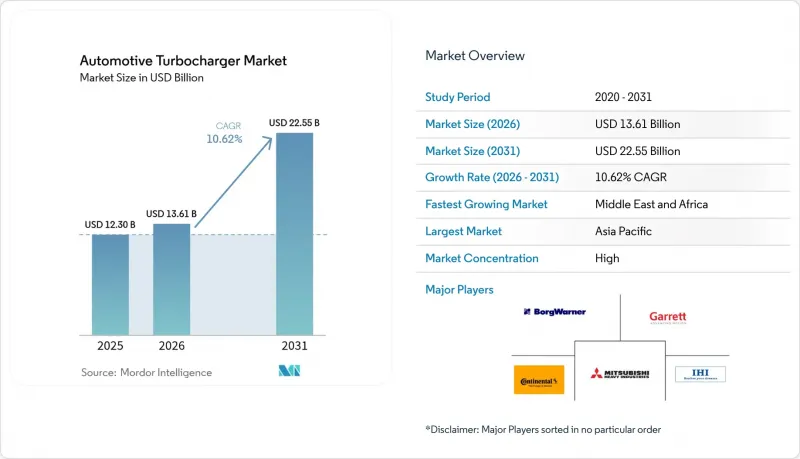
本報告按車輛類型(乘用車、輕型商用車、中重型商用車、非公路用車)、燃料類型(汽油、柴油、壓縮天然氣/液化石油氣、氫燃料內燃機)、銷售管道(原廠配套和售後市場)、渦輪增壓技術(廢氣旁通閥式、可變幾何渦輪增壓器、雙渦管式等)以及地區進行細分。市場預測以價值(美元)和銷售(輛)為單位呈現。
全球汽車渦輪增壓器市場趨勢與洞察
更嚴格的二氧化碳和氮氧化物排放法規正在加速渦輪增壓汽油引擎的普及。
排放氣體法規正在從根本上改變全球汽車市場渦輪增壓器的應用策略。歐盟7排放標準對火星點火式車輛的顆粒物排放設定了限制,並強制所有引擎安裝汽油顆粒過濾器,這些技術要求有利於渦輪增壓器的應用。輕型車輛的汽油引擎需要整合先進的燃油噴射和燃燒技術才能滿足超低排放氣體標準,因此渦輪增壓器對於在滿足排放氣體法規的同時實現所需的功率密度至關重要。這些法規的分階段實施,使得可變幾何形狀渦輪增壓器的需求持續成長,以最佳化廢氣再循環(EGR)和後處理系統的效率。這項法律規範不僅限於歐洲;中國和印度也正在推行類似的標準,這兩個國家的汽車產量佔全球汽車產量的40%以上。在滿足這些標準的同時保持性能特性的技術複雜性,迫使製造商採用能夠根據排放氣體要求即時調節增壓壓力的先進渦輪增壓器解決方案。
為符合車隊平均燃油消耗量規定,引擎尺寸縮小。
車隊平均燃油經濟性 (FFE) 法規要求製造商透過先進的渦輪增壓技術,最大限度地提高小排氣量引擎的燃油效率。北美企業平均燃油經濟性 (CAFE) 標準和類似的歐洲法規,獎勵製造商用更小排氣量的渦輪增壓引擎取代大排氣量自然進氣引擎。這一趨勢使製造商能夠在保持性能的同時顯著提高燃油效率,渦輪增壓引擎的燃油經濟性比同等排氣量的自然吸氣引擎高出 20% 至 40%。小型化策略尤其受益於雙渦流和可變幾何渦輪增壓技術,這些技術能夠最大限度地提高低轉速扭矩輸出,同時最大限度地減少渦輪遲滯。製造商擴大採用整合式排氣歧管設計和電動廢氣旁通閥執行器,以最佳化瞬態響應特性。滿足車隊平均燃油經濟性目標的經濟壓力,使得從緊湊型乘用車到中型 SUV 等所有車型領域對渦輪增壓解決方案的需求持續成長,而小型化策略對這些車型在法規遵從性方面的影響最大。
純電動車的快速普及將使渦輪增壓系統不再必要。
隨著製造商將產能轉向電動動力傳動系統系統,電池式電動車(BEV)的普及對渦輪增壓器的需求構成了結構性阻力。由於純電動車的基本架構拋棄了內燃機,因此不再需要增壓系統,導致電動車的普及率與渦輪增壓器市場的成長之間形成了一種零和關係。中國的新能源汽車市場清晰地展現了這一趨勢,純電動車銷量的成長與傳統渦輪增壓器解決方案需求的下降直接相關。然而,這種轉變也為渦輪增壓器製造商在燃料電池應用領域帶來了新的機遇,燃料電池需要專用的離心式壓縮機來提供壓縮空氣。 IHI公司專門為氫燃料電池系統開發了一款電動渦輪增壓器,採用無油運轉和機電一體化技術,可最佳化燃料電池的效率。這項技術在滿足燃料電池空氣供應需求的同時,也保留了渦輪增壓器製造商在旋轉機械和空氣動力學設計方面的核心優勢。
細分市場分析
相較之下,預計到2025年,乘用車將佔據最大的渦輪增壓器市場佔有率,達到53.48%,這主要得益於滿足車隊需求的小型渦輪增壓汽油引擎的廣泛應用。商用卡車和巴士佔22.37%,輕型商用貨車佔18.29%。設備製造商目前正在指定使用可變幾何渦輪增壓器和電動輔助渦輪增壓器,這些增壓器即使在恆速行駛和多塵環境下也能保持增壓壓力。預計2026年至2031年,非公路用機械的複合年成長率將達到12.35%,這將是全球渦輪增壓器市場中最高的成長率。
這一發展勢頭主要得益於開發中國家農業和施工機械的蓬勃發展。渦輪增壓器供應商正在設計水冷軸承座和更寬的壓縮機特性曲線,以應對這些嚴苛的運作工況。隨著排放氣體法規的實施,非道路引擎也開始受到監管,原始設備製造商(OEM)正在採用與響應靈敏的渦輪增壓器配合良好的廢氣後處理系統。因此,隨著政府加大對農村機械化和基礎建設的投入,非道路平台的渦輪增壓器市場也不斷擴張。此外,OEM的服務計劃也積極推廣再製造產品,以控制生命週期成本並維持較高的運轉率。
預計到2025年,柴油引擎將佔據渦輪增壓器市場60.02%的佔有率,這主要得益於其在貨運和非公路應用領域的統治地位;而氫燃料內燃機(ICE)的應用預計將以25.10%的複合年成長率成長。康明斯的新型氫燃料引擎渦輪增壓器採用客製化的空氣動力學設計,以適應更高的排氣流量和水蒸氣排放。汽油引擎的市佔率為32.24%,主要得益於其符合歐盟7排放標準;而壓縮天然氣(CNG)和液化石油氣(LPG)合計佔6.08%的市佔率。
氫燃料內燃機的測試結果表明,與自然吸氣模式相比,加裝渦輪增壓器後,功率輸出可提升高達165%,並且使用可再生氫氣時可實現零碳燃燒。因此,渦輪增壓器製造商正加大對密封件和不銹鋼材料的研發投入,以防止氫脆。儘管目前氫燃料系統中渦輪增壓器的市場佔有率較低,但強力的政策支持使其成為未來十年具有戰略成長潛力的領域。
區域分析
預計亞太地區將成為全球渦輪增壓器市場的主要驅動力,到2025年將佔據48.41%的市場佔有率。這反映了該地區作為全球最大的汽車製造地和成長最快的汽車市場的地位。同時,中東和非洲地區預計將實現最快成長,複合年成長率(CAGR)將達到12.98%。中國大型卡車產業清晰地展現了該地區的市場動態,在經歷了前一年的下滑後,預計2023年銷量將達到約90萬輛。由於燃料成本更低、排放氣體環保,CNG和LNG卡車的市佔率正在擴大。該地區正受惠於產能的顯著擴張,三菱重工為滿足不斷成長的國內需求,正以每年20%的速度提高其在中國的渦輪增壓器產量,新增四條組裝,使其年產量達到435萬輛。
由於嚴格的排放氣體法規和先進渦輪增壓系統領域的技術領先優勢,歐洲繼續保持顯著的市場佔有率。歐盟將於2024年5月發布的歐7排放氣體法規進一步收緊了氮氧化物和顆粒物排放標準,並引入排放氣體監測系統以確保合規,從而持續推動對可變幾何渦輪增壓器和電動渦輪增壓器技術的需求。這些法規的實施計畫從2026年到2034年分階段進行,並按車輛類別分類,這將使歐洲成為下一代渦輪增壓器技術的試驗場,這些技術最終將推廣到全球市場。
北美佔全球市場佔有率的18.37%,其成長主要得益於企業平均燃油經濟性(CAFE)標準,該標準鼓勵所有車型採用渦輪增壓器。製造商透過引擎小型化策略(高度依賴先進的渦輪增壓器技術)實現了20%至40%的燃油效率提升,進一步推動了該地區的成長。康明斯將於2025年1月推出適用於Ram重型卡車的下一代6.7升渦輪增壓柴油引擎,該引擎配備了新型可變幾何形狀渦輪增壓器和改進的空氣管理系統,這表明該地區對高性能商用車應用的重視。北美市場對皮卡和商用車的關注,催生了對能夠應對高扭力應用的高性能渦輪增壓器設計的需求。同時,該地區48V輕混系統的普及也推動了電動輔助渦輪增壓器技術的創新。
其他好處:
- Excel格式的市場預測(ME)表
- 3個月的分析師支持
目錄
第1章:引言
- 研究假設和市場定義
- 調查範圍
第2章:調查方法
第3章執行摘要
第4章 市場狀況
- 市場概覽
- 市場促進因素
- 對二氧化碳和氮氧化物排放的更嚴格規定正在加速渦輪增壓汽油車的普及。
- 為滿足車隊平均燃油消耗標準而縮小引擎尺寸
- 亞太地區商用車產量的成長正在推動對渦輪增壓器的需求。
- 為了改善瞬態響應,汽車製造商正在向 48V 電動輔助渦輪增壓器過渡。
- 將電動渦輪增壓技術整合到混合動力和插電式混合動力架構中
- 氫內燃機和燃料電池空氣壓縮器的早期應用
- 市場限制因素
- 純電動車的快速普及將消除對渦輪增壓的需求。
- 現代1.2公升以下自然進氣引擎具有競爭力的成本
- 在主要市場,渦輪遲滯的感知正在阻礙消費者的接受度。
- 高速馬達轉子關鍵金屬(釹鐵硼)的供應風險
- 價值供應鏈分析
- 監理情勢
- 技術展望
- 波特五力模型
第5章 市場規模與成長預測
- 車輛類型
- 搭乘用車
- 輕型商用車
- 中型和重型商用車輛
- 非公路用途(用於農業和建築)
- 按燃料類型
- 汽油
- 柴油引擎
- CNG/LPG
- 氫內燃機
- 按銷售管道
- 適用於OEM
- 替換件/售後市場
- 渦輪增壓技術
- 廢氣旁通閥渦輪增壓器
- 可變幾何渦輪增壓器(VGT)
- 雙渦流渦輪增壓器
- 電動渦輪增壓器
- 按地區
- 北美洲
- 美國
- 加拿大
- 其他北美國家
- 南美洲
- 巴西
- 阿根廷
- 其他南美國家
- 歐洲
- 德國
- 英國
- 法國
- 義大利
- 西班牙
- 俄羅斯
- 其他歐洲國家
- 亞太地區
- 中國
- 印度
- 日本
- 韓國
- 澳洲和紐西蘭
- 其他亞太國家
- 中東和非洲
- 土耳其
- 沙烏地阿拉伯
- 阿拉伯聯合大公國
- 南非
- 其他中東和非洲國家
- 北美洲
第6章 競爭情勢
- 市場集中度
- 策略趨勢
- 市佔率分析
- 公司簡介
- Garrett Motion Inc.
- BorgWarner Inc.
- IHI Corporation
- Mitsubishi Heavy Industries Ltd.
- Cummins Inc.(Turbo Technologies)
- Continental AG
- BMTS Technology GmbH and Co. KG
- Keyyang Precision Co., Ltd.
- Rotomaster International
- Turbo Energy Private Limited
- MAHLE GmbH
- Valeo SA
- Eaton Corporation
- Hyundai Mobis
第7章 市場機會與未來展望
According to Mordor Intelligence, the automotive turbocharger market size was valued at USD 12.30 billion in 2025 and estimated to grow from USD 13.61 billion in 2026 to reach USD 22.55 billion by 2031, at a CAGR of 10.62% during the forecast period (2026-2031).
This report is Segmented by Vehicle Type (Passenger Cars, Light Commercial Vehicles, Medium and Heavy Commercial Vehicles, and Off-Highway), Fuel Type (Gasoline, Diesel, CNG/LPG, and Hydrogen ICE), Sales Channel (OEM Fitment and Aftermarket), Turbo Technology (Wastegate, VGT, Twin-Scroll, and More) and Geography. The Market Forecasts are Provided in Terms of Value (USD) and Volume (Units).
Global Automotive Turbocharger Market Trends and Insights
Stricter CO2 and NOx Legislation Accelerating Turbo-Gasoline Adoption
Emissions regulations are fundamentally altering turbocharger deployment strategies across global automotive markets. The Euro 7 regulation introduces particulate number limits for spark ignition vehicles and mandates gasoline particulate filters for all engines, creating technical requirements that favor turbocharged configurations. Light-duty gasoline engines must integrate enhanced fuel injection and combustion technologies to meet ultra-low emissions thresholds, positioning turbochargers as essential for achieving required power density while maintaining emissions compliance. The regulation's phased implementation creates sustained demand for variable geometry turbochargers to optimize exhaust gas recirculation and aftertreatment system efficiency. This regulatory framework extends beyond Europe, with China and India implementing similar standards, representing over 40% of global vehicle production. The technical complexity of meeting these standards while maintaining performance characteristics drives manufacturers toward sophisticated turbocharging solutions that can modulate boost pressure in real-time based on emissions requirements.
Engine Downsizing for Fleet-Average Fuel-Economy Compliance
Fleet-average fuel economy regulations are compelling manufacturers to extract maximum efficiency from smaller displacement engines through advanced turbocharging. The Corporate Average Fuel Economy standards in North America and similar regulations in Europe create economic incentives for manufacturers to replace larger naturally aspirated engines with smaller turbocharged alternatives. This trend enables manufacturers to maintain performance characteristics while achieving significant fuel economy improvements, with turbocharged engines delivering 20-40% better fuel efficiency compared to naturally aspirated equivalents. The downsizing strategy particularly benefits from twin-scroll and variable geometry turbocharger technologies that minimize turbo lag while maximizing low-end torque production. Manufacturers are increasingly adopting integrated exhaust manifold designs and electric wastegate actuators to optimize transient response characteristics. The economic pressure to meet fleet-average targets creates sustained demand for turbocharging solutions across vehicle segments, from compact passenger cars to mid-size SUVs where downsizing strategies yield the greatest compliance benefits.
Rapid BEV Penetration Eliminates Forced-Induction Requirements
Battery electric vehicle adoption creates structural headwinds for turbocharger demand as manufacturers transition production capacity toward electric powertrains. The fundamental architecture of BEVs eliminates internal combustion engines, removing the need for forced induction systems and creating a zero-sum relationship between electric vehicle penetration and turbocharger market growth. China's new energy vehicle market demonstrates this dynamic, with BEV sales growth directly correlating with reduced demand for traditional turbocharging solutions. However, the transition creates opportunities for turbocharger manufacturers in fuel cell applications, where compressed air delivery systems require specialized centrifugal compressors. IHI Corporation developed electric turbochargers specifically for hydrogen fuel cell systems, featuring oil-free operation and mechatronic integration to optimize fuel cell efficiency. The technology addresses fuel cell air supply requirements while maintaining turbocharger manufacturers' core competencies in rotating machinery and aerodynamic design.
Other drivers and restraints analyzed in the detailed report include:
- Rising Commercial-Vehicle Output in Asia-Pacific Elevates Turbo Demand
- OEM Shift to 48V Electric-Assist Turbos for Transient Response
- Competitive Cost Of Modern Naturally-Aspirated Engines in Less than 1.2L
For complete list of drivers and restraints, kindly check the Table Of Contents.
Segment Analysis
Passenger cars, by contrast, hold the largest turbocharger market share at 53.48% in 2025, due to the widespread use of small, turbo-gasoline engines that satisfy fleet targets. Commercial trucks and buses contribute 22.37%, and light commercial vans make up 18.29%. Equipment makers now specify variable-geometry and electrically assisted units that maintain boost under constant-speed operation and dusty conditions. Off-highway machinery is on track for a 12.35% CAGR between 2026 and 2031, the fastest in the global turbocharger market.
The agriculture and construction machinery boom in developing economies underpins this momentum. Turbo suppliers are designing water-cooled bearing housings and wider compressor maps for these harsh duty cycles. As emissions laws reach non-road engines, OEMs adopt exhaust-aftertreatment that works best with a responsive turbo. The turbocharger market size allocated to off-highway platforms therefore, scales in tandem with government spending on rural mechanization and infrastructure builds. OEM service programs also push remanufactured units to control lifecycle cost and keep uptime high.
Diesel held 60.02% of the turbocharger market size in 2025 because of its dominance in freight and off-highway segments, yet hydrogen ICE applications will accelerate at a 25.10% CAGR. Cummins' new hydrogen engine turbo features bespoke aerodynamics to cope with higher exhaust flow and water vapor. Gasoline engines account for 32.24%, lifted by Euro 7 conformity, while CNG and LPG combined sit at 6.08%.
Hydrogen ICE testing shows up to 165% more power with turbocharging compared to naturally aspirated modes, and zero-carbon combustion is possible when renewable hydrogen is used. Turbo suppliers are therefore investing in seals and stainless materials that defeat hydrogen embrittlement. The turbocharger market share for hydrogen systems is low today, but strong policy backing positions it as a strategic segment for decade-end growth.
Complete Report Scope:
- By Vehicle Type
- Passenger Cars
- Light Commercial Vehicles
- Medium and Heavy Commercial Vehicles
- Off-highway (Agricultural, Construction)
- By Fuel Type
- Gasoline
- Diesel
- CNG/LPG
- Hydrogen Internal-Combustion
- By Sales Channel
- OEM Fitment
- Replacement / Aftermarket
- By Turbo Technology
- Wastegate Turbocharger
- Variable Geometry Turbocharger (VGT)
- Twin-Scroll Turbocharger
- Electric Turbocharger
- By Geography
- North America
- United States
- Canada
- Rest of North America
- South America
- Brazil
- Argentina
- Rest of South America
- Europe
- Germany
- United Kingdom
- France
- Italy
- Spain
- Russia
- Rest of Europe
- Asia-Pacific
- China
- India
- Japan
- South Korea
- Australia and New Zealand
- Rest of Asia-Pacific
- Middle East and Africa
- Turkey
- Saudi Arabia
- United Arab Emirates
- South Africa
- Rest of Middle East and Africa
- North America
Geography Analysis
Asia-Pacific dominates the global turbocharger market with a 48.41% share in 2025, reflecting the region's position as the world's largest automotive manufacturing hub and fastest-growing vehicle market, while the Middle East and Africa region is forecast to grow the fastest at 12.98% CAGR. China's heavy-duty trucking industry demonstrates the region's market dynamics, with approximately 900,000 units sold in 2023 following recovery from previous year declines. CNG and LNG trucks gain market share due to lower fuel costs and advantages in emissions. The region benefits from substantial manufacturing capacity expansion, with Mitsubishi Heavy Industries increasing Chinese turbocharger production by 20% annually to meet rising local demand, establishing four additional assembly lines to achieve an annual output of 4.35 million units.
Europe maintains a significant market share, driven by stringent emissions regulations and technological leadership in advanced turbocharger systems. The European Union's Euro 7 emissions regulation, published in May 2024, mandates stricter NOx and particulate matter limits while introducing onboard monitoring systems for emissions compliance, creating sustained demand for variable geometry and electric turbocharger technologies. The regulation's implementation timeline, spanning 2026 to 2034 across vehicle categories, positions Europe as a testing ground for next-generation turbocharger technologies that will eventually spread to global markets.
North America represents 18.37% of the global market, with growth driven by Corporate Average Fuel Economy standards that incentivize turbocharger adoption across vehicle segments. The region benefits from manufacturers achieving 20-40% fuel efficiency improvements through engine downsizing strategies that rely heavily on advanced turbocharging technologies. Cummins' launch of its next-generation 6.7L Turbo Diesel engine for Ram Heavy Duty trucks in January 2025, featuring a new variable-geometry turbocharger and improved air management systems, demonstrates the region's focus on high-performance commercial vehicle applications. The North American market's emphasis on pickup trucks and commercial vehicles creates demand for robust turbocharger designs capable of handling high-torque applications, while the region's adoption of 48V mild-hybrid systems drives innovation in electric-assist turbocharger technologies.
- Garrett Motion Inc.
- BorgWarner Inc.
- IHI Corporation
- Mitsubishi Heavy Industries Ltd.
- Cummins Inc. (Turbo Technologies)
- Continental AG
- BMTS Technology GmbH and Co. KG
- Keyyang Precision Co., Ltd.
- Rotomaster International
- Turbo Energy Private Limited
- MAHLE GmbH
- Valeo SA
- Eaton Corporation
- Hyundai Mobis
Additional Benefits:
- The market estimate (ME) sheet in Excel format
- 3 months of analyst support
TABLE OF CONTENTS
1 Introduction
- 1.1 Study Assumptions and Market Definition
- 1.2 Scope of the Study
2 Research Methodology
3 Executive Summary
4 Market Landscape
- 4.1 Market Overview
- 4.2 Market Drivers
- 4.2.1 Stricter CO2 and NOx legislation is accelerating turbo-gasoline adoption
- 4.2.2 Engine downsizing for fleet-average fuel-economy compliance
- 4.2.3 Rising commercial-vehicle output in Asia-Pacific elevates turbo demand
- 4.2.4 OEM shift to 48 V electric-assist turbos for transient response
- 4.2.5 Integration of e-turbos in hybrid and plug-in hybrid architectures
- 4.2.6 Early adoption in hydrogen ICE and fuel-cell air-compression stacks
- 4.3 Market Restraints
- 4.3.1 Rapid BEV penetration eliminates forced-induction requirements
- 4.3.2 Competitive cost of modern naturally-aspirated engines in less than 1.2 L
- 4.3.3 Turbo-lag perception limiting consumer acceptance in key markets
- 4.3.4 Critical-metal (Nd-Fe-B) supply risk for high-speed e-machine rotors
- 4.4 Value / Supply-Chain Analysis
- 4.5 Regulatory Landscape
- 4.6 Technological Outlook
- 4.7 Porter's Five Forces
- 4.7.1 Threat of New Entrants
- 4.7.2 Bargaining Power of Buyers / Consumers
- 4.7.3 Bargaining Power of Suppliers
- 4.7.4 Threat of Substitute Products
- 4.7.5 Intensity of Competitive Rivalry
5 Market Size and Growth Forecasts (Value and Volume)
- 5.1 By Vehicle Type
- 5.1.1 Passenger Cars
- 5.1.2 Light Commercial Vehicles
- 5.1.3 Medium and Heavy Commercial Vehicles
- 5.1.4 Off-highway (Agricultural, Construction)
- 5.2 By Fuel Type
- 5.2.1 Gasoline
- 5.2.2 Diesel
- 5.2.3 CNG/LPG
- 5.2.4 Hydrogen Internal-Combustion
- 5.3 By Sales Channel
- 5.3.1 OEM Fitment
- 5.3.2 Replacement / Aftermarket
- 5.4 By Turbo Technology
- 5.4.1 Wastegate Turbocharger
- 5.4.2 Variable Geometry Turbocharger (VGT)
- 5.4.3 Twin-Scroll Turbocharger
- 5.4.4 Electric Turbocharger
- 5.5 By Geography
- 5.5.1 North America
- 5.5.1.1 United States
- 5.5.1.2 Canada
- 5.5.1.3 Rest of North America
- 5.5.2 South America
- 5.5.2.1 Brazil
- 5.5.2.2 Argentina
- 5.5.2.3 Rest of South America
- 5.5.3 Europe
- 5.5.3.1 Germany
- 5.5.3.2 United Kingdom
- 5.5.3.3 France
- 5.5.3.4 Italy
- 5.5.3.5 Spain
- 5.5.3.6 Russia
- 5.5.3.7 Rest of Europe
- 5.5.4 Asia-Pacific
- 5.5.4.1 China
- 5.5.4.2 India
- 5.5.4.3 Japan
- 5.5.4.4 South Korea
- 5.5.4.5 Australia and New Zealand
- 5.5.4.6 Rest of Asia-Pacific
- 5.5.5 Middle East and Africa
- 5.5.5.1 Turkey
- 5.5.5.2 Saudi Arabia
- 5.5.5.3 United Arab Emirates
- 5.5.5.4 South Africa
- 5.5.5.5 Rest of Middle East and Africa
- 5.5.1 North America
6 Competitive Landscape
- 6.1 Market Concentration
- 6.2 Strategic Moves
- 6.3 Market Share Analysis
- 6.4 Company Profiles (includes Global level Overview, Market level overview, Core Segments, Financials as available, Strategic Information, Market Rank/Share for key companies, Products and Services, and Recent Developments)
- 6.4.1 Garrett Motion Inc.
- 6.4.2 BorgWarner Inc.
- 6.4.3 IHI Corporation
- 6.4.4 Mitsubishi Heavy Industries Ltd.
- 6.4.5 Cummins Inc. (Turbo Technologies)
- 6.4.6 Continental AG
- 6.4.7 BMTS Technology GmbH and Co. KG
- 6.4.8 Keyyang Precision Co., Ltd.
- 6.4.9 Rotomaster International
- 6.4.10 Turbo Energy Private Limited
- 6.4.11 MAHLE GmbH
- 6.4.12 Valeo SA
- 6.4.13 Eaton Corporation
- 6.4.14 Hyundai Mobis
7 Market Opportunities and Future Outlook
- 7.1 White-space and Unmet-Need Assessment

 超高速增壓器全球市場規模、佔有率、趨勢和成長分析報告(2026-2034)
 汽車再生式渦輪增壓器市場:全球市場預測,2026-2032年
 汽車渦輪增壓器市場預測至2034年-全球分析(按燃料類型、渦輪增壓器類型、技術、引擎排氣量、推進系統、應用和地區分類)汽車渦輪增壓器市場:按技術、冷卻系統、燃料類型、材料、引擎排氣量、銷售管道、最終用戶和車輛類型分類-2026-2032年全球市場預測
 汽車渦輪增壓器市場分析與預測(至2035年):類型、產品類型、技術、組件、應用、材料類型、最終用戶、功能超高速增壓器市場分析及預測(至2035年):類型、產品類型、服務、技術、組件、應用、最終用戶、安裝配置、設備、解決方案
 超高壓器市場規模、佔有率和成長分析:按技術類型、輸出功率、電流類型、應用、銷售管道和地區分類-2026-2033年產業預測
 2026年全球汽車渦輪增壓器市場報告2026年全球汽車渦輪增壓器軟管市場報告2026年全球超級充電器市場報告