


 |
市場調查報告書
商品編碼
2113603
南美洲飼料黏合劑:市場佔有率分析、行業趨勢和統計數據以及成長預測(2026-2031 年)South America Feed Binders - Market Share Analysis, Industry Trends & Statistics, Growth Forecasts (2026 - 2031) |
||||||

※ 本網頁內容可能與最新版本有所差異。詳細情況請與我們聯繫。
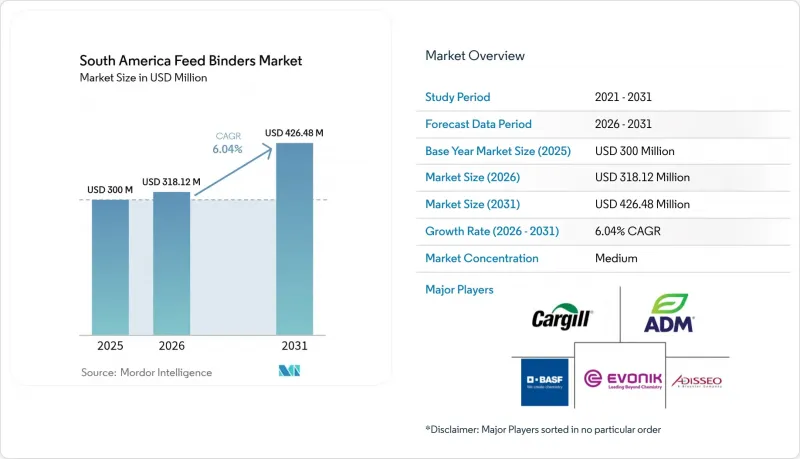
根據 Mordor Intelligence 預測,南美飼料黏合劑市場規模將從 2025 年的 3 億美元成長到 2026 年的 3.1812 億美元,然後在 2031 年達到 4.2648 億美元,2026 年至 2031 年的複合年成長率為 6.04%。
本報告按類型(天然和合成)、目標動物(反芻動物、家禽、豬、水產養殖和其他動物種類)和國家(巴西、阿根廷等)進行分類。市場預測以美元計價。
南美洲飼料黏合劑市場趨勢與洞察。
畜牧業生產增加
在巴西和哥倫比亞,商業牲畜數量持續成長,帶動了複合飼料產量的提高,並對能夠減少細顆粒、提高顆粒密度的耐用黏合劑產生了持續的需求。根據糧農組織統計資料庫(FAOSTAT)的數據,巴西禽肉產量從2022年的1,490萬噸增加到2023年的1,500萬噸。即使在2024年牛數量下降的阿根廷,以出口為導向的育肥場仍然依賴性能穩定的粘合劑來確保屠體產量。此外,秘魯盈利的肉雞和生豬養殖戶正在從粉狀飼料轉向顆粒飼料,這催生了對能夠適應低產能製粉設備的專用黏合劑系統的需求。
關注動物健康與營養
隨著區域內生產系統向無抗生素模式的轉變,功能性飼料粘合劑的重要性日益凸顯,它們不僅能增強顆粒飼料的機械強度,還能改善腸道環境。阿根廷第445/2024號決議禁止使用促生長或亞治療劑量的抗生素,這為含有益生元、有機酸或植物萃取物的粘合劑創造了即時的市場機會。巴西肉雞一體化生產商目前正在尋找源自植物單寧和酵母的粘合劑,這些黏合劑兼具物理黏合性和調節腸道菌群的作用。智利鮭魚生產商則在尋找源自海帶、富含益生元的親水膠體,以增強鮭魚在溫水脅迫下的抗病能力。這些多方面的需求有利於那些能夠提供全面技術諮詢的供應商。
原物料價格劇烈波動
關鍵粘合劑原料的價格波動給區域飼料生產商的利潤率帶來了巨大壓力,並削弱了其配方的穩定性。玉米澱粉是許多黏合劑體系的基礎原料,其價格季節性波動幅度超過每年25%,而從印度進口的瓜爾膠則面臨外匯風險和供應鏈中斷的威脅。阿根廷貨幣貶值推高了特種聚合物的進口成本,巴西麵粉廠則因河川乾旱而面臨運費上漲的困境。簽訂長期供應合約和轉向使用本地可獲得的木質纖維素原料是主要的風險緩解策略,但供應商的整合正在削弱他們的議價能力。
細分市場分析
預計到2025年,天然粘合劑將佔南美飼料粘合劑市場61.35%的佔有率,並以7.34%的複合年成長率成長,這反映出該地區正加速向永續飼料添加劑解決方案轉型。黏土基粘合劑,特別是膨潤土和高嶺土,因其成本效益和在顆粒飼料性能方面久經考驗的穩定性,在傳統畜牧業應用中保持著強勁的地位。植物來源解決方案,包括瓜爾膠和澱粉衍生物,在高階飼料配方中越來越受歡迎,這得益於當地的生產能力和符合有機認證標準。親水性膠體,例如鹿角菜膠和黃原膠,在需要水穩定性的水產養殖應用中表現尤為出色,而且海洋來源的粘合劑比陸生替代品更受青睞。
合成替代品主要針對成本敏感型應用和特殊工業飼料的特定需求。聚醋酸乙烯酯和丙烯酸類聚合物在大規模商業生產中仍然發揮著至關重要的作用,在這些生產中,穩定的黏合性能比永續性更為重要。監管壓力和消費者偏好正日益限制合成粘合劑的使用,尤其是在以出口為導向、旨在滿足歐洲和北美更嚴格殘留物標準的畜牧企業中。
其他好處:
- Excel格式的市場預測(ME)表
- 3個月的分析師支持
目錄
第1章:引言
- 研究假設和市場定義
- 調查範圍
第2章:調查方法
第3章執行摘要
第4章 市場狀況
- 市場概覽
- 市場促進因素
- 畜牧業生產增加
- 專注於動物健康和營養
- 永續性和天然飼料添加劑
- 精密製粒和微批次飼料廠的擴建
- 亞馬遜河流域水產養殖集約化迅速擴張
- 政府的碳強度降低計畫正在推動甲烷減排黏合劑的使用。
- 市場限制因素
- 原物料價格波動很大。
- 現代化顆粒工廠所需的資金
- 偏遠港口低溫運輸基礎設施不足,濕度控制不力。
- 關於次級代謝物殘留標準的監管不確定性
- 監理情勢
- 技術展望
- 波特五力分析
第5章 市場規模與成長預測
- 按類型
- 自然的
- 合成
- 依動物類型
- 家禽
- 豬
- 反芻動物
- 水產養殖
- 其他動物類型
- 國家
- 巴西
- 阿根廷
- 智利
- 哥倫比亞
- 秘魯
- 其他南美國家
第6章 競爭情勢
- 市場集中度
- 策略趨勢
- 市佔率分析
- 公司簡介
- Cargill, Incorporated
- Archer-Daniels-Midland Company
- Evonik Industries AG
- BASF SE
- Adisseo Nutrition Group Limited
- Kemin Industries, Inc.
- Bentoli, Inc.
- Uniscope, Inc.
- Borregaard ASA
- Avebe UA
- CP Kelco Inc.
- Darling Ingredients Inc.
- Gelita AG
- Roquette Freres SA
- International Flavors & Fragrances Inc.
第7章 市場機會與未來展望
According to Mordor Intelligence, the South America feed binders market size is expected to grow from USD 300 million in 2025 to USD 318.12 million in 2026 and is forecast to reach USD 426.48 million by 2031 at 6.04% CAGR over 2026-2031.
This report is Segmented by Type (Natural and Synthetic), by Animal (Ruminant, Poultry, Swine, Aquaculture, and Other Animal Types), and by Country (Brazil, Argentina, and More). The Market Forecasts are Provided in Terms of Value (USD).
South America Feed Binders Market Trends and Insights
Growing Livestock Production
Commercial animal numbers continue to climb in Brazil and Colombia, lifting compound feed output and creating a sustained pull for durable binders that cut fines and improve pellet density. According to FAOSTAT, Brazil's production of poultry meat was 14.9 million metric tons in 2022, which increased by 15.0 million metric tons in 2023. Even in Argentina, where cattle numbers slipped in 2024, export-oriented feedlots still rely on consistent binder performance to secure premium carcass yields. Peru's cash-positive broiler and swine operators are also shifting from mash to pelleted formulations, opening opportunities for specialized binding systems compatible with lower-throughput mills.
Focus on Animal Health and Nutrition
The regional shift toward antibiotic-free production systems has elevated the importance of functional feed binders that deliver gut health benefits beyond mechanical pellet integrity. Argentina's Resolution 445/2024 prohibits antimicrobial use for growth promotion and sub-therapeutic dosing, creating immediate market opportunities for binders incorporating prebiotics, organic acids, or botanical extracts. Brazilian broiler integrators now ask for plant tannin or yeast-derived binders that combine physical cohesion with microbiome modulation. Chilean salmon producers pursue kelp-based hydrocolloids enriched with prebiotics to enhance disease resistance during warm-water stress events. These multifaceted requirements favor suppliers that can deliver turnkey technical advice alongside the product.
High Raw-Material Price Volatility
Commodity price fluctuations for key binder ingredients create significant margin pressure and formulation instability for regional feed manufacturers. Corn-based starch prices, fundamental to many binding systems, experience seasonal variations exceeding 25% annually, while guar gum imports from India face currency exchange risks and supply chain disruptions. Currency devaluation in Argentina magnifies import bills for specialty polymers while Brazilian mills fight freight surcharges tied to river droughts. Contracting long-term supply and diversifying toward locally available lignocellulosic sources are the main mitigation strategies, and supplier consolidation limits bargaining leverage.
Other drivers and restraints analyzed in the detailed report include:
- Sustainability and Natural Feed Additives
- Expansion of Precision Pelletization and Micro-Batch Feed Mills
- Capital Requirement for Modern Pellet Mills
For complete list of drivers and restraints, kindly check the Table Of Contents.
Segment Analysis
Natural binders command 61.35% South America feed binder market size in 2025 and are forecast to expand at a 7.34% CAGR, reflecting the region's accelerating transition toward sustainable feed additive solutions. Clay-based binders, particularly bentonite and kaolin, maintain strong positions in traditional livestock applications due to their cost-effectiveness and proven durability in pellet performance. Plant-based solutions, including guar gum and starch derivatives, are gaining traction in premium feed formulations, supported by local production capabilities and compatibility with organic certification. Hydrocolloids such as carrageenan and xanthan demonstrate particular strength in aquaculture applications where water stability requirements favor marine-derived binding agents over terrestrial alternatives.
Synthetic alternatives primarily serve cost-sensitive applications and specialized industrial feed requirements. Polyvinyl acetate and acrylic polymers maintain relevance in high-throughput commercial operations where consistent binding performance outweighs sustainability considerations. Regulatory pressure and consumer preferences are increasingly constraining the adoption of synthetic binders, particularly in export-oriented livestock operations serving European and North American markets with stringent residue standards.
Complete Report Scope:
- By Type
- Natural
- Synthetic
- By Animal Type
- Poultry
- Swine
- Ruminants
- Aquaculture
- Other Animal Types
- By Country
- Brazil
- Argentina
- Chile
- Colombia
- Peru
- Rest of South America
List of Companies Covered in this Report:
- Cargill, Incorporated
- Archer-Daniels-Midland Company
- Evonik Industries AG
- BASF SE
- Adisseo Nutrition Group Limited
- Kemin Industries, Inc.
- Bentoli, Inc.
- Uniscope, Inc.
- Borregaard ASA
- Avebe U.A.
- CP Kelco Inc.
- Darling Ingredients Inc.
- Gelita AG
- Roquette Freres S.A
- International Flavors & Fragrances Inc.
Additional Benefits:
- The market estimate (ME) sheet in Excel format
- 3 months of analyst support
TABLE OF CONTENTS
1 Introduction
- 1.1 Study Assumptions and Market Definition
- 1.2 Scope of the Study
2 Research Methodology
3 Executive Summary
4 Market Landscape
- 4.1 Market Overview
- 4.2 Market Drivers
- 4.2.1 Growing Livestock Production
- 4.2.2 Focus on Animal Health and Nutrition
- 4.2.3 Sustainability and Natural Feed Additives
- 4.2.4 Expansion of Precision Pelletization and Micro-Batch Feed Mills
- 4.2.5 Surging Aquaculture Intensification along Amazon Basin
- 4.2.6 Government Carbon-Intensity Programs Driving Methane-Reducing Binders
- 4.3 Market Restraints
- 4.3.1 High Raw-Material Price Volatility
- 4.3.2 Capital Requirement for Modern Pellet Mills
- 4.3.3 Low Density of Cold-Chain and Humidity Control in Remote Ports
- 4.3.4 Regulatory Uncertainty on Secondary-Metabolite Residue Limits
- 4.4 Regulatory Landscape
- 4.5 Technological Outlook
- 4.6 Porter's Five Forces Analysis
- 4.6.1 Bargaining Power of Suppliers
- 4.6.2 Bargaining Power of Buyers
- 4.6.3 Threat of New Entrants
- 4.6.4 Threat of Substitutes
- 4.6.5 Intensity of Competitive Rivalry
5 Market Size and Growth Forecasts (Value)
- 5.1 By Type
- 5.1.1 Natural
- 5.1.2 Synthetic
- 5.2 By Animal Type
- 5.2.1 Poultry
- 5.2.2 Swine
- 5.2.3 Ruminants
- 5.2.4 Aquaculture
- 5.2.5 Other Animal Types
- 5.3 By Country
- 5.3.1 Brazil
- 5.3.2 Argentina
- 5.3.3 Chile
- 5.3.4 Colombia
- 5.3.5 Peru
- 5.3.6 Rest of South America
6 Competitive Landscape
- 6.1 Market Concentration
- 6.2 Strategic Moves
- 6.3 Market Share Analysis
- 6.4 Company Profiles (includes Global level Overview, Market level overview, Core Segments, Financials as available, Strategic Information, Market Rank/Share for key companies, Products and Services, and Recent Developments)
- 6.4.1 Cargill, Incorporated
- 6.4.2 Archer-Daniels-Midland Company
- 6.4.3 Evonik Industries AG
- 6.4.4 BASF SE
- 6.4.5 Adisseo Nutrition Group Limited
- 6.4.6 Kemin Industries, Inc.
- 6.4.7 Bentoli, Inc.
- 6.4.8 Uniscope, Inc.
- 6.4.9 Borregaard ASA
- 6.4.10 Avebe U.A.
- 6.4.11 CP Kelco Inc.
- 6.4.12 Darling Ingredients Inc.
- 6.4.13 Gelita AG
- 6.4.14 Roquette Freres S.A
- 6.4.15 International Flavors & Fragrances Inc.
7 Market Opportunities and Future Outlook

 飼料黏合劑市場:2026-2032年全球市場預測(按黏合劑類型、飼料類別、飼料形態、目標動物、最終用戶和分銷管道分類)
 非洲飼料粘合劑:市場佔有率分析、行業趨勢和統計數據以及成長預測(2026-2031 年)
 2026-2034年全球飼料粘合劑市場規模、佔有率、趨勢和成長分析報告
 飼料黏合劑市場規模、佔有率和成長分析(按產品類型、特性、動物種類和地區分類)-2026-2033年產業預測飼料粘合劑市場:2025-2030 年預測
 飼料黏合劑市場-全球產業規模、佔有率、趨勢、機會和預測(按類型、牲畜、性質、地區和競爭細分,2020-2030 年)