


 |
市場調查報告書
商品編碼
2073065
非洲飼料粘合劑:市場佔有率分析、行業趨勢和統計數據以及成長預測(2026-2031 年)Africa Feed Binders - Market Share Analysis, Industry Trends & Statistics, Growth Forecasts (2026 - 2031) |
||||||

※ 本網頁內容可能與最新版本有所差異。詳細情況請與我們聯繫。
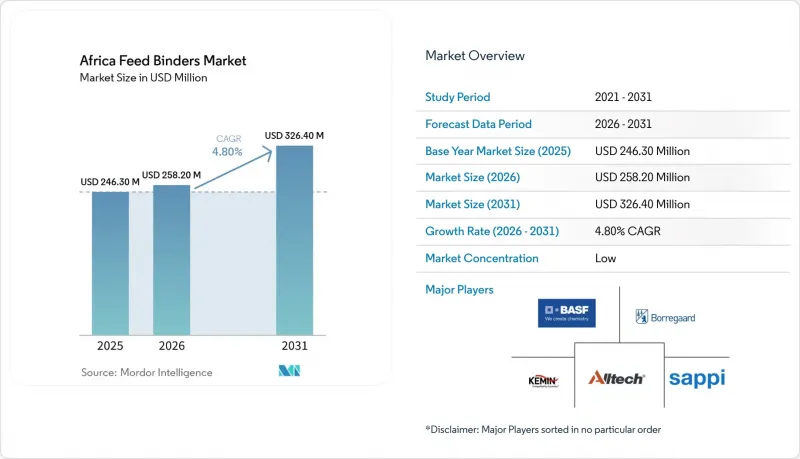
根據 Mordor Intelligence 預測,非洲飼料粘合劑市場規模將從 2025 年的 2.463 億美元成長到 2026 年的 2.582 億美元,然後在 2031 年達到 3.264 億美元,2026 年至 2031 年的複合年成長率為 4.80%。
本報告按粘合劑類型(天然黏合劑和粘合劑) 、動物類型(水產養殖、家禽、反芻動物、豬和其他動物)以及地區(南非、奈及利亞、埃及、肯亞、摩洛哥以及其他中東和非洲國家)進行細分。市場預測以價值(美元)和數量(噸)表示。
非洲飼料粘合劑市場趨勢與洞察
非洲複合飼料產量增加
複合飼料產量的不斷成長仍然是非洲飼料粘合劑市場需求的主要支柱之一。商業性飼料生產對粘合劑的需求直接成長,因為顆粒飼料需要耐用、低且加工能力穩定。而農場散裝飼料則不存在這些要求。預計到2025年,包括複合飼料在內的非洲飼料產量將達到每年6,420萬噸。南非、奈及利亞、埃及和肯亞預計將成為推動市場成長的主要力量,因為它們擁有能夠加工更大批量粘合劑的飼料廠。奈及利亞政府主導的舉措以及埃及的監管檢查活動也表明,飼料生產正變得更加規範化,添加劑認證和持續採購的條件也得到了改善。隨著標準化飼料廠系統加工飼料量的增加,非洲飼料粘合劑市場將受益於新型製粒生產線的引入、飼料廠設備的升級以及從非正式混合生產向工業化生產的轉變。
對顆粒狀家禽飼料的需求
由於家禽飼料市場規模龐大、商業性結構完善,且對飼料轉換率要求嚴格,因此家禽飼料仍是非洲飼料粘合劑市場最可靠的需求來源。肉雞和蛋雞養殖高度依賴顆粒飼料的一致性,因此粘合劑不僅在顆粒強度方面發揮關鍵作用,而且在飼料轉換率、處理性能以及減少運輸過程中的營養損失方面也至關重要。根據美國農業部(USDA)預測,到2025年,南非的雞肉產量預計將達到164.5萬噸。奈及利亞的經濟復甦以及飼料和牧場政策框架的舉措,都支持了該地區畜牧生產系統中顆粒添加劑的持續使用,而該地區的畜牧生產系統是非洲飼料消耗量最大的地區。
進口特種粘合劑的成本和外匯波動
對進口的依賴仍然是非洲飼料粘合劑市場的主要限制因素。該地區使用的絕大多數合成和優質礦物粘合劑仍然來自歐洲和北美,這意味著運費、關稅和貨幣貶值將直接反映在進口價格中。在一些非洲市場,預計該地貨幣在2024年和2025年將對美元大幅貶值。貨幣貶值導致飼料生產商縮短採購週期並降低庫存水準。因此,優質粘合劑的推廣變得更加困難,因為它們不僅需要在技術性能方面證明自身價值,還需要在受外匯波動影響的快速變化的預算環境中證明自身價值。擁有本地生產設施或庫存的銷售代理商(例如南非的Sappi公司)的供應商更有能力應對非洲飼料粘合劑市場中與貨幣相關的挑戰。
細分市場分析
預計到2025年,天然粘合劑將佔非洲飼料粘合劑市場62%的佔有率,並在2026年至2031年間以4.8%的複合年成長率成長,繼續在禽類、反芻動物和水產養殖領域保持主導地位。其主導地位源於高效的黏合性能、飼料生產商的高度認可以及廣泛的監管批准。在南非,Sappi位於托格拉的工廠透過確保粘合劑產品的可靠本地供應,為許多其他非洲市場提供了競爭優勢,而這些市場目前仍依賴進口。這種國內供應增強了供應穩定性,並降低了外匯波動和特種飼料添加劑運輸成本的風險。澱粉、糊精和糖蜜基產品仍然是天然粘合劑領域的基礎,其中糖蜜發揮著至關重要的作用,尤其是在南非反芻動物飼料配方中,有助於提高偏好和飼料量。
在非洲飼料粘合劑市場,合成粘合劑仍被用於一些特殊應用領域,尤其是在飼料廠需要更優異的水穩定性、更強的顆粒強度或更嚴格的製程控制的領域。然而,由於成本高以及非洲大部分地區仍然依賴進口,合成黏合劑的普及程度仍然有限。同時,膨潤土、高嶺土和海泡石等礦物基粘合劑在肯亞、烏干達和坦尚尼亞等國越來越受到關注,因為這些國家的飼料粘合劑越來越重視顆粒的耐久性和黴菌毒素的控制。因此,市場正變得比整體佔有率分佈所顯示的更加多元化,但天然粘合劑仍然佔據大部分需求,並且仍然是非洲飼料粘合劑行業的主要成長要素。
其他好處
- Excel格式的市場預測(ME)表
- 3個月的分析師支持
目錄
第1章:引言
- 研究假設和市場定義
- 調查範圍
第2章:調查方法
第3章執行摘要
第4章 市場狀況
- 市場概覽
- 市場促進因素
- 非洲複合飼料產量增加
- 對顆粒狀家禽飼料的需求
- 需要擴大水產養殖飼料,並提高水體穩定性。
- 減少細懸浮微粒和維持營養成分的效果
- 轉向天然木質素基粘合劑
- 透過高強度顆粒降低能源成本
- 市場限制因素
- 進口特種粘合劑的成本和外匯波動
- 中小型飼料廠的價格敏感性
- 電力和蒸氣供應不穩定
- 穀物品質和原料存在差異,且黴菌毒素含量較高。
- 監理情勢
- 技術展望
- 波特五力分析
第5章 市場規模與成長預測
- 按粘合劑類型
- 天然粘合劑
- 合成粘合劑
- 依動物類型
- 家禽
- 按目標動物
- 肉雞
- 產蛋母雞
- 其他家禽
- 反芻動物
- 按目標動物
- 牛
- 乳牛
- 其他反芻動物
- 水產養殖
- 按目標動物
- 魚
- 蝦
- 其他養殖物種
- 按目標動物
- 豬
- 其他動物
- 按地區
- 南非
- 奈及利亞
- 埃及
- 肯亞
- 摩洛哥
- 其他非洲地區
第6章 競爭情勢
- 市場集中度
- 策略趨勢
- 市佔率分析
- 公司簡介
- Sappi Limited
- Borregaard ASA
- Kemin Industries, Inc.
- Roquette Freres
- Bentoli, Inc.
- Uniscope, Inc.
- Cargill, Incorporated
- Nutreco NV
- BASF SE
- Ingredion Incorporated
- Tereos SCA
- Alltech, Inc.
- Amlan International
- Royal De Heus
- Nutreco NV
第7章 市場機會與未來展望
According to Mordor Intelligence, the africa feed binders market size is anticipated to grow from USD 246.30 million in 2025 to USD 258.20 million in 2026 and is forecast to reach USD 326.40 million by 2031 at 4.80% CAGR over 2026-2031.
This report is Segmented by Sub Additives (Natural Binders and Synthetic Binders), by Animal Type (Aquaculture, Poultry, Ruminants, Swine, and Other Animals), and by Geography (South Africa, Nigeria, Egypt, Kenya, Morocco, and Rest of Africa). The Market Forecasts are Provided in Terms of Value (USD) and Volume (Metric Tons).
Africa Feed Binders Market Trends and Insights
Rising Compound Feed Output in Africa
Rising compound feed output remains one of the clearest demand anchors for the Africa feed binders market. Commercial feed production creates a direct need for binding chemistry because pelleted output depends on durability, lower fines, and stable throughput, whereas on-farm loose feed does not. Africa's feed production is estimated to reach 64.2 million metric tons annually by 2025, including compound feed. South Africa, Nigeria, Egypt, and Kenya are projected to lead in terms of installed mill capacity capable of accommodating higher binder volumes. Government-backed plans in Nigeria and regulatory testing activity in Egypt also indicate that feed production is being organized more formally, improving the conditions for additive qualification and repeat procurement. As more feed volume moves into standardized mill systems, the Africa feed binders market gains from every new pelleting line, every mill upgrade, and every shift from informal mixing to industrial production.
Poultry Feed Pelletization Demand
Poultry remains the most dependable volume base for the Africa feed binders market because it combines scale, commercial structure, and tight pressure on feed efficiency. Broiler and layer operations depend heavily on pellet consistency, which makes binders important not only for pellet integrity but also for feed conversion, handling performance, and reduced nutrient loss during transport. According to the United States Department of Agriculture (USDA), South Africa's poultry chicken meat production reached 1,645 thousand metric tons in 2025. Recovery efforts and Nigeria's emphasis on stronger feed and fodder policy frameworks have supported the continued use of pellet-oriented additives in the region's largest feed-consuming livestock system.
Imported Specialty Binder Costs and Currency Volatility
Import dependency continues to be a significant constraint on the African feed binders market. The majority of synthetic and premium mineral binders used across the region still come from Europe and North America, which means freight costs, tariffs, and currency weakness feed directly into landed prices. Local currencies in several Africa markets are projected to depreciate significantly against the United States dollar in 2024 and 2025. This depreciation has led mills to shorten their purchasing cycles and reduce stock levels. As a result, the adoption of premium binders becomes more challenging, as they must demonstrate value not only through technical performance but also within a rapidly changing budgeting environment influenced by fluctuating exchange rates. Suppliers with local production facilities or distributor-held stock, such as Sappi in South Africa, are better positioned to navigate currency-related challenges in the African feed binders market.
Other drivers and restraints analyzed in the detailed report include:
- Aquaculture Feed Expansion and Water-Stability Needs
- Fines Reduction and Nutrient Retention Gains
- Grain-Quality Variability and Mycotoxin-Heavy Raw Materials
For complete list of drivers and restraints, kindly check the Table Of Contents.
Segment Analysis
Natural binders accounted for 62% of the Africa feed binders market in 2025 and are projected to grow at a CAGR of 4.8% between 2026 and 2031, maintaining their leading position across poultry, ruminant, and aquaculture applications. Their dominance is attributed to effective binding performance, familiarity among feed manufacturers, and broader regulatory acceptance. In South Africa, Sappi's Pelletin production at the Tugela Mill provides a competitive advantage by ensuring a reliable local supply of binder products, which are still imported in many other African markets. This domestic availability enhances supply security and reduces exposure to currency fluctuations and freight-related costs associated with specialty feed additives. Starches, dextrins, and molasses-based products remain the cornerstone of the natural binder segment, with molasses playing a particularly significant role in Southern African ruminant feed formulations, contributing to palatability and feed intake.
Synthetic binders continue to serve specialized applications within the Africa feed binders market, particularly where feed mills require enhanced water stability, stronger pellet integrity, or tighter process control. However, the adoption of synthetic binders remains limited due to higher costs and continued reliance on imports across much of the continent. Meanwhile, mineral-based binders such as bentonite, kaolin, and sepiolite are gaining traction in countries like Kenya, Uganda, and Tanzania, where feed producers are increasingly focusing on pellet durability and mycotoxin management. Consequently, the market is becoming more diversified than the overall share distribution suggests, although natural binders continue to dominate volume demand and remain the primary growth driver of the Africa feed binders industry.
Complete Report Scope:
- By Binder Type
- Natural binders
- Synthetic binders
- By Animal
- Poultry
- By Sub Animal
- Broiler
- Layer
- Other Poultry Birds
- Ruminants
- By Sub Animal
- Beef Cattle
- Dairy Cattle
- Other Ruminants
- Aquaculture
- By Sub Animal
- Fish
- Shrimp
- Other Aquaculture Species
- By Sub Animal
- Swine
- Other Animal
- By Geography
- South Africa
- Nigeria
- Egypt
- Kenya
- Morocco
- Rest of Africa
List of Companies Covered in this Report:
- Sappi Limited
- Borregaard ASA
- Kemin Industries, Inc.
- Roquette Freres
- Bentoli, Inc.
- Uniscope, Inc.
- Cargill, Incorporated
- Nutreco N.V.
- BASF SE
- Ingredion Incorporated
- Tereos SCA
- Alltech, Inc.
- Amlan International
- Royal De Heus
- Nutreco N.V.
Additional Benefits:
- The market estimate (ME) sheet in Excel format
- 3 months of analyst support
TABLE OF CONTENTS
1 Introduction
- 1.1 Study Assumption and Market Definition
- 1.2 Scope of the Study
2 Research Methodology
3 Executive Summary
4 Market Landscape
- 4.1 Market Overview
- 4.2 Market Drivers
- 4.2.1 Rising compound feed output in Africa
- 4.2.2 Poultry feed pelletization demand
- 4.2.3 Aquaculture feed expansion and water-stability needs
- 4.2.4 Fines reduction and nutrient retention gains
- 4.2.5 Shift toward natural lignin-based binders
- 4.2.6 Energy-cost savings from stronger pellets
- 4.3 Market Restraints
- 4.3.1 Imported specialty binder costs and currency volatility
- 4.3.2 Price sensitivity among small and mid-sized feed mills
- 4.3.3 Unstable power and steam availability
- 4.3.4 Grain-quality variability and mycotoxin-heavy raw materials
- 4.4 Regulatory Landscape
- 4.5 Technological Outlook
- 4.6 Porter's Five Forces Analysis
- 4.6.1 Bargaining Power of Suppliers
- 4.6.2 Bargaining Power of Buyers
- 4.6.3 Threat of New Entrants
- 4.6.4 Threat of Substitute Products
- 4.6.5 Intensity of Competitive Rivalry
5 Market Size and Growth Forecasts (Value and Volume)
- 5.1 By Binder Type
- 5.1.1 Natural binders
- 5.1.2 Synthetic binders
- 5.2 By Animal
- 5.2.1 Poultry
- 5.2.2 By Sub Animal
- 5.2.2.1 Broiler
- 5.2.2.2 Layer
- 5.2.2.3 Other Poultry Birds
- 5.2.3 Ruminants
- 5.2.4 By Sub Animal
- 5.2.4.1 Beef Cattle
- 5.2.4.2 Dairy Cattle
- 5.2.4.3 Other Ruminants
- 5.2.5 Aquaculture
- 5.2.5.1 By Sub Animal
- 5.2.5.1.1 Fish
- 5.2.5.1.2 Shrimp
- 5.2.5.1.3 Other Aquaculture Species
- 5.2.5.1 By Sub Animal
- 5.2.6 Swine
- 5.2.7 Other Animal
- 5.3 By Geography
- 5.3.1 South Africa
- 5.3.2 Nigeria
- 5.3.3 Egypt
- 5.3.4 Kenya
- 5.3.5 Morocco
- 5.3.6 Rest of Africa
6 Competitive Landscape
- 6.1 Market Concentration
- 6.2 Strategic Moves
- 6.3 Market Share Analysis
- 6.4 Company Profiles (Includes Global Level Overview, Market Level Overview, Core Business Segments, Financials, Headcount, Key Information, Market Rank, Market Share, Products and Services, and Analysis of Recent Developments)
- 6.4.1 Sappi Limited
- 6.4.2 Borregaard ASA
- 6.4.3 Kemin Industries, Inc.
- 6.4.4 Roquette Freres
- 6.4.5 Bentoli, Inc.
- 6.4.6 Uniscope, Inc.
- 6.4.7 Cargill, Incorporated
- 6.4.8 Nutreco N.V.
- 6.4.9 BASF SE
- 6.4.10 Ingredion Incorporated
- 6.4.11 Tereos SCA
- 6.4.12 Alltech, Inc.
- 6.4.13 Amlan International
- 6.4.14 Royal De Heus
- 6.4.15 Nutreco N.V.
7 Market Opportunities and Future Outlook

 南美洲飼料黏合劑:市場佔有率分析、行業趨勢和統計數據以及成長預測(2026-2031 年)
 飼料黏合劑市場:2026-2032年全球市場預測(按黏合劑類型、飼料類別、飼料形態、目標動物、最終用戶和分銷管道分類)
 2026-2034年全球飼料粘合劑市場規模、佔有率、趨勢和成長分析報告
 飼料黏合劑市場規模、佔有率和成長分析(按產品類型、特性、動物種類和地區分類)-2026-2033年產業預測飼料粘合劑市場:2025-2030 年預測
 飼料黏合劑市場-全球產業規模、佔有率、趨勢、機會和預測(按類型、牲畜、性質、地區和競爭細分,2020-2030 年)