


 |
市場調查報告書
商品編碼
2113532
風力發電機齒輪箱維修與維修:市場佔有率分析、產業趨勢與統計及成長預測(2026-2031)Wind Turbine Gearbox Repair And Refurbishment - Market Share Analysis, Industry Trends & Statistics, Growth Forecasts (2026 - 2031) |
||||||

※ 本網頁內容可能與最新版本有所差異。詳細情況請與我們聯繫。
據 Mordor Intelligence 稱,風力發電機機齒輪箱維修和維修市場預計到 2026 年價值 52.8 億美元,高於 2025 年的 50.7 億美元,預計到 2031 年將達到 64.3 億美元。
預計從 2026 年到 2031 年,其複合年成長率將達到 4.05%。
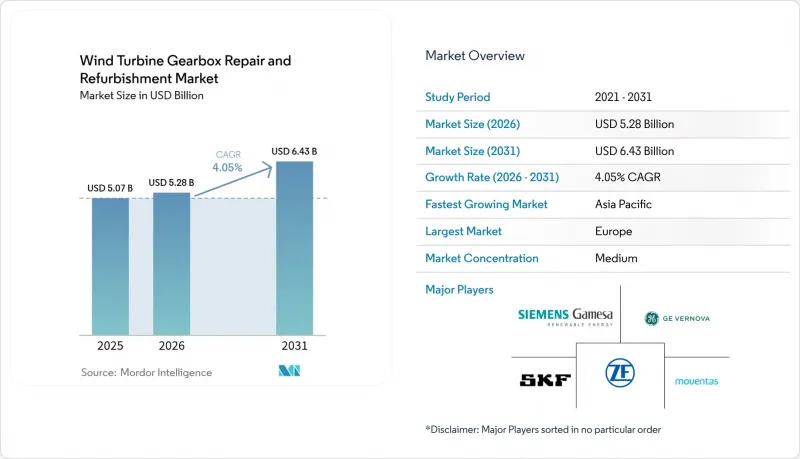
本報告按類型(維修和翻新)、齒輪箱故障零件(軸承、齒輪、軸和殼體等)、渦輪機功率等級(2 MW 以下、2-5 MW、5 MW 以上)、服務供應商(OEM 服務部門、獨立服務供應商等)、安裝類型(陸上和海上)以及地區(北美、歐洲、亞太地區等)進行分類。
全球風力發電機機齒輪箱維修和維修市場趨勢及洞察
運作超過 10 年的陸上風力發電機快速老化。
2010年至2014年間投入運作的設備目前已接近7-10年,此時變速箱通常需要大規模。許多舊風力發電機缺乏先進的狀態監測系統,迫使業者只能進行被動維修,每次維修費用高達25萬至30萬美元。由於風力發電廠早期建設導致維護週期同步,這種影響在歐洲(尤其是德國和丹麥)更為明顯。預計到2027年,這種需求激增的趨勢將進一步加劇,確保風力發電機齒輪箱維修和維修市場的持續需求。
OEM支持的全球維修中心擴張
為了縮短前置作業時間並確保售後市場利潤,原始設備製造商 (OEM) 正在投資建造集中式製造地。通用電氣 Vernova 已撥款 1 億美元,用於擴建其位於德克薩斯德克薩斯州阿馬裡洛的齒輪箱再製造產能,這是其 6 億美元美國供應鏈計畫的一部分。西門子歌美颯在西班牙經營一家再製造工廠,並已為 Eneco 的 Princess Amalia 風電場完成了為期 10 週的全面檢修。集中式樞紐透過提供行星齒輪維修專用工具和實現基於預測的庫存管理,進一步拓展了風力發電機渦輪機齒輪箱維修和維修市場。
直接驅動式渦輪機(無需齒輪箱)的普及速度正在加快。
離岸風力發電開發商更傾向於直驅系統,因為這種系統無需齒輪箱,可靠性更高,尤其是在難以到達的地區。同行評審的對比研究表明,齒輪式風力發電機的每兆瓦運作成本(OPEX)比直驅式風力發電機高出9.3%。然而,稀土元素磁鐵的需求以及高昂的資本投資成本限制了直驅式風力發電機在大規模海上項目中的應用,而且其短期內替代現有齒輪式風力發電機的可能性也有限。
細分市場分析
在風力發電機機齒輪箱維修和維修市場中,預計到2025年,維修服務市場規模將達到35.1億美元,佔總收入的69.14%。傳統上,操作員傾向於讓齒輪箱運作直至發生故障,並選擇快速維修以恢復運轉率。然而,隨著資產所有者對延長保固期和使用壽命的需求不斷成長,維修市場正以4.7%的複合年成長率快速擴張。 GE Vernova位於西班牙的工廠正在將技術升級融入維修的驅動系統中,從而減少二次干預,並展現出向預防性大修的戰略轉變。該領域的這一發展趨勢表明,風力發電機機齒輪箱維修和維修市場正在努力平衡即時運作和長期資產最佳化之間的關係。
翻新改造允許使用更廣泛的材料,從而可以針對已知的故障模式進行軸承升級、齒輪重新加工以及潤滑系統重新設計。保險公司通常會為翻新後的機組提供更長的保固期,從而改善所有者的財務狀況。隨著老舊風力渦輪機運作年限達到10年,翻新改造的獲利能力將在整個風力發電機機齒輪箱維修和翻新產業中逐漸縮小與維修之間的差距。
到2025年,60.55%的故障將歸因於軸承,這將推動對專業更換和潤滑服務的需求。軸承狀況是預測性維護分析的重點,因為污染物、波動負荷和微點蝕會導致過早磨損。齒輪損壞比例較低,但隨著白蝕裂紋日益受到業界關注,預計其複合年成長率將達到4.95%。最佳化潤滑系統可減少高達50%的能量損失並延長零件壽命。在軸承診斷和閃充服務方面擁有專業知識的服務供應商正在風力發電機機齒輪箱維修和維修市場中佔據重要的短期價值佔有率。
區域分析
到2025年,歐洲將佔全球銷售額的37.45%。這反映了歐洲大陸對相關技術的早期應用以及現有基礎設施的老化。諸如歐洲風能協會(WindEurope)的「清潔工業協議」等政策正在推動國內維護能力的提升,以保持競爭力。北海離岸風力發電帶動了對塔頂先進物流和維修工具的需求。預測性維護的引入正獲得監管機構的支持,這將確保風力發電機機齒輪箱維修和維修市場的工作量穩定成長。
亞太地區是成長最快的地區,預計到2031年複合年成長率將達到6.55%。中國龐大的風電裝置容量正從保固期轉向強調預測性維護的多年期契約,而印度的「風電改造政策」則將2兆瓦以下的風力發電機納入維修計劃。像金風科技這樣的國內巨頭正在與獨立服務供應商(ISP)合作建立零件交換池,但技術轉移的法規仍然維持著在地採購的優勢。
在北美,風力發電機組擁有大規模的裝置量,並透過GE Vernova位於阿馬裡洛的再製造工廠等原始設備製造商(OEM)的基地提供服務,確保美國營運商能夠獲得快速反應。拉丁美洲、中東和非洲仍處於發展階段,受限於獲得認證的服務中心數量;然而,隨著設備老化,風力發電機組齒輪箱維修和維修市場的需求預計將逐步成長。
其他好處:
- Excel格式的市場預測(ME)表
- 3個月的分析師支持
目錄
第1章:引言
- 研究假設和市場定義
- 調查範圍
第2章:調查方法
第3章執行摘要
第4章 市場狀況
- 市場概覽
- 市場促進因素
- 運作超過 10 年的陸上風力發電機快速老化。
- OEM支持的全球維修中心擴張(例如,GE Vernova、西門子歌美颯)
- 從基於時間的預測性維護合約過渡到基於資料的預測性維護合約
- 受新冠疫情影響,新變速箱供不應求,前置作業時間18 個月。
- 保險公司強制要求預防性維修,以減少停電期間的保險賠償。
- 模組化、可互換的起重機池經營模式可減少起重機運作時間 35-50%。
- 市場限制因素
- 直接驅動式渦輪機(無需齒輪箱)的普及正在加速。
- 與海上齒輪箱運輸相關的物流成本很高(超過運費的 30%)。
- 拉丁美洲 (LATAM) 和中東及非洲 (MEA) 地區獲得 Class 認證的再生設施數量有限。
- 受智慧財產權限制的設計數據阻礙了多品牌維修。
- 供應鏈分析
- 監理情勢
- 技術展望
- 波特五力模型
第5章 市場規模與成長預測
- 按類型
- 維修
- 維修
- 變速箱零件故障
- 軸承
- 齒輪
- 軸和殼體
- 其他(密封件、潤滑系統)
- 渦輪機額定輸出功率
- 小於2兆瓦
- 2~5 MW
- 5兆瓦或以上
- 透過服務供應商
- OEM服務部門
- 獨立服務供應商(ISP)
- 內部公用設施研討會
- 不同的發展
- 陸上
- 離岸
- 按地區
- 北美洲
- 美國
- 加拿大
- 墨西哥
- 歐洲
- 德國
- 英國
- 法國
- 義大利
- 北歐國家
- 俄羅斯
- 其他歐洲國家
- 亞太地區
- 中國
- 印度
- 日本
- 韓國
- 東南亞國協
- 其他亞太國家
- 南美洲
- 巴西
- 阿根廷
- 其他南美國家
- 中東和非洲
- 沙烏地阿拉伯
- 阿拉伯聯合大公國
- 南非
- 埃及
- 其他中東和非洲國家
- 北美洲
第6章 競爭情勢
- 市場集中度
- 策略趨勢(併購、聯盟、購電協議)
- 市場佔有率分析(主要公司的市場排名和佔有率)
- 公司簡介
- Siemens Gamesa Renewable Energy SA
- GE Vernova(incl. Winergy)
- ZF Friedrichshafen AG
- Dana-Brevini SpA
- Moventas Gears Oy
- Stork Gears & Services BV
- NGC(Nanjing High Speed)
- SKF Group(Driveline Services)
- Timken Power Systems
- Romax Technology(Hexagon)
- ME Production A/S
- Connected Wind Services A/S
- Turbine Repair Solutions
- Grenaa Motorfabrik A/S
- Bachmann electronic GmbH
- Flender GmbH
- ENERCON GmbH
- Vestas Service & Solutions
- Bonfiglioli Riduttori SpA
- Heli Gearbox(Zhejiang Hengfengtai)
第7章 市場機會與未來展望
According to Mordor Intelligence, wind turbine gearbox repair and refurbishment market size in 2026 is estimated at USD 5.28 billion, growing from 2025 value of USD 5.07 billion with 2031 projections showing USD 6.43 billion, growing at 4.05% CAGR over 2026-2031.
This report is Segmented by Type (Repair and Refurbishment), Gearbox Failure Component (Bearings, Gears, Shafts and Housings, and Others), Turbine Rated Capacity (Below 2 MW, 2 To 5 MW, and Above 5 MW), Service Provider (OEM Service Divisions, Independent Service Providers, and More), Deployment (Onshore and Offshore), Geography (North America, Europe, Asia-Pacific, and More).
Global Wind Turbine Gearbox Repair And Refurbishment Market Trends and Insights
Rapid Ageing of Over 10-Year Onshore Turbine Fleet
Installations commissioned between 2010-2014 are now hitting the 7-10-year window when gearboxes typically demand major intervention. The absence of advanced condition monitoring on many legacy turbines pushes operators toward reactive repairs that cost USD 250,000-300,000 each. Europe feels the crunch first because early wind build-outs in Germany and Denmark created synchronized maintenance cycles. This demographic swell will intensify through 2027, ensuring sustained demand for the wind turbine gearbox repair and refurbishment market.
OEM-Backed Global Repair-Hub Roll-Outs
OEMs invest in centralized remanufacturing hubs to shorten turnaround times and capture aftermarket margins. GE Vernova earmarked USD 100 million for gearbox refurbishment capacity in Amarillo, Texas, under a broader USD 600 million U.S. supply-chain program. Siemens Gamesa runs a Spanish refurbishment plant that completes 10-week overhaul cycles for Eneco's Princess Amalia farm. Centralized hubs maintain specialized tooling for planetary gear repairs and enable predictive inventory stocking, further enlarging the wind turbine gearbox repair and refurbishment market.
Accelerated Migration to Direct-Drive Turbines Eliminating Gearboxes
Offshore developers prefer direct-drive configurations that remove the gearbox and improve reliability, especially where access is difficult. Peer-reviewed comparisons show geared turbines incur 9.3% higher OPEX per MW than direct-drive counterparts.Yet rare-earth magnet requirements and higher capital expense confine adoption to large offshore projects, limiting near-term displacement of the existing geared fleet.
Other drivers and restraints analyzed in the detailed report include:
- Shift from Time-Based to Data-Driven Predictive Maintenance Contracts
- Scarcity of New Gearbox Supply & 18-Month Lead Time
- High Logistics Cost for Offshore Gearbox Handling
For complete list of drivers and restraints, kindly check the Table Of Contents.
Segment Analysis
The wind turbine gearbox repair and refurbishment market for repair services reached USD 3.51 billion in 2025, 69.14% of total revenue. Operators historically run gearboxes to failure, favoring quick repairs that restore availability. Refurbishment, however, is advancing at 4.7% CAGR as asset owners seek extended warranties and lifecycle gains. GE Vernova's Spanish hub embeds engineering upgrades into refurbished drivetrains, cutting repeat interventions and signalling a strategic pivot toward proactive overhauls. The segment evolution shows how the wind turbine gearbox repair and refurbishment market balances immediate uptime needs with long-term asset optimization.
Refurbishment's higher materials scope allows bearing upgrades, gear re-profiling, and lubrication redesigns targeting known failure modes. Insurers often grant longer coverage on refurbished units, enhancing owner economics. With aging fleets entering their second decade, refurbishment will progressively narrow the revenue gap to repair across the wind turbine gearbox repair and refurbishment industry.
Bearings triggered 60.55% of failures in 2025, driving specialized replacement and lubrication services. Contaminants, variable loads, and micro-pitting cause premature wear, making bearing health the focal point of predictive analytics. Gear tooth damage follows at a smaller share, yet a 4.95% CAGR will be seen as white-etching cracks gain industry attention. Lubrication-system optimization can avoid up to 50% of energy loss and extend component life. Service providers that master bearing diagnostics and flush-and-fill services capture the bulk of near-term value in the wind turbine gearbox repair and refurbishment market.
Complete Report Scope:
- By Type
- Repair
- Refurbishment
- By Gearbox Failure Component
- Bearings
- Gears
- Shafts and Housings
- Others (Seals, Lubrication system)
- By Turbine Rated Capacity
- Below 2 MW
- 2 to 5 MW
- Above 5 MW
- By Service Provider
- OEM Service Divisions
- Independent Service Providers (ISP)
- In-house Utility Workshops
- By Deployment
- Onshore
- Offshore
- By Geography
- North America
- United States
- Canada
- Mexico
- Europe
- Germany
- United Kingdom
- France
- Italy
- NORDIC Countries
- Russia
- Rest of Europe
- Asia-Pacific
- China
- India
- Japan
- South Korea
- ASEAN Countries
- Rest of Asia-Pacific
- South America
- Brazil
- Argentina
- Rest of South America
- Middle East and Africa
- Saudi Arabia
- United Arab Emirates
- South Africa
- Egypt
- Rest of Middle East and Africa
- North America
Geography Analysis
Europe delivered 37.45% of global revenue in 2025, reflecting the continent's early adoption and now-aging fleet. Policies such as WindEurope's Clean Industrial Deal push domestic servicing capacity to protect competitiveness. Offshore wind in the North Sea lifts demand for advanced logistics and uptower repair tools. Predictive maintenance roll-outs gain regulatory favor, ensuring steady workload growth inside the wind turbine gearbox repair and refurbishment market.
Asia Pacific is the fastest-growing region at 6.55% CAGR to 2031. China's vast fleet is shifting from warranty to multiyear service agreements that emphasize predictive monitoring, while India's Repowering Policy funnels sub-2 MW turbines into refurbishment pipelines. Domestic champions like Goldwind collaborate with ISPs on component exchange pools, but technology-transfer rules preserve local content advantages.
North America maintains a sizeable installed base serviced by OEM hubs like GE Vernova's Amarillo remanufacturing facility, ensuring fast turnaround for U.S. operators. Latin America, the Middle East & Africa remain nascent, constrained by limited class-certified workshops, yet maturing fleets promise incremental demand across the wind turbine gearbox repair and refurbishment market.
- Siemens Gamesa Renewable Energy SA
- GE Vernova (incl. Winergy)
- ZF Friedrichshafen AG
- Dana-Brevini SpA
- Moventas Gears Oy
- Stork Gears & Services BV
- NGC (Nanjing High Speed)
- SKF Group (Driveline Services)
- Timken Power Systems
- Romax Technology (Hexagon)
- ME Production A/S
- Connected Wind Services A/S
- Turbine Repair Solutions
- Grenaa Motorfabrik A/S
- Bachmann electronic GmbH
- Flender GmbH
- ENERCON GmbH
- Vestas Service & Solutions
- Bonfiglioli Riduttori SpA
- Heli Gearbox (Zhejiang Hengfengtai)
Additional Benefits:
- The market estimate (ME) sheet in Excel format
- 3 months of analyst support
TABLE OF CONTENTS
1 Introduction
- 1.1 Study Assumptions & Market Definition
- 1.2 Scope of the Study
2 Research Methodology
3 Executive Summary
4 Market Landscape
- 4.1 Market Overview
- 4.2 Market Drivers
- 4.2.1 Rapid ageing of Over 10-year onshore turbine fleet
- 4.2.2 OEM-backed global repair-hub roll-outs (e.g., GE Vernova, Siemens Gamesa)
- 4.2.3 Shift from time-based to data-driven predictive maintenance contracts
- 4.2.4 Scarcity of new gearbox supply & 18-month lead-time post-COVID
- 4.2.5 Insurance-mandated proactive repairs to lower outage payouts
- 4.2.6 Modular, exchange-pool business models cutting crane hours by 35-50 %
- 4.3 Market Restraints
- 4.3.1 Accelerated migration to direct-drive turbines eliminating gearboxes
- 4.3.2 High logistics cost for offshore gearbox handling (Above 30 % of ticket)
- 4.3.3 Limited availability of class-certified refurbishment facilities in LATAM & MEA
- 4.3.4 IP-restricted design data hindering multi-brand repairs
- 4.4 Supply-Chain Analysis
- 4.5 Regulatory Landscape
- 4.6 Technological Outlook
- 4.7 Porter's Five Forces
- 4.7.1 Bargaining Power of Suppliers
- 4.7.2 Bargaining Power of Consumers
- 4.7.3 Threat of New Entrants
- 4.7.4 Threat of Substitutes Products and Services
- 4.7.5 Intensity of Competitive Rivalry
5 Market Size & Growth Forecasts
- 5.1 By Type
- 5.1.1 Repair
- 5.1.2 Refurbishment
- 5.2 By Gearbox Failure Component
- 5.2.1 Bearings
- 5.2.2 Gears
- 5.2.3 Shafts and Housings
- 5.2.4 Others (Seals, Lubrication system)
- 5.3 By Turbine Rated Capacity
- 5.3.1 Below 2 MW
- 5.3.2 2 to 5 MW
- 5.3.3 Above 5 MW
- 5.4 By Service Provider
- 5.4.1 OEM Service Divisions
- 5.4.2 Independent Service Providers (ISP)
- 5.4.3 In-house Utility Workshops
- 5.5 By Deployment
- 5.5.1 Onshore
- 5.5.2 Offshore
- 5.6 By Geography
- 5.6.1 North America
- 5.6.1.1 United States
- 5.6.1.2 Canada
- 5.6.1.3 Mexico
- 5.6.2 Europe
- 5.6.2.1 Germany
- 5.6.2.2 United Kingdom
- 5.6.2.3 France
- 5.6.2.4 Italy
- 5.6.2.5 NORDIC Countries
- 5.6.2.6 Russia
- 5.6.2.7 Rest of Europe
- 5.6.3 Asia-Pacific
- 5.6.3.1 China
- 5.6.3.2 India
- 5.6.3.3 Japan
- 5.6.3.4 South Korea
- 5.6.3.5 ASEAN Countries
- 5.6.3.6 Rest of Asia-Pacific
- 5.6.4 South America
- 5.6.4.1 Brazil
- 5.6.4.2 Argentina
- 5.6.4.3 Rest of South America
- 5.6.5 Middle East and Africa
- 5.6.5.1 Saudi Arabia
- 5.6.5.2 United Arab Emirates
- 5.6.5.3 South Africa
- 5.6.5.4 Egypt
- 5.6.5.5 Rest of Middle East and Africa
- 5.6.1 North America
6 Competitive Landscape
- 6.1 Market Concentration
- 6.2 Strategic Moves (M&A, Partnerships, PPAs)
- 6.3 Market Share Analysis (Market Rank/Share for key companies)
- 6.4 Company Profiles (includes Global level Overview, Market level overview, Core Segments, Financials as available, Strategic Information, Products & Services, and Recent Developments)
- 6.4.1 Siemens Gamesa Renewable Energy SA
- 6.4.2 GE Vernova (incl. Winergy)
- 6.4.3 ZF Friedrichshafen AG
- 6.4.4 Dana-Brevini SpA
- 6.4.5 Moventas Gears Oy
- 6.4.6 Stork Gears & Services BV
- 6.4.7 NGC (Nanjing High Speed)
- 6.4.8 SKF Group (Driveline Services)
- 6.4.9 Timken Power Systems
- 6.4.10 Romax Technology (Hexagon)
- 6.4.11 ME Production A/S
- 6.4.12 Connected Wind Services A/S
- 6.4.13 Turbine Repair Solutions
- 6.4.14 Grenaa Motorfabrik A/S
- 6.4.15 Bachmann electronic GmbH
- 6.4.16 Flender GmbH
- 6.4.17 ENERCON GmbH
- 6.4.18 Vestas Service & Solutions
- 6.4.19 Bonfiglioli Riduttori SpA
- 6.4.20 Heli Gearbox (Zhejiang Hengfengtai)
7 Market Opportunities & Future Outlook
- 7.1 White-space & Unmet-need Assessment

 風力發電機齒輪箱市場:全球市場預測,2026-2032年
 風力發電機齒輪箱市場-全球產業規模、佔有率、趨勢、機會、預測:按類型、應用、地區和競爭格局分類,2021-2031年
 風力發電機齒輪箱市場規模、佔有率、成長及全球產業分析:按類型、應用和地區分類,並提供2026-2034年的洞察和預測風力發電機傳動箱市場:依傳動類型、組件、傳動級數、功率範圍、應用、安裝類型、最終用戶和銷售管道,全球預測,2026-2032年
 風力發電機齒輪箱市場規模、佔有率和成長分析(按應用、齒輪箱類型、渦輪機容量、最終用途和地區分類)—產業預測,2026-2033年
 風力渦輪機齒輪箱維修和翻新市場機會、成長動力、產業趨勢分析及 2025 - 2034 年預測風力發電機維修市場(按維修類型、服務類型、組件類型、渦輪機容量、場地類型和最終用戶分類)—2025-2030 年全球預測
 風力發電機用變速箱的全球市場的評估:類別,安裝類別,各用途,各地區,機會,預測(2018年~2032年)
 2025-2029年全球風力發電機機齒輪箱市場
 風力發電機齒輪箱:市場佔有率分析、產業趨勢/統計、成長預測(2025-2030)