


 |
市場調查報告書
商品編碼
2113488
風力發電機塔架:市場佔有率分析、產業趨勢與統計、成長預測(2026-2031)Wind Turbine Tower - Market Share Analysis, Industry Trends & Statistics, Growth Forecasts (2026 - 2031) |
||||||

※ 本網頁內容可能與最新版本有所差異。詳細情況請與我們聯繫。
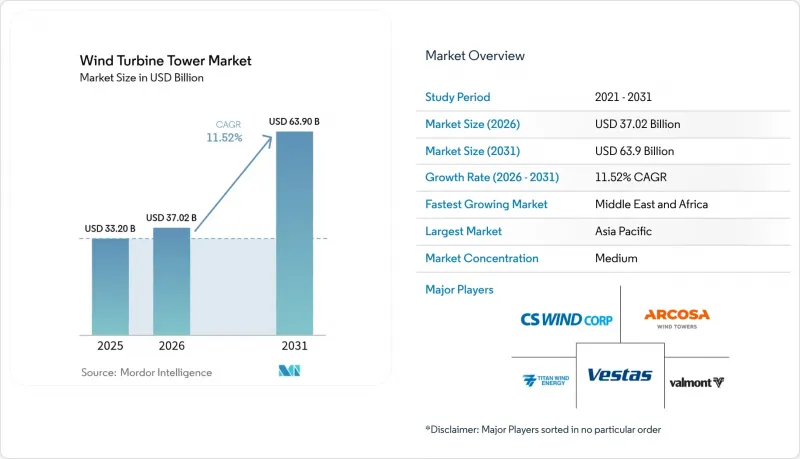
根據 Mordor Intelligence 預測,風力發電機塔架市場規模將從 2025 年的 332 億美元成長到 2026 年的 370.2 億美元,然後在 2031 年達到 639 億美元,2026 年至 2031 年的複合年成長率為 11.52%。
本報告按塔型(鋼管型、混凝土型、鋼-混凝土組合型、網格型、拉索型和模組化/分層組合型)、安裝方法(陸上、海上固定式、浮體式海上)、塔高(80米以下、81-120米、121-160米和160米以上)和地區(北美、歐洲和非洲地區分類(北美、歐洲和非洲地區)和地區分類(北美、歐洲和非洲地區)。
全球風力發電機塔架市場趨勢及洞察
美國鋼塔產能超過 1 億座的在地化生產,得益於《通膨控制法案》(IRA) 的推動。
《工業關係法》(IRA)關於國內採購價格的規定促使中西部地區總投資達20億美元的塔筒工廠建設項目激增。 CS Wind和Arcosa等全球大型企業紛紛採用「雙岸」生產策略,以平衡美國市場需求與亞洲成本。這些新工廠旨在生產高度超過120公尺的塔筒,從而減少對進口的依賴,並提升該地區在超高層建築設計方面的技術能力。 Broadwind公司2024年第四季的訂單激增85%,顯示在地採購採購的供應規模已達到具有競爭力的水平。
德國和北歐國家對授權制度進行改革,以允許建造超過 160 公尺高的塔樓。
柏林2024年頒布的《陸上風電法案》將核准流程縮短了40%,導致高層風電計畫激增,其中包括現已運作中的364公尺高的魯薩蒂亞風電場。北歐各國統一的高度限制使開發商能夠利用更穩定的高空風,同時也迫使原始設備製造商(OEM)最佳化下一代風力渦輪機的負載管理軟體和噪音容限。
美國東岸海運物流的瓶頸:直徑超過 15 公尺的塔架部分。
由於《瓊斯法案》對外國船舶營運的限制,用於吊起超大直徑構件的重型裝運船隻出現短缺。港口倉儲設施和起重機能力的提升無法滿足需求,迫使企業採用海上模組化組裝和浮體式基礎等替代方案,導致成本和勞動成本增加。
細分市場分析
預計到2025年,混合鋼-混凝土塔架將佔風力發電機總裝機量的18.20%,並有望以每年12.68%的速度成長至2031年。這是因為這種便於運輸的模組化設計使得輪轂高度可達160公尺甚至更高,而無需道路運輸護送。混凝土用量最多可減少40%,從而提高了經濟效益。尤其是在印度和中國,在地採購義務為水泥採購帶來了優勢。諾德克斯公司自主研發的混合生產線正在支援其迄今為止最大的塔架——179公尺高的塔架的安裝。同時,在維斯塔斯公司的支持下,Modvion公司的層壓木材原型塔架預示著繼鋼材和混凝土之後,第二次材料革命即將到來。在風力發電機塔架市場,鋼管塔架在批量生產中仍然佔據主導地位,但隨著鋼板價格的持續波動,混合塔架正在縮小與鋼管塔架的成本差距。
隨著原始設備製造商(OEM)競相實現垂直整合,它們正致力於獲取戰略價值。通用電氣伯諾瓦位於密蘇裡州的工廠正在進行維修,以生產法蘭式混合風力發電機組零件,從而減少供應商數量並提高品管。相較之下,獨立製造商則在升級其環焊機器人並轉向使用耐腐蝕塗層,以保護其在風力發電機塔架市場的佔有率。
區域分析
預計到2025年,亞太地區將佔據42.70%的市場佔有率,這主要歸功於中國規模龐大的鋼板工廠以及印度對混合系統的快速應用。然而,隨著土地資源日益緊張,人們的焦點正轉向利潤更高的離岸風電和高塔架風電領域。日本第三次競標選定了1.8吉瓦的15兆瓦級風力發電機,並強制要求使用耐腐蝕塔架,這推高了該地區的平均售價。同時,韓國已向蔚山近海一個6吉瓦的浮體式風電叢集投入資金,將加速對160公尺單樁和200公尺混合塔架的需求。
歐洲正憑藉其監管方面的前瞻性,取得超越自身規模的成果。德國簡化核准流程,將專案週期縮短了18個月,使PNE和RWE等早期進入者受益匪淺。歐盟的碳邊境調節稅促使採購轉向綠色鋼鐵,使維斯塔斯能夠為其波羅的海電力公司和北光公司專案購買低碳鋼板。隨著風力發電機塔架市場的全球化,這種永續性溢價正在支撐歐洲的出口競爭力。
中東和非洲地區在低基數的基礎上,正以每年22.90%的速度成長,這主要得益於沙烏地阿拉伯和阿拉伯聯合大公國主權財富基金對1-3吉瓦裝置容量叢集的資助,這些集群與綠色氫能中心融合。在北美,由於《通貨膨脹控制法案》(IRA)推動了工廠建設,對進口的依賴程度正在降低。 CS Wind在德克薩斯州的產能擴張正在滿足美國和拉丁美洲的需求。在南美,電網升級是重點。光是巴西東北部的一個國有輸電計畫就獲得了9吉瓦的併網容量,為該地區的計畫儲備注入了新的活力。
其他好處:
- Excel格式的市場預測(ME)表
- 3個月的分析師支持
目錄
第1章:引言
- 研究假設和市場定義
- 調查範圍
第2章:調查方法
第3章執行摘要
第4章 市場狀況
- 市場概覽
- 市場促進因素
- 《工業關係法》促使美國國內集中生產高度超過 100 公尺的輸電塔。
- 德國和北歐國家對授權制度進行改革,以允許建造超過 160 公尺高的塔樓。
- 在印度及中國內陸低風速地區,採用鋼-混凝土混合塔架降低平準化電成本
- 歐盟碳邊境調節措施正在加速綠色鋼塔的引進。
- 韓國和日本的海上發電工程數量激增,這些計畫的目標是建造超過 150 公尺高的耐腐蝕鐵塔。
- 加州和西班牙的試點計畫:現場 3D 列印混凝土塔可顯著降低物流成本。
- 市場限制因素
- 美國東岸直徑超過15公尺的塔架構件海運瓶頸
- 厚鋼板價格的波動正在扭曲成本模型。
- 新興市場混合塔架型式認證延誤
- 本地化內容分配製度限制了從亞洲進口低成本基地台。
- 供應鏈分析
- 監理展望
- 技術展望
- 波特五力模型
第5章 市場規模與成長預測
- 塔式
- 鋼管塔
- 混凝土塔
- 鋼筋混凝土混合鋼塔
- 格子形杆塔
- 帶有分支線路的塔
- 模組化/堆疊式複合塔
- 不同的發展
- 陸上
- 離岸(固定)
- 海上(浮體式)
- 塔高(公尺)
- 80米或更短
- 81~120 m
- 121~160 m
- 160公尺或以上
- 按地區
- 北美洲
- 美國
- 加拿大
- 墨西哥
- 歐洲
- 德國
- 英國
- 法國
- 西班牙
- 義大利
- 俄羅斯
- 丹麥
- 瑞典
- 挪威
- 其他歐洲國家
- 亞太地區
- 中國
- 印度
- 日本
- 韓國
- 東南亞國協
- 澳洲
- 其他亞太國家
- 南美洲
- 巴西
- 阿根廷
- 其他南美國家
- 中東和非洲
- 阿拉伯聯合大公國
- 沙烏地阿拉伯
- 南非
- 埃及
- 其他中東和非洲國家
- 北美洲
第6章 競爭情勢
- 市場集中度
- 策略趨勢(併購、聯盟、購電協議)
- 市場佔有率分析(主要公司的市場排名和佔有率)
- 公司簡介
- CS Wind Corporation
- Titan Wind Energy
- Valmont Industries Inc.
- Arcosa Wind Towers Inc.
- Trinity Structural Towers
- Broadwind Energy Inc.
- KGW Schweriner Maschinen-und Anlagenbau
- Dongkuk S&C
- Speco Technologies Co. Ltd
- Vestas Wind Systems A/S
- Siemens Gamesa Renewable Energy
- GE Vernova
- Goldwind
- Enercon GmbH
- Nordex SE
- Senvion SA
- Max Bogl Wind AG
- Ming Yang Smart Energy
- Envision Energy
- Sinoma Wind Towers
第7章 市場機會與未來展望
According to Mordor Intelligence, the wind turbine tower market size is expected to grow from USD 33.20 billion in 2025 to USD 37.02 billion in 2026 and is forecast to reach USD 63.9 billion by 2031 at 11.52% CAGR over 2026-2031.
This report is Segmented by Tower Type (Tubular Steel, Concrete, Hybrid Steel-Concrete, Lattice, Guyed Pole, and Modular/Stacked Composite), Deployment (Onshore, Offshore-Fixed-Bottom, and Offshore-Floating), Tower Height (Up To 80 M, 81-120 M, 121-160 M, and Above 160 M), and Geography (North America, Europe, Asia-Pacific, South America, and Middle East and Africa).
Global Wind Turbine Tower Market Trends and Insights
IRA-driven localization of Over 100 m steel tower capacity in the United States
Domestic-content rules embedded in the IRA have triggered USD 2 billion of tower factory announcements across the Midwest, drawing global leaders such as CS Wind and Arcosa into dual-shore production strategies that balance U.S. demand with Asian cost bases.New plants are engineered for >120 m sections, eliminating historical import dependence and raising regional competence for ultra-tall designs. Order inflows at Broadwind surged 85% in Q4 2024, demonstrating that localized supply now achieves competitive scale.
Permitting reforms enabling >160 m towers in Germany & the Nordics
Berlin's 2024 "Onshore Wind Law" cut approval timelines by 40%, unleashing a queue of extreme-height projects, including the 364 m Lusatia installation now operational. Coordinated Nordic height caps allow developers to tap steadier high-altitude winds, compelling OEMs to refine load-management software and noise envelopes on next-generation turbines.
Seaborne logistics bottlenecks for >15 m-diameter tower sections on the U.S. East Coast
Jones Act rules limit foreign vessels, creating a scarcity of heavy-lift ships needed for XXL-diameter sections. Port staging yards and crane upgrades lag demand, forcing modular at-sea assembly or floating foundation workarounds that add cost and time.
Other drivers and restraints analyzed in the detailed report include:
- Hybrid steel-concrete towers cutting LCoE for low-wind inland sites in India & China
- EU carbon border adjustment accelerating adoption of green-steel towers
- Volatility in heavy-plate steel prices distorting cost models
For complete list of drivers and restraints, kindly check the Table Of Contents.
Segment Analysis
Hybrid steel-concrete towers captured 18.20% of 2025 installations and are forecast to grow 12.68% annually to 2031 as transportation-friendly modules allow >160 m hub heights without escorted road convoys. Concrete savings of up to 40% improve economics, especially in India and China, where local content mandates reward cement sourcing. Nordex's in-house hybrid line underpins the firm's largest-ever 179 m tower deployment, while Vestas-backed Modvion's laminated timber prototype signals a second material revolution beyond steel and concrete. The wind turbine tower market continues to lean on tubular steel for mass production, yet hybrid options are closing the cost gap as raw-plate volatility persists.
OEMs racing toward vertical integration highlight strategic value capture. GE Vernova's Missouri plant retrofit now outputs flange-ready hybrid sections, shrinking supplier lists and tightening quality control. Independent fabricators respond by upgrading circumferential welding robots and shifting toward corrosion-resistant coatings to defend their share in the wind turbine tower market.
Complete Report Scope:
- By Tower Type
- Tubular Steel Towers
- Concrete Towers
- Hybrid Steel-Concrete Towers
- Lattice Towers
- Guyed Pole Towers
- Modular/Stacked Composite Towers
- By Deployment
- Onshore
- Offshore (Fixed-Bottom)
- Offshore (Floating)
- By Tower Height (m)
- Up to 80 m
- 81 to 120 m
- 121 to 160 m
- Above 160 m
- By Geography
- North America
- United States
- Canada
- Mexico
- Europe
- Germany
- United Kingdom
- France
- Spain
- Italy
- Russia
- Denmark
- Sweden
- Norway
- Rest of Europe
- Asia Pacific
- China
- India
- Japan
- South Korea
- ASEAN Countries
- Australia
- Rest of Asia Pacific
- South America
- Brazil
- Argentina
- Rest of South America
- Middle East and Africa
- United Arab Emirates
- Saudi Arabia
- South Africa
- Egypt
- Rest of Middle East and Africa
- North America
Geography Analysis
Asia-Pacific's 42.70% share in 2025 flowed from China's giga-scale steel plate mills and India's rapid hybrid adoption. Yet the spotlight shifts to higher-margin offshore and tall-tower segments as land constraints tighten. Japan's Round 3 auction launches 1.8 GW of 15 MW class turbines, mandating corrosion-resistant towers that elevate regional average selling prices. Simultaneously, South Korea allocates CAPEX to a 6 GW floating pilot cluster off Ulsan, accelerating demand for 160 m monopiles and 200 m hybrid towers.
Europe leverages regulatory foresight to punch above its weight. Streamlined German permitting shaved 18 months from project cycles, rewarding early movers PNE and RWE. EU carbon-border charges shift procurement towards green steel, letting Vestas lock in low-carbon plate at Baltic Power and Nordlicht. Such sustainability premiums buttress European export competitiveness as the wind turbine tower market globalizes.
The Middle East & Africa grows 22.90% annually from a low base as sovereign funds in Saudi Arabia and the UAE bankroll 1-3 GW clusters integrated with green hydrogen hubs. North America's IRA-fuelled factory buildout is shrinking import dependence; CS Wind's Texas ramp-up feeds both U.S. and Latin American demand. South America eyes grid upgrades-Brazil's northeast state-run transmission plan alone frees 9 GW of interconnection-re-energizing the regional project pipeline.
- CS Wind Corporation
- Titan Wind Energy
- Valmont Industries Inc.
- Arcosa Wind Towers Inc.
- Trinity Structural Towers
- Broadwind Energy Inc.
- KGW Schweriner Maschinen- und Anlagenbau
- Dongkuk S&C
- Speco Technologies Co. Ltd
- Vestas Wind Systems A/S
- Siemens Gamesa Renewable Energy
- GE Vernova
- Goldwind
- Enercon GmbH
- Nordex SE
- Senvion SA
- Max Bogl Wind AG
- Ming Yang Smart Energy
- Envision Energy
- Sinoma Wind Towers
Additional Benefits:
- The market estimate (ME) sheet in Excel format
- 3 months of analyst support
TABLE OF CONTENTS
1 Introduction
- 1.1 Study Assumptions & Market Definition
- 1.2 Scope of the Study
2 Research Methodology
3 Executive Summary
4 Market Landscape
- 4.1 Market Overview
- 4.2 Market Drivers
- 4.2.1 IRA-Driven Localization of Above 100 m Steel Tower Manufacturing Capacity in the United States
- 4.2.2 Permitting Reforms Enabling Above 160 m Towers in Germany & the Nordics
- 4.2.3 Hybrid Steel-Concrete Towers Cutting LCoE for Low-Wind Inland Sites in India & China
- 4.2.4 EU Carbon Border Adjustment Accelerating Adoption of Green-Steel Towers
- 4.2.5 Surging South-Korean & Japanese Offshore Targets for Over 150 m Corrosion-Resistant Towers
- 4.2.6 On-site 3D-Printed Concrete Towers Slashing Logistics Costs in California & Spain Pilots
- 4.3 Market Restraints
- 4.3.1 Seaborne Logistics Bottlenecks for Above 15 m-Diameter Tower Sections on U.S. East Coast
- 4.3.2 Volatility in Heavy-Plate Steel Prices Distorting Cost Models
- 4.3.3 Delayed Type-Certification for Hybrid Towers in Emerging Markets
- 4.3.4 Local-Content Quotas Constraining Import of Low-Cost Asian Towers
- 4.4 Supply-Chain Analysis
- 4.5 Regulatory Outlook
- 4.6 Technological Outlook
- 4.7 Porter's Five Forces
- 4.7.1 Bargaining Power of Suppliers
- 4.7.2 Bargaining Power of Consumers
- 4.7.3 Threat of New Entrants
- 4.7.4 Threat of Substitutes
- 4.7.5 Intensity of Competitive Rivalry
5 Market Size & Growth Forecasts
- 5.1 By Tower Type
- 5.1.1 Tubular Steel Towers
- 5.1.2 Concrete Towers
- 5.1.3 Hybrid Steel-Concrete Towers
- 5.1.4 Lattice Towers
- 5.1.5 Guyed Pole Towers
- 5.1.6 Modular/Stacked Composite Towers
- 5.2 By Deployment
- 5.2.1 Onshore
- 5.2.2 Offshore (Fixed-Bottom)
- 5.2.3 Offshore (Floating)
- 5.3 By Tower Height (m)
- 5.3.1 Up to 80 m
- 5.3.2 81 to 120 m
- 5.3.3 121 to 160 m
- 5.3.4 Above 160 m
- 5.4 By Geography
- 5.4.1 North America
- 5.4.1.1 United States
- 5.4.1.2 Canada
- 5.4.1.3 Mexico
- 5.4.2 Europe
- 5.4.2.1 Germany
- 5.4.2.2 United Kingdom
- 5.4.2.3 France
- 5.4.2.4 Spain
- 5.4.2.5 Italy
- 5.4.2.6 Russia
- 5.4.2.7 Denmark
- 5.4.2.8 Sweden
- 5.4.2.9 Norway
- 5.4.2.10 Rest of Europe
- 5.4.3 Asia Pacific
- 5.4.3.1 China
- 5.4.3.2 India
- 5.4.3.3 Japan
- 5.4.3.4 South Korea
- 5.4.3.5 ASEAN Countries
- 5.4.3.6 Australia
- 5.4.3.7 Rest of Asia Pacific
- 5.4.4 South America
- 5.4.4.1 Brazil
- 5.4.4.2 Argentina
- 5.4.4.3 Rest of South America
- 5.4.5 Middle East and Africa
- 5.4.5.1 United Arab Emirates
- 5.4.5.2 Saudi Arabia
- 5.4.5.3 South Africa
- 5.4.5.4 Egypt
- 5.4.5.5 Rest of Middle East and Africa
- 5.4.1 North America
6 Competitive Landscape
- 6.1 Market Concentration
- 6.2 Strategic Moves (M&A, Partnerships, PPAs)
- 6.3 Market Share Analysis (Market Rank/Share for key companies)
- 6.4 Company Profiles (includes Global level Overview, Market level overview, Core Segments, Financials as available, Strategic Information, Products & Services, and Recent Developments)
- 6.4.1 CS Wind Corporation
- 6.4.2 Titan Wind Energy
- 6.4.3 Valmont Industries Inc.
- 6.4.4 Arcosa Wind Towers Inc.
- 6.4.5 Trinity Structural Towers
- 6.4.6 Broadwind Energy Inc.
- 6.4.7 KGW Schweriner Maschinen- und Anlagenbau
- 6.4.8 Dongkuk S&C
- 6.4.9 Speco Technologies Co. Ltd
- 6.4.10 Vestas Wind Systems A/S
- 6.4.11 Siemens Gamesa Renewable Energy
- 6.4.12 GE Vernova
- 6.4.13 Goldwind
- 6.4.14 Enercon GmbH
- 6.4.15 Nordex SE
- 6.4.16 Senvion SA
- 6.4.17 Max Bogl Wind AG
- 6.4.18 Ming Yang Smart Energy
- 6.4.19 Envision Energy
- 6.4.20 Sinoma Wind Towers
7 Market Opportunities & Future Outlook
- 7.1 White-Space & Unmet-Need Assessment

 2034年風力塔市場預測-按塔型、塔高、渦輪機功率、部署狀態、最終用戶和地區分類的全球分析
 風力渦輪機塔筒市場:全球市場預測,2026-2032年
 風力發電機塔架市場機會、成長促進因素、產業趨勢分析及2026-2035年預測
 風力渦輪機塔筒市場規模、佔有率、成長及全球產業分析:按類型、應用和地區分類,並預測至2026-2034年
 風力塔市場 - 全球產業規模、佔有率、趨勢、機會、預測:按類型、應用、安裝類型、容量、地區和競爭格局分類,2021-2031年風力發電機塔筒市場 - 全球產業規模、佔有率、趨勢、機會及按類型、安裝方式、地區和競爭格局分類的預測(2021-2031年)
 風力塔市場規模、佔有率和成長分析(按類型、安裝方式、應用和地區分類)—產業預測(2026-2033 年)2032 年風力發電機塔架市場預測:按塔類型、高度、額定容量、基礎類型、塗層、應用和地區分類的全球分析離岸風電塔市場(按塔類型、材料類型、塔高和最終用途)—2025-2030 年全球預測
 風力發電機塔架市場規模、佔有率、趨勢分析報告:按類型、地點、地區、細分市場、預測,2025 年至 2030 年