


 |
市場調查報告書
商品編碼
2113444
義大利汽車自我調整照明系統:市場佔有率分析、產業趨勢與統計及成長預測(2026-2031 年)Italy Automotive Adaptive Lighting System - Market Share Analysis, Industry Trends & Statistics, Growth Forecasts (2026 - 2031) |
||||||

※ 本網頁內容可能與最新版本有所差異。詳細情況請與我們聯繫。
據 Mordor Intelligence 稱,2025 年義大利汽車自我調整照明系統市場價值 6,000 萬美元,預計 2026 年將達到 7,000 萬美元,預計到 2031 年將達到 1.3 億美元。
預計從 2026 年到 2031 年,其複合年成長率將達到 13.71%。
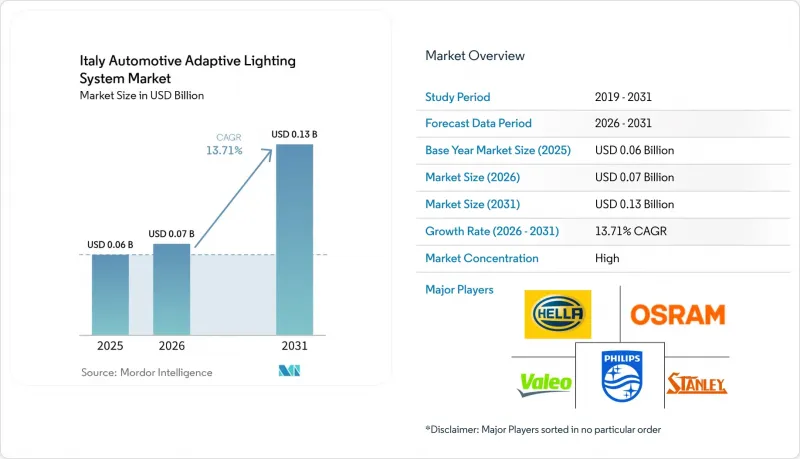
本報告按車輛類型(例如,乘用車)、照明類型(前燈和尾燈)、組件(例如,燈具總成)、銷售管道(OEM 和售後市場)以及技術(例如,LED 矩陣)進行細分。市場預測以貨幣價值(美元)和銷售(單位)兩種形式呈現。
義大利汽車自我調整照明系統市場趨勢與洞察
歐盟通用安全法規將強制要求從 2027 年起所有新車安裝 ADB(自適應遠光燈)。
歐盟通用安全法規 (EU 2019/2144) 強制要求所有在 2027 年 7 月之後獲得型式認證的新乘用車和輕型商用車必須配備自我調整遠光燈 (ADB) 功能,從而取消了原始設備製造商 (OEM) 的自主選擇權,並將自我調整前燈列為合規要求。因此,義大利的組裝和進口商必須採用符合 UNECE R123 標準的系統才能維持型式認證,這為供應商設定了“固定需求下限”,使其免受經濟波動的影響。像海拉 (HELLA) 這樣擁有成熟產品系列的現有公司,已經受益於長達數年的訂單儲備,這些訂單將持續到 2028 年該計劃正式啟動之時。除了新車銷售外,該法規還將創造長期的售後市場需求,因為 2027 年車型的維修需求將持續到 2030 年以後。
LED矩陣模組價格的大幅下降導致其在B級車中的應用日益廣泛。
12,000像素LED矩陣陣列的模組成本已降至50歐元(55美元)以下,使得飛雅特熊貓等義大利B級車能夠在不影響毛利率的情況下,標配無眩光遠光燈。海拉將於2024年推出的「FlatLightµMX」組件,透過將光學厚度減少高達50%並降低功耗,進一步緩解了封裝和電氣負載方面的挑戰。因此,該技術的適用範圍已從高階D級轎車擴展到大眾市場小型車,徹底改變了競爭格局。隨著硬體的日益同質化,基於軟體的光束控制演算法正成為新的競爭領域。
由於半導體供應波動,ECU 的前置作業時間已延長至 52 週以上。
採用28奈米製程製造的成熟節點微控制器持續面臨長期供不應求,前置作業時間長達一年,迫使一級供應商要麼維持緩衝庫存,要麼支付現貨溢價。海拉2025年報告指出,Nexperia的配額限制導致一些專案不得不暫時重新設計。這種不確定性正在擠壓專案利潤空間,並威脅到義大利汽車製造商(OEM)目前應用於小批量車型的準時生產模式。
細分市場分析
儘管輕型商用車目前在義大利汽車自我調整照明系統市場中所佔佔有率很小,但預計到2031年,其年複合成長率(CAGR)將達到13.74%,超過乘用車。到2025年,由於原始設備製造商(OEM)在歐盟監管過渡期前提前採用自適應照明系統,乘用車的出貨量將佔據67.16%的主導地位。未來五年,Lombardia第大區的「零願景」(Vision Zero)津貼(每輛貨車800歐元)將使主動式轉向頭燈可以略微減少每輛車每年因事故造成的停機時間。在波河沿岸霧氣瀰漫的高速公路上運營黎明前配送路線的小包裹和食品配送公司是自適應照明系統的領先,他們在2026年的採用者週期中訂購了包含前置鏡頭升級套件的售後市場套件。
展望未來,輕型商用車 (LCV) 車隊在投資報酬率計算方面更具優勢,因為每次避免碰撞都能直接轉化為確保交貨時段、減少鈑金停工時間和降低保險免賠額。即使沒有補貼支持,這些協同效應也足以證明高額初始投資的合理性,這意味著即使在現有津貼於 2027 年結束後,該細分市場仍能保持兩位數的成長。在乘用車市場,隨著所有新型式認證車輛都將配備 ADB 硬體,銷量必將成長,但隨著 LED 矩陣式大燈價格的持續下降,預計收益彈性將會降低。
到2025年,前部自我調整照明系統將佔據義大利汽車自我調整照明系統市場71.24%的佔有率。這主要是因為,由於聯合國歐洲經濟委員會(UNECE)R123標準對發光強度提出了嚴格的要求,因此動態頭燈正逐漸成為汽車製造商的強制性配置。儘管後部自我調整照明系統的基數較小,但預計到2031年,其複合年成長率將達到13.83%,成為成長最快的系統。後部自適應照明系統利用微型LED陣列顯示動態危險警告圖標,即使在50米霧霾天氣下也能有效減少多車碰撞事故。一項在摩德納-布倫納A22走廊重型貨車(HGV)和輕型商用車(LCV)上開展的試點項目表明,採用動態後部警示圖標代替靜態警示燈可以顯著縮短後方車輛駕駛員的反應時間。Lombardia政府在敦促羅馬政府制定車對車(V2V)交通資訊共享系統實施指南時,引用了這些數據。
儘管條件有利,但後部照明模組仍面臨監管方面的灰色地帶。目前,聯合國歐洲經濟委員會(UNECE)的標準規定了顏色和亮度,但並未涵蓋動態符號集,這迫使汽車製造商必須適應各成員國不同的解釋。供應商透過交付韌體鎖定的燈具來降低這種風險,允許客戶在各國法規結構批准特定圖標庫後才能啟用該功能。
其他好處:
- Excel格式的市場預測(ME)表
- 3個月的分析師支持
目錄
第1章:引言
- 研究假設和市場定義
- 調查範圍
第2章:調查方法
第3章執行摘要
第4章 市場狀況
- 市場概覽
- 市場促進因素
- 根據歐盟一般安全法規,從 2027 年起,新車必須安裝自適應遠光燈 (ADB)。
- LED點陣顯示器的價格正在快速下降(每塊降幅超過50歐元)。這擴大了它們在B級車中的應用範圍。
- OEM廠商的OTA賦能型收入模式正在加速選配採用率的提高。
- 與 AMS-OSRAM 和 STMICRO 等國內一級供應商建立合作關係,可使物料清單 (BOM) 減少 12%。
- 在波河流域能見度低的情況下,利用微型LED尾燈進行霧霾預警通訊。
- Lombardia的「零願景」:為輕型商用車 (LCV) 車隊提供主動式轉向頭燈的激勵措施
- 市場限制因素
- 由於半導體供應波動,ECU 的前置作業時間已延長至 52 週以上。
- 義大利的登記稅以產量計算,對高流明改裝套件不利。
- 皮埃蒙特地區以外電氣工程人才的短缺正在減緩該地區研發的擴張。
- 聯合國歐洲經濟委員會的光度測試費用(每次變化不到 90 萬歐元)阻礙了中小企業的進入。
- 價值供應鏈分析
- 監理情勢
- 技術展望
- 波特五力模型
第5章 市場規模與成長預測
- 車輛類型
- 搭乘用車
- 輕型商用車(LCV)
- 中型和大型商用車輛(M&HCV)
- 依照明類型
- 前部自我調整照明(頭燈)
- 後部自我調整照明(尾燈)
- 按組件
- 燈具組件
- 感應器和攝影機
- 控制器
- 其他
- 按銷售管道
- OEM
- 售後市場
- 透過技術
- LED矩陣/像素照明
- 基於雷射的自我調整照明
- 鹵素/氙氣自我調整照明
第6章 競爭情勢
- 市場集中度
- 策略趨勢
- 市佔率分析
- 公司簡介
- HELLA GmbH & Co. KGaA
- Valeo SA
- Marelli Automotive Lighting
- Koito Manufacturing Co. Ltd.
- Stanley Electric Co. Ltd.
- ams OSRAM
- ZKW Group GmbH
- Hyundai Mobis Co. Ltd.
- LG Innotek Co. Ltd.
- Robert Bosch GmbH
- Koninklijke Philips NV
- DENSO Corporation
- Aptiv PLC
- Texas Instruments Inc.
- Renesas Electronics Corp.
- STMicroelectronics NV
- Infineon Technologies AG
- Lear Corporation
- Panasonic Automotive Systems
- Nichia Corporation
第7章 市場機會與未來展望
According to Mordor Intelligence, the Italian automotive adaptive lighting system market size is valued at USD 0.06 billion in 2025, is estimated at USD 0.07 billion in 2026, and is projected to reach USD 0.13 billion by 2031, growing at a CAGR of 13.71% over 2026-2031.
This report is Segmented by Vehicle Type (Passenger Cars and More), Lighting Type (Front and Rear), Component (Lamp Assemblies and More), Sales Channel (OEM and Aftermarket), and Technology (LED-Matrix and More). Market Forecasts are Provided in Value (USD) and Volume (Units).
Italy Automotive Adaptive Lighting System Market Trends and Insights
EU General Safety Regulation Mandates ADB in New Vehicle Types From 2027
The European Union's General Safety Regulation (EU 2019/2144) mandates adaptive driving beam capability in every new passenger car and light commercial vehicle type approved after July 2027, removing OEM discretion and turning adaptive headlights into a compliance item . Italian assemblers and importers must therefore integrate UNECE R123-compliant systems to preserve type-approval, creating a locked-in demand floor that shields suppliers from cyclical swings. Incumbents with validated portfolios, such as HELLA, benefit from multi-year nomination pipelines already stretching to 2028 program launches. Beyond new-vehicle volumes, the rule seeds a long-tail aftermarket for replacement parts once today's 2027-era cars cycle into repair age after 2030.
Rapid LED-Matrix Price Erosion Widens Fitment to B-Segment Cars
Module costs for 12,000-pixel LED-Matrix arrays have fallen below EUR 50 (USD 55), enabling Italian B-segment nameplates such as the Fiat Panda to bundle glare-free high beam without trimming gross margin. HELLA's FlatLight µMX package, introduced in 2024, trims optical depth by up to 50% and reduces power draw, further easing packaging and electrical load hurdles . As a result, the volume ceiling shifts from premium D-segment sedans to mass-market superminis, flipping the competitive script: hardware is commoditizing, while software-based beam-steering algorithms become the new battleground.
Semiconductor Supply Volatility Lengthens ECU Lead-Times Beyond 52 Weeks
Mature-node microcontrollers fabricated on 28 nm lines remain chronically tight, inflating lead-times to one year and forcing Tier-1s to hold buffer stock or pay spot premiums. HELLA's FY2025 bulletin cited Nexperia allocation caps that required last-minute redesigns. Such unpredictability compresses program margins and endangers just-in-time models that Italian OEMs apply to lower-volume nameplates.
Other drivers and restraints analyzed in the detailed report include:
- OEM OTA Feature-Unlock Revenue Models Accelerate Option Take-Rate
- Domestic Tier-1 Collaboration With ams OSRAM & STMicro Shrinks BOM by 12%
- Power-Based Italian Registration Tax Penalizes High-Lumen Retrofit Kits
For complete list of drivers and restraints, kindly check the Table Of Contents.
Segment Analysis
Light commercial vehicles account for a modest slice of the Italian automotive adaptive lighting system market size, but will outpace passenger cars with a 13.74% CAGR through 2031. In 2025, passenger cars dominated volumes at 67.16% share, powered by early OEM integration ahead of the EU regulation cut-over. Over the next five years, Lombardy's Vision-Zero grants, worth EUR 800 per van, tilt economics in favor of adaptive headlights that can cut accident-related downtime by a minimal rate per fleet year. Parcel and grocery operators that run pre-dawn routes across fog-laden Po Valley highways have become first movers, ordering retrofit kits bundled with forward-camera upgrades in 2026 procurement cycles.
Looking ahead, LCV fleets enjoy stronger payback math because each avoided collision translates directly into kept delivery slots, reduced body-shop downtime, and lower insurance deductibles. That benefit stack justifies higher up-front spend even without subsidy support, suggesting the segment can maintain double-digit growth once today's grants sunset in 2027. Passenger cars will add volumes mechanically as every new type-approved model carries ADB hardware, yet revenue elasticity will compress as LED-Matrix pricing continues to slide.
Front adaptive lighting held 71.24% of the Italian automotive adaptive lighting system market share in 2025, anchored by UNECE R123's stringent photometric benchmarks that make dynamic headlamps an OEM must-have. Rear adaptive lighting, though starting from a smaller base, is projected to post the fastest 13.83% CAGR through 2031 as micro-LED arrays unlock animated hazard icons that cut multi-car pile-ups in 50-meter fog. HGV and LCV pilots on the A22 Modena-Brenner corridor have shown faster reaction times among following drivers when dynamic rear icons replace static lamps, data that Lombardy authorities cite when lobbying Rome for V2V adoption guidelines.
Despite the tailwind, rear modules face regulatory gray zones: current UNECE files cover color and intensity but not animated symbol sets, forcing automakers to navigate varied member-state interpretations. Suppliers mitigate risk by shipping firmware-locked lamps that customers can activate only after national frameworks green-light specific icon libraries.
Complete Report Scope:
- By Vehicle Type
- Passenger Cars
- Light Commercial Vehicles (LCVs)
- Medium & Heavy Commercial Vehicles (M&HCVs)
- By Lighting Type
- Front Adaptive Lighting (Headlamps)
- Rear Adaptive Lighting (Tail Lamps)
- By Component
- Lamp Assemblies
- Sensors & Cameras
- Controllers
- Others
- By Sales Channel
- OEM
- Aftermarket
- By Technology
- LED-Matrix / Pixel Lighting
- Laser-Based Adaptive Lighting
- Halogen-/Xenon-Based Adaptive Lighting
List of Companies Covered in this Report:
- HELLA GmbH & Co. KGaA
- Valeo SA
- Marelli Automotive Lighting
- Koito Manufacturing Co. Ltd.
- Stanley Electric Co. Ltd.
- ams OSRAM
- ZKW Group GmbH
- Hyundai Mobis Co. Ltd.
- LG Innotek Co. Ltd.
- Robert Bosch GmbH
- Koninklijke Philips N.V.
- DENSO Corporation
- Aptiv PLC
- Texas Instruments Inc.
- Renesas Electronics Corp.
- STMicroelectronics N.V.
- Infineon Technologies AG
- Lear Corporation
- Panasonic Automotive Systems
- Nichia Corporation
Additional Benefits:
- The market estimate (ME) sheet in Excel format
- 3 months of analyst support
TABLE OF CONTENTS
1 Introduction
- 1.1 Study Assumptions & Market Definition
- 1.2 Scope of the Study
2 Research Methodology
3 Executive Summary
4 Market Landscape
- 4.1 Market Overview
- 4.2 Market Drivers
- 4.2.1 EU General Safety Regulation Mandates ADB in New Vehicle Types From 2027
- 4.2.2 Rapid Led-Matrix Price Erosion (More than Euro 50/Unit) Widens Fitment to B-Segment Cars
- 4.2.3 OEM OTA Feature-Unlock Revenue Models Accelerate Option-Take-Rate
- 4.2.4 Domestic Tier-1 Collaboration With AMS-OSRAM & STMICRO Shrinks BOM by 12 %
- 4.2.5 Micro-Led Rear-Lamp Communication for Low-Visibility Po Valley Fog Alerts
- 4.2.6 Lombardy "Vision-Zero" Incentives for Adaptive Headlights on LCV Fleets
- 4.3 Market Restraints
- 4.3.1 Semiconductor Supply Volatility Lengthens ECU Lead-Times Beyond 52 Weeks
- 4.3.2 Power-Based Italian Registration Tax Penalises High-Lumen Retrofit Kits
- 4.3.3 Limited Electronics Talent Pool Outside Piedmont Slows Local R&D Scaling
- 4.3.4 UNECE Photometric Test Costs (Less than Euro 0.9 M Per Variant) Deter SME Entrants
- 4.4 Value / Supply-Chain Analysis
- 4.5 Regulatory Landscape
- 4.6 Technological Outlook
- 4.7 Porter's Five Forces
- 4.7.1 Threat of New Entrants
- 4.7.2 Bargaining Power of Buyers
- 4.7.3 Bargaining Power of Suppliers
- 4.7.4 Threat of Substitutes
- 4.7.5 Competitive Rivalry
5 Market Size & Growth Forecasts (Value (USD) and Volume (Units))
- 5.1 By Vehicle Type
- 5.1.1 Passenger Cars
- 5.1.2 Light Commercial Vehicles (LCVs)
- 5.1.3 Medium & Heavy Commercial Vehicles (M&HCVs)
- 5.2 By Lighting Type
- 5.2.1 Front Adaptive Lighting (Headlamps)
- 5.2.2 Rear Adaptive Lighting (Tail Lamps)
- 5.3 By Component
- 5.3.1 Lamp Assemblies
- 5.3.2 Sensors & Cameras
- 5.3.3 Controllers
- 5.3.4 Others
- 5.4 By Sales Channel
- 5.4.1 OEM
- 5.4.2 Aftermarket
- 5.5 By Technology
- 5.5.1 LED-Matrix / Pixel Lighting
- 5.5.2 Laser-Based Adaptive Lighting
- 5.5.3 Halogen-/Xenon-Based Adaptive Lighting
6 Competitive Landscape
- 6.1 Market Concentration
- 6.2 Strategic Moves
- 6.3 Market Share Analysis
- 6.4 Company Profiles (includes Global Level Overview, Market Level Overview, Core Segments, Financials as Available, Strategic Information, Market Rank/Share for Key Companies, Products and Services, SWOT Analysis, and Recent Developments)
- 6.4.1 HELLA GmbH & Co. KGaA
- 6.4.2 Valeo SA
- 6.4.3 Marelli Automotive Lighting
- 6.4.4 Koito Manufacturing Co. Ltd.
- 6.4.5 Stanley Electric Co. Ltd.
- 6.4.6 ams OSRAM
- 6.4.7 ZKW Group GmbH
- 6.4.8 Hyundai Mobis Co. Ltd.
- 6.4.9 LG Innotek Co. Ltd.
- 6.4.10 Robert Bosch GmbH
- 6.4.11 Koninklijke Philips N.V.
- 6.4.12 DENSO Corporation
- 6.4.13 Aptiv PLC
- 6.4.14 Texas Instruments Inc.
- 6.4.15 Renesas Electronics Corp.
- 6.4.16 STMicroelectronics N.V.
- 6.4.17 Infineon Technologies AG
- 6.4.18 Lear Corporation
- 6.4.19 Panasonic Automotive Systems
- 6.4.20 Nichia Corporation
7 Market Opportunities & Future Outlook
- 7.1 White-Space & Unmet-Need Assessment

 2026-2030年全球汽車自適應頭燈系統市場
 自我調整頭燈市場預測至2034年-全球分析(按組件、光源、功能、系統類型、車輛驅動系統、車輛類型、技術、頭燈類型、銷售管道和地區分類)
 自動遠光燈控制:市場佔有率分析、產業趨勢與統計、成長預測(2026-2031)
 自適應頭燈市場 - 全球產業規模、佔有率、趨勢、機會、預測:按車輛類型、技術、地區和競爭格局分類,2021-2031年
 自適應照明系統市場分析與預測(至2035年):類型、產品類型、服務、技術、組件、應用、形式、功能、安裝方式、解決方案
 汽車自我調整頭燈系統市場報告(按產品類型、應用和地區分類,2026-2034年)自動遠光燈控制市場 - 全球產業規模、佔有率、趨勢、機會及預測(按車輛類型、動力類型、銷售管道、技術、地區和競爭格局分類,2021-2031年)
 汽車自我調整頭燈市場規模、佔有率和成長分析(按技術、車輛類型、銷售管道和地區分類)-2026-2033年產業預測
 自適應車燈的全球市場:車輛類別,頭燈類別,各銷售管道,各地區,機會,預測,2018年~2032年自動遠光燈控制市場預測(至 2032 年):按車型、動力系統、零件、技術、銷售管道和地區進行的全球分析