


 |
市場調查報告書
商品編碼
2097343
自動遠光燈控制:市場佔有率分析、產業趨勢與統計、成長預測(2026-2031)Automatic High Beam Control - Market Share Analysis, Industry Trends & Statistics, Growth Forecasts (2026 - 2031) |
||||||

※ 本網頁內容可能與最新版本有所差異。詳細情況請與我們聯繫。
根據 Mordor Intelligence 預測,自動遠光燈控制的市場規模預計將在 2025 年達到 12.5 億美元,2026 年達到 13.6 億美元,到 2031 年達到 20.2 億美元,2026 年至 2031 年的複合年成長率為 8.23%。
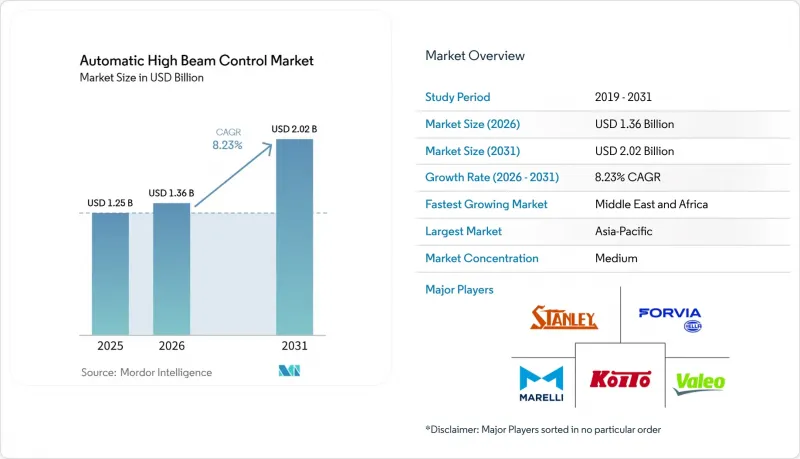
本報告按技術(攝影機系統、雷達系統、LiDAR系統、感測器融合模組)、車輛類型(乘用車、輕型商用車等)、動力系統(內燃機等)、分銷管道(OEM、售後市場)和地區進行細分。市場預測以美元計價。
全球自動遠光燈控制市場趨勢與分析
美國允許使用自我調整駕駛光束的法規
2022年9月,美國國家公路交通安全管理局 (NHTSA) 批准了自我調整遠光燈,打破了十年的障礙。這使得汽車製造商能夠在全球範圍內推廣該功能,並受益於共用模具和軟體。夜間遠光燈的使用率仍然很低。根據美國公路安全保險協會 (IIHS) 的研究,只有18%的駕駛會手動開啟遠光燈,而自動防眩光遠光燈則解決了已被證實存在的安全隱患。車型更新周期與這項法規相吻合,使得汽車製造商能夠在產品生命週期中期無需增加成本即可整合此功能。各州車輛檢驗標準的後續更新也進一步推動了經銷商展示室的需求。
LED矩陣成本的降低使得AHB技術得以進入大眾市場。
在亞太市場,成本效益至關重要。近年來,晶圓良率的提升與驅動元件整合度的提升顯著降低了矩陣式LED構裝的成本。這項轉變正推動自動遠光燈控制成為中階車型的標配。供應商正逐步部署可適應不同區域配置的高度可擴充性模組化光學元件。這項創新將使汽車製造商能夠提供具有獨特照明功能的差異化產品。此外,隨著LED組裝流程向中國主要汽車製造地轉移,預計成本將進一步降低,這得益於物流挑戰的減少和外匯風險的降低。
暴雨中相機眩光和性能差異阻礙了監管部門的批准。
基於攝影機的自動遠光燈系統在惡劣天氣條件下表現不佳,尤其是在暴雨、陽光直射或反射面導致感測器眩光的情況下。熱帶地區的監管機構對批准可能在季風季節發生故障的技術持謹慎態度。隨著測試週期的延長,市場准入被推遲,人們對雷達視覺融合技術的興趣日益濃厚。原始設備製造商(OEM)正在權衡額外的組件成本與保固索賠風險,導致儘管旗艦車型配備了此功能,但入門級車型採用該技術的速度仍然緩慢。
基於細分市場的分析
到2025年,相機模組將佔據自動遠光燈控制市場69.57%的佔有率。這主要得益於前向ADAS攝影機的重複利用,從而降低了額外成本。基於感測器融合設計的自動遠光燈控制市場規模預計在預測期(2026-2031年)內將以11.57%的複合年成長率成長。這是因為雷達,以及未來的短程LiDAR,將增強在霧天和暴雨天氣下的冗餘性。汽車製造商正擴大將融合技術整合到網域控制器中,不僅可以減輕佈線重量,還能實現更高的像素密度,從而獲得無眩光、高精度的影像。隨著可擴展性的提高,預計這一細分市場將對獨立攝影機解決方案構成壓力,尤其是在天氣條件快速變化的商用車輛中。
感測器融合模組透過融合頻譜輸入,突破了性能極限,實現了更平滑的光束截止,並降低了誤報率。供應商已展示了即使在 40 勒克斯的後向散射光條件下也能保持目標識別的演算法,而僅靠攝影機很難達到閾值。開放原始碼感知堆疊縮短了演示時間,而授權模式使得即使是中端品牌也能利用先進的融合技術,而無需擁有完整的堆疊。預計到本十年末,除低成本車輛外,僅使用攝影機的主導地位將會下降,這與基本前向碰撞警報系統的趨勢類似。
2025年,乘用車將在自動遠光燈控制市場佔據64.46%的主導市場佔有率,預計在預測期(2026-2031年)內將以10.29%的最高複合年成長率成長。汽車製造商已將這項功能從高階車型轉變為許多大眾市場車型的標準配置,因此消費者現在將防眩光遠光燈視為日常安全功能,而非豪華選項。 LED矩陣式頭燈價格的降低和相關法規的明確性是推動這一轉變的主要因素,而以安全為中心的行銷也使消費者更願意接受略高的額外成本。輕型商用車位居第二,據報道,該系統可以減少夜間碰撞事故並降低保險費用。在中型和重型卡車中,這項技術主要應用於長途運輸路線,這些路線夜間行駛時間更長,事故風險更高,因此投資回報更加明顯。
多種因素可能會繼續維持乘用車的市場主導地位。零件成本保持低位,使得汽車製造商能夠在不大幅提高展示室售價的情況下,增加遠光燈輔助功能。主要市場的監管機構已將先進頭燈納入安全評估範圍,從而提升了該功能在選配配置中的優先順序。消費者意識也是一個關鍵因素。每當駕駛員在夜間擁有更清晰的視野,且不會被對面來車的眩光所干擾時,口碑和保險折扣都會促進需求成長。在巴士和長途客車領域,這項功能也正在引入,主要集中在乘客安全和責任風險較高的熱門線路上,但公共預算緊張阻礙了其廣泛應用。所有這些趨勢都讓人聯想到安全氣囊和電子穩定控制系統(ESC)的快速普及。如果消費者和監管機構都認可這些功能的益處,那麼它們很可能會在業界迅速普及。
區域分析
到2025年,亞太地區將佔據自動遠光燈控制市場46.04%的佔有率。這主要得益於中國電池式電動車(BEV)的蓬勃發展以及日本強大的照明供應鏈。蔚來和比亞迪等國內電動車製造商正將遠光燈輔助功能作為標準配置,以符合NCAP碰撞測試標準並提升自身產品的競爭力。日本一級供應商小糸工業株式會社和史丹利公司正透過為國內和出口項目提供矩陣模組,鞏固其在亞太地區的領先地位。韓國正結合半導體技術和光學技術,為現代和起亞平台開發自主研發的整合式LED驅動器ASIC晶片。印度雖然較為注重成本,但隨著Bharat NCAP的推出,其對安全評估的重視程度正在不斷提高,這為2027年後的市場進一步拓展奠定了基礎。
儘管歐洲的普及率依然很高,但由於該地區經濟面臨許多不利因素,成長速度正在放緩。聯合國歐洲經濟委員會(UNECE)制定的頭燈法規統一了27個成員國的要求,並簡化了供應商認證程序。豪華車市場,尤其是德國汽車製造商,持續追求更高的像素密度,歐洲大陸正逐漸成為高解析度自我調整車燈的試驗場。東歐的代工組裝使用相同的照明線束,在無需承擔單獨認證成本的情況下擴展了供應鏈。能源價格波動仍然是一個較小的阻力,但整車製造商(OEM)在每次推出新電動車時都努力銷售盈利的技術包,這在一定程度上抵消了其影響。
北美緊隨其後,預計到2031年將以6.27%的複合年成長率成長,其中美國國家公路交通安全管理局(NHTSA)2022年的監管變化將進一步推動需求成長。皮卡和大型SUV的需求成長最為迅速,因為這些車型較高的駕駛視線高度加劇了眩光問題,使得自我調整光束成為一項廣受歡迎的行銷優勢。加拿大嚴酷的冬季凸顯了自適應光束在低對比度雪地上的性能,而美國保險公司已經開始為在IIHS大燈評估中獲得“良好”評級的車輛提供保費折扣。墨西哥正利用美墨加協定(USMCA)的在地採購要求,建立車燈模組出口中心,從而加強其在北美大陸的供應鏈。中東和非洲地區雖然絕對規模小規模,但其複合年成長率高達8.59%,位居榜首,這得益於海灣國家豪華車進口量的成長以及南非組裝廠不斷提升的車輛安全配置水平,使其與全球安全標準保持同步。
其他好處:
- Excel格式的市場預測(ME)表
- 3個月的分析師支持
目錄
第1章:引言
- 市場分析與定義的前提條件
- 分析範圍
第2章 分析方法
第3章執行摘要
第4章 市場狀況
- 市場概覽
- 市場促進因素
- 美國自我調整駕駛光束許可的監管要求(2022 年)
- LED矩陣成本的降低使得AHB技術得以推向大眾市場。
- 美國採用先進的車頭燈,為全球標準化鋪平了道路。
- 照明軟體的分層特性(允許OTA升級)正在創造新的收入來源。
- 保險和安全評估方面的獎勵正在加速OEM整合。
- 拉丁美洲和東協地區的NCAP照明協定正在加速這些功能的採用。
- 市場限制因素
- 暴雨期間相機眩光和性能差異阻礙了監管部門的批准。
- 提高頭燈 ECU(UN R155)網路安全的成本給一級製造商的利潤率帶來了壓力。
- 自動切換事件錯誤後,駕駛操作停用。
- 新興市場消費者意識較低,導致選擇權採用率成長放緩。
- 價值鍊和供應鏈分析
- 監理情勢
- 技術展望
- 波特五力分析
第5章:預測市場規模與成長率
- 透過技術
- 基於攝影機的系統
- 雷達系統
- LiDAR系統
- 感測器融合模組
- 按車輛類型
- 搭乘用車
- 輕型商用車(LCV)
- 中型和重型商用車輛(MHCV)
- 巴士和長途汽車
- 透過驅動系統
- 內燃機(ICE)
- 電池式電動車(BEV)
- 插電式混合動力汽車(PHEV)
- 混合動力汽車(HEV)
- 燃料電池汽車(FCEV)
- 透過分銷管道
- OEM
- 售後市場
- 按地區
- 北美洲
- 美國
- 加拿大
- 其他北美國家
- 南美洲
- 巴西
- 阿根廷
- 其他南美國家
- 歐洲
- 英國
- 德國
- 西班牙
- 義大利
- 法國
- 俄羅斯
- 其他歐洲國家
- 亞太地區
- 印度
- 中國
- 日本
- 韓國
- 其他亞太國家
- 中東和非洲
- 阿拉伯聯合大公國
- 沙烏地阿拉伯
- 土耳其
- 南非
- 其他中東和非洲國家
- 北美洲
第6章 競爭情勢
- 市場集中度
- 策略趨勢
- 市佔率分析
- 公司簡介
- Koito Manufacturing Co., Ltd.
- Hella GmbH and Co. KGaA
- Valeo SA
- Stanley Electric Co., Ltd.
- Marelli Automotive Lighting
- Continental AG
- Robert Bosch GmbH
- Hyundai Mobis Co., Ltd.
- DENSO Corporation
- ZKW Group GmbH
- Gentex Corporation
- OSRAM Continental GmbH
- Varroc Engineering Ltd.
- Magna International Inc.
- Aptiv PLC
- Texas Instruments Inc.
- NXP Semiconductors NV
- Renesas Electronics Corp.
- Lear Corporation
- Panasonic Holdings Corp.
第7章 市場機會與未來展望
According to Mordor Intelligence, the automatic high beam control market size reached USD 1.25 billion in 2025, USD 1.36 billion in 2026, and is expected to reach USD 2.02 billion by 2031, growing at a CAGR of 8.23% from 2026 to 2031.
This report is Segmented by Technology (Camera-Based Systems, Radar-Based Systems, LiDAR-Based Systems, and Sensor Fusion Module), Vehicle Type (Passenger Cars, Light Commercial Vehicles, and More), Propulsion Type (Internal Combustion Engine and More), Distribution Channel (OEM and Aftermarket), and Geography. The Market Forecasts are Provided in Terms of Value (USD).
Global Automatic High Beam Control Market Trends and Insights
Regulatory Mandates Allowing Adaptive Driving Beam in the United States
The National Highway Traffic Safety Administration cleared adaptive driving beams in September 2022, removing a decade-long roadblock. Automakers can now standardize the function across global programs, benefiting from shared tooling and software. Night-time high-beam usage remains low; IIHS found that only 18% of drivers engage manual beams, so automated glare-free high beams address a proven safety gap. Model-year refresh cycles align with the ruling, helping OEMs incorporate the feature without mid-cycle cost penalties. Follow-on updates to state inspection codes are reinforcing demand in dealership showrooms.
LED Matrix Cost Decline Enabling Mass-Market AHB Integration
In Asia-Pacific markets, where cost efficiency is paramount, recent enhancements in wafer yields and the integration of driver components have slashed the costs of matrix LED packages. This shift is paving the way for automatic high beam control to become a standard feature in mid-range vehicles. Suppliers are rolling out scalable modular optics that cater to diverse zone configurations. This innovation allows automakers to offer differentiated trim levels with distinct lighting features. Furthermore, as LED assembly operations relocate closer to China's primary automotive manufacturing hubs, they stand to benefit from reduced logistics challenges and diminished currency exposure, heralding further cost reductions.
Camera Glint and Heavy-Rain Performance Gaps Limit Regulatory Acceptance
Camera-based automatic high beam systems experience performance degradation in challenging weather conditions, particularly during heavy rainfall and when facing direct sunlight or reflective surfaces that cause sensor glint. Regulators in tropical markets hesitate to approve tech that may fail during seasonal monsoons. Testing cycles grow longer, delaying launches and driving interest in radar-vision fusion. OEMs weigh the extra bill of materials against warranty-claim risk, slowing take rate on entry models even as halo cars showcase the feature.
Other drivers and restraints analyzed in the detailed report include:
- United States Embraces Advanced Headlights, Setting Stage for Global Standardization
- OTA-Upgradable Lighting Software Tiers Creating New Revenue Pools
- Cyber-Hardening Costs for Headlamp ECU (UN R155) Pressure Tier-1 Margins
For complete list of drivers and restraints, kindly check the Table Of Contents.
Segment Analysis
Camera modules accounted for 69.57% of the automatic high beam control market share in 2025, favored for reusing forward-facing ADAS cameras, which limit incremental costs. The automatic high beam control market size tied to sensor-fusion designs is projected to expand at an 11.57% CAGR during the forecast period (2026-2031) as radar and, later, short-range LiDAR add redundancy in fog and heavy rain. Automakers increasingly integrate fusion within domain controllers, trimming wiring weight and enabling higher pixel counts for glare-free precision. As scalability improves, the segment is expected to put pressure on standalone camera solutions, especially in commercial vehicles operating in variable weather conditions.
Sensor-fusion modules push the performance envelope by blending multi-spectral inputs, yielding smoother beam cutoffs and fewer false negatives. Suppliers demonstrate algorithms that maintain target recognition at 40 lux backscatter, a threshold that cameras struggle to meet on their own. Open-source perception stacks shorten time-to-proof, and licensing models mean even mid-tier brands can access advanced fusion without owning the full stack. By decade's end, pure camera dominance is likely to recede in favor of budget cars, similar to the trajectory seen with basic forward-collision warning systems.
Passenger cars held a commanding 64.46% market share in the automatic high beam control market in 2025 and are expected to post the fastest 10.29% CAGR during the forecast period (2026-2031). Carmakers have moved the feature from high-end trims into standard equipment on many mass-market models, so shoppers now view glare-free high beams as routine safety gear rather than a luxury add-on. Falling LED matrix prices and clearer regulations encourage that shift, while safety-focused marketing helps buyers justify the small extra cost. Light commercial vans rank second because fleet managers report fewer nighttime collisions and lower insurance bills when the systems are fitted. Medium and heavy trucks adopt the technology mainly on long-haul routes where hours of darkness raise crash risk, so payback looks more convincing.
Several forces will keep the passenger-car lead intact. Component costs are still easing, letting automakers add beam-assist without nudging showroom prices out of reach. Regulators in major markets now count advanced headlights toward safety ratings, pushing the feature up the options list. Consumer awareness also matters; word of mouth and insurer discounts reinforce demand each time a driver experiences clearer night vision with no oncoming glare. Buses and coaches primarily add the function to premium lines, where passenger safety and liability are top of mind, but tight public budgets slow broader rollouts. Taken together, these trends echo the rapid rise of airbags and electronic stability control: once buyers and regulators agree on the benefits, industry-wide adoption follows in short order.
Complete Report Scope:
- By Technology
- Camera-Based Systems
- Radar-Based Systems
- LiDAR-Based Systems
- Sensor Fusion Modules
- By Vehicle Type
- Passenger Cars
- Light Commercial Vehicles (LCVs)
- Medium and Heavy Commercial Vehicles (MHCVs)
- Buses and Coaches
- By Propulsion Type
- Internal Combustion Engine (ICE)
- Battery Electric Vehicle (BEV)
- Plug-in Hybrid Electric Vehicle (PHEV)
- Hybrid Electric Vehicle (HEV)
- Fuel Cell Electric Vehicle (FCEV)
- By Distribution Channel
- OEM
- Aftermarket
- By Region
- North America
- United States
- Canada
- Rest of North America
- South America
- Brazil
- Argentina
- Rest of South America
- Europe
- United Kingdom
- Germany
- Spain
- Italy
- France
- Russia
- Rest of Europe
- Asia-Pacific
- India
- China
- Japan
- South Korea
- Rest of Asia-Pacific
- Middle East and Africa
- United Arab Emirates
- Saudi Arabia
- Turkey
- South Africa
- Rest of Middle-East and Africa
- North America
Geography Analysis
Asia-Pacific delivered 46.04% of the automatic high beam control market share in 2025, propelled by China's battery-electric boom and Japan's lighting supply chain depth. Domestic EV makers such as NIO and BYD standardize beam assist to meet NCAP protocols and differentiate their dashboards. Japanese tier-1s Koito and Stanley funnel matrix modules to both local and export programs, reinforcing regional leadership. South Korea aligns its semiconductor prowess with optical know-how, bringing integrated LED driver ASICs in-house for Hyundai and Kia platforms. India, while cost-sensitive, benefits from rising awareness of safety ratings as Bharat NCAP comes online, setting the stage for wider penetration after 2027.
Europe maintains a high installed base, though growth is moderating as the region faces economic headwinds. UNECE headlamp rules harmonize requirements across 27 member states, simplifying supplier validation. Luxury segments, especially German marques, continue to push pixel densities upward, making the continent a proving ground for high-resolution adaptive lamps. Eastern Europe's contract assemblers adopt identical lighting harnesses, broadening reach without separate homologation costs. Energy-price fluctuations remain a minor drag but are partly offset by the OEM push to sell profitable technology bundles with every new EV.
North America follows closely, expanding at a 6.27% CAGR through 2031, with the 2022 NHTSA rule change catalyzing demand. Pickup trucks and large SUVs gain the most because their high eye-point exacerbates glare concerns, making adaptive beams an easy marketing win. Canada's harsh winters validate performance claims in low-contrast snow, and United States insurers already offer premium discounts for IIHS "good" headlight ratings. Mexico leverages USMCA content rules to establish lamp-module export bases, reinforcing the continental supply web. Middle East and Africa, though smaller in absolute value, experiences the swiftest 8.59% CAGR as Gulf-state luxury imports and South African assembly clusters converge on global safety feature sets.
- Koito Manufacturing Co., Ltd.
- Hella GmbH and Co. KGaA
- Valeo SA
- Stanley Electric Co., Ltd.
- Marelli Automotive Lighting
- Continental AG
- Robert Bosch GmbH
- Hyundai Mobis Co., Ltd.
- DENSO Corporation
- ZKW Group GmbH
- Gentex Corporation
- OSRAM Continental GmbH
- Varroc Engineering Ltd.
- Magna International Inc.
- Aptiv PLC
- Texas Instruments Inc.
- NXP Semiconductors N.V.
- Renesas Electronics Corp.
- Lear Corporation
- Panasonic Holdings Corp.
Additional Benefits:
- The market estimate (ME) sheet in Excel format
- 3 months of analyst support
TABLE OF CONTENTS
1 Introduction
- 1.1 Study Assumptions and Market Definition
- 1.2 Scope of the Study
2 Research Methodology
3 Executive Summary
4 Market Landscape
- 4.1 Market Overview
- 4.2 Market Drivers
- 4.2.1 Regulatory Mandates Allowing Adaptive Driving Beam in the United States (2022)
- 4.2.2 LED Matrix Cost Decline Enabling Mass-Market AHB Integration
- 4.2.3 United States Embraces Advanced Headlights, Setting Stage for Global Standardization
- 4.2.4 OTA-Upgradable Lighting Software Tiers Creating New Revenue Pools
- 4.2.5 Insurance and Safety-Rating Incentives Accelerating OEM Integration
- 4.2.6 Regional NCAP Lighting Protocols in Latin America and ASEAN Speeding Feature Adoption
- 4.3 Market Restraints
- 4.3.1 Camera Glint and Heavy-Rain Performance Gaps Limit Regulatory Acceptance
- 4.3.2 Cyber-Hardening Costs For Headlamp ECU (UN R155) Pressure Tier-1 Margins
- 4.3.3 Driver Disengagement After False Automatic Switching Events
- 4.3.4 Low Consumer Awareness In Emerging Markets Slows Option-Take Rates
- 4.4 Value / Supply-Chain Analysis
- 4.5 Regulatory Landscape
- 4.6 Technological Outlook
- 4.7 Porter's Five Forces Analysis
- 4.7.1 Threat of New Entrants
- 4.7.2 Bargaining Power of Suppliers
- 4.7.3 Bargaining Power of Buyers
- 4.7.4 Threat of Substitutes
- 4.7.5 Intensity of Competitive Rivalry
5 Market Size and Growth Forecasts (Value (USD))
- 5.1 By Technology
- 5.1.1 Camera-Based Systems
- 5.1.2 Radar-Based Systems
- 5.1.3 LiDAR-Based Systems
- 5.1.4 Sensor Fusion Modules
- 5.2 By Vehicle Type
- 5.2.1 Passenger Cars
- 5.2.2 Light Commercial Vehicles (LCVs)
- 5.2.3 Medium and Heavy Commercial Vehicles (MHCVs)
- 5.2.4 Buses and Coaches
- 5.3 By Propulsion Type
- 5.3.1 Internal Combustion Engine (ICE)
- 5.3.2 Battery Electric Vehicle (BEV)
- 5.3.3 Plug-in Hybrid Electric Vehicle (PHEV)
- 5.3.4 Hybrid Electric Vehicle (HEV)
- 5.3.5 Fuel Cell Electric Vehicle (FCEV)
- 5.4 By Distribution Channel
- 5.4.1 OEM
- 5.4.2 Aftermarket
- 5.5 By Region
- 5.5.1 North America
- 5.5.1.1 United States
- 5.5.1.2 Canada
- 5.5.1.3 Rest of North America
- 5.5.2 South America
- 5.5.2.1 Brazil
- 5.5.2.2 Argentina
- 5.5.2.3 Rest of South America
- 5.5.3 Europe
- 5.5.3.1 United Kingdom
- 5.5.3.2 Germany
- 5.5.3.3 Spain
- 5.5.3.4 Italy
- 5.5.3.5 France
- 5.5.3.6 Russia
- 5.5.3.7 Rest of Europe
- 5.5.4 Asia-Pacific
- 5.5.4.1 India
- 5.5.4.2 China
- 5.5.4.3 Japan
- 5.5.4.4 South Korea
- 5.5.4.5 Rest of Asia-Pacific
- 5.5.5 Middle East and Africa
- 5.5.5.1 United Arab Emirates
- 5.5.5.2 Saudi Arabia
- 5.5.5.3 Turkey
- 5.5.5.4 South Africa
- 5.5.5.5 Rest of Middle-East and Africa
- 5.5.1 North America
6 Competitive Landscape
- 6.1 Market Concentration
- 6.2 Strategic Moves
- 6.3 Market Share Analysis
- 6.4 Company Profiles (includes Global level Overview, Market level overview, Core Segments, Financials as available, Strategic Information, Market Rank/Share for key companies, Products and Services, and Recent Developments)
- 6.4.1 Koito Manufacturing Co., Ltd.
- 6.4.2 Hella GmbH and Co. KGaA
- 6.4.3 Valeo SA
- 6.4.4 Stanley Electric Co., Ltd.
- 6.4.5 Marelli Automotive Lighting
- 6.4.6 Continental AG
- 6.4.7 Robert Bosch GmbH
- 6.4.8 Hyundai Mobis Co., Ltd.
- 6.4.9 DENSO Corporation
- 6.4.10 ZKW Group GmbH
- 6.4.11 Gentex Corporation
- 6.4.12 OSRAM Continental GmbH
- 6.4.13 Varroc Engineering Ltd.
- 6.4.14 Magna International Inc.
- 6.4.15 Aptiv PLC
- 6.4.16 Texas Instruments Inc.
- 6.4.17 NXP Semiconductors N.V.
- 6.4.18 Renesas Electronics Corp.
- 6.4.19 Lear Corporation
- 6.4.20 Panasonic Holdings Corp.
7 Market Opportunities and Future Outlook
- 7.1 White-space and unmet-need assessment

 2026-2030年全球汽車自適應頭燈系統市場
 義大利汽車自我調整照明系統:市場佔有率分析、產業趨勢與統計及成長預測(2026-2031 年)
 自我調整頭燈市場預測至2034年-全球分析(按組件、光源、功能、系統類型、車輛驅動系統、車輛類型、技術、頭燈類型、銷售管道和地區分類)
 自適應頭燈市場 - 全球產業規模、佔有率、趨勢、機會、預測:按車輛類型、技術、地區和競爭格局分類,2021-2031年
 自適應照明系統市場分析與預測(至2035年):類型、產品類型、服務、技術、組件、應用、形式、功能、安裝方式、解決方案
 汽車自我調整頭燈系統市場報告(按產品類型、應用和地區分類,2026-2034年)自動遠光燈控制市場 - 全球產業規模、佔有率、趨勢、機會及預測(按車輛類型、動力類型、銷售管道、技術、地區和競爭格局分類,2021-2031年)
 汽車自我調整頭燈市場規模、佔有率和成長分析(按技術、車輛類型、銷售管道和地區分類)-2026-2033年產業預測
 自適應車燈的全球市場:車輛類別,頭燈類別,各銷售管道,各地區,機會,預測,2018年~2032年自動遠光燈控制市場預測(至 2032 年):按車型、動力系統、零件、技術、銷售管道和地區進行的全球分析