


 |
市場調查報告書
商品編碼
2113414
安全開關:市場佔有率分析、產業趨勢與統計、成長預測(2026-2031)Safety Switches - Market Share Analysis, Industry Trends & Statistics, Growth Forecasts (2026 - 2031) |
||||||

※ 本網頁內容可能與最新版本有所差異。詳細情況請與我們聯繫。
根據 Mordor Intelligence 預測,安全開關市場規模將從 2025 年的 22 億美元成長到 2026 年的 23.2 億美元,然後在 2031 年達到 29.9 億美元,2026 年至 2031 年的複合年成長率為 5.23%。
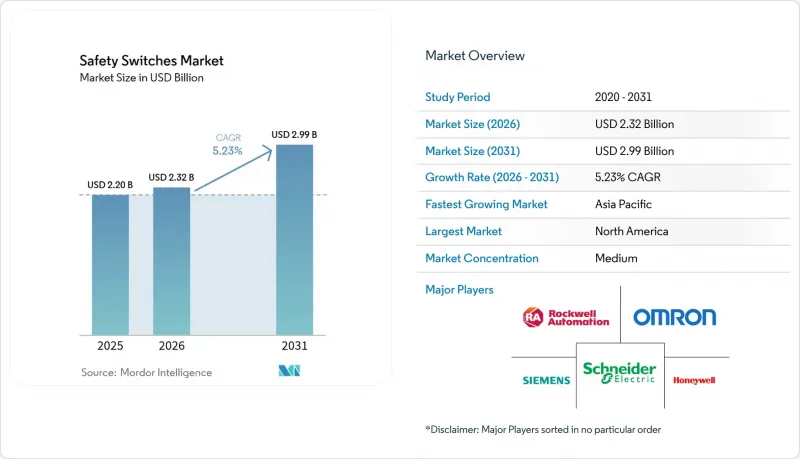
本報告按類型(電磁式、非接觸式)、執行器類型(鑰匙操作聯鎖等)、安裝方式(面板安裝、DIN導軌安裝)、最終用戶(工業、商業、醫療、石油和天然氣)以及地區(北美、歐洲、亞太等)進行細分。市場規模和預測均以美元計價。
全球安全開關市場趨勢及洞察
亞洲地區因自動化程度提高而提出的安全要求不斷提高
在亞洲製造業,隨著自動化普及速度的加快,安全概念正在發生根本性的轉變,導致對先進安全開關的需求顯著成長。中國、日本和韓國等國家正在實施更嚴格的職場安全法規,強制要求在自動化生產線上使用經認證的安全裝置。這項監管變革與該地區智慧製造的推進不謀而合,安全開關在確保人機協同方面發揮關鍵作用。尤其是在人事費用不斷上漲和技術純熟勞工持續短缺的情況下,將安全開關整合到工廠自動化系統中已成為製造商平衡生產效率和工人安全的戰略重點。根據IDEC預測,從2024年起,亞洲對安全開關的需求預計將成長30%以上,其中非接觸式產品的普及率最高,尤其是在電子製造業。
協作機器人的普及需要整合安全解決方案。
協作機器人(cobot)在製造業的普及從根本上改變了安全系統的要求,並為先進的安全開關技術帶來了巨大的商機。與在封閉迴路境中運作的傳統工業機器人不同,協作機器人與人類協同工作,因此需要能夠根據接近程度和運作模式動態調整保護參數的複雜安全機制。 2024 年修訂的 ISO 10218 工業機器人安全標準對協作應用的功能安全要求進行了更清晰的定義,從而增加了對能夠與機器人控制系統協同工作的安全開關的需求。雖然協作機器人本身俱有一定的安全特性,但仍需要補充保護解決方案來應對諸如夾傷和程式錯誤等殘餘風險。據 PowerSafe Automation 稱,正確整合的安全開關可以將協作機器人相關事故減少高達 85%,同時保持運作效率,使其成為工業 4.0 實施的關鍵組件。
非接觸式開關在對成本較為敏感的中小型企業中平均售價較高。
RFID感測器的成本是電子機械感測器的兩到三倍,這阻礙了預算和技術資源有限的小規模作業場所快速更換感測器。因此,中小型機械製造商採用先進設備的比例仍低於25%,這是限制安全開關市場短期成長的因素。
細分市場分析
由於其即使在多塵和高振動環境下也具有久經考驗的耐用性,電子機械安全開關仍然主導著安全開關市場。然而,非接觸式RFID感測器正經歷最快的成長,複合年成長率高達7.45%,因為原始設備製造商(OEM)希望防止篡改並獲取即時診斷數據。到2025年,電子機械開關將佔45.40%的銷售佔有率,而隨著監管機構推出更嚴格的防竄改法規,RFID在製藥生產線的應用也大幅成長。預計到2031年,非接觸式安全開關市場規模將達到11.1億美元,反映出其在機器人組裝單元的應用日益廣泛。
此外,RFID感測器支援預測性維護分析。內建記憶體記錄循環次數,以便在故障發生前發出服務警報。防爆外殼和不銹鋼材質的改進拓展了其在腐蝕性和危險環境中的應用範圍,從而增加了供應商的潛在收入來源。持續的微型化技術使得在緊湊型協作機器人夾爪中整合多感測器陣列成為可能,進一步推動了安全開關市場的未來需求。
由於機械結構簡單且成本低廉,鑰匙式連鎖裝置仍被廣泛使用。然而,基於RFID編碼和磁性執行器的連鎖裝置正逐漸佔據主導地位,尤其是在防護防篡改至關重要的4類和PLe應用中。這些設計允許使用單一電纜級聯多達32個節點,從而縮短安裝時間。在製藥業的無塵室和食品加工生產線中,非接觸式方法更受歡迎,因為它可以消除污染物可能積聚的縫隙,從而催生了安全開關市場的新需求。
基於乙太網路的功能安全技術也正在興起。供應商正在將執行器和安全繼電器功能整合到單一機殼中,並將診斷資訊傳輸到MES控制面板。這實現了傳統硬佈線的虛擬化,並支援靈活的單元重配置,這是工業4.0的核心要求。因此,執行器創新將繼續在安全開關市場創造價值方面發揮關鍵作用。
區域分析
亞太地區受中國和韓國電子產業叢集的推動,預計到2025年將佔全球銷售額的37.90%。各國「智慧製造」計畫下的工廠升級使得RFID連鎖和IO-Link診斷成為必需品,從而推高了平均售價。印度和越南政府對自動化生產線的補貼預計將繼續鞏固該地區在安全開關市場的主導地位。
預計到2031年,中東地區的複合年成長率將達到8.75%。阿拉伯聯合大公國和沙烏地阿拉伯的國有石油公司目前正在為其天然氣壓縮、煉油和液化天然氣出口工廠尋求ATEX或IECEx認證的開關設備。提供溫度範圍為-55 度C至+55 度C且採用不銹鋼機殼產品的供應商正在簽署多年框架協議,這推動了市場的快速擴張。
儘管歐洲和北美市場已趨於成熟,但仍蘊藏著豐富的商機。歐盟機械指令的修訂要求化學和食品加工企業在兩年內維修老舊的攪拌機和輸送機,這一短期需求正在推動設備更新換代。在美國,履約中心正在採用聯網交換機,將安全資料傳輸到雲端倉庫管理系統(WMS)平台,支撐了安全開關市場銷售的穩定成長。
其他好處:
- Excel格式的市場預測(ME)表
- 3個月的分析師支持
目錄
第1章:引言
- 研究假設和市場定義
- 調查範圍
第2章:調查方法
第3章執行摘要
第4章 市場狀況
- 市場概覽
- 市場促進因素
- 亞洲自動化相關的安全要求不斷提高
- 隨著協作機器人的日益普及,整合安全解決方案變得不可或缺。
- 歐洲加工工業中對過時機械的強制性維修
- 中東石油和天然氣產業對防爆設備的需求激增。
- 在高效率藥物生產設施中實施RFID編碼連鎖裝置(美國/歐盟)
- 電子商務倉庫需求的激增導致輸送機安全開關的使用量增加(北美)。
- 市場限制因素
- 成本意識強的中小企業對非接觸式開關的平均售價(ASP)要求不斷提高。
- 工廠跨越多個司法管轄區的認證流程十分複雜
- 與特定產業安全現場匯流排的兼容性差距
- 低價假冒進口產品阻礙了品牌產品的流通(亞太地區)
- 價值供應鏈分析
- 監理展望
- 技術展望
- 波特五力分析
第5章 市場規模與成長預測
- 按類型
- 電子機械安全開關
- 非接觸式(RFID/磁性)安全開關
- 防爆/重型安全開關
- 其他類型
- 按下執行器類型
- 鑰匙操作聯鎖裝置
- 鉸鍊式互鎖
- 與RFID代碼聯鎖
- 磁性致動器
- 透過部署配置
- 面板安裝型
- DIN導軌安裝型
- 最終用戶
- 工業製造
- 車
- 食品/飲料
- 化學品和製藥
- 航太/國防
- 金屬和採礦
- 能源與電力
- 石油和天然氣
- 發電
- 適用於商業和機構用途
- 建築自動化
- 物流和倉儲
- 衛生保健
- 其他
- 工業製造
- 按銷售管道
- 直接 OEM
- 分銷商/系統整合商
- 按地區
- 北美洲
- 美國
- 加拿大
- 墨西哥
- 南美洲
- 巴西
- 阿根廷
- 其他拉丁美洲國家
- 歐洲
- 德國
- 英國
- 法國
- 義大利
- 西班牙
- 其他歐洲國家
- 中東和非洲
- 土耳其
- 阿拉伯聯合大公國
- 沙烏地阿拉伯
- 南非
- 其他中東和非洲國家
- 亞太地區
- 中國
- 日本
- 韓國
- 印度
- 澳洲
- 其他亞太國家
- 北美洲
第6章 競爭情勢
- 市場集中度
- 策略趨勢
- 市佔率分析
- 公司簡介
- Schneider Electric
- Rockwell Automation
- Banner Engineering
- Eaton Corporation
- Euchner GmbH
- SICK AG
- Pilz GmbH and Co. KG
- Siemens AG
- Omron Corporation
- Honeywell International
- Phoenix Contact
- ABB Ltd.
- IDEC Corporation
- BERNSTEIN AG
- Pepperl+Fuchs
- Keyence Corporation
- Leuze electronic
- Schmersal Group
- TURCK
- Crouzet
第7章 市場機會與未來展望
According to Mordor Intelligence, the safety switches market size is expected to grow from USD 2.2 billion in 2025 to USD 2.32 billion in 2026 and is forecast to reach USD 2.99 billion by 2031 at 5.23% CAGR over 2026-2031.
This report is Segmented Type (Electromagnetic, and Non-Contact), Actuator Type (Key-Operated Interlock, and More). Installation Configuration (Panel-Mounted, and DIN-Rail Mounted), End-User (Industrial, Commercial, Healthcare, Oil and Gas), and Geography (North America, Europe, Asia-Pacific, and More). The Market Sizes and Forecasts are Provided in Terms of Value (USD)
Global Safety Switches Market Trends and Insights
Expanding automation-driven safety requirements in Asia
Asia's manufacturing sector is experiencing a fundamental shift in safety paradigms as automation adoption accelerates, creating substantial demand for sophisticated safety switches. Countries like China, Japan, and South Korea are implementing stricter workplace safety regulations that mandate the use of certified safety devices in automated production lines. This regulatory evolution coincides with the region's push toward smart manufacturing, where safety switches serve as critical components in ensuring human-machine coexistence. The integration of safety switches with factory automation systems has become a strategic priority for manufacturers seeking to balance productivity with worker protection, particularly as labor costs rise and skilled worker shortages persist. According to IDEC, demand for safety switches in Asia has grown by over 30% since 2024, with non-contact varieties seeing the highest adoption rates in electronics manufacturing.
Rise in collaborative robots necessitating integrated safety solutions
The proliferation of collaborative robots (cobots) across manufacturing environments is fundamentally transforming safety system requirements, creating significant opportunities for advanced safety switch technologies. Unlike traditional industrial robots that operate in caged environments, cobots work alongside humans, necessitating sophisticated safety mechanisms that can dynamically adjust protection parameters based on proximity and operation mode. The revision of ISO 10218 standard for industrial robot safety in 2024 has established clearer functional safety requirements for collaborative applications, driving demand for safety switches that can interface with robot control systems. Despite their inherent safety features, cobots still require complementary guarding solutions to address residual risks such as pinch points and programming errors. PowerSafe Automation reports that properly integrated safety switches can reduce cobot-related incidents by up to 85% while maintaining operational efficiency, making them essential components in Industry 4.0 implementations.
Higher ASPs of Non-Contact Switches in Cost-Sensitive SMEs
RFID sensors cost two to three times more than electromechanical models, discouraging rapid swap-outs in small workshops where budget and technical skills are limited. Consequently, penetration of advanced units among SME machine builders remains below 25%, tempering near-term uptake across the Safety switches market.
Other drivers and restraints analyzed in the detailed report include:
- Mandatory Retrofit of Legacy Machinery in Europe's Process Industries
- Demand Surge for Explosion-Proof Devices in Middle-East Oil & Gas
- Complex Certification Cycles Across Multi-Jurisdictional Plants
For complete list of drivers and restraints, kindly check the Table Of Contents.
Segment Analysis
Electromechanical models still lead the safety switches market thanks to proven durability in dusty, high-vibration sites. Yet non-contact RFID sensors show the swiftest momentum, expanding at 7.45% CAGR as OEMs look to curb bypassing and gain live diagnostic data. In 2025, electromechanicals held a 45.40% revenue share, while RFID uptake in pharma lines rose sharply after regulators tightened tampering rules. The Safety switches market size for non-contact devices is projected to reach USD 1.11 billion by 2031, mirroring wider adoption in robotic assembly cells.
RFID sensors also unlock predictive-maintenance analytics; embedded memory logs cycle counts, enabling service alerts before failure. Explosion-proof housings and stainless-steel variants are broadening use in corrosive and hazardous settings, expanding supplier addressable revenue pools. Continuous miniaturization further allows multi-sensor arrays inside compact cobot grippers, reinforcing future demand within the safety switches market.
Key-operated interlocks retain widespread use due to mechanical simplicity and low unit cost. Still, RFID-coded and magnetic actuators now set the pace, especially in Category 4, PLe applications that prohibit guard cheating. These designs cascade up to 32 nodes over a single cable, shrinking installation time. Pharmaceutical cleanrooms and food-processing lines favor non-contact formats to eliminate crevices where contaminants might lodge, spurring fresh volume in the Safety switches market.
Functional safety over Ethernet is also emerging. Vendors bundle actuator and safety-relay functions in the same housing, streaming diagnostics to MES dashboards. This virtualizes traditional hard-wired chains and supports flexible cell reconfiguration, a core Industry 4.0 requirement. Consequently, actuator innovation will remain pivotal to value capture within the Safety switches market.
Complete Report Scope:
- By Type
- Electromechanical Safety Switches
- Non-Contact (RFID / Magnetic) Safety Switches
- Explosion-Proof / Heavy-Duty Safety Switches
- Other Types
- By Actuator Type
- Key-Operated Interlock
- Hinge-Operated Interlock
- RFID-Coded Interlock
- Magnetic Actuator
- By Installation Configuration
- Panel-Mounted
- DIN-Rail Mounted
- By End-User
- Industrial Manufacturing
- Automotive
- Food and Beverage
- Chemicals and Pharmaceuticals
- Aerospace and Defense
- Metals and Mining
- Energy and Power
- Oil and Gas
- Power Generation
- Commercial and Institutional
- Building Automation
- Logistics and Warehousing
- Healthcare
- Others
- Industrial Manufacturing
- By Sales Channel
- Direct OEM
- Distributor / System Integrator
- By Geography
- North America
- United States
- Canada
- Mexico
- South America
- Brazil
- Argentina
- Rest of Latin America
- Europe
- Germany
- United Kingdom
- France
- Italy
- Spain
- Rest of Europe
- Middle East and Africa
- Turkey
- United Arab Emirates
- Saudi Arabia
- South Africa
- Rest of Middle East and Africa
- Asia-Pacific
- China
- Japan
- South Korea
- India
- Australia
- Rest of Asia Pacific
- North America
Geography Analysis
Asia-Pacific generated 37.90% of 2025 revenue, led by Chinese and South Korean electronics clusters. Factory upgrades under national "smart manufacturing" plans specify RFID interlocks and IO-Link diagnostics, lifting average selling prices. Government subsidies for automated lines in India and Vietnam will sustain regional leadership of the safety switches market.
The Middle East is forecast to grow at 8.75% CAGR through 2031. National oil companies in UAE and Saudi Arabia now demand ATEX or IECEx-certified switchgear for gas compression, refining and LNG export trains. Suppliers offering -55 °C to +55 °C temperature ratings and stainless-steel enclosures have secured multiyear framework deals, catalyzing swift market expansion.
Europe and North America remain mature but opportunity rich. EU Machinery Directive revisions compel chemical and food processors to retrofit older mixers and conveyors within two years; this short-cycle demand inflates replacement volumes. In the US, e-commerce fulfillment centers adopt network-ready switches that feed safety data to cloud WMS platforms, preserving steady unit growth in the safety switches market.
- Schneider Electric
- Rockwell Automation
- Banner Engineering
- Eaton Corporation
- Euchner GmbH
- SICK AG
- Pilz GmbH and Co. KG
- Siemens AG
- Omron Corporation
- Honeywell International
- Phoenix Contact
- ABB Ltd.
- IDEC Corporation
- BERNSTEIN AG
- Pepperl+Fuchs
- Keyence Corporation
- Leuze electronic
- Schmersal Group
- TURCK
- Crouzet
Additional Benefits:
- The market estimate (ME) sheet in Excel format
- 3 months of analyst support
TABLE OF CONTENTS
1 INTRODUCTION
- 1.1 Study Assumptions and Market Definition
- 1.2 Scope of the Study
2 RESEARCH METHODOLOGY
3 EXECUTIVE SUMMARY
4 MARKET LANDSCAPE
- 4.1 Market Overview
- 4.2 Market Drivers
- 4.2.1 Expanding Automation-Driven Safety Requirements in Asia
- 4.2.2 Rise in Collaborative Robots Necessitating Integrated Safety Solutions
- 4.2.3 Mandatory Retrofit of Legacy Machinery in Europe's Process Industries
- 4.2.4 Demand Surge for Explosion-Proof Devices in Middle-East Oil and Gas
- 4.2.5 Adoption of RFID-Coded Interlocks in High-Potency Pharma Facilities (US/EU)
- 4.2.6 E-Commerce Warehousing Boom Boosting Conveyor Safety Switch Usage (NA)
- 4.3 Market Restraints
- 4.3.1 Higher ASPs of Non-Contact Switches in Cost-Sensitive SMEs
- 4.3.2 Complex Certification Cycles Across Multi-Jurisdictional Plants
- 4.3.3 Compatibility Gaps with Industry-Specific Safety Fieldbuses
- 4.3.4 Counterfeit Low-Cost Imports Undermining Brand Adoption (APAC)
- 4.4 Value / Supply-Chain Analysis
- 4.5 Regulatory Outlook
- 4.6 Technological Outlook
- 4.7 Porter's Five Forces Analysis
- 4.7.1 Bargaining Power of Suppliers
- 4.7.2 Bargaining Power of Buyers
- 4.7.3 Threat of New Entrants
- 4.7.4 Threat of Substitutes
- 4.7.5 Intensity of Competitive Rivalry
5 MARKET SIZE AND GROWTH FORECASTS (VALUE)
- 5.1 By Type
- 5.1.1 Electromechanical Safety Switches
- 5.1.2 Non-Contact (RFID / Magnetic) Safety Switches
- 5.1.3 Explosion-Proof / Heavy-Duty Safety Switches
- 5.1.4 Other Types
- 5.2 By Actuator Type
- 5.2.1 Key-Operated Interlock
- 5.2.2 Hinge-Operated Interlock
- 5.2.3 RFID-Coded Interlock
- 5.2.4 Magnetic Actuator
- 5.3 By Installation Configuration
- 5.3.1 Panel-Mounted
- 5.3.2 DIN-Rail Mounted
- 5.4 By End-User
- 5.4.1 Industrial Manufacturing
- 5.4.1.1 Automotive
- 5.4.1.2 Food and Beverage
- 5.4.1.3 Chemicals and Pharmaceuticals
- 5.4.1.4 Aerospace and Defense
- 5.4.1.5 Metals and Mining
- 5.4.2 Energy and Power
- 5.4.2.1 Oil and Gas
- 5.4.2.2 Power Generation
- 5.4.3 Commercial and Institutional
- 5.4.3.1 Building Automation
- 5.4.3.2 Logistics and Warehousing
- 5.4.4 Healthcare
- 5.4.5 Others
- 5.4.1 Industrial Manufacturing
- 5.5 By Sales Channel
- 5.5.1 Direct OEM
- 5.5.2 Distributor / System Integrator
- 5.6 By Geography
- 5.6.1 North America
- 5.6.1.1 United States
- 5.6.1.2 Canada
- 5.6.1.3 Mexico
- 5.6.2 South America
- 5.6.2.1 Brazil
- 5.6.2.2 Argentina
- 5.6.2.3 Rest of Latin America
- 5.6.3 Europe
- 5.6.3.1 Germany
- 5.6.3.2 United Kingdom
- 5.6.3.3 France
- 5.6.3.4 Italy
- 5.6.3.5 Spain
- 5.6.3.6 Rest of Europe
- 5.6.4 Middle East and Africa
- 5.6.4.1 Turkey
- 5.6.4.2 United Arab Emirates
- 5.6.4.3 Saudi Arabia
- 5.6.4.4 South Africa
- 5.6.4.5 Rest of Middle East and Africa
- 5.6.5 Asia-Pacific
- 5.6.5.1 China
- 5.6.5.2 Japan
- 5.6.5.3 South Korea
- 5.6.5.4 India
- 5.6.5.5 Australia
- 5.6.5.6 Rest of Asia Pacific
- 5.6.1 North America
6 COMPETITIVE LANDSCAPE
- 6.1 Market Concentration
- 6.2 Strategic Moves
- 6.3 Market Share Analysis
- 6.4 Company Profiles (includes Global level Overview, Market level overview, Core Segments, Financials as available, Strategic Information, Market Rank/Share for key companies, Products and Services, and Recent Developments)
- 6.4.1 Schneider Electric
- 6.4.2 Rockwell Automation
- 6.4.3 Banner Engineering
- 6.4.4 Eaton Corporation
- 6.4.5 Euchner GmbH
- 6.4.6 SICK AG
- 6.4.7 Pilz GmbH and Co. KG
- 6.4.8 Siemens AG
- 6.4.9 Omron Corporation
- 6.4.10 Honeywell International
- 6.4.11 Phoenix Contact
- 6.4.12 ABB Ltd.
- 6.4.13 IDEC Corporation
- 6.4.14 BERNSTEIN AG
- 6.4.15 Pepperl+Fuchs
- 6.4.16 Keyence Corporation
- 6.4.17 Leuze electronic
- 6.4.18 Schmersal Group
- 6.4.19 TURCK
- 6.4.20 Crouzet
7 MARKET OPPORTUNITIES AND FUTURE OUTLOOK
- 7.1 White-space and Unmet Need Analysis

 緊急停止開關:市場佔有率分析、產業趨勢與統計、成長預測(2026-2031)
 安全開關市場分析:按產品類型、安全系統、開關類型、最終用戶和地區分類(2026-2034 年)
 安全開關市場:按開關類型、電氣額定值、應用、執行器和最終用戶產業分類-2026年至2032年全球預測
 安全開關市場分析及預測(至2035年):依類型、產品類型、技術、組件、應用、最終用戶、安裝類型、設備、解決方案及裝置分類
 全球安全開關市場規模、佔有率、趨勢和成長分析報告(2026-2034年)全球緊急停止開關市場規模、佔有率、趨勢和成長分析報告(2026-2034年)
 安全開關市場規模、佔有率、成長分析(按產品類型、類型、電壓範圍、安全系統、開關類型、最終用戶和地區分類)-2026-2033年產業預測
 全球緊急停止開關市場亞太地區安全開關:市場佔有率分析、產業趨勢與成長預測(2025-2030)歐洲安全開關:市場佔有率分析、產業趨勢、成長預測(2025-2030)