


 |
市場調查報告書
商品編碼
2063299
緊急停止開關:市場佔有率分析、產業趨勢與統計、成長預測(2026-2031)Emergency Stop Switches - Market Share Analysis, Industry Trends & Statistics, Growth Forecasts (2026 - 2031) |
||||||

※ 本網頁內容可能與最新版本有所差異。詳細情況請與我們聯繫。
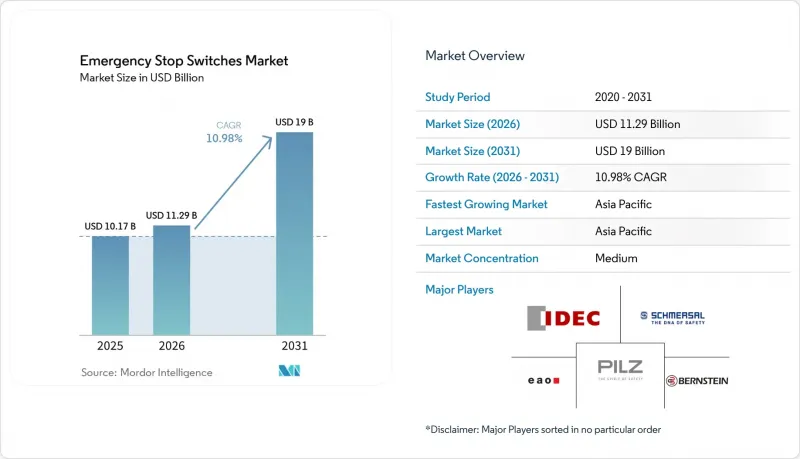
根據 Mordor Intelligence 預測,緊急停止開關市場規模將從 2025 年的 101.7 億美元和 2026 年的 112.9 億美元成長到 2031 年的 190 億美元,2026 年至 2031 年的複合年成長率將達到 10.98%。
本報告按產品類型(按鈕式、拉繩式、腳踏式、掌式/洋菇頭式、整合聯鎖式)、復位機制(推拉式、旋轉釋放式、鑰匙釋放式、槓桿式、自動/電子式)、終端用戶行業(製造業、電梯等)、接點配置(1個閉接點、2個常閉點、1個常閉點、1個常閉點、1個常閉點、1個常閉點、1個常閉點)市場預測以美元(USD)為單位。
全球緊急停止開關市場趨勢與洞察
加強機械安全法規與功能安全合規性
由於機械安全法規的變更,緊急停止開關市場目前正經歷短期內最大的成長。這是因為法規的每次修訂都迫使原始設備製造商 (OEM) 和機械製造商重新審查其已通過核准的設計和技術文件。 2026 年 2 月發布的 IEC 60947-5-5:2026 標準引入了新的閂鎖機構測試規程,並新增了關於指示啟動和停用狀態的帶指示燈緊急停止裝置的附錄 B。這導致供應商對其所有產品系列進行了重新設計和重新認證工作。 ISO 13849:2023 和 IEC 62061:2021/A1:2024 標準繼續支援對緊急停止功能更高的性能要求,在高度自動化的環境中,PLe 或 SIL 3 的設計目標通常超越了基本合規性要求。修訂後的歐盟機械法規 2023/1230 擴大了合規範圍,將自主移動機械、連網設備和基於人工智慧的安全功能納入其中,從而提升了經認證的安全組件的價值,該法規將於 2027 年 1 月生效。這項轉變意味著緊急停止裝置不再只是配件,而是被視為固定的材料清單(BOM) 項目,必須通過機械和系統級審核。因此,緊急停止開關市場不僅受益於替換需求,也受益於市場向更高規格設備的廣泛轉變,這些設備能夠增強審核應對力並降低合規風險。
提高個體製造的自動化程度和機器人密度
緊急停止開關市場的發展也受到機器人密度不斷提高的推動。隨著工業機器人單元、協作機器人工作站或自動化模組的增加,機器的安全佈局中也需要增加經過認證的停止點。根據IFR的報告,到2024年,西歐每萬名製造業工人將擁有267台機器人,美國則達到307台。這使得北美和歐洲在每台已安裝機器的安全裝置密度方面仍然位居世界前列。中國擁有全球最大的運作機器人數量,預計到2024年每萬名製造業工人將擁有166台機器人。雖然每台機器的認證裝置數量仍落後於嚴格的工廠,但單位需求依然強勁。 IFR也記錄了2024年全球協作機器人部署量為64,542台,商用服務機器人部署量為199,000台。這兩項數據都意義重大,因為協作環境和行動自動化需要更加分散的安全功能以及清晰易懂、便於操作的緊急停止機制。 IDEC 的「緊急停止輔助系統」表明,這種需求正在擴展到 AGV 和 AMR 環境中,在這些環境中,當操作員無法快速觸及固定按鈕時,無線遠端控制就顯得尤為重要。這一趨勢有利於緊急停止開關市場,因為自動化密度的提高不僅會帶來更多的安裝需求,還會增加對多觸點、整合聯鎖和可遠端控制設計的需求。
維修現有設備所需的停機時間和檢驗成本。
緊急停止開關市場最大的商業性障礙並非開關本身的價格,而是維修相關的系統工程負擔。 Revere Control Systems指出,機器停機時間、功能測試和合規性文件編制可能佔到維修工程總時間的30%至40%。此外,在連續生產過程中,即使是計劃內的停機也可能造成重大的生產損失,因此證明這種負擔的合理性尤其困難。例如,德國Pohlann公司一台600噸液壓機的維修就需要徹底更換安全控制系統、安裝新的防護門連鎖裝置、測量停機時間,並在運作前準備好符合審核要求的文件。這清楚地說明了為什麼小規模業者會推遲專案。因此,許多現有工廠的業者會推遲升級緊急停止裝置,直到受到審核、保險審查或大規模檢修的強制要求,導致交付週期縮短,價格敏感度增加。 PowerSafe Automation 的分階段升級方案表明,成本問題可以在 90 天、3-12 個月和 12-24 個月三個階段進行控制,但同時也造成了錯開的訂購計劃,增加了分銷商的規劃難度。因此,緊急停止開關市場的成長速度低於僅基於合規要求的預期,因為維修的時機往往取決於停機造成的經濟損失,而非設備的緊迫性。
細分市場分析
截至2025年,按鈕式緊急停止開關將佔60.51%的市場佔有率,成為緊急停止開關市場中最大的產品類別。這是因為它們仍然是操作面板、控制器機殼和通用機器工作站的預設選擇。其地位歸功於實施成本低、操作人員熟悉度高以及基於主要緊急停止標準的明確合規路徑。 ISO 13850和IEC 60947-5-5仍然是這些設備的視覺和功能標準,其要求包括紅色操作部件、黃色背景以及從常閉位置直接斷開的觸點。實際上,許多機器製造商在設計之初仍然會考慮按鈕系統,只有在危險分析需要額外功能時才會轉向更複雜的設備。這種預設做法非常重要,因為它即使在高規格替代方案快速成長的情況下也能保障大批量需求。因此,緊急停止開關市場仍然依賴按鈕式產品作為最廣泛和最穩定的部署基礎。
高階供應商正透過專注於故障行為、緊湊型機殼以及機器級認證的便利性,在這個成熟的細分市場中尋求差異化優勢。 IDEC 的 XW 和 XA 系列產品就充分體現了這一點,其短小的外形尺寸和反向能量結構確保即使模組損壞或分離,常閉觸點也能保持斷開狀態。同時,整合安全聯鎖的緊急停止開關預計到 2031 年將以 11.11% 的複合年成長率成長,成為所有產品類型中成長最快的,並且其設計邏輯也各不相同。這些設備將緊急停止操作、防護監控和鎖定功能整合到單一機殼中,從而降低了佈線複雜性,並滿足了緊湊型機器單元的高級診斷需求。 Euchener 的 CTP 就是這項轉變的典型例子,它將 RFID 防護鎖、按鈕控制和緊急停止功能整合到符合 PL e 和 4 類標準的機殼中。在大量使用輸送機的佈局中,拉繩式開關仍然至關重要;而腳踏式、掌式和洋菇式開關則在工具機、壓力機和改裝應用中繼續發揮作用。因此,緊急停止開關產業正在圍繞按鈕式開關模式建立一個整合的安全層,而不是取代它。
預計到2025年,推拉式復位機構將佔據47.54%的市場佔有率,成為緊急停止開關市場的主導復歸方式。這是因為它們仍然能夠提供最清晰的物理確認,表明在重新啟動請求發出之前,危險已被消除。其廣泛應用既反映了其簡便性,也反映了其在北美地區的大規模部署經驗——在北美,拉拉式復位在許多機械類別中仍然很常見。雖然ISO 13850標準並未明確建議使用拉拉式重設而非旋轉式復位,但實際操作仍會因地區和操作人員的偏好而有所不同。旋轉式復位佔據第二大市場佔有率,因為歐洲機械設計師認為旋轉運動是一種更人為的操作,從而降低了意外釋放的風險。在緊急停止開關市場,這兩種類型仍然並存,因為在所有應用中,沒有哪種類型完全取代了另一種類型。
預計到2031年,自動和電子重設產品將以11.02%的複合年成長率成長,並有望成為成長最快的複位類型,因為在軟性製造單元中,重新啟動邏輯正逐漸轉移到經過認證的控制器上。在這些環境中,重設決策不再侷限於操作員走到控制面板並按下按鈕。取而代之的是,安全控制器會驗證緊急停止電路是否已斷開、機器軸是否處於安全狀態,以及檢驗的邏輯是否允許重新啟動。這種架構適用於協作機器人單元、AGV介面和緊湊型自動化模組,在這些應用中,手動重設會導致延遲或存取問題。鑰匙釋放和可鎖定版本在鎖定/掛牌程序中也變得越來越重要,尤其是在維護人員必須在運行期間控制對機器的存取時。 IDEC的掛鎖相容產品允許在單一裝置上安裝多達12個個人鎖,這表明緊急停止開關產業正在調整復位硬體,以滿足除簡單停止功能之外的運作控制需求。
區域分析
預計到2025年,亞太地區將佔據緊急停止開關市場42.80%的佔有率,並將在2031年之前以11.64%的複合年成長率成長。這使其成為本報告中規模最大、成長最快的區域市場。該地區既擁有日本和韓國等成熟且高度自動化的經濟體,又擁有中國和印度等大規模且正在快速擴張的市場,既具備穩固的現有設備基礎,又受益於新建設的強勁成長勢頭。根據IFR的報告,2024年,中國每1萬名製造業工人將配備166台機器人,隨著工廠逐步達到出口合規標準,安全設備市場仍有進一步成長的空間。此外,印度電子、半導體和製藥業的待開發區製造項目也推動了對符合跨國公司安全標準的認證停止設備的需求。在韓國和日本,半導體、顯示器和汽車製造業對具有互鎖和通訊功能的高階設備的需求持續成長,施梅爾薩爾於 2025 年 3 月在韓國設立子公司,正是為了抓住這一機會。
預計到2025年,北美將佔據第二大市場佔有率,該地區緊急停止開關市場的發展將受到製造業回流、電動車生產、半導體投資以及倉儲自動化擴張等因素的影響。根據IFR的報告,到2024年,北美地區的機器人普及率將達到每萬名製造業工人204台機器人,使美國成為全球機器人普及率最高的地區之一,達到每萬名製造業工人307台機器人。如此龐大的運作規模促使每台機器人配備的安全裝置搭載率不斷增加,這一趨勢在高壓電池和電力電子生產線上尤其明顯,因為這些生產線的停止功能必須滿足更嚴格的安全邏輯。此外,該地區還擁有大量老舊設備,對壓平機、沖壓系統和射出成型線的改造需求仍然強勁。歐洲仍然是監管最嚴格的地區,德國、英國、法國和義大利支撐著該地區緊急停止開關市場的規模,因為原始設備製造商 (OEM) 在歐盟機械指令於 2027 年 1 月實施之前對組件進行預認證。
儘管南美、中東和非洲的市場佔有率總和較小,但緊急停止開關市場正透過採礦、石油天然氣、公共產業以及部分工業現代化項目持續擴張。巴西在南美市場處於領先地位,其採礦業的安全措施不斷加強,農產品加工業也在蓬勃發展,繩索操作裝置和高防護等級的緊急停止裝置適用於潔淨和惡劣的工作環境。沙烏地阿拉伯和阿拉伯聯合大公國(阿拉伯聯合大公國)在中東地區佔據主導地位,兩國正在能源項目和工業自由貿易區實施符合IEC和ISO標準的國際認證安全系統。非洲市場仍在發展中,但南非和埃及憑藉著採礦、公共產業和食品製造業的需求,佔據了該地區的大部分市場佔有率。
其他好處:
- Excel格式的市場預測(ME)表
- 3個月的分析師支持
目錄
第1章:引言
- 研究假設和市場定義
- 調查範圍
第2章:調查方法
第3章執行摘要
第4章 市場狀況
- 市場概覽
- 市場促進因素
- 加強機器安全規章制度與功能安全合規性
- 提高個體製造業的自動化和機器人採用率
- 輸送機和倉庫自動化的擴展
- 製程工業和重型機械的安全維修
- 擴大電池、電力電子產品和高能量元件組裝。
- 在食品和製藥生產線中引入衛生級和高IP防護等級的緊急停止按鈕。
- 市場限制因素
- 維修舊有系統相關的停機時間和檢驗成本
- 低價、未經認證產品的價格壓力
- 網路驗證對診斷節點和聯網緊急關斷節點的負擔。
- 人為因素造成的故障,例如部署和監控不當。
- 產業價值鏈分析
- 監理情勢
- 技術展望
- 宏觀經濟因素對市場的影響
- 波特五力分析
第5章 市場規模與成長預測
- 依產品類型
- 按鈕式緊急停止開關
- 拉繩開關
- 腳踏式緊急停止開關
- 掌式/洋菇式開關
- 安全連鎖整合緊急停止裝置
- 復位機制
- 推拉
- 旋轉釋放
- 鑰匙釋放/鎖定類型
- 槓桿/機械復位
- 自動/電子復位
- 按最終用戶行業分類
- 製造/通用機械
- 電梯和電扶梯
- 輸送機和物料輸送
- 能源公用事業
- 其他終端用戶產業
- 聯繫配置
- 1 NC
- 2 NC
- 1 NO+1 NC
- 多觸點(2 個常閉觸點或以上)
- 按地區
- 北美洲
- 美國
- 加拿大
- 墨西哥
- 南美洲
- 巴西
- 阿根廷
- 其他南美國家
- 歐洲
- 英國
- 德國
- 法國
- 義大利
- 其他歐洲國家
- 亞太地區
- 中國
- 日本
- 印度
- 韓國
- 其他亞太國家
- 中東
- 阿拉伯聯合大公國
- 沙烏地阿拉伯
- 土耳其
- 以色列
- 其他中東國家
- 非洲
- 南非
- 埃及
- 其他非洲國家
- 北美洲
第6章 競爭情勢
- 市場集中度
- 策略趨勢
- 市佔率分析
- 公司簡介
- IDEC Corporation
- KA Schmersal GmbH & Co. KG
- EAO AG
- Pilz GmbH & Co. KG
- BERNSTEIN AG
- EUCHNER GmbH+Co. KG
- Georg Schlegel GmbH & Co. KG
- RAFI GmbH & Co. KG
- Pizzato Elettrica Srl
- COMEPI Srl
- IDEM Safety Switches Limited
- Rees, Inc.
- NKK SWITCHES CO., LTD.
- APEM SAS
- Giovenzana International BV
- TER Tecno Elettrica Ravasi Srl
- Lovato Electric SpA
- E. Dold & Sohne GmbH & Co. KG
- Baco Controls, Inc.
第7章 市場機會與未來展望
According to Mordor Intelligence, the emergency stop switches market size is expected to increase from USD 10.17 billion in 2025, USD 11.29 billion in 2026 and reach USD 19 billion by 2031, growing at a CAGR of 10.98% over 2026-2031.
This report is Segmented by Product Type (Push-Button, Rope Pull, Foot-Operated, Palm/Mushroom, and Interlock-Integrated), Reset Mechanism (Push-Pull, Twist-Release, Key-Release, Lever, and Auto/Electronic), End-User Industry (Manufacturing, Elevators, and More), Contact Configuration (1 NC, 2 NC, 1 NO+1 NC, and Multi-Contact), and Geography. The Market Forecasts are Provided in Terms of Value (USD).
Global Emergency Stop Switches Market Trends and Insights
Tighter Machinery Safety Enforcement And Functional Safety Compliance
The emergency stop switches market is receiving its strongest near-term lift from changing machinery safety rules, because each new revision forces OEMs and machine builders to revisit approved designs and technical files. The February 2026 release of IEC 60947-5-5:2026 introduced new latch-mechanism test protocols and added Annex B for illuminated emergency stop devices that indicate active and inactive states, pushing product redesign and recertification work across vendor portfolios. ISO 13849:2023 and IEC 62061:2021/A1:2024 continue to support higher performance expectations for emergency stop functions, and high-automation settings often move beyond baseline compliance toward PLe or SIL 3 design targets. The revised EU Machinery Regulation 2023/1230 widens the compliance lens to cover autonomous mobile machinery, connected equipment, and AI-based safety functions, which is raising the value of certified safety components before the rule becomes effective in January 2027. That shift means emergency stop devices are now treated less as simple accessories and more as fixed bill-of-materials items that must withstand both mechanical and system-level review. The emergency stop switches market, therefore, benefits not only from replacement demand but also from a broader shift toward higher-specification devices that enhance audit readiness and reduce conformity risk.
Higher Automation And Robotics Density In Discrete Manufacturing
The emergency stop switches market is also supported by rising robot density, as each industrial robot cell, cobot station, or automated module adds certified stop points to the machine safety layout. IFR reported that Western Europe reached 267 robots per 10,000 manufacturing employees in 2024, while the United States reached 307, which kept North America and Europe among the highest-density regions for safety-device content per installed machine. China reached 166 robots per 10,000 manufacturing employees in 2024 and held the largest operational stock worldwide, keeping unit demand high even as certified device content per machine still trails that of the most regulated factories. IFR also recorded 64,542 cobot installations worldwide in 2024 and 199,000 professional service robot installations, both of which matter because collaborative settings and mobile automation require more distributed safety functions and clearer human-access emergency stop access. IDEC's Emergency Stop Assist System showed how this need is spreading into AGV and AMR environments, where wireless remote actuation becomes useful when operators cannot reach a fixed button fast enough. The emergency stop switches market gains from this trend because higher automation density does not just increase unit counts; it also raises demand for multi-contact, interlock-integrated, and remotely accessible designs.
Legacy Retrofit Downtime And Validation Costs
The largest commercial friction point in the emergency stop switches market is still the system engineering effort around a retrofit, not the price of the switch itself. Revere Control Systems noted that machine downtime, functional testing, and compliance documentation can consume 30-40% of retrofit engineering hours, and that burden is especially hard to justify in continuous-process operations, where even planned outages can incur major production losses. Pohlann's 600-ton hydraulic press retrofit in Germany required a full safety control system replacement, new guard-door interlocks, stopping-time measurements, and audit-ready documentation before restart, which illustrates why smaller operators often delay projects. Many legacy-plant operators therefore postpone emergency-stop upgrades until an audit, insurance review, or major overhaul forces action, compressing procurement into shorter windows and increasing price sensitivity. PowerSafe Automation's phased upgrade approach shows that the cost problem can be managed across 90-day, 3-12-month, and 12-24-month stages, but it also fragments order timing and complicates distributor planning. The emergency stop switches market, therefore, grows more slowly than the compliance need alone would suggest, because retrofit timing is often determined by outage economics rather than device urgency.
Other drivers and restraints analyzed in the detailed report include:
- Conveyor And Warehouse Automation Expansion
- Safety Retrofits In Process Industries And Heavy Machinery
- Price Pressure From Low-Cost, Non-Certified Products
For complete list of drivers and restraints, kindly check the Table Of Contents.
Segment Analysis
Push-button e-stop switches held a 60.51% share in 2025, making them the largest product pool in the emergency stop switches market, as they remain the default choice for operator panels, controller enclosures, and general machine workstations. Their position is tied to low installed cost, clear familiarity among operators, and a straightforward conformity path under the main emergency stop standards. ISO 13850 and IEC 60947-5-5 still serve as the visual and functional baseline for these devices through requirements for red actuators, yellow backgrounds, and direct-opening normally closed contacts. In practice, many machine builders still begin a design review with a push-button architecture and shift to a more complex device only if the hazard analysis calls for additional functions. That default behavior matters because it protects volume demand even as higher-specification alternatives grow faster. The emergency stop switches market, therefore, continues to rely on the push-button category as its broadest and most stable installed base.
Premium vendors still find room to differentiate within this mature segment by focusing on failure behavior, compact packaging, and easier machine-level certification. IDEC's XW and XA series demonstrated this clearly through a short-body form and a reverse-energy structure that ensures normally closed contacts open even if the block is damaged or separated. At the same time, safety interlock-integrated e-stops are forecast to grow at a 11.11% CAGR through 2031, marking the fastest pace among product types and pointing to a different design logic. These devices combine emergency stop actuation, guard monitoring, and locking functions in a single housing, reducing wiring complexity and supporting higher diagnostic expectations in compact machine cells. Euchener's CTP is a live example of that shift, combining RFID guard locking, pushbutton controls, and emergency stop functionality in a PL e and Category 4 housing. Rope-pull switches remain essential in conveyor-heavy layouts, while foot-operated and palm- or mushroom-style variants retain their role in machine-tool, press, and retrofit applications, so the emergency stop switches industry is not replacing the push-button paradigm so much as building integrated safety layers around it.
Push-pull reset mechanisms accounted for 47.54% of the market in 2025, making them the leading reset type in the emergency stop switches market, as they still offer the clearest physical confirmation that the hazard has been cleared before a restart request. Their wide use reflects both simplicity and a large North American installed base, where pull-reset has remained familiar in many machine categories. ISO 13850 does not favor pull-reset over twist-reset, but actual practice still varies by region and operator preference. Twist-release holds the next-largest share because European machinery designers often view the rotational action as a more deliberate human gesture, reducing the risk of accidental release. The emergency stop switches market keeps both formats active because neither one has displaced the other across all applications.
Automatic and electronic reset variants are projected to expand at a 11.02% CAGR through 2031, making them the fastest-growing reset type as flexible manufacturing cells move more restart logic into certified controllers. In these settings, the reset decision is not limited to an operator walking to a panel and releasing a button. Instead, the safety controller checks whether the emergency stop circuit is clear, whether the machine axes are in a safe state, and whether the validated logic has authorized the restart condition. That architecture fits collaborative robot cells, AGV interfaces, and compact automated modules where manual reset would slow operations or create access issues. Key-release and lockable versions are also gaining relevance in lockout and tagout procedures, especially where maintenance staff must control access to a machine while work is underway. IDEC's padlock-capable offering, which accepts up to 12 personal locks on one device, shows how the emergency stop switches industry is adapting reset hardware to operational control needs rather than to stop function alone.
Geography Analysis
Asia-Pacific accounted for 42.80% of the emergency stop switches market share in 2025 and is also projected to expand at an 11.64% CAGR through 2031, which makes it both the largest and fastest-growing regional market in the report. The region combines mature high-automation economies such as Japan and South Korea with large expansion markets such as China and India, so it carries both installed-base depth and new-build momentum. IFR reported that China reached 166 robots per 10,000 manufacturing employees in 2024, leaving room for further growth in safety devices as factories move closer to export-grade compliance standards. India's greenfield manufacturing projects in electronics, semiconductors, and pharmaceuticals are also driving new demand for certified stop devices in facilities designed to meet multinational safety standards. South Korea and Japan continue to drive premium demand for interlock-integrated and communication-ready devices in semiconductor, display, and automotive manufacturing, and Schmersal's March 2025 subsidiary launch in South Korea directly reflects that opportunity.
North America held the second-largest share in 2025, and the emergency stop switches market there is being shaped by reshoring, EV production, semiconductor investment, and warehouse automation build-out. IFR reported that North America reached 204 robots per 10,000 manufacturing employees in 2024, while the United States ranked among the world's highest-density robot markets at 307 robots per 10,000 manufacturing employees. That operating base supports stronger safety-device content per machine, especially on high-voltage battery and power-electronics lines, where stop functions must meet more demanding safety logic. The region also has a sizeable legacy equipment base, which keeps retrofit demand active in presses, stamping systems, and injection molding lines. Europe remains the most compliance-intensive regional market, and the emergency stop switches market size there is being supported by Germany, the United Kingdom, France, and Italy as OEMs pre-qualify parts ahead of the EU Machinery Regulation implementation in January 2027.
South America, the Middle East, and Africa together make up a smaller share, but the emergency stop switches market is still expanding there through mining, oil and gas, utilities, and selective industrial modernization. Brazil leads South America through mining safety upgrades and agri-food processing expansion, where rope-pull devices and high-IP emergency stop units are well-suited for washdown and harsh-duty environments. The Middle East is supported by Saudi Arabia and the UAE, where energy projects and industrial free zones are increasing the adoption of internationally certified safety systems aligned with IEC and ISO standards. Africa remains nascent, with South Africa and Egypt accounting for much of the regional demand through mining, utilities, and food manufacturing.
- IDEC Corporation
- K.A. Schmersal GmbH & Co. KG
- EAO AG
- Pilz GmbH & Co. KG
- BERNSTEIN AG
- EUCHNER GmbH + Co. KG
- Georg Schlegel GmbH & Co. KG
- RAFI GmbH & Co. KG
- Pizzato Elettrica S.r.l.
- COMEPI S.r.l.
- IDEM Safety Switches Limited
- Rees, Inc.
- NKK SWITCHES CO., LTD.
- APEM SAS
- Giovenzana International B.V.
- TER Tecno Elettrica Ravasi S.r.l.
- Lovato Electric S.p.A.
- E. Dold & Sohne GmbH & Co. KG
- Baco Controls, Inc.
Additional Benefits:
- The market estimate (ME) sheet in Excel format
- 3 months of analyst support
TABLE OF CONTENTS
1 INTRODUCTION
- 1.1 Study Assumptions and Market Definition
- 1.2 Scope of the Study
2 RESEARCH METHODOLOGY
3 EXECUTIVE SUMMARY
4 MARKET LANDSCAPE
- 4.1 Market Overview
- 4.2 Market Drivers
- 4.2.1 Tighter Machinery Safety Enforcement and Functional Safety Compliance
- 4.2.2 Higher Automation and Robotics Density in Discrete Manufacturing
- 4.2.3 Conveyor and Warehouse Automation Expansion
- 4.2.4 Safety Retrofits in Process Industries and Heavy Machinery
- 4.2.5 Battery, Power Electronics, and High-Energy Assembly Line Build-Out
- 4.2.6 Hygiene-Grade and High-IP Emergency Stop Adoption in Food and Pharma Lines
- 4.3 Market Restraints
- 4.3.1 Legacy Retrofit Downtime and Validation Costs
- 4.3.2 Price Pressure From Low-Cost, Non-Certified Products
- 4.3.3 Cyber-Validation Burden for Diagnostic and Networked Emergency Stop Nodes
- 4.3.4 Human-Factors Failures From Poor Placement and Guarding
- 4.4 Industry Value-Chain Analysis
- 4.5 Regulatory Landscape
- 4.6 Technological Outlook
- 4.7 Impact of Macroeconomic Factors on the Market
- 4.8 Porter's Five Forces Analysis
- 4.8.1 Threat of New Entrants
- 4.8.2 Bargaining Power of Suppliers
- 4.8.3 Bargaining Power of Buyers
- 4.8.4 Threat of Substitutes
- 4.8.5 Competitive Rivalry
5 MARKET SIZE AND GROWTH FORECASTS (VALUE)
- 5.1 By Product Type
- 5.1.1 Push-Button E-Stop Switches
- 5.1.2 Rope Pull Switches
- 5.1.3 Foot-Operated E-Stop Switches
- 5.1.4 Palm / Mushroom Switches
- 5.1.5 Safety Interlock-Integrated E-Stops
- 5.2 By Reset Mechanism
- 5.2.1 Push-Pull
- 5.2.2 Twist-Release
- 5.2.3 Key-Release / Lockable
- 5.2.4 Lever / Mechanical Reset
- 5.2.5 Automatic / Electronic Reset
- 5.3 By End-user Industry
- 5.3.1 Manufacturing and General Machinery
- 5.3.2 Elevators and Escalators
- 5.3.3 Conveyors and Material Handling
- 5.3.4 Energy and Utilities
- 5.3.5 Other End-user Industries
- 5.4 By Contact Configuration
- 5.4.1 1 NC
- 5.4.2 2 NC
- 5.4.3 1 NO + 1 NC
- 5.4.4 Multi-contact (More than 2 NC)
- 5.5 By Geography
- 5.5.1 North America
- 5.5.1.1 United States
- 5.5.1.2 Canada
- 5.5.1.3 Mexico
- 5.5.2 South America
- 5.5.2.1 Brazil
- 5.5.2.2 Argentina
- 5.5.2.3 Rest of South America
- 5.5.3 Europe
- 5.5.3.1 United Kingdom
- 5.5.3.2 Germany
- 5.5.3.3 France
- 5.5.3.4 Italy
- 5.5.3.5 Rest of Europe
- 5.5.4 Asia-Pacific
- 5.5.4.1 China
- 5.5.4.2 Japan
- 5.5.4.3 India
- 5.5.4.4 South Korea
- 5.5.4.5 Rest of Asia-Pacific
- 5.5.5 Middle East
- 5.5.5.1 United Arab Emirates
- 5.5.5.2 Saudi Arabia
- 5.5.5.3 Turkey
- 5.5.5.4 Israel
- 5.5.5.5 Rest of Middle East
- 5.5.6 Africa
- 5.5.6.1 South Africa
- 5.5.6.2 Egypt
- 5.5.6.3 Rest of Africa
- 5.5.1 North America
6 COMPETITIVE LANDSCAPE
- 6.1 Market Concentration
- 6.2 Strategic Moves
- 6.3 Market Share Analysis
- 6.4 Company Profiles (includes Global Level Overview, Market Level Overview, Core Segments, Financials as available, Strategic Information, Market Rank/Share, Products and Services, Recent Developments)
- 6.4.1 IDEC Corporation
- 6.4.2 K.A. Schmersal GmbH & Co. KG
- 6.4.3 EAO AG
- 6.4.4 Pilz GmbH & Co. KG
- 6.4.5 BERNSTEIN AG
- 6.4.6 EUCHNER GmbH + Co. KG
- 6.4.7 Georg Schlegel GmbH & Co. KG
- 6.4.8 RAFI GmbH & Co. KG
- 6.4.9 Pizzato Elettrica S.r.l.
- 6.4.10 COMEPI S.r.l.
- 6.4.11 IDEM Safety Switches Limited
- 6.4.12 Rees, Inc.
- 6.4.13 NKK SWITCHES CO., LTD.
- 6.4.14 APEM SAS
- 6.4.15 Giovenzana International B.V.
- 6.4.16 TER Tecno Elettrica Ravasi S.r.l.
- 6.4.17 Lovato Electric S.p.A.
- 6.4.18 E. Dold & Sohne GmbH & Co. KG
- 6.4.19 Baco Controls, Inc.
7 MARKET OPPORTUNITIES AND FUTURE OUTLOOK
- 7.1 White-Space and Unmet-Need Assessment

 安全開關:市場佔有率分析、產業趨勢與統計、成長預測(2026-2031)
 安全開關市場分析:按產品類型、安全系統、開關類型、最終用戶和地區分類(2026-2034 年)
 安全開關市場:按開關類型、電氣額定值、應用、執行器和最終用戶產業分類-2026年至2032年全球預測
 安全開關市場分析及預測(至2035年):依類型、產品類型、技術、組件、應用、最終用戶、安裝類型、設備、解決方案及裝置分類
 全球安全開關市場規模、佔有率、趨勢和成長分析報告(2026-2034年)全球緊急停止開關市場規模、佔有率、趨勢和成長分析報告(2026-2034年)
 安全開關市場規模、佔有率、成長分析(按產品類型、類型、電壓範圍、安全系統、開關類型、最終用戶和地區分類)-2026-2033年產業預測
 全球緊急停止開關市場亞太地區安全開關:市場佔有率分析、產業趨勢與成長預測(2025-2030)歐洲安全開關:市場佔有率分析、產業趨勢、成長預測(2025-2030)