


 |
市場調查報告書
商品編碼
2113332
地工止水膜:市場佔有率分析、產業趨勢與統計、成長預測(2026-2031)Geomembranes - Market Share Analysis, Industry Trends & Statistics, Growth Forecasts (2026 - 2031) |
||||||

※ 本網頁內容可能與最新版本有所差異。詳細情況請與我們聯繫。
據 Mordor Intelligence 稱,地工止水膜市場預計到 2026 年價值 28.9 億美元,高於 2025 年的 27.3 億美元,預計到 2031 年將達到 38.3 億美元。
預計從 2026 年到 2031 年,其複合年成長率將達到 5.8%。
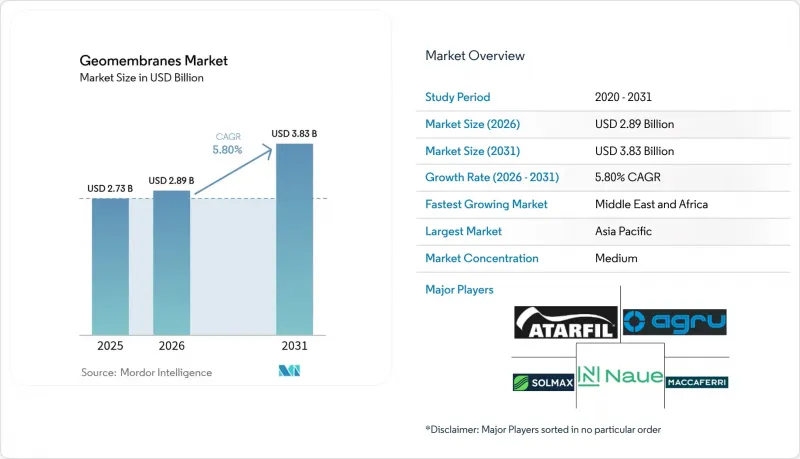
本報告按原料(高密度聚苯乙烯、低密度聚乙烯、聚氯乙烯、聚丙烯等)、應用(水資源管理、廢棄物管理、採礦等)、製造方法(擠出/吹膜、壓延、共擠出多層阻隔、增強/複合材料)和地區(亞太地區、北美、歐洲、南美洲以及中東和非洲)進行分類。
全球地工止水膜市場趨勢與洞察
全球對掩埋滲漏問題制定更嚴格的法規
全球掩埋法規強制要求採用複合襯墊系統,迫使營運方使用更厚、耐化學腐蝕性更強的地工止水膜,以確保其在較長的使用壽命內保持近乎零滲透性。美國環保署 (EPA) 40 CFR 第 258 部分及歐盟類似法規的修訂提高了洩漏檢測標準,其影響也波及新興經濟體。美國各州(例如肯塔基州加強了襯墊法規)的修訂表明,地方政府可以超越聯邦標準,以降低法律責任風險。這種監管連鎖反應推動了產品的持續改進,供應商推出了諸如紫外線穩定多層高密度聚乙烯 (HDPE) 薄膜和帶有導電層以進行完整性檢測的產品等。能夠透過第三方認證證明完全合規的市場參與企業將獲得定價權,並可在市政競標中獲得優先競標地位。隨著新建掩埋場單元的資本預算擴大將總項目預算的 10-15% 用於襯墊包裝,對地工止水膜的需求正在穩步成長。
安地斯地區希普里奇銅礦計畫的激增
智利和秘魯的銅礦商正在擴大堆浸作業規模,以經濟高效地處理低品位礦石,每個堆場都需要數百萬平方公尺的高耐酸襯墊。智利國家銅業公司(CODELCO)在所有尾礦設施中實施GISTM認證,是防滲透相關支出不斷成長的典型例證,其影響波及承包商和整個樹脂供應鏈。添加抗氧化劑並提高分子量的HDPE和PP等級材料正逐漸成為標準配置,以承受高濃度硫酸和高溫。當地承包商正在冷焊熔合和完整性測試方面累積專業技術,這使他們在與普通土木工程承包商的競爭中佔據優勢。擁有本地庫存和雙語技術支援的供應商,在擴建階段同步進行維護工作的同時,也獲得了重複訂單。預計2030年,安地斯走廊仍將是亞太地區以外對地工止水膜市場需求最集中的單一區域。
石油衍生樹脂價格波動
自2024年以來,由於煉油廠停產和物流中斷,高密度聚乙烯(HDPE)和聚氯乙烯(PVC)樹脂的價格每季波動15-20%。由於膜材生產商採用固定價格契約,樹脂成本的急劇上漲正在擠壓利潤空間。雖然一些項目現在包含樹脂成本上漲條款,但市政競標中通常不接受浮動價格結構,迫使供應商透過期貨合約來對沖風險。使用聚丙烯(PP)和特殊混合物替代部分材料可以部分抵消價格波動,但也增加了供應鏈的複雜性。這個問題在新興市場更為突出,這些市場對成本的敏感度可能導致襯墊更換延遲,從而減緩地工止水膜市場的短期成長。
細分市場分析
由於高密度聚乙烯(HDPE)在暴露於惡劣環境的圍護系統中展現出優異的耐化學腐蝕性、抗紫外線線性和抗應力開裂性,預計到2025年,HDPE將佔據地工止水膜市場42.18%的佔有率。該材料仍然是掩埋封蓋、礦山水庫和設計壽命超過50年的管道襯砌的首選材料。儘管HDPE的性能和全球樹脂供應鏈確保了其品質的穩定性,但由於價格波動風險,一些買家正在考慮轉向聚丙烯(PP)。 PP已成為成長最快的原料,預計到2031年將以5.95%的複合年成長率成長,這主要得益於雙軸拉伸和多層共混技術的進步,這些技術實現了高柔軟性和低熱膨脹係數。這些特性使其適用於對薄膜尺寸穩定性要求極高的浮動覆蓋層和太陽能池塘混合結構。
聚氯乙烯(PVC)因其易於預製和工廠焊接的特性,在化學品倉儲設施和隧道防水應用中仍被廣泛應用,但環境問題正在阻礙其發展。低密度聚乙烯(LDPE)和線性低密度聚乙烯(LLDPE)則佔據著一些特定的細分市場,例如需要適應不規則路基和臨時襯砌的應用,這些應用需要快速現場拼接。三元乙丙橡膠(EPDM)因其即使在極端溫度下也能保持彈性體性能,而應用於屋頂材料和飲用水水庫。採用再生聚合物和奈米填料的混合複合材料正在興起,提高了材料的抗穿刺性和抗刮性。儘管目前應用仍然有限,但這充分展現了地工止水膜市場創新技術的廣泛性。
區域分析
到2025年,亞太地區將佔全球銷售額的45.05%,反映出該地區公共基礎設施投資規模之大,其他任何地區都無法比擬。中國投資1,370億美元的摩拓發電工程和印度投資132億美元的杉上游綜合計畫都已獲批,這些都是大型開發案帶來長期襯墊需求的典型例證。中國和東南亞正在大力推動農業現代化,引入襯墊池塘用於水產養殖和灌溉;與此同時,印尼和菲律賓正在根據新的環保法規擴建城市固態廢棄物掩埋。該地區的樹脂生產能力具有成本優勢,使當地製造商能夠以更短的前置作業時間回應專案需求。中國和韓國的出口型製造商正將工廠生產的板材運往南美和非洲,利用其貨幣優勢在地工止水膜市場贏得國際競標。
預計到2031年,中東和非洲地區的複合年成長率將達到5.78%,這主要得益於各國水資源戰略的推動,這些戰略要求建設襯砌式水庫、蒸發器和尾礦壩。摩洛哥耗資400億美元的水資源計畫和阿爾及利亞的多階段海水淡化計畫是政府支持的大型企劃的典型案例,所有這些計畫都在競標中包含了地工止水膜組件。從南部非洲的銅礦帶到加納的金礦,採礦投資的不斷成長正在推動對符合國際標準的耐化學腐蝕高密度聚乙烯(HDPE)襯砌的需求。該地區的供應鏈仍然嚴重依賴高品質薄膜產品的進口,這促使全球供應商在杜拜和卡薩布蘭卡設立分銷中心,以確保快速交貨。
在北美和歐洲,隨著老舊掩埋場和污水儲存達到使用壽命終點並開始更換,市場需求仍然強勁。儘管掩埋的建設速度保持平穩,但由於新掩埋場的厚度規格提高,以及受美國環保署(EPA)更嚴格的法規和歐盟循環經濟指令的推動,強制使用雙層襯裡系統,市場需求得以維持。南美洲的前景依然光明,這得歸功於安地斯山脈地區採礦業的擴張以及智利和秘魯嚴格的尾礦管理法規。雖然本地襯裡具有成本競爭力,但大型專案為了確保投資者的信心,紛紛採用全球知名品牌的地工膜,從而在地工止水膜市場實現了區域供應商和國際供應商之間的健康平衡。
其他好處:
- Excel格式的市場預測(ME)表
- 3個月的分析師支持
目錄
第1章:引言
- 研究假設和市場定義
- 調查範圍
第2章:調查方法
第3章執行摘要
第4章 市場狀況
- 市場概覽
- 市場促進因素
- 全球加強對掩埋滲濾液的監管
- 安地斯山脈地區採用堆浸法開採銅礦的計畫激增。
- 由於缺水,中東地區強制要求對水庫進行襯砌。
- 布魯馬迪尼奧災難發生後,尾礦壩安全改革迅速實施。
- 農業科技的蓬勃發展正在推動襯砌灌溉池塘的普及(亞太地區)
- 市場限制因素
- 石油衍生高密度聚乙烯和聚氯乙烯樹脂的價格波動
- 擴大地工合成黏土襯墊作為替代方案的應用。
- 偏遠礦區合格的安裝人員數量有限。
- 價值鏈分析
- 波特五力模型
第5章 市場規模與成長預測
- 按成分
- 高密度聚苯乙烯(HDPE)
- 低密度聚乙烯(LDPE)
- 線型低密度聚乙烯(LLDPE)
- 聚氯乙烯(PVC)
- 乙丙橡膠(EPDM)
- 聚丙烯(PP)
- 其他原料
- 透過使用
- 水資源管理
- 廢棄物管理
- 礦業
- 隧道施工及襯砌
- 農業和水產養殖
- 土壤管理和侵蝕防治
- 透過製造方法
- 擠出成型/膨脹成型
- 日曆
- 共擠出多層阻隔膜
- 增強材料/複合材料
- 按地區
- 亞太地區
- 中國
- 印度
- 日本
- 韓國
- 東南亞國協
- 其他亞太國家
- 北美洲
- 美國
- 加拿大
- 墨西哥
- 歐洲
- 德國
- 英國
- 法國
- 義大利
- 西班牙
- 俄羅斯
- 其他歐洲國家
- 南美洲
- 巴西
- 阿根廷
- 智利
- 其他南美國家
- 中東和非洲
- 沙烏地阿拉伯
- 阿拉伯聯合大公國
- 南非
- 奈及利亞
- 其他中東和非洲國家
- 亞太地區
第6章 競爭情勢
- 市場集中度
- 策略趨勢
- 市佔率** / 排名分析
- 公司簡介
- AGRU America, Inc.
- ATARFIL, SL
- Carlisle SynTec Systems
- Carthage Mills
- Firestone Building Products Company LLC
- HUESKER International
- Huifeng Geosynthetics
- Jutta Ltd.
- Megaplast India
- NAUE GmbH & Co KG
- Nilex Inc.
- Officine Maccaferri SpA
- Plastika Kritis SA
- Raven Industries, Inc.
- RENOLIT SE
- SOLMAX
- Sotrafa
- Texel Industries
第7章 市場機會與未來展望
According to Mordor Intelligence, geomembranes market size in 2026 is estimated at USD 2.89 billion, growing from 2025 value of USD 2.73 billion with 2031 projections showing USD 3.83 billion, growing at 5.8% CAGR over 2026-2031.
This report is Segmented by Raw Material (High-Density Polyethylene, Low-Density Polyethylene, Polyvinyl Chloride, Polypropylene, and More), Application (Water Management, Waste Management, Mining, and More), Manufacturing Method (Extrusion/Blown-Film, Calendaring, Co-Extruded Multilayer Barrier, Reinforced/Composite), and Geography (Asia-Pacific, North America, Europe, South America, Middle East and Africa).
Global Geomembranes Market Trends and Insights
Stricter Global Landfill-Seepage Regulations
Worldwide landfill directives now compel composite liner systems, pushing operators to adopt thicker, chemically robust geomembranes that guarantee near-zero permeability over long service lives. The U.S. EPA's 40 CFR Part 258 updates, as well as similar EU rules, have set higher leakage detection standards that roll downstream into emerging economies. U.S. state amendments, such as Kentucky's heightened liner provisions, illustrate how local jurisdictions can exceed federal baselines to mitigate liability exposure. This regulatory cascade drives continuous product upgrades, prompting suppliers to market multilayer HDPE films fortified with UV stabilizers and conductive layers for integrity surveys. Market participants able to demonstrate full compliance through third-party certifications gain pricing power and preferred-bid status in municipal bids. Capital budgets for new landfill cells increasingly earmark 10-15% of project value for liner packages, embedding steady demand into the geomembranes market.
Surging Heap-Leach Copper Projects in Andean Region
Copper miners in Chile and Peru are scaling heap-leach operations to process lower-grade ores cost-effectively, each pad demanding millions of square meters of high-acid-resistant liners. CODELCO's alignment of all tailings facilities to GISTM exemplifies elevated containment spend that ripples through contractor and resin supply chains. HDPE and PP grades modified with antioxidants and higher molecular weight are becoming standard to endure high sulfuric acid concentrations and elevated temperatures. Regional installers are building niche expertise in cold-weld fusion and integrity testing, creating a competitive moat against generalist civil contractors. Suppliers that offer localized stock points and bilingual technical support secure repeat orders as maintenance campaigns run concurrently with expansion phases. By 2030, the Andean corridor is expected to remain the largest single regional pocket of geomembranes market demand outside Asia-Pacific.
Price Volatility of Petro-Based Resins
HDPE and PVC resin prices have experienced 15-20% quarter-to-quarter swings since 2024, driven by refinery outages and logistics disruptions. Membrane producers operate under fixed-award contracts that compress margins when resin costs spike. Some projects now include resin cost escalation clauses, but municipal tenders often resist variable pricing structures, forcing suppliers to hedge through forward contracts. Material substitution with PP or specialty blends partially offsets volatility but introduces supply complexities. The issue is more pronounced in emerging markets where cost sensitivity can delay liner upgrades, moderating short-term geomembranes market growth.
Other drivers and restraints analyzed in the detailed report include:
- Water-Scarcity-Led Reservoir Lining Mandates (Middle East)
- Ag-Tech Boom Driving Lined Irrigation Ponds (APAC)
- Limited Certified Installers in Frontier Mining Regions
For complete list of drivers and restraints, kindly check the Table Of Contents.
Segment Analysis
HDPE anchored 42.18% of the geomembranes market share in 2025 thanks to its proven chemical resistance, UV stability, and stress-crack endurance in exposed containment systems. The material remains the first choice for landfill caps, mining ponds, and canal linings where design lives exceed 50 years. HDPE's property profile and global resin supply chains allow consistent quality, yet its price fluctuation risk nudges some buyers toward PP. PP's 5.95% CAGR through 2031 positions it as the fastest-growing raw material, underpinned by advances in biaxially oriented and multilayer blends that deliver high flexibility and low thermal expansion. These traits suit floating covers and solar-pond hybrids where membrane dimensional stability is critical.
Polyvinyl chloride continues to serve chemical storage and tunnel waterproofing where ease of factory pre-fabrication and weldability are paramount, though environmental concerns cap its growth. LDPE and LLDPE occupy specialist niches requiring conformability over irregular subgrades or temporary linings that demand rapid field seaming. EPDM addresses roofing and potable-water reservoirs because of its elastomeric behavior at extreme temperatures. Hybrid formulations incorporating recycled polymers and nanofillers are emerging, offering improved puncture resistance and scratch toughness. Adoption remains limited but showcases the innovation bandwidth that characterizes the geomembranes market.
Complete Report Scope:
- By Raw Material
- High-density Polyethylene (HDPE)
- Low-density Polyethylene (LDPE)
- Linear Low-density Polyethylene (LLDPE)
- Polyvinyl Chloride (PVC)
- Ethylene Propylene Diene Monomer (EPDM)
- Polypropylene (PP)
- Other Raw Materials
- By Application
- Water Management
- Waste Management
- Mining
- Construction and Tunnel Lining
- Agriculture and Aquaculture
- Soil Management and Erosion Control
- By Manufacturing Method
- Extrusion/Blown-Film
- Calendaring
- Co-extruded Multilayer Barrier
- Reinforced/Composite
- By Geography
- Asia-Pacific
- China
- India
- Japan
- South Korea
- ASEAN Countries
- Rest of Asia-Pacific
- North America
- United States
- Canada
- Mexico
- Europe
- Germany
- United Kingdom
- France
- Italy
- Spain
- Russia
- Rest of Europe
- South America
- Brazil
- Argentina
- Chile
- Rest of South America
- Middle East and Africa
- Saudi Arabia
- United Arab Emirates
- South Africa
- Nigeria
- Rest of Middle East and Africa
- Asia-Pacific
Geography Analysis
Asia-Pacific captured 45.05% of global revenue in 2025, reflecting a scale of public infrastructure investment unmatched elsewhere. China's approval of the USD 137 billion Motuo Hydropower Project and India's USD 13.2 billion Siang Upper Multipurpose Project illustrate mega-developments that embed long-term liner demand. Robust agricultural modernization programs across China and Southeast Asia deploy lined ponds for aquaculture and irrigation, while Indonesia and the Philippines expand municipal solid-waste landfills under new environmental rules. Regional resin production capacity offers cost advantages, enabling local manufacturers to serve projects with shorter lead times. Export-oriented producers in China and South Korea ship factory-fabricated panels to the Americas and Africa, leveraging currency competitiveness to win international bids within the geomembranes market.
Middle East and Africa is on track to post a 5.78% CAGR to 2031, propelled by national water strategies that prescribe lined reservoirs, evaporation ponds, and tailings dams. Morocco's USD 40 billion water plan and Algeria's multi-phase desalination roll-outs typify government-backed megaprojects that embed geomembrane line items into every tender. Mining investment from southern Africa's copperbelt to Ghana's gold fields heightens demand for chemical-resistant HDPE liners compliant with global standards. Regional supply chains still lean heavily on imports of premium membranes, encouraging global suppliers to establish distribution hubs in Dubai and Casablanca for faster delivery.
North America and Europe maintain steady replacement-cycle demand as older landfill cells and wastewater lagoons reach end-of-life. Tightened EPA rules and EU circular-economy directives elevate specification thickness and require double-liner systems in new cells, sustaining volume despite flat landfill openings. South America remains a bright spot because of Andean mining expansion and strict tailings legislation in Chile and Peru. Local liners compete on cost, but major projects rely on globally branded membranes to secure financier confidence, nurturing a healthy mix of regional and international suppliers within the geomembranes market.
- AGRU America, Inc.
- ATARFIL, S.L.
- Carlisle SynTec Systems
- Carthage Mills
- Firestone Building Products Company LLC
- HUESKER International
- Huifeng Geosynthetics
- Jutta Ltd.
- Megaplast India
- NAUE GmbH & Co KG
- Nilex Inc.
- Officine Maccaferri S.p.A
- Plastika Kritis S.A.
- Raven Industries, Inc.
- RENOLIT SE
- SOLMAX
- Sotrafa
- Texel Industries
Additional Benefits:
- The market estimate (ME) sheet in Excel format
- 3 months of analyst support
TABLE OF CONTENTS
1 Introduction
- 1.1 Study Assumptions and Market Definition
- 1.2 Scope of the Study
2 Research Methodology
3 Executive Summary
4 Market Landscape
- 4.1 Market Overview
- 4.2 Market Drivers
- 4.2.1 Stricter global landfill-seepage regulations
- 4.2.2 Surging heap-leach copper projects in Andean region
- 4.2.3 Water-scarcity led reservoir lining mandates (Middle East)
- 4.2.4 Rapid tailings-dam safety reforms after Brumadinho disaster
- 4.2.5 Ag-tech boom driving lined irrigation ponds (APAC)
- 4.3 Market Restraints
- 4.3.1 Price volatility of petro-based HDPE and PVC resins
- 4.3.2 Rising adoption of geosynthetic-clay liners as substitutes
- 4.3.3 Limited certified installers in frontier mining regions
- 4.4 Value Chain Analysis
- 4.5 Porter's Five Forces
- 4.5.1 Bargaining Power of Suppliers
- 4.5.2 Bargaining Power of Buyers
- 4.5.3 Threat of New Entrants
- 4.5.4 Threat of Substitutes
- 4.5.5 Degree of Competition
5 Market Size and Growth Forecasts (Value)
- 5.1 By Raw Material
- 5.1.1 High-density Polyethylene (HDPE)
- 5.1.2 Low-density Polyethylene (LDPE)
- 5.1.3 Linear Low-density Polyethylene (LLDPE)
- 5.1.4 Polyvinyl Chloride (PVC)
- 5.1.5 Ethylene Propylene Diene Monomer (EPDM)
- 5.1.6 Polypropylene (PP)
- 5.1.7 Other Raw Materials
- 5.2 By Application
- 5.2.1 Water Management
- 5.2.2 Waste Management
- 5.2.3 Mining
- 5.2.4 Construction and Tunnel Lining
- 5.2.5 Agriculture and Aquaculture
- 5.2.6 Soil Management and Erosion Control
- 5.3 By Manufacturing Method
- 5.3.1 Extrusion/Blown-Film
- 5.3.2 Calendaring
- 5.3.3 Co-extruded Multilayer Barrier
- 5.3.4 Reinforced/Composite
- 5.4 By Geography
- 5.4.1 Asia-Pacific
- 5.4.1.1 China
- 5.4.1.2 India
- 5.4.1.3 Japan
- 5.4.1.4 South Korea
- 5.4.1.5 ASEAN Countries
- 5.4.1.6 Rest of Asia-Pacific
- 5.4.2 North America
- 5.4.2.1 United States
- 5.4.2.2 Canada
- 5.4.2.3 Mexico
- 5.4.3 Europe
- 5.4.3.1 Germany
- 5.4.3.2 United Kingdom
- 5.4.3.3 France
- 5.4.3.4 Italy
- 5.4.3.5 Spain
- 5.4.3.6 Russia
- 5.4.3.7 Rest of Europe
- 5.4.4 South America
- 5.4.4.1 Brazil
- 5.4.4.2 Argentina
- 5.4.4.3 Chile
- 5.4.4.4 Rest of South America
- 5.4.5 Middle East and Africa
- 5.4.5.1 Saudi Arabia
- 5.4.5.2 United Arab Emirates
- 5.4.5.3 South Africa
- 5.4.5.4 Nigeria
- 5.4.5.5 Rest of Middle East and Africa
- 5.4.1 Asia-Pacific
6 Competitive Landscape
- 6.1 Market Concentration
- 6.2 Strategic Moves
- 6.3 Market Share**/Ranking Analysis
- 6.4 Company Profiles (includes Global level Overview, Market level overview, Core Segments, Financials as available, Strategic Information, Market Rank/Share, Products and Services, Recent Developments)
- 6.4.1 AGRU America, Inc.
- 6.4.2 ATARFIL, S.L.
- 6.4.3 Carlisle SynTec Systems
- 6.4.4 Carthage Mills
- 6.4.5 Firestone Building Products Company LLC
- 6.4.6 HUESKER International
- 6.4.7 Huifeng Geosynthetics
- 6.4.8 Jutta Ltd.
- 6.4.9 Megaplast India
- 6.4.10 NAUE GmbH & Co KG
- 6.4.11 Nilex Inc.
- 6.4.12 Officine Maccaferri S.p.A
- 6.4.13 Plastika Kritis S.A.
- 6.4.14 Raven Industries, Inc.
- 6.4.15 RENOLIT SE
- 6.4.16 SOLMAX
- 6.4.17 Sotrafa
- 6.4.18 Texel Industries
7 Market Opportunities and Future Outlook
- 7.1 White-space and Unmet-Need Assessment

 全球地工止水膜市場:按類型、製造流程、應用和地區分類-預測至2031年
 PE地工止水膜市場報告:趨勢、預測及競爭分析(至2035年)
 池塘襯墊市場-2026-2032年全球市場預測地工止水膜市場-2026-2032年全球市場預測
 地工止水膜市場規模、佔有率和成長分析:按材料、應用、最終用途和地區分類-2026-2033年產業預測
 地工止水膜市場規模、佔有率和成長分析:按材料、應用、最終用途、厚度和地區分類-2026-2033年產業預測
 地工止水膜市場機會、成長要素、產業趨勢分析及2026-2035年預測
 地工止水膜市場報告:按原料、製造流程、應用和地區分類(2026-2034 年)
 地工止水膜市場:依材料、應用、厚度和地區分類
 2026年全球池塘襯墊市場報告