


 |
市場調查報告書
商品編碼
2113327
空氣品質管理系統:市場佔有率分析、產業趨勢與統計、成長預測(2026-2031)Air Quality Control System - Market Share Analysis, Industry Trends & Statistics, Growth Forecasts (2026 - 2031) |
||||||

※ 本網頁內容可能與最新版本有所差異。詳細情況請與我們聯繫。
根據 Mordor Intelligence 預測,空氣品質管理系統市場規模將從 2025 年的 1,078.5 億美元成長到 2026 年的 1,137.5 億美元,到 2031 年將達到 1,484.6 億美元,2026 年至 2031 年的複合年成長率為 5.47%。
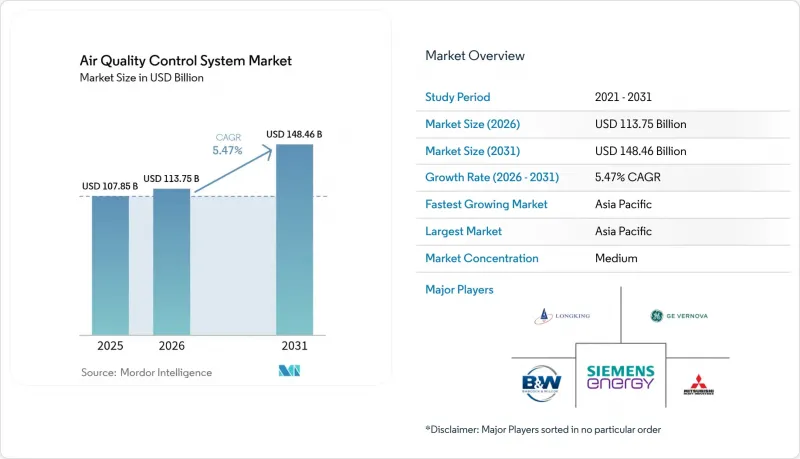
本報告按類型(靜電除塵器、排煙脫硫系統、洗滌器、布/陶瓷過濾器等)、組件(硬體、軟體和分析、服務)、安裝類型(新安裝和維修/升級)、應用(發電、水泥、化學和石化、其他)以及地區(北美、歐洲、亞太、其他)進行分類。
全球空氣品質管理系統市場趨勢及洞察
嚴格的跨洲排放上限將鼓勵即時投資以遵守規定。
國際海事組織 (IMO) 2020 年硫排放法規和歐盟 (EU) 工業排放指令引發了一場 500 億美元的投資浪潮,旨在推動航運、電力和重工業等行業的合規性。雖然超過 95% 的船舶的脫硫維修通常可在五年內收回成本,但相關的開放回路脫硫廢水會產生 6.8 億歐元的外部環境成本,從而推動了對閉合迴路系統的需求。歐盟禁止在開關設備中使用六氟化硫 (SF6) 等配套法規正在加速清潔空氣隔離設備 (CAL) 的應用,其中 Blue GIS 技術與傳統設計相比可減少 30% 的二氧化碳排放。這種連鎖反應如今正擴展到水泥和鋼鐵業,類似的排放強度目標正在推動這些產業維修,以實現全面的空氣品質管理,並將顆粒物、酸性氣體和微量金屬的捕集整合到一個平台中。
亞洲從煤炭轉向天然氣正在創造維修機會。
亞太地區的政策制定者優先考慮的是柔軟性,而非徹底淘汰燃煤發電廠,他們傾向於採用先進的排放控制維修,而不是完全拆除。中國的戰略目標是到2030年新增194-245吉瓦可再生能源,並將轉型成本降低1,760億美元,催生了對生質能混燒和綠色氨摻混系統的強勁需求。在印度,強制部署排煙脫硫(FGD)系統(其二氧化硫去除效率已超過98%)為大規模維修提供了商業依據。由於液化天然氣尚未基本取代煤炭,資產所有者正在轉向多燃料洗滌器和低氮氧化物燃燒器,以便在遵守日益嚴格的法規的同時繼續運作燃煤電廠。
原料價格波動和經合組織國家煤炭項目的減少對設備的利潤率帶來了壓力。
受俄羅斯和南非地緣政治動盪的影響,不銹鋼、鉑金和鈀金的價格波動,推高了催化劑更換成本,而催化劑更換成本佔選擇性催化還原(SCR)系統全生命週期成本的60%之多。同時,美國和歐洲燃煤發電廠的加速淘汰正在萎縮傳統洗滌器和靜電集塵機(ESP)的市場。這些因素共同擠壓了原始設備製造商(OEM)的利潤空間,並延長了買方的決策週期。供應商正透過套期採購、推出替代催化劑配方以及專注於燃料轉換維修專案需求強勁的成長地區來應對這種情況。
細分市場分析
在2025年的空氣污染控制系統市場中,煙氣脫硫(FGD)系統佔38.60%。在印度近期的計畫中,濕式系統的二氧化硫去除率超過98%,而半乾式設計在嚴重缺水地區也備受關注。纖維和陶瓷過濾器以5.86%的複合年成長率推動市場成長,其99%的顆粒物捕集效率和對高達1800 度C高溫氣流的耐受性使其備受青睞。隨著水泥和生質能混燒導致粒狀物負荷增加,預計空氣污染控制系統市場中過濾領域的市場規模將穩定擴大。
產品系列也正在朝向能夠應對多種污染物的架構轉型。閉合迴路洗滌器可減少洗滌水的排放,這在歐盟港口日益受到關注;而新興的選擇性催化還原(SCR)技術可將氮氧化物(NOx)排放量控制在30 ppm以下,滿足氫氣相容鍋爐的超低排放標準。儘管目前市場規模較小,但在適用綜合排放標準的地區,對汞和揮發性有機化合物(VOC)控制模組的需求日益成長,這促使供應商開發可堆疊式反應器陣列。
預計到2025年,硬體銷售額將佔總銷售額的67.20%,這主要反映了反應器、管道和感應通風機的成本。然而,分析平台成長最快,複合年成長率達7.32%,這得益於其預測性排放監測功能,與傳統的連續排放氣體監測系統(CEMS)相比,該功能可在不影響合規性的前提下節省50%至80%的成本。嵌入式數位孿生技術可為維護儀表板提供信息,從而減少意外停機時間和零件庫存。
此外,隨著組件、性能保證和人工智慧驅動的洞察被打包到長期營運合約中,服務的重要性日益凸顯。因此,軟體即服務 (SaaS) 空氣品質管理系統的市場佔有率預計每年將略有成長,這將對獨立硬體的市場佔有率構成壓力。將強大的設備與雲端分析相結合的供應商正在降低工廠所有者的轉型成本。
區域分析
亞太地區是當之無愧的領頭羊,預計到2025年將佔全球銷售額的42.70%,到2031年將維持6.02%的複合年成長率。中國為確保電網柔軟性而繼續運作燃煤電廠,同時推進生質能和綠色氨的混燒,推動了大規模維修,採用超低氮氧化物燃燒器和高效能洗滌器。印度的強制性排煙脫硫脫硫(FGD)工程進展順利,預計每年可減少110萬噸二氧化硫排放,近期安裝的脫硫裝置脫硫率已達98%。在全部區域,鋼鐵和水泥行業的擴張推動了對高溫袋濾式集塵器和乾式吸附劑噴射裝置的需求,預計將帶來持續的訂單。日本和韓國透過要求業界領先的排放因子來推動技術需求,刺激了國內原始設備製造商(OEM)的研發投資。
北美和歐洲正在形成成熟且充滿活力的維修市場。歐盟的工業排放指令和燃煤發電廠除塵器。在美國,電力容量轉換計畫借鑒了巴布科克-威爾科克斯公司的燃料轉換案例,該計畫將低氮氧化物燃燒器與預測性排放監測相結合,在不廢棄現有設施的情況下滿足州政府的許可要求。這兩個地區都在優先考慮人工智慧驅動的維護和碳捕獲技術的整合,這正在產生高價值的服務契約,從而抵消交易量成長放緩的影響。
中東和非洲是除亞洲以外成長潛力最大的地區。杜拜的垃圾焚化發電為13.5萬戶家庭供電,顯示固態廢棄物管理領域亟需大規模的廢氣處理。撒哈拉以南非洲水泥熟料市場的新參與企業需要堅固耐用的袋式除塵器和混合式靜電集塵機(ESP),這些設備專為多塵、高鹼性環境而設計。例如,阿爾及利亞的傑勒法工廠計畫年產能180萬噸,專注於生產環保水泥。南美洲在監管嚴格程度上落後於其他地區,但採礦和金屬項目正在逐步完善其監管實施記錄,將汞和酸性氣體排放控制納入其中,以滿足出口市場的需求。
其他好處:
- Excel格式的市場預測(ME)表
- 3個月的分析師支持
目錄
第1章:引言
- 研究假設和市場定義
- 調查範圍
第2章:調查方法
第3章執行摘要
第4章 市場狀況
- 市場概覽
- 市場促進因素
- 嚴格的跨洲排放法規(例如,IMO 2020、歐盟 IED)
- 亞洲發電結構從煤炭轉向天然氣,推動了設備維修的需求。
- 撒哈拉以南非洲地區的水泥產能擴張正在加速。
- 人工智慧驅動的預測性維護可降低營運成本。
- 需要超低氮氧化物排放的綠色氫氣鍋爐 AQCS
- 市場限制因素
- 原物料價格波動(不鏽鋼、催化劑)
- 經合組織國家燃煤發電廠建設計畫減少
- 人們對濕式洗滌器中 PFAS 和二次污染的擔憂
- 供應鏈分析
- 監理情勢
- 技術展望
- 波特五力模型
第5章 市場規模與成長預測
- 按類型
- 靜電集塵器(乾式和濕式)
- 廢氣脫硫(濕法、乾法和半乾法)
- 洗滌器(濕式、乾式、船舶用)
- 選擇性催化還原與非催化還原
- 織物/陶瓷過濾器
- 汞和揮發性有機化合物控制設備
- 按組件
- 硬體(反應器、管道、風扇)
- 軟體和分析
- 服務(維運、維修)
- 按安裝類型
- 新建工程
- 改裝/升級
- 透過使用
- 發電
- 水泥
- 鋼
- 化工/石油化工
- 紙漿和造紙
- 垃圾焚化發電
- 其他行業(玻璃、採礦等)
- 按地區
- 北美洲
- 美國
- 加拿大
- 墨西哥
- 歐洲
- 德國
- 法國
- 英國
- 義大利
- 俄羅斯
- 其他歐洲國家
- 亞太地區
- 中國
- 印度
- 日本
- 韓國
- 東南亞國協
- 其他亞太國家
- 南美洲
- 巴西
- 阿根廷
- 其他南美國家
- 中東和非洲
- 沙烏地阿拉伯
- 阿拉伯聯合大公國
- 南非
- 埃及
- 其他中東和非洲國家
- 北美洲
第6章 競爭情勢
- 市場集中度
- 策略趨勢(併購、聯盟、購電協議)
- 市場佔有率分析(主要公司的市場排名和佔有率)
- 公司簡介
- Mitsubishi Heavy Industries
- General Electric
- Babcock & Wilcox
- Siemens Energy
- Thermax
- Fujian Longking
- Hamon Group
- Andritz
- Ducon Technologies
- GEA Bischoff
- Pure Air Solutions
- Tri-Mer Corporation
- Anguil Environmental Systems
- Durr
- CECO Environmental
- Airex Industries
- Albmarle Mercury Control
- KC Cottrell
- Yara Marine Technologies
- Wartsila
第7章 市場機會與未來展望
According to Mordor Intelligence, the air quality control system market size is expected to grow from USD 107.85 billion in 2025 to USD 113.75 billion in 2026 and is forecast to reach USD 148.46 billion by 2031 at 5.47% CAGR over 2026-2031.
This report is Segmented by Type (Electrostatic Precipitators, Flue-Gas Desulfurization, Scrubbers, Fabric/Ceramic Filters, and More), Component (Hardware, Software and Analytics, and Services), Installation Type (New Build and Retrofit/Upgrade), Application (Power Generation, Cement, Chemicals and Petrochemicals, and More), and Geography (North America, Europe, Asia-Pacific, and More).
Global Air Quality Control System Market Trends and Insights
Stringent Trans-Continental Emission Caps Drive Immediate Compliance Investments
The International Maritime Organization's 2020 sulfur limits and the European Union's Industrial Emissions Directive have triggered a USD 50 billion compliance-driven spending cycle across shipping, power, and heavy industry. Scrubber retrofits typically reach economic break-even inside five years for more than 95% of vessels, yet the associated open-loop wash water has created EUR 680 million in external environmental costs that are steering demand toward closed-loop systems. Complementary regulation, such as the EU F-gas ban on SF6 in switchgear, is accelerating the uptake of clean-air insulated equipment, with Blue GIS technology lowering CO2 footprints by 30% relative to legacy designs. Spill-over effects now reach cement and steel, where similar intensity targets are prompting holistic air quality control retrofits that bundle particulate, acid-gas, and trace-metal capture in one platform.
Coal-to-Gas Transition in Asia Unlocks Retrofit Opportunities
Asia-Pacific policymakers prioritize coal-plant flexibility over outright retirement, requiring sophisticated emission-control retrofits rather than decommissioning. China's strategy allows 194-245 GW of incremental renewable penetration and trims transition costs by USD 176 billion by 2030, creating strong demand for systems that tolerate biomass co-firing and green ammonia blends. India's mandated FGD roll-out already posts SO2 removal efficiency above 98%, underscoring the business case for large-scale retrofits. LNG has not displaced coal materially, so asset owners are turning to multi-fuel-capable scrubbers and low-NOx burners to comply with tightening norms while dispatching coal capacity.
Volatile Raw-Material Prices and Shrinking OECD Coal Pipeline Compress Equipment Margins
Prices for stainless steel, platinum, and palladium move with geopolitical disruptions in Russia and South Africa, inflating catalyst replacement costs representing up to 60% of selective catalytic reduction lifecycle spend. Simultaneously, the United States and Europe are accelerating coal-plant retirements, narrowing the addressable base for traditional scrubber and ESP installations. Combined, these factors squeeze OEM margins and lengthen buyer decision cycles. Suppliers are countering through hedged procurement, alternative catalyst recipe,s and targeting growth regions where fuel-switch retrofits keep demand robust.
Other drivers and restraints analyzed in the detailed report include:
- Accelerated Cement Capacity Additions in Sub-Saharan Africa Create Specialized Demand
- AI-Enabled Predictive Maintenance Reduces Operational Expenditure
- PFAS and Secondary Pollution Concerns Challenge Wet Scrubber Applications
For complete list of drivers and restraints, kindly check the Table Of Contents.
Segment Analysis
Flue-Gas Desulfurization systems accounted for 38.60% of the air quality control system market 2025. Wet units achieve SO2 removal beyond 98% in India's latest projects, while semi-dry designs appeal where water scarcity prevails. Fabric and ceramic filters lead growth at a 5.86% CAGR, favoured for 99% particulate capture and tolerance of gas streams up to 1,800 °C. The air quality control system market size for filtration is forecast to expand steadily as cement and biomass co-firing raise particulate loads.
Product portfolios are also shifting to multi-pollutant architectures. Closed-loop scrubbers mitigate wash-water discharges flagged by EU ports, while emerging SCR variants drive NOx below 30 ppm, meeting ultra-low standards for hydrogen-ready boilers. Though smaller in value, demand for mercury and VOC control modules is rising where integrated limits apply, reinforcing vendor push toward stackable reactor trains.
Hardware comprised 67.20% of 2025 revenue, reflecting the cost of reactors, ducting, and induced-draft fans. However, analytics platforms are the fastest mover at 7.32% CAGR, because predictive emission monitoring can deliver 50-80% cost savings against conventional CEMS without sacrificing compliance. Embedded digital twins lower unplanned outages and feed maintenance dashboards that trim parts inventory.
Services also gain weight as long-term operating contracts bundle parts, performance guarantees, and AI-driven insights. As a result, the air quality control system market share for software-plus-services is projected to inch higher each year, compressing the standalone hardware proportion. Suppliers that marry rugged equipment with cloud analytics are building durable switching costs for plant owners.
Complete Report Scope:
- By Type
- Electrostatic Precipitators (Dry & Wet)
- Flue-Gas Desulfurization (Wet, Dry, Semi-dry)
- Scrubbers (Wet, Dry, Marine)
- Selective Catalytic and Non-Catalytic Reduction
- Fabric/Ceramic Filters
- Mercury and VOC Control Units
- By Component
- Hardware (Reactors, Ductwork, Fans)
- Software and Analytics
- Services (O&M, Retrofit)
- By Installation Type
- New Build
- Retrofit/Upgrade
- By Application
- Power Generation
- Cement
- Iron and Steel
- Chemicals and Petrochemicals
- Pulp and Paper
- Waste-to-Energy
- Others (Glass, Mining, etc.)
- By Geography
- North America
- United States
- Canada
- Mexico
- Europe
- Germany
- France
- United Kingdom
- Italy
- Russia
- Rest of Europe
- Asia-Pacific
- China
- India
- Japan
- South Korea
- ASEAN Countries
- Rest of Asia-Pacific
- South America
- Brazil
- Argentina
- Rest of South America
- Middle East and Africa
- Saudi Arabia
- United Arab Emirates
- South Africa
- Egypt
- Rest of Middle East and Africa
- North America
Geography Analysis
Asia-Pacific's 42.70% revenue share in 2025 makes it the undisputed leader, with a forecast 6.02% CAGR through 2031. China's decision to keep coal capacity online for grid flexibility while co-firing biomass and green ammonia drives an extensive retrofit wave for ultra-low-NOx burners and high-efficiency scrubbers. India's FGD mandate is on track to cut 1.1 million t of SO2 annually after recent installations reached 98% removal. Region-wide, steel and cement expansions reinforce demand for high-temperature fabric filters and dry sorbent injection, ensuring sustained order flow. Japan and South Korea add technology pull by insisting on best-in-class emission factors, spurring R&D investment by domestic OEMs.
North America and Europe form mature yet vibrant retrofit markets. The EU Industrial Emissions Directive and the F-gas phase-out propel swap-outs of legacy switchgear and coal-plant dust collectors with clean-air GIS and SCR-plus-carbon-capture hybrids. In the United States, capacity-conversion projects mirror the Babcock & Wilcox fuel switch, pairing low-NOx burners with predictive emission monitoring to satisfy state permits without abandoning existing sites. Both regions prioritize AI-assisted maintenance and carbon-capture integration, generating high-value service contracts that offset lower volume growth.
The Middle East and Africa present the highest upside outside Asia. Dubai's waste-to-energy complex powers 135,000 homes while proving the case for large-scale flue-gas treatment in solid-waste applications. Sub-Saharan Africa's clinker entrants need robust baghouses and hybrid ESPs tailored for dusty, high-alkali environments. Algeria's Djelfa plant, for example, plans 1.8 million t of capacity with a green-cement slant. South America lags in regulatory rigor, yet mining and metals projects embed mercury and acid-gas controls to meet export-market expectations, slowly broadening the installed base.
- Mitsubishi Heavy Industries
- General Electric
- Babcock & Wilcox
- Siemens Energy
- Thermax
- Fujian Longking
- Hamon Group
- Andritz
- Ducon Technologies
- GEA Bischoff
- Pure Air Solutions
- Tri-Mer Corporation
- Anguil Environmental Systems
- Durr
- CECO Environmental
- Airex Industries
- Albmarle Mercury Control
- KC Cottrell
- Yara Marine Technologies
- Wartsila
Additional Benefits:
- The market estimate (ME) sheet in Excel format
- 3 months of analyst support
TABLE OF CONTENTS
1 Introduction
- 1.1 Study Assumptions & Market Definition
- 1.2 Scope of the Study
2 Research Methodology
3 Executive Summary
4 Market Landscape
- 4.1 Market Overview
- 4.2 Market Drivers
- 4.2.1 Stringent trans-continental emission caps (e.g., IMO 2020, EU IED)
- 4.2.2 Coal-to-gas power-mix shift in Asia driving retrofits
- 4.2.3 Accelerated cement capacity additions in Sub-Saharan Africa
- 4.2.4 AI-enabled predictive maintenance cutting OPEX
- 4.2.5 Green-hydrogen fired boilers requiring ultra-low-NOx AQCS
- 4.3 Market Restraints
- 4.3.1 Volatile raw-material prices (stainless steel, catalysts)
- 4.3.2 Declining coal power pipeline in OECD economies
- 4.3.3 PFAS & secondary pollution concerns for wet scrubbers
- 4.4 Supply-Chain Analysis
- 4.5 Regulatory Landscape
- 4.6 Technological Outlook
- 4.7 Porter's Five Forces
- 4.7.1 Bargaining Power of Suppliers
- 4.7.2 Bargaining Power of Buyers
- 4.7.3 Threat of New Entrants
- 4.7.4 Threat of Substitutes
- 4.7.5 Intensity of Competitive Rivalry
5 Market Size & Growth Forecasts
- 5.1 By Type
- 5.1.1 Electrostatic Precipitators (Dry & Wet)
- 5.1.2 Flue-Gas Desulfurization (Wet, Dry, Semi-dry)
- 5.1.3 Scrubbers (Wet, Dry, Marine)
- 5.1.4 Selective Catalytic and Non-Catalytic Reduction
- 5.1.5 Fabric/Ceramic Filters
- 5.1.6 Mercury and VOC Control Units
- 5.2 By Component
- 5.2.1 Hardware (Reactors, Ductwork, Fans)
- 5.2.2 Software and Analytics
- 5.2.3 Services (O&M, Retrofit)
- 5.3 By Installation Type
- 5.3.1 New Build
- 5.3.2 Retrofit/Upgrade
- 5.4 By Application
- 5.4.1 Power Generation
- 5.4.2 Cement
- 5.4.3 Iron and Steel
- 5.4.4 Chemicals and Petrochemicals
- 5.4.5 Pulp and Paper
- 5.4.6 Waste-to-Energy
- 5.4.7 Others (Glass, Mining, etc.)
- 5.5 By Geography
- 5.5.1 North America
- 5.5.1.1 United States
- 5.5.1.2 Canada
- 5.5.1.3 Mexico
- 5.5.2 Europe
- 5.5.2.1 Germany
- 5.5.2.2 France
- 5.5.2.3 United Kingdom
- 5.5.2.4 Italy
- 5.5.2.5 Russia
- 5.5.2.6 Rest of Europe
- 5.5.3 Asia-Pacific
- 5.5.3.1 China
- 5.5.3.2 India
- 5.5.3.3 Japan
- 5.5.3.4 South Korea
- 5.5.3.5 ASEAN Countries
- 5.5.3.6 Rest of Asia-Pacific
- 5.5.4 South America
- 5.5.4.1 Brazil
- 5.5.4.2 Argentina
- 5.5.4.3 Rest of South America
- 5.5.5 Middle East and Africa
- 5.5.5.1 Saudi Arabia
- 5.5.5.2 United Arab Emirates
- 5.5.5.3 South Africa
- 5.5.5.4 Egypt
- 5.5.5.5 Rest of Middle East and Africa
- 5.5.1 North America
6 Competitive Landscape
- 6.1 Market Concentration
- 6.2 Strategic Moves (M&A, Partnerships, PPAs)
- 6.3 Market Share Analysis (Market Rank/Share for key companies)
- 6.4 Company Profiles (includes Global level Overview, Market level overview, Core Segments, Financials as available, Strategic Information, Products & Services, and Recent Developments)
- 6.4.1 Mitsubishi Heavy Industries
- 6.4.2 General Electric
- 6.4.3 Babcock & Wilcox
- 6.4.4 Siemens Energy
- 6.4.5 Thermax
- 6.4.6 Fujian Longking
- 6.4.7 Hamon Group
- 6.4.8 Andritz
- 6.4.9 Ducon Technologies
- 6.4.10 GEA Bischoff
- 6.4.11 Pure Air Solutions
- 6.4.12 Tri-Mer Corporation
- 6.4.13 Anguil Environmental Systems
- 6.4.14 Durr
- 6.4.15 CECO Environmental
- 6.4.16 Airex Industries
- 6.4.17 Albmarle Mercury Control
- 6.4.18 KC Cottrell
- 6.4.19 Yara Marine Technologies
- 6.4.20 Wartsila
7 Market Opportunities & Future Outlook
- 7.1 White-space & Unmet-need Assessment

 可攜式空氣品質監測系統市場(截至2034年)
 室內空氣品質監測系統市場(至2034年)
 空氣品質管理系統市場:依產品類型、技術、應用、最終用戶和通路分類-2026-2032年全球市場預測
 空氣品質管理系統市場:依產品類型、應用和地區分類
 北美工業空氣污染控制系統:市佔率分析、產業趨勢與統計及成長預測(2026-2031 年)
 空氣清淨機市場預測至2034年-按產品、技術、應用、最終用戶和地區分類的全球分析2034年自動化室內空氣品質監測艙市場預測-按產品類型、部署模式、感測器類型、連接技術、安裝模式、最終用戶和地區分類的全球分析
 2026年全球空氣品質管理系統市場報告全球環境顆粒物空氣監測器市場(按技術、產品、顆粒尺寸、應用和最終用戶分類)預測(2026-2032)
 2035年船舶靜電集塵器市場分析及預測:按類型、產品、服務、技術、組件、應用、材料類型、最終用戶和功能分類