


 |
市場調查報告書
商品編碼
2100760
德國智慧家庭:市場佔有率分析、產業趨勢與統計及成長預測(2026-2031)Germany Smart Home - Market Share Analysis, Industry Trends & Statistics, Growth Forecasts (2026 - 2031) |
||||||

※ 本網頁內容可能與最新版本有所差異。詳細情況請與我們聯繫。
根據 Mordor Intelligence 估計,德國智慧家庭市場在 2026 年的價值將達到 85.4 億美元,高於 2025 年的 78.6 億美元,預計到 2031 年將達到 129.1 億美元。
預計從 2026 年到 2031 年,其複合年成長率將達到 8.62%。
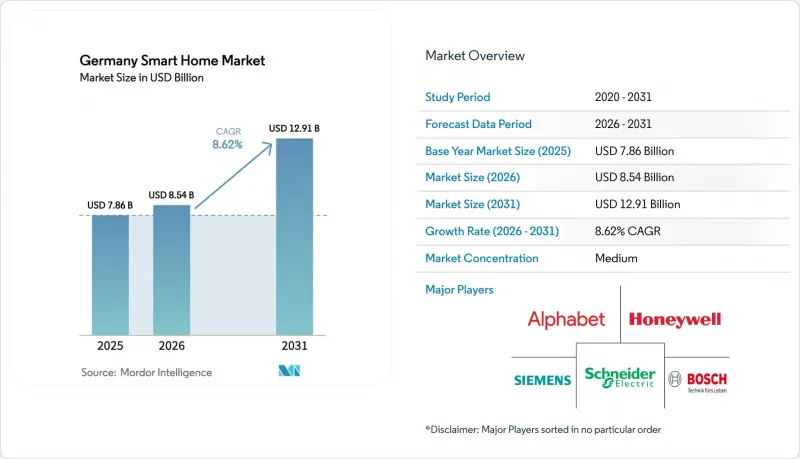
本報告按產品(舒適和照明、控制和連接等)、連接技術(Wi-Fi、Zigbee、Z-Wave 等)、最終用戶(獨棟住宅、多用戶住宅等)和銷售管道(線上零售、連鎖零售等)進行分類。
德國智慧家庭市場的趨勢與洞察
政府對節能住宅的補貼正在促進市場擴張。
德國復興信貸銀行 (KfW) 和聯邦農業及食品管理局 (BAFA) 的計畫降低了能源管理設備的初始成本,並為智慧家庭改造提供高達 15,000 歐元的津貼。 2024 年《建築能源法》的修訂強制要求新建住宅安裝智慧佈線,加速了智慧電錶的普及。智慧電錶的安裝數量從 2022 年的 272,024 個激增至 2024 年 9 月的 100 多萬個。多用戶住宅開發商正利用這些補貼,將溫控器和能源監視器打包銷售,以實現 20-30% 的能源效率提升,從而獲得最高津貼。補貼利用率在維修需求高的地區最高,尤其是在 1990 年前建造的住宅存量中,這推動了德國智慧家庭市場的成長。
消費者節能意識的提高正在改變他們的購買決策。
碳排放稅的上漲推高了家庭能源成本,使得連網恆溫器和智慧熱泵控制器更具經濟吸引力。研究表明,到2025年,42%的設備購買將用於提高能源效率,高於2022年的28%。在美國西部各州,家庭每年投資3000至5000歐元整合屋頂太陽能、電池儲能和自適應加熱等解決方案。這些趨勢正在推動對能夠量化即時節能效果並與消費者永續性目標相契合的分析主導平台的需求。
高昂的安裝和維修成本阻礙了其在普通市場上的廣泛應用。
安裝一套功能齊全的系統需要花費 8,000 至 12,000 歐元,而老舊建築通常需要花費 3,000 至 5,000 歐元進行維修才能安裝設備。獎勵機制錯配的問題依然存在,因為 54% 的家庭居住在租賃住宅中。這意味著房東承擔硬體成本,而租戶則享有租金減免。雖然像 Homematic IP 這樣的品牌提供的 500 歐元以下的入門套件降低了進入門檻,但德國智慧家居市場仍然嚴重依賴貸款和補貼來擴大普及。
細分市場分析
2025年,安防平台佔銷售額的26.65%,主要得益於保險公司為安裝入侵感測器和連網攝影機的客戶提供的獎勵。該細分市場透過整合門窗感測器、運動感測器和雲端影片功能,創造了訂閱收入,從而提高了客戶維繫。能源管理設備目前是成長最快的細分市場,到2031年複合年成長率將達到13.78%,這主要得益於可變電價機制促進了自動負載轉移。智慧恆溫器、熱泵控制器和太陽能逆變器透過「Matter」平台整合,從而縮短了安裝時間並互通性。不同價格區間的成長趨勢各不相同。入門級感應器套裝在電商市場佔據主導地位,而豪華別墅則開始採用全住宅照明場景和整合式音響系統。博世家電在2025年國際消費電子展(CES)上推出首款搭載「Matter」平台的冷藏庫,顯示智慧家電正在加入主流產品線,預示著白色家電將成為德國智慧家居市場的核心組成部分。
Wi-Fi 已成為家用路由器的標配,支援 43.35% 的裝置連線。電力線通訊 (PLC) 技術利用電力線,電力公司正在將其應用於需量反應試點項目,以應對 2025 年需量反應的強制實施。 PLC 的複合年成長率 (CAGR) 為 17.1%,無需新的佈線即可滿足邊緣電錶的延遲要求,並支援德國智慧家庭市場中能源儀錶板的需求。隨著供應商逐漸放棄專有集線器,Thread 和 Zigbee 正透過 Matter 獲得越來越多的市場佔有率。德國電信正在將智慧家庭控制功能整合到標準路由器中,推廣無集線器設置,從而減輕用戶的擁有負擔。藍牙和Sub-GHz頻段射頻技術在諸如門鎖和洩漏偵測器等對低功耗和長電池續航時間要求極高的應用領域中扮演著重要角色。 Z-Wave 仍然可供客製化整合商使用,但授權費用推高了組件成本,限制了新設備的普及速度。
其他好處:
- Excel格式的市場預測(ME)表
- 3個月的分析師支持
目錄
第1章:引言
- 研究假設和市場定義
- 調查範圍
第2章:調查方法
第3章執行摘要
第4章 市場狀況
- 市場概覽
- 市場促進因素
- 政府對節能住宅的補貼
- 消費者節能意識日益增強
- 智慧型手機和寬頻普及率高
- 德國「建築維修熱潮」中的獎勵
- 智慧安防產品可享保險費折扣
- 動態定價試點項目,協助需量反應
- 市場限制因素
- 實施和維修成本高昂
- 資料隱私和網路安全問題
- 標準的互通性和碎片化
- 安裝承包商和技術人員短缺
- 價值供應鏈分析
- 監理情勢
- 技術展望
- 波特五力分析
- 投資分析
第5章 市場規模與成長預測
- 依產品
- 舒適度和照明
- 控制和連接功能
- 能源管理
- 家庭娛樂
- 安全
- 智慧家庭設備
- 透過連接技術
- Wi-Fi
- 藍牙和射頻
- Zigbee
- Z-Wave
- 寬頻公司
- 其他協議
- 最終用戶
- 獨立式住宅
- 多用戶住宅
- 公寓
- 豪華別墅
- 按銷售管道
- 線上零售
- 有組織的零售連鎖店
- 專賣店
- 直接承包商網路
第6章 競爭情勢
- 市場集中度
- 策略趨勢
- 市佔率分析
- 公司簡介
- Robert Bosch Smart Home GmbH
- ABB Ltd
- Schneider Electric SE
- Honeywell International Inc.
- Emerson Electric Co.
- Siemens AG
- Google LLC(Alphabet)
- LG Electronics Inc.
- Samsung Electronics Co.
- Telekom Deutschland GmbH(Magenta SmartHome)
- Amazon.com Inc.
- Eve Systems GmbH
- Homematic IP
- tado GmbH
- Nuki Home Solutions GmbH
- Devolo AG
- Gigaset AG
- Somfy SA
- Netatmo
- IKEA
- TP-Link Technologies Co.
第7章 市場機會與未來展望
According to Mordor Intelligence, Germany smart home market size in 2026 is estimated at USD 8.54 billion, growing from 2025 value of USD 7.86 billion with 2031 projections showing USD 12.91 billion, growing at 8.62% CAGR over 2026-2031.
This report is Segmented by Product (Comfort and Lighting, Control and Connectivity and More), Connectivity Technology (Wi-Fi, Zigbee, Z-Wave and More), by End User (Single-Family Homes, Multi-Family Homes and More), Sales Channel (Online Retail, Organised Retail Chains and More).
Germany Smart Home Market Trends and Insights
Government subsidies for energy-efficient homes drive market acceleration
Germany's KfW and BAFA programs cut the upfront cost of energy-management gear and reward smart-ready renovations with grants of up to EUR 15,000. The 2024 Building Energy Act amendments require smart-ready wiring in new builds and accelerate smart-meter deployment, which jumped from 272,024 units in 2022 to more than 1 million by September 2024. Multi-family developers tap these subsidies to bundle thermostats and energy monitors, achieving the 20-30% efficiency gains that secure maximum funding. Subsidy uptake is strongest in renovation-intensive regions where housing stock dates from before 1990, reinforcing the Germany smart home market growth.
Rising consumer awareness of energy savings transforms purchase decisions
Higher carbon levies lifted the cost of household energy, making connected thermostats and smart heat-pump controllers financially compelling. Surveys show that 42% of 2025 device purchases target energy efficiency, up from 28% in 2022. In western states, households invest EUR 3,000-5,000 each year in integrated solutions that link rooftop solar, battery storage, and adaptive heating. These patterns heighten demand for analytics-driven platforms that quantify real-time savings and align with consumers' sustainability goals.
High installation & retrofit costs constrain mass-market adoption
A full-featured system costs EUR 8,000-12,000 to install, and older buildings often need EUR 3,000-5,000 in wiring upgrades before devices go in. With 54% of households renting, split-incentive problems persist: landlords pay for hardware while tenants reap lower bills. Starter kits priced under EUR 500 from brands such as Homematic IP soften the barrier, yet the Germany smart home market still relies on financing and subsidy schemes to broaden reach.
Other drivers and restraints analyzed in the detailed report include:
- High smartphone & broadband penetration enables seamless integration
- Building Renovation Wave incentives accelerate smart integration
- Installer/technician talent shortage creates a market bottleneck
For complete list of drivers and restraints, kindly check the Table Of Contents.
Segment Analysis
Security platforms generated 26.65% of 2025 sales as insurers rewarded customers who deploy intrusion sensors and connected cameras. The segment bundles door-window contacts, motion detectors, and cloud video for subscription revenue streams that improve retention. Energy-management devices now register the fastest expansion at 13.78% CAGR through 2031, buoyed by dynamic utility tariffs that favor automated load shifting. Smart thermostats, heat-pump controllers, and PV inverters integrate through Matter, shrinking installation times and boosting interoperability. Growth dynamics vary across price tiers. Entry-level sensor packs dominate e-commerce, whereas premium villas specify whole-house lighting scenes and integrated audio. Smart appliances enter mainstream portfolios after BSH launched the first Matter-enabled refrigerator at CES 2025, signalling that white goods will become core nodes in the Germany smart home market.
Household routers make Wi-Fi the default, underpinning 43.35% of device links. PLC technology rides on power lines, so utilities adopt it for demand-response pilots that precede the 2025 dynamic-pricing mandate. With an 17.1% CAGR, PLC meets edge-meter latency requirements without new wiring, supporting the Germany smart home market size allocated to energy dashboards. Thread and Zigbee scale through Matter as vendors migrate from proprietary hubs. Deutsche Telekom embeds smart-home control in standard routers, fostering hub-less set-ups that simplify ownership. Bluetooth and sub-GHz RF fill niche roles such as locks and water leakage alarms where low power or long battery life matters. Z-Wave persists in custom-integrator circles but shows limited new-device momentum because license fees raise bill-of-materials cost.
Complete Report Scope:
- By Product
- Comfort and Lighting
- Control and Connectivity
- Energy Management
- Home Entertainment
- Security
- Smart Appliances
- By Connectivity Technology
- Wi-Fi
- Bluetooth and RF
- Zigbee
- Z-Wave
- Broadband PLC
- Other Protocols
- By End User
- Single-Family Homes
- Multi-Family Homes
- Apartments
- Luxury Villas
- By Sales Channel
- Online Retail
- Organised Retail Chains
- Specialty Stores
- Direct Installer Network
List of Companies Covered in this Report:
- Robert Bosch Smart Home GmbH
- ABB Ltd
- Schneider Electric SE
- Honeywell International Inc.
- Emerson Electric Co.
- Siemens AG
- Google LLC (Alphabet)
- LG Electronics Inc.
- Samsung Electronics Co.
- Telekom Deutschland GmbH (Magenta SmartHome)
- Amazon.com Inc.
- Eve Systems GmbH
- Homematic IP
- tado GmbH
- Nuki Home Solutions GmbH
- Devolo AG
- Gigaset AG
- Somfy SA
- Netatmo
- IKEA
- TP-Link Technologies Co.
Additional Benefits:
- The market estimate (ME) sheet in Excel format
- 3 months of analyst support
TABLE OF CONTENTS
1 INTRODUCTION
- 1.1 Study Assumptions and Market Definition
- 1.2 Scope of the Study
2 RESEARCH METHODOLOGY
3 EXECUTIVE SUMMARY
4 MARKET LANDSCAPE
- 4.1 Market Overview
- 4.2 Market Drivers
- 4.2.1 Government subsidies for energy?efficient homes
- 4.2.2 Rising consumer awareness of energy savings
- 4.2.3 High smartphone and broadband penetration
- 4.2.4 Germany's Building Renovation Wave incentives
- 4.2.5 Insurance premium discounts for smart security
- 4.2.6 Dynamic utility pricing pilots enabling demand response
- 4.3 Market Restraints
- 4.3.1 High installation and retrofit costs
- 4.3.2 Data-privacy and cybersecurity concerns
- 4.3.3 Interoperability and standards fragmentation
- 4.3.4 Installer/technician talent shortage
- 4.4 Value / Supply-Chain Analysis
- 4.5 Regulatory Landscape
- 4.6 Technological Outlook
- 4.7 Porter's Five Forces Analysis
- 4.7.1 Bargaining Power of Suppliers
- 4.7.2 Bargaining Power of Consumers
- 4.7.3 Threat of New Entrants
- 4.7.4 Threat of Substitute Products
- 4.7.5 Intensity of Competitive Rivalry
- 4.8 Investment Analysis
5 MARKET SIZE AND GROWTH FORECASTS
- 5.1 By Product
- 5.1.1 Comfort and Lighting
- 5.1.2 Control and Connectivity
- 5.1.3 Energy Management
- 5.1.4 Home Entertainment
- 5.1.5 Security
- 5.1.6 Smart Appliances
- 5.2 By Connectivity Technology
- 5.2.1 Wi-Fi
- 5.2.2 Bluetooth and RF
- 5.2.3 Zigbee
- 5.2.4 Z-Wave
- 5.2.5 Broadband PLC
- 5.2.6 Other Protocols
- 5.3 By End User
- 5.3.1 Single-Family Homes
- 5.3.2 Multi-Family Homes
- 5.3.3 Apartments
- 5.3.4 Luxury Villas
- 5.4 By Sales Channel
- 5.4.1 Online Retail
- 5.4.2 Organised Retail Chains
- 5.4.3 Specialty Stores
- 5.4.4 Direct Installer Network
6 COMPETITIVE LANDSCAPE
- 6.1 Market Concentration
- 6.2 Strategic Moves
- 6.3 Market Share Analysis
- 6.4 Company Profiles (includes Global level Overview, Market level overview, Core Segments, Financials as available, Strategic Information, Market Rank/Share for key companies, Products and Services, and Recent Developments)
- 6.4.1 Robert Bosch Smart Home GmbH
- 6.4.2 ABB Ltd
- 6.4.3 Schneider Electric SE
- 6.4.4 Honeywell International Inc.
- 6.4.5 Emerson Electric Co.
- 6.4.6 Siemens AG
- 6.4.7 Google LLC (Alphabet)
- 6.4.8 LG Electronics Inc.
- 6.4.9 Samsung Electronics Co.
- 6.4.10 Telekom Deutschland GmbH (Magenta SmartHome)
- 6.4.11 Amazon.com Inc.
- 6.4.12 Eve Systems GmbH
- 6.4.13 Homematic IP
- 6.4.14 tado GmbH
- 6.4.15 Nuki Home Solutions GmbH
- 6.4.16 Devolo AG
- 6.4.17 Gigaset AG
- 6.4.18 Somfy SA
- 6.4.19 Netatmo
- 6.4.20 IKEA
- 6.4.21 TP-Link Technologies Co.
7 MARKET OPPORTUNITIES AND FUTURE OUTLOOK
- 7.1 White-space and Unmet-Need Assessment

 智慧家庭安防:市場佔有率分析、產業趨勢與統計、成長預測(2026-2031)東協智慧家庭:市場佔有率分析、產業趨勢與統計及成長預測(2026-2031)美國智慧家庭:市場佔有率分析、產業趨勢與統計及成長預測(2026-2031 年)
 2034年家庭節水技術市場預測-按安裝類型、技術類型、銷售管道、應用領域、最終用戶和地區分類的全球分析智慧家庭安裝服務:市場佔有率分析、產業趨勢與統計及成長預測(2026-2031)
 智慧家庭市場報告:趨勢、預測和競爭分析(至2035年)智慧家庭:市場佔有率分析、產業趨勢與統計、成長預測(2026-2031)北美智慧家庭:市場佔有率分析、產業趨勢與統計及成長預測(2026-2031 年)
 2026年全球自主防禦平台市場報告
 智慧家庭市場:2026-2032年全球市場預測(按產品、使用者介面、安裝類型、技術、應用、最終用戶和分銷管道分類)