

 |
市場調查報告書
商品編碼
2100752
印度施工機械:市場佔有率分析、產業趨勢與統計、成長預測(2026-2031)India Construction Equipment - Market Share Analysis, Industry Trends & Statistics, Growth Forecasts (2026 - 2031) |
||||||

※ 本網頁內容可能與最新版本有所差異。詳細情況請與我們聯繫。
根據 Mordor Intelligence 預測,印度施工機械市場規模將從 2025 年的 85.5 億美元成長到 2026 年的 92.4 億美元,然後在 2031 年達到 136.1 億美元,2026 年至 2031 年的複合年成長率為 8.05%。
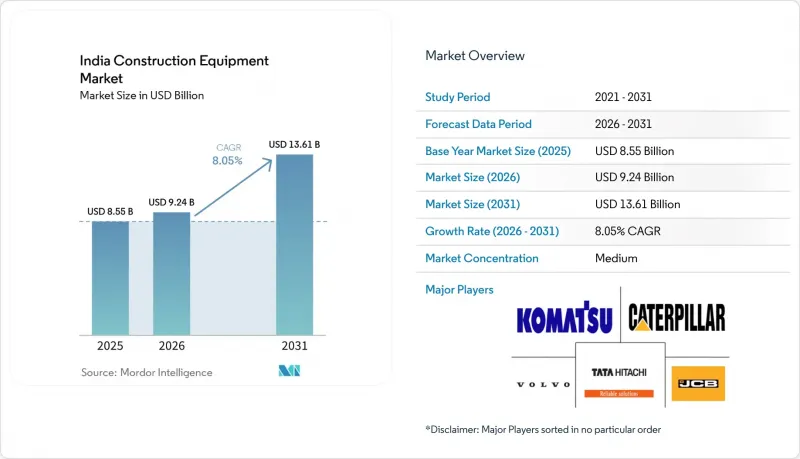
本報告按設備類型(土木工程機具、道路施工機械、物料輸送機械、混凝土機械、材料搬運及破碎機械)、驅動系統(傳統液壓/柴油驅動及其他)、終端用戶行業、額定功率、所有權類型和地區進行細分。市場預測以價值(美元)和數量(台)兩種形式呈現。
印度施工機械市場趨勢與洞察
政府主導的大型基礎建設項目
國家基礎建設計劃涵蓋交通、能源和城市建設等領域的9,742個項目,總投資達3.08兆美元。受該計畫的推動,2023-24會計年度施工機械銷售額激增26%,其中土木工程機具和道路修整設備銷量成長最為顯著。光是德里-孟買工業走廊和印度公路網一期等主要走廊計畫就投入了1,720億美元,持續帶動了對挖土機、後鏟式裝載機和壓路機的需求。
二、三線城市的快速都市化
中產階級向勒克瑙、齋浦爾和哥印拜陀等城市的遷移,推動高層住宅開工量預計將比2023年水準高出35%。在這些空間有限的地塊上,緊湊型挖土機、卡車起重機和加長型堆高機因其在狹小空間內具有高機動性而備受青睞。面積小、配備基於遠端資訊處理技術的安全功能的施工機械製造商,正在這場都市區改造熱潮中擴大市場佔有率。
鋼鐵價格波動
由於原料成本佔施工機械製造成本的60-65%,鋼材價格波動對市場成長構成重大限制。短期內15-20%的價格波動會擾亂生產計畫,並擠壓整機製造商(OEM)的利潤空間,尤其是那些避險能力有限的國內製造商。這些成本壓力正日益轉嫁給終端用戶,預計2024年機械價格將比前一年上漲8-12%。此外,CEV第五階段排放氣體標準的實施使情況更加複雜,預計將使機械成本再上漲12-15%。 [4]
細分市場分析
2025年,土木工程機具佔總銷售額的56.62%。其中,後鏟式裝載機的銷售額就超過一半,這充分反映了其在挖掘、開挖溝槽和小規模起重作業方面的多功能性。道路施工機械的成長速度最快,年增率達40%,主要得益於高速公路和乾線公路工程的加速建設。然而,預計到2031年,道路施工機械市場的複合年成長率將僅為10.05%。
土木機械仍然是印度施工機械市場的核心組成部分,廣泛應用於基礎設施、採礦和房地產等各個領域。同時,物流園區和港口的現代化改造帶動了對輪式裝載機、堆高機和正面吊運機的需求成長,進而推動了物料輸送技術的應用也在快速發展,將曾經被視為「普通機械」的設備轉變為能夠減少運作和燃油消耗的連網資產。
到2025年,柴油液壓鑽機將佔交付的94.72%,這得益於與桅杆相容的燃料基礎設施和久經考驗的可靠性。同時,電動混合動力鑽機的交付量僅佔5.28%,但隨著原始設備製造商(OEM)陸續推出符合第五階段排放標準的裝載機、壓路機和小型挖掘機,其複合年成長率(CAGR)正以15.68%的速度成長。
電池密度的提高、建築工地模組化充電樁的引入以及更嚴格的排放氣體法規,正使零排放機械的經濟效益向買家傾斜。城市軌道運輸和機場建設領域的早期採用者表示,零排放機械能夠降低生命週期成本,並更容易滿足受嚴格噪音和排放氣體法規約束的城市項目的合規要求。預計到2031年,印度施工機械市場中電動馬達型的市場規模將成長兩倍。
其他福利
- Excel格式的市場預測(ME)表
- 3個月的分析師支持
目錄
第1章:引言
- 研究假設和市場定義
- 調查範圍
第2章:調查方法
第3章執行摘要
第4章 市場狀況
- 市場概覽
- 市場促進因素
- 政府主導的大型基礎設施項目,在國家基礎設施計畫(NIP)框架下,刺激了對設備的需求。
- 快速的都市化正在推動二、三線城市高層住宅的建設。
- 採礦業改革的加速推進增加了對大容量挖土機的需求。
- 「Bharatmala」和「Gati Shakti Corridor」計畫的快速實施正在推動道路建設設備的訂單成長。
- 設備租賃平台的普及為中小型建築公司提供了更多利用這些平台的機會。
- OEM廠商對本地生產和CKD組裝的投資可以縮短前置作業時間和降低成本。
- 市場限制因素
- 鋼材價格波動推高了原始設備製造商的生產成本和客戶的資本投資預算。
- 土地徵用長期延誤導致工程設備運轉率下降。
- 充電基礎設施的缺乏阻礙了電動車和混合動力汽車的廣泛普及。
- 即將實施的 CEV Stage V排放氣體法規存在許多監管不確定性,將增加合規負擔。
- 價值供應鏈分析
- 監理展望
- 技術趨勢(車載資訊系統、自動駕駛、電氣化)
- 波特五力模型
第5章 市場規模與成長預測
- 依設備類型
- 土木機械
- 挖土機
- 後鏟式裝載機
- 輪式裝載機
- 推土機
- 平土機機
- 壓實輥
- 道路施工機械
- 瀝青路面和肥育豬
- 冷刨銑床切割機
- 物料輸送設備
- 移動式起重機
- 堆高機和加長型堆高機
- 高空作業平台
- 混凝土設備
- 混凝土攪拌車
- 混凝土泵
- 攪拌站
- 物料加工和破碎設備
- 顎式破碎機和錐形軋碎機
- 分類廠
- 打樁和鑽井鑽機
- 土木機械
- 透過驅動系統
- 傳統液壓/柴油
- 電動/混合動力
- 按最終用戶行業分類
- 基礎建設(公路、鐵路、機場、港口)
- 房地產(住宅、商業)
- 採礦和採石
- 工業能源
- 按類型分類的額定輸出
- 100馬力或以下
- 101~200HP
- 201~400HP
- 超過400馬力
- 依所有權類型
- 租賃車輛
- 承包商所有
- 按地區
- 印度北部
- 南印度
- 西印度群島
- 東印度
- 印度中部
- 印度東北部
第6章 競爭情勢
- 市場集中度
- 策略性舉措(併購、合資、在地化、產品發布)
- 市佔率分析
- 公司簡介
- JCB India Ltd.
- Tata Hitachi Construction Machinery Co. Pvt. Ltd.
- Caterpillar Inc.
- Komatsu India Pvt. Ltd.
- Volvo Construction Equipment India
- Larsen & Toubro Construction & Mining Equipment
- SANY Heavy Industry India
- XCMG Construction Machinery Co. Ltd.
- Hyundai Construction Equipment India
- BEML Ltd.
- Action Construction Equipment Ltd.
- Kobelco Construction Equipment India
- CNH Industrial(CASE Construction)
- Doosan Bobcat India
- Zoomlion Heavy Industry Science & Technology
- LiuGong India
- Mahindra Construction Equipment
- Wirtgen India(John Deere)
- Schwing Stetter India
- Putzmeister India
第7章 市場機會與未來展望
According to Mordor Intelligence, the Indian construction equipment market size is expected to grow from USD 8.55 billion in 2025 to USD 9.24 billion in 2026 and is forecast to reach USD 13.61 billion by 2031 at 8.05% CAGR over 2026-2031.
This report is Segmented by Equipment Type (Earthmoving Equipment, Road Construction Equipment, Material Handling Equipment, Concrete Equipment, and Material Processing and Crushing Equipment), by Drive Type (Conventional Hydraulic / Diesel, and More), by End-User Industry, by Power Output Rating, by Ownership Model, and Region. The Market Forecasts are Provided in Terms of Value (USD) and Volume (Units).
India Construction Equipment Market Trends and Insights
Government-led Mega Infrastructure Projects
The National Infrastructure Pipeline spans 9,742 projects worth USD 3.08 trillion across transport, energy and urban sectors. Equipment sales jumped 26% in FY 2023-24 on the back of this pipeline, led by earthmoving machines and road finishers. Flagship corridors such as the Delhi-Mumbai Industrial Corridor and Bharatmala Phase I alone account for USD 172 billion of spending and drive sustained demand for excavators, backhoe loaders and compactors.
Rapid Urbanization in Tier II & III Cities
Middle-class migration to cities such as Lucknow, Jaipur, and Coimbatore is pushing high-rise residential starts 35% higher than 2023 levels. These constrained sites favor compact excavators, truck-mounted cranes, and telehandlers that maneuver in tight spaces. Equipment makers offering smaller footprints and telematics-enabled safety features are capturing share in this urban infill wave.
Volatile Steel Prices
Steel price volatility has emerged as a critical constraint on market growth, with raw material costs accounting for 60-65% of construction equipment manufacturing expenses. Price fluctuations of 15-20% within short timeframes have disrupted production planning and eroded profit margins for OEMs, particularly domestic manufacturers with limited hedging capabilities. These cost pressures are increasingly being passed on to end-users, with equipment prices rising by 8-12% in 2024 compared to the previous year.The situation is further complicated by the implementation of CEV Stage V emission norms, which is expected to add another 12-15% to equipment costs[4].
Other drivers and restraints analyzed in the detailed report include:
- Mining Sector Reforms
- Fast-Track Road Corridor Execution
- Persistent Land Acquisition Delays
For complete list of drivers and restraints, kindly check the Table Of Contents.
Segment Analysis
Earthmoving machinery generated 56.62% of 2025 unit sales. Backhoe loaders alone secured more than half of that volume, a testament to their versatility in excavation, trenching, and minor lifting tasks. Road-building equipment, logged the sharpest 40% annual growth as highway and corridor projects accelerated. However, road construction machinery is projected to expand at a 10.05% CAGR through 2031.
Earthmoving remains the anchor of the Indian construction equipment market thanks to cross-sector utility in infrastructure, mining, and real estate. Meanwhile, material-handling units sales surge as logistics parks and port modernization absorbed wheel loaders, forklifts, and reach stackers. Telematics adoption is rising swiftly, turning formerly "dumb iron" into connected assets that cut idle time and fuel burn.
Diesel-hydraulic rigs controlled 94.72% of deliveries in 2025, supported by mast-ready fuel infrastructure and proven ruggedness. Yet the electric/hybrid cohort, though only 5.28% of shipments, is scaling at a 15.68% CAGR as OEMs unveil Stage V-compliant loaders, compactors, and mini excavators.
Battery density gains, modular charging containers at project sites, and tightening emission norms are tilting buyer economics in favor of zero-tailpipe machines. Early adopters in metro rail and airport builds cite lower lifetime operating costs and easier compliance for urban projects with strict noise and emission caps. The Indian construction equipment market size for electric models is projected to triple by 2031.
Complete Report Scope:
- By Equipment Type
- Earthmoving Equipment
- Excavator
- Backhoe Loader
- Wheeled Loader
- Bulldozer
- Motor Grader
- Compaction Roller
- Road Construction Equipment
- Asphalt Paver & Finishers
- Cold Planers & Milling Machines
- Material Handling Equipment
- Mobile Cranes
- Forklift & Telehandler
- Aerial Work Platforms
- Concrete Equipment
- Transit Mixer
- Concrete Pump
- Batching Plant
- Material Processing & Crushing Equipment
- Jaw & Cone Crushers
- Screening Plants
- Pile-Driving & Drilling Rigs
- Earthmoving Equipment
- By Drive Type
- Conventional Hydraulic / Diesel
- Electric / Hybrid
- By End-User Industry
- Infrastructure (Roads, Rail, Airports, Ports)
- Real Estate (Residential, Commercial)
- Mining & Quarrying
- Industrial & Energy
- By Power Output Rating
- less than 100 HP
- 101- 200 HP
- 201- 400 HP
- greater than 400 HP
- By Ownership Model
- Rental Fleet
- Contractor-Owned
- By Region
- North India
- South India
- West India
- East India
- Central India
- North-East India
List of Companies Covered in this Report:
- JCB India Ltd.
- Tata Hitachi Construction Machinery Co. Pvt. Ltd.
- Caterpillar Inc.
- Komatsu India Pvt. Ltd.
- Volvo Construction Equipment India
- Larsen & Toubro Construction & Mining Equipment
- SANY Heavy Industry India
- XCMG Construction Machinery Co. Ltd.
- Hyundai Construction Equipment India
- BEML Ltd.
- Action Construction Equipment Ltd.
- Kobelco Construction Equipment India
- CNH Industrial (CASE Construction)
- Doosan Bobcat India
- Zoomlion Heavy Industry Science & Technology
- LiuGong India
- Mahindra Construction Equipment
- Wirtgen India (John Deere)
- Schwing Stetter India
- Putzmeister India
Additional Benefits:
- The market estimate (ME) sheet in Excel format
- 3 months of analyst support
TABLE OF CONTENTS
1 Introduction
- 1.1 Study Assumptions & Market Definition
- 1.2 Scope of the Study
2 Research Methodology
3 Executive Summary
4 Market Landscape
- 4.1 Market Overview
- 4.2 Market Drivers
- 4.2.1 Government-led Mega Infrastructure Projects Under National Infrastructure Pipeline (NIP) Stimulating Equipment Demand
- 4.2.2 Rapid Urbanization Propelling High-rise Residential Construction in Tier II & III Cities
- 4.2.3 Acceleration of Mining Sector Reforms Increasing Demand for High-Capacity Excavators
- 4.2.4 Fast-Track Execution of Bharatmala & Gati Shakti Corridor Programs Boosting Road Equipment Orders
- 4.2.5 Proliferation of Equipment Rental Platforms Expanding Access for SME Contractors
- 4.2.6 OEM Investment in Localized Manufacturing & CKD Assembly Lowering Lead Times & Costs
- 4.3 Market Restraints
- 4.3.1 Volatile Steel Prices Inflating OEM Production Costs & Customer Capex Budgets
- 4.3.2 Persistent Delays in Land Acquisition Slowing Equipment Utilization Rates on Projects
- 4.3.3 Limited Charging Infrastructure Hindering Adoption of Electric & Hybrid Machines
- 4.3.4 Regulatory Uncertainty Around Upcoming CEV Stage V Emission Norms Adding Compliance Burden
- 4.4 Value / Supply-Chain Analysis
- 4.5 Regulatory Outlook
- 4.6 Technological Outlook (Telematics, Autonomous Operation, Electrification)
- 4.7 Porter's Five Forces
- 4.7.1 Threat of New Entrants
- 4.7.2 Bargaining Power of Buyers
- 4.7.3 Bargaining Power of Suppliers
- 4.7.4 Threat of Substitutes
- 4.7.5 Intensity of Competitive Rivalry
5 Market Size & Growth Forecasts (Value, USD Billion)
- 5.1 By Equipment Type
- 5.1.1 Earthmoving Equipment
- 5.1.1.1 Excavator
- 5.1.1.2 Backhoe Loader
- 5.1.1.3 Wheeled Loader
- 5.1.1.4 Bulldozer
- 5.1.1.5 Motor Grader
- 5.1.1.6 Compaction Roller
- 5.1.2 Road Construction Equipment
- 5.1.2.1 Asphalt Paver & Finishers
- 5.1.2.2 Cold Planers & Milling Machines
- 5.1.3 Material Handling Equipment
- 5.1.3.1 Mobile Cranes
- 5.1.3.2 Forklift & Telehandler
- 5.1.3.3 Aerial Work Platforms
- 5.1.4 Concrete Equipment
- 5.1.4.1 Transit Mixer
- 5.1.4.2 Concrete Pump
- 5.1.4.3 Batching Plant
- 5.1.5 Material Processing & Crushing Equipment
- 5.1.5.1 Jaw & Cone Crushers
- 5.1.5.2 Screening Plants
- 5.1.5.3 Pile-Driving & Drilling Rigs
- 5.1.1 Earthmoving Equipment
- 5.2 By Drive Type
- 5.2.1 Conventional Hydraulic / Diesel
- 5.2.2 Electric / Hybrid
- 5.3 By End-User Industry
- 5.3.1 Infrastructure (Roads, Rail, Airports, Ports)
- 5.3.2 Real Estate (Residential, Commercial)
- 5.3.3 Mining & Quarrying
- 5.3.4 Industrial & Energy
- 5.4 By Power Output Rating
- 5.4.1 less than 100 HP
- 5.4.2 101- 200 HP
- 5.4.3 201- 400 HP
- 5.4.4 greater than 400 HP
- 5.5 By Ownership Model
- 5.5.1 Rental Fleet
- 5.5.2 Contractor-Owned
- 5.6 By Region
- 5.6.1 North India
- 5.6.2 South India
- 5.6.3 West India
- 5.6.4 East India
- 5.6.5 Central India
- 5.6.6 North-East India
6 Competitive Landscape
- 6.1 Market Concentration
- 6.2 Strategic Moves (M&A, JV, Localization, Product Launches)
- 6.3 Market Share Analysis
- 6.4 Company Profiles (includes Global level Overview, Market level overview, Core Segments, Financials as available, Strategic Information, Market Rank/Share for key companies, Products & Services, and Recent Developments)
- 6.4.1 JCB India Ltd.
- 6.4.2 Tata Hitachi Construction Machinery Co. Pvt. Ltd.
- 6.4.3 Caterpillar Inc.
- 6.4.4 Komatsu India Pvt. Ltd.
- 6.4.5 Volvo Construction Equipment India
- 6.4.6 Larsen & Toubro Construction & Mining Equipment
- 6.4.7 SANY Heavy Industry India
- 6.4.8 XCMG Construction Machinery Co. Ltd.
- 6.4.9 Hyundai Construction Equipment India
- 6.4.10 BEML Ltd.
- 6.4.11 Action Construction Equipment Ltd.
- 6.4.12 Kobelco Construction Equipment India
- 6.4.13 CNH Industrial (CASE Construction)
- 6.4.14 Doosan Bobcat India
- 6.4.15 Zoomlion Heavy Industry Science & Technology
- 6.4.16 LiuGong India
- 6.4.17 Mahindra Construction Equipment
- 6.4.18 Wirtgen India (John Deere)
- 6.4.19 Schwing Stetter India
- 6.4.20 Putzmeister India
7 Market Opportunities & Future Outlook
- 7.1 White-Space & Unmet-Need Assessment

 施工機械市場-2026-2032年全球市場預測
 水泥和砂漿測試設備市場規模、佔有率和成長分析:按設備類型、技術、應用、最終用戶和地區分類-2026-2033年產業預測
 2026年全球壓實控制系統市場報告
 施工機械市場分析及預測(至2035年):依類型、產品、服務、技術、零件、應用、最終用戶、功能及安裝方式分類
 施工機械售後市場規模、佔有率及成長分析:依零件類型、機器類型、通路、服務及地區分類-2026-2033年產業預測
 施工機械市場規模、佔有率和成長分析:按重型設備、物料輸送、混凝土機械、道路施工機械和土木工程機具,並按地區分類-2026-2033年產業預測
 施工機械市場-全球產業規模、佔有率、趨勢、機會、預測:按類型、功率、應用、終端用戶產業、地區和競爭格局分類,2021-2031年
 施工機械市場規模、佔有率、趨勢和預測:按解決方案類型、機器類型、應用、行業和地區分類,2026-2034年2026年全球挖溝機市場報告2026年全球施工機械售後市場報告