


 |
市場調查報告書
商品編碼
2100734
UVC LED:市場佔有率分析、行業趨勢和統計數據、成長預測(2026-2031)UVC LED - Market Share Analysis, Industry Trends & Statistics, Growth Forecasts (2026 - 2031) |
||||||

※ 本網頁內容可能與最新版本有所差異。詳細情況請與我們聯繫。
據 Mordor Intelligence 稱,UVC LED 市場規模預計在 2026 年達到 13.9 億美元,高於 2025 年的 10.5 億美元,預計到 2031 年將達到 55.9 億美元。
預計從 2026 年到 2031 年,其複合年成長率將達到 32.18%。
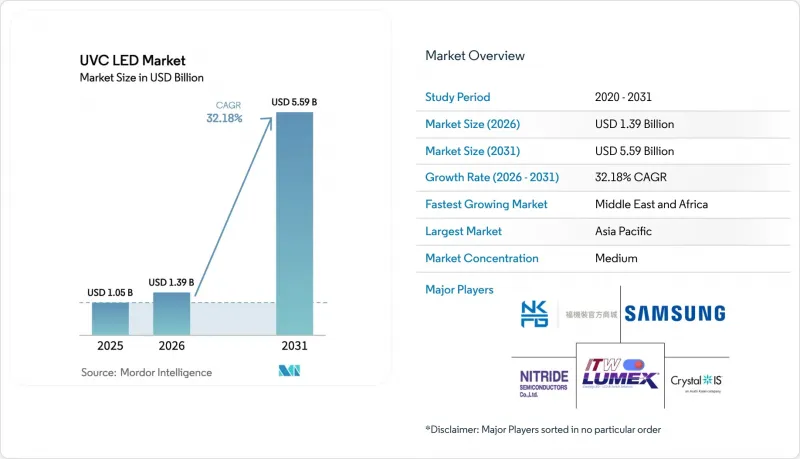
本報告按應用領域(表面消毒、空氣消毒及其他)、光輸出功率(低功率(50 MW 或以下)、其他)、峰值波長(nm)(250-260 nm 及其他)、封裝技術(表面黏著技術貼裝 (SMD)、通孔及其他)、終端用戶(水和廢水處理及其他)以及地區進行細分。市場預測以美元 (USD) 為單位。
全球UVC LED市場趨勢與洞察
水消毒應用需求不斷成長
隨著氣候變遷導致的水資源壓力日益加劇,地方政府供水事業正在擴大UVC LED模組的應用,以確保飲用水供應。預計到2025年,其安裝量將年增78%。這反映出人們對固態設備的信心日益增強,這些設備針對260-270奈米的殺菌峰值波長,與汞燈相比,能耗可降低30%。其緊湊的結構使其能夠維修現有管道系統,這在空間有限、難以安裝大型反應器的密集都市區設施中具有顯著優勢。整合到智慧控制器中的即時輻照劑量監測功能可根據濁度波動最佳化輻照,從而減少化學殘留並降低運行成本。現場檢驗表明,即使在以前認為LED無法達到的流速下,也能去活化99.99%的病原體,包括抗藥性菌株。這些性能提升正在將這項技術確立為下一代水資源韌性策略的基石。
空氣消毒系統的應用日益廣泛
在商業建築、交通樞紐和住宅建築中,UVC LED陣列正被整合到暖通空調系統中,以應對後疫情時代氣溶膠傳播的病原體。研究表明,UVC LED陣列運作後15分鐘內可減少空氣中99.9%的微生物,受此推動,預計到2025年,商業設施的UVC LED陣列安裝量將比2024年成長65%。航空公司正在為其客艙空氣處理系統配備高頻脈衝LED,與持續運作的照明設備相比,可將乘客接觸呼吸道病毒的風險降低87%,同時降低40%的能耗。設施管理人員也十分欣賞與人體感應器連動的即時功能。此功能可最大限度地減少光損耗,並延長發光元件的使用壽命。
與傳統紫外線技術相比,初始成本較高。
系統價格仍比汞燈高出2.5到3.5倍,尤其是在需要多陣列配置的情況下。這種價格差異在採購預算受到嚴格審查的大型水處理廠尤為顯著,但隨著設備平均售價預計從2024年起下降30%,這種差距正在縮小。總擁有成本(TCO)估算始終表明,在扣除能源和維護成本的節省後,投資可在12到18個月內收回,這對於那些正苦於應對不斷飆升的汞廢物處理成本的負責人來說,無疑是一個極具吸引力的訊息。
細分市場分析
至2025年,水消毒領域將佔UVC LED市場規模的44.20%,鞏固其核心地位。供水事業之所以青睞LED,是因為它們能夠去活化耐氯寄生蟲,與傳統反應器相比,面積縮小了40%。預計到2025年,家用水龍頭即用型過濾器和智慧飲水機的出貨量將激增85%,顯示市政部門的採用正在帶動下游消費者的需求成長。
空氣消毒領域成長最為迅猛,預計到2031年將以34.6%的複合年成長率成長,這主要得益於建築規範中不斷提高的室內空氣品質基準值。目前,醫院、學校和飛機客艙均強制要求對暖通空調(HVAC)盤管進行UVC LED改造。在該市場中,自校準感測器檢驗照射水平,並將數據傳輸至建築管理系統。物聯網分析與固體紫外線技術的協同作用正在推動一種基於服務的收入模式的轉變,在這種模式下,供應商不再直接銷售硬體,而是通過保證微生物含量達到可接受的標準來盈利。
到2025年,低功率( 50mW或以下)UVC LED將佔據47.30%的市場佔有率,這主要得益於輕量化電池供電設備(例如旅行消毒器和智慧水瓶)的普及。持續的微型化技術使得品牌能夠在不影響人體工學設計的前提下,將多個晶片整合到瓶蓋和手機殼中,這一趨勢引起了注重衛生的消費者的共鳴。
高功率裝置(100mW及以上)正以33.1%的複合年成長率推動市場成長,並擴大應用於市政供水系統和食品加工廠的大容量輸送機系統中。 2024年下半年發布的樣品在265nm波長下保持115mW的功率,同時確保超過20,000小時的使用壽命,滿足公共工程嚴格的佔空比要求。中功率範圍(50-100mW)為辦公室和零售商店的分散式空調機組提供了一種成本績效高效的選擇,並且可以透過陣列方式確保冗餘。
區域分析
亞太地區將成為UVC LED市場的主要驅動力,預計2025年將佔全球銷售額的40.60%。日本、韓國和中國是這一趨勢的主要支撐,這三個國家供應了全球70%以上的晶片產量。韓國於2025年啟動的12億美元UVC舉措等國家研發項目,正在建造一個將AlGaN外延技術與可大規模生產的陶瓷封裝生產線結合的生態系統。消費者對UVC LED的接受度同樣很高,隨著智慧家居平台大力宣傳其經證實有效的微生物滅菌率,配備LED的空氣清淨機的銷量預計在2024年同比成長三倍。北美緊隨其後,市佔率為28.10%,主要得益於其嚴格的感染控制標準。到2024年底,三分之二的大型醫院網路已將UVC LED治療納入其標準作業流程,從而帶動了推車式和吸頂式照明燈具的批量採購。公共部門支出仍然強勁,美國環保署 (EPA) 發布指南,建議在初級消毒中使用紫外線,促使 2024 年超過 120 家地方政府水質淨化廠安裝了 LED反應器。 2024 年創業投資超過 1.7 億美元,推動了整合紫外線硬體和感測器分析技術的新創公司的發展。歐洲佔 18.10% 的市場佔有率,其中德國在清潔生產區和製藥領域的工業應用方面主導。有害物質限制指令 (RoHS) 繼續限制工廠中使用汞燈,從而帶動了維修套件的強勁訂單。中東和非洲的市佔率較小,為 8.10%,但預計成長速度最快,到 2031 年複合年成長率將達到 33.2%,這得益於旨在加強水安全和提高感染疾病預防能力的大型企劃。南美洲佔 5.10% 的佔有率,這主要得益於巴西為保護供水網路免受耐氯微生物侵害所做的努力。
其他福利
- Excel格式的市場預測(ME)表
- 3個月的分析師支持
目錄
第1章:引言
- 研究假設和市場定義
- 調查範圍
第2章:調查方法
第3章執行摘要
第4章 市場狀況
- 市場概覽
- 市場促進因素
- 歐洲對無汞消毒液的監管推廣
- 小型化技術使其能夠整合到北美消費性電子產品中
- 新興亞洲經濟體嚴格的飲用水標準
- 半導體製造廠表面滅菌技術實施現狀
- 波灣合作理事會成員國的醫院感染控制計劃
- 歐盟 RoHS 2024 禁令實施後,傳統汞燈的更換週期。
- 市場限制因素
- 光輸出功率超過 100mW 時,溫度控管面臨挑戰。
- 由於AlGaN晶體缺陷導致的光子效率上限
- 平均售價的下降給亞洲二線晶圓廠的利潤率帶來了壓力。
- 缺乏標準化的測試規程正在延緩美國OEM認證的進程。
- 工業生態系分析
- 技術展望
- 波特五力分析
- 價格分析
- UV-C LED製造流程分析
- 紫外線燈技術比較
第5章 市場規模與成長預測
- 透過使用
- 表面消毒
- 空氣消毒
- 水消毒
- 物品和設備的消毒
- 生物調查和實驗室滅菌
- 透過光輸出
- 低功率(50mW 或更低)
- 中功率(50-100mW)
- 高功率(100mW 或以上)
- 按峰值波長(nm)
- 250~260nm
- 260~270nm
- 270~280nm
- 產品技術
- 表面黏著型元件(SMD)
- 通孔
- 板載晶片(COB)
- 其他(覆晶、晶圓級)
- 按最終用戶細分
- 供水和污水處理
- 住宅及商業用電終端系統
- 醫療保健和醫療設備
- 食品和飲料加工
- 工業和半導體製造
- 家用電器和家用電腦
- 按地區
- 北美洲
- 美國
- 加拿大
- 墨西哥
- 歐洲
- 德國
- 英國
- 法國
- 義大利
- 西班牙
- 其他歐洲國家
- 亞太地區
- 中國
- 日本
- 韓國
- 印度
- 東南亞
- 其他亞太國家
- 南美洲
- 巴西
- 其他南美國家
- 中東和非洲
- 中東
- 阿拉伯聯合大公國
- 沙烏地阿拉伯
- 其他中東國家
- 非洲
- 南非
- 其他非洲地區
- 中東
- 北美洲
第6章 競爭情勢
- 市場集中度
- 策略趨勢
- 市佔率分析
- 公司簡介
- Seoul Viosys Co., Ltd.
- Nichia Corporation
- Crystal IS, Inc.(Asahi Kasei Group)
- ams-Osram AG
- Luminus Devices, Inc.
- Nitride Semiconductors Co., Ltd.
- Stanley Electric Co., Ltd.
- Lite-On Technology Corporation
- Bolb Inc.
- NKFG Corporation
- Hongli Zhihui Group Co., Ltd.
- Lumex Inc.(ITW)
- International Light Technologies, Inc.
- Qingdao Jason Electric Co., Ltd.
- Violumas
- DOWA Electronics Materials Co., Ltd.
- Everlight Electronics Co., Ltd.
- Union Semiconductor(Suzhou)Co., Ltd.
- Sensor Electronic Technology, Inc.(SETi)
- Excelitas Technologies Corp.
- Ushio Inc.
- Heraeus Holding GmbH
- Dr. Honle AG
第7章 市場機會與未來展望
According to Mordor Intelligence, UVC LED market size in 2026 is estimated at USD 1.39 billion, growing from 2025 value of USD 1.05 billion with 2031 projections showing USD 5.59 billion, growing at 32.18% CAGR over 2026-2031.
This report is Segmented by Application (Surface Disinfection, Air Disinfection, and More), Optical Power Output (Low-Power (Less Than 50 MW), and More), Peak Wavelength (nm) (250-260 Nm, and More), Packaging Technology (Surface-Mount Device (SMD), Through-Hole, and More), End-User Sector (Municipal Water and Wastewater Treatment, and More), and Geography. The Market Forecasts are Provided in Terms of Value (USD).
Global UVC LED Market Trends and Insights
Rising demand for water disinfection applications
Municipal utilities are scaling UVC LED modules to safeguard drinking supplies as climate-induced water stress intensifies. Installations grew 78% year-on-year in 2025, reflecting confidence in solid-state devices that target the 260-270 nm germicidal peak while consuming 30% less energy than mercury lamps. Compact architectures allow retrofits within existing pipe galleries, an advantage in dense urban plants where space premiums limit large reactors.Real-time dose monitoring embedded in smart controllers optimizes exposure to varying turbidity, cutting chemical residuals and operating expenditures. Field evidence shows 99.99% pathogen inactivation-including drug-resistant strains-at flow rates once considered unreachable for LEDs. These performance gains position the technology as a cornerstone of next-generation water resilience strategies.
Growing adoption in air disinfection systems
Commercial buildings, transport hubs, and homes are embedding UVC LED arrays into HVAC plenums to counter aerosolized pathogens in the post-pandemic era. Installations in commercial properties climbed 65% in 2025 over 2024, driven by studies demonstrating a 99.9% drop in airborne microbial counts within 15 minutes of operation. Airlines have fitted cabin-air units with high-frequency pulsed LEDs, cutting passenger exposure to respiratory viruses by 87% while consuming 40% less power than continuous-mode fixtures. Facility managers also value instant-on operation that aligns with occupancy sensors, a feature that minimizes wasted irradiation and extends emitter life.
High initial costs compared to traditional UV technologies
System prices remain 2.5-3.5 times higher than mercury lamps, especially where multi-array configurations are essential. The delta is acute in large-capacity water plants where procurement budgets face scrutiny, although falling device ASPs-down 30% since 2024-are closing the gap. Total-cost-of-ownership modeling consistently shows payback within 12-18 months once energy and maintenance savings are tallied, a message that resonates with operators familiar with escalating mercury disposal fees.
Other drivers and restraints analyzed in the detailed report include:
- Increasing focus on healthcare-associated infection prevention
- Technological advancements improving efficiency and reducing costs
- Technical limitations in efficiency and lifespan
For complete list of drivers and restraints, kindly check the Table Of Contents.
Segment Analysis
Water disinfection captured 44.20% of the UVC LED market size in 2025, cementing its role as the anchor segment. Utilities favor LEDs for their ability to neutralize chlorine-resistant parasites while occupying footprints 40% smaller than legacy reactors. Point-of-use filters fitted to household taps and smart dispensers posted an 85% shipment spike in 2025, showing that municipal deployments reverberate downstream into consumer demand.
Air disinfection posted the quickest uptick, advancing at a 34.6% CAGR through 2031 as building codes elevate indoor-air-quality thresholds. Hospitals, schools, and aircraft cabins now specify UVC LED retrofits in HVAC coils, a market where self-calibrating sensors verify delivered dose and feed data to building-management dashboards. The synergy between IoT analytics and solid-state UV is encouraging service-based revenue models in which providers guarantee microbial limits instead of selling hardware outright.
Low-power emitters ( Less than 50 mW) dominated with 47.30% UVC LED market share in 2025 owing to lightweight battery-operated gadgets such as travel sterilizers and smart water bottles. Continuous miniaturization lets brands integrate multiple chips into lids and phone cases without compromising ergonomics, a trend that resonates with hygiene-conscious consumers.
High-power devices (Above 100 mW) are the growth pacesetters at a 33.1% CAGR, unlocking municipal water channels and high-throughput conveyor systems in food plants. Samples released in late 2024 sustain 115 mW at 265 nm while preserving lifetime above 20,000 hours, meeting the stringent duty cycles demanded by public utilities. The mid-power tier (50-100 mW) sits in the price-performance sweet spot for decentralized air units in offices and retail, providing redundancy when arranged in tiled arrays.
Complete Report Scope:
- By Application
- Surface Disinfection
- Air Disinfection
- Water Disinfection
- Object/Tool Disinfection
- Biological Research and Laboratory Sterilization
- By Optical Power Output
- Low-Power (Less than 50 mW)
- Medium-Power (50-100 mW)
- High-Power (Above 100 mW)
- By Peak Wavelength (nm)
- 250-260 nm
- 260-270 nm
- 270-280 nm
- By Packaging Technology
- Surface-Mount Device (SMD)
- Through-Hole
- Chip-on-Board (COB)
- Others (Flip-Chip, Wafer-Level)
- By End-User Sector
- Municipal Water and Wastewater Treatment
- Residential and Commercial Point-of-Use Systems
- Healthcare and Medical Devices
- Food and Beverage Processing
- Industrial and Semiconductor Manufacturing
- Consumer Electronics and Appliances
- By Geography
- North America
- United States
- Canada
- Mexico
- Europe
- Germany
- United Kingdom
- France
- Italy
- Spain
- Rest of Europe
- Asia-Pacific
- China
- Japan
- South Korea
- India
- South East Asia
- Rest of Asia-Pacific
- South America
- Brazil
- Rest of South America
- Middle East and Africa
- Middle East
- United Arab Emirates
- Saudi Arabia
- Rest of Middle East
- Africa
- South Africa
- Rest of Africa
- Middle East
- North America
Geography Analysis
Asia Pacific LED the UVC LED market with 40.60% revenue in 2025, underpinned by Japan, South Korea, and China, which together supply more than 70% of global chip output. National R&D programs-such as South Korea's USD 1.2 billion UV initiative launched in 2025-anchor an ecosystem that pairs AlGaN epitaxy expertise with high-volume ceramic packaging lines. Consumer uptake is equally vigorous; air-purifier sales fitted with LEDs tripled year-on-year in 2024 as smart-home platforms advertised verified microbial kill rates. North America followed with 28.10%, propelled by stringent infection-control norms. By late 2024, two-thirds of large hospital networks had embedded UVC LED regimens into standard operating practice, driving bulk procurement of cart-based and ceiling-mounted fixtures. Public-sector spending remains strong, with more than 120 municipal water plants commissioning LED reactors in 2024 after U.S. Environmental Protection Agency guidance endorsed UV for primary disinfection. Venture capital exceeded USD 170 million in 2024, nurturing start-ups that mash up UV hardware with sensor analytics. Europe secured an 18.10% share, with Germany spearheading industrial deployment in clean-production zones and pharmaceuticals. The Restriction of Hazardous Substances (RoHS) Directive continues to nudge factories away from mercury lamps, sustaining order books for retrofit kits. The Middle East and Africa region, though smaller at 8.10%, is the fastest climber at a 33.2% CAGR to 2031, buoyed by mega-projects that fortify water security and upgrade infection-prevention capacity. South America holds 5.10%, LED by Brazil's push to shield water grids from chlorine-resistant microbes.
- Seoul Viosys Co., Ltd.
- Nichia Corporation
- Crystal IS, Inc. (Asahi Kasei Group)
- ams-Osram AG
- Luminus Devices, Inc.
- Nitride Semiconductors Co., Ltd.
- Stanley Electric Co., Ltd.
- Lite-On Technology Corporation
- Bolb Inc.
- NKFG Corporation
- Hongli Zhihui Group Co., Ltd.
- Lumex Inc. (ITW)
- International Light Technologies, Inc.
- Qingdao Jason Electric Co., Ltd.
- Violumas
- DOWA Electronics Materials Co., Ltd.
- Everlight Electronics Co., Ltd.
- Union Semiconductor (Suzhou) Co., Ltd.
- Sensor Electronic Technology, Inc. (SETi)
- Excelitas Technologies Corp.
- Ushio Inc.
- Heraeus Holding GmbH
- Dr. Honle AG
Additional Benefits:
- The market estimate (ME) sheet in Excel format
- 3 months of analyst support
TABLE OF CONTENTS
1 INTRODUCTION
- 1.1 Study Assumptions and Market Definition
- 1.2 Scope of the Study
2 RESEARCH METHODOLOGY
3 EXECUTIVE SUMMARY
4 MARKET LANDSCAPE
- 4.1 Market Overview
- 4.2 Market Drivers
- 4.2.1 Regulatory Push for Mercury-Free Disinfection Solutions in Europe
- 4.2.2 Miniaturization Enabling Integration into Consumer Appliances in North America
- 4.2.3 Stringent Drinking Water Standards in Asian Emerging Economies
- 4.2.4 Uptake in Semiconductor Fabs for Surface Sterilization
- 4.2.5 Hospital-Acquired Infection Reduction Programs in Gulf Cooperation Council Countries Countries
- 4.2.6 Replacement Cycle of Conventional Mercury Lamps Due to EU RoHS 2024 Ban
- 4.3 Market Restraints
- 4.3.1 Heat Management Challenges Above 100 mW Optical Output
- 4.3.2 Photonic Efficiency Ceiling Due to AlGaN Crystal Defects
- 4.3.3 ASP Declines Squeezing Margins for Tier-2 Asian Fabs
- 4.3.4 Limited Standardized Testing Protocols Delaying OEM Qualification in the U.S.
- 4.4 Industry Ecosystem Analysis
- 4.5 Technological Outlook
- 4.6 Porter's Five Forces Analysis
- 4.6.1 Bargaining Power of Suppliers
- 4.6.2 Bargaining Power of Buyers
- 4.6.3 Threat of New Entrants
- 4.6.4 Threat of Substitutes
- 4.6.5 Intensity of Competitive Rivalry
- 4.7 Pricing Analysis
- 4.8 UV-C LED Manufacturing Process Analysis
- 4.9 Comparison of UV Lamp Technologies
5 MARKET SIZE AND GROWTH FORECASTS (VALUES)
- 5.1 By Application
- 5.1.1 Surface Disinfection
- 5.1.2 Air Disinfection
- 5.1.3 Water Disinfection
- 5.1.4 Object/Tool Disinfection
- 5.1.5 Biological Research and Laboratory Sterilization
- 5.2 By Optical Power Output
- 5.2.1 Low-Power (Less than 50 mW)
- 5.2.2 Medium-Power (50-100 mW)
- 5.2.3 High-Power (Above 100 mW)
- 5.3 By Peak Wavelength (nm)
- 5.3.1 250-260 nm
- 5.3.2 260-270 nm
- 5.3.3 270-280 nm
- 5.4 By Packaging Technology
- 5.4.1 Surface-Mount Device (SMD)
- 5.4.2 Through-Hole
- 5.4.3 Chip-on-Board (COB)
- 5.4.4 Others (Flip-Chip, Wafer-Level)
- 5.5 By End-User Sector
- 5.5.1 Municipal Water and Wastewater Treatment
- 5.5.2 Residential and Commercial Point-of-Use Systems
- 5.5.3 Healthcare and Medical Devices
- 5.5.4 Food and Beverage Processing
- 5.5.5 Industrial and Semiconductor Manufacturing
- 5.5.6 Consumer Electronics and Appliances
- 5.6 By Geography
- 5.6.1 North America
- 5.6.1.1 United States
- 5.6.1.2 Canada
- 5.6.1.3 Mexico
- 5.6.2 Europe
- 5.6.2.1 Germany
- 5.6.2.2 United Kingdom
- 5.6.2.3 France
- 5.6.2.4 Italy
- 5.6.2.5 Spain
- 5.6.2.6 Rest of Europe
- 5.6.3 Asia-Pacific
- 5.6.3.1 China
- 5.6.3.2 Japan
- 5.6.3.3 South Korea
- 5.6.3.4 India
- 5.6.3.5 South East Asia
- 5.6.3.6 Rest of Asia-Pacific
- 5.6.4 South America
- 5.6.4.1 Brazil
- 5.6.4.2 Rest of South America
- 5.6.5 Middle East and Africa
- 5.6.5.1 Middle East
- 5.6.5.1.1 United Arab Emirates
- 5.6.5.1.2 Saudi Arabia
- 5.6.5.1.3 Rest of Middle East
- 5.6.5.2 Africa
- 5.6.5.2.1 South Africa
- 5.6.5.2.2 Rest of Africa
- 5.6.5.1 Middle East
- 5.6.1 North America
6 COMPETITIVE LANDSCAPE
- 6.1 Market Concentration
- 6.2 Strategic Moves
- 6.3 Market Share Analysis
- 6.4 Company Profiles (includes Global level Overview, Market level overview, Core Segments, Financials as available, Strategic Information, Market Rank/Share for key companies, Products and Services, and Recent Developments)
- 6.4.1 Seoul Viosys Co., Ltd.
- 6.4.2 Nichia Corporation
- 6.4.3 Crystal IS, Inc. (Asahi Kasei Group)
- 6.4.4 ams-Osram AG
- 6.4.5 Luminus Devices, Inc.
- 6.4.6 Nitride Semiconductors Co., Ltd.
- 6.4.7 Stanley Electric Co., Ltd.
- 6.4.8 Lite-On Technology Corporation
- 6.4.9 Bolb Inc.
- 6.4.10 NKFG Corporation
- 6.4.11 Hongli Zhihui Group Co., Ltd.
- 6.4.12 Lumex Inc. (ITW)
- 6.4.13 International Light Technologies, Inc.
- 6.4.14 Qingdao Jason Electric Co., Ltd.
- 6.4.15 Violumas
- 6.4.16 DOWA Electronics Materials Co., Ltd.
- 6.4.17 Everlight Electronics Co., Ltd.
- 6.4.18 Union Semiconductor (Suzhou) Co., Ltd.
- 6.4.19 Sensor Electronic Technology, Inc. (SETi)
- 6.4.20 Excelitas Technologies Corp.
- 6.4.21 Ushio Inc.
- 6.4.22 Heraeus Holding GmbH
- 6.4.23 Dr. Honle AG
7 MARKET OPPORTUNITIES AND FUTURE OUTLOOK
- 7.1 White-Space and Unmet-Need Assessment

 園藝照明:市場佔有率分析、產業趨勢與統計、成長預測(2026-2031)
 園藝照明市場-2026-2032年全球市場預測
 園藝LED照明市場:按應用、技術、最終用戶和地區分類
 2025-2029年全球園藝照明市場UVC LED消毒模組市場:按模組配置、分銷管道、應用和最終用戶分類 - 全球預測(2026-2032)園藝照明感測器市場:按感測器類型、技術、應用、最終用途和分銷管道分類-2026-2032年全球預測
 園藝照明市場規模、佔有率和成長分析(按安裝類型、照明類型、產品、種植類型、技術、應用和地區分類)-2026-2033年產業預測
 園藝照明市場規模、佔有率和趨勢分析報告,按產品、技術、照明類型、安裝類型、最終用途、地區和細分趨勢分類:2025 年至 2033 年
 UVC LED 市場規模:依技術、應用、地區分類,2026-2032 年水產養殖和園藝照明,全球市場 2024-2030