

 |
市場調查報告書
商品編碼
2100663
露營車和旅居車:市場佔有率分析、行業趨勢和統計數據以及成長預測(2026-2031 年)Caravan And Motor Home - Market Share Analysis, Industry Trends & Statistics, Growth Forecasts (2026 - 2031) |
||||||

※ 本網頁內容可能與最新版本有所差異。詳細情況請與我們聯繫。
根據 Mordor Intelligence 估計,到 2026 年,露營車和旅居車值將達到 636.8 億美元,高於 2025 年的 596 億美元,預計到 2031 年將達到 886.5 億美元。
預計從 2026 年到 2031 年,其複合年成長率將達到 6.84%。
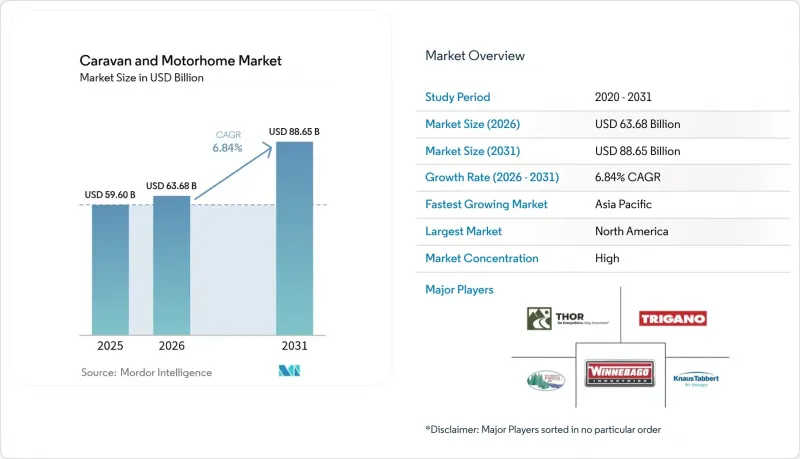
本報告按產品類型(旅行拖車和旅居車)、動力系統(內燃機、混合動力、電池式電動車)、總長度(6米以下、6-8米、8米以上)、最終用戶(個人買家和車隊所有者)、銷售管道(特許經銷商、公司自營店、線上直銷)和地區進行細分。市場預測以價值(美元)和銷售(輛)為單位呈現。
全球露營車與旅居車市場趨勢與洞察
新冠疫情後,人們對國內旅行和戶外旅行的偏好增加。
近期產業調查顯示,人們越來越偏好規劃性露營和公路旅行,反映出旅行重心正從國際旅行轉向國內旅行。安全顧慮、跨境旅行的複雜性以及本地探索的成本效益是推動這一趨勢的主要因素。房車露營持續走紅,在經濟普遍不確定性的情況下,有助於維持房旅居車市場的穩定。北美和歐洲完善的露營地網路提供媲美飯店的便利設施,進一步提升了房車旅行的吸引力。對許多家庭而言,擁有房車是應對不可預測的旅行開支的有效策略,從而推動了房車市場的長期需求。
千禧世代和Z世代的房車擁有率正在飆升。
隨著千禧世代和Z世代消費者越來越重視探險旅行而非財富積累,房車買家的平均年齡已從53歲降至49歲,這使得年輕一代能夠影響房車的設計和行銷策略。許多35至54歲的車主優先考慮互聯性、永續性和靈活的內部空間,促使製造商轉向輕質材料、整合式太陽能系統和模組化家具。社群媒體透過用戶評論和網紅內容,鞏固了全職或混合型遊牧生活方式的形象,進一步擴大了市場需求。金融機構也積極回應,提供類似汽車貸款的還款條款,幫助首次購車者克服高昂的購車成本。透過升級和數位化功能不斷提升客戶參與度,提高了客戶維繫,鼓勵重複購買,並支持房旅居車市場的持續成長。
高昂的初始購買成本和擁有成本
購買新二手車(休閒車)的資金籌措給家庭預算帶來了沉重負擔。保險、維護和存放等額外費用往往會導致房車提前出售,從而降低客戶滿意度並減少口碑。雖然房車旅行與生活方式高度親和性,但可支配收入有限的年輕買家更容易受到價格波動的影響。在某些市場,供應過剩已導致價格大幅調整,凸顯了價格上漲可能加劇市場波動的風險。如何在保持價格可負擔的同時又不影響盈利,仍然是房車產業面臨的一大挑戰。
細分市場分析
2025年,拖曳式房車在「房車和旅居車市場」的銷售量中佔比高達61.34%。這主要歸功於注重成本績效的買家青睞其低廉的購置成本以及將拖曳式房車作為日常交通工具的柔軟性。在這一細分市場中,拖掛式房車的價格範圍從經濟型到高階型不斷擴大,吸引力日益增強;而第五輪拖車式房車則吸引了那些追求住宅般舒適體驗的普通用戶。折疊式露營車雖然輕巧且適合車庫存放,但隨著市場趨勢轉向隔熱性和安全性更高的硬殼車型,其市場佔有率正在下降。同時,預計到2031年,旅居車的年複合成長率(CAGR)將達到8.08%,憑藉其集生活空間和駕駛於一體的佈局,便於用戶隨時隨地出行,其增速將超過房車和旅居車市場的整體增速。 B 型廂型車因其停車方便而受到都市區探險家的歡迎,而 A 型客車則吸引了願意投資寬敞內部空間的退休人士和數位遊民。
千禧世代對「承包解決方案」日益成長的興趣對旅居車來說是一大利好,因為與拖掛式房車相比,房車更容易整合駕駛輔助技術、太陽能電池板和智慧家庭控制系統。 Thor Industries 的混合動力 A 級房車原型車和 Jayco 售價 46 萬美元的 Embark EV 房車都展示了整合推進和居住系統的高階應用。為了應對這一趨勢,拖掛旅居車房車製造商正試圖透過使用更輕的複合材料牆體和模組化內飾來彌合創新方面的差距。隨著露營地預訂 API 和太陽能發電/儲能套件逐漸成為標配,產品差異化不僅取決於平面佈局,也取決於數位生態系統。因此,儘管拖曳式房車仍將在銷售上保持領先地位,但旅居車很可能將決定「拖曳式房車-旅居車市場」的技術發展方向。
到2025年,內燃機車型將佔「露營車和旅居車市場」銷售量的91.74%,這反映了其成熟的燃料供應網路和久經考驗的耐用性。然而,隨著環保法規的日益嚴格和電池成本的下降,預計到2031年,純電動房車的年複合成長率將達到8.94%,顯著高於「露營車和旅居車市場」的整體成長速度。像Lightship這樣採用空氣動力學設計的旅行拖車等早期進入者,凸顯了市場對靜音運行和低運行成本的需求。混合動力系統則扮演著過渡角色,它結合了內燃機以提升續航里程,以及電動馬達以增強露營地的機動性和提供安靜的夜間電力供應。
車隊租賃公司是電動車普及速度最快的群體,他們利用可預測的路線和充電站來彌補基礎設施的不足。消費者對電動車的接受度仍然受到國家公園充電限制和前期成本等問題的限制,但州和地方政府的獎勵正在逐年提高投資報酬率 (ROI)。製造商正在利用福特 E-Transit 和梅賽德斯-奔馳 eSprinter 等商用電動車底盤來縮短開發週期。電池能量密度的提高使得電池組重量更輕,從而釋放了車內空間,並緩解了與車輛總長度法規相關的挑戰。總而言之,儘管內燃機在未來十年仍將佔據主導地位,但房車和旅居車市場的創新趨勢將由電氣化主導。
區域分析
預計到2025年,北美將佔全球房車和旅居車銷量的53.25%,這得益於其濃厚的房車文化、廣闊的公共土地以及便於高價購車的資金籌措結構。美國房車出貨量預計將在2025年成長,並在未來幾年持續成長,顯示儘管利率上升,但國內需求仍然強勁。加拿大正透過專業的複合板材供應商和不斷成長的全職數位遊民群體,加強其區域售後市場生態系統。國家公園門票和露營地維修等公共資金正被用於擴建設施,以支持日益成長的使用率。 B型改裝車的日益普及,尤其適合都市區停車規定,也對房車和旅居車市場產生了正面影響。
在歐洲,以德國為首的市場呈現穩定成長態勢。由於道路狹窄和排放氣體法規嚴格,緊湊型佈局仍然至關重要。義大利和西班牙正著力發展可容納房車的農家樂設施,從而豐富了商業露營地以外的住宿選擇。在斯堪地那維亞,受可再生能源激勵政策的推動,電動車的普及率不斷提高,使該地區在房旅居車市場擁有技術優勢。
預計到2031年,亞太地區將以8.55%的年複合成長率(CAGR)保持全球最高水平,這主要得益於可支配收入的成長和旅遊政策的不斷完善。日本房車市場持續成長,其特點是配備了符合車庫高度限制的電動升降車頂等創新功能。在中國,中產階級對房車的興趣日益濃厚,這得益於政府對國內旅遊路線的大力推廣,儘管西部省份的基礎設施仍然存在差距。在澳洲成熟的房車市場,點對點租賃模式蓬勃發展,Camplify等公司不斷擴大的車隊規模也推動了房車利用率的提升。在韓國和印度等新興市場,配備房車網路連接的路邊休息區建設正在穩步推進,並催生了早期需求。總而言之,隨著基礎設施的不斷改進和生活方式的轉變,亞太地區將繼續在房旅居車市場的成長中發揮關鍵作用。
其他好處:
- Excel格式的市場預測(ME)表
- 3個月的分析師支持
目錄
第1章:引言
- 研究假設和市場定義
- 調查範圍
第2章:調查方法
第3章執行摘要
第4章 市場狀況
- 市場概覽
- 市場促進因素
- 千禧世代和Z世代擁有房車的人數激增。
- 「房車工作」生活方式的興起,使得遠距辦公成為可能。
- 新冠疫情後,人們對國內旅行和戶外旅行的偏好增加。
- 模組化、可升級房車平台的出現。
- 採用 48V 直流電氣架構,實現離網運作。
- 與 OEM-Campground API 整合可實現即時營地預訂。
- 市場限制因素
- 高昂的初始購買成本和擁有成本
- 對利率敏感的資金籌措環境
- 來自 DIY 改裝廂型車和點對點租賃的競爭。
- 國家公園對配備高容量電池的房車接入電網有限制
- 價值供應鏈分析
- 監理情勢
- 技術展望
- 波特五力模型
第5章 市場規模與成長預測
- 依產品類型
- 露營車
- 旅行拖車
- 第五輪拖車
- 折疊式露營拖車
- 卡車露營車
- 露營車
- A級
- B 型(廂型車改裝)
- C級
- 露營車
- 透過推進力
- 內燃機(ICE)
- 混合式(並聯/串聯)
- 電池驅動的電動房車
- 按長度
- 小於6米
- 6-8米
- 超過8米
- 最終用戶
- 直接買家
- 車隊車主 - 租賃和訂閱平台
- 按銷售管道
- 加盟店
- 公司自營店
- 線上直接面對消費者
- 按地區
- 北美洲
- 美國
- 加拿大
- 其他北美國家
- 南美洲
- 巴西
- 阿根廷
- 其他南美國家
- 歐洲
- 德國
- 英國
- 法國
- 義大利
- 西班牙
- 其他歐洲國家
- 亞太地區
- 中國
- 日本
- 澳洲
- 韓國
- 印度
- 其他亞太國家
- 中東和非洲
- 阿拉伯聯合大公國
- 沙烏地阿拉伯
- 土耳其
- 埃及
- 南非
- 其他中東和非洲國家
- 北美洲
第6章 競爭情勢
- 市場集中度
- 策略趨勢
- 市佔率分析
- 公司簡介
- Thor Industries Inc.
- Forest River Inc.
- Winnebago Industries Inc.
- Trigano SA
- Knaus Tabbert AG
- Swift Group
- Erwin Hymer Group
- Jayco Inc.
- Burstner GmbH & Co. KG
- Dethleffs GmbH and Co. KG
- Triple E Recreational Vehicles
- Tiffin Motorhomes Inc.
- Coachmen RV
- REV Group
- Leisure Travel Vans
- Airstream Inc.
- Adria Mobil doo
- Hobby-Wohnwagenwerk
- Westfalia Mobil GmbH
第7章 市場機會與未來展望
According to Mordor Intelligence, the caravan and motor home market size in 2026 is estimated at USD 63.68 billion, growing from 2025 value of USD 59.60 billion with 2031 projections showing USD 88.65 billion, growing at 6.84% CAGR over 2026-2031.
This report is Segmented by Product Type (Caravan and Motorhome), Propulsion (Internal Combustion Engine, Hybrid, and Battery-Electric), Length (Below 6m, 6-8m, and Above 8m), End User (Direct Buyers and Fleet Owners), Sales Channel (Franchise Dealerships, Company-Owned Stores, and Online Direct-To-Consumer), and Geography. The Market Forecasts are Provided in Terms of Value (USD) and Volume (Units).
Global Caravan And Motor Home Market Trends and Insights
Growing Preference for Domestic and Outdoor Travel Post-COVID
The recent industry survey highlights a growing preference for planned camping and road trips, reflecting a shift from international to domestic travel. Safety concerns, border complexities, and the cost-effectiveness of local exploration drive this trend. RV camping continues to gain popularity, helping stabilize the Caravan And Motor Home Market amid broader economic uncertainties. Well-developed campground networks in North America and Europe offer convenience comparable to hotels, enhancing the appeal of RV travel. For many families, owning an RV is a strategic way to manage unpredictable travel costs, reinforcing long-term demand.
Surging Millennial and Gen-Z RV Ownership
The average RV buyer's age fell from 53 to 49 years as millennials and Gen-Z consumers elevated adventure travel over asset accumulation, positioning younger cohorts to influence design and marketing strategies . Most owners aged 35-54 prioritize connectivity, sustainability, and flexible interiors, steering manufacturers toward lighter materials, solar integration, and modular furniture. Social media further amplifies demand, as peer reviews and influencer content normalize full-time or hybrid nomadic lifestyles. Lenders have responded with term structures that mirror auto financing, helping first-time buyers surmount high ticket prices. Continuous engagement through upgrades and digital features improves retention and feeds repeat purchases, supporting sustained Caravan And Motor Home Market growth.
High Initial Purchase and Ownership Cost
The cost of financing new and used RV units is placing significant pressure on household budgets. Additional expenses like insurance, maintenance, and storage often lead to early resale, dampening customer satisfaction and reducing positive word-of-mouth. Despite strong lifestyle alignment with RV travel, younger buyers are susceptible to pricing due to limited disposable income. Oversupply in some markets has led to notable price corrections, underscoring how elevated prices can amplify volatility. The industry continues to face the challenge of managing affordability without compromising profitability.
Other drivers and restraints analyzed in the detailed report include:
- Rise in Remote-Work-Enabled "Work-From-RV" Lifestyle
- Emergence of Modular, Upgradable RV Platforms
- Competition From DIY Van Conversions and Peer-To-Peer Rentals
For complete list of drivers and restraints, kindly check the Table Of Contents.
Segment Analysis
Caravans captured 61.34% of the Caravan And Motor Home Market revenue in 2025 as value-minded buyers favored lower acquisition costs and the flexibility of using the tow vehicle for daily transit. Within this segment, travel trailers span budget to luxury price points, broadening appeal, while fifth-wheel units attract full-time users seeking residential comfort. Folding campers, though lighter and garage-friendly, lose share as customers graduate to hard-sided models that offer better insulation and security. Motorhomes, however, are forecast for an 8.08% CAGR through 2031, eclipsing the broader Caravan And Motor Home Market pace thanks to integrated living-driving layouts that ease spontaneous travel. Class B vans stand out among urban adventurers for parking convenience, whereas Class A coaches draw retirees and digital nomads willing to invest in spacious interiors.
Growing millennial interest in turnkey solutions benefits motorhomes, incorporating driver-assistance tech, solar arrays, and smart-home controls more readily than towables. Thor Industries' hybrid Class A prototype and Jayco's USD 460,000 Embark EV illustrate premium adoption of integrated propulsion and living systems. Caravan makers counter with lighter composite walls and modular interiors to close the innovation gap. As campsite booking APIs and solar-storage packages become standard, product differentiation hinges on digital ecosystems as much as floor plans. Consequently, caravans will retain volume leadership, but motorhomes will set the technological agenda of the Caravan And Motor Home Market.
Internal combustion engine models retained 91.74% of the Caravan And Motor Home Market revenue in 2025, reflecting well-established fueling networks and proven durability. Yet battery-electric RVs are projected for a 8.94% CAGR through 2031, well above the overall Caravan And Motor Home Market size trajectory, as environmental regulations tighten and battery costs fall. Early entrants like Lightship's aerodynamic travel trailer highlight demand for silent operation and low running costs. Hybrid systems serve as a bridge, pairing combustion engines for range with electric motors for campground maneuverability and quiet overnight power.
Fleet rental firms adopt electrics fastest, using predictable routes and depot charging to mitigate infrastructure gaps. Consumer adoption remains sensitive to national park charging restrictions and upfront pricing, but state and provincial incentives improve ROI metrics annually. Manufacturers leverage commercial EV chassis from Ford E-Transit or Mercedes eSprinter platforms to shorten development cycles. Lighter packs free interior space as battery density rises, easing the length-regulation tension. Overall, combustion will dominate this decade, yet electrification sets the innovation narrative for the Caravan And Motor Home Market.
Complete Report Scope:
- By Product Type
- Caravan
- Travel Trailers
- Fifth-Wheel Trailers
- Folding Camp Trailers
- Truck Campers
- Motorhome
- Class A
- Class B (Van Conversions)
- Class C
- Caravan
- By Propulsion
- Internal-Combustion Engine (ICE)
- Hybrid (Parallel / Series)
- Battery-Electric RV
- By Length
- Below 6 meters
- 6-8 meters
- Above 8 meters
- By End User
- Direct Buyers
- Fleet Owners - Rental and Subscription Platforms
- By Sales Channel
- Franchise Dealerships
- Company-Owned Stores
- Online Direct-to-Consumer
- By Geography
- North America
- United States
- Canada
- Rest of North America
- South America
- Brazil
- Argentina
- Rest of South America
- Europe
- Germany
- United Kingdom
- France
- Italy
- Spain
- Rest of Europe
- Asia-Pacific
- China
- Japan
- Australia
- South Korea
- India
- Rest of Asia-Pacific
- Middle East and Africa
- United Arab Emirates
- Saudi Arabia
- Turkey
- Egypt
- South Africa
- Rest of Middle East and Africa
- North America
Geography Analysis
North America controlled 53.25% of the Caravan And Motor Home Market revenue in 2025, underpinned by deep-rooted RV culture, vast public lands, and financing structures that ease high-ticket purchases. The United States shipments climbed in 2025 and are projected to grow in the coming years, signaling resilient domestic demand despite higher interest rates. Canada contributes specialized composite-panel suppliers and a growing cohort of full-time digital nomads, strengthening regional aftermarket ecosystems. National park entry fees and campground upgrades funnel public funds into site expansion, supporting usage growth. The Caravan And Motor Home Market also benefits from the widespread availability of Class B conversions that suit urban storage restrictions.
Europe advanced steadily, led by Germany. Compact layouts remain essential due to narrow roads and stringent emission zones. Italy and Spain focus on agri-tourism sites that welcome RVs, diversifying overnight options beyond commercial campgrounds. Scandinavian countries see higher electric adoption spurred by renewable energy incentives, adding a technology edge to the region's Caravan And Motor Home Market.
Asia-Pacific records the fastest 8.55% CAGR through 2031, propelled by rising disposable income and evolving tourism policies. Japan's RV market is growing, featuring innovations like electric pop-up roofs that preserve garage height limits. China's middle class shows growing interest, supported by government promotion of domestic tourism corridors, yet infrastructure gaps persist in western provinces. Australia's mature caravan scene benefits from peer-to-peer rentals, with Camplify's fleet expansion driving utilization. Emerging markets like South Korea and India invest in roadway rest areas with RV hookups, establishing early-stage demand. Overall, infrastructural progress and lifestyle shifts keep the Asia-Pacific pivotal to future Caravan And Motor Home Market size growth.
- Thor Industries Inc.
- Forest River Inc.
- Winnebago Industries Inc.
- Trigano SA
- Knaus Tabbert AG
- Swift Group
- Erwin Hymer Group
- Jayco Inc.
- Burstner GmbH & Co. KG
- Dethleffs GmbH and Co. KG
- Triple E Recreational Vehicles
- Tiffin Motorhomes Inc.
- Coachmen RV
- REV Group
- Leisure Travel Vans
- Airstream Inc.
- Adria Mobil d.o.o
- Hobby-Wohnwagenwerk
- Westfalia Mobil GmbH
Additional Benefits:
- The market estimate (ME) sheet in Excel format
- 3 months of analyst support
TABLE OF CONTENTS
1 Introduction
- 1.1 Study Assumptions and Market Definition
- 1.2 Scope of the Study
2 Research Methodology
3 Executive Summary
4 Market Landscape
- 4.1 Market Overview
- 4.2 Market Drivers
- 4.2.1 Surging Millennial and Gen-Z RV Ownership
- 4.2.2 Rise in Remote-Work-Enabled "Work-From-RV" Lifestyle
- 4.2.3 Growing Preference for Domestic and Outdoor Travel Post-COVID
- 4.2.4 Emergence Of Modular, Upgradable RV Platforms
- 4.2.5 Adoption of 48-V DC Electrical Architectures for Off-Grid Capability
- 4.2.6 OEM-Campground API Integrations Enabling Real-Time Site Booking
- 4.3 Market Restraints
- 4.3.1 High Initial Purchase and Ownership Cost
- 4.3.2 Interest-Rate-Sensitive Financing Environment
- 4.3.3 Competition From DIY Van Conversions and Peer-To-Peer Rentals
- 4.3.4 Grid-Access Restrictions for High-Capacity Battery RVs in National Parks
- 4.4 Value / Supply-Chain Analysis
- 4.5 Regulatory Landscape
- 4.6 Technological Outlook
- 4.7 Porter's Five Forces
- 4.7.1 Threat of New Entrants
- 4.7.2 Bargaining Power of Buyers
- 4.7.3 Bargaining Power of Suppliers
- 4.7.4 Threat of Substitutes
- 4.7.5 Intensity of Competitive Rivalry
5 Market Size and Growth Forecasts (Value (USD), Volume (Units))
- 5.1 By Product Type
- 5.1.1 Caravan
- 5.1.1.1 Travel Trailers
- 5.1.1.2 Fifth-Wheel Trailers
- 5.1.1.3 Folding Camp Trailers
- 5.1.1.4 Truck Campers
- 5.1.2 Motorhome
- 5.1.2.1 Class A
- 5.1.2.2 Class B (Van Conversions)
- 5.1.2.3 Class C
- 5.1.1 Caravan
- 5.2 By Propulsion
- 5.2.1 Internal-Combustion Engine (ICE)
- 5.2.2 Hybrid (Parallel / Series)
- 5.2.3 Battery-Electric RV
- 5.3 By Length
- 5.3.1 Below 6 meters
- 5.3.2 6-8 meters
- 5.3.3 Above 8 meters
- 5.4 By End User
- 5.4.1 Direct Buyers
- 5.4.2 Fleet Owners - Rental and Subscription Platforms
- 5.5 By Sales Channel
- 5.5.1 Franchise Dealerships
- 5.5.2 Company-Owned Stores
- 5.5.3 Online Direct-to-Consumer
- 5.6 By Geography
- 5.6.1 North America
- 5.6.1.1 United States
- 5.6.1.2 Canada
- 5.6.1.3 Rest of North America
- 5.6.2 South America
- 5.6.2.1 Brazil
- 5.6.2.2 Argentina
- 5.6.2.3 Rest of South America
- 5.6.3 Europe
- 5.6.3.1 Germany
- 5.6.3.2 United Kingdom
- 5.6.3.3 France
- 5.6.3.4 Italy
- 5.6.3.5 Spain
- 5.6.3.6 Rest of Europe
- 5.6.4 Asia-Pacific
- 5.6.4.1 China
- 5.6.4.2 Japan
- 5.6.4.3 Australia
- 5.6.4.4 South Korea
- 5.6.4.5 India
- 5.6.4.6 Rest of Asia-Pacific
- 5.6.5 Middle East and Africa
- 5.6.5.1 United Arab Emirates
- 5.6.5.2 Saudi Arabia
- 5.6.5.3 Turkey
- 5.6.5.4 Egypt
- 5.6.5.5 South Africa
- 5.6.5.6 Rest of Middle East and Africa
- 5.6.1 North America
6 Competitive Landscape
- 6.1 Market Concentration
- 6.2 Strategic Moves
- 6.3 Market Share Analysis
- 6.4 Company Profiles (Includes Global level Overview, Market level overview, Core Segments, Financials as available, Strategic Information, Market Rank/Share for key companies, Products and Services, and Recent Developments)
- 6.4.1 Thor Industries Inc.
- 6.4.2 Forest River Inc.
- 6.4.3 Winnebago Industries Inc.
- 6.4.4 Trigano SA
- 6.4.5 Knaus Tabbert AG
- 6.4.6 Swift Group
- 6.4.7 Erwin Hymer Group
- 6.4.8 Jayco Inc.
- 6.4.9 Burstner GmbH & Co. KG
- 6.4.10 Dethleffs GmbH and Co. KG
- 6.4.11 Triple E Recreational Vehicles
- 6.4.12 Tiffin Motorhomes Inc.
- 6.4.13 Coachmen RV
- 6.4.14 REV Group
- 6.4.15 Leisure Travel Vans
- 6.4.16 Airstream Inc.
- 6.4.17 Adria Mobil d.o.o
- 6.4.18 Hobby-Wohnwagenwerk
- 6.4.19 Westfalia Mobil GmbH
7 Market Opportunities and Future Outlook

 露營車和旅居車市場-全球市場預測(2026-2032年)
 房車和旅居車市場規模、佔有率和成長分析:按產品類型、燃料/驅動系統、最終用途/生命週期階段和地區分類-2026-2033年產業預測
 露營車市場機會、成長要素、產業趨勢分析及2026-2035年預測。
 露營車市場 - 全球產業規模、佔有率、趨勢、機會、預測:按類型、最終用戶、地區和競爭格局分類,2021-2031年
 旅居車市場:市場佔有率分析、產業趨勢與統計、成長預測(2026-2031)
 房車和旅居車市場規模、佔有率、趨勢和預測:按產品類型、最終用戶和地區分類,2026-2034 年
 2026年全球旅居車市場報告2026年全球旅居車車市場報告
 露營車和旅居車市場:按產品和地區分類
 全球旅居車市場規模、佔有率、趨勢和成長分析報告(2026-2034)