


 |
市場調查報告書
商品編碼
2100656
汽車產業的巨量資料:市場佔有率分析、產業趨勢與統計數據以及成長預測(2026-2031 年)Big Data In Automotive Industry - Market Share Analysis, Industry Trends & Statistics, Growth Forecasts (2026 - 2031) |
||||||

※ 本網頁內容可能與最新版本有所差異。詳細情況請與我們聯繫。
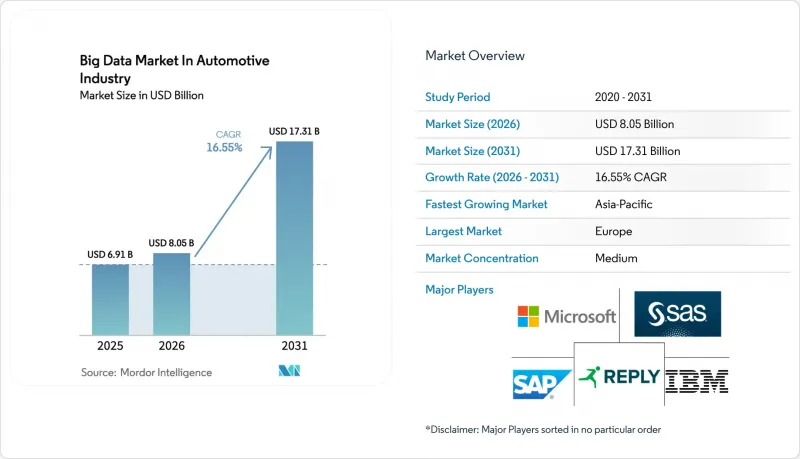
根據 Mordor Intelligence 估計,汽車產業的巨量資料市場規模將在 2026 年達到 80.5 億美元,高於 2025 年的 69.1 億美元,預計到 2031 年將達到 173.1 億美元。
預計 2026 年至 2031 年的複合年成長率為 16.55%。
本報告按應用領域(產品開發、供應鏈和製造、OEM保固和售後服務/經銷商等)、資料來源(動力傳動系統和CAN總線日誌等)、模型(本地部署和雲端/邊緣雲端)、最終用戶(OEM廠商、一級供應商等)以及地區進行細分。以上所有細分市場的規模和預測均以美元(USD)計價。
汽車產業巨量資料市場的洞見與趨勢
加強將車輛產生的數據貨幣化
汽車製造商正將其收入模式轉向利用遠端資訊處理數據的數位訂閱模式。福特汽車旗下的福特Pro公司在2024年第二季實現了26億美元的息稅前利潤(EBIT),營收達到170億美元,這主要得益於60萬份付費軟體訂閱,這些訂閱利用車隊數據來最佳化車輛運作。到2030年,訂閱服務每年可為每輛聯網汽車帶來高達3.1億美元的收入,進而提高利潤率。目前,汽車製造商可以透過市場平台將其資料集授權給保險公司、市政當局和能源供應商。因此,汽車行業的巨量資料市場以分析引擎為核心,這些引擎能夠將原始感測器日誌轉化為可銷售的洞察。可擴展性取決於能夠無延遲地攝取Terabyte資料的超大規模夥伴關係關係。
聯網汽車和軟體定義汽車的部署日益增多
預計到2027年,全球聯網汽車數量將達到3.67億輛,較2023年成長91%。在日本,25條公共道路正在為自動駕駛汽車做準備,目標是到2035年實現100%的汽車銷售為電動車。這些法規正在擴大即時資訊服務可覆蓋的車輛範圍。此外,以軟體為中心的架構支援持續的空中下載(OTA)功能升級,從而帶來持續的收入成長。掌握車輛操作系統技術的供應商預計將佔據新興價值池的大部分佔有率。汽車產業的巨量資料市場正依靠這種硬體無關的轉型來提升數據量和數據品質。
更嚴格的隱私和資料主權法規
包括GDPR、加州CPRA和中國PIPL在內的一系列複雜法規,迫使汽車製造商在管治投入大量資金。印度擬議的2025年法規新增了72小時資料外洩通知要求和年度影響評估。中國的本地化條款強制要求全球品牌在防火牆後建立平行基礎設施。違反監管規定會帶來罰款、聲譽損害和服務中斷等風險,減緩汽車產業巨量資料市場的短期成長速度。供應商正在利用聯邦學習等隱私增強技術來應對這些挑戰,以確保原始資料在國內存儲,同時共用模型權重。
細分市場分析
預計到2025年,聯網汽車和智慧交通將佔據汽車產業巨量資料市場佔有率的42.70%,複合年成長率(CAGR)為16.95%。這一成長主要得益於5G的部署、ADAS功能的強制實施以及消費者對無縫資訊娛樂體驗日益成長的需求。即時交通堵塞路線引導、電池狀態監控和動態收費等都是可產生收益的應用案例。歐洲強制實施緊急煞車系統等政策措施也進一步推動了資料量的成長。汽車製造商(OEM)的保固和售後服務部門正在分析服務歷史記錄,以預測零件需求並減少停機時間。銷售和市場部門正在利用行為分析來客製化優惠方案,從而提高轉換率。由生成式人工智慧驅動的交通最佳化演算法現在能夠高精度地偵測事故,使其對公共部門更具吸引力。隨著這些應用的擴展,汽車產業的巨量資料市場正在鞏固其作為跨產業數據協調者的地位。
產品開發、供應鏈和製造領域的分析正在創造更多附加價值。 Stellantis 正在利用其 Mobilisights 平台來提升其在歐洲的車隊效率。預測性維護模型減少了生產線意外停機時間,而工廠的數位孿生模型則縮短了新車型的推出產時間。基於遠端資訊處理的服務調度提高了客戶滿意度。行銷團隊正在利用用戶使用模式建立訂閱套餐,從而創造更穩定的收入來源。這些趨勢共同強化了一個回饋循環:以數據為中心的服務正在推動汽車產業對巨量資料市場的進一步投資。
到2025年,用於高級駕駛輔助系統(ADAS)和自動駕駛的感測器將佔據汽車行業巨量資料市場佔有率的36.85%,複合年成長率(CAGR)高達17.72%。視覺、LiDAR和雷達單元輸出高解析度資料流,支援車道維持和碰撞避免等安全功能。歐盟法規強制所有新車配備自動緊急煞車(AEB),確保了感測器的廣泛應用。邊緣人工智慧晶片對資料流進行壓縮和分類,然後傳輸傳輸到雲端進行模型重新訓練。車載資訊娛樂系統和人機互動(HMI)的日誌記錄使用者偏好,並為個人化內容引擎提供資訊。動力傳動系統和CAN總線數據流入健康評分演算法,透過在故障發生前發出警告來降低車主的保固成本。
此外,車隊和保險公司資料庫完善了資料來源結構。劍橋行動遠端資訊處理公司的研究表明,積極使用遠端資訊處理技術的使用者可將駕駛分心程度降低 20%。基於使用量的保險利用這些資訊近乎即時地調整保費。隨著感測器精度的提高,物體偵測精度也隨之提高,從而增強了自動駕駛能力。像 Aptiv 這樣的供應商已經推出了支援空中下載 (OTA) 升級的第六代平台。這些技術飛躍正在反過來推動汽車產業的巨量資料市場發展,豐富預測能力和商業化選擇。
區域分析
到2025年,北美將維持在汽車產業巨量資料市場34.10%的佔有率。整車製造商(OEM)與供應商之間的緊密合作、有利於數據共用的法規以及美加之間的跨境貿易,都為規模經濟的實現提供了支持。 2022年,美國汽車製造商向加拿大出口了價值172億美元的汽車,體現了其一體化的供應鏈。聯邦政府對國內半導體製造業的激勵措施以及520億美元的《晶片技術創新與應用法案》(CHIPS Act)為分析工作負載所需的運算資源提供了支援。通用汽車(GM)透過部署NVIDIA Omniverse進行工廠模擬以及部署DRIVE AGX進行車載人工智慧,彰顯了其在資料驅動型製造領域的領先地位。
亞太地區以18.08%的複合年成長率 (CAGR) 成為成長最快的地區,受益於中國5000億美元的自動駕駛汽車藍圖以及日本力爭在下一代車型中佔據30%全球市場佔有率的目標。日本已開放25條公共道路用於自動駕駛汽車測試,加速了資料累積。印度的汽車產業願景是到2030年實現3000億美元的產值,並為此制定了5億美元的電動車生產政策和1030億美元的人工智慧計劃,用於建立國家級GPU叢集。該地區智慧型手機的廣泛普及和低成本的通訊基礎設施為車載資訊服務 (Telematics) 的應用創造了理想的環境,為汽車行業的巨量資料市場帶來了大量數據。
在歐洲,汽車巨量資料市場正穩定成長,這得益於嚴格的隱私保護。歐盟數據法預計到2025年,每輛車每天將產生30TB的數據,這將使保險公司能夠在保障消費者權益的同時,制定即時保險政策。 2024年,Stellantis公司透過其子公司Mobilaisite,開始提供基於「優先獲得用戶同意」原則的車隊、保險和電動車充電資料包。永續發展目標和充電基礎設施的建設正在推動電動車的普及,進一步豐富了資料集。為了滿足本地化要求,汽車製造商正在部署區域雲端和隱私增強型加密技術,從而支援汽車巨量資料市場的穩定成長。
其他好處:
- Excel格式的市場預測(ME)表
- 3個月的分析師支持
目錄
第1章:引言
- 研究假設和市場定義
- 調查範圍
第2章:調查方法
第3章執行摘要
第4章 市場狀況
- 市場概覽
- 市場促進因素
- 生態系統成員正在加大力度,將車輛產生的數據貨幣化。
- 聯網汽車和軟體定義汽車的部署日益增多
- 監管義務(例如歐盟全球安全條例、中國工業和資訊化部等)正在增加遠端資訊處理資料的可用性。
- 邊緣雲分析循環在自動駕駛模式訓練的應用。
- 由汽車製造商主導的車輛數據市場正在開闢新的、持續的收入來源。
- 將即時 ADAS 日誌卸載到超大規模雲端可以縮短檢驗時間。
- 市場限制因素
- 加強隱私和資料主權方面的監管(GDPR、CPRA、中國的PIPL)
- 汽車資料集缺乏業界通用的標準模式
- Petabyte級低延遲分析基礎設施的總擁有成本高昂
- 原始設備製造商不願共用其獨特的駕駛場景相關的智慧財產權。
- 價值供應鏈分析
- 監理情勢
- 技術展望
- 波特五力分析
- 新冠疫情對產業的影響
第5章 市場規模與成長預測
- 透過使用
- 產品開發、供應鏈、製造
- 原廠保固和售後服務/經銷商
- 聯網汽車和智慧型運輸系統
- 銷售、行銷等用途
- 按數據來源
- 動力傳動系統和CAN總線日誌
- ADAS/自動駕駛感知器數據
- 車載資訊娛樂系統與人機互動數據
- 車輛運營和里程相關的保險數據
- 按部署模式
- 現場
- 雲/邊緣雲端
- 最終用戶
- OEMs
- 一級供應商
- 車輛運營商和旅行服務供應商
- 保險和金融公司
- 售後市場和經銷商網路
- 按地區
- 北美洲
- 美國
- 加拿大
- 墨西哥
- 南美洲
- 巴西
- 阿根廷
- 其他南美國家
- 歐洲
- 德國
- 英國
- 法國
- 義大利
- 西班牙
- 其他歐洲國家
- 亞太地區
- 中國
- 日本
- 印度
- 韓國
- 其他亞太國家
- 中東
- 沙烏地阿拉伯
- 阿拉伯聯合大公國
- 土耳其
- 其他中東國家
- 非洲
- 南非
- 奈及利亞
- 其他非洲國家
- 北美洲
第6章 競爭情勢
- 市場集中度
- 策略趨勢
- 市佔率分析
- 公司簡介
- IBM Corporation
- Microsoft Corporation
- Amazon Web Services
- Google Cloud
- SAP SE
- SAS Institute
- Teradata
- Continental AG
- Robert Bosch GmbH
- HERE Technologies
- Otonomo Technologies
- Caruso GmbH
- NVIDIA Corporation
- Harman International
- N-iX
- Future Processing
- Reply SpA(Data Reply)
- Phocas
- Sight Machine
- Qburst
- Monixo
- Allerin
- Positive Thinking Company
- National Instruments
第7章 市場機會與未來展望
According to Mordor Intelligence, the big data market size in the Automotive Industry market size in 2026 is estimated at USD 8.05 billion, growing from 2025 value of USD 6.91 billion with 2031 projections showing USD 17.31 billion, growing at 16.55% CAGR over 2026-2031.
This report is Segmented by Application (Product Development, Supply Chain and Manufacturing, OEM Warranty and Aftersales/Dealers, and More), Data Source (Power-Train and CAN-Bus Logs, and More), Model (On-Premises and Cloud/Edge Cloud), End-User (OEMs, Tier-1 Suppliers, and More), and Geography. The Market Sizes and Forecasts are Provided in Terms of Value (USD) for all the Above Segments.
Insights and Trends of Big Data Market In Automotive Industry
Increasing efforts to monetize vehicle-generated data
Automakers are redirecting revenue models toward digital subscriptions that ride on telematics feeds. Ford Pro recorded USD 2.6 billion EBIT on USD 17 billion revenue in Q2 2024, propelled by 600,000 paid software subscriptions that leverage fleet data for uptime optimization. Subscription services could generate as much as USD 310 per connected vehicle each year by 2030, bolstering margins. Marketplace platforms now let OEMs license data sets to insurers, municipalities, and energy providers. The Big Data market in the automotive industry, therefore, pivots on analytics engines that convert raw sensor logs into saleable insights. Scalability hinges on hyperscale partnerships that can ingest terabytes without latency.
Growing installed base of connected and software-defined vehicles
Global connected-vehicle stock is projected to hit 367 million units in 2027, a 91% leap over 2023. Japan is clearing 25 public roads for driverless cars and targets 100% electric-vehicle sales by 2035. Such regulations expand the addressable fleet for real-time data services. Software-centric architectures also allow continuous over-the-air feature upgrades, sharpening recurring revenue. Suppliers that master vehicle operating systems stand to capture the lion's share of emerging value pools. The Big Data market in the automotive industry relies on this hardware-agnostic shift to amplify data volume and quality.
Stricter privacy and data-sovereignty regulations
A web of statutes, including GDPR, California's CPRA, and China's PIPL, forces OEMs to invest heavily in governance. India's draft 2025 rules add a mandatory breach notice within 72 hours and annual impact assessments. Chinese localization clauses oblige global brands to build parallel infrastructure behind the firewall. Non-compliance risks fines, reputational harm, and service lockdowns, trimming the near-term expansion tempo of the Big Data market in the automotive industry. Vendors are responding with privacy-enhancing technologies such as federated learning to keep raw data in-country while sharing model weights.
Other drivers and restraints analyzed in the detailed report include:
- Regulatory mandates spurring telematics data availability
- Emergence of edge-cloud analytics loops for autonomous-driving model training
- Lack of industry-wide standard schemas for automotive data sets
For complete list of drivers and restraints, kindly check the Table Of Contents.
Segment Analysis
Connected Vehicle and Intelligent Transportation logged the largest slice of Big Data market share in the automotive industry at 42.70% in 2025 and is advancing at a 16.95% CAGR. This growth rests on 5G build-outs, mandated ADAS functions, and rising consumer appetite for seamless infotainment. Real-time congestion rerouting, battery-health monitoring, and dynamic tolling are examples of revenue-generating use cases. Policy moves such as mandatory emergency braking systems in Europe further boost data volumes. OEM Warranty and Aftersales units mine service histories to predict parts demand, cutting downtime. Sales and marketing arms rely on behavioral analytics to tailor offers that lift conversion rates. Traffic optimization algorithms powered by generative AI now flag incidents with high precision, enhancing public-sector appeal. As these applications scale, the Big Data market in the automotive industry cements its role as a cross-sector data orchestrator.
Product Development, Supply Chain, and Manufacturing analytics add another layer of value. Stellantis employs its Mobilisights platform to refine fleet efficiency across Europe. Predictive maintenance models shave unplanned line stoppages, while digital twins of factories cut ramp-up time for new models. Telematics-driven service scheduling improves customer satisfaction scores. Marketing teams leverage usage patterns to craft subscription bundles, translating into steadier revenue streams. Together, these trends reinforce a feedback loop where data-centric services finance further investment in the Big Data market in the automotive industry.
ADAS and autonomous sensors commanded 36.85% of the Big Data market share in the automotive industry in 2025 and carry the fastest 17.72% CAGR. Vision, lidar, and radar units output high-resolution streams that underpin safety features such as lane keeping and collision avoidance. Regulatory edicts in the EU require autonomous emergency braking in all new models, ensuring sensor proliferation. Edge AI chips compress and classify feeds before forwarding summaries to the cloud for model retraining. In-car infotainment and HMI logs capture user preferences, feeding personalized content engines. Power-train and CAN-bus data flow into health-score algorithms that alert owners ahead of faults, cutting warranty costs.
Fleet and insurance databases round out the source mix. Cambridge Mobile Telematics shows that engaged telematics users reduce distracted driving by 20%. Usage-based insurance leverages those inputs to adjust premiums in near real time. As sensor fidelity improves, object-detection accuracy rises, enhancing autonomy. Suppliers like Aptiv have unveiled Gen 6 platforms with over-the-air upgrade paths. Each leap feeds back into the Big Data market in the automotive industry, enriching predictive power and monetization options.
Complete Report Scope:
- By Application
- Product Development, Supply Chain and Manufacturing
- OEM Warranty and Aftersales/Dealers
- Connected Vehicle and Intelligent Transportation
- Sales, Marketing and Other Applications
- By Data Source
- Power-train and CAN-bus Logs
- ADAS/Autonomous Sensor Data
- In-car Infotainment and HMI Data
- Fleet Operations and Usage-based Insurance Data
- By Deployment Model
- On-premises
- Cloud/Edge Cloud
- By End User
- OEMs
- Tier-1 Suppliers
- Fleet Operators and Mobility Service Providers
- Insurance and Finance Companies
- Aftermarket and Dealer Networks
- By Geography
- North America
- United States
- Canada
- Mexico
- South America
- Brazil
- Argentina
- Rest of South America
- Europe
- Germany
- United Kingdom
- France
- Italy
- Spain
- Rest of Europe
- Asia-Pacific
- China
- Japan
- India
- South Korea
- Rest of Asia-Pacific
- Middle East
- Saudi Arabia
- United Arab Emirates
- Turkey
- Rest of Middle East
- Africa
- South Africa
- Nigeria
- Rest of Africa
- North America
Geography Analysis
North America retained 34.10% of the Big Data market share in the automotive industry in 2025. Deep OEM-supplier linkages, favorable data-sharing regulations, and cross-border trade between the United States and Canada sustain scale advantages. U.S. automakers dispatched USD 17.2 billion worth of vehicles to Canada in 2022, reflecting integrated supply chains. Federal incentives for domestic chip fabrication and the USD 52 billion CHIPS Act underpin the compute supply for analytics workloads. General Motors is implementing NVIDIA Omniverse for plant simulation and DRIVE AGX for in-vehicle AI, highlighting regional leadership in data-driven manufacturing.
Asia Pacific, the fastest-growing territory at 18.08% CAGR, benefits from China's USD 500 billion autonomous-vehicle roadmap and Japan's goal to capture 30% global share in next-generation models. Japan has opened 25 public roads to driverless testing, accelerating data accrual. India's automotive vision targets USD 300 billion output by 2030, backed by a USD 500 million EV production policy and a ₹10,300 crore AI mission that funds national GPU clusters. Smartphone penetration and low-cost connectivity prime the region for telematics adoption, feeding the Big Data market in the automotive industry with high-velocity inputs.
Europe shows steady expansion underpinned by rigorous privacy safeguards. The EU Data Act could surface 30 TB of data per vehicle daily by 2025, enabling insurers to craft real-time policies while safeguarding consumer rights. Stellantis launched fleet, insurance, and EV-charging data packages through its Mobilisights arm in 2024, operating under consent-first principles. Sustainability targets and charging-infrastructure rollouts drive EV penetration, further enriching datasets. To comply with localization clauses, OEMs deploy regional clouds and privacy-enhancing encryption, supporting measured yet resilient growth in the Big Data market in the automotive industry.
- IBM Corporation
- Microsoft Corporation
- Amazon Web Services
- Google Cloud
- SAP SE
- SAS Institute
- Teradata
- Continental AG
- Robert Bosch GmbH
- HERE Technologies
- Otonomo Technologies
- Caruso GmbH
- NVIDIA Corporation
- Harman International
- N-iX
- Future Processing
- Reply SpA (Data Reply)
- Phocas
- Sight Machine
- Qburst
- Monixo
- Allerin
- Positive Thinking Company
- National Instruments
Additional Benefits:
- The market estimate (ME) sheet in Excel format
- 3 months of analyst support
TABLE OF CONTENTS
1 INTRODUCTION
- 1.1 Study Assumptions and Market Definition
- 1.2 Scope of the Study
2 RESEARCH METHODOLOGY
3 EXECUTIVE SUMMARY
4 MARKET LANDSCAPE
- 4.1 Market Overview
- 4.2 Market Drivers
- 4.2.1 Increasing efforts by ecosystem players to monetise vehicle-generated data
- 4.2.2 Growing installed base of connected and software-defined vehicles
- 4.2.3 Regulatory mandates (e.g., EU-GSR, Chinese MIIT) spurring telematics data availability
- 4.2.4 Emergence of edge-cloud analytics loops for autonomous-driving model training
- 4.2.5 OEM-led vehicle-data marketplaces unlocking new recurring-revenue streams
- 4.2.6 Real-time ADAS log offload to hyperscale clouds reducing time-to-validation
- 4.3 Market Restraints
- 4.3.1 Stricter privacy and data-sovereignty regulations (GDPR, CPRA, China PIPL)
- 4.3.2 Lack of industry-wide standard schemas for automotive data sets
- 4.3.3 High TCO of petabyte-scale, low-latency analytics infrastructure
- 4.3.4 OEM reluctance to share proprietary driving-scenario IP
- 4.4 Value/Supply-Chain Analysis
- 4.5 Regulatory Landscape
- 4.6 Technological Outlook
- 4.7 Porter's Five Forces Analysis
- 4.7.1 Bargaining Power of Suppliers
- 4.7.2 Bargaining Power of Buyers
- 4.7.3 Threat of New Entrants
- 4.7.4 Threat of Substitutes
- 4.7.5 Intensity of Competitive Rivalry
- 4.8 Impact of COVID-19 on the Industry
5 MARKET SIZE AND GROWTH FORECASTS (VALUE)
- 5.1 By Application
- 5.1.1 Product Development, Supply Chain and Manufacturing
- 5.1.2 OEM Warranty and Aftersales/Dealers
- 5.1.3 Connected Vehicle and Intelligent Transportation
- 5.1.4 Sales, Marketing and Other Applications
- 5.2 By Data Source
- 5.2.1 Power-train and CAN-bus Logs
- 5.2.2 ADAS/Autonomous Sensor Data
- 5.2.3 In-car Infotainment and HMI Data
- 5.2.4 Fleet Operations and Usage-based Insurance Data
- 5.3 By Deployment Model
- 5.3.1 On-premises
- 5.3.2 Cloud/Edge Cloud
- 5.4 By End User
- 5.4.1 OEMs
- 5.4.2 Tier-1 Suppliers
- 5.4.3 Fleet Operators and Mobility Service Providers
- 5.4.4 Insurance and Finance Companies
- 5.4.5 Aftermarket and Dealer Networks
- 5.5 By Geography
- 5.5.1 North America
- 5.5.1.1 United States
- 5.5.1.2 Canada
- 5.5.1.3 Mexico
- 5.5.2 South America
- 5.5.2.1 Brazil
- 5.5.2.2 Argentina
- 5.5.2.3 Rest of South America
- 5.5.3 Europe
- 5.5.3.1 Germany
- 5.5.3.2 United Kingdom
- 5.5.3.3 France
- 5.5.3.4 Italy
- 5.5.3.5 Spain
- 5.5.3.6 Rest of Europe
- 5.5.4 Asia-Pacific
- 5.5.4.1 China
- 5.5.4.2 Japan
- 5.5.4.3 India
- 5.5.4.4 South Korea
- 5.5.4.5 Rest of Asia-Pacific
- 5.5.5 Middle East
- 5.5.5.1 Saudi Arabia
- 5.5.5.2 United Arab Emirates
- 5.5.5.3 Turkey
- 5.5.5.4 Rest of Middle East
- 5.5.6 Africa
- 5.5.6.1 South Africa
- 5.5.6.2 Nigeria
- 5.5.6.3 Rest of Africa
- 5.5.1 North America
6 COMPETITIVE LANDSCAPE
- 6.1 Market Concentration
- 6.2 Strategic Moves
- 6.3 Market Share Analysis
- 6.4 Company Profiles (includes Global level Overview, Market level overview, Core Segments, Financials as available, Strategic Information, Market Rank/Share for key companies, Products and Services, and Recent Developments)
- 6.4.1 IBM Corporation
- 6.4.2 Microsoft Corporation
- 6.4.3 Amazon Web Services
- 6.4.4 Google Cloud
- 6.4.5 SAP SE
- 6.4.6 SAS Institute
- 6.4.7 Teradata
- 6.4.8 Continental AG
- 6.4.9 Robert Bosch GmbH
- 6.4.10 HERE Technologies
- 6.4.11 Otonomo Technologies
- 6.4.12 Caruso GmbH
- 6.4.13 NVIDIA Corporation
- 6.4.14 Harman International
- 6.4.15 N-iX
- 6.4.16 Future Processing
- 6.4.17 Reply SpA (Data Reply)
- 6.4.18 Phocas
- 6.4.19 Sight Machine
- 6.4.20 Qburst
- 6.4.21 Monixo
- 6.4.22 Allerin
- 6.4.23 Positive Thinking Company
- 6.4.24 National Instruments
7 MARKET OPPORTUNITIES AND FUTURE OUTLOOK
- 7.1 White-space and Unmet-need Assessment

 巨量資料在石油天然氣探勘與生產的應用:市場佔有率分析、產業趨勢與統計數據以及成長預測(2026-2031 年)
 巨量資料軟體即服務(SaaS) 市場-2026-2032 年全球市場預測
 巨量資料智慧引擎市場規模、佔有率和成長分析:按組件類型、引擎功能、部署模式、最終用戶產業和地區分類-2026-2033年產業預測巨量資料商業分析市場:按組件、分析類型、組織規模、資料類型、技術、定價模式、部署方法、應用分類 - 全球市場預測(2026-2032 年)
 永續程式工程市場預測至2034年-全球工程解決方案、製程類型、技術、應用、最終用戶和區域分析巨量資料市場:2026-2032年全球市場預測(依組件、資料類型、部署方式、應用領域、產業及組織規模分類)
 巨量資料軟體市場規模、佔有率和成長分析:按軟體類型、部署模式、產業和地區分類-2026-2033年產業預測
 2026年全球資料轉換電路市場報告
 石油天然氣巨量資料市場-全球產業規模、佔有率、趨勢、機會與預測:按組件、應用、資料類型、地區和競爭對手分類,2021-2031年巨量資料技術市場預測至2034年-按解決方案、服務、部署類型、組織規模、應用、最終用戶和地區分類的全球分析