

 |
市場調查報告書
商品編碼
2100633
地板黏合劑:市場佔有率分析、產業趨勢和統計數據、成長預測(2026-2031)Floor Adhesives - Market Share Analysis, Industry Trends & Statistics, Growth Forecasts (2026 - 2031) |
||||||

※ 本網頁內容可能與最新版本有所差異。詳細情況請與我們聯繫。
據 Mordor Intelligence 稱,2025 年地板黏合劑市值為 21.2 億美元,預計到 2031 年將達到 28.1 億美元,而 2026 年為 22.2 億美元,預測期(2026-2031 年)的複合年成長率為 4.78%。
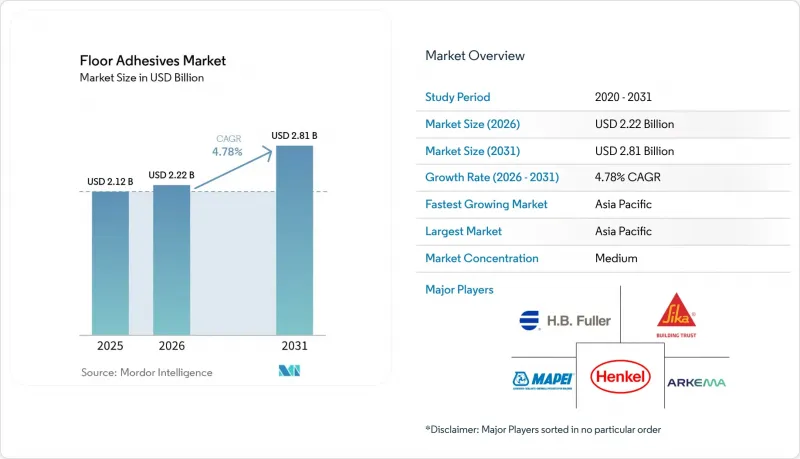
本報告按樹脂類型(環氧樹脂、丙烯酸樹脂、乙烯基樹脂等)、技術(水性及溶劑型)、應用領域(瓷磚和石材、地毯、複合地板、彈性地板材料等)、終端用戶行業(住宅、商業、工業)以及地區(亞太地區、北美、歐洲、南美、中東和非洲)進行細分。市場預測以美元計價。
全球地板黏合劑市場趨勢及洞察
全球建築支出迅速成長
隨著全球建築支出不斷成長,地板黏合劑市場正經歷對耐用黏合劑解決方案需求的穩定供應。 2024年,美國建築支出較去年同期成長11.3%,主要得益於非住宅建築18%的成長和獨棟住宅5.5%的成長。在印度,水泥需求(建設活動的指標之一)預計到2026年將以7.5%的複合年成長率成長,這得益於政府的住宅計劃,該計劃已為農村地區提供了2564萬套住宅。建築商8.5個月的訂單積壓顯示黏合劑消費穩定,而半導體工廠的建造(受《半導體生產促進和科學法案》(CHIPS法案)的推動)則創造了對高規格地板材料的需求。巴西、印尼和沙烏地阿拉伯的基礎設施相關立法措施也為防潮環氧樹脂和快速固化聚氨酯系統的供應商創造了類似的商機。原物料價格每年適度上漲 2%,使得製造商能夠在不影響需求的情況下將價格上漲轉嫁給消費者,從而在住宅和商業領域維持利潤率。
成熟經濟體對房屋翻新和維修的需求不斷成長
原定於2024年進行的維護需求已逐漸積累,並推動了北美和歐洲地板黏合劑市場的黏合劑。美國地板材料產業在2024年實現了3%的成長,商業領域的成長抵消了住宅領域的下滑,但業內高層預測,隨著房屋抵押貸款利率的降低和第二套房屋交易的復甦,2025年將出現更強勁的復甦。在歐洲,旨在提高能源效率的房屋維修正在推進,新型防水地板系統的安裝也日益普遍。這需要使用低揮發性有機化合物(VOC)含量的黏合劑,以滿足更嚴格的室內空氣品質標準。據住宅修繕用品零售商稱,市場對簡化DIY(自己動手)安裝的壓敏黏著劑產品的需求不斷成長,從而將客戶群擴展到專業安裝人員之外。快乾水性丙烯酸黏合劑的高價提高了零售商的利潤率,而電子商務通路則促進了小包裝產品的銷售,以滿足消費者進行局部維修的需求。這些趨勢結合起來,即使新建築的數量出現波動,也能為黏合劑供應商提供持續的收入來源。
嚴格的揮發性有機化合物和室內空氣品質法規
更嚴格的排放限制促使人們重新評估黏合劑的化學成分,迫使地板黏合劑市場的製造商修改其傳統溶劑型產品的配方。 2025年1月,美國環保署 (EPA) 為氣霧劑塗料設定了新的反應性加權揮發性有機化合物 (VOC) 限值,並將地毯和織物黏合劑中有機有害空氣污染物的允許閾值收緊至重量百分比不超過5%。歐洲的 REACH 法規現在限制含有超過 0.1% 二異氰酸酯的產品,加速了雙組分環氧樹脂和丙烯酸黏合劑在結構地板材料應用中的普及。加州南海岸空氣品質管理區 (AQMD) 對某些地毯襯墊黏合劑維持著 4 克/公升的全球最低 VOC 限值,實際上設定了國家標準。合規成本包括購買低氣味丙二醇醚和安裝封閉式混合生產線,這增加了小規模本地混合商的資本負擔。雖然這些政策可能會在短期內抑制溶劑的需求,但它們也為提供經認證的、不含揮發性有機化合物的、水性或生物基替代品的供應商創造了差異化的機會。
細分市場分析
預計到2025年,環氧樹脂產品將維持39.05%的地板黏合劑市場佔有率,其耐化學性和高抗壓強度在物流中心和醫療設施走廊等應用中備受青睞。聚氨酯的銷售量成長最快,複合年成長率達5.06%,這主要得益於生物基多元醇的推動,此類多元醇可減少高達50%的碳排放,並滿足綠建築認證要求。預計到2031年,聚氨酯級地板黏合劑市場規模將達到10.7億美元,這主要得益於彈性乙烯基板材的市場需求成長,此類板材能夠隨著基材的移動而靈活伸縮。丙烯酸分散體繼續用於住宅裝修,因為無味和快乾是其主要需求;而混合型濕固化化學品則滿足冷庫和食品加工廠地板等特定應用的需求。漢高的「樂泰HB S ECO」平台由超過60%的生物基原料組成,這顯示推廣永續性確保在公共部門競標中獲得更高的資格。
在地板黏合劑市場,黏合劑製造商正在擴大以植物油為原料的多元醇的先導工廠,這些多元醇的拉伸性能可與石油基基準產品媲美,從而填補了此前限制其應用的性能差距。BASF報告稱,由於其丙烯酸乙酯的生產轉向使用生質能平衡原料,其產品的碳足跡減少了30%,這表明整個產業正在轉變。厚塗層自流平地板材料對低熱環氧樹脂的需求也在成長,供應商在其產品中添加潛熱固化胺,以延長大規模商業安裝中的施工時間。這些樹脂層面的創新相結合,正使化學技術成為贏得高價值項目的關鍵差異化因素。
由於溶劑型產品具有卓越的黏合強度和廣泛的承包商認可度,預計到2025年,其銷售額將佔總銷售額的44.20%。然而,日益嚴格的VOC法規正推動市場佔有率轉移,水性產品的複合年成長率(CAGR)為5.48%。隨著承包商和建築師要求使用低氣味產品以最大限度地減少專案停工時間,預計到2031年,採用水性化學技術的地板黏合劑市場規模將超過11.2億美元。 VINNAPAS的生態聚合物分散體表明,水性平台可以透過生物甲醇取代化石衍生的正丁醇,在不影響剪切強度的前提下減少範圍3排放,從而在性能方面與溶劑型產品展開同等競爭。熱熔反應型胺甲酸乙酯正被應用於零售商店的快速部署中,這些商店要求顧客在一小時內完成購物,但由於設備成本較高,其整體應用仍處於小眾市場。
監管合規是地板黏合劑市場發展的最大推動力。加州空氣資源委員會提出的2026年修正案可能徹底禁止某些芳香族溶劑,這將使水性產品供應商在規範制定方面領先。製造商正透過改進流變改性劑以增強初始黏合性能,並添加交聯劑以提高耐熱性,來解決承包商長期以來的擔憂。隨著人們對水性膠合劑的認知不斷提高,分銷商正在為採用雙袋包裝的雙組分水性黏合劑分配貨架空間,這種包裝可以減少混合誤差,從而進一步加速其普及。
區域分析
亞太地區預計將引領市場,到2025年將佔全球銷售額的43.40%,並預計在2031年之前以5.92%的複合年成長率持續成長。印度和印尼一系列大型企劃的推動加速了競標活動。該地區的地面黏合劑市場佔有率受益於中國的城市更新預算和鐵路擴建項目,這些項目均指定使用減震環氧砂漿。越南工業園區的外商直接投資催生了對採用導電聚氨酯配製的防靜電地板材料的需求。印度的建築化學品產業價值20,000印度盧比(約23億美元),正吸引著來自世界各地的新參與企業。 Master Builders Solutions的目標是透過其針對高濕度氣候客製化的本地化瓷磚黏合劑產品線,到2028年實現500,000印度盧比(約580億美元)的銷售額。
北美位居第二,這得益於2024年建築支出增加11.3%,以及聯邦政府對半導體製造廠的激勵措施,這些工廠需要無塵、耐化學腐蝕的地面。預計隨著醫療和教育設施的維修在2025年恢復,美國商用地面黏合劑市場將實現中等個位數的成長。加拿大的基礎設施計畫撥款330億加幣(241億美元)用於公共交通設施的維修,訂單主要集中在用於車站月台的防潮環氧樹脂上。歐洲的成長速度較慢,但相關法規維持了其高價。符合化學品註冊、評估、授權和限制(REACH)法規的丙烯酸產品比傳統的溶劑型產品價格高出8-10%,即使銷售量持平,也能保證供應商的盈利。
即使將南美、中東和非洲三地加起來,到2025年它們對地板黏合劑市場的需求也僅佔不到15%,但大型活動和旅遊項目仍有成長空間。沙烏地阿拉伯的智慧城市開發計畫「NEOM」正在招標醫院和飯店的地板材料解決競標,該計畫要求使用低VOC黏合劑,這為水性黏合劑專家進入市場創造了機會。巴西對國內石化投資的稅收優惠政策可望穩定當地原料成本,並緩解先前阻礙黏合劑普及的價格波動。
其他好處:
- Excel格式的市場預測(ME)表
- 3個月的分析師支持
目錄
第1章:引言
- 研究假設和市場定義
- 調查範圍
第2章:調查方法
第3章執行摘要
第4章 市場狀況
- 市場概覽
- 市場促進因素
- 全球建築支出激增
- 成熟經濟體對房屋翻新和改造的需求不斷成長
- 商業轉型轉向彈性地板和LVT地板系統
- 模組化地板的出現需要可剝離的黏合劑。
- 適用於綠建築的生物基聚氨酯配方
- 市場限制因素
- 對揮發性有機化合物和室內空氣品質的嚴格監管
- 石化原料價格波動劇烈
- 高技能黏合劑應用技術人員短缺
- 價值鏈分析
- 波特五力模型
第5章 市場規模與成長預測
- 依樹脂類型
- 環氧樹脂
- 聚氨酯
- 丙烯酸纖維
- 乙烯基塑膠
- 其他樹脂類型
- 透過技術
- 水溶液
- 溶劑型
- 其他技術
- 透過使用
- 磁磚和石材
- 地毯
- 樹
- 層壓板
- 彈性地板材料
- 其他用途
- 按最終用戶行業分類
- 住宅
- 商業的
- 產業
- 按地區
- 亞太地區
- 中國
- 印度
- 日本
- 韓國
- ASEAN
- 其他亞太國家
- 北美洲
- 美國
- 加拿大
- 墨西哥
- 歐洲
- 德國
- 英國
- 法國
- 義大利
- 西班牙
- 俄羅斯
- 其他歐洲國家
- 南美洲
- 巴西
- 阿根廷
- 其他南美國家
- 中東和非洲
- 沙烏地阿拉伯
- 阿拉伯聯合大公國
- 南非
- 埃及
- 其他中東和非洲國家
- 亞太地區
第6章 競爭情勢
- 市場集中度
- 策略趨勢
- 市佔率和排名分析
- 公司簡介
- 3M
- Ardex Group
- Arkema
- Ashland
- BASF
- Dow
- Forbo Flooring
- HB Fuller Company
- Henkel AG & Co. KGaA
- Jowat
- LATICRETE International, Inc.
- MAPEI SpA
- Pidilite Industries Ltd.
- Saint-Gobain
- Sika AG
- Tesa SE
- Wacker Chemie AG
第7章 市場機會與未來展望
According to Mordor Intelligence, the floor adhesives market size was valued at USD 2.12 billion in 2025 and estimated to grow from USD 2.22 billion in 2026 to reach USD 2.81 billion by 2031, at a CAGR of 4.78% during the forecast period (2026-2031).
This report is Segmented by Resin Type (Epoxy, Acrylic, Vinyl, and More), Technology (Water-Borne and Solvent-Borne), Application (Tile and Stone, Carpet, Laminate, Resilient Flooring, and More), End-User Industry (Residential, Commercial, and Industrial), and Geography (Asia-Pacific, North America, Europe, South America, and Middle East and Africa). The Market Forecasts are Provided in Terms of Value (USD).
Global Floor Adhesives Market Trends and Insights
Rapidly Growing Global Construction Spending
Construction outlays are increasing worldwide, giving the Floor Adhesive market a steady pipeline of projects that need durable bonding solutions. United States construction spending climbed 11.3% year over year in 2024, lifted by an 18% surge in non-residential work and single-family housing gains of 5.5%. India's cement demand, a proxy for building activity, is expected to rise at 7.5% CAGR through 2026 under government housing programs that have delivered 25.64 Million rural units. The contractor backlog of 8.5 months signals consistent adhesive consumption, while semiconductor-plant construction incentivized by the Creating Helpful Incentives to Produce Semiconductors (CHIPS) and Science Act adds high-specification flooring needs. Legislative infrastructure packages in Brazil, Indonesia, and Saudi Arabia are creating parallel opportunities for suppliers offering moisture-resistant epoxy and quick-set polyurethane systems. Moderate raw-material inflation of 2% annually is allowing producers to pass through price increases without eroding demand, preserving margins across residential and commercial channels.
Rising Renovation and Remodeling Demand in Mature Economies
Deferred maintenance during 2024 created pent-up replacement activity that is now boosting adhesive sales in North America and Europe in the Floor Adhesive market. The United States flooring sector managed 3% growth in 2024 as commercial gains offset residential softness, but industry executives forecast a sharper recovery in 2025 once mortgage rates ease and secondary-home transactions rebound. European households are undertaking energy-efficiency upgrades that frequently involve installing new waterproof floor systems, which require low-volatile organic compound (VOC) adhesives to satisfy stricter indoor-air-quality codes. Retail home-improvement chains report higher demand for pressure-sensitive products that simplify Do-It-Yourself (DIY) installation, widening the customer base beyond professional contractors. Premium pricing for water-borne acrylics with fast tack times is improving retailer margins, while e-commerce channels are promoting small-pack offerings for consumers handling spot repairs. These trends collectively support recurring revenue streams for adhesive suppliers even when new-build volumes fluctuate.
Stringent VOC and Indoor-Air-Quality Regulations
Tougher emission limits are reshaping adhesive chemistry, compelling producers in the floor adhesives market to reformulate legacy solvent-borne lines. The United States Environmental Protection Agency imposed new reactivity-weighted VOC caps for aerosol coatings in January 2025, tightening permissible thresholds for carpet and fabric adhesives to 5% organic hazardous air-pollutants by weight. Europe's REACH rules now restrict products containing over 0.1% diisocyanates, hastening adoption of two-part epoxies and acrylics in structural flooring applications. California's South Coast Air Quality Management District (AQMD) maintains the world's lowest VOC allowance at 4 g/L for certain carpet-pad glues, effectively setting a de-facto national benchmark. Compliance costs include sourcing low-odor propylene glycol ethers and installing closed-loop mixing lines, raising capital expenditure for small regional blenders. While these policies suppress short-term solvent demand, they also open differentiation avenues for suppliers offering certified zero-VOC water-borne or bio-based alternatives.
Other drivers and restraints analyzed in the detailed report include:
- Commercial Shift Toward Resilient and LVT Flooring Systems
- Emergence of Modular Flooring Needing Releasable Adhesives
- Volatile Petrochemical Feedstock Prices
For complete list of drivers and restraints, kindly check the Table Of Contents.
Segment Analysis
Epoxy systems retained a 39.05% share of the Floor Adhesive market in 2025, favored for chemical resistance and high compressive strength in logistics centers and healthcare corridors. Polyurethane volumes are rising fastest at a 5.06% CAGR, propelled by bio-based polyols that cut embodied carbon by up to 50% and qualify for green-building credits. The Floor Adhesives market size for polyurethane grades is projected to reach USD 1.07 billion by 2031, capturing incremental demand from resilient vinyl planks that flex with substrate movement. Acrylic dispersions continue to serve residential renovations where odor neutrality and quick tack are priorities, while hybrid moisture-cure chemistries tackle niche cold-storage and food-processing floors. Henkel's LOCTITE HB S ECO platform uses more than 60% bio-attributed feedstock, demonstrating how sustainable claims can secure premium specifications in public-sector bids.
Adhesive manufacturers are scaling pilot plants for vegetable-oil-derived polyols in the floor adhesives market that maintain equivalent tensile properties to petroleum-based references, bridging performance gaps that once limited adoption. BASF reported a 30% product-carbon-footprint drop after shifting ethyl acrylate production to biomass-balanced feedstock, signaling broader industry migration. Demand for low-exotherm epoxies in thick-pour self-leveling floors is also climbing, and suppliers are adding latent-curing amines that extend pot life for large commercial pours. Collectively, these resin-level innovations position chemistry as the key differentiator in winning high-value projects.
Solvent-borne lines still command 44.20% of 2025 revenues thanks to proven bond strength and broad installer familiarity, but tightening VOC limits are shifting share to water-borne products growing at 5.48% CAGR . The floor adhesives market size attributed to water-borne chemistries is forecast to surpass USD 1.12 billion by 2031 as builders and architects seek low-odor installations that minimize project downtime. VINNAPAS eco polymer dispersions substitute fossil n-butanol with bio-methanol inputs, reducing Scope 3 emissions without sacrificing shear strength, illustrating how water-borne platforms can compete head-to-head on performance. Hot-melt reactive urethanes find use in fast-track retail store rollouts where 1-hour walk-on time is essential, though their overall penetration remains niche due to equipment costs.
Regulatory compliance is the chief tailwind in the floor adhesive market: California's upcoming 2026 Air Resources Board revision may ban certain aromatic solvents entirely, giving water-borne suppliers a head start on specification. Manufacturers are upgrading rheology modifiers to improve early-grab characteristics and adding crosslinkers that raise heat resistance, answering historical installer objections. As awareness grows, distributors are dedicating shelf space to two-part water dispersions packaged in dual-pouch sachets that lower mixing errors, further accelerating adoption.
Complete Report Scope:
- By Resin Type
- Epoxy
- Polyurethane
- Acrylic
- Vinyl
- Other Resin Types
- By Technology
- Water-borne
- Solvent-borne
- Other Technologies
- By Application
- Tile and Stone
- Carpet
- Wood
- Laminate
- Resilient Flooring
- Other Applications
- By End-user Industry
- Residential
- Commercial
- Industrial
- By Geography
- Asia-Pacific
- China
- India
- Japan
- South Korea
- ASEAN
- Rest of Asia-Pacific
- North America
- United States
- Canada
- Mexico
- Europe
- Germany
- United Kingdom
- France
- Italy
- Spain
- Russia
- Rest of Europe
- South America
- Brazil
- Argentina
- Rest of South America
- Middle East and Africa
- Saudi Arabia
- United Arab Emirates
- South Africa
- Egypt
- Rest of Middle East and Africa
- Asia-Pacific
Geography Analysis
Asia-Pacific led with 43.40% of 2025 revenue and is set to advance at a 5.92% CAGR through 2031 as megaproject pipelines in India and Indonesia accelerate tender activity. The floor adhesive market share of the region benefits from China's urban-renewal budgets and railway expansions that specify vibration-dampening epoxy mortars. Foreign direct investment into Vietnam's industrial parks is spawning demand for anti-static flooring bonded with conductive polyurethane. India's INR 20,000 crore (USD 2.3 Billion) construction-chemicals sector is luring global entrants; Master Builders Solutions targets INR 500 crore (USD 58 Billion) turnover by 2028 via localized tile-adhesive lines compatible with high-humidity climates.
North America ranks second, underpinned by an 11.3% uptick in 2024 construction expenditure and federal incentives for semiconductor fabs that require dust-free, chemical-resistant floors. The United States commercial installations' floor adhesives market size is poised for mid-single-digit growth once deferred healthcare and education refurbishments restart in 2025. Canada's infrastructure plan allocates CAD 33 Billion (USD 24.1 Billion) to public transit upgrades and channel orders to moisture-mitigating epoxies for station platforms. Europe's trajectory is flatter, yet premium due to regulations; Registration, Evaluation, Authorization, and Restriction of Chemicals (REACH)-compliant acrylics enjoy price premiums of 8-10% over legacy solvent lines, preserving supplier profitability even as volumes level off.
South America and the Middle East & Africa collectively represent less than 15% of 2025 demand floor adhesive market but offer upside in mega-events and tourism projects. Saudi Arabia's NEOM smart-city development is tendering hospital and hotel flooring packages that mandate low-VOC adhesives, creating entry points for water-borne specialists. Brazil's tax incentives for domestic petrochemical investments could stabilize local raw-material costs, moderating price swings that have historically dampened adhesive uptake.
- 3M
- Ardex Group
- Arkema
- Ashland
- BASF
- Dow
- Forbo Flooring
- H.B. Fuller Company
- Henkel AG & Co. KGaA
- Jowat
- LATICRETE International, Inc.
- MAPEI S.p.A.
- Pidilite Industries Ltd.
- Saint-Gobain
- Sika AG
- Tesa SE
- Wacker Chemie AG
Additional Benefits:
- The market estimate (ME) sheet in Excel format
- 3 months of analyst support
TABLE OF CONTENTS
1 Introduction
- 1.1 Study Assumptions & Market Definition
- 1.2 Scope of the Study
2 Research Methodology
3 Executive Summary
4 Market Landscape
- 4.1 Market Overview
- 4.2 Market Drivers
- 4.2.1 Rapidly Growing Global Construction Spending
- 4.2.2 Rising Renovation and Remodeling Demand in Mature Economies
- 4.2.3 Commercial Shift Toward Resilient and LVT Flooring Systems
- 4.2.4 Emergence of Modular Flooring Needing Releasable Adhesives
- 4.2.5 Bio-based Polyurethane Recipes Aligned with Green Buildings
- 4.3 Market Restraints
- 4.3.1 Stringent VOC and Indoor-air-quality Regulations
- 4.3.2 Volatile Petrochemical Feedstock Prices
- 4.3.3 Installer Skill Shortages for Advanced Adhesives
- 4.4 Value Chain Analysis
- 4.5 Porter's Five Forces
- 4.5.1 Bargaining Power of Suppliers
- 4.5.2 Bargaining Power of Buyers
- 4.5.3 Threat of New Entrants
- 4.5.4 Threat of Substitutes
- 4.5.5 Degree of Competition
5 Market Size & Growth Forecasts (Value)
- 5.1 By Resin Type
- 5.1.1 Epoxy
- 5.1.2 Polyurethane
- 5.1.3 Acrylic
- 5.1.4 Vinyl
- 5.1.5 Other Resin Types
- 5.2 By Technology
- 5.2.1 Water-borne
- 5.2.2 Solvent-borne
- 5.2.3 Other Technologies
- 5.3 By Application
- 5.3.1 Tile and Stone
- 5.3.2 Carpet
- 5.3.3 Wood
- 5.3.4 Laminate
- 5.3.5 Resilient Flooring
- 5.3.6 Other Applications
- 5.4 By End-user Industry
- 5.4.1 Residential
- 5.4.2 Commercial
- 5.4.3 Industrial
- 5.5 By Geography
- 5.5.1 Asia-Pacific
- 5.5.1.1 China
- 5.5.1.2 India
- 5.5.1.3 Japan
- 5.5.1.4 South Korea
- 5.5.1.5 ASEAN
- 5.5.1.6 Rest of Asia-Pacific
- 5.5.2 North America
- 5.5.2.1 United States
- 5.5.2.2 Canada
- 5.5.2.3 Mexico
- 5.5.3 Europe
- 5.5.3.1 Germany
- 5.5.3.2 United Kingdom
- 5.5.3.3 France
- 5.5.3.4 Italy
- 5.5.3.5 Spain
- 5.5.3.6 Russia
- 5.5.3.7 Rest of Europe
- 5.5.4 South America
- 5.5.4.1 Brazil
- 5.5.4.2 Argentina
- 5.5.4.3 Rest of South America
- 5.5.5 Middle East and Africa
- 5.5.5.1 Saudi Arabia
- 5.5.5.2 United Arab Emirates
- 5.5.5.3 South Africa
- 5.5.5.4 Egypt
- 5.5.5.5 Rest of Middle East and Africa
- 5.5.1 Asia-Pacific
6 Competitive Landscape
- 6.1 Market Concentration
- 6.2 Strategic Moves
- 6.3 Market Share(%)/Ranking Analysis
- 6.4 Company Profiles (includes Global level Overview, Market level overview, Core Segments, Financials as available, Strategic Information, Market Rank/Share, Products & Services, Recent Developments)
- 6.4.1 3M
- 6.4.2 Ardex Group
- 6.4.3 Arkema
- 6.4.4 Ashland
- 6.4.5 BASF
- 6.4.6 Dow
- 6.4.7 Forbo Flooring
- 6.4.8 H.B. Fuller Company
- 6.4.9 Henkel AG & Co. KGaA
- 6.4.10 Jowat
- 6.4.11 LATICRETE International, Inc.
- 6.4.12 MAPEI S.p.A.
- 6.4.13 Pidilite Industries Ltd.
- 6.4.14 Saint-Gobain
- 6.4.15 Sika AG
- 6.4.16 Tesa SE
- 6.4.17 Wacker Chemie AG
7 Market Opportunities & Future Outlook
- 7.1 White-space & Unmet-Need Assessment
- 7.2 Sustainable Binders for Floor Adhesives

 地板黏合劑市場-2026-2032年全球市場預測地板黏合劑市場:類型、技術、銷售管道、應用和最終用途 - 2026-2032年全球市場預測
 全球地板材料黏合劑市場:市場規模、佔有率和趨勢分析(按樹脂、應用、最終用途和地區分類),細分市場預測(2026-2033 年)
 全球地板黏合劑市場規模、佔有率、趨勢和成長分析報告(2026-2034)
 2026年全球地板黏合劑市場報告
 地板黏合劑市場規模、佔有率和成長分析(按樹脂類型、技術、應用、最終用戶和地區分類)—2026-2033年產業預測
 地板黏合劑市場-全球產業規模、佔有率、趨勢、機會和預測,按樹脂類型、技術、應用、地區和競爭格局分類,2020-2030年預測
 亞太地板樹脂:市場佔有率分析、產業趨勢與統計、成長預測(2025-2030 年)
 2024-2028年全球地板膠市場