


 |
市場調查報告書
商品編碼
2100623
無氣輪胎:市佔率分析、產業趨勢與統計、成長預測(2026-2031)Airless Tires - Market Share Analysis, Industry Trends & Statistics, Growth Forecasts (2026 - 2031) |
||||||

※ 本網頁內容可能與最新版本有所差異。詳細情況請與我們聯繫。
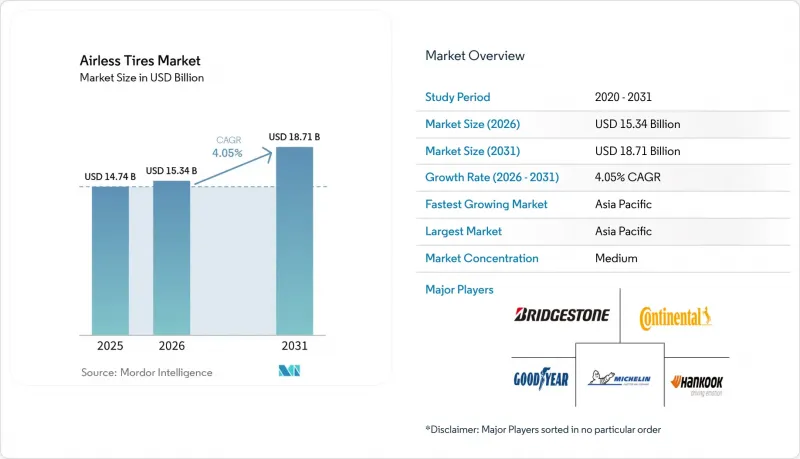
據 Mordor Intelligence 稱,2025 年無氣輪胎市值為 147.4 億美元,預計到 2031 年將達到 187.1 億美元,而 2026 年為 153.4 億美元,預測期(2026-2031 年)的複合年成長率為 4.05%。
本報告按車輛類型(乘用車、商用車等)、材料(橡膠、塑膠等)、製造技術(3D列印網格結構、模壓輻條網等)、銷售管道(OEM和售後市場)以及地區(北美、南美等)進行細分。市場預測以美元計價。
全球無氣輪胎市場趨勢及洞察
電動車製造商需要快速防刺穿解決方案
為了擴大車內空間並減輕整車重量,電動車製造商正在減少備胎的存放空間,這導致車輛在路上發生故障時成本更高。 Uptis 與特斯拉合作的試點計畫表明,單一汽車製造商的決策有可能推動整個無氣輪胎市場的大規模應用。車隊營運商報告稱,改用無氣輪胎後,故障率降低了高達 80%,從而減少了與意外停機相關的成本。無氣輪胎具有高承載能力,能夠承受電池的重量和扭矩,這與無氣輪胎設計的優勢相符。米其林預測,無氣輪胎的廣泛應用每年可減少 2 億條輪胎的報廢。這些因素使得電動車平台成為推動無氣輪胎市場中期成長的重要動力。
減少採礦業輪胎停機時間的努力
運輸卡車的運作可能導致礦石產量損失超過10萬美元。Bridgestone的「智慧現場」解決方案將無氣輪胎與人工智慧診斷功能相結合,可對礦場車隊進行預測性維護和調度。米其林位於智利的輪胎回收工廠每年處理3萬噸工程輪胎,透過循環經濟將耐用性與價值創造連結起來。經證實的投資報酬率促使礦業業者接受溢價,進而推動無氣輪胎市場持續擴張,尤其是在亞太地區。
與子午線輪胎相比,單價更高
由於使用了特殊的聚氨酯和複合材料,目前的無氣輪胎比同類子午線輪胎貴40%至60%。全球充氣輪胎的產量已達24億條,遠超過目前的無氣輪胎產能,限制了規模經濟效益。雖然由於減少停機時間的優勢,無氣輪胎在礦業和小包裹物流車輛的應用持續成長,但普通乘用車市場對價格的敏感度依然很高,這將在中期內抑制無氣輪胎市場的成長。
細分市場分析
預計到2025年,乘用車將保持最大的市場佔有率,達到45.68%,而越野車預計將以7.12%的複合年成長率成長。隨著礦業公司將設備運作放在首位,越野機械用無氣輪胎的市場規模已達到相當可觀的水平。對於休閒全地形車(ATV)和多用途車(UTV),採用徑向剛性輻條設計以應對崎嶇地形正在擴大其消費群體。
在商用卡車領域,隨著防刺穿性能在整體擁有成本 (TCO) 方面的重要性日益凸顯,無氣輪胎的普及正在穩步推進。在強力運動市場,製造商透過融入免維護功能來打造差異化產品,這些功能對偏遠地區的越野騎乘者極具吸引力。雖然摩托車應用目前仍屬於小眾市場,但在都市區,其應用持續成長,因為可靠性對於電動自行車車隊至關重要。總體而言,各種車輛類型的結合正在推動無氣輪胎市場超越其最初的工業基礎。
預計到2025年,橡膠將佔據64.74%的市場佔有率,這反映了其傳統的供應鏈和成本優勢;而複合彈性體預計將以5.89%的複合年成長率實現最高成長。生物基原料的採用正在推動循環經濟的發展,米其林的目標是到2030年實現40%的材料可再生和可回收材料。聚氨酯彈性體為輻條組件提供了卓越的抗裂性能,從而提高了無氣輪胎市場的整體耐用性。
雖然橡膠在大規模生產中仍然具有成本效益,但複合材料從環境稅收角度來看更具優勢。塑膠複合材料則滿足了對耐化學性有特殊要求的細分市場,例如機場地面支援設備(GSE)。這些材料的進步凸顯了永續發展要求如何改變供應商的策略,並鞏固其在無氣輪胎市場的高階地位。
區域分析
亞太地區佔最大的市場佔有率,達38.20%,複合年成長率(CAGR)最高,達7.88%。政府對電動車(EV)的獎勵、眾多原始設備製造商(OEM)的存在以及韓泰輪胎「iFlex」計畫等本土創新者的湧現,共同推動了該地區的發展勢頭。全球排名前75的輪胎公司中有34家總部位於中國,其規模和成本優勢正在推動無氣輪胎市場在國內和出口通路的成長。
北美受惠於國防相關合約和先進的研發生態系統。美國工程集團的零壓技術以及特斯拉和米其林的示範計畫證明了該技術的跨產業效度。多個州實施的生產者責任法規正在推動可回收輪胎的設計,儘管初期成本較高,但仍有助於無氣輪胎市場的長期成長。
在歐洲,嚴格的排放氣體法規和掩埋處理規則已經生效。歐盟7輪胎磨損限制和生產者延伸責任框架與無氣輪胎的可回收特性相契合。米其林正透過與其「願景」一致的生產方式,順應歐洲的發展趨勢,在確保性能的同時,助力區域無氣輪胎市場履行其應對氣候變遷的承諾。
其他好處:
- Excel格式的市場預測(ME)表
- 3個月的分析師支持
目錄
第1章:引言
- 研究假設和市場定義
- 調查範圍
第2章:調查方法
第3章執行摘要
第4章 市場狀況
- 市場概覽
- 市場促進因素
- 電動車製造商對快速防刺穿解決方案的需求日益成長。
- 減少採礦業輪胎停機時間的努力
- 增加軍方在防爆輪胎機動平台上的支出
- 歐盟更嚴格的掩埋法規鼓勵使用可回收的非充氣輪胎。
- 3D列印的晶格結構輪子顯著縮短了原型製作週期。
- 用於最後一公里物流的微型出行車輛數量增加
- 市場限制因素
- 與子午線輪胎相比,單位成本更高
- 高速負載的認證有限。
- 由於NVH方面的擔憂,OEM廠商猶豫不決。
- 關於新車輛檢驗標準的監管不確定性
- 價值供應鏈分析
- 監理情勢
- 技術展望
- 波特五力模型
第5章 市場規模與成長預測
- 車輛類型
- 搭乘用車
- 商用車輛
- 越野車
- 摩托車
- 強力運動(全地形車/多用途車、雪上摩托車)
- 材料
- 橡皮
- 塑膠
- 複合彈性體
- 透過製造技術
- 3D列印網格結構
- 模壓輻條網
- 層壓蜂窩
- 按銷售管道
- OEM
- 售後市場
- 按地區
- 北美洲
- 美國
- 加拿大
- 其他北美國家
- 南美洲
- 巴西
- 阿根廷
- 其他南美國家
- 歐洲
- 德國
- 英國
- 法國
- 西班牙
- 義大利
- 俄羅斯
- 其他歐洲國家
- 亞太地區
- 中國
- 日本
- 印度
- 韓國
- 澳洲
- 紐西蘭
- 其他亞太國家
- 中東和非洲
- 沙烏地阿拉伯
- 阿拉伯聯合大公國
- 埃及
- 土耳其
- 南非
- 其他中東和非洲國家
- 北美洲
第6章 競爭情勢
- 市場集中度
- 策略趨勢
- 市佔率分析
- 公司簡介
- Michelin Group
- Goodyear Tire & Rubber Co.
- Continental AG
- Hankook Tire & Technology Group
- Bridgestone Corporation
- Trelleborg AB
- Toyo Tire Corporation
- Amerityre Corporation
- Tannus Ltd
- Polaris Inc.(Resilient Technologies)
- Kenda Rubber Industrial Co.
- Marathon Industries Inc.
- SMART Tire Company
第7章 市場機會與未來展望
According to Mordor Intelligence, the airless tires market size was valued at USD 14.74 billion in 2025 and estimated to grow from USD 15.34 billion in 2026 to reach USD 18.71 billion by 2031, at a CAGR of 4.05% during the forecast period (2026-2031).
This report is Segmented by Vehicle Type (Passenger Vehicles, Commercial Vehicles, and More), Material (Rubber, Plastic, and More), Manufacturing Technology (3-D Printed Lattice, Molded Spoke Web, and More), Sales Channel (OEM and Aftermarket), and Geography (North America, South America, and More). The Market Forecasts are Provided in Terms of Value (USD).
Global Airless Tires Market Trends and Insights
Rapid Puncture-Proof Solutions Demanded by EV OEMs
EV makers eliminate spare-tire space to extend cabin volume and curb weight; doing so elevates the cost of roadside failures. Uptis trials with Tesla illustrate how a single OEM decision can pull the wider airless tires market toward volume adoption. Fleet operators report up to 80% fewer breakdowns after switching to non-pneumatic tires, cutting unplanned downtime costs. Higher load tolerance for battery mass and torque aligns with airless construction advantages, while Michelin projects 200 million tire scrappage avoidance annually once deployment scales. These factors position EV platforms as the medium-term catalyst for the airless tires market momentum.
Mining Sector Push to Cut Tire Downtime
Haul-truck immobilization can exceed USD 100,000 in lost ore output. Bridgestone's Smart On-Site bundle couples airless tires with AI diagnostics, delivering predictive scheduling for pit fleets. Michelin's tire recycling plant in Chile processes 30,000 tons of earthmover tires annually, linking durability with circular value capture. The proven ROI persuades mine operators to accept premium pricing, sustaining Asia-Pacific-led expansion of the airless tires market.
Higher Unit Cost Versus Radial Tires
Current non-pneumatic units cost 40-60% above comparable radials owing to specialized polyurethane and composite inputs. Global output of 2.4 billion pneumatic units dwarfs current airless capacity, limiting economies of scale. Fleets in mining or parcel logistics are still buying due to downtime savings, yet mainstream passenger sales remain price sensitive, tempering the airless tires market trajectory during the medium term.
Other drivers and restraints analyzed in the detailed report include:
- Rising Military Spending on Run-Flat Mobility Platforms
- Stricter EU Landfill Rules Favoring Recyclable Non-Pneumatics
- Limited High-Speed Load Certifications
For complete list of drivers and restraints, kindly check the Table Of Contents.
Segment Analysis
Off-road vehicles posted the highest 7.12% CAGR outlook, even though passenger models retained the largest 45.68% share in 2025. The airless tires market size for off-road machinery reached a significant value as mine operators prioritized uptime. Recreational ATVs and UTVs use spoked designs offering higher radial stiffness for rough terrain, thereby widening consumer segments.
The commercial-truck niche shows steady conversion because total-cost-of-ownership models reward puncture avoidance. In Power-sports market, the makers differentiate models through maintenance-free features attractive to remote trail riders. Two-wheeler use is a niche yet growing in urban settings where e-bike fleets value reliability. Overall, diverse vehicle classes collectively expand the airless tires market beyond its initial industrial anchor points.
Rubber held a 64.74% share in 2025, reflecting legacy supply chains and cost advantages, whereas composite elastomers are projected to register the fastest 5.89% CAGR. Incorporation of bio-sourced feedstocks advances circularity pledges; Michelin targets 40% renewable and recyclable content by 2030. Polyurethane-based elastomers offer superior crack resistance for spoke assemblies, enhancing durability across the airless tires market.
Rubber remains cost-effective for high-volume runs, yet environmental levies favor composites. Plastic formulations serve specialist chemical-resistant niches such as airport GSE. The materials evolution underscores how sustainability mandates are reshaping supplier strategies and reinforce premium positioning within the airless tires market.
Complete Report Scope:
- By Vehicle Type
- Passenger Vehicles
- Commercial Vehicles
- Off-Road Vehicles
- Two-Wheeler
- Power Sports (ATV/UTV, Snowmobile)
- By Material
- Rubber
- Plastic
- Composite Elastomers
- By Manufacturing Technology
- 3-D Printed Lattice
- Molded Spoke Web
- Layered Honeycomb
- By Sales Channel
- OEM
- Aftermarket
- By Geography
- North America
- United States
- Canada
- Rest of North America
- South America
- Brazil
- Argentina
- Rest of South America
- Europe
- Germany
- United Kingdom
- France
- Spain
- Italy
- Russia
- Rest of Europe
- Asia-Pacific
- China
- Japan
- India
- South Korea
- Australia
- New Zealand
- Rest of Asia-Pacific
- Middle East and Africa
- Saudi Arabia
- United Arab Emirates
- Egypt
- Turkey
- South Africa
- Rest of Middle East and Africa
- North America
Geography Analysis
Asia-Pacific combined the largest 38.20% slice with the fastest 7.88% CAGR. Government EV incentives, a dense OEM base, and domestic innovators such as Hankook's iFlex program power regional momentum. China's 34 of the top 75 global tire companies deliver scale and cost advantages, propelling the airless tires market in local and export channels.
North America benefits from defense contracts and advanced R&D ecosystems. American Engineering Group's zero-pressure work and Tesla-Michelin pilots demonstrate cross-sector validation. Producer-responsibility regulations in several states support recyclable designs, underpinning long-term growth of the airless tires market despite higher upfront costs.
Europe orchestrates stringent emission and landfill rules. Euro 7 tyre abrasion caps and extended-producer-responsibility frameworks align with airless recyclability attributes. Michelin leverages continental policy trends through Vision-aligned production, helping the regional airless tires market meet climate commitments while safeguarding performance.
- Michelin Group
- Goodyear Tire & Rubber Co.
- Continental AG
- Hankook Tire & Technology Group
- Bridgestone Corporation
- Trelleborg AB
- Toyo Tire Corporation
- Amerityre Corporation
- Tannus Ltd
- Polaris Inc. (Resilient Technologies)
- Kenda Rubber Industrial Co.
- Marathon Industries Inc.
- SMART Tire Company
Additional Benefits:
- The market estimate (ME) sheet in Excel format
- 3 months of analyst support
TABLE OF CONTENTS
1 Introduction
- 1.1 Study Assumptions & Market Definition
- 1.2 Scope of the Study
2 Research Methodology
3 Executive Summary
4 Market Landscape
- 4.1 Market Overview
- 4.2 Market Drivers
- 4.2.1 Rapid puncture-proof solutions demanded by EV OEMs
- 4.2.2 Mining sector's push to cut tyre downtime
- 4.2.3 Rising military spending on run-flat mobility platforms
- 4.2.4 Stricter EU landfill rules favouring recyclable non-pneumatics
- 4.2.5 3-D printed lattice wheels slashing prototyping cycles
- 4.2.6 Growing micro-mobility fleets for last-mile logistics
- 4.3 Market Restraints
- 4.3.1 Higher unit cost versus radial tires
- 4.3.2 Limited high-speed load certifications
- 4.3.3 OEM hesitation due to NVH concerns
- 4.3.4 Regulatory uncertainty on new road-worthiness standards
- 4.4 Value / Supply-Chain Analysis
- 4.5 Regulatory Landscape
- 4.6 Technological Outlook
- 4.7 Porter's Five Forces
- 4.7.1 Threat of New Entrants
- 4.7.2 Bargaining Power of Buyers
- 4.7.3 Bargaining Power of Suppliers
- 4.7.4 Threat of Substitute Products
- 4.7.5 Intensity of Competitive Rivalry
5 Market Size & Growth Forecasts (Value in USD)
- 5.1 By Vehicle Type
- 5.1.1 Passenger Vehicles
- 5.1.2 Commercial Vehicles
- 5.1.3 Off-Road Vehicles
- 5.1.4 Two-Wheeler
- 5.1.5 Power Sports (ATV/UTV, Snowmobile)
- 5.2 By Material
- 5.2.1 Rubber
- 5.2.2 Plastic
- 5.2.3 Composite Elastomers
- 5.3 By Manufacturing Technology
- 5.3.1 3-D Printed Lattice
- 5.3.2 Molded Spoke Web
- 5.3.3 Layered Honeycomb
- 5.4 By Sales Channel
- 5.4.1 OEM
- 5.4.2 Aftermarket
- 5.5 By Geography
- 5.5.1 North America
- 5.5.1.1 United States
- 5.5.1.2 Canada
- 5.5.1.3 Rest of North America
- 5.5.2 South America
- 5.5.2.1 Brazil
- 5.5.2.2 Argentina
- 5.5.2.3 Rest of South America
- 5.5.3 Europe
- 5.5.3.1 Germany
- 5.5.3.2 United Kingdom
- 5.5.3.3 France
- 5.5.3.4 Spain
- 5.5.3.5 Italy
- 5.5.3.6 Russia
- 5.5.3.7 Rest of Europe
- 5.5.4 Asia-Pacific
- 5.5.4.1 China
- 5.5.4.2 Japan
- 5.5.4.3 India
- 5.5.4.4 South Korea
- 5.5.4.5 Australia
- 5.5.4.6 New Zealand
- 5.5.4.7 Rest of Asia-Pacific
- 5.5.5 Middle East and Africa
- 5.5.5.1 Saudi Arabia
- 5.5.5.2 United Arab Emirates
- 5.5.5.3 Egypt
- 5.5.5.4 Turkey
- 5.5.5.5 South Africa
- 5.5.5.6 Rest of Middle East and Africa
- 5.5.1 North America
6 Competitive Landscape
- 6.1 Market Concentration
- 6.2 Strategic Moves
- 6.3 Market Share Analysis
- 6.4 Company Profiles (Includes Global Level Overview, Market Level Overview, Core Segments, Financials as Available, Strategic Information, Market Rank/Share for Key Companies, Products and Services, SWOT Analysis, and Recent Developments)
- 6.4.1 Michelin Group
- 6.4.2 Goodyear Tire & Rubber Co.
- 6.4.3 Continental AG
- 6.4.4 Hankook Tire & Technology Group
- 6.4.5 Bridgestone Corporation
- 6.4.6 Trelleborg AB
- 6.4.7 Toyo Tire Corporation
- 6.4.8 Amerityre Corporation
- 6.4.9 Tannus Ltd
- 6.4.10 Polaris Inc. (Resilient Technologies)
- 6.4.11 Kenda Rubber Industrial Co.
- 6.4.12 Marathon Industries Inc.
- 6.4.13 SMART Tire Company
7 Market Opportunities & Future Outlook
- 7.1 White-space & Unmet-Need Assessment

 無氣輪胎市場-2026-2032年全球市場預測
 無氣輪胎技術市場分析及預測(至2035年):類型、產品、技術、組件、應用、材質、最終用戶、功能、安裝方式
 全球無氣輪胎市場規模、佔有率、趨勢和成長分析報告(2026-2034年)無氣輪胎市場分析及預測(至2035年):類型、產品類型、技術、組件、應用、材料、最終用戶、功能、安裝方式
 無氣輪胎市場 - 全球產業規模、佔有率、趨勢、機會、預測:按類型、車輛、材料、輪胎尺寸、銷售管道、地區和競爭格局分類,2021-2031年
 2026年全球無氣輪胎市場報告
 無氣輪胎市場規模、佔有率和成長分析(按材料、產品、輪胎尺寸、車輛類型、銷售管道和地區分類)-2026-2033年產業預測
 無氣輪胎市場規模、佔有率、趨勢分析報告:按車型、銷售管道、地區、細分市場預測,2025-2030 年
 2030 年無氣輪胎市場預測:按類型、車輛類型、材料、銷售管道、應用和地區進行全球分析
 無氣輪胎市場機會、成長動力、產業趨勢分析與 2025 - 2034 年預測