


 |
市場調查報告書
商品編碼
2100599
戶外LED照明:市場佔有率分析、產業趨勢與統計、成長預測(2026-2031年)Outdoor LED Lighting - Market Share Analysis, Industry Trends & Statistics, Growth Forecasts (2026 - 2031) |
||||||

※ 本網頁內容可能與最新版本有所差異。詳細情況請與我們聯繫。
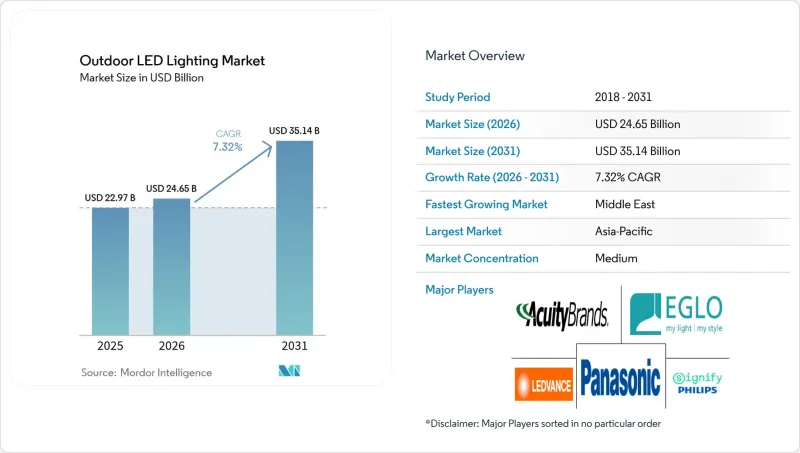
2025年戶外LED照明市場價值為229.7億美元,預計到2031年將達到351.4億美元,而2026年為246.5億美元,預測期(2026-2031年)複合年成長率為7.32%。
本報告按產品類型(燈具、照明設備)、應用領域(街道和道路照明、建築和景觀照明、體育場館照明、隧道和橋樑照明等)、安裝類型(新安裝、維修安裝)、配銷通路(直銷、批發、零售等)和地區進行細分。市場預測以美元計價。
全球戶外LED照明市場趨勢與洞察
城市智慧城市計畫正在加速現代化進程。
在全球智慧城市建設中,連網公共照明作為基礎基礎設施,仍是優先事項。在杜拜,謝赫拉希德大道沿線的900盞燈具已全部更換為LED燈,節能60%,平均使用壽命延長173%。費城一項類似的基於數據驅動的實施方案顯示,自運作自適應調光控制以來,節能50%,交通事故顯著減少。市政採購負責人開始將連網路燈視為感測器樞紐,它們可以產生有關交通和空氣品質的高價值數據,從而創造額外收入,並為規劃提供寶貴資訊。
零件價格的下降正在擴大目標市場。
2024年,封裝式LED的平均價格再次下降8%,而主流戶外照明燈具的光效提升至每瓦150-175流明。這使得在偏遠交通樞紐、臨時建築工地和低收入社區等以往因資金限制而難以實施的地區,經濟上可行的部署成為可能。製造商透過「固定性能」服務合約來體現成本節約,這些合約保證流明輸出,並將技術風險轉移給市政當局和業主。
原料供應中斷導致成本上升
中國控制全球近80%的鎵產量,其2024年的許可證制度導致現貨價格飆升,前置作業時間延長。用於隧道和體育賽事照明的高效晶片受影響最大,迫使一些原始設備製造商(OEM)重新設計封裝,採用替代磷光體。跨國公司已儲備了緩衝庫存,但二級供應商正面臨利潤率下降和訂單間歇性積壓的壓力。
細分市場分析
在戶外LED照明市場,照明燈具預計在2025年佔總銷售額的67.80%。這主要得益於新開發案的湧現以及智慧城市建設對具備全面控制功能的住宅的迫切需求。例如,猶他州的Maverick Center等大型體育場館安裝了76盞符合NHL照明標準的廣播級LED泛光燈,同時每年可節省72%的電力成本。預計該細分市場將繼續支撐市場價值,但隨著競爭加劇,其成長速度可能會放緩。
在LED最初熱潮中常被忽視的燈具品類,如今正重拾成長勢頭,預計到2031年將以6.34%的複合年成長率成長。即插即用型燈具能夠重複利用現有燈罩,且易於更換,因此對注重預算的市政部門極具吸引力。加州禁止使用螢光的政策立即推動了訂單的成長,預計學區和小型企業也將加快遵守相關法規。此外,住宅對戶外PAR燈的維修也帶動了需求的進一步成長,而大型DIY零售商的推動更是加劇了這一趨勢。
到2025年,街道和道路照明設施將佔總收入的41.85%,這得益於傳統鈉燈安裝的豐富經驗。杜拜各地的維修項目表明,採購團隊透過將照明設備與多年服務合約捆綁銷售,可以實現規模經濟效益。除了節省成本外,城市還優先考慮提高照明均勻性、減少眩光以及能夠調節燈光亮度以適應野生動物遷徙季節。
體育設施和體育場館的照明雖然市佔率較小,但預計將以5.18%的複合年成長率實現最快成長。廣播公司對超慢動作回放所需的高照度和頻閃控制功能提出了更高的要求,而鹵素燈系統無法滿足這些需求。北美保險公司目前為配備LED防眩光系統和緊急模式冗餘的設施提供保費折扣,這為設施營運商提供了進一步的經濟獎勵。受舉辦大型賽事帶來的維修週期推動,預計到2031年,體育場館戶外LED照明市場規模將超過15.3億美元。
區域分析
亞太地區在中國垂直整合的供應鏈和印度聯合採購項目的支撐下,預計到2025年將佔全球銷售額的45.20%。政府旨在發展綠色基礎設施的獎勵策略,加上豐富的製造業產能,有助於降低整體擁有成本(TCO)。然而,在原料供應受限和海運成本上漲的壓力下,該地區的優勢正在逐漸減弱。
中東地區展現出最強勁的成長勢頭,預計年複合成長率將達到8.46%。沙烏地阿拉伯「2030願景」和阿拉伯聯合大公國「2050淨零排放藍圖」中提出的宏偉目標,正推動著機場、人行道和文化遺產地等場所大規模的戶外照明預算投入。沙烏地阿拉伯聯合國教科文組織世界遺產「生命之光」(At To Life)安裝了3,200套馬丁專業照明燈具,這充分體現了該地區對兼顧文化敏感性和高品質設計的高需求。
其他好處:
- Excel格式的市場預測(ME)表
- 3個月的分析師支持
目錄
第1章:引言
- 研究假設和市場定義
- 調查範圍
第2章:調查方法
第3章執行摘要
第4章 市場狀況
- 市場概覽
- 市場促進因素
- 城市智慧城市計畫的快速進展
- LED元件價格下降,流明/瓦特比提高。
- 政府正逐步淘汰高強度氣體放電燈(HID路燈)。
- 對自適應照明和物聯網照明設備的需求
- 體育設施照明安全措施可享保險費折扣
- 地方政府為維修工程簽訂的小規模購電合約
- 市場限制因素
- 鎵和銦供應鏈的波動性
- 新興城市維修智慧控制系統的初期成本很高。
- 審查市政預算中有關電動交通基礎設施的優先事項
- 限制光輸出的眩光和光害法規
- 產業價值鏈分析
- 監理情勢
- 技術展望
- 宏觀經濟因素對市場的影響
- 波特五力分析
第5章 市場規模與成長預測
- 依產品類型
- 燈
- 燈具/照明裝置
- 透過使用
- 街道和道路照明
- 建築/景觀設計
- 體育場館
- 隧道和橋樑
- 停車和交通區域
- 其他用途
- 按安裝類型
- 新推出
- 改裝安裝
- 透過分銷管道
- 直銷
- 批發的
- 零售
- 電子商務
- 按地區
- 北美洲
- 美國
- 加拿大
- 墨西哥
- 南美洲
- 巴西
- 阿根廷
- 其他南美國家
- 歐洲
- 德國
- 英國
- 法國
- 義大利
- 西班牙
- 俄羅斯
- 其他歐洲國家
- 亞太地區
- 中國
- 日本
- 印度
- 韓國
- 澳洲
- 其他亞太國家
- 中東和非洲
- 中東
- 沙烏地阿拉伯
- 阿拉伯聯合大公國
- 土耳其
- 其他中東國家
- 非洲
- 南非
- 奈及利亞
- 其他非洲國家
- 中東
- 北美洲
第6章 競爭情勢
- 市場集中度
- 策略趨勢
- 市佔率分析
- 公司簡介
- Signify NV
- Acuity Brands, Inc.
- ams-OSRAM AG
- Hubbell Incorporated
- Zumtobel Group AG
- Cree Lighting, a division of IDEAL INDUSTRIES, Inc.
- Dialight plc
- Eaton Corporation plc(Cooper Lighting Solutions)
- Samsung Electronics Co., Ltd.
- LG Electronics Inc.
- GE Current, a Daintree company
- Thorn Lighting Ltd
- Valmont Industries, Inc.
- Nichia Corporation
- Everlight Electronics Co., Ltd.
- Legrand SA
- Panasonic Holdings Corporation
- Fagerhult Group AB
- OSINLUX Lighting Group Ltd.
- Bridgelux Inc.
第7章 市場機會與未來展望
According to Mordor Intelligence, the outdoor LED lighting market size was valued at USD 22.97 billion in 2025 and estimated to grow from USD 24.65 billion in 2026 to reach USD 35.14 billion by 2031, at a CAGR of 7.32% during the forecast period (2026-2031).
This report is Segmented by Product Type (Lamps, and Luminaires/Fixtures), Application (Street and Roadway Lighting, Architectural and Landscape, Sports and Stadium, Tunnel and Bridge, and More), Installation Type (New Installation, and Retrofit Installation), Distribution Channel (Direct Sales, Wholesale, Retail, and More), and Geography. The Market Forecasts are Provided in Terms of Value (USD).
Global Outdoor LED Lighting Market Trends and Insights
Urban Smart-City Programs Accelerate Modernization
Global smart-city spending continues to prioritize networked public lighting as foundational infrastructure. Dubai completed a 900-luminaire LED conversion along Sheikh Rashid Road that cut electricity use by 60% and extended average service life by 173%. Similar data-driven deployments in Philadelphia show 50% energy savings and measurable reductions in traffic incidents after adaptive dimming controls were activated. Municipal buyers are increasingly viewing connected poles as sensor hubs that generate high-value data on mobility and air quality, creating incremental revenue and providing valuable planning insights.
Component Price Deflation Expands Addressable Base
Average packaged-LED prices fell another 8% in 2024, while efficacy in mainstream outdoor fixtures climbed to 150-175 lumens per watt. The cost curve now supports economically viable deployments in remote transit hubs, temporary construction sites, and low-income municipalities that were previously locked out due to capital constraints. Manufacturers pass along savings through performance-locked service contracts that guarantee lumen output levels, transferring technical risk away from cities and property owners.
Raw-Material Disruptions Create Cost Spikes
China controls close to 80% of global gallium output, and its 2024 export licensing regime has caused spot prices to surge and lead times to lengthen. High-efficacy chips used in tunnel and broadcast-grade sports lighting are most exposed, forcing some OEMs to redesign packages around alternative phosphors. While multinationals carry buffer inventory, second-tier suppliers face margin pressure and sporadic order backlogs.
Other drivers and restraints analyzed in the detailed report include:
- Regulations Cement the Shift Away from HID
- IoT-Ready Fixtures Unlock Long-Term Value
- Capital Constraints Stall Smart-Control Rollouts
For complete list of drivers and restraints, kindly check the Table Of Contents.
Segment Analysis
Luminaires captured 67.80% of the 2025 revenue in the outdoor LED lighting market, buoyed by greenfield projects and smart-city mandates that require fully integrated housings with controls. Flagship sports venues, such as Utah's Maverik Center, installed 76 broadcast-grade LED floodlights that cut annual electricity costs by 72% while meeting NHL illumination standards. The segment will continue to anchor value, although its growth will moderate as price competition intensifies.
The lamp category, often overlooked during the early LED wave, is regaining momentum with a projected 6.34% CAGR to 2031. Straight-swap "plug and play" lamps appeal to budget-sensitive municipalities that can reuse existing housings. California's fluorescent ban is set to create an immediate spike in orders, accelerating compliance across school districts and small businesses. Secondary gains arise from homeowners adopting outdoor PAR-style retrofits, a trend amplified by big-box DIY retailers.
Street and roadway installations accounted for 41.85% of total revenue in 2025, underpinned by the large installed base of legacy sodium lamps. Dubai's city-wide retrofit demonstrates the scale economies now achievable when procurement teams bundle fixture supply with multiyear service contracts. Beyond savings, cities value enhanced uniformity, lower glare, and the ability to dim fixtures for wildlife migration seasons.
Sports and stadium lighting, while representing a smaller slice, will clock the swiftest expansion at a 5.18% CAGR. Broadcasters demand higher lux levels and stroboscopic control for ultra-slow-motion replays, requirements that halide systems cannot meet. Insurance firms in North America now offer premium discounts to venues with LED-based glare control and emergency-mode redundancy, providing facility operators with an additional financial incentive. The outdoor LED lighting market size for stadiums is projected to exceed USD 1.53 billion by 2031, driven by tournament-driven renovation cycles.
Complete Report Scope:
- By Product Type
- Lamps
- Luminaires / Fixtures
- By Application
- Street and Roadway Lighting
- Architectural and Landscape
- Sports and Stadium
- Tunnel and Bridge
- Parking and Transit Areas
- Other Applications
- By Installation Type
- New Installation
- Retrofit Installation
- By Distribution Channel
- Direct Sales
- Wholesale
- Retail
- E-commerce
- By Geography
- North America
- United States
- Canada
- Mexico
- South America
- Brazil
- Argentina
- Rest of South America
- Europe
- Germany
- United Kingdom
- France
- Italy
- Spain
- Russia
- Rest of Europe
- APAC
- China
- Japan
- India
- South Korea
- Australia
- Rest of APAC
- Middle East and Africa
- Middle East
- Saudi Arabia
- United Arab Emirates
- Turkey
- Rest of Middle East
- Africa
- South Africa
- Nigeria
- Rest of Africa
- Middle East
- North America
Geography Analysis
Asia-Pacific controlled 45.20% revenue in 2025, supported by vertically integrated Chinese supply chains and India's pooled procurement programs. The government stimulus aimed at green infrastructure, combined with abundant manufacturing capacity, helps keep the total cost of ownership low. Yet, the region's dominance is slowly eroding under the weight of raw material constraints and escalating maritime freight charges.
The Middle East exhibits the most dynamic runway, projected at an 8.46% CAGR. Ambitions embedded in Saudi Vision 2030 and the UAE's Net-Zero 2050 roadmap translate into large-scale outdoor lighting budgets for airports, promenades, and heritage sites. Martin Professional's 3,200-fixture lighting of Saudi Arabia's At-Turaif UNESCO site highlights the region's appetite for premium, culturally sensitive designs.
- Signify N.V.
- Acuity Brands, Inc.
- ams-OSRAM AG
- Hubbell Incorporated
- Zumtobel Group AG
- Cree Lighting, a division of IDEAL INDUSTRIES, Inc.
- Dialight plc
- Eaton Corporation plc (Cooper Lighting Solutions)
- Samsung Electronics Co., Ltd.
- LG Electronics Inc.
- GE Current, a Daintree company
- Thorn Lighting Ltd
- Valmont Industries, Inc.
- Nichia Corporation
- Everlight Electronics Co., Ltd.
- Legrand S.A.
- Panasonic Holdings Corporation
- Fagerhult Group AB
- OSINLUX Lighting Group Ltd.
- Bridgelux Inc.
Additional Benefits:
- The market estimate (ME) sheet in Excel format
- 3 months of analyst support
TABLE OF CONTENTS
1 INTRODUCTION
- 1.1 Study Assumptions and Market Definition
- 1.2 Scope of the Study
2 RESEARCH METHODOLOGY
3 EXECUTIVE SUMMARY
4 MARKET LANDSCAPE
- 4.1 Market Overview
- 4.2 Market Drivers
- 4.2.1 Rapid urban smart-city projects
- 4.2.2 Falling LED component prices and higher lumen/W ratios
- 4.2.3 Government phasing-out of HID street-lamps
- 4.2.4 Demand for adaptive lighting and IoT-ready luminaires
- 4.2.5 Insurance rebates for safer sports-venue lighting
- 4.2.6 Micro power-purchase agreements for municipal retrofits
- 4.3 Market Restraints
- 4.3.1 Supply-chain volatility in gallium and indium
- 4.3.2 High upfront cost for smart-control retrofits in emerging cities
- 4.3.3 Municipal budget re-prioritisation toward e-mobility infrastructure
- 4.3.4 Glare and light-pollution regulations limiting luminous flux
- 4.4 Industry Value Chain Analysis
- 4.5 Regulatory Landscape
- 4.6 Technological Outlook
- 4.7 The Impact of Macroeconomic Factors on the Market
- 4.8 Porter's Five Forces Analysis
- 4.8.1 Threat of New Entrants
- 4.8.2 Bargaining Power of Suppliers
- 4.8.3 Bargaining Power of Buyers
- 4.8.4 Threat of Substitutes
- 4.8.5 Competitive Rivalry
5 MARKET SIZE AND GROWTH FORECASTS (VALUE)
- 5.1 By Product Type
- 5.1.1 Lamps
- 5.1.2 Luminaires / Fixtures
- 5.2 By Application
- 5.2.1 Street and Roadway Lighting
- 5.2.2 Architectural and Landscape
- 5.2.3 Sports and Stadium
- 5.2.4 Tunnel and Bridge
- 5.2.5 Parking and Transit Areas
- 5.2.6 Other Applications
- 5.3 By Installation Type
- 5.3.1 New Installation
- 5.3.2 Retrofit Installation
- 5.4 By Distribution Channel
- 5.4.1 Direct Sales
- 5.4.2 Wholesale
- 5.4.3 Retail
- 5.4.4 E-commerce
- 5.5 By Geography
- 5.5.1 North America
- 5.5.1.1 United States
- 5.5.1.2 Canada
- 5.5.1.3 Mexico
- 5.5.2 South America
- 5.5.2.1 Brazil
- 5.5.2.2 Argentina
- 5.5.2.3 Rest of South America
- 5.5.3 Europe
- 5.5.3.1 Germany
- 5.5.3.2 United Kingdom
- 5.5.3.3 France
- 5.5.3.4 Italy
- 5.5.3.5 Spain
- 5.5.3.6 Russia
- 5.5.3.7 Rest of Europe
- 5.5.4 APAC
- 5.5.4.1 China
- 5.5.4.2 Japan
- 5.5.4.3 India
- 5.5.4.4 South Korea
- 5.5.4.5 Australia
- 5.5.4.6 Rest of APAC
- 5.5.5 Middle East and Africa
- 5.5.5.1 Middle East
- 5.5.5.1.1 Saudi Arabia
- 5.5.5.1.2 United Arab Emirates
- 5.5.5.1.3 Turkey
- 5.5.5.1.4 Rest of Middle East
- 5.5.5.2 Africa
- 5.5.5.2.1 South Africa
- 5.5.5.2.2 Nigeria
- 5.5.5.2.3 Rest of Africa
- 5.5.5.1 Middle East
- 5.5.1 North America
6 COMPETITIVE LANDSCAPE
- 6.1 Market Concentration
- 6.2 Strategic Moves
- 6.3 Market Share Analysis
- 6.4 Company Profiles (includes Global Level Overview, Market Level Overview, Core Segments, Financials as available, Strategic Information, Market Rank/Share for key companies, Products and Services, and Recent Developments)
- 6.4.1 Signify N.V.
- 6.4.2 Acuity Brands, Inc.
- 6.4.3 ams-OSRAM AG
- 6.4.4 Hubbell Incorporated
- 6.4.5 Zumtobel Group AG
- 6.4.6 Cree Lighting, a division of IDEAL INDUSTRIES, Inc.
- 6.4.7 Dialight plc
- 6.4.8 Eaton Corporation plc (Cooper Lighting Solutions)
- 6.4.9 Samsung Electronics Co., Ltd.
- 6.4.10 LG Electronics Inc.
- 6.4.11 GE Current, a Daintree company
- 6.4.12 Thorn Lighting Ltd
- 6.4.13 Valmont Industries, Inc.
- 6.4.14 Nichia Corporation
- 6.4.15 Everlight Electronics Co., Ltd.
- 6.4.16 Legrand S.A.
- 6.4.17 Panasonic Holdings Corporation
- 6.4.18 Fagerhult Group AB
- 6.4.19 OSINLUX Lighting Group Ltd.
- 6.4.20 Bridgelux Inc.
7 MARKET OPPORTUNITIES AND FUTURE OUTLOOK
- 7.1 White-space and unmet-need assessment

 戶外LED照明市場:全球市場預測,2026-2032年
 印度戶外LED照明:市場佔有率分析、產業趨勢與統計及成長預測(2026-2031年)
 2026年全球戶外LED照明市場報告日本戶外LED照明:市場佔有率分析、產業趨勢與統計及成長預測(2026-2031年)
 太陽能LED路燈市場-全球產業規模、佔有率、趨勢、機會及預測(按應用、照明類型、產品類型、地區和競爭格局分類,2021-2031年)戶外LED照明市場-全球產業規模、佔有率、趨勢、機會與預測:來源、通路、應用、地區和競爭格局(2021-2031年)
 戶外LED照明市場規模、佔有率和成長分析(按類型、安裝方式、交付形式、銷售管道、應用和地區分類)—產業預測(2026-2033年)軍用戶外 LED 照明市場(按產品類型、電源、功率輸出、技術、應用、最終用戶和分銷管道)- 2025-2030 年全球預測中國戶外 LED 照明:市場佔有率分析、產業趨勢與統計、成長預測(2025-2030 年)中東和非洲戶外 LED 照明:市場佔有率分析、行業趨勢和統計、成長預測(2025-2030 年)