


 |
市場調查報告書
商品編碼
2100569
北美自動化物料輸送:市場佔有率分析、產業趨勢與統計及成長預測(2026-2031 年)North America Automated Material Handling - Market Share Analysis, Industry Trends & Statistics, Growth Forecasts (2026 - 2031) |
||||||

※ 本網頁內容可能與最新版本有所差異。詳細情況請與我們聯繫。
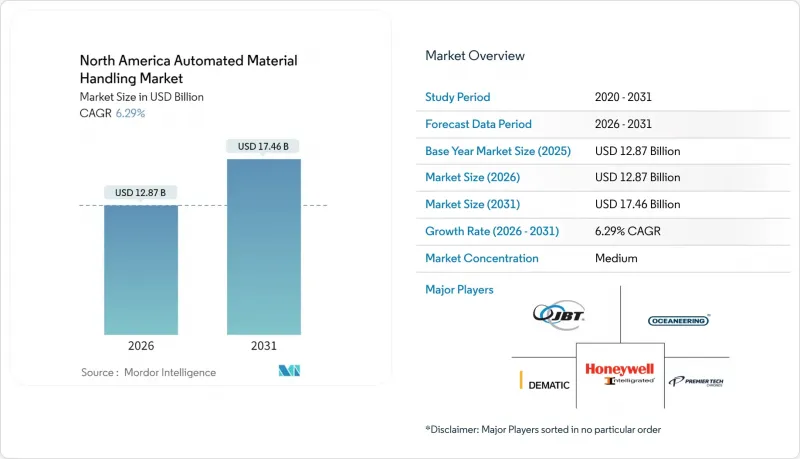
根據 Mordor Intelligence 預測,北美自動化物料輸送市場規模預計將在 2026 年達到 128.7 億美元,並在 2031 年擴大到 174.6 億美元。
這意味著在此期間的複合年成長率為 6.29%,凸顯了向高度自動化和軟體整合的物流網路的結構性轉變。
本報告按產品類型(硬體、軟體、服務)、設備類型(移動機器人、自動化立體倉庫、輸送機、堆垛機等)、系統功能(儲存、運輸、包裝等)、終端用戶產業(機場、汽車、食品飲料、零售和倉儲等)以及地區進行細分。市場預測以美元計價。
北美自動化物料輸送市場趨勢與洞察
電子商務推動了對高容量履約中心的需求。
預計到2025年,北美小包裹量將超過160億件,這將迫使零售商和第三方物流供應商(3PL)在人口稠密的城市將訂單到出貨週期縮短至兩小時以內。大型零售商已投入大量資金。例如,到2025年,亞馬遜將在美國營運超過110個分揀中心和1,000個配送站,每個中心和配送站的設計處理能力均超過每日100萬件包裹。 2025年10月,沃爾瑪累計14億美元用於維修物流中心,安裝自動化倉儲系統(AS/RS)和機器人堆垛機,目標是到2027年實現90%的線上訂單當日送達。大型連鎖企業的這些舉措正在向中型企業推廣,這些企業現在正在租賃配備「貨到人(GTP)」系統的共用微型倉配中心的空間,而資金正集中在少數幾家整合商手中。
擴大自主移動機器人在第三方物流倉庫的應用
到了2025年,美國第三方物流(3PL)管理的倉庫容量將達到約21億平方英尺,但其中只有18%實現自動化。機器人供應商抓住了這一機遇。據一家領先的供應商稱,他們已向DHL、GXO Logistics和Geodis等公司的倉庫部署了超過12,000台夥伴關係機器人,與人工揀貨相比,揀貨效率提高了2.5倍。透過將車隊管理軟體直接整合到倉庫管理系統中,部署時間已從六個月縮短至最短八週,從而加快了投資回報。柔軟性至關重要,因為3PL客戶通常每季都會重新協商庫存單位(SKU)和貨量。不受固定路徑限制的自主移動機器人(AMR)能夠快速重新配置,並將停機時間降至最低。
棕地地開發案初始投資與整合成本高
維修舊倉庫的成本通常比新建同等規模的待開發區高出每平方英尺 40% 至 60%。這是因為為了全天候自動化,通常需要升級地板、電氣系統和暖通空調系統。一項針對 150 家物流業者的 2024 年調查發現,62% 的受訪者認為整合複雜性是採用自動化系統的主要障礙。整合商在 2024 年為美國汽車零件批發商開展的項目,由於意想不到的結構問題,導致成本超支 800 萬美元,進一步加劇了投資者的謹慎情緒。租戶也面臨額外的風險,因為房東通常拒絕永久性改造,導致租戶在租賃期滿時需要承擔拆除費用。
細分市場分析
2025年,硬體銷售額佔總銷售額的63.21%,反映了輸送機、自動化立體倉庫(AS/RS)起重機和機械臂等設備的資本密集特性。然而,隨著營運商追求數據驅動的處理能力提升,軟體正以7.27%的複合年成長率快速成長,成為成長最快的領域。與安裝和長期維護相關的服務收入緊隨硬體成長,但受到熟練技術人員短缺的限制。在北美自動化物料輸送市場,由於模組化授權模式允許分階段啟動功能,軟體解決方案的市場規模預計將增加,其支出佔有率也將隨之成長。同時,在新設施中,硬體仍然至關重要,輸送機和分類機通常佔專案預算的80%之多,這凸顯了一種將實體容量與智慧控制相結合的雙重投資模式。
第二代倉庫執行平台整合了預測分析、數位孿生和車隊編配,正在鞏固其持續的收入來源。據一家領先供應商稱,軟體收入目前佔部門收入的11%,而兩年前這一比例還不到1%。另一家供應商則透過模組化定價,在降低前期成本35%的同時,透過年度訂閱模式提升了產品的生命週期價值。北美自動化物料輸送市場的發展軌跡依然是:先在新設施中部署硬體,然後透過分階段部署軟體逐步提升處理能力。這一趨勢也體現在包含遠端監控和預測性維護的服務合約佔有率不斷成長。
預計到2025年,單元貨載(AS/RS)系統將佔設備銷售額的28.4%,這表明其在高吞吐量環境中依然具有強大的吸引力,尤其是在密度和托盤級速度至關重要的領域。然而,自主移動機器人(AMR)憑藉其無需固定導軌即可在動態佈局中導航的能力,以7.91%的複合年成長率成為成長最快的類別。隨著現有設施的營運商需要傳統輸送機和自動導引車(AGV)無法提供的柔軟性,AMR市場在北美自動化物料輸送市場正在不斷擴張。 AGV在汽車和製藥等對路線和無塵室要求較為嚴格的環境中仍然發揮著至關重要的作用,而雷射導引車則滿足了對柔軟性要求適中的應用領域的特定需求。
電子商務推動的小包裹量成長和SKU激增,促使企業越來越傾向於採購能夠快速重新部署以應對產品組合變化的機器人。領先的供應商目前正在將車隊管理軟體捆綁銷售,以協調不同品牌機器人的任務,從而降低供應商鎖定風險,並促進多車隊策略的實施。同時,在每小時處理超過1萬個小包裹的小包裹中心,諸如交叉傳送帶分類機之類的固定基礎設施仍然至關重要,這表明在北美自動化物料輸送市場,自主移動機器人(AMR)扮演的是輸送機的補充角色,而非完全替代。
其他好處:
- Excel格式的市場預測(ME)表
- 3個月的分析師支持
目錄
第1章:引言
- 研究假設和市場定義
- 調查範圍
第2章:調查方法
第3章執行摘要
第4章 市場狀況
- 市場概覽
- 宏觀經濟因素對市場的影響
- 市場促進因素
- 倉庫自動化投資激增
- 擴大自主移動機器人在第三方物流倉庫的應用。
- 電子商務推動了對高容量履約中心的需求。
- 引入人工智慧驅動的倉庫管理系統
- 美國和加拿大對自動化投資的稅額扣抵和激勵措施
- 永續性法規正在推動節能型物料輸送方案的發展。
- 市場限制因素
- 棕地地開發案初始投資與整合成本高
- 缺乏熟練技術人員來維護先進的自動化系統
- 網路連接物料輸送系統的網路安全風險
- 維修工程中遵守建築規範和安全標準所面臨的複雜挑戰。
- 產業價值鏈分析
- 監理情勢
- 技術展望
- 波特五力分析
第5章 市場規模與成長預測
- 依產品類型
- 硬體
- 軟體
- 服務
- 依設備類型
- 移動機器人
- 自動導引運輸車(AGV)
- 自動堆高機
- 自動拖車
- 單元貨載
- 組裝
- 特殊用途
- 自主移動機器人(AMR)
- 雷射導引運輸車(LGV)
- 自動導引運輸車(AGV)
- 自動化倉庫系統(AS/RS)
- 固定巷道式(堆垛機高機+接駁車)
- 旋轉式(水平+垂直)
- 垂直升降模組(VLM)
- 自動輸送機
- 皮帶類型
- 滾筒式
- 托盤類型
- 架空類型
- 堆垛機
- 傳統型(高水準+低水準)
- 機器人
- 分類系統
- 移動機器人
- 系統功能
- 貯存
- 運輸
- 包裝
- 揀貨
- 送貨
- 廢棄物處理
- 按行業分類的最終用戶
- 飛機場
- 車
- 食品/飲料
- 零售、倉儲和物流中心
- 一般製造業
- 製藥
- 郵件和小包裹
- 其他
- 國家
- 美國
- 加拿大
- 墨西哥
第6章 競爭情勢
- 市場集中度
- 策略趨勢
- 市佔率分析
- 公司簡介
- Dematic Corp.
- Honeywell Intelligrated(Honeywell International Inc.)
- Daifuku Co., Ltd.(Jervis B. Webb)
- SSI Schaefer Group GmbH
- Bastian Solutions LLC
- JBT Corporation
- Westfalia Technologies Inc.
- Oceaneering International Inc.
- Premier Tech Chronos Inc.
- DMW &H, Inc.
- OPUS Automation Inc.
- Creative Automation Inc.
- Remtec Automation LLC
- Shuttleworth LLC
- Siggins AB
- Cornerstone Automation Systems LLC
第7章 市場機會與未來展望
According to Mordor Intelligence, the North America automated material handling market reached USD 12.87 billion in 2026 and is forecast to expand to USD 17.46 billion by 2031, translating into a 6.29% CAGR over the period, underscoring the structural shift toward highly automated, software-orchestrated distribution networks.
This report is Segmented by Product Type (Hardware, Software, and Services), Equipment Type (Mobile Robots, AS/RS, Conveyors, Palletizers, and More), System Function (Storage, Transportation, Packaging, and More), End-User Vertical (Airport, Automotive, Food and Beverage, Retail and Warehousing, and More), and Geography. The Market Forecasts are Provided in Terms of Value (USD).
North America Automated Material Handling Market Trends and Insights
E-Commerce Driven Demand for High-Throughput Fulfilment Centers
Parcel volumes in North America surpassed 16 billion units in 2025, pushing retailers and 3PLs to compress order-to-ship cycles below two hours in densely populated cities. Tier-one merchants invested heavily: Amazon operated more than 110 sortation centers and 1,000 delivery stations across the United States in 2025; each designed for peak throughput above one million items per day. Walmart earmarked USD 1.4 billion in October 2025 to retrofit 65 distribution centers with AS/RS and robotic palletizers, pursuing same-day delivery coverage for 90% of online orders by 2027. Similar commitments from large chains are cascading to mid-tier operators that now lease space in shared micro-fulfilment hubs equipped with goods-to-person systems, concentrating capital with a handful of integrators.
Rising Adoption of Autonomous Mobile Robots Across 3PL Warehouses
3PLs managed roughly 2.1 billion ft2 of warehouse capacity in the United States in 2025, yet only 18% was automated. Robot suppliers seized the opportunity: one leading vendor reported deployments of more than 12,000 collaborative units across facilities run by DHL, GXO Logistics, and Geodis, boosting pick rates by 2.5X over manual methods. Partnerships that integrate fleet management software directly into warehouse management systems have cut commissioning time from six months to as little as eight weeks, accelerating return on investment. Flexibility is paramount because 3PL clients often renegotiate SKUs and volumes every quarter; AMRs, unaffected by fixed guide paths, allow rapid reconfiguration with minimal downtime.
High Upfront Capital and Integration Costs for Brownfield Sites
Retrofitting older warehouses typically costs 40%-60% more per square foot than comparable greenfield builds because floors, electrical systems, and HVAC often require upgrades to support 24/7 automation. A 2024 survey of 150 logistics operators found 62% cited integration complexity as the main barrier to adoption. One integrator's 2024 project at a U.S. automotive parts distributor suffered USD 8 million in cost overruns due to unforeseen structural issues, magnifying investor caution. Lessees face additional risk: landlords frequently decline permanent modifications, leaving tenants liable for decommissioning expenses at lease end.
Other drivers and restraints analyzed in the detailed report include:
- Adoption of AI-Powered Warehouse Execution Systems
- Investment Tax Credits and Incentives for Automation
- Shortage of Skilled Technicians for Advanced Automation Maintenance
For complete list of drivers and restraints, kindly check the Table Of Contents.
Segment Analysis
Hardware commanded 63.21% of 2025 revenue, reflecting the capital intensity of conveyors, AS/RS cranes, and robotic arms, yet software is the fastest-growing component, advancing at 7.27% CAGR as operators chase data-driven throughput gains. Services revenue, tied to installation and long-term maintenance, follows hardware growth but is constrained by the technician shortage. The North America automated material handling market size for software solutions is projected to capture a growing share of expenditures, enabled by modular licensing that allows phased feature activation. In parallel, hardware remains indispensable for new facilities where conveyors and sorters typically consume up to 80% of project budgets, underscoring a dual-track investment pattern that fuses physical capacity with intelligent control.
Second-generation warehouse execution platforms that integrate predictive analytics, digital twins, and fleet orchestration are solidifying recurring revenue streams. One leading supplier reported that software now accounts for 11% of divisional revenue, up from single-digits two years prior, while another's modular pricing trimmed upfront outlays by 35% yet secured higher lifetime value through annual subscriptions. The North America automated material handling market continues to follow a trajectory where hardware penetrates greenfield sites first, then software increments unlock incremental capacity gains, a pattern mirrored in the rising share of service contracts that embed remote monitoring and preventive maintenance.
Unit-load AS/RS systems held 28.4% of 2025 equipment revenue, demonstrating their enduring appeal for high-throughput environments that prioritize density and pallet-level speed. Nevertheless, autonomous mobile robots represent the fastest-growing category at 7.91% CAGR, driven by their ability to navigate dynamic layouts without fixed guideways. The North America automated material handling market size for AMRs is expanding as brownfield operators seek flexibility that conventional conveyors or AGVs cannot deliver. AGVs maintain relevance in automotive and pharmaceutical settings where predetermined paths and cleanroom requirements prevail, while laser-guided vehicles fill a niche for medium-flexibility applications.
Rising e-commerce parcel volumes and SKU proliferation are tilting purchasing toward robots that can be redeployed quickly as product mixes shift. Leading suppliers now bundle fleet-management software that coordinates tasks across mixed robot brands, easing vendor-lock concerns and fostering multi-fleet strategies. In parallel, fixed infrastructure such as cross-belt sorters remains essential at parcel hubs processing more than 10,000 packages per hour, underscoring that AMRs complement rather than completely displace conveyors in the North America automated material handling market.
Complete Report Scope:
- By Product Type
- Hardware
- Software
- Services
- By Equipment Type
- Mobile Robots
- Automated Guided Vehicles
- Automated Forklift
- Automated Tow-Tractor
- Unit Load
- Assembly Line
- Special Purpose
- Autonomous Mobile Robots
- Laser Guided Vehicles
- Automated Guided Vehicles
- Automated Storage and Retrieval Systems
- Fixed Aisle (Stacker Crane + Shuttle)
- Carousel (Horizontal + Vertical)
- Vertical Lift Module
- Automated Conveyors
- Belt
- Roller
- Pallet
- Overhead
- Palletizers
- Conventional (High Level + Low Level)
- Robotic
- Sortation Systems
- Mobile Robots
- By System Function
- Storage
- Transportation
- Packaging
- Order Picking
- Distribution
- Waste Handling
- By End-User Vertical
- Airport
- Automotive
- Food and Beverage
- Retail, Warehousing and Distribution Centers
- General Manufacturing
- Pharmaceuticals
- Post and Parcel
- Other End-User Verticals
- By Country
- United States
- Canada
- Mexico
List of Companies Covered in this Report:
- Dematic Corp.
- Honeywell Intelligrated (Honeywell International Inc.)
- Daifuku Co., Ltd. (Jervis B. Webb)
- SSI Schaefer Group GmbH
- Bastian Solutions LLC
- JBT Corporation
- Westfalia Technologies Inc.
- Oceaneering International Inc.
- Premier Tech Chronos Inc.
- DMW&H, Inc.
- OPUS Automation Inc.
- Creative Automation Inc.
- Remtec Automation LLC
- Shuttleworth LLC
- Siggins AB
- Cornerstone Automation Systems LLC
Additional Benefits:
- The market estimate (ME) sheet in Excel format
- 3 months of analyst support
TABLE OF CONTENTS
1 INTRODUCTION
- 1.1 Study Assumptions and Market Definition
- 1.2 Scope of the Study
2 RESEARCH METHODOLOGY
3 EXECUTIVE SUMMARY
4 MARKET LANDSCAPE
- 4.1 Market Overview
- 4.2 Impact of Macroeconomic Factors on the Market
- 4.3 Market Drivers
- 4.3.1 Surge in Warehouse Automation Investments
- 4.3.2 Rising Adoption of Autonomous Mobile Robots Across 3PL Warehouses
- 4.3.3 E-Commerce Driven Demand for High-Throughput Fulfilment Centers
- 4.3.4 Adoption of AI-Powered Warehouse Execution Systems
- 4.3.5 Investment Tax Credits and Incentives for Automation in United States and Canada
- 4.3.6 Sustainability Mandates Driving Energy-Efficient Material Handling Solutions
- 4.4 Market Restraints
- 4.4.1 High Upfront Capital and Integration Costs for Brownfield Sites
- 4.4.2 Shortage of Skilled Technicians for Advanced Automation Maintenance
- 4.4.3 Cybersecurity Risks in Connected Material Handling Systems
- 4.4.4 Building Code and Safety Compliance Complexities in Retrofitting
- 4.5 Industry Value Chain Analysis
- 4.6 Regulatory Landscape
- 4.7 Technological Outlook
- 4.8 Porter's Five Forces Analysis
- 4.8.1 Threat of New Entrants
- 4.8.2 Bargaining Power of Suppliers
- 4.8.3 Bargaining Power of Buyers
- 4.8.4 Threat of Substitutes
- 4.8.5 Intensity of Competitive Rivalry
5 MARKET SIZE AND GROWTH FORECASTS (VALUE)
- 5.1 By Product Type
- 5.1.1 Hardware
- 5.1.2 Software
- 5.1.3 Services
- 5.2 By Equipment Type
- 5.2.1 Mobile Robots
- 5.2.1.1 Automated Guided Vehicles
- 5.2.1.1.1 Automated Forklift
- 5.2.1.1.2 Automated Tow-Tractor
- 5.2.1.1.3 Unit Load
- 5.2.1.1.4 Assembly Line
- 5.2.1.1.5 Special Purpose
- 5.2.1.2 Autonomous Mobile Robots
- 5.2.1.3 Laser Guided Vehicles
- 5.2.1.1 Automated Guided Vehicles
- 5.2.2 Automated Storage and Retrieval Systems
- 5.2.2.1 Fixed Aisle (Stacker Crane + Shuttle)
- 5.2.2.2 Carousel (Horizontal + Vertical)
- 5.2.2.3 Vertical Lift Module
- 5.2.3 Automated Conveyors
- 5.2.3.1 Belt
- 5.2.3.2 Roller
- 5.2.3.3 Pallet
- 5.2.3.4 Overhead
- 5.2.4 Palletizers
- 5.2.4.1 Conventional (High Level + Low Level)
- 5.2.4.2 Robotic
- 5.2.5 Sortation Systems
- 5.2.1 Mobile Robots
- 5.3 By System Function
- 5.3.1 Storage
- 5.3.2 Transportation
- 5.3.3 Packaging
- 5.3.4 Order Picking
- 5.3.5 Distribution
- 5.3.6 Waste Handling
- 5.4 By End-User Vertical
- 5.4.1 Airport
- 5.4.2 Automotive
- 5.4.3 Food and Beverage
- 5.4.4 Retail, Warehousing and Distribution Centers
- 5.4.5 General Manufacturing
- 5.4.6 Pharmaceuticals
- 5.4.7 Post and Parcel
- 5.4.8 Other End-User Verticals
- 5.5 By Country
- 5.5.1 United States
- 5.5.2 Canada
- 5.5.3 Mexico
6 COMPETITIVE LANDSCAPE
- 6.1 Market Concentration
- 6.2 Strategic Moves
- 6.3 Market Share Analysis
- 6.4 Company Profiles (includes Global level Overview, Market level overview, Core Segments, Financials as available, Strategic Information, Market Rank/Share for key companies, Products and Services, and Recent Developments)
- 6.4.1 Dematic Corp.
- 6.4.2 Honeywell Intelligrated (Honeywell International Inc.)
- 6.4.3 Daifuku Co., Ltd. (Jervis B. Webb)
- 6.4.4 SSI Schaefer Group GmbH
- 6.4.5 Bastian Solutions LLC
- 6.4.6 JBT Corporation
- 6.4.7 Westfalia Technologies Inc.
- 6.4.8 Oceaneering International Inc.
- 6.4.9 Premier Tech Chronos Inc.
- 6.4.10 DMW&H, Inc.
- 6.4.11 OPUS Automation Inc.
- 6.4.12 Creative Automation Inc.
- 6.4.13 Remtec Automation LLC
- 6.4.14 Shuttleworth LLC
- 6.4.15 Siggins AB
- 6.4.16 Cornerstone Automation Systems LLC
7 MARKET OPPORTUNITIES AND FUTURE OUTLOOK
- 7.1 White-Space and Unmet-Need Assessment

 2026-2030年全球自動化物料輸送(AMH)市場
 冷氣動力噴塗設備市場分析及預測(至2035年):依類型、產品、服務、技術、組件、應用、材料類型、製程及最終用戶分類
 自動化物料輸送市場-全球市場預測(2026-2032年)
 自動化物料輸送(AMH):市場佔有率分析、產業趨勢與統計資料、成長預測(2026-2031)
 小型貨梯市場規模、佔有率和成長分析:按產品類型、載重能力、應用、最終用戶、安裝類型、分銷管道和地區分類-2026-2033年產業預測自動化物料輸送設備市場:依設備類型、自動化程度、組件類型及最終用戶產業分類-2026-2032年全球市場預測
 自動化物料輸送設備市場:市場規模、佔有率和趨勢分析(按產品、系統類型、產業和地區分類),細分市場預測(2026-2033 年)
 2026年全球換電機器人市場報告2026年全球機器人組裝系統市場報告2026年全球自動化鉚接系統市場報告