


 |
市場調查報告書
商品編碼
2100548
自動化物料輸送(AMH):市場佔有率分析、產業趨勢與統計資料、成長預測(2026-2031)Automated Material Handling (AMH) - Market Share Analysis, Industry Trends & Statistics, Growth Forecasts (2026 - 2031) |
||||||

※ 本網頁內容可能與最新版本有所差異。詳細情況請與我們聯繫。
2025 年自動化物料輸送市場價值為 706.8 億美元,預計到 2031 年將達到 1,406 億美元,而 2026 年為 792.5 億美元,預測期(2026-2031 年)複合年成長率為 12.12%。
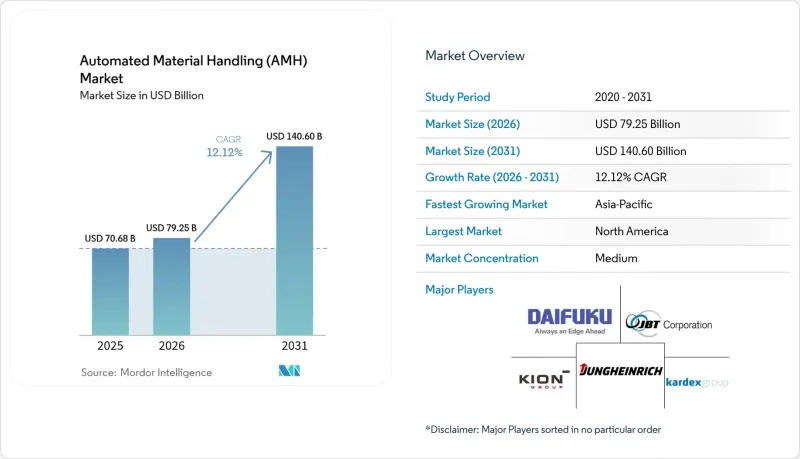
本報告按產品類型(硬體、軟體、服務)、設備類型(移動機器人、自動化倉庫系統、自動化輸送機等)、最終用戶(機場、汽車、食品和飲料、零售、倉儲物流、一般製造業等)、功能(儲存、運輸和牽引、揀選和放置等)和地區對產業進行分類。
全球自動化物料輸送(AMH)市場趨勢與洞察
電子商務履約需求激增。
微型倉配中心徹底改變了訂單處理的經濟模式,即使在面積僅 2000 平方英尺(約 186 平方米)的狹小空間內,也能實現兩小時內送達。實施穿梭車自動化系統的連鎖超市,每天處理 5000 筆訂單,準確率高達 99.99%,這是人工作業無法實現的。食品飲料產業也部署了具備溫度控制功能的自動化系統,以滿足 HACCP 要求。隨著直接面對消費者 (D2C) 模式的興起,能夠應對季節性 SKU 激增的彈性系統需求日益成長,自動化也從單純的成本節約措施轉變為競爭優勢。那些實現了最後一公里配送自動化的零售商,透過兌現傳統倉庫無法保證的配送承諾,贏得了客戶的忠誠度。
與工業4.0相關的棕地工廠資本投資週期。
製造商將網實整合系統整合到物料輸送設備中,創建混合工作流程,使組裝效率提高了33%,同時降低了64%的人事費用。數位孿生模擬降低了停機風險,並最佳化了資本配置。製藥公司透過先進的棕地維修,在維持GMP合規性和溫度控制完整性的前提下,將儲存容量擴大了60%。因此,第二波資本投資週期著重於互通性和擴充性,而非徹底更換設備,這使得成熟工廠能夠在不中斷現有流程的情況下,充分利用工業4.0的優勢。
高昂的初始整合和維修成本
全面的倉庫自動化需要200萬至400萬美元的投資,這對中型企業來說一直是個難題。在棕地專案中,安裝期間需要維持運營,這增加了複雜性,也推高了客製化介面的成本。像BALYO這樣的機器人即服務(RaaS)方案降低了資本支出,並承諾在基於績效的計費模式下降低30%的營運成本。然而,對供應商鎖定和高昂生命週期成本的擔憂,導致企業在採用這些方案時仍然持謹慎態度。在溫控環境下,所需的資本投入會翻倍,這促使中小企業選擇模組化部署方案,以犧牲規模為代價來降低成本。
細分市場分析
2025年,硬體銷售額將佔總銷售額的61.60%,其中輸送機、自動化立體倉庫(AS/RS)和機器人將成為資本投資預算的支柱;而軟體到2031年將維持18.30%的複合年成長率。隨著基於人工智慧的編配的日益普及,自動化物料輸送市場軟體的市場規模預計將快速成長。服務板塊雖然規模較小,但透過提供整合式預防性保養合約以確保運作,從而獲得了穩定的收入。
軟體的快速成長反映了物料輸送產業向智慧決策的轉變。 SaaS交付模式無需更換硬體即永續更新。與倉庫管理軟體整合的數位孿生技術,透過減少25%的停機時間和最佳化能源負載平衡,提高了跨國公司的投資報酬率。
到 2025 年,移動機器人將佔設備銷售額的 34.65%,而自主移動機器人 (AMR) 正在經歷快速成長,到 2031 年的複合年成長率將達到 26.20%。自動化倉庫系統 (AS/RS) 透過高密度儲存保持其市場佔有率,而輸送機實現了物料的普遍流動。
AMR無需基礎設施的導航技術縮短了部署時間,並實現了靈活的擴充性。 DHL部署5000台AMR設備就是一個典型的例子,這是目前規模最大的AMR項目。由於電子商務交易量的成長,堆垛機和分類系統在自動化物料輸送市場的佔有率穩步擴大。電腦視覺技術的進步,使其能夠適應各種形狀的SKU,也推動了這一成長。
區域分析
預計到2025年,亞太地區將佔全球銷售額的45.85%,並在2031年之前以12.55%的複合年成長率成長。這項成長主要由中國推動,中國佔全球倉儲機器人產量的52%,跨境電商的需求也推動了這項成長。各地區政府都在支持自動化發展,例如DAIFUKU CO. LTD.在印度新建的工廠和京東物流在墨爾本設立的高科技物流中心。一體化的供應鏈降低了硬體成本和部署時間,為本地採用者帶來了成本優勢。
北美則位居第二,其特點是擁有大規模的機器人設施,例如亞馬遜位於科羅拉多佔地350萬平方英尺、配備5000台機器人的配送中心。沃爾瑪的五個高科技生鮮產品物流中心在提升處理能力的同時,創造了2000個就業崗位,展現了該地區現有設施快速轉型升級的態勢。永續性法規推動了整個物流網路進行節能維修。
歐洲的實施重點在於將符合ESG(環境、社會和治理)標準的解決方案與工業4.0結合。 REWE位於馬德堡的工廠每天在嚴格的環境標準下處理28.6萬個包裹;德馬泰克(Dematic)與Groove Robert的合作率先在魁北克省引入了全自動冷藏倉庫,成為技術出口的典範。 《企業永續性報告指令》設定了可衡量的碳減排目標,並鼓勵投資建造使用可再生能源的倉庫。
其他好處:
- Excel格式的市場預測(ME)表
- 3個月的分析師支持
目錄
第1章:引言
- 研究假設和市場定義
- 調查範圍
第2章:調查方法
第3章執行摘要
第4章 市場狀況
- 市場概覽
- 市場促進因素
- 電子商務履約需求激增。
- 與工業4.0相關的棕地工廠資本投資週期
- 經合組織物流中心人手不足
- 受環境、社會及公司治理 (ESG) 因素的影響,對節能型物流的需求日益成長。
- 移動機器人電池即服務 (BaaS) 模型
- 雜貨連鎖店發展微型倉配中心
- 市場限制因素
- 初始整合和維修成本相對較高。
- 網路實體安全漏洞
- 自動化領域精通工程師短缺
- 稀土元素和鋼鐵價格波動
- 重要法規結構的評估
- 價值鏈分析
- 技術展望
- 波特五力模型
- 對關鍵相關人員的影響評估
- 主要用例和案例研究
- 宏觀經濟因素對市場的影響
- 投資分析
第5章 市場區隔
- 依產品類型
- 硬體
- 軟體
- 服務
- 依設備類型
- 移動機器人
- 自動導引運輸車(AGV)
- 自主移動機器人(AMR)
- 自動化倉庫系統
- 固定通道類型
- 旋轉木馬
- 垂直升降模組
- 自動輸送機
- 腰帶
- 滾筒
- 調色盤
- 開賣
- 堆垛機
- 傳統的
- 機器人
- 分類系統
- 移動機器人
- 最終用戶
- 飛機場
- 車
- 食品/飲料
- 零售/倉儲/配送
- 一般製造業
- 製藥
- 郵件和小包裹
- 其他
- 按功能
- 貯存
- 運輸和拖車
- 挑選和放置
- 分類
- 包裝和托盤堆垛
- 按地區
- 北美洲
- 美國
- 加拿大
- 墨西哥
- 南美洲
- 巴西
- 阿根廷
- 其他南美國家
- 歐洲
- 德國
- 英國
- 法國
- 義大利
- 俄羅斯
- 其他歐洲國家
- 亞太地區
- 中國
- 日本
- 韓國
- 印度
- ASEAN
- 其他亞太國家
- 中東和非洲
- 中東
- 沙烏地阿拉伯
- 阿拉伯聯合大公國
- 土耳其
- 其他中東國家
- 非洲
- 南非
- 奈及利亞
- 其他非洲國家
- 中東
- 北美洲
第6章 競爭情勢
- 市場集中度
- 策略趨勢
- 市佔率分析
- 公司簡介
- Daifuku Co., Ltd.
- KION Group AG(Dematic GmbH)
- Honeywell Intelligrated, Inc.
- SSI SCHAFER Group
- TGW Logistics Group GmbH
- Kardex Holding AG
- JBT Corporation
- Jungheinrich AG
- KNAPP AG
- Mecalux, SA
- System Logistics SpA
- viastore SYSTEMS GmbH
- BEUMER Group GmbH & Co. KG
- Interroll Holding AG
- WITRON Logistik+Informatik GmbH
- Siemens AG
- KUKA AG
- Murata Machinery, Ltd.
- Toyota Industries Corporation
- VisionNav Robotics Co., Ltd.
- AutoStore Holdings Ltd.
- Locus Robotics Corp.
- Vanderlande Industries BV
- GreyOrange Pte. Ltd.
- Amazon Robotics LLC
第7章 市場機會與未來展望
According to Mordor Intelligence, the automated material handling market size was valued at USD 70.68 billion in 2025 and estimated to grow from USD 79.25 billion in 2026 to reach USD 140.6 billion by 2031, at a CAGR of 12.12% during the forecast period (2026-2031).
This report Segments the Industry Into Product Type (Hardware, Software, and Services), Equipment Type (Mobile Robots, Automated Storage and Retrieval Systems, Automated Conveyors, and More), End User (Airports, Automotive, Food and Beverages, Retail/Warehousing/Distribution, General Manufacturing, and More), Function (Storage, Transport and Tow, Picking and Placing, and More), and Geography.
Global Automated Material Handling (AMH) Market Trends and Insights
E-commerce Fulfillment Intensity Surge
Micro-fulfillment centers reshaped order-fulfillment economics, enabling 2-hour delivery windows in spaces as small as 2,000 ft2 Grocery chains using shuttle automation processed 5,000 order lines daily at 99.99% accuracy levels unattainable with manual. The food and beverage sector integrated temperature-controlled automation to satisfy HACCP requirements. Direct-to-consumer models intensified demand for flexible systems able to scale with seasonal SKU spikes, transforming automation from a cost lever into a competitive differentiator. Retailers that automated last-mile nodes secured customer loyalty by meeting delivery promises that traditional warehouses could not sustain.
Industry 4.0-Linked Capex Cycles in Brown-Field Plants.
Manufacturers layered cyber-physical systems onto legacy material-handling assets, creating hybrid workflows that lifted assembly-line efficiency by 33% while cutting labor costs 64%. Digital twin simulations reduced downtime risk and sharpened capital allocation. Pharmaceutical facilities expanded storage capacity 60% while maintaining GMP compliance and temperature integrity through sophisticated brownfield retrofits. The second-wave capex cycle thus focused on interoperability and scalability rather than wholesale equipment replacement, allowing mature plants to unlock Industry 4.0 benefits without dismantling existing flows.
High Upfront Integration and Retrofit Costs
Comprehensive warehouse automation required USD 2-4 million, a hurdle for mid-market firms. Brownfield sites faced added complexity as operations continued during installation, inflating custom-interface expenses. Robotics-as-a-Service schemes such as BALYO's reduced capital outlays and promised 30% opex savings under performance-based invoicing. Yet adoption remained cautious due to lock-in fears and higher lifetime costs. Temperature-controlled environments saw capital needs double, prompting SMEs to adopt modular deployments that trade scale for affordability.
Other drivers and restraints analyzed in the detailed report include:
- Labor Shortages in OECD Logistics Hubs
- ESG-Driven Demand for Energy-Efficient Intralogistics
- Cyber-Physical Security Vulnerabilities
For complete list of drivers and restraints, kindly check the Table Of Contents.
Segment Analysis
Hardware commanded 61.60% revenue in 2025 as conveyors, AS/RS, and robots anchored capital budgets, while software posted a 18.30% CAGR through 2031. The automated material handling market size for software is projected to climb sharply as AI-based orchestration gains acceptance. Services, though smallest, secured recurring revenue via integration and preventive maintenance contracts that ensured uptime.
The software boom mirrored the automated material handling industry's pivot toward intelligent decision-making. SaaS delivery allowed continuous updates without hardware swaps. Digital twins linked to warehouse-control software reduced downtime 25% and optimized energy load balancing, enhancing ROI at multinational facilities.
Mobile robots captured 34.65% of 2025 equipment revenue, and Autonomous Mobile Robots are accelerating at 26.20% CAGR to 2031. Automated Storage and Retrieval Systems retained share through high-density storage, while conveyors provided ubiquitous material flow.
AMRs' infrastructure-free navigation lowered deployment time and delivered flexible scaling, exemplified by DHL's 5,000-unit rollout-the largest AMR project to date. The automated material handling market share held by palletizers and sortation systems grew steadily, thanks to e-commerce volumes, aided by computer-vision upgrades that accommodated SKU shape diversity.
Complete Report Scope:
- By Product Type
- Hardware
- Software
- Services
- By Equipment Type
- Mobile Robots
- Automated Guided Vehicles (AGV)
- Autonomous Mobile Robots (AMR)
- Automated Storage and Retrieval Systems
- Fixed-Aisle
- Carousel
- Vertical Lift Module
- Automated Conveyors
- Belt
- Roller
- Pallet
- Overhead
- Palletizers
- Conventional
- Robotic
- Sortation Systems
- Mobile Robots
- By End User
- Airports
- Automotive
- Food and Beverages
- Retail / Warehousing / Distribution
- General Manufacturing
- Pharmaceuticals
- Post and Parcel
- Others
- By Function
- Storage
- Transport and Tow
- Picking and Placing
- Sorting
- Packaging and Palletising
- By Geography
- North America
- United States
- Canada
- Mexico
- South America
- Brazil
- Argentina
- Rest of South America
- Europe
- Germany
- United Kingdom
- France
- Italy
- Russia
- Rest of Europe
- Asia-Pacific
- China
- Japan
- South Korea
- India
- ASEAN
- Rest of Asia-Pacific
- Middle East and Africa
- Middle East
- Saudi Arabia
- United Arab Emirates
- Turkey
- Rest of Middle East
- Africa
- South Africa
- Nigeria
- Rest of Africa
- Middle East
- North America
Geography Analysis
Asia-Pacific accounted for 45.85% 2025 revenue and is growing at 12.55% CAGR through 2031, propelled by China's 52% share of global warehouse-robot output and cross-border e-commerce demand. Regional governments supported automation, illustrated by Daifuku's new Indian plant and JD Logistics' high-tech Melbourne hub. Integrated supply chains reduced hardware costs and deployment times, giving local adopters a cost edge.
North America ranked second, featuring large-scale robotics facilities such as Amazon's 3.5 million ft2 Colorado center, hosting 5,000 robots. Walmart's five high-tech perishable distribution centers doubled throughput while creating 2,000 jobs, demonstrating the region's brownfield transformation pace. Sustainability mandates spurred energy-efficient retrofits across logistics networks.
Europe's adoption focused on ESG-compliant solutions and Industry 4.0 convergence. REWE's Magdeburg facility processed 286,000 packages daily under strict environmental standards, and Dematic's partnership with Groupe Robert pioneered fully automated cold storage in Quebec, showcasing technology exports. The Corporate Sustainability Reporting Directive drove measurable carbon-reduction targets, encouraging investment in renewable-powered warehouses.
- Daifuku Co., Ltd.
- KION Group AG (Dematic GmbH)
- Honeywell Intelligrated, Inc.
- SSI SCHAFER Group
- TGW Logistics Group GmbH
- Kardex Holding AG
- JBT Corporation
- Jungheinrich AG
- KNAPP AG
- Mecalux, S.A.
- System Logistics S.p.A.
- viastore SYSTEMS GmbH
- BEUMER Group GmbH & Co. KG
- Interroll Holding AG
- WITRON Logistik + Informatik GmbH
- Siemens AG
- KUKA AG
- Murata Machinery, Ltd.
- Toyota Industries Corporation
- VisionNav Robotics Co., Ltd.
- AutoStore Holdings Ltd.
- Locus Robotics Corp.
- Vanderlande Industries B.V.
- GreyOrange Pte. Ltd.
- Amazon Robotics LLC
Additional Benefits:
- The market estimate (ME) sheet in Excel format
- 3 months of analyst support
TABLE OF CONTENTS
1 INTRODUCTION
- 1.1 Study Assumptions and Market Definition
- 1.2 Scope of the Study
2 RESEARCH METHODOLOGY
3 EXECUTIVE SUMMARY
4 MARKET LANDSCAPE
- 4.1 Market Overview
- 4.2 Market Drivers
- 4.2.1 E-commerce fulfilment intensity surge
- 4.2.2 Industry 4.0-linked capex cycles in brown-field plants
- 4.2.3 Labour shortages in OECD logistics hubs
- 4.2.4 ESG-driven demand for energy-efficient intralogistics
- 4.2.5 Battery-as-a-Service (BaaS) models for mobile robots
- 4.2.6 Micro-fulfilment centre roll-outs by grocery chains
- 4.3 Market Restraints
- 4.3.1 High upfront integration and retro-fit costs
- 4.3.2 Cyber-physical security vulnerabilities
- 4.3.3 Scarcity of automation-literate technicians
- 4.3.4 Volatile rare-earth and steel prices
- 4.4 Evaluation of Critical Regulatory Framework
- 4.5 Value Chain Analysis
- 4.6 Technological Outlook
- 4.7 Porter's Five Forces
- 4.7.1 Bargaining Power of Suppliers
- 4.7.2 Bargaining Power of Buyers
- 4.7.3 Threat of New Entrants
- 4.7.4 Threat of Substitutes
- 4.7.5 Competitive Rivalry
- 4.8 Impact Assessment of Key Stakeholders
- 4.9 Key Use Cases and Case Studies
- 4.10 Impact on Macroeconomic Factors of the Market
- 4.11 Investment Analysis
5 MARKET SEGMENTATION
- 5.1 By Product Type
- 5.1.1 Hardware
- 5.1.2 Software
- 5.1.3 Services
- 5.2 By Equipment Type
- 5.2.1 Mobile Robots
- 5.2.1.1 Automated Guided Vehicles (AGV)
- 5.2.1.2 Autonomous Mobile Robots (AMR)
- 5.2.2 Automated Storage and Retrieval Systems
- 5.2.2.1 Fixed-Aisle
- 5.2.2.2 Carousel
- 5.2.2.3 Vertical Lift Module
- 5.2.3 Automated Conveyors
- 5.2.3.1 Belt
- 5.2.3.2 Roller
- 5.2.3.3 Pallet
- 5.2.3.4 Overhead
- 5.2.4 Palletizers
- 5.2.4.1 Conventional
- 5.2.4.2 Robotic
- 5.2.5 Sortation Systems
- 5.2.1 Mobile Robots
- 5.3 By End User
- 5.3.1 Airports
- 5.3.2 Automotive
- 5.3.3 Food and Beverages
- 5.3.4 Retail / Warehousing / Distribution
- 5.3.5 General Manufacturing
- 5.3.6 Pharmaceuticals
- 5.3.7 Post and Parcel
- 5.3.8 Others
- 5.4 By Function
- 5.4.1 Storage
- 5.4.2 Transport and Tow
- 5.4.3 Picking and Placing
- 5.4.4 Sorting
- 5.4.5 Packaging and Palletising
- 5.5 By Geography
- 5.5.1 North America
- 5.5.1.1 United States
- 5.5.1.2 Canada
- 5.5.1.3 Mexico
- 5.5.2 South America
- 5.5.2.1 Brazil
- 5.5.2.2 Argentina
- 5.5.2.3 Rest of South America
- 5.5.3 Europe
- 5.5.3.1 Germany
- 5.5.3.2 United Kingdom
- 5.5.3.3 France
- 5.5.3.4 Italy
- 5.5.3.5 Russia
- 5.5.3.6 Rest of Europe
- 5.5.4 Asia-Pacific
- 5.5.4.1 China
- 5.5.4.2 Japan
- 5.5.4.3 South Korea
- 5.5.4.4 India
- 5.5.4.5 ASEAN
- 5.5.4.6 Rest of Asia-Pacific
- 5.5.5 Middle East and Africa
- 5.5.5.1 Middle East
- 5.5.5.1.1 Saudi Arabia
- 5.5.5.1.2 United Arab Emirates
- 5.5.5.1.3 Turkey
- 5.5.5.1.4 Rest of Middle East
- 5.5.5.2 Africa
- 5.5.5.2.1 South Africa
- 5.5.5.2.2 Nigeria
- 5.5.5.2.3 Rest of Africa
- 5.5.5.1 Middle East
- 5.5.1 North America
6 COMPETITIVE LANDSCAPE
- 6.1 Market Concentration
- 6.2 Strategic Moves
- 6.3 Market Share Analysis
- 6.4 Company Profiles {(includes Global level Overview, Market level overview, Core Segments, Financials as available, Strategic Information, Market Rank/Share for key companies, Products and Services, and Recent Developments)}
- 6.4.1 Daifuku Co., Ltd.
- 6.4.2 KION Group AG (Dematic GmbH)
- 6.4.3 Honeywell Intelligrated, Inc.
- 6.4.4 SSI SCHAFER Group
- 6.4.5 TGW Logistics Group GmbH
- 6.4.6 Kardex Holding AG
- 6.4.7 JBT Corporation
- 6.4.8 Jungheinrich AG
- 6.4.9 KNAPP AG
- 6.4.10 Mecalux, S.A.
- 6.4.11 System Logistics S.p.A.
- 6.4.12 viastore SYSTEMS GmbH
- 6.4.13 BEUMER Group GmbH & Co. KG
- 6.4.14 Interroll Holding AG
- 6.4.15 WITRON Logistik + Informatik GmbH
- 6.4.16 Siemens AG
- 6.4.17 KUKA AG
- 6.4.18 Murata Machinery, Ltd.
- 6.4.19 Toyota Industries Corporation
- 6.4.20 VisionNav Robotics Co., Ltd.
- 6.4.21 AutoStore Holdings Ltd.
- 6.4.22 Locus Robotics Corp.
- 6.4.23 Vanderlande Industries B.V.
- 6.4.24 GreyOrange Pte. Ltd.
- 6.4.25 Amazon Robotics LLC
7 MARKET OPPORTUNITIES AND FUTURE OUTLOOK
- 7.1 White-space and Unmet-Need Assessment

 2026-2030年全球自動化物料輸送(AMH)市場
 冷氣動力噴塗設備市場分析及預測(至2035年):依類型、產品、服務、技術、組件、應用、材料類型、製程及最終用戶分類
 自動化物料輸送市場-全球市場預測(2026-2032年)
 北美自動化物料輸送:市場佔有率分析、產業趨勢與統計及成長預測(2026-2031 年)
 小型貨梯市場規模、佔有率和成長分析:按產品類型、載重能力、應用、最終用戶、安裝類型、分銷管道和地區分類-2026-2033年產業預測自動化物料輸送設備市場:依設備類型、自動化程度、組件類型及最終用戶產業分類-2026-2032年全球市場預測
 自動化物料輸送設備市場:市場規模、佔有率和趨勢分析(按產品、系統類型、產業和地區分類),細分市場預測(2026-2033 年)
 2026年全球換電機器人市場報告2026年全球機器人組裝系統市場報告2026年全球自動化鉚接系統市場報告