


 |
市場調查報告書
商品編碼
2100561
甘油:市場佔有率分析、產業趨勢與統計、成長預測(2026-2031)Glycerin - Market Share Analysis, Industry Trends & Statistics, Growth Forecasts (2026 - 2031) |
||||||

※ 本網頁內容可能與最新版本有所差異。詳細情況請與我們聯繫。
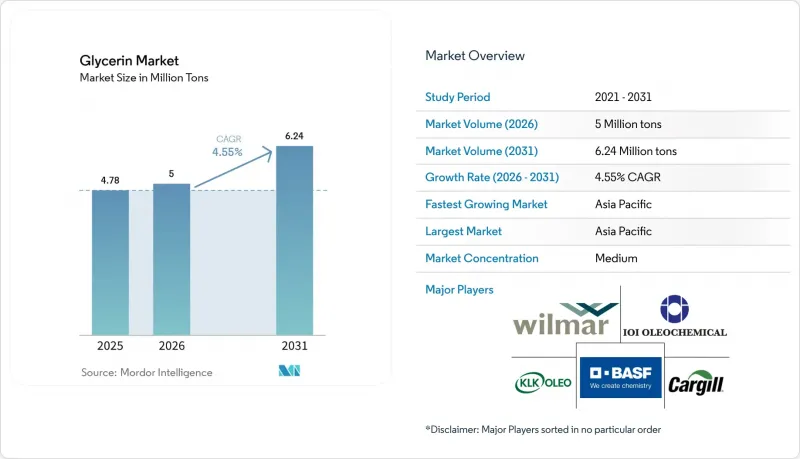
2025 年甘油市場價值為 478 萬噸,預計到 2031 年將達到 624 萬噸,而 2026 年為 500 萬噸,預測期(2026-2031 年)複合年成長率為 4.55%。
本報告按等級(粗甘油和精製甘油)、原料(生質柴油、脂肪酸、脂醇類及其他)、應用領域(個人護理及化妝品、醫藥、食品飲料、聚醚及多元醇等)及地區(亞太、北美、歐洲、南美、中東和非洲)進行細分。市場預測以噸為單位。
全球甘油市場趨勢與洞察
製藥業對符合美國藥典(USP)標準的甘油的需求正在飆升。
繼美國食品藥物管理局 (FDA) 於 2023 年強制要求對所有輔料批次進行二伸乙甘醇和乙二醇檢測後,市場對符合 GMP 標準的 99.5% 或更高純度甘油的需求發生了顯著變化。路易達孚公司計劃於 2025 年在印尼擴建產能,以及德國 Verbio 公司創紀錄的甘油產量,都清楚地表明了全球為確保艾哈默德巴德市場合規供應而展開的激烈競爭。口服和外用製劑仍然是主要市場,而印度的生產關聯獎勵(PLI) 計劃正在推動上游工程,以確保國內生產的原料藥藥 (API) 可以完全追溯到輔料。
在個人護理和化妝品行業中不斷擴大應用
消費者對合成保濕劑的關注度日益提高,以及永續性標準,推動了植物來源甘油在保濕霜、洗面乳和精華液中的應用。各大品牌在2024年至2025年間推出的產品均明確標示為「天然來源」。BASF和Acies Bio等公司合作,利用可再生甲醇生產上游工程表面活性劑,這些表面活性劑通常與甘油配合使用,從而鞏固了甘油在「清潔美容」潮流中的地位。
原油甘油價格波動與生質柴油原料需求相關
粗甘油價格與生質柴油產量和原料成本高度相關,這對甘油市場的煉油商和調配商的利潤率帶來壓力,因為他們無法將價格波動轉嫁給終端客戶。在巴西,儘管出貨量增加,但2023年出口額卻下降了52.9%,這凸顯了生物柴油摻混義務的增加如何導致供應過剩,使銷售量與利潤率脫鉤。在阿根廷,由於政策轉變,閒置產能率已超過70%,導致供應不穩定和現貨價格劇烈波動。製藥公司被迫持有大量庫存,營運資金需求不斷成長。
細分市場分析
預計到2025年,精製甘油產品將佔甘油市場佔有率的69.1%,並且隨著製藥、個人護理和食品採購商對符合美國藥典(USP)標準的可追溯性需求不斷成長,這一佔有率預計將以5.02%的複合年成長率成長。美國食品藥物管理局(FDA)的雜質法規加速了全球多級蒸餾和離子交換計畫的推進,2024年至2025年間,粗甘油和精製甘油之間的價格差異將擴大至每噸400至700美元。
像Verbio和Louis Dreyfus這樣的綜合性公司正在證明,生物柴油聯合企業能夠將醫藥溢價轉化為企業自身的利潤,而Argent Energy的中等純度技術級(99.0-99.5%)則填補了無需USP認證的工業用戶的需求缺口。隨著越來越多的生物柴油工廠引入精煉工藝,粗甘油的出口量正在下降,但全球精煉甘油的供應仍然緊張,支撐了北美和歐洲的溢價。
區域分析
亞太地區佔全球甘油需求的49.03%,預計2031年將以每年5.09%的速度成長,成為甘油市場最大的區域貢獻者。中國將其大部分生質柴油出口到歐盟,但將伴隨的粗甘油用於國內油脂化學品應用。同時,印度計劃在2030年實現5%的生物柴油摻混比例,一旦廢棄食用油回收基礎設施建成,這將顯著增加甘油供應。由於國內產量有限,日本和韓國需要進口符合美國藥典(USP)標準的甘油產品,這迫使馬來西亞和印尼的煉油商必須獲得世界衛生組織(WHO)的良好生產規範(GMP)認證才能獲得市場進入。
在北美,甘油市場持續面臨結構性供不應求,儘管原油價格波動,但仍需從巴西和東南亞進口。加拿大可再生柴油的協同加工進一步加劇了國內供應緊張,凸顯了美國墨西哥灣沿岸和中西部生物柴油中心附近本地煉油計畫的重要性。墨西哥甘油市場也依賴區域進口來滿足需求。
儘管由於柴油需求下降和政策轉向氫化植物油(HVO),歐洲傳統的甘油主導地位正在減弱,但RED II法規下對增值甘油的雙重累計推動了下游向生物基乙烯-乙烯二酚(bio-ECH)和丙二醇的轉化,從而支撐了甘油市場的整體發展。印尼和馬來西亞嚴格的森林砍伐法規導致原料供應緊張,但荷蘭和德國的廢油流在ISCC認證下維持了供應。南美洲供應大量粗甘油,但巴西在引進B15後利潤率大幅下降,以及阿根廷政策的波動,都造成了不確定性。中東市場仍在發展中,但隨著Sipchem和LyondellBasell等公司石化業務的多元化發展,該市場正在加速成長,未來可能會對該地區甘油的供需平衡產生影響。
其他好處:
- Excel格式的市場預測(ME)表
- 3個月的分析師支持
目錄
第1章:引言
- 研究假設和市場定義
- 調查範圍
第2章:調查方法
第3章執行摘要
第4章 市場狀況
- 市場概覽
- 市場促進因素
- 製藥業對符合美國藥典標準的甘油的需求正在激增。
- 在個人護理和化妝品領域不斷擴大應用
- 食品業中植物來源甘油的應用日益廣泛
- 固體甘油電解質在新一代電池的應用
- 一個將粗甘油轉化為生物基環氧氯丙烷的循環經濟項目。
- 市場限制因素
- 原油和甘油價格的波動與生質柴油原料需求有關。
- 替代品(丙二醇、山梨糖醇)的可用性
- 對棕櫚油供應鏈的永續性審查
- 價值鏈分析
- 原料分析
- 價格分析(歷史數據和預測)
- 波特五力模型
第5章 市場規模與成長預測
- 按年級
- 粗甘油
- 純化甘油
- 來源
- 生質柴油
- 脂肪酸
- 脂醇類
- 其他來源
- 透過使用
- 個人護理化妝品
- 製藥
- 食品/飲料
- 聚醚多元醇
- 醇酸樹脂和表面塗料
- 菸草加濕器
- 其他用途
- 按地區
- 亞太地區
- 中國
- 印度
- 日本
- 韓國
- 其他亞太國家
- 北美洲
- 美國
- 加拿大
- 墨西哥
- 歐洲
- 德國
- 英國
- 義大利
- 法國
- 其他歐洲國家
- 南美洲
- 巴西
- 阿根廷
- 其他南美國家
- 中東和非洲
- 沙烏地阿拉伯
- 阿拉伯聯合大公國
- 土耳其
- 南非
- 埃及
- 其他中東和非洲國家
- 亞太地區
第6章 競爭情勢
- 市場集中度
- 策略趨勢
- 市佔率和排名分析
- 公司簡介
- ADM
- Aemetis Inc.
- BASF
- Cargill Inc.
- Dow Chemical Co.
- Emery Oleochemicals
- Godrej Industries
- IOI Corporation Berhad
- Kao Corporation
- KLK OLEO
- Louis Dreyfus Company
- Munzer Bioindustrie GmbH
- Musim Mas Group
- Oleon NV
- Procter & Gamble
- Renewable Biofuels
- Stepan Company
- Thai Glycerine Co.
- Vance Group Ltd.
- Vantage Specialty Chemicals
- Wilmar International Ltd.
第7章 市場機會與未來展望
According to Mordor Intelligence, the glycerin market size was valued at 4.78 Million tons in 2025 and is estimated to grow from 5 Million tons in 2026 to reach 6.24 Million tons by 2031, at a CAGR of 4.55% during the forecast period (2026-2031).
This report is Segmented by Grade (Crude Glycerin and Refined Glycerin), Source (Biodiesel, Fatty Acids, Fatty Alcohols, and Other Sources), Application (Personal Care and Cosmetics, Pharmaceuticals, Food and Beverage, Polyether Polyols, and More), and Geography (Asia-Pacific, North America, Europe, South America, and Middle-East and Africa). The Market Forecasts are Provided in Terms of Volume (tons).
Global Glycerin Market Trends and Insights
Surging Demand for USP-grade Glycerin in Pharmaceutical Industry
FDA's 2023 requirement to test every excipient batch for diethylene and ethylene glycols triggered a sharp pivot toward 99.5%-plus glycerin produced under GMP conditions. Indonesian capacity additions by Louis Dreyfus Company in 2025 and record output from Verbio in Germany illustrate the global scramble for compliant supply in the glycerin market. Oral and topical formulations remain the core outlets, and India's PLI scheme is prompting refiners near Hyderabad and Ahmedabad to backward-integrate so that domestic APIs can secure fully traceable excipients.
Increasing Use in the Personal Care and Cosmetics Industries
Consumer scrutiny of synthetic humectants and tighter sustainability norms are lifting vegetable-glycerin penetration in moisturizers, cleansers, and serums, with major brand launches in 2024-2025 citing natural origin on pack. Partnerships such as BASF-Acies Bio leverage renewable-methanol routes for upstream surfactants that often co-formulate with glycerin, entrenching its role in "clean beauty" claims within the glycerin market.
Volatile Crude-Glycerin Prices Linked to Biodiesel Feedstocks
Crude-glycerin pricing exhibits high correlation with biodiesel production volumes and feedstock costs, creating margin compression for refiners and formulators who cannot pass through price swings to end customers in the glycerol market. Brazil's 2023 export revenue fell 52.9% even as shipments climbed, proving how oversupply from rising biodiesel blend mandates decouples volume from margin. In Argentina, idle capacity topping 70% amid shifting policy keeps supply erratic and spot prices whipsawing, forcing pharmaceutical buyers to hold more inventory and widening working-capital needs.
Other drivers and restraints analyzed in the detailed report include:
- Rising Adoption of Vegetable-Sourced Glycerin in Food Industry
- Emergence of Solid-State Glycerin Electrolytes for Next-Gen Batteries
- Availability of Substitutes (Propylene Glycol, Sorbitol)
For complete list of drivers and restraints, kindly check the Table Of Contents.
Segment Analysis
Refined material captured 69.1% of the glycerin market share in 2025, and its portion of the glycerin market size is set to increase at a 5.02% CAGR because drug, personal-care, and food buyers require USP-grade traceability. The FDA impurity rule accelerated multi-stage distillation and ion-exchange projects worldwide, widening the crude-to-refined margin spread to USD 400-700/t in 2024-2025.
Integrated players such as Verbio and Louis Dreyfus demonstrate that biodiesel complexes can monetize the pharmaceutical premium in-house, while mid-tier technical grades (99.0-99.5%) from Argent Energy fill the gap for industrial users who do not need USP certification. As more biodiesel plants add purification, crude-export flows thin out, but global refined supply remains tight, underpinning premium pricing in North America and Europe.
Complete Report Scope:
- By Grade
- Crude Glycerin
- Refined Glycerin
- By Source
- Biodiesel
- Fatty Acids
- Fatty Alcohols
- Other Sources
- By Application
- Personal Care and Cosmetics
- Pharmaceuticals
- Food and Beverage
- Polyether Polyols
- Alkyd Resins and Surface Coatings
- Tobacco Humectants
- Other Applications
- By Geography
- Asia-Pacific
- China
- India
- Japan
- South Korea
- Rest of Asia-Pacific
- North America
- United States
- Canada
- Mexico
- Europe
- Germany
- United Kingdom
- Italy
- France
- Rest of Europe
- South America
- Brazil
- Argentina
- Rest of South America
- Middle-East and Africa
- Saudi Arabia
- United Arab Emirates
- Turkey
- South Africa
- Egypt
- Rest of Middle-East and Africa
- Asia-Pacific
Geography Analysis
Asia-Pacific owns 49.03% of global demand and is forecast to expand at 5.09% annually through 2031, making it the largest regional contributor in the glycerol market. China exports most of its biodiesel to the EU yet retains associated crude glycerin for domestic oleochemical uses, while India's push to a 5% biodiesel blend by 2030 could unleash significant incremental supply once used-cooking-oil collection infrastructure scales. Japan and South Korea import USP-grade volumes because local production is limited, directing Malaysian and Indonesian refiners to seek WHO-GMP certification to secure market access.
North America remains structurally short in the glycerin market, so imports from Brazil and Southeast Asia persist despite volatile crude-price swings. Renewable diesel co-processing in Canada is tightening domestic supply further, underlining the value of local purification projects near the US Gulf Coast and Midwest biodiesel clusters. The Mexico glycerine market also relies on regional import flows to meet demand.
Europe's historic dominance is ebbing as diesel demand falls and policy pivots toward HVO, yet RED II's double-counting of glycerin valorization encourages downstream conversion to bio-ECH and propylene glycol, supporting development across the glycerol market. Stringent deforestation rules squeeze feedstock from Indonesia and Malaysia, but waste-oil streams in the Netherlands and Germany maintain flow under ISCC certification. South America delivers large crude volumes, though Brazil's margin collapse after B15 implementation and Argentina's policy swings inject uncertainty. The Middle East is nascent but gaining traction via petrochemical diversification moves such as Sipchem-LyondellBasell, which could later influence regional glycerin balances.
- ADM
- Aemetis Inc.
- BASF
- Cargill Inc.
- Dow Chemical Co.
- Emery Oleochemicals
- Godrej Industries
- IOI Corporation Berhad
- Kao Corporation
- KLK OLEO
- Louis Dreyfus Company
- Munzer Bioindustrie GmbH
- Musim Mas Group
- Oleon NV
- Procter & Gamble
- Renewable Biofuels
- Stepan Company
- Thai Glycerine Co.
- Vance Group Ltd.
- Vantage Specialty Chemicals
- Wilmar International Ltd.
Additional Benefits:
- The market estimate (ME) sheet in Excel format
- 3 months of analyst support
TABLE OF CONTENTS
1 Introduction
- 1.1 Study Assumptions & Market Definition
- 1.2 Scope of the Study
2 Research Methodology
3 Executive Summary
4 Market Landscape
- 4.1 Market Overview
- 4.2 Market Drivers
- 4.2.1 Surging demand for USP-grade glycerin in pharmaceuticals
- 4.2.2 Increasing use in personal care & cosmetics
- 4.2.3 Rising adoption of vegetable sourced glycerin in food industry
- 4.2.4 Emergence of solid-state glycerin electrolytes for next-gen batteries
- 4.2.5 Circular-economy projects converting crude glycerin to bio-ECH
- 4.3 Market Restraints
- 4.3.1 Volatile crude-glycerin prices linked to biodiesel feedstocks
- 4.3.2 Availability of substitutes (propylene glycol, sorbitol)
- 4.3.3 Sustainability scrutiny on palm-oil supply chains
- 4.4 Value Chain Analysis
- 4.5 Feedstock Analysis
- 4.6 Pricing Analysis (Historical & Forecast)
- 4.7 Porter's Five Forces
- 4.7.1 Bargaining Power of Suppliers
- 4.7.2 Bargaining Power of Buyers
- 4.7.3 Threat of New Entrants
- 4.7.4 Threat of Substitutes
- 4.7.5 Competitive Rivalry
5 Market Size & Growth Forecasts (Volume)
- 5.1 By Grade
- 5.1.1 Crude Glycerin
- 5.1.2 Refined Glycerin
- 5.2 By Source
- 5.2.1 Biodiesel
- 5.2.2 Fatty Acids
- 5.2.3 Fatty Alcohols
- 5.2.4 Other Sources
- 5.3 By Application
- 5.3.1 Personal Care and Cosmetics
- 5.3.2 Pharmaceuticals
- 5.3.3 Food and Beverage
- 5.3.4 Polyether Polyols
- 5.3.5 Alkyd Resins and Surface Coatings
- 5.3.6 Tobacco Humectants
- 5.3.7 Other Applications
- 5.4 By Geography
- 5.4.1 Asia-Pacific
- 5.4.1.1 China
- 5.4.1.2 India
- 5.4.1.3 Japan
- 5.4.1.4 South Korea
- 5.4.1.5 Rest of Asia-Pacific
- 5.4.2 North America
- 5.4.2.1 United States
- 5.4.2.2 Canada
- 5.4.2.3 Mexico
- 5.4.3 Europe
- 5.4.3.1 Germany
- 5.4.3.2 United Kingdom
- 5.4.3.3 Italy
- 5.4.3.4 France
- 5.4.3.5 Rest of Europe
- 5.4.4 South America
- 5.4.4.1 Brazil
- 5.4.4.2 Argentina
- 5.4.4.3 Rest of South America
- 5.4.5 Middle-East and Africa
- 5.4.5.1 Saudi Arabia
- 5.4.5.2 United Arab Emirates
- 5.4.5.3 Turkey
- 5.4.5.4 South Africa
- 5.4.5.5 Egypt
- 5.4.5.6 Rest of Middle-East and Africa
- 5.4.1 Asia-Pacific
6 Competitive Landscape
- 6.1 Market Concentration
- 6.2 Strategic Moves
- 6.3 Market Share(%)/Ranking Analysis
- 6.4 Company Profiles (includes Global overview, Market overview, Core segments, Financials, Strategic info, Market Rank/Share, Products & Services, Recent Developments)
- 6.4.1 ADM
- 6.4.2 Aemetis Inc.
- 6.4.3 BASF
- 6.4.4 Cargill Inc.
- 6.4.5 Dow Chemical Co.
- 6.4.6 Emery Oleochemicals
- 6.4.7 Godrej Industries
- 6.4.8 IOI Corporation Berhad
- 6.4.9 Kao Corporation
- 6.4.10 KLK OLEO
- 6.4.11 Louis Dreyfus Company
- 6.4.12 Munzer Bioindustrie GmbH
- 6.4.13 Musim Mas Group
- 6.4.14 Oleon NV
- 6.4.15 Procter & Gamble
- 6.4.16 Renewable Biofuels
- 6.4.17 Stepan Company
- 6.4.18 Thai Glycerine Co.
- 6.4.19 Vance Group Ltd.
- 6.4.20 Vantage Specialty Chemicals
- 6.4.21 Wilmar International Ltd.
7 Market Opportunities & Future Outlook
- 7.1 White-space & Unmet-need Assessment
- 7.2 Rapid uptake of glycerin in e-cigarette liquids

 全球食品級甘油市場
 粗甘油市場:依原料、等級、生產流程、儲存方式、最終用途及通路分類-2026-2032年全球市場預測
 甘油市場報告:依生產流程、等級、原料、應用和地區分類(2026-2034年)甘油市場:依原料、等級、應用和最終用戶分類-2026-2032年全球市場預測乙基己基甘油市場:按產品形式、功能、分銷管道、應用和最終用途分類的全球市場預測 – 2026–2032甘油市場:2026-2032年全球市場預測(依原料、純度、功能、應用及通路分類)
 全球化妝品用有機甘油市場規模、佔有率、趨勢和成長分析報告:2026-2034年技術級甘油市場規模、佔有率、成長率及產業分析:按類型、應用和地區劃分的分析與預測(2026-2034)
 全球甘油市場,市場規模(2025-2034 年)
 2032 年食品甘油市場預測:按工藝、來源、等級、形式、應用、最終用戶和地區進行的全球分析