


 |
市場調查報告書
商品編碼
2100560
人機介面:市場佔有率分析、產業趨勢與統計、成長預測(2026-2031)Human Machine Interface - Market Share Analysis, Industry Trends & Statistics, Growth Forecasts (2026 - 2031) |
||||||

※ 本網頁內容可能與最新版本有所差異。詳細情況請與我們聯繫。
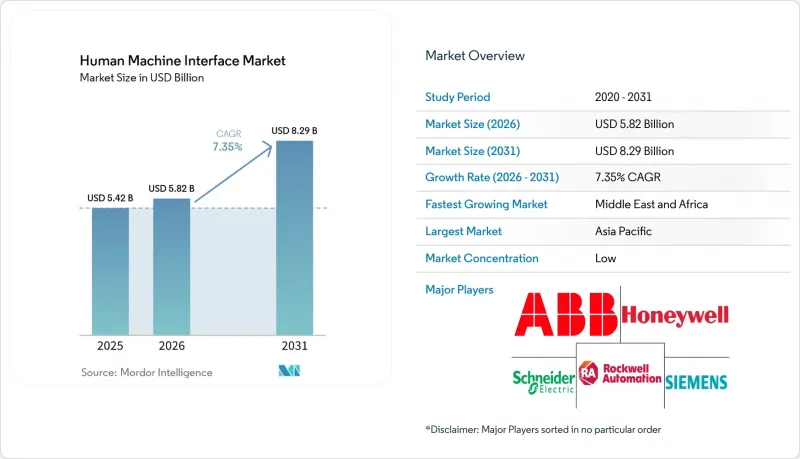
預計到 2026 年,人機介面 (HMI) 市場規模將達到 58.2 億美元,高於 2025 年的 54.2 億美元,預計到 2031 年將達到 82.9 億美元。
預計從 2026 年到 2031 年,其複合年成長率將達到 7.35%。
本報告按交付方式(硬體、軟體等)、介面技術(觸控螢幕、按鈕/小鍵盤等)、配置(嵌入式人機介面、獨立式人機介面等)、最終用戶產業(汽車、食品飲料等)和地區進行細分。市場預測以美元計價。
全球人機介面(HMI)市場趨勢與洞察
加速採用工業4.0
隨著工業4.0的到來,人機介面(HMI)正從被動的顯示器轉變為數據驅動的指揮中心,整合來自感測器、製造執行系統(MES)和企業資源計劃(ERP)的數據,並將其整合到情境感知儀表板中。在許多工廠中,操作員使用HMI來控制協作機器人(cobot)、協調批次切換並啟動預測性維護工作流程。 MDPI 2025年的調查報告強調了工業5.0中對協作機器人的重視,並指出直覺的HMI對於實現無縫的人機協作至關重要。西門子已證明互聯HMI能夠帶來切實的投資回報,其Senseye平台透過人工智慧驅動的異常警報,避免了一家乳製品廠代價高昂的停機。
OT和IT網路安全需求的融合
遠端連接和與企業雲端的連接使傳統控制面板面臨現代攻擊面的威脅,因此亟需向零信任架構轉型。歐盟的NIS2指令強制要求關鍵基礎設施營運商在所有HMI節點上採用嚴格的身份驗證和基於角色的控制。西班牙電信技術公司(Telefónica Tech)強調,多因素身份驗證和持續檢驗正迅速成為介面的基本功能。為了滿足這些要求,供應商目前正在整合安全啟動、簽署韌體和加密協定。
在實施傳統PLC方面擁有良好的業績記錄。
老舊的控制器缺乏最新的協議,造成整合障礙。工廠不願更換長期使用的設備,而是選擇分層部署協議閘道器,但這會增加成本和複雜性。 《食品工程》雜誌指出,當專有匯流排與最新的 OPC UA 和 MQTT 框架衝突時,版本控制就會面臨挑戰。
細分市場分析
2025年人機介面(HMI)市場中,硬體將佔56.30%。這是因為加固型面板、工業用電腦和邊緣閘道器將繼續發揮關鍵任務的作用。德克薩斯證實,向嵌入式人工智慧的轉型正在推進,以平衡確定性控制和預測分析。服務業以10.94%的複合年成長率成長,反映了對整合、增強網路安全和持續培訓日益成長的需求。 Control Global指出,供應商正在從一次性專案轉向以訂閱模式為基礎的生命週期夥伴關係,旨在最佳化介面。
硬體技術的進步使得模組化電路板和高亮度顯示器(具備I類和2區認證)得以廣泛應用。供應商正在整合可熱插拔的固態硬碟托架和可現場升級的CPU,以延長產品生命週期。同時,託管服務團隊正在進行遠端使用者體驗審核、修復關鍵漏洞並重新培訓操作人員以充分利用新功能。預計到2031年,這一趨勢將使業務收益整個人機介面(HMI)市場約三分之一的佔有率。
到2025年,觸控螢幕仍將佔據人機介面(HMI)市場70.40%的佔有率。這得益於可戴手套操作的電容層以及能夠滿足嚴苛工廠環境要求的化學強化玻璃。多點觸控手勢可減少導航時間和錯誤率,尤其是在批次切換過程中。然而,擴增實境/虛擬實境(AR/VR)介面正以17.62%的複合年成長率(CAGR)以最快的速度成長,並正在重新定義操作員互動模式。 MDPI關於基於XR的機器人程式設計的研究表明,與傳統的手持式程式設計方法相比,XR程式設計能夠加快試運行並減少停機時間。
支援擴增實境(AR)功能的頭戴式設備具備空間疊加功能,使工程師能夠可視化隱藏的管道、扭矩目標或即時分析數據。汽車原始設備製造商(OEM)正在使用身臨其境型設計評審來取代黏土模型,從而縮短概念週期。遊戲引擎與工業數據的融合正在為空間計算控制室鋪平道路,並預計在2031年之前提升其在人機互動(HMI)市場的佔有率。
區域分析
到2025年,亞太地區將以37.60%的市佔率引領人機介面(HMI)市場。隨著智慧工廠的普及,中國預計將部署超過1,825萬台人機介面設備,創造92.8億元人民幣(約13.9億美元)的收入。日本和韓國正在推動下一代OLED面板的商業化,而印度則透過與生產掛鉤的獎勵計劃,加速在製藥和耐用消費品行業採用自動化技術。Delta電子等區域供應商正在擴大在地化生產,為消費者提供更多具有成本競爭力的面板產品。
中東和非洲地區以9.25%的複合年成長率保持最高增速。沙烏地阿拉伯的「2030願景」和阿拉伯聯合大公國的「3000億行動」計畫正在推動對石化、物流和可再生能源領域數位化工廠的投資。在「非洲未來製造大會」上,人工智慧驅動的品管和自動化相關的勞動力技能發展成為關注焦點,這預示著大型專案儲備將持續成長。
在北美,鼓勵製造業回流的政策和成熟的工業軟體生態系統正推動著這一趨勢。像Inductive Automation的「Ignition」這樣的平台透過採用無限制授權模式,降低了多站點部署的整體擁有成本(TCO)。網路安全法規,例如CISA指南,正在推動支援安全啟動的人機介面(HMI)的普及,進一步增強了國防和關鍵基礎設施領域的市場需求。
歐洲憑藉嚴格的法規和在永續發展領域的領先地位,在人機介面(HMI)市場佔有舉足輕重的佔有率。符合NIS2和生態設計法規的要求,促使企業選擇符合IEC 62443認證的節能面板。西門子在歐洲投資20億美元擴建其數位化中心,凸顯了歐洲致力於主導以人性化、低碳產業發展的決心。
其他好處:
- Excel格式的市場預測(ME)表
- 3個月的分析師支持
目錄
第1章:引言
- 研究假設和市場定義
- 調查範圍
第2章:調查方法
第3章執行摘要
第4章 市場狀況
- 市場概覽
- 市場促進因素
- 加速採用工業4.0
- OT和IT網路安全需求的融合
- 用於預測使用者體驗的邊緣人工智慧
- 低程式碼/無程式碼人機介面設定工具的普及
- 工業顯示器能源效率相關法規
- 利用5G實現超低延遲遠端人機介面
- 市場限制因素
- 許多老舊的PLC仍在繼續使用。
- 特種半導體供應鏈的波動
- 使用者體驗標準因地區而異。
- 勒索軟體攻擊營運技術部門導致成本增加
- 價值供應鏈分析
- 監理情勢
- 技術展望
- 波特五力模型
第5章 市場規模與成長預測
- 報價
- 硬體
- 人機介面面板
- 工業用電腦
- 軟體
- 配置/程式設計
- 服務
- 硬體
- 透過介面技術
- 觸控螢幕
- 按鈕/小鍵盤
- 基於手勢
- 語音控制
- 利用擴增實境/虛擬實境技術
- 按最終用戶行業分類
- 車
- 食品/飲料
- 包裝
- 製藥
- 石油和天然氣
- 金屬和採礦
- 能源公用事業
- 航太/國防
- 半導體和電子學
- 其他最終用戶
- 透過配置
- 嵌入式人機介面
- 獨立式人機介面
- 去中心化/遠端人機介面
- 按地區
- 北美洲
- 美國
- 加拿大
- 墨西哥
- 歐洲
- 德國
- 英國
- 法國
- 義大利
- 俄羅斯
- 其他歐洲國家
- 亞太地區
- 中國
- 日本
- 印度
- 韓國
- 其他亞太國家
- 中東和非洲
- 沙烏地阿拉伯
- 阿拉伯聯合大公國
- 土耳其
- 南非
- 其他中東和非洲國家
- 南美洲
- 巴西
- 阿根廷
- 其他南美國家
- 北美洲
第6章 競爭情勢
- 市場集中度
- 策略趨勢
- 市佔率分析
- 公司簡介
- ABB Ltd
- Honeywell International Inc.
- Rockwell Automation, Inc.
- Mitsubishi Electric Corporation
- Schneider Electric SE
- Emerson Electric Co.
- GE Vernova(Industrial Automation)
- Texas Instruments Inc.
- Yokogawa Electric Corporation
- Siemens AG
- Robert Bosch GmbH
- Eaton Corporation plc
- Advantech Co., Ltd.
- Delta Electronics, Inc.
- Beijer Electronics Group
- Omron Corporation
- Parker Hannifin Corporation
- Phoenix Contact GmbH
- Red Lion Controls(Spectris)
- Moxa Inc.
第7章 市場機會與未來展望
According to Mordor Intelligence, human machine interface market size in 2026 is estimated at USD 5.82 billion, growing from 2025 value of USD 5.42 billion with 2031 projections showing USD 8.29 billion, growing at 7.35% CAGR over 2026-2031.
This report is Segmented by Offering (Hardware, Software and More), Interface Technology (Touchscreen, Push-Button / Keypad and More), Configuration (Embedded HMI, Stand-Alone HMI and More), End-User Industry (Automotive, Food & Beverage and More), and Geography. The Market Forecasts are Provided in Terms of Value (USD).
Global Human Machine Interface Market Trends and Insights
Accelerated Industry 4.0 adoption
Industry 4.0 programs transform HMIs from passive displays into data-driven command hubs that aggregate sensor, MES, and ERP feeds into context-aware dashboards. In many plants, operators now use HMIs to orchestrate co-bots, coordinate batch changes, and launch predictive maintenance workflows. A 2025 MDPI study highlights Industry 5.0's emphasis on collaborative robots, noting that intuitive HMIs are essential for seamless human-machine teamwork. Siemens reported its Senseye platform prevented costly downtime at a dairy facility through AI-enabled anomaly alerts, demonstrating tangible ROI for connected HMIs.
Convergence of OT-IT cybersecurity requirements
Remote connectivity and enterprise cloud links expose legacy panels to modern attack surfaces, prompting a move toward Zero Trust Architecture. The European Union's NIS2 directive compels critical-infrastructure operators to adopt strict authentication and role-based controls on every HMI node. Telefonica Tech underscores that multi-factor authentication and continuous verification are quickly becoming baseline interface functions. Vendors now embed secure boot, signed firmware, and encrypted protocols to satisfy these mandates.
Persistent legacy PLC installed base
Older controllers lack modern protocols, creating integration hurdles. Plants hesitate to rip and replace mature assets, instead layering protocol gateways that add cost and complexity. Food Engineering notes version-control headaches when proprietary buses clash with modern OPC UA or MQTT frameworks.
Other drivers and restraints analyzed in the detailed report include:
- Edge-AI enabling predictive UX
- Low-code/no-code HMI configuration tools
- Supply-chain volatility for specialty semiconductors
For complete list of drivers and restraints, kindly check the Table Of Contents.
Segment Analysis
Hardware generated 56.30% of the HMI market in 2025 as rugged panels, industrial PCs, and edge gateways remain mission critical. Texas Instruments confirms a pivot toward embedded AI to balance deterministic control with predictive analytics. The services segment, advancing at 10.94% CAGR, reflects mounting demand for integration, cybersecurity hardening, and continuous training. Control Global observes suppliers shifting from one-off projects to lifecycle partnerships with subscription models for interface optimization.
Hardware evolution now favours modular boards, and high brightness displays certified for Class I, Division 2 zones. Vendors integrate hot-swap SSD bays and field-upgradeable CPUs to extend lifespan. Meanwhile, managed services teams conduct remote UX audits, patch critical vulnerabilities, and retrain operators to exploit new features, a dynamic expected to lift service revenues to nearly one third of overall HMI market size by 2031.
Touchscreens retained 70.40% of the HMI market in 2025 because glove-friendly capacitive layers and chemically strengthened glass satisfy harsh-plant demands. Multi-touch gestures shorten navigation time and cut error rates, especially in batch changeovers. Yet AR/VR interfaces are scaling fastest at 17.62% CAGR, reshaping operator interaction paradigms. An MDPI study on XR-based robot programming reported faster commissioning and lower downtime than traditional pendant methods.
AR-equipped headsets provide spatial overlays, letting technicians visualize hidden piping, torque targets, or live analytics. Automotive OEMs run immersive design reviews that replace clay modelling and shorten concept loops. This cross-pollination of gaming engines and industrial data paves the way for spatial computing control rooms, potentially capturing an expanded share of HMI market size through 2031.
Complete Report Scope:
- By Offering
- Hardware
- HMI Panels
- Industrial PCs
- Software
- Configuration / Programming
- Services
- Hardware
- By Interface Technology
- Touchscreen
- Push-button / Keypad
- Gesture-based
- Voice-controlled
- AR / VR-assisted
- By End-User Industry
- Automotive
- Food and Beverage
- Packaging
- Pharmaceutical
- Oil and Gas
- Metal and Mining
- Energy and Utilities
- Aerospace and Defense
- Semiconductors and Electronics
- Other End Users
- By Configuration
- Embedded HMI
- Stand-alone HMI
- Distributed / Remote HMI
- By Geography
- North America
- United States
- Canada
- Mexico
- Europe
- Germany
- United Kingdom
- France
- Italy
- Russia
- Rest of Europe
- Asia-Pacific
- China
- Japan
- India
- South Korea
- Rest of Asia-Pacific
- Middle East and Africa
- Saudi Arabia
- United Arab Emirates
- Turkey
- South Africa
- Rest of Middle East and Africa
- South America
- Brazil
- Argentina
- Rest of South America
- North America
Geography Analysis
Asia-Pacific led the HMI market with 37.60% share in 2025. Chinese installations surpassed 18.25 million units, generating revenue of CNY 9.28 billion (USD 1.39 billion) amid a climb in smart-factory rollouts. Japan and South Korea continue to commercialize next-gen OLED panels, while India's production-linked incentives propel automation uptake in pharmaceuticals and consumer durables. Regional suppliers such as Delta Electronics are scaling local manufacturing, widening access to cost-competitive panels.
The Middle East and Africa registers the highest growth at 9.25% CAGR. Vision 2030 initiatives in Saudi Arabia and the UAE's Operation 300bn plan are investing in digital plants for petrochemicals, logistics, and renewables. The Future Manufacturing Africa Conference spotlights AI-driven quality control and workforce upskilling for automation, signalling sustained large-project pipelines.
North America benefits from reshoring incentives and an established industrial-software ecosystem. Platforms like Ignition by Inductive Automation employ unlimited licensing to cut total cost of ownership for multi-site rollouts. Cybersecurity regulations such as CISA guidelines fuel adoption of secure-boot HMIs, further solidifying market demand across defence and critical-infrastructure verticals.
Europe maintains a sizeable slice of the HMI market on the back of regulatory rigor and sustainability leadership. Compliance with NIS2 and eco-design mandates drives preference for energy-efficient, IEC 62443-certified panels. Siemens' USD 2 billion European investment into digital-center expansions underscores the continent's determination to lead in human-centric, low-carbon industry.
- ABB Ltd
- Honeywell International Inc.
- Rockwell Automation, Inc.
- Mitsubishi Electric Corporation
- Schneider Electric SE
- Emerson Electric Co.
- GE Vernova (Industrial Automation)
- Texas Instruments Inc.
- Yokogawa Electric Corporation
- Siemens AG
- Robert Bosch GmbH
- Eaton Corporation plc
- Advantech Co., Ltd.
- Delta Electronics, Inc.
- Beijer Electronics Group
- Omron Corporation
- Parker Hannifin Corporation
- Phoenix Contact GmbH
- Red Lion Controls (Spectris)
- Moxa Inc.
Additional Benefits:
- The market estimate (ME) sheet in Excel format
- 3 months of analyst support
TABLE OF CONTENTS
1 INTRODUCTION
- 1.1 Study Assumptions and Market Definition
- 1.2 Scope of the Study
2 RESEARCH METHODOLOGY
3 EXECUTIVE SUMMARY
4 MARKET LANDSCAPE
- 4.1 Market Overview
- 4.2 Market Drivers
- 4.2.1 Accelerated Industry 4.0 adoption
- 4.2.2 Convergence of OT-IT cybersecurity requirements
- 4.2.3 Edge-AI enabling predictive UX
- 4.2.4 Expansion of low-code/no-code HMI configuration tools
- 4.2.5 Energy-efficiency mandates for industrial displays
- 4.2.6 5G-enabled ultra-low-latency remote HMI
- 4.3 Market Restraints
- 4.3.1 Persistent legacy PLC installed base
- 4.3.2 Supply-chain volatility for specialty semiconductors
- 4.3.3 Fragmented UX standards across regions
- 4.3.4 Escalating OT-focused ransomware costs
- 4.4 Value / Supply-Chain Analysis
- 4.5 Regulatory Landscape
- 4.6 Technological Outlook
- 4.7 Porters Five Forces
- 4.7.1 Bargaining Power of Suppliers
- 4.7.2 Bargaining Power of Buyers
- 4.7.3 Threat of New Entrants
- 4.7.4 Threat of Substitutes
- 4.7.5 Intensity of Competitive Rivalry
5 MARKET SIZE AND GROWTH FORECASTS (VALUE)
- 5.1 By Offering
- 5.1.1 Hardware
- 5.1.1.1 HMI Panels
- 5.1.1.2 Industrial PCs
- 5.1.2 Software
- 5.1.2.1 Configuration / Programming
- 5.1.3 Services
- 5.1.1 Hardware
- 5.2 By Interface Technology
- 5.2.1 Touchscreen
- 5.2.2 Push-button / Keypad
- 5.2.3 Gesture-based
- 5.2.4 Voice-controlled
- 5.2.5 AR / VR-assisted
- 5.3 By End-User Industry
- 5.3.1 Automotive
- 5.3.2 Food and Beverage
- 5.3.3 Packaging
- 5.3.4 Pharmaceutical
- 5.3.5 Oil and Gas
- 5.3.6 Metal and Mining
- 5.3.7 Energy and Utilities
- 5.3.8 Aerospace and Defense
- 5.3.9 Semiconductors and Electronics
- 5.3.10 Other End Users
- 5.4 By Configuration
- 5.4.1 Embedded HMI
- 5.4.2 Stand-alone HMI
- 5.4.3 Distributed / Remote HMI
- 5.5 By Geography
- 5.5.1 North America
- 5.5.1.1 United States
- 5.5.1.2 Canada
- 5.5.1.3 Mexico
- 5.5.2 Europe
- 5.5.2.1 Germany
- 5.5.2.2 United Kingdom
- 5.5.2.3 France
- 5.5.2.4 Italy
- 5.5.2.5 Russia
- 5.5.2.6 Rest of Europe
- 5.5.3 Asia-Pacific
- 5.5.3.1 China
- 5.5.3.2 Japan
- 5.5.3.3 India
- 5.5.3.4 South Korea
- 5.5.3.5 Rest of Asia-Pacific
- 5.5.4 Middle East and Africa
- 5.5.4.1 Saudi Arabia
- 5.5.4.2 United Arab Emirates
- 5.5.4.3 Turkey
- 5.5.4.4 South Africa
- 5.5.4.5 Rest of Middle East and Africa
- 5.5.5 South America
- 5.5.5.1 Brazil
- 5.5.5.2 Argentina
- 5.5.5.3 Rest of South America
- 5.5.1 North America
6 COMPETITIVE LANDSCAPE
- 6.1 Market Concentration
- 6.2 Strategic Moves
- 6.3 Market Share Analysis
- 6.4 Company Profiles (includes Global level Overview, Market level overview, Core Segments, Financials as available, Strategic Information, Market Rank/Share for key companies, Products and Services, and Recent Developments)
- 6.4.1 ABB Ltd
- 6.4.2 Honeywell International Inc.
- 6.4.3 Rockwell Automation, Inc.
- 6.4.4 Mitsubishi Electric Corporation
- 6.4.5 Schneider Electric SE
- 6.4.6 Emerson Electric Co.
- 6.4.7 GE Vernova (Industrial Automation)
- 6.4.8 Texas Instruments Inc.
- 6.4.9 Yokogawa Electric Corporation
- 6.4.10 Siemens AG
- 6.4.11 Robert Bosch GmbH
- 6.4.12 Eaton Corporation plc
- 6.4.13 Advantech Co., Ltd.
- 6.4.14 Delta Electronics, Inc.
- 6.4.15 Beijer Electronics Group
- 6.4.16 Omron Corporation
- 6.4.17 Parker Hannifin Corporation
- 6.4.18 Phoenix Contact GmbH
- 6.4.19 Red Lion Controls (Spectris)
- 6.4.20 Moxa Inc.
7 MARKET OPPORTUNITIES AND FUTURE OUTLOOK
- 7.1 White-space and Unmet-Need Assessment

 人機介面 (HMI) 軟體市場預測至 2034 年—按軟體類型、部署模式、功能、應用、最終用戶和地區分類的全球分析
 人機介面(HMI)市場規模、佔有率、成長、全球產業分析、區域趨勢及2026-2034年預測
 北美人機介面:市場佔有率分析、產業趨勢與統計及成長預測(2026-2031 年)
 人機介面市場-2026-2032年全球市場預測
 人機介面 (HMI) 市場規模、佔有率和成長分析:按產品、最終用戶產業和地區分類-2026-2033 年產業預測人機介面(HMI)系統市場預測至2034年-按產品類型、組件、技術、應用、最終用戶和地區分類的全球分析
 人機介面市場報告:按組件、配置、技術類型、最終用途行業和地區分類(2026-2034 年)
 人機介面市場:依產品、應用和地區分類
 2026年全球人機互動市場報告2026年全球人機介面市場報告