


 |
市場調查報告書
商品編碼
2100269
燃油流量計:市場佔有率分析、產業趨勢與統計、成長預測(2026-2031)Fuel Flow Meter - Market Share Analysis, Industry Trends & Statistics, Growth Forecasts (2026 - 2031) |
||||||

※ 本網頁內容可能與最新版本有所差異。詳細情況請與我們聯繫。
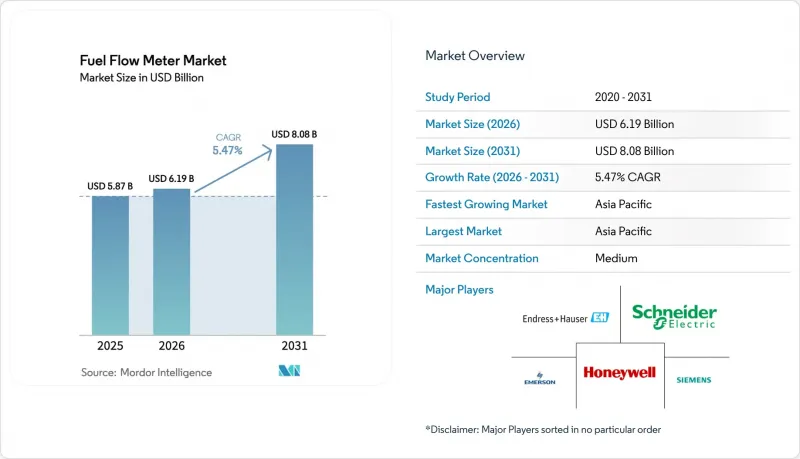
據 Mordor Intelligence 稱,燃油流量計市場預計到 2026 年價值 61.9 億美元,高於 2025 年的 58.7 億美元,預計到 2031 年將達到 80.8 億美元。
預計 2026 年至 2031 年的複合年成長率為 5.47%。
本報告按流量計類型(容積式、科氏式、超音波等)、燃料類型(柴油、重油、液化天然氣/低溫燃料等)、管線尺寸(25mm以下、26-50mm、51-100mm、100mm以上)、產業領域(石油天然氣、航太與國防、化工及地區進行細分工業等)及地區進行細分。市場預測以美元計價。
全球燃油流量計市場趨勢及洞察
國際海事組織 (IMO) 嚴格的 DCS 法規正在加速其在海事領域的應用。
國際海事組織(IMO)資料收集系統(DCS)將於2024年生效,屆時總噸位超過5000噸的船舶必須上報實際燃油消耗量,逐步淘汰先前估計值的報告方式,並要求船舶迅速升級至精度達到±2.5%的認證流量計。目前,約有6萬艘船舶受此法規約束,為燃油流量計市場帶來了大規模的維修機會。科隆(KROHNE)等供應商提供質量流量計硬體和自動碳排放計算軟體的組合套裝,以確保符合IMO和歐盟的MRV(測量、報告和檢驗)框架。許多船隊已經感受到這項政策的影響,因為目前仍在使用缺乏數據傳輸電子輸出的舊式機械設備。在歐洲和亞洲船旗國,由於執法機制的完善,新規的早期採用率最高。這些因素共同推動了全球燃油流量計市場的成長。
整合高精度流量計的即時航空燃油最佳化系統
航空公司正將質量流量感知器與飛行管理電腦整合,以即時調整燃油輸送,從而幫助每次飛行降低高達3%的燃油消耗,並實現淨零排放目標。賽峰集團的「LiSafe」和伊頓的數位流量計在減輕線束重量的同時,實現了±0.1%的精度,這是傳統渦輪流量計無法達到的。這些升級透過提高運行性能和直接降低成本,增強了高階流量計的提案,從而抵消了單價的上漲。生物噴射機燃料和電轉液(PTL)燃料的認證確保了飛機機隊未來的應對力。隨著亞太地區航空公司機隊的現代化,預計隨著該地區的擴張,燃油流量計的潛在市場也將進一步擴大。
高精度科氏流量計與機械流量計的資本支出差異
科氏流量計的價格通常是渦輪流量計的三到五倍,其特殊的安裝結構進一步增加了安裝成本。如此高昂的價格可能會成為阻礙,使得在體積測量即可滿足需求的應用中難以升級。營運商在權衡短期預算與整個生命週期成本節約時,可能會推遲購買,從而可能減緩燃油流量計市場的短期成長。然而,免維護設計和直接品質輸出仍然降低了總擁有成本,因此隨著資金籌措模式的演變,這些限制有望得到緩解。
細分市場分析
到2025年,科氏流量計將佔據燃料流量計市場27.84%的佔有率,凸顯其在交易量測量和多燃料運作中的重要角色。其直接品質測量方法無需密度校正,並允許氫氣、液化天然氣和生質燃料的混合而無需重新校準。隨著工廠運營商整合流量測量點以減少洩漏路徑和維護工作,科里奧利流量計在2英寸以上管道中的應用日益廣泛。超音波流量計發展勢頭強勁,這主要得益於新近收購的Flexim公司的夾裝式設計,該設計減少了維修期間的停機時間,預計其複合年成長率將達到5.65%。渦輪流量計和容積式流量計在低黏度或低流量應用中仍佔有一席之地,尤其是在預算受限的情況下。雖然渦式流量計和電磁流量計的市場佔有率較小,但它們仍然是蒸氣和導電液體的可行選擇。這些因素共同促使供應商將研發重點放在多路徑訊號處理、自我診斷功能和增強的網路安全性上,這表明技術多樣性正在支持燃油流量計市場的擴張。
2026年至2031年間,科氏流量計供應商計劃將濕潤部分直徑擴大至16英寸,從而進軍散裝終端市場,而該市場傳統上一直由超音波流量計主導。具備先進診斷功能的模組化變送器可即時檢測污染物、沉積物和振動問題,從而減少故障排除工作量。系統整合商目前正將科氏流量計與能源管理軟體捆綁銷售,為使用者提供涵蓋流量、密度、溫度和排放的單一控制面板。這種以生態系統為導向的方法確保硬體能夠深度整合到客戶的工作流程中,從而增強客戶維繫並實現持續收入。這些因素不僅提升了科氏流量計的優勢,也推動了互補型超音波流量計的成長,顯示多元化技術組合是燃料流量計市場長期穩健發展的基礎。
由於重型卡車、鐵路和緊急電源仍以柴油為主,柴油燃料仍佔燃油流量計市場規模的56.05%。然而,隨著航運和道路運輸車輛轉向低碳燃料,液化天然氣(LNG)和其他低溫燃料正以5.88%的複合年成長率推動市場成長。低溫運輸需要在-162 度C下達到1.0級精度,但能夠滿足此要求的科氏和超音波設計有限。航空業正在加速採用永續燃料,流量計供應商正在推進電子煤油和HEFA混合燃料的ASTM D4054硬體認證。雖然隨著國際海事組織(IMO)硫排放法規的收緊,對重質燃油的需求正在下降,但沿海航線的輔助引擎仍需要高黏度流量計。氫氣和氨氣的試驗應用正在催生對低密度氣體計量的利基需求,這推高了燃油流量計市場的平均售價。
燃料多樣化迫使供應商開發能夠模擬各種溫度、壓力和黏度曲線的校準設備。多流體韌體允許在單一變送器中儲存多達 20 種不同的產品特性曲線,使用戶無需現場重新校準即可切換燃料。這些特性縮短了切換時間並降低了庫存成本。隨著可再生柴油混合物在道路運輸中日益普及,檢測密度和黏度變化的能力正成為一項必要的操作,從而推動了對具備數位密度測量功能的高級流量計的需求。這種轉變擴大了應用範圍,並保護了燃料流量計市場免受宏觀經濟燃料替代風險的影響。
區域分析
預計到2025年,亞太地區將以34.40%的市佔率主導燃油流量計市場,並在2031年之前維持6.25%的複合年成長率。這一成長主要得益於中國的碳中和計畫、日本的氫能相關舉措以及印度的工業現代化。新加坡的液化天然氣燃料庫協議已成為東南亞港口燃油流量計規格的區域標準。在地化製造地帶來的前置作業時間縮短和成本降低,正在增強亞洲供應商在燃油流量計市場的競爭力。
北美位居第二,這主要得益於頁岩氣輸送計量、美國環保署嚴格的排放法規以及航太領域的創新叢集。該地區目前也在進行氫氣輸送管道的初步測試,這些管道需要低密度氣體校準。對數位孿生和預測分析的投資正在推動對能夠與SCADA系統無縫整合的智慧電錶的需求。
歐洲繼續保持其監管主導,實施歐盟MRV和「Fit-for-55」方案,以促進船舶和工業鍋爐採用先進計量技術。歐洲的氫能經濟藍圖正在推動用於處理成分波動混合氣體的流量計的研發,同時符合ATEX安全標準。東歐煉油廠的現代化改造和區域供熱網路的建設也促進了需求的逐步成長。
中東和非洲受益於大規模的油氣投資和採礦項目,但嚴酷的氣候條件要求設備具備堅固的機殼和高防護等級。在南美洲,尤其是在巴西的近海能源開發和智利的銅礦開採中,人們對遠端和雲端監控的興趣日益濃厚,以降低營運成本。這些區域差異確保了技術組合的多樣性,並保障了全球燃油流量計市場的穩健發展。
其他好處:
- Excel格式的市場預測(ME)表
- 3個月的分析師支持
目錄
第1章:引言
- 研究假設和市場定義
- 調查範圍
第2章:調查方法
第3章執行摘要
第4章 市場狀況
- 市場概覽
- 市場促進因素
- 國際海事組織對分散式控制系統(DCS)的嚴格要求正在加速其在海事領域的應用。
- 整合高精度儀器的即時航空燃油最佳化系統
- 隨著液化天然氣燃料庫的擴張,科氏流量計將變得不可或缺。
- 對自主採礦車隊柴油機進行遠端監控的需求
- 隨著向低碳燃料的過渡,需要進行多流體校準。
- 利用物聯網計量器防止新興市場燃油竊盜
- 市場限制因素
- 高精度科氏流量計與機械流量計的資本支出(CAPEX)比較
- 由於老舊海上平台維修工程而導致的運作
- 超低硫船用燃料校準的複雜性
- 替代基於ECU的虛擬燃油流量分析
- 產業生態系分析
- 技術展望
- 波特五力分析
第5章 市場規模與成長預測
- 按流量計類型
- 正位移
- 科里奧利公式
- 超音波型
- 渦輪
- 電磁學
- 渦流
- 其他類型
- 按燃料類型
- 柴油引擎
- 重油(HFO)
- 液化天然氣/低溫燃料
- 替代燃料和生質燃料(電甲醇、生質柴油、SAF)
- 按管道尺寸
- 25毫米或更小
- 26~50 mm
- 51~100 mm
- 100毫米或以上
- 按行業分類
- 石油和天然氣(上游、中游、下游)
- 海事/航運
- 汽車和商用車輛車隊管理
- 航太/國防
- 工業發電與公共產業
- 化工和加工工業
- 農業和非公路機械
- 按地區
- 北美洲
- 美國
- 加拿大
- 墨西哥
- 歐洲
- 德國
- 英國
- 法國
- 北歐的
- 其他歐洲國家
- 南美洲
- 巴西
- 其他南美國家
- 亞太地區
- 中國
- 日本
- 印度
- 東南亞
- 其他亞太國家
- 中東和非洲
- 中東
- 波灣合作理事會(GCC)成員國
- 土耳其
- 其他中東國家
- 非洲
- 南非
- 其他非洲國家
- 中東
- 北美洲
第6章 競爭情勢
- 市場集中度
- 策略性舉措(併購、合作、新產品發布)
- 市佔率分析
- 公司簡介
- Emerson Electric Co.
- Honeywell International Inc.
- Endress+Hauser Group
- Schneider Electric SE
- Siemens AG
- Yokogawa Electric Corporation
- Roper Technologies Inc.
- KROHNE Group
- Brooks Instrument LLC
- Omega Engineering Inc.
- Badger Meter Inc.
- Aalborg Instruments
- AW-Lake Company
- Fueltek Ltd.
- Aquametro Oil and Marine AG
- Litre Meter Ltd.
- Smartflow Technologies Ltd.
- FUELTRAX(Nautical Control Solutions)
- Contrec Ltd.
- TE Connectivity(Sierra Instruments)
第7章 市場機會與未來展望
According to Mordor Intelligence, the fuel flow meter market size in 2026 is estimated at USD 6.19 billion, growing from 2025 value of USD 5.87 billion with 2031 projections showing USD 8.08 billion, growing at 5.47% CAGR over 2026-2031.
This report is Segmented by Flowmeter Type (Positive Displacement, Coriolis, Ultrasonic, and More), Fuel Type (Diesel, Heavy Fuel Oil, LNG/Cryogenic Fuels, and More), Pipe Size (Up To 25mm, 26-50mm, 51-100mm, Above 100mm), Industry Vertical (Oil and Gas, Aerospace and Defense, Chemicals and Process Industries, and More), and Geography. The Market Forecasts are Provided in Terms of Value (USD).
Global Fuel Flow Meter Market Trends and Insights
Stringent IMO DCS Mandates Accelerating Maritime Adoption
The 2024 implementation of the IMO Data Collection System obliges vessels over 5,000 GT to report actual fuel consumption, eliminating historical estimations and forcing rapid upgrades to certified meters that meet +-2.5% accuracy. About 60,000 ships now fall under this rule, creating a sizeable retrofit opportunity within the fuel flow meter market. Providers such as KROHNE bundle mass-flow hardware with automated carbon-emissions software to ensure compliance with both IMO and EU MRV frameworks. The policy impact is immediate because many fleets still operate legacy mechanical devices that lack electronic outputs for data transfer. Early adoption is strongest in European and Asian flag states where enforcement mechanisms are mature. These factors collectively add momentum to global fuel flow meter market growth.
Real-time Aviation Fuel Optimization Systems Integrating Precision Meters
Airlines integrate mass-flow sensors with flight-management computers to adjust fuel delivery in real time, trimming consumption by up to 3% per flight and supporting net-zero goals. Safran's LiSafe and Eaton's digital gauges reduce wiring weight while delivering +-0.1% accuracy, a level that conventional turbine meters cannot match. These upgrades improve operational performance and unlock direct savings that offset higher unit prices, strengthening the value proposition of premium meters. Certification to handle bio-jet and power-to-liquid blends future-proofs aircraft fleets. Expansion into Asia-Pacific fleets will widen the addressable fuel flow meter market as regional carriers modernize.
High CAPEX of High-Accuracy Coriolis vs Mechanical Meters
Coriolis units often cost three-to-five times more than turbine meters, and specialized mounting pushes installed cost even higher. The sticker shock discourages upgrades in applications where volumetric measurement suffices. Operators weighing short-term budgets against lifecycle savings may postpone purchases, trimming near-term growth of the fuel flow meter market. Yet the maintenance-free design and direct mass output still lower total cost of ownership, so the restraint is expected to ease as financing models evolve.
Other drivers and restraints analyzed in the detailed report include:
- LNG Bunkering Expansion Requiring Cryogenic-Capable Coriolis Meters
- Autonomous Mining Fleets' Need for Remote Diesel Monitoring
- Substitution by ECU-Based Virtual Fuel Flow Analytics
For complete list of drivers and restraints, kindly check the Table Of Contents.
Segment Analysis
Coriolis meters delivered 27.84% of fuel flow meter market share in 2025, underscoring their role in custody transfer and multi-fuel operations. Their direct mass measurement eliminates density corrections and supports hydrogen, LNG, and biofuel blends without recalibration. Adoption rises in pipe sizes above 2 inches as plant operators consolidate flow points to reduce leak paths and maintenance. Ultrasonic meters gain the momentum to post a 5.65% CAGR, primarily because clamp-on designs from newly acquired Flexim shorten shutdowns during retrofits. Turbine and positive-displacement units retain niche roles in low-viscosity or low-flow applications where budget constraints persist. Vortex and electromagnetic technologies occupy smaller shares but remain viable for steam or conductive liquids. The combined effect keeps supplier R&D focused on multi-path signal processing, self-diagnostics, and cybersecurity hardening, illustrating how technology diversity sustains expansion in the fuel flow meter market.
Across 2026-2031, Coriolis vendors aim to lift wetted-line diameters to 16 inches, enabling penetration into bulk terminals where ultrasonic meters have historically prevailed. Modular transmitters with advanced diagnostics detect entrained gas, coating, or vibration issues in real time, cutting troubleshooting labor. Integrators now bundle Coriolis meters with energy-management software to give users a single dashboard that covers rate, density, temperature, and emissions. Such ecosystem thinking embeds hardware deeper into customer workflows, reinforcing retention and recurring revenue. These factors elevate Coriolis dominance yet also spur complementary ultrasonic growth, showing that multi-technology portfolios underpin long-term resilience within the fuel flow meter market.
Diesel still accounts for 56.05% of the fuel flow meter market size because heavy-duty trucking, rail, and backup power remain diesel-centric. Nonetheless, LNG and other cryogens lead growth at a 5.88% CAGR as shipping and on-road fleets pivot to low-carbon fuels. Cryogenic transfers demand Class 1.0 accuracy at -162 °C, which only a limited set of Coriolis and ultrasonic designs can meet. Aviation accelerates sustainable fuel adoption, prompting meter suppliers to qualify hardware under ASTM D4054 for e-kerosene and HEFA blends. Heavy fuel oil declines as IMO sulfur caps tighten, yet it still requires viscous-service meters for auxiliary engines in short-sea corridors. Hydrogen and ammonia pilots create niche demand for low-density gas metering, commanding premium prices and raising average selling values across the fuel flow meter market.
Fuel diversity pushes vendors to develop calibration rigs that simulate wide temperature, pressure, and viscosity profiles. Multi-fluid firmware now stores up to 20 product curves in a single transmitter, letting users switch fuels without field recalibration. These capabilities lower change-over time and inventory costs. As renewable diesel blends permeate road transport, the ability to detect density and viscosity shifts becomes an operational necessity, locking in advanced meters with digital density measurement. The shift expands addressable applications and shields the fuel flow meter market from macro-fuel substitution risk.
Complete Report Scope:
- By Flowmeter Type
- Positive Displacement
- Coriolis
- Ultrasonic
- Turbine
- Electromagnetic
- Vortex
- Other Types
- By Fuel Type
- Diesel
- Heavy Fuel Oil (HFO)
- LNG/Cryogenic Fuels
- Alternative and Biofuels (E-Methan ol, Biodiesel, SAF)
- By Pipe Size
- Upto 25 mm
- 26 - 50 mm
- 51 - 100 mm
- Above 100 mm
- By Industry Vertical
- Oil and Gas (Upstream, Midstream, Downstream)
- Marine and Shipping
- Automotive and Commercial Fleet Management
- Aerospace and Defense
- Industrial Power Generation and Utilities
- Chemicals and Process Industries
- Agriculture and Off-Road Machinery
- By Geography
- North America
- United States
- Canada
- Mexico
- Europe
- Germany
- United Kingdom
- France
- Nordics
- Rest of Europe
- South America
- Brazil
- Rest of South America
- Asia-Pacific
- China
- Japan
- India
- South-East Asia
- Rest of Asia-Pacific
- Middle East and Africa
- Middle East
- Gulf Cooperation Council Countries
- Turkey
- Rest of Middle East
- Africa
- South Africa
- Rest of Africa
- Middle East
- North America
Geography Analysis
Asia-Pacific dominated the fuel flow meter market with a 34.40% share in 2025 and leads in growth with a 6.25% CAGR through 2031, buoyed by China's carbon-neutrality program, Japan's hydrogen initiatives, and India's industrial upgrades. Singapore's LNG bunkering protocols act as a regional reference, standardizing meter specifications across Southeast Asian ports. Local manufacturing hubs shorten lead times and reduce cost, strengthening competitiveness of Asia-based suppliers within the fuel flow meter market.
North America ranks second, propelled by shale gas custody transfer, strict EPA emissions rules, and aerospace innovation clusters. The region witnesses early trials of hydrogen transmission lines that require low-density gas calibration. Investment in digital twins and predictive analytics enhances demand for smart meters that integrate seamlessly with SCADA systems.
Europe maintains regulatory leadership, enforcing EU MRV and Fit-for-55 packages that incentivize advanced measurement on vessels and industrial boilers. The continent's hydrogen economy roadmap drives R&D for meters handling variable-composition blends while meeting ATEX safety codes. Eastern Europe's modernizing refineries and district heating networks also contribute incremental demand.
The Middle East and Africa benefit from large-scale oil and gas investments and mining projects, though harsh climates necessitate ruggedized enclosures and high-IP ratings. South America, led by Brazil's offshore energy expansion and Chilean copper mines, shows growing interest in remote, cloud-enabled monitoring to cut operational costs. These regional variations ensure that technology portfolios remain diversified, safeguarding resilience in the global fuel flow meter market.
- Emerson Electric Co.
- Honeywell International Inc.
- Endress+Hauser Group
- Schneider Electric SE
- Siemens AG
- Yokogawa Electric Corporation
- Roper Technologies Inc.
- KROHNE Group
- Brooks Instrument LLC
- Omega Engineering Inc.
- Badger Meter Inc.
- Aalborg Instruments
- AW-Lake Company
- Fueltek Ltd.
- Aquametro Oil and Marine AG
- Litre Meter Ltd.
- Smartflow Technologies Ltd.
- FUELTRAX (Nautical Control Solutions)
- Contrec Ltd.
- TE Connectivity (Sierra Instruments)
Additional Benefits:
- The market estimate (ME) sheet in Excel format
- 3 months of analyst support
TABLE OF CONTENTS
1 INTRODUCTION
- 1.1 Study Assumptions and Market Definition
- 1.2 Scope of the Study
2 RESEARCH METHODOLOGY
3 EXECUTIVE SUMMARY
4 MARKET LANDSCAPE
- 4.1 Market Overview
- 4.2 Market Drivers
- 4.2.1 Stringent IMO DCS Mandates Accelerating Maritime Adoption
- 4.2.2 Real-time Aviation Fuel Optimization Systems Integrating Precision Meters
- 4.2.3 LNG Bunkering Expansion Requiring Cryogenic-Capable Coriolis Meters
- 4.2.4 Autonomous Mining Fleets' Need for Remote Diesel Monitoring
- 4.2.5 Shift to Low-Carbon Fuels Demanding Multi-Fluid Calibration
- 4.2.6 Fuel Theft Mitigation in Emerging Markets via IoT-Enabled Meters
- 4.3 Market Restraints
- 4.3.1 High CAPEX of High-Accuracy Coriolis vs Mechanical Meters
- 4.3.2 Retrofitting Downtime on Aging Offshore Platforms
- 4.3.3 Calibration Complexity with Very-Low-Sulfur Marine Fuels
- 4.3.4 Substitution by ECU-Based Virtual Fuel Flow Analytics
- 4.4 Industry Ecosystem Analysis
- 4.5 Technological Outlook
- 4.6 Porter's Five Forces Analysis
- 4.6.1 Bargaining Power of Suppliers
- 4.6.2 Bargaining Power of Buyers
- 4.6.3 Threat of New Entrants
- 4.6.4 Threat of Substitutes
- 4.6.5 Intensity of Competitive Rivalry
5 MARKET SIZE AND GROWTH FORECASTS (VALUES)
- 5.1 By Flowmeter Type
- 5.1.1 Positive Displacement
- 5.1.2 Coriolis
- 5.1.3 Ultrasonic
- 5.1.4 Turbine
- 5.1.5 Electromagnetic
- 5.1.6 Vortex
- 5.1.7 Other Types
- 5.2 By Fuel Type
- 5.2.1 Diesel
- 5.2.2 Heavy Fuel Oil (HFO)
- 5.2.3 LNG/Cryogenic Fuels
- 5.2.4 Alternative and Biofuels (E-Methan ol, Biodiesel, SAF)
- 5.3 By Pipe Size
- 5.3.1 Upto 25 mm
- 5.3.2 26 - 50 mm
- 5.3.3 51 - 100 mm
- 5.3.4 Above 100 mm
- 5.4 By Industry Vertical
- 5.4.1 Oil and Gas (Upstream, Midstream, Downstream)
- 5.4.2 Marine and Shipping
- 5.4.3 Automotive and Commercial Fleet Management
- 5.4.4 Aerospace and Defense
- 5.4.5 Industrial Power Generation and Utilities
- 5.4.6 Chemicals and Process Industries
- 5.4.7 Agriculture and Off-Road Machinery
- 5.5 By Geography
- 5.5.1 North America
- 5.5.1.1 United States
- 5.5.1.2 Canada
- 5.5.1.3 Mexico
- 5.5.2 Europe
- 5.5.2.1 Germany
- 5.5.2.2 United Kingdom
- 5.5.2.3 France
- 5.5.2.4 Nordics
- 5.5.2.5 Rest of Europe
- 5.5.3 South America
- 5.5.3.1 Brazil
- 5.5.3.2 Rest of South America
- 5.5.4 Asia-Pacific
- 5.5.4.1 China
- 5.5.4.2 Japan
- 5.5.4.3 India
- 5.5.4.4 South-East Asia
- 5.5.4.5 Rest of Asia-Pacific
- 5.5.5 Middle East and Africa
- 5.5.5.1 Middle East
- 5.5.5.1.1 Gulf Cooperation Council Countries
- 5.5.5.1.2 Turkey
- 5.5.5.1.3 Rest of Middle East
- 5.5.5.2 Africa
- 5.5.5.2.1 South Africa
- 5.5.5.2.2 Rest of Africa
- 5.5.5.1 Middle East
- 5.5.1 North America
6 COMPETITIVE LANDSCAPE
- 6.1 Market Concentration
- 6.2 Strategic Moves (M&A, Partnerships, Product Launches)
- 6.3 Market Share Analysis
- 6.4 Company Profiles {(includes Global level Overview, Market level overview, Core Segments, Financials as available, Strategic Information, Market Rank/Share for key companies, Products and Services, and Recent Developments)}
- 6.4.1 Emerson Electric Co.
- 6.4.2 Honeywell International Inc.
- 6.4.3 Endress+Hauser Group
- 6.4.4 Schneider Electric SE
- 6.4.5 Siemens AG
- 6.4.6 Yokogawa Electric Corporation
- 6.4.7 Roper Technologies Inc.
- 6.4.8 KROHNE Group
- 6.4.9 Brooks Instrument LLC
- 6.4.10 Omega Engineering Inc.
- 6.4.11 Badger Meter Inc.
- 6.4.12 Aalborg Instruments
- 6.4.13 AW-Lake Company
- 6.4.14 Fueltek Ltd.
- 6.4.15 Aquametro Oil and Marine AG
- 6.4.16 Litre Meter Ltd.
- 6.4.17 Smartflow Technologies Ltd.
- 6.4.18 FUELTRAX (Nautical Control Solutions)
- 6.4.19 Contrec Ltd.
- 6.4.20 TE Connectivity (Sierra Instruments)
7 MARKET OPPORTUNITIES AND FUTURE OUTLOOK
- 7.1 White-Space and Unmet-Need Assessment

 流量計市場:依產品類型、測量方法、被測物質、最終用途產業和地區分類。
 2026年全球壓縮空氣流量計市場報告
 流量計:市場佔有率分析、產業趨勢與統計、成長預測(2026-2031)
 全球流量計市場規模、佔有率、趨勢和成長分析報告(2026-2034年)
 嵌入式流量計市場規模、佔有率和成長分析:按流量計類型、安裝方式、應用、最終用戶、輸出類型和地區分類-2026-2033年產業預測
 氮氣流量計市場規模、佔有率和成長分析:按產品類型、顯示類型、應用、最終用戶、便攜性和地區分類-2026-2033年產業預測
 流式黏度計市場規模、佔有率和成長分析:按流式黏度計規格、材料、應用、最終用戶、測量範圍和地區分類-產業預測,2026-2033年
 流量計市場-2026-2032年全球市場預測
 槳輪式流量計市場 - 全球產業規模、佔有率、趨勢、機會、預測:按流體類型、機構、銷售管道、應用、地區和競爭格局分類,2021-2031年
 液體流量計- 全球市佔率與排名,2026-2032年總銷售額和需求預測