


 |
市場調查報告書
商品編碼
2100260
數位教育:市場佔有率分析、產業趨勢與統計、成長預測(2026-2031)Digital Education - Market Share Analysis, Industry Trends & Statistics, Growth Forecasts (2026 - 2031) |
||||||

※ 本網頁內容可能與最新版本有所差異。詳細情況請與我們聯繫。
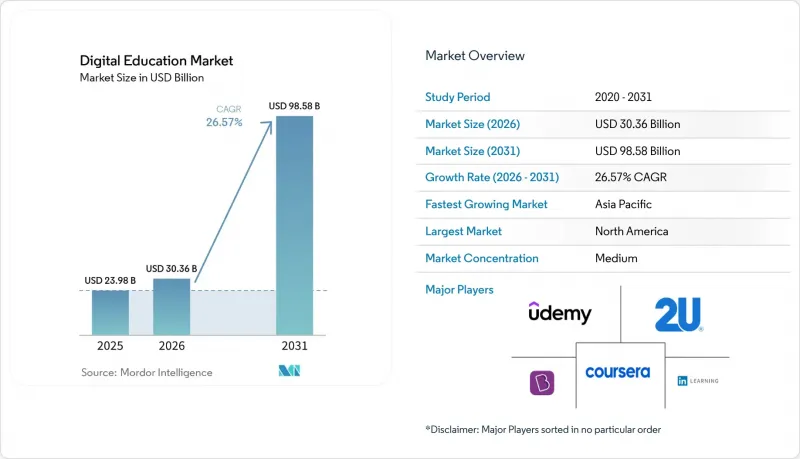
根據 Mordor Intelligence 估計,數位教育市場在 2026 年的價值將達到 303.6 億美元,高於 2025 年的 239.8 億美元,預計到 2031 年將達到 985.8 億美元。
預計從 2026 年到 2031 年,其複合年成長率將達到 26.57%。
本報告按類型(自主線上教育、教師主導的線上教育等)、課程類型(STEM、工商管理等)、最終用戶(教育機構/個人、公司等)、技術(學習管理系統、行動學習應用程式等)、收入模式(訂閱、按課程收費等)和地區進行分類。
全球數位教育市場趨勢與洞察
對靈活學習的需求日益成長
隨著混合辦公模式的興起,同步課堂培訓變得越來越不切實際,企業正在尋求能夠跨時區和跨裝置提供一致教學的平台。到2025年,72%的美國公立學校將採用混合式教學模式,以在課程安排被打亂的情況下保持教學的連續性。自適應引擎能夠根據即時表現數據最佳化學習路徑,使專業人士能夠在不中斷日常工作的情況下提陞技能。金融和軟體開發等知識密集產業現在優先考慮靈活學習,以緩解技能快速過時的問題。由此產生的規模經濟效益使跨國公司能夠在全球範圍內開展培訓,同時保持教育品質的一致性。
政府在數位素養方面的措施和資金
重點公共投資正在加速基礎設施部署和平台應用。亞洲開發銀行已撥款150億美元用於改善當地教育環境,包括教師培訓、設備採購和提供在地化內容。在美國,2024年透過「加速技術實施」津貼提供40萬美元,用於促進全面的數位化計畫。目前,能夠透過分析儀表板視覺化學習成果的供應商更受青睞,這使得現有供應商能夠保持競爭優勢。此外,印度和印尼等市場的「國內優先採購」政策正在造成區域性差異,並改變競爭格局。
高昂的實施成本與數位落差
企業級部署的成本可能在 5 萬至 20 萬美元之間,包括整合、客製化和用戶引導。拉丁美洲和非洲的中小型企業 (SME) 往往由於預算緊張和預期收益不確定而推遲部署。網路連線的差異進一步阻礙了部署效果。在寬頻不穩定的地區,互動式模組可能會出現緩衝或無法運行,從而削弱學習者的信心。這種成本障礙加劇了資金雄厚的大企業和中小企業之間的績效差距。
細分市場分析
到2025年,自主學習模組將佔據數位教育市場40.15%的佔有率,這顯示市場對這種便利的學習方式有著強烈的需求。混合式學習模式正以16.10%的複合年成長率快速發展,企業將數位材料與線下專案結合,以提升員工的實務技能。教師主導的影片課程是對自主學習的補充,為學習者提供了一個無需差旅費用的、按計劃進行的學習框架。混合式學習模式在工程和醫療保健領域尤其普遍,模擬實驗室能夠有效補充理論學習。這種模式兼顧了成本效益和透過小組學習實現的社交強化,使同時支持這兩種學習方式的機構能夠提高客戶留存率和終身價值。
學員期望非同步模組和即時研討會之間能夠無縫銜接。該平台現已整合了涵蓋這兩種學習場景的日程安排工具、分析功能和認證儀錶板。隨著 5G 和雲端基礎設施的日益成熟,利用 VR 和 AR 技術的身臨其境型實驗室正逐漸成為混合式學習計畫的一部分,為遠距學員帶來實踐性的問題解決體驗。
隨著企業持續重視資料科學、人工智慧和網路安全能力,預計到2025年,STEM(科學、技術、工程和數學)領域將佔據數位教育市場37.42%的佔有率。由於全球化和勞動力分散化加劇,跨國計畫需要多語言協作,而語言課程市場正以15.92%的複合年成長率快速成長。管理類課程作為領導力人才培育的重要來源,需求穩定;而藝術和人文課程則吸引許多創新專業人才。雲端運算和DevOps等微證書課程能夠幫助學員快速提陞技能,而無需攻讀學位。
語言學習平台透過整合語音辨識和自適應語法練習,縮短了使用者掌握語言所需的時間。一些供應商將技術學習和語言學習相結合,使軟體開發人員能夠在單一學習路徑中同時掌握程式設計和英語技能,這反映了市場對多技能專業人才的需求。
區域分析
到2025年,北美將佔總收入的31.28%,這反映出該地區企業培訓預算的成熟以及對人工智慧個人化引擎的早期應用。此外,該地區正在試行法律規範,這些框架將塑造全球最佳實踐,使合規方面的專業知識成為供應商的商業性優勢。
亞太地區擁有18億行動用戶,加上政府主導的數位素養目標,預計到2031年將維持14.74%的複合年成長率。中國的「教育現代化計畫」和印度的「數位印度」舉措都在為數位學習基礎設施投入大量資金。在以智慧型手機為中心的市場中,可以直接跳過以桌上型電腦為中心的模式,平台可以以更低的額外成本觸及本地學習者。
在歐洲,隨著企業將培訓納入ESG合規和員工轉型規劃,培訓產業正穩步成長。雖然資料本地化和多語言內容的要求日益複雜,但也有助於保護本土供應商。拉丁美洲、中東和非洲仍處於起步階段,但隨著寬頻普及率的提高和終端成本的降低,成長空間仍然龐大。
其他好處:
- Excel格式的市場預測(ME)表
- 3個月的分析師支持
目錄
第1章:引言
- 市場定義與研究假設
- 調查範圍
第2章:調查方法
第3章執行摘要
第4章 市場狀況
- 市場概覽
- 市場促進因素
- 對靈活學習的需求日益成長
- 政府在數位素養方面的措施和資金
- 行動網際網路普及率的提升
- 微證書的普及
- 提升以 ESG(環境、社會和治理)原則為驅動的公司員工的技能。
- 人工智慧驅動的個人化學習成果
- 市場限制因素
- 高昂的實施成本與數位落差
- 內容在地化和語言障礙
- 加強教育科技平台的資料隱私監管
- 學歷證書價格的上漲正在削弱其在人們眼中的價值。
- 價值供應鏈分析
- 重要法規結構的評估
- 技術展望
- 波特五力分析
- 宏觀經濟因素的影響
- 對關鍵相關人員的影響評估
第5章 市場規模與成長預測
- 不同的學習模式
- 線上教育,讓您可以按照自己的步調學習。
- 教師主導的線上教育
- 混合式/融合式學習
- 依課程類型
- STEM
- 商業管理
- 藝術與人文
- 語言學習
- 其他課程
- 最終用戶
- 學術機構和個人
- 公司
- 政府和非營利組織
- 職業訓練中心
- 透過技術
- 學習管理系統(LMS)
- 行動學習應用
- 虛擬實境與擴增實境(XR)
- 人工智慧(AI)和自適應學習
- 其他
- 按收入模式
- 基於訂閱
- 每門課程收費
- 免費增值模式與廣告收入模式
- 企業許可
- 按地區
- 北美洲
- 美國
- 加拿大
- 墨西哥
- 南美洲
- 巴西
- 阿根廷
- 其他南美國家
- 歐洲
- 德國
- 英國
- 法國
- 義大利
- 西班牙
- 俄羅斯
- 其他歐洲國家
- 亞太地區
- 中國
- 日本
- 印度
- 韓國
- 澳洲和紐西蘭
- 其他亞太國家
- 中東和非洲
- 中東
- 沙烏地阿拉伯
- UAE
- 土耳其
- 其他中東國家
- 非洲
- 南非
- 奈及利亞
- 肯亞
- 其他非洲國家
- 中東
- 北美洲
第6章 競爭情勢
- 市場集中度
- 策略趨勢
- 市佔率分析
- 公司簡介
- Coursera, Inc.
- 2U, Inc.
- Udemy, Inc.
- LinkedIn Learning(Microsoft Corporation)
- BYJU'S(Think and Learn Pvt Ltd)
- Udacity, Inc.
- Khan Academy, Inc.
- DataCamp, Inc.
- Intellipaat Software Solutions Pvt Ltd
- FutureLearn Limited
- Pluralsight, Inc.
- edX LLC
- Chegg, Inc.
- Skillshare Inc.
- Teachable, Inc.
- Simplilearn Solutions Pvt Ltd
- Codecademy(Skillsoft Corp.)
- Skillsoft Corp.
- Alison
- OpenSesame Inc.
- Moodle Pty Ltd
- Blackboard Inc.
- Docebo Inc.
- SAP Litmos
- Instructure Inc.
第7章 市場機會與未來趨勢
- 評估未開發的領域和未滿足的需求
According to Mordor Intelligence, digital education market size in 2026 is estimated at USD 30.36 billion, growing from 2025 value of USD 23.98 billion with 2031 projections showing USD 98.58 billion, growing at 26.57% CAGR over 2026-2031.
This report is Segmented by Type (Self-Paced Online Education, Instructor-Led Online Education, and More), Course Type (STEM, Business Management, and More), End-User (Academic Institutions and Individuals, Enterprises, and More), Technology (Learning Management Systems, Mobile Learning Apps, and More), Revenue Model (Subscription-Based, Pay-Per-Course, and More) and Geography.
Global Digital Education Market Trends and Insights
Rising Demand for Flexible Learning
Hybrid work models make synchronous classroom training impractical, so enterprises seek platforms that deliver consistent instruction across time zones and devices. In 2025, 72% of United States public schools integrated blended approaches to maintain continuity during schedule disruptions . Adaptive engines tailor pathways to real-time performance data, letting professionals reskill without halting day-to-day operations. Knowledge-intensive industries such as finance and software development now prioritize flexible learning to mitigate rapid skill obsolescence. The resulting scale efficiencies help multinational firms roll out global training while holding instructional quality steady.
Government Initiatives and Funding for Digital Literacy
Targeted public investment accelerates infrastructure rollouts and platform adoption. The Asian Development Bank earmarked USD 15 billion for regional education upgrades that include teacher training, device procurement, and localized content delivery . In the United States, the Stepping-up Technology Implementation grant disbursed USD 400,000 to advance inclusive digital programs in 2024. Preference now leans toward providers that can document learning outcomes through analytics dashboards, giving established vendors an edge. Domestic-first procurement in markets such as India and Indonesia also creates regional carve-outs that alter the competitive map.
High Implementation Costs and Digital Divide
Enterprise-grade rollouts can cost between USD 50,000 and USD 200,000 for integration, customization, and user onboarding. Smaller businesses in Latin America and Africa often delay adoption because expected returns are uncertain when budgets are tight. Connectivity gaps further hamper efficacy: where broadband reliability is low, interactive modules buffer or fail, undermining learner trust. The cost hurdle widens the performance gap between well-funded corporations and SMEs.
Other drivers and restraints analyzed in the detailed report include:
- Growing Mobile-Internet Penetration
- AI-Driven Personalised Learning Outcomes
- Rising Data-Privacy Scrutiny on Ed-Tech Platforms
For complete list of drivers and restraints, kindly check the Table Of Contents.
Segment Analysis
Self-paced modules retained 40.15% share of the digital education market size in 2025, demonstrating enduring preference for anytime access. The blended model is scaling fastest at 16.10% CAGR as enterprises combine digital coursework with in-person projects to sharpen applied skills. Instructor-led video sessions complement self-paced reading, giving learners the structure of scheduled touchpoints without travel costs. Hybrid adoption is particularly strong in engineering and healthcare where simulation labs augment theory. This configuration balances cost efficiency with the social reinforcement of cohort learning, so providers that support both modalities increase stickiness and lifetime value.
Learners expect a seamless handoff between asynchronous modules and live workshops. Platforms now embed scheduling tools, analytics, and credential dashboards that span both contexts. As 5G and cloud infrastructure mature, immersive labs using VR or AR become part of hybrid programs, bringing tactile problem solving to remote audiences.
STEM disciplines represented 37.42% of the digital education market share in 2025 because firms continue to prioritize data science, AI, and cybersecurity competencies. Globalization and distributed workforces fuel a 15.92% CAGR in language offerings as multinational projects require multilingual collaboration. Business management content remains steady, supplying leadership pipelines, while arts and humanities attract niche creative professionals. Micro-credential tracks in cloud computing and DevOps enable rapid upskilling without full degree commitments.
Language platforms integrate speech recognition and adaptive grammar exercises to compress mastery timelines. Some vendors combine technical and language learning so software developers can gain both coding and English proficiency in a single pathway, reflecting demand for multi-skill professionals.
Complete Report Scope:
- By Learning Mode
- Self-paced Online Education
- Instructor-led Online Education
- Blended / Hybrid Learning
- By Course Type
- STEM
- Business Management
- Arts and Humanities
- Language Learning
- Other Courses
- By End-user
- Academic Institutions and Individuals
- Enterprise
- Government and Non-profits
- Vocational Training Centres
- By Technology
- Learning Management Systems (LMS)
- Mobile Learning Apps
- Virtual and Augmented Reality (XR)
- Artificial Intelligence and Adaptive Learning
- Others
- By Revenue Model
- Subscription-based
- Pay-Per-Course
- Freemium and Ad-supported
- Corporate Licensing
- By Geography
- North America
- United States
- Canada
- Mexico
- South America
- Brazil
- Argentina
- Rest of South America
- Europe
- Germany
- United Kingdom
- France
- Italy
- Spain
- Russia
- Rest of Europe
- Asia-Pacific
- China
- Japan
- India
- South Korea
- Australia and New Zealand
- Rest of Asia-Pacific
- Middle East and Africa
- Middle East
- Saudi Arabia
- UAE
- Turkey
- Rest of Middle East
- Africa
- South Africa
- Nigeria
- Kenya
- Rest of Africa
- Middle East
- North America
Geography Analysis
North America retained 31.28% of 2025 revenue, reflecting mature enterprise training budgets and early adoption of AI personalisation engines. The region also pilots regulatory frameworks that shape global best practice, making compliance expertise a commercial advantage for vendors.
Asia-Pacific is projected to post a 14.74% CAGR through 2031, fueled by 1.8 billion mobile subscribers and state-led digital-literacy targets. China's Education Modernisation Plan and India's Digital India initiative both earmark significant funding for e-learning infrastructure. Smartphone-first markets enable leapfrogging of desktop-centric models, letting platforms reach rural learners at low incremental cost.
Europe shows steady growth as enterprises embed training within ESG compliance and workforce-transition agendas. Data-localization and multilingual content requirements add complexity but also insulate domestic vendors. Latin America, the Middle East, and Africa remain early-stage yet present upside once broadband density improves and device costs fall.
- Coursera, Inc.
- 2U, Inc.
- Udemy, Inc.
- LinkedIn Learning (Microsoft Corporation)
- BYJU'S (Think and Learn Pvt Ltd)
- Udacity, Inc.
- Khan Academy, Inc.
- DataCamp, Inc.
- Intellipaat Software Solutions Pvt Ltd
- FutureLearn Limited
- Pluralsight, Inc.
- edX LLC
- Chegg, Inc.
- Skillshare Inc.
- Teachable, Inc.
- Simplilearn Solutions Pvt Ltd
- Codecademy (Skillsoft Corp.)
- Skillsoft Corp.
- Alison
- OpenSesame Inc.
- Moodle Pty Ltd
- Blackboard Inc.
- Docebo Inc.
- SAP Litmos
- Instructure Inc.
Additional Benefits:
- The market estimate (ME) sheet in Excel format
- 3 months of analyst support
TABLE OF CONTENTS
1 INTRODUCTION
- 1.1 Market Definition and Study Assumptions
- 1.2 Scope of the Study
2 RESEARCH METHODOLOGY
3 EXECUTIVE SUMMARY
4 MARKET LANDSCAPE
- 4.1 Market Overview
- 4.2 Market Drivers
- 4.2.1 Rising demand for flexible learning
- 4.2.2 Government initiatives and funding for digital literacy
- 4.2.3 Growing mobile?internet penetration
- 4.2.4 Micro-credentialing acceptance
- 4.2.5 Corporate ESG-driven workforce up-skilling
- 4.2.6 AI-driven personalised learning outcomes
- 4.3 Market Restraints
- 4.3.1 High implementation costs and digital divide
- 4.3.2 Content localisation and language barriers
- 4.3.3 Rising data-privacy scrutiny on ed-tech platforms
- 4.3.4 Credential inflation diluting perceived value
- 4.4 Value / Supply-Chain Analysis
- 4.5 Evaluation of Critical Regulatory Framework
- 4.6 Technological Outlook
- 4.7 Porter's Five Forces Analysis
- 4.7.1 Bargaining Power of Suppliers
- 4.7.2 Bargaining Power of Consumers
- 4.7.3 Threat of New Entrants
- 4.7.4 Threat of Substitutes
- 4.7.5 Intensity of Competitive Rivalry
- 4.8 Impact of Macro-economic Factors
- 4.9 Impact Assessment of Key Stakeholders
5 MARKET SIZE AND GROWTH FORECASTS (VALUE)
- 5.1 By Learning Mode
- 5.1.1 Self-paced Online Education
- 5.1.2 Instructor-led Online Education
- 5.1.3 Blended / Hybrid Learning
- 5.2 By Course Type
- 5.2.1 STEM
- 5.2.2 Business Management
- 5.2.3 Arts and Humanities
- 5.2.4 Language Learning
- 5.2.5 Other Courses
- 5.3 By End-user
- 5.3.1 Academic Institutions and Individuals
- 5.3.2 Enterprise
- 5.3.3 Government and Non-profits
- 5.3.4 Vocational Training Centres
- 5.4 By Technology
- 5.4.1 Learning Management Systems (LMS)
- 5.4.2 Mobile Learning Apps
- 5.4.3 Virtual and Augmented Reality (XR)
- 5.4.4 Artificial Intelligence and Adaptive Learning
- 5.4.5 Others
- 5.5 By Revenue Model
- 5.5.1 Subscription-based
- 5.5.2 Pay-Per-Course
- 5.5.3 Freemium and Ad-supported
- 5.5.4 Corporate Licensing
- 5.6 By Geography
- 5.6.1 North America
- 5.6.1.1 United States
- 5.6.1.2 Canada
- 5.6.1.3 Mexico
- 5.6.2 South America
- 5.6.2.1 Brazil
- 5.6.2.2 Argentina
- 5.6.2.3 Rest of South America
- 5.6.3 Europe
- 5.6.3.1 Germany
- 5.6.3.2 United Kingdom
- 5.6.3.3 France
- 5.6.3.4 Italy
- 5.6.3.5 Spain
- 5.6.3.6 Russia
- 5.6.3.7 Rest of Europe
- 5.6.4 Asia-Pacific
- 5.6.4.1 China
- 5.6.4.2 Japan
- 5.6.4.3 India
- 5.6.4.4 South Korea
- 5.6.4.5 Australia and New Zealand
- 5.6.4.6 Rest of Asia-Pacific
- 5.6.5 Middle East and Africa
- 5.6.5.1 Middle East
- 5.6.5.1.1 Saudi Arabia
- 5.6.5.1.2 UAE
- 5.6.5.1.3 Turkey
- 5.6.5.1.4 Rest of Middle East
- 5.6.5.2 Africa
- 5.6.5.2.1 South Africa
- 5.6.5.2.2 Nigeria
- 5.6.5.2.3 Kenya
- 5.6.5.2.4 Rest of Africa
- 5.6.5.1 Middle East
- 5.6.1 North America
6 COMPETITIVE LANDSCAPE
- 6.1 Market Concentration
- 6.2 Strategic Moves
- 6.3 Market Share Analysis
- 6.4 Company Profiles (includes Global level Overview, Market level overview, Core Segments, Financials as available, Strategic Information, Market Rank/Share for key companies, Products and Services, and Recent Developments)
- 6.4.1 Coursera, Inc.
- 6.4.2 2U, Inc.
- 6.4.3 Udemy, Inc.
- 6.4.4 LinkedIn Learning (Microsoft Corporation)
- 6.4.5 BYJU'S (Think and Learn Pvt Ltd)
- 6.4.6 Udacity, Inc.
- 6.4.7 Khan Academy, Inc.
- 6.4.8 DataCamp, Inc.
- 6.4.9 Intellipaat Software Solutions Pvt Ltd
- 6.4.10 FutureLearn Limited
- 6.4.11 Pluralsight, Inc.
- 6.4.12 edX LLC
- 6.4.13 Chegg, Inc.
- 6.4.14 Skillshare Inc.
- 6.4.15 Teachable, Inc.
- 6.4.16 Simplilearn Solutions Pvt Ltd
- 6.4.17 Codecademy (Skillsoft Corp.)
- 6.4.18 Skillsoft Corp.
- 6.4.19 Alison
- 6.4.20 OpenSesame Inc.
- 6.4.21 Moodle Pty Ltd
- 6.4.22 Blackboard Inc.
- 6.4.23 Docebo Inc.
- 6.4.24 SAP Litmos
- 6.4.25 Instructure Inc.
7 MARKET OPPORTUNITIES AND FUTURE TRENDS
- 7.1 White-space and Unmet-need Assessment

 全球數位教育市場規模、佔有率、趨勢和成長分析報告(2026-2034)
 教育評估與測驗市場預測至2034年-全球分析(依評估類型、交付方式、測驗類型、組成部分、應用、最終使用者和地區分類)
 數位教育市場:2026-2032年全球市場預測(按產品/服務、訂閱模式、學習形式、內容類型、技術、部署方式和最終用戶分類)數位教育市場預測至2034年—全球解決方案類型、學習方式、部署方式、設備類型、收入模式、應用、最終用戶和地區分析2034年幼兒教育平台市場預測-全球分析(按組件、學習形式、設備類型、應用、最終用戶和地區分類)
 2026-2030年全球教育產業數位電子看板市場
 翻轉教室市場報告:按產品、最終用戶和地區分類(2026-2034 年)
 數位教育出版:市場佔有率分析、產業趨勢與統計、成長預測(2026-2031)
 2026年全球數位教育市場報告數位教育出版市場:依格式、主題、定價模式、設備、交付方式及最終用戶分類-2026年至2032年全球預測