


 |
市場調查報告書
商品編碼
2099984
越南農業生技藥品市場:市場佔有率分析、產業趨勢與統計、成長預測(2026-2031年)Vietnam Agricultural Biologicals - Market Share Analysis, Industry Trends & Statistics, Growth Forecasts (2026 - 2031) |
||||||

※ 本網頁內容可能與最新版本有所差異。詳細情況請與我們聯繫。
預計越南農業生技藥品市場規模將從 2025 年的 1.6278 億美元和 2026 年的 1.7484 億美元成長到 2031 年的 2.4996 億美元,2026 年至 2031 年的年複合成長率(CAGR)為 7.41%。
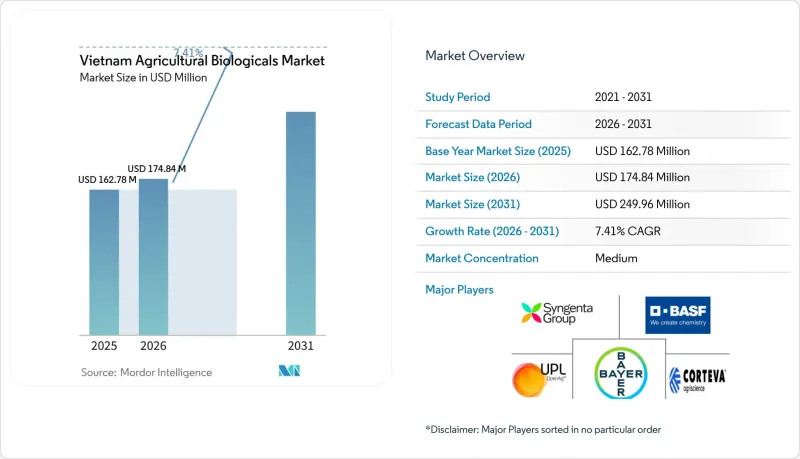
本報告按功能(作物營養和作物保護)和作物類型(大田作物、園藝作物和經濟作物)進行分類。市場預測以價值(美元)和數量(公噸)表示。
越南農業生技藥品市場趨勢及洞察。
擴大零殘留出口作物的種植面積
遵守出口法規仍是越南農業生技藥品市場短期內最明顯的成長要素。越南果蔬供應鏈在出口路線上面臨日益嚴格的殘留物檢測,火龍果、辣椒和秋葵等產品在歐洲市場的檢測頻率已提高。這些壓力促使生產商轉向生物農藥和生物防治措施,因為殘留物記錄現在不僅影響技術合規性,也影響商業性市場進入。 2025年,越南農業與環境部與聯合國糧食及農業組織(糧農組織)合作啟動了一個項目,旨在加強越南實施生物農藥解決方案和基於自然的病蟲害管理的能力。同時,該部正在更新國家批准的植物保護產品登記冊,加快已通過核准生物農藥的商業化進程,並支持更廣泛地採用永續作物保護技術。因此,越南農業生技藥品市場對可追溯投入方案的需求不斷成長,這些方案能夠保障出口的持續性。
政府支持低碳水稻和氣候智慧型農業
越南農業生技藥品市場也受惠於一項由政府主導的水稻種植脫碳計畫。湄公河三角洲地區的試點計畫透過減少種子用量以及減少合成肥料和農藥的使用,在2024年至2025年間將生產成本降低了8.2%至24.2%。 2025年11月,越南農業與環境部製定了藍圖,將在30萬公頃優質水稻產區實施測量、報告和檢驗(MRV)協議。預計這將促進在受監控的種植系統中更廣泛地使用生物來源材料。該計劃意義重大,因為生物來源材料能夠以可追溯的方式向買家和政策項目證明農場合成材料用量的減少。在此背景下,越南的農業生物技術市場與正規的生產模式而非孤立的田間試驗緊密相連。
與合成替代品相比,初始成本較高
高昂的初始產品成本仍是越南農業生技藥品市場推廣應用的最大障礙。由於許多越南農場耕地面積小規模,生產者往往只評估單一種植週期內的投入效益,而非跨越多個種植季。在這種情況下,即使生物來源從長遠來看有助於提高合規性和土壤修復,其成本仍然可能很高。此外,生物來源通常需要及時使用、處理和諮詢支持,這間接增加了缺乏技術支援的生產者的成本。因此,越南農業生物來源市場主要在商業性較高的農場和合作社組織中快速擴張。
細分市場分析
作物保護是越南最大的功能領域,預計2025年將佔越南農業生技藥品市場67.6%的佔有率。這一地位反映了出口導向園藝業和水稻種植系統(這些領域對農藥殘留監測要求較高)對生物農藥的強勁需求。越南生物農藥市場擁有種類繁多的註冊商品名稱。越南農業生技藥品市場受益於法規結構,該框架提高了生物來源活性成分在國家植物保護清單中的重要性。這種監管支持促進了生物解決方案的採用,推動了永續農業實踐,並減少了對化學投入品的依賴。此外,將生物產品納入國家植物保護清單提高了農民獲取和接受這些產品的機會,進一步推動了市場成長。
此細分市場主要由源自微生物的生物農藥驅動,例如蘇力菌、球孢白菌、綠菌和木黴屬真菌,這些微生物已在商業市場佔據穩固地位。儘管生物防治劑的銷售量仍然較低,但在保護性栽培、栽培輔助以及已建立可追溯性標準的領域,其應用正在增加。 「作物營養」是成長最快的細分市場,預計2026年至2031年,該細分市場在越南農業生技藥品市場的規模將以9.4%的複合年成長率成長。這一成長得益於人們對土壤劣化的擔憂、低排放量水稻種植計劃的推廣以及對生物促效劑和生物肥料的需求,以減少對合成肥料的依賴。
其他好處:
- Excel格式的市場預測(ME)表
- 3個月的分析師支持
目錄
第1章:引言
- 研究假設和市場定義
- 調查範圍
第2章:調查方法
第3章:執行摘要和主要發現
第4章 市場狀況與主要產業趨勢
- 有機耕作面積
- 人均有機產品支出
- 法律規範
- 越南
- 價值鍊和通路分析
- 市場促進因素
- 擴大無殘留出口作物的種植面積。
- 政府支持低碳水稻和氣候智慧型農業
- 集約化耕作區土壤健康惡化
- 在高附加價值園藝領域推廣綜合蟲害管理
- 對氣候脅迫、鹽鹼化和作物耐受性的需求。
- 數位農業諮詢有助於產品定位和試驗部署。
- 市場限制因素
- 與合成替代品相比,初始成本較高
- 本地發酵規模的限制以及低溫運輸實施的程度。
- 產品品質參差不齊以及與農民之間缺乏信任
- 註冊延遲和產品採用停滯不前
- 技術展望
- 波特五力模型
第5章 市場規模與成長預測
- 按功能
- 作物營養
- 有機肥料
- 生物肥料
- 生物促效劑
- 作物保護
- 生物農藥
- 生物防治劑
- 作物營養
- 按作物類型
- 大田作物
- 園藝作物
- 經濟作物
第6章 競爭情勢
- 關鍵策略趨勢
- 市佔率分析
- 企業狀況
- 公司簡介
- Bayer AG
- BASF SE
- Syngenta Group
- Corteva, Inc.
- UPL Limited
- FMC Corporation
- Rovensa Next
- Koppert BV
- Biobest Group NV
- Novonesis
- Lallemand Inc.
- Certis Biologicals
- Valagro SpA
- T. Stanes and Company Limited
- PI Industries Limited
第7章:農業生物學領域中相關人員面臨的關鍵策略挑戰
According to Mordor Intelligence, the Vietnam agricultural biologicals market size is projected to expand from USD 162.78 million in 2025 and USD 174.84 million in 2026 to USD 249.96 million by 2031, registering a CAGR of 7.41% between 2026 to 2031.
This report is Segmented by Function (Crop Nutrition and Crop Protection), and by Crop Type (Row Crops, Horticultural Crops, and Cash Crops). The Market Forecasts are Provided in Value (USD) and Volume (Metric Tons).
Vietnam Agricultural Biologicals Market Trends and Insights
Rising Adoption of Residue-Free Export Crops
Export compliance remains the clearest near-term growth driver in the Vietnam agricultural biologicals market. Vietnamese fruit and vegetable supply chains are facing stricter residue checks in export channels, and dragon fruit, chili peppers, and okra have already been subject to elevated inspection frequencies in the European market. That pressure is pushing growers toward biological pesticides and biological control measures because residue records now affect commercial access, not just technical compliance. In 2025, the Ministry of Agriculture and Environment, in collaboration with the Food and Agriculture Organization (FAO), launched a project to strengthen Vietnam's capacity to adopt biological plant protection solutions and nature-based pest management. In parallel, the Ministry updated the national register of permitted plant protection products, facilitating the commercialization of approved biological pesticides and supporting wider adoption of sustainable crop protection technologies. As a result, the Vietnam agricultural biologicals market is gaining demand from growers who need traceable input programs that can support export continuity.
Government Support for Low-Carbon Rice and Climate-Smart Farming
The Vietnam agricultural biologicals market is also being supported by state-led rice decarbonization efforts. Pilot models in the Mekong Delta recorded production-cost reductions of 8.2% to 24.2% between 2024 and 2025, supported by lower seed use and reduced applications of synthetic fertilizers and pesticides. In November 2025, the Ministry of Agriculture and Environment has already agreed on a roadmap to implement Measurement, Reporting, and Verification (MRV) protocols across 300,000 hectares of high-quality rice, which will support the wider use of biological inputs in monitored cultivation systems. This program matters because biologicals help farms show lower synthetic input intensity in a format that buyers and policy programs can track. In this setting, the Vietnam agricultural biologicals market is tied to a formal production model rather than to isolated field trials.
Higher Upfront Cost Versus Synthetic Alternatives
Higher upfront product cost remains the most persistent adoption restraint in the Vietnam agricultural biologicals market. Many Vietnamese farms operate on small landholdings, so growers tend to judge input economics within a single crop cycle instead of across several seasons. In that setting, a biological program can appear expensive even when it supports better compliance or soil recovery over time. Biological products also often require better timing, handling, and advisory support, which adds indirect cost for growers who lack technical assistance. This means the Vietnam agricultural biologicals market still expands fastest among more commercial farms and organized cooperative structures.
Other drivers and restraints analyzed in the detailed report include:
- Soil Health Degradation Across Intensive Cropping Zones
- Expansion of Integrated Pest Management in High-Value Horticulture
- Limited Local Fermentation Scale and Cold-Chain Reach
For complete list of drivers and restraints, kindly check the Table Of Contents.
Segment Analysis
Crop Protection is the largest function, accounting for 67.6% of the Vietnam agricultural biologicals market in 2025. This position reflects strong demand for biopesticides in export-oriented horticulture and in rice systems, where scrutiny of residues is rising. Vietnam's biological crop protection market encompasses a diverse array of registered trade names. The agricultural biologicals market in Vietnam benefits from a regulatory framework that has elevated the prominence of biological active ingredients within the national plant protection list. This regulatory support has encouraged the adoption of biological solutions, fostering sustainable agricultural practices and reducing dependency on chemical inputs. Additionally, the inclusion of biological products in the national plant protection list has enhanced their accessibility and acceptance among farmers, further driving market growth.
The segment is led by microbial-based biopesticides, such as Bacillus thuringiensis, Beauveria bassiana, Metarhizium anisopliae, and Trichoderma species, which are already well established in the commercial market. Biocontrol agents still represent a smaller volume base, but their use is increasing where protected horticulture, training support, and traceability standards are already in place. Crop Nutrition is the fastest-growing segment, and the Vietnam agricultural biologicals market size for this segment is projected to expand at a 9.4% CAGR between 2026 to 2031. That growth is being supported by concerns about soil degradation, low-emission rice programs, and demand for biostimulants and biofertilizers to help reduce dependence on synthetic nutrient programs.
Complete Report Scope:
- By Function
- Crop Nutrition
- Organic Fertilizers
- Biofertilizers
- Biostimulants
- Crop Protection
- Biopesticides
- Biocontrol Agents
- Crop Nutrition
- By Crop Type
- Row Crops
- Horticultural Crops
- Cash Crops
List of Companies Covered in this Report:
- Bayer AG
- BASF SE
- Syngenta Group
- Corteva, Inc.
- UPL Limited
- FMC Corporation
- Rovensa Next
- Koppert B.V.
- Biobest Group NV
- Novonesis
- Lallemand Inc.
- Certis Biologicals
- Valagro S.p.A.
- T. Stanes and Company Limited
- PI Industries Limited
Additional Benefits:
- The market estimate (ME) sheet in Excel format
- 3 months of analyst support
TABLE OF CONTENTS
1 INTRODUCTION
- 1.1 Study Assumptions and Market Definition
- 1.2 Scope of the Study
2 RESEARCH METHODOLOGY
3 EXECUTIVE SUMMARY AND KEY FINDINGS
4 MARKET LANDSCAPE AND KEY INDUSTRY TRENDS
- 4.1 Area Under Organic Cultivation
- 4.2 Per Capita Spending On Organic Products
- 4.3 Regulatory Framework
- 4.3.1 Vietnam
- 4.4 Value Chain And Distribution Channel Annalysis
- 4.5 Market Drivers
- 4.5.1 Rising adoption of residue-free export crops
- 4.5.2 Government support for low-carbon rice and climate-smart farming
- 4.5.3 Soil health degradation across intensive cropping zones
- 4.5.4 Expansion of integrated pest management in high-value horticulture
- 4.5.5 Climate stress, salinity, and crop resilience needs
- 4.5.6 Digital agri-advisory improves product targeting and trial adoption
- 4.6 Market Restraints
- 4.6.1 Higher upfront cost versus synthetic alternatives
- 4.6.2 Limited local fermentation scale and cold-chain reach
- 4.6.3 Inconsistent product quality and farmer trust gaps
- 4.6.4 Slow registration and fragmented product acceptance
- 4.7 Technological Outlook
- 4.8 Porter's Five Forces
- 4.8.1 Threat of New Entrants
- 4.8.2 Bargaining Power of Suppliers
- 4.8.3 Bargaining Power of Buyers
- 4.8.4 Threat of Substitutes
- 4.8.5 Intensity of Competitive Rivalry
5 MARKET SIZE AND GROWTH FORECASTS (VALUE AND VOLUME)
- 5.1 By Function
- 5.1.1 Crop Nutrition
- 5.1.1.1 Organic Fertilizers
- 5.1.1.2 Biofertilizers
- 5.1.1.3 Biostimulants
- 5.1.2 Crop Protection
- 5.1.2.1 Biopesticides
- 5.1.2.2 Biocontrol Agents
- 5.1.1 Crop Nutrition
- 5.2 By Crop Type
- 5.2.1 Row Crops
- 5.2.2 Horticultural Crops
- 5.2.3 Cash Crops
6 COMPETITIVE LANDSCAPE
- 6.1 Key Strategic Moves
- 6.2 Market Share Analysis
- 6.3 Company Landscape
- 6.4 Company Profiles (Includes Global Overview, Market Overview, Core Segments, Financials, Strategic Information, Market Rank/Share, Products And Services, and Recent Developments)
- 6.4.1 Bayer AG
- 6.4.2 BASF SE
- 6.4.3 Syngenta Group
- 6.4.4 Corteva, Inc.
- 6.4.5 UPL Limited
- 6.4.6 FMC Corporation
- 6.4.7 Rovensa Next
- 6.4.8 Koppert B.V.
- 6.4.9 Biobest Group NV
- 6.4.10 Novonesis
- 6.4.11 Lallemand Inc.
- 6.4.12 Certis Biologicals
- 6.4.13 Valagro S.p.A.
- 6.4.14 T. Stanes and Company Limited
- 6.4.15 PI Industries Limited
7 KEY STRATEGIC QUESTIONS FOR AGRICULTURAL BIOLOGICAL STAKEHOLDERS

 2026年全球核糖核酸(RNA)農藥市場報告
 生物合理作物保護(BCP)市場規模、佔有率和成長分析:按產品類型、作物類型、應用方法、最終用戶和地區分類-2026-2033年產業預測
 農業生技藥品市場:按產品類型、原料、應用方法、目標作物、地區和主要參與者分類的趨勢和預測(至 2035 年)
 農業生技藥品市場:2026-2032年全球市場預測(按產品類型、應用方法、原料、製劑、製劑形式、功能、最終用戶和分銷管道分類)
 2034年細菌微生物材料市場預測-按產品類型、細菌菌株、應用方法、用途和地區分類的全球分析
 農業生物製藥:市場佔有率分析、產業趨勢與統計、成長預測(2026-2031)2034年農業生物製品市場預測-按產品類型、原料、作物類型、功能、配方、最終用戶細分市場和地區分類的全球分析
 農業生技藥品市場規模、佔有率、趨勢和預測:按類型、原料、應用方法、用途和地區分類,2026-2034年
 農業生物技術市場:按產品類型、應用方法、用途和地區分類
 動物微生物組市場規模、佔有率和成長分析:按動物種類、產品類型、原料、形態、應用、最終用戶、通路和地區分類——2026-2033年行業預測