


 |
市場調查報告書
商品編碼
2099979
歐洲、中東和非洲(EMEA)生物促效劑種子處理市場:市場佔有率分析、行業趨勢和統計數據、成長預測(2026-2031 年)Europe, Middle East, and Africa (EMEA) Biostimulants Seed Treatment - Market Share Analysis, Industry Trends & Statistics, Growth Forecasts (2026 - 2031) |
||||||

※ 本網頁內容可能與最新版本有所差異。詳細情況請與我們聯繫。
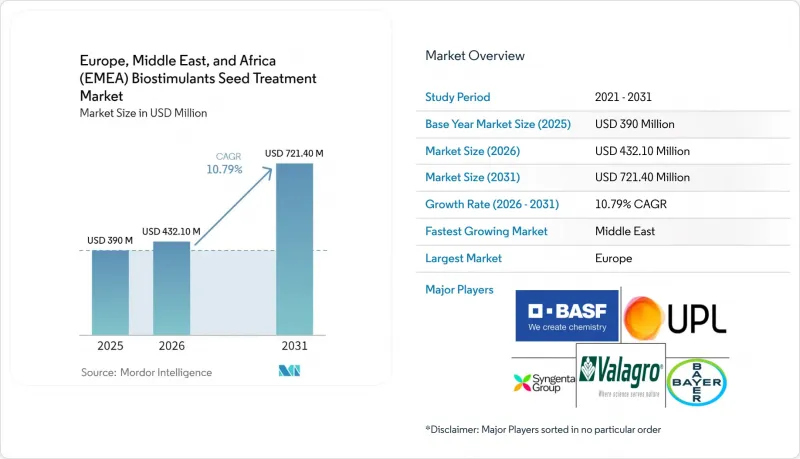
預計到 2025 年,歐洲、中東和非洲 (EMEA) 生物促效劑種子處理市場規模將達到 3.9 億美元,到 2026 年將成長至 4.321 億美元,到 2031 年將達到 7.214 億美元,在 2026 年至 2031 年的預測期內,複合年成長率 10.79%。
本報告按產品類型(腐植酸、胺基酸等)、形態(液體和固體)、施用方法(葉面噴布、種子處理等)、作物類型(穀物、油籽和豆類等)以及地區(歐洲、中東和非洲)進行細分。市場預測以美元計價。
歐洲、中東和非洲 (EMEA) 生物促效劑種子處理市場的趨勢和見解。
作物生長初期對保育的需求日益成長。
作物早期出苗是歐洲、中東和非洲地區種植者關注的重點,這也推動了該地區生物促效劑種子處理市場的需求。生物促效劑在種子處理的應用日益廣泛,旨在提高種子萌發率、促進根系發育、增強養分吸收,並提高幼苗在關鍵早期生長階段的活力。 2025年發表於《生物醫學中心植物生物學》(BMC Plant Biology)的一項研究表明,在溫度條件欠佳的情況下,用植物促生真菌對種子進行生物浸種處理可顯著提高小麥的萌發率和幼苗活力,凸顯了生物種子處理在逆境環境下的重要性。隨著種植者尋求降低種植風險並提高作物均勻度,各大種植體系對生物促效劑種子處理的需求持續成長。
對低殘留種子相關資料進行監管的趨勢日益明顯。
在歐洲、中東和非洲地區(EMEA),生物促效劑種子處理市場正蓬勃發展,這得益於旨在推廣永續和低殘留農業材料的法律規範。其中一個關鍵因素是歐盟的《肥料產品法規》,該法規為生物促效劑制定了統一規則,並簡化了成員國之間的市場准入。 2024年通過的歐盟法規2024/2516引入了對含有生物促效劑的歐盟肥料產品的數位化標籤要求,提高了單一市場的產品透明度和監管效率。這個法規結構鼓勵對符合規定的生物種子處理解決方案進行投資,並為現有生產商拓展了商業化機會。
與傳統的種子處理劑相比,其初始成本較高。
與傳統種子處理方法相比,生物促效劑種子處理方法的高昂初始成本仍然是阻礙其在歐洲、中東和非洲(EMEA)部分地區推廣應用的主要障礙。在非洲和中東部分農業市場,這個問題尤其突出,因為這些地區獲得價格合理的農業融資管道仍然有限。根據小規模農戶和農業中小企業融資與投資網路(SAFIN)發布的《2025年產業趨勢報告》,小規模農戶和農業中小企業的年度資金需求超過3,230億美元,而可用資金僅為950億美元,導致非洲存在巨大的資金缺口。由於資金管道有限,儘管生物來源種子處理方法具有許多農業優勢,但生產者仍不願投資這些成本高昂的技術。
細分市場分析
在歐洲、中東和非洲(EMEA)生物促效劑種子處理市場,預計到2025年,海藻萃取物基種子處理劑將佔據31.2%的最大市場佔有率。海藻萃取物之所以能保持強勁的市場地位,是因為它與多種作物具有良好的兼容性,並且能夠促進養分吸收、根系發育和增強作物對環境脅迫的抵抗力。其在商業農業和特種作物中的成熟應用也為其廣泛推廣提供了支持。腐植酸和胺基酸仍然是重要的產品類型,它們能夠提供互補作用,在不同的栽培條件下提高植物活力和促進作物早期生長。
預計2026年至2031年間,微生物促效劑將以12.5%的複合年成長率(CAGR)達到最高成長。這一成長主要得益於人們對能夠改善作物生長初期根系微生物定殖、提高養分利用效率和增強植物抗逆性的生物解決方案日益成長的興趣。配方技術的進步正在提升產品的穩定性、保存期限以及與現代種子處理流程的兼容性。製造商也在加大研發投入,以提高產品性能和品質的穩定性。隨著種植者尋求符合環境目標和監管要求的永續替代方案,微生物促效劑正被越來越多的農業生產系統所接受。
到2025年,液態包衣劑將佔據最大的市場佔有率,達到68.7%。這些配方之所以備受青睞,是因為它們能夠實現均勻的種子包衣,並能無縫整合到商業性種子加工流程中。與自動化噴塗系統的兼容性使其能夠進行大規模加工,同時確保加工品質的穩定性。這些操作優勢鞏固了液態包衣劑在工業種子加工設施和該地區成熟農業供應鏈中的地位。
預計2026年至2031年間,乾粉製劑市場將以11.2%的複合年成長率達到最高成長。這一成長主要得益於其儲存穩定性、運輸便利性以及對低溫運輸基礎設施薄弱地區的適應性。乾粉製劑在高溫地區和配送條件不穩定的地區具有物流優勢。製造商不斷改進製劑技術,以提高生物活性和產品性能。隨著分銷網路向新興農業市場擴展,預計乾粉製劑將得到更廣泛的認可,從而與液體製劑的優勢形成互補。
其他好處:
- Excel格式的市場預測(ME)表
- 3個月的分析師支持
目錄
第1章:引言
- 研究假設和市場定義
- 調查範圍
第2章:調查方法
第3章執行摘要
第4章 市場狀況
- 市場概覽
- 市場促進因素
- 作物生長初期對保育的需求日益成長。
- 監管機構越來越熱衷於推廣使用低殘留種子。
- 氣候壓力正在加速種子處理技術的應用。
- 精準播種和種子披衣技術的擴展
- 擴大有機農業和再生農業項目
- 本地測試數據和銷售代理培訓提高了轉換率。
- 市場限制因素
- 田間作物生長情況會因土壤和氣候條件而異。
- 與傳統的種子處理方法相比,初始成本較高。
- 療效測試和療效聲明的標準化程度不足。
- 非洲和中東部分地區的小規模農戶技術知識水準較低。
- 監理情勢
- 技術展望
- 波特五力分析
第5章 市場規模與成長預測
- 依產品類型
- 腐植質
- 胺基酸
- 微生物刺激物
- 海藻萃取物
- 其他產品類型
- 按形式
- 液體
- 乾燥
- 透過應用方法
- 葉面噴布
- 種子處理
- 土壤施用
- 按作物類型
- 穀類和穀類食品
- 油籽/豆類
- 水果和蔬菜
- 草坪和景觀美化
- 其他作物類型
- 按地區
- 歐洲
- 德國
- 法國
- 義大利
- 英國
- 俄羅斯
- 其他歐洲國家
- 中東
- 沙烏地阿拉伯
- 阿拉伯聯合大公國
- 以色列
- 土耳其
- 其他中東國家
- 非洲
- 南非
- 埃及
- 摩洛哥
- 其他非洲國家
- 歐洲
第6章 競爭情勢
- 市場集中度
- 策略趨勢
- 市佔率分析
- 公司簡介
- BASF SE
- Bayer AG
- Syngenta Crop Protection AG(Syngenta Group)
- UPL Limited
- Koppert BV
- Novonesis A/S
- Biolchim SpA(JM Huber Corporation)
- Valagro SpA
- FMC Corporation
- Acadian Seaplants Limited
- Seipasa, SA
- Bioiberica, SAU
- Atlantica Agricola, SA
- Sumitomo Chemical Company Limited
- Trade Corporation International, SA
第7章 市場機會與未來展望
According to Mordor Intelligence, the Europe, Middle East, and Africa (EMEA) biostimulants seed treatment market was valued at USD 390.00 million in 2025 and is projected to grow from USD 432.10 million in 2026 to USD 721.40 million by 2031, registering a CAGR of 10.79% during the forecast period from 2026 to 2031.
This report is Segmented by Product Type (Humic Substances, Amino Acids, and More), by Form (Liquid and Dry), by Application Method (Foliar Spray, Seed Treatment, and More), by Crop Type (Cereals and Grains, Oilseeds and Pulses, and More), and by Geography (Europe, The Middle East, and Africa). The Market Forecasts are Provided in Terms of Value (USD).
Europe, Middle East, and Africa (EMEA) Biostimulants Seed Treatment Market Trends and Insights
Increasing Demand for Early-Stage Crop Establishment Protection
Early-season crop establishment has become a primary focus for growers across Europe, the Middle East, and Africa, driving demand in the EMEA biostimulants seed treatment market. Seed-applied biostimulants are increasingly utilized to improve germination, root development, nutrient uptake, and seedling vigor during critical early growth stages. A 2025 study published in BioMed Central (BMC) Plant Biology demonstrated that seed biopriming with plant growth-promoting bacteria significantly enhanced wheat germination and seedling vigor under suboptimal temperature conditions, emphasizing the importance of biological seed treatments in stress-prone environments. As growers aim to mitigate establishment risks and enhance crop uniformity, the demand for biostimulant seed treatments continues to grow across major arable cropping systems.
Rising Regulatory Preference for Low-Residue Seed Inputs
The Europe, Middle East, and Africa (EMEA) biostimulants seed treatment market is experiencing growth due to regulatory frameworks promoting sustainable and low-residue agricultural inputs. A significant factor is the European Union Fertilising Products Regulation, which provides harmonized rules for biostimulants, simplifying market access across member states. Regulation (European Union) 2024/2516, adopted in 2024, introduced digital labeling requirements for European Union (EU) fertilising products, including biostimulants, enhancing product transparency and regulatory efficiency within the single market. This regulatory framework fosters investment in compliant biological seed treatment solutions and expands commercialization opportunities for established manufacturers.
Higher Upfront Cost versus Conventional Seed Treatments
Higher upfront costs compared to conventional seed treatments continue to hinder the adoption of biostimulant-based seed treatments in parts of the Europe, Middle East, and Africa (EMEA) region. This issue is particularly pronounced in Africa and several Middle Eastern agricultural markets, where access to affordable farm financing remains limited. According to the 2025 State of the Sector Report by the Smallholder and Agri-SME Finance and Investment Network (SAFIN), the annual financing demand of smallholder farmers and agricultural SMEs exceeds USD 323 billion, while available financing amounts to only USD 95 billion, resulting in a significant funding gap in Africa. Limited access to capital discourages growers from investing in higher-cost biological seed treatment solutions, despite their agronomic advantages.
Other drivers and restraints analyzed in the detailed report include:
- Climate Stress Intensifies Seed Treatment Adoption
- Expansion of Precision Planting and Seed Coating Technologies
- Low Technical Awareness Among Smallholder Farmers in Parts of Africa and the Middle East
For complete list of drivers and restraints, kindly check the Table Of Contents.
Segment Analysis
Europe, Middle East, and Africa (EMEA) biostimulants seed treatment market, seaweed extract seed treatment accounted for the largest share at 31.2% in 2025. Seaweed extracts maintain a strong position due to their broad compatibility across crop types and their ability to support nutrient uptake, root development, and tolerance to environmental stress. Their established use across commercial agriculture and specialty crops has supported widespread adoption. Humic substances and amino acids also remain important product categories, providing complementary benefits that enhance plant vigor and early-stage crop performance under diverse growing conditions.
Microbial stimulants are forecast to grow at the fastest CAGR of 12.5% from 2026 to 2031. Growth is supported by increasing interest in biological solutions that improve root colonization, nutrient efficiency, and plant resilience during crop establishment. Advances in formulation technologies are improving product stability, shelf life, and compatibility with modern seed treatment processes. Manufacturers are also investing in research and development to strengthen product performance and consistency. As growers seek sustainable alternatives that align with environmental objectives and regulatory requirements, microbial stimulants are gaining greater acceptance across a broad range of agricultural production systems.
The liquid segment accounted for the largest market share of 68.7% in 2025. These formulations are preferred due to their ability to provide uniform seed coverage and their seamless integration into commercial seed treatment operations. Their compatibility with automated application systems enables large-scale processing while ensuring consistent treatment quality. These operational benefits have solidified their position in industrial seed treatment facilities and established agricultural supply chains across the region.
The dry segment is projected to grow at the fastest CAGR of 11.2% from 2026 to 2031. This growth is driven by their storage stability, ease of transportation, and suitability for regions with limited cold-chain infrastructure. Dry formulations offer logistical advantages in areas with high temperatures and inconsistent distribution conditions. Manufacturers are continuously improving formulation technologies to enhance biological viability and product performance. As distribution networks expand into emerging agricultural markets, dry formulations are projected to gain wider acceptance while continuing to complement the dominance of liquid products.
Complete Report Scope:
- By Product Type
- Humic Substances
- Amino Acids
- Microbial Stimulants
- Seaweed Extracts
- Other Product Types
- By Form
- Liquid
- Dry
- By Application Method
- Foliar Spray
- Seed Treatment
- Soil Application
- By Crop Type
- Cereals and Grains
- Oilseeds and Pulses
- Fruits and Vegetables
- Turf and Landscapes
- Other Crop Types
- By Geography
- Europe
- Germany
- France
- Italy
- United Kingdom
- Russia
- Rest of Europe
- Middle East
- Saudi Arabia
- United Arab Emirates
- Israel
- Turkey
- Rest of Middle East
- Africa
- South Africa
- Egypt
- Morocco
- Rest of Africa
- Europe
List of Companies Covered in this Report:
- BASF SE
- Bayer AG
- Syngenta Crop Protection AG (Syngenta Group)
- UPL Limited
- Koppert B.V.
- Novonesis A/S
- Biolchim S.p.A. (J.M. Huber Corporation)
- Valagro S.p.A.
- FMC Corporation
- Acadian Seaplants Limited
- Seipasa, S.A.
- Bioiberica, S.A.U.
- Atlantica Agricola, S.A.
- Sumitomo Chemical Company Limited
- Trade Corporation International, S.A.
Additional Benefits:
- The market estimate (ME) sheet in Excel format
- 3 months of analyst support
TABLE OF CONTENTS
1 Introduction
- 1.1 Study Assumptions and Market Definition
- 1.2 Scope of the Study
2 Research Methodology
3 Executive Summary
4 Market Landscape
- 4.1 Market Overview
- 4.2 Market Drivers
- 4.2.1 Increasing demand for early-stage crop establishment protection
- 4.2.2 Rising regulatory preference for low-residue seed inputs
- 4.2.3 Climate stress intensifies seed treatment adoption
- 4.2.4 Expansion of precision planting and seed coating technologies
- 4.2.5 Growth of organic and regenerative farming programs
- 4.2.6 Local trial data and distributor education improve conversion rates
- 4.3 Market Restraints
- 4.3.1 Inconsistent field performance across soil and weather conditions
- 4.3.2 Higher upfront cost versus conventional seed treatments
- 4.3.3 Limited standardization of efficacy testing and claims
- 4.3.4 Low technical awareness among smallholder farmers in parts of Africa and the Middle East
- 4.4 Regulatory Landscape
- 4.5 Technological Outlook
- 4.6 Porter's Five Forces Analysis
- 4.6.1 Bargaining Power of Suppliers
- 4.6.2 Bargaining Power of Buyers
- 4.6.3 Threat of New Entrants
- 4.6.4 Threat of Substitutes
- 4.6.5 Intensity of Competitive Rivalry
5 Market Size and Growth Forecasts (Value)
- 5.1 By Product Type
- 5.1.1 Humic Substances
- 5.1.2 Amino Acids
- 5.1.3 Microbial Stimulants
- 5.1.4 Seaweed Extracts
- 5.1.5 Other Product Types
- 5.2 By Form
- 5.2.1 Liquid
- 5.2.2 Dry
- 5.3 By Application Method
- 5.3.1 Foliar Spray
- 5.3.2 Seed Treatment
- 5.3.3 Soil Application
- 5.4 By Crop Type
- 5.4.1 Cereals and Grains
- 5.4.2 Oilseeds and Pulses
- 5.4.3 Fruits and Vegetables
- 5.4.4 Turf and Landscapes
- 5.4.5 Other Crop Types
- 5.5 By Geography
- 5.5.1 Europe
- 5.5.1.1 Germany
- 5.5.1.2 France
- 5.5.1.3 Italy
- 5.5.1.4 United Kingdom
- 5.5.1.5 Russia
- 5.5.1.6 Rest of Europe
- 5.5.2 Middle East
- 5.5.2.1 Saudi Arabia
- 5.5.2.2 United Arab Emirates
- 5.5.2.3 Israel
- 5.5.2.4 Turkey
- 5.5.2.5 Rest of Middle East
- 5.5.3 Africa
- 5.5.3.1 South Africa
- 5.5.3.2 Egypt
- 5.5.3.3 Morocco
- 5.5.3.4 Rest of Africa
- 5.5.1 Europe
6 Competitive Landscape
- 6.1 Market Concentration
- 6.2 Strategic Moves
- 6.3 Market Share Analysis
- 6.4 Company Profiles (Includes Global Level Overview, Market Level Overview, Core Segments, Financials as Available, Strategic Information, Market Rank/Share for Key Companies, Products and Services, and Recent Developments)
- 6.4.1 BASF SE
- 6.4.2 Bayer AG
- 6.4.3 Syngenta Crop Protection AG (Syngenta Group)
- 6.4.4 UPL Limited
- 6.4.5 Koppert B.V.
- 6.4.6 Novonesis A/S
- 6.4.7 Biolchim S.p.A. (J.M. Huber Corporation)
- 6.4.8 Valagro S.p.A.
- 6.4.9 FMC Corporation
- 6.4.10 Acadian Seaplants Limited
- 6.4.11 Seipasa, S.A.
- 6.4.12 Bioiberica, S.A.U.
- 6.4.13 Atlantica Agricola, S.A.
- 6.4.14 Sumitomo Chemical Company Limited
- 6.4.15 Trade Corporation International, S.A.
7 Market Opportunities and Future Outlook

 全球生物種子處理市場規模、佔有率、趨勢和成長分析報告(2026-2034)
 生物種子加工市場報告:趨勢、預測與競爭分析(至2035年)
 生物種子處理市場:預測至2034年-按產品類型、活性成分、作物類型、應用方法和地區分類的全球分析
 2026年全球生物種子處理市場報告
 生物種子處理市場:按功能、作物類型和地區分類
 青貯發酵接種劑市場按類型、作物類型、劑型、最終用戶和分銷管道分類,全球預測(2026-2032年)
 全球生物種子處理市場佔有率分析、產業趨勢與統計、成長預測(2025-2030)生物種子處理市場:2025-2030 年預測