


 |
市場調查報告書
商品編碼
2099958
工業和物聯網應用DRAM:市場佔有率分析、行業趨勢和統計數據以及成長預測(2026-2031年)DRAM For Industrial and IoT Applications - Market Share Analysis, Industry Trends & Statistics, Growth Forecasts (2026 - 2031) |
||||||

※ 本網頁內容可能與最新版本有所差異。詳細情況請與我們聯繫。
根據 Mordor Intelligence 預測,工業和物聯網應用領域 DRAM 的市場規模預計將在 2025 年達到 31.8 億美元,2026 年達到 35.1 億美元,到 2031 年達到 63.2 億美元,2026 年至 2031 年的複合年成長率為 12.48%。
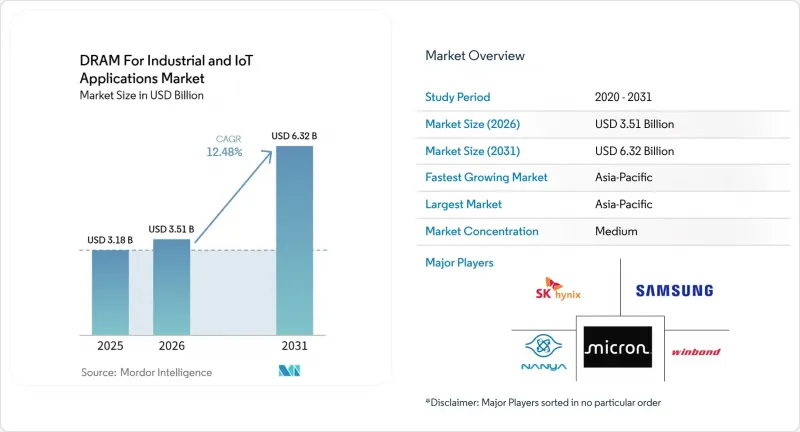
本報告按架構(DDR3、DDR4、DDR5 等)、製程節點(20 奈米及以上、19 奈米至 10 奈米等)、容量(4 GB 至 8 GB、8 GB 至 16 GB 等)、最終用途(工業用電腦和控制器、工業自動化系統等)以及地區(北美、亞太等)進行細分。市場預測以美元 (USD) 為單位。
全球DRAM市場趨勢及工業與物聯網應用洞察
不斷成長的工業邊緣人工智慧工作負載
工業和物聯網應用領域的DRAM市場正因人工智慧推理工作負載從集中式伺服器轉移到工廠現場設備的轉移而直接推動。智慧攝影機、偵測站、機器人控制器和工業閘道器現在都在本地處理更多數據,導致即使在運算能力達到極限之前,記憶體頻寬需求也隨之增加。邊緣人工智慧與視覺聯盟指出,在執行偵測、追蹤和分割的多攝影機工作負載中,LPDDR5X的頻寬預算可能在神經處理資源被充分利用之前就已耗盡。 NVIDIA也正在推廣其IGX Thor工業平台,該平台配備約128GB的LPDDR5X內存,支援全DRAM ECC糾錯,頻寬高達273GB/s,旨在強調內存正成為機器人、醫療和工廠自動化環境中系統設計的核心要素。業內人士也指出,整體人工智慧應用中LPDDR4X和LPDDR5X的供不應求依然存在,這表明記憶體正逐漸被視為一種受限的生產投入,而不僅僅是普通的材料清單(頻寬)項目。隨著這一趨勢的蔓延,工業和物聯網應用領域的 DRAM 市場可能會更青睞那些能夠將頻寬、ECC 保護和供貨保證打包提供的供應商,而不是僅僅銷售容量記憶體的供應商。
快速認證低功耗DDR5和LPDDR5X模組
此外,以工業和物聯網應用為導向的DRAM市場正受益於DDR5和LPDDR5X模組認證流程的加速,這些模組適用於嵌入式和航太。 2026年3月,研華科技進一步推動了這一趨勢,發布了面向智慧城市、國防和工業自動化的SQRAM DDR5 7,200 MT/s系列產品。此系列產品容量高達64 GB,動作溫度範圍為-25 度C至95 度C 。隨後,在2025年10月,JEDEC發布了JESD400-5D 1.4版本更新,增加了對高達9200 MT/s DDR5速度的支持,並正式定義了工業檢驗程序開展長期產品週期所需的SOCAMM2外形尺寸。這縮短了主流記憶體產品與工業領域應用之間的時間差。同時,也增強了那些已經熟悉如何針對多種外形尺寸的產品進行工業機械、散熱和可靠性檢驗的供應商的地位。
DRAM價格週期性和分配風險
由於供應緊張和採購不穩定,工業和物聯網應用領域的DRAM市場持續面臨明顯的限制。這個問題不再局限於傳統的記憶體週期,因為製造商正將策略重點進一步轉向利潤更高的AI時代產品。三星宣布將於2026年2月開始商業化出貨HBM4,並預計2026年HBM銷量將成長三倍以上。這顯示高階產能正被投入哪些領域。 SK海力士也於2026年6月交付了12層HBM4E的樣品,強調其更高的資料處理速度和卓越的能源效率,以滿足高效能運算的需求。由於尖端晶圓優先分配給這些產品,即使工業買家本身的需求保持穩定,他們取得標準DDR4和DDR5資源的難度也會更大。因此,價格、前置作業時間和資源分配風險仍然是工業和物聯網應用領域DRAM市場的阻礙因素,尤其對於那些沒有長期供應合約的買家而言更是如此。
細分市場分析
截至2025年,DDR4將佔據工業和物聯網應用DRAM市場50.71%的佔有率,但DDR5預計到2031年將以13.14%的複合年成長率成長。這一起始點反映了大量工業系統已完成DDR4認證週期,並且仍在長期服務合約下持續生產。工業和物聯網DRAM市場仍然是DDR4的重要市場,因為工廠系統、SCADA平台和嵌入式控制器的運作通常遠遠超出消費產品的典型更換週期。同時,由於DDR5具有頻寬、效率和片上ECC等特性,非常適合邊緣AI推理和更集中的控制功能,因此越來越多的新設計開始採用DDR5。 JEDEC於2024年4月發布的JESD79-5C更新為下一代運算環境增加了關鍵的可靠性、安全性和效能特性,為DDR5在工業專案中的應用奠定了更堅實的標準基礎。
這種轉變並不意味著傳統記憶體會很快消失。 DDR3 仍然在老舊的 PLC、SCADA 系統和低運算負載控制系統中發揮作用,因為在這些系統中,重新設計的成本仍然難以證明其合理性。 LPDDR 的各種變體在緊湊型閘道、無風扇嵌入式系統和空間受限的邊緣節點中變得越來越重要,因為傳統的 DIMM 架構在這些應用中並不實用。因此,工業記憶體負責人正在採取兩種平行策略:一方面維護成熟的平台,另一方面為需要更高吞吐量的系統認證新一代記憶體。工業和物聯網應用的 DRAM 市場正是由這種重疊趨勢所塑造的,因為供應商的價值在於支援系統的延續性和過渡性,而不是強制推行徹底的平台改造。能夠證明其產品符合標準、提供長期供貨保證以及在 DDR4、DDR5 和低功耗格式方面獲得工業檢驗的公司,很可能在這種架構轉型中佔據最有利的地位。
2025年,19nm至10nm製程節點佔據了54.26%的市場佔有率,但預計到2031年,10nm以下EUV製程將以12.68%的複合年成長率成長。這表明,工業和物聯網應用領域的DRAM市場仍然依賴在各種工業產品中提供成本、良率和認證成熟度最佳平衡的製程節點。成熟的生產系統仍然至關重要,因為許多工業應用並不需要最高密度,可靠性、可用性和可預測的採購才是主要的採購標準。另一方面,機器人、機器視覺和高階邊緣伺服器等領域記憶體負載的快速成長將越來越需要更精細製程節點所提供的更高密度和更高頻寬。 2025年9月,SK海力士組裝了業界首個高數值孔徑EUV微影術系統,並將其納入其下一代DRAM藍圖。這表明,未來高效能記憶體的製造基礎正在逐步建立。
從買家的實際角度來看,在記憶體整合快速成長的背景下,先進製程節點至關重要。高頻寬自動化單元、邊緣大規模人工智慧模型和多感測器機器人平台最有可能從10奈米以下製程技術中獲益。相較之下,低密度物聯網終端、通訊模組和傳統控制系統將繼續依賴老一代製程節點較長時間。因此,工業和物聯網應用領域的DRAM市場呈現出兩極化的結構:成熟的製程節點保障了供應穩定性,而EUV微影技術主導的進步則推動了效能的提升。應用基礎的多樣性使得市場難以快速轉型。這也意味著,最具吸引力的機會集中在那些先進製程節點能夠顯著提升每瓦頻寬和每基板密度的領域,而不僅僅是進行微小的技術升級。
區域分析
預計到2025年,亞太地區將佔據工業和物聯網DRAM市場46.53%的佔有率,並在2031年之前以13.19%的複合年成長率成長。該地區的主導地位得益於中國、日本、韓國和台灣地區大規模的製造能力,以及緊密整合的工業OEM生態系統。這種組合使亞太地區在自動化、電子製造和嵌入式系統領域擁有強大的供應能力和大規模的現有需求基礎。韓國繼續保持尤為重要的地位,三星電子和SK海力士於2026年7月決定投資392兆韓元(約2,525億美元)在忠清地區建設新的半導體產業叢集,其中包括HBM製造和先進封裝設施。雖然這項投資與人工智慧時代的記憶體密切相關,但其龐大的規模將進一步增強該地區的製造基礎,從而支撐整個工業和物聯網DRAM市場。
在北美,雖然需求規模較小,但其產品更偏向高階特性。航太和國防電子產品、半導體製造設備、先進醫療設備以及石油和天然氣行業的自動化系統,都比消費性電子產品需要更嚴格的認證標準、更廣泛的熱設計能力和更高的文件標準。美國商務部工業安全局 (BIS) 的規定於 2026 年 1 月 15 日正式生效,該規定改變了先進半導體的許可條件,並將 DRAM 總頻寬的閾值設定在 6,500 GB/s 以下,以便更靈活地處理對華出口。這為記憶體採購決策增加了新的合規性要求。美光公司於 2026 年 5 月宣布擴建其位於維吉尼亞馬納薩斯的製造地,這表明國內供應和可靠的供應商對於美國工業和政府買家至關重要。這將使北美成為工業和物聯網應用 DRAM 高合規性、高階採購市場的重要參與者。
歐洲仍以德國、法國和北歐國家為中心,這些地區的機械、機器人和精密製造OEM廠商需要記憶體來滿足工業功能安全和環境法規的要求。世界其他地區雖然規模較小,但也受益於石油天然氣、採礦、鐵路和交通系統等產業的自動化需求。這些市場主要消費成熟製程節點的中等密度配置,與主要工業經濟體相比,新一代記憶體的普及速度往往較慢。在所有地區,工業和物聯網DRAM市場都受到先進製程節點產能集中度與工業界對穩定、長期供應的廣泛需求之間存在的結構性差異的影響。
其他好處:
- Excel格式的市場預測(ME)表
- 3個月的分析師支持
目錄
第1章:引言
- 研究假設和市場定義
- 調查範圍
第2章:調查方法
第3章執行摘要
第4章 市場狀況
- 市場概覽
- 市場促進因素
- 工業邊緣人工智慧工作負載增加
- 快速認證低功耗DDR5和LPDDR5X模組
- 工業自動化中的基於區域的架構和基於域的架構
- 面向邊緣伺服器的基於 CXL 的記憶體擴展
- 採用耐環境腐蝕且寬溫域相容的記憶體。
- 工業OEM廠商的記憶體供應鏈本地化
- 市場限制因素
- DRAM價格週期性和配置風險
- 惡劣環境下的認證和可靠性挑戰
- 高階記憶體的出口限制和客戶篩選
- 傳統工業平台僅限於DDR3和低密度SKU。
- 產業供應鏈分析
- 監理情勢
- 技術展望
- 宏觀經濟因素對市場的影響
- 波特五力分析
第5章 市場規模與成長預測
- 以建築學為例
- DDR2 及更早版本
- DDR3
- DDR4
- DDR5
- LPDDR
- 其他特殊DRAM
- 按技術領域
- 20奈米或以上
- 19 Nm~10 Nm
- EUV小於10牛頓米
- 按產能
- 4 GB 或更少
- 4 GB~8 GB
- 8 GB~16 GB
- 16 GB 或更多
- 按最終用途
- 工業用電腦和控制器
- 工業自動化系統
- 工業IoT閘道器和邊緣設備
- 機器人與機器視覺
- 工業網路及通訊設備
- 其他工業和物聯網應用
- 按地區
- 北美洲
- 歐洲
- 亞太地區
- 中國
- 日本
- 韓國
- 台灣
- 其他亞太國家
- 世界其他地區
第6章 競爭情勢
- 市場集中度
- 策略趨勢
- 市佔率分析
- 公司簡介
- Samsung Electronics Co., Ltd.
- SK hynix Inc.
- Micron Technology, Inc.
- Nanya Technology Corporation
- Winbond Electronics Corporation
- Apacer Technology Inc.
- ADATA Technology Co., Ltd.
- Innodisk Corporation
- Transcend Information, Inc.
- Kingston Technology Company, Inc.
- G.SKILL International Enterprise Co., Ltd.
- Rambus Inc.
- Renesas Electronics Corporation
- Super Micro Computer, Inc.
- Synology Inc.
- Elite Semiconductor Memory Technology Inc.
- Integrated Silicon Solution, Inc.
- Alliance Memory, Inc.
- GigaDevice Semiconductor Inc.
- ChangXin Memory Technologies, Inc.
第7章 市場機會與未來展望
According to Mordor Intelligence, the DRAM for industrial and IoT applications market size is projected to be USD 3.18 billion in 2025, USD 3.51 billion in 2026, and reach USD 6.32 billion by 2031, growing at a CAGR of 12.48% from 2026 to 2031.
This report is Segmented by Architecture (DDR3, DDR4, DDR5, and More), Technology Node (20 Nm and Above, 19 Nm To 10 Nm, and More), Capacity (4 GB To 8 GB, 8 GB To 16 GB, and More), End-Use Application (Industrial PCs and Controllers, Industrial Automation Systems, and More), and Geography (North America, Asia Pacific, and More). The Market Forecasts are Provided in Terms of Value (USD).
Global DRAM For Industrial and IoT Applications Market Trends and Insights
Rising Industrial Edge AI Workloads
The DRAM for industrial and IoT applications market is gaining direct support from the shift of AI inference workloads from centralized servers to equipment placed on factory floors. Smart cameras, inspection stations, robotics controllers, and industrial gateways now process more data locally, increasing memory bandwidth requirements even before compute limits are reached. The Edge AI and Vision Alliance noted that multi-camera workloads running detection, tracking, and segmentation can exhaust LPDDR5X bandwidth budgets before neural processing resources are fully used. NVIDIA also positioned its IGX Thor industrial platform around 128 GB of LPDDR5X and 273 GB/s of bandwidth with full DRAM ECC, underscoring how memory is becoming a core system design element in robotics, medical, and factory automation environments. The same industry source also described persistent undersupply of LPDDR4X and LPDDR5X across edge AI applications, indicating that memory is increasingly treated as a constrained production input rather than a routine bill-of-materials item. As this pattern spreads, the DRAM for industrial and IoT applications market is likely to reward suppliers that can offer bandwidth, ECC protection, and supply assurance together rather than selling memory only on capacity.
Fast Qualification of Low-Power DDR5 and LPDDR5X Modules
The DRAM for industrial and IoT applications market is also being boosted by faster qualification of DDR5 and LPDDR5X modules for embedded and rugged systems. Innodisk introduced DDR5 CAMM2 and LPDDR5X CAMM2 modules in August 2025 with speeds up to 8,533 MT/s, a footprint 60% smaller than SO-DIMM, and screw-lock mounting for vibration resistance in industrial, transportation, and aerospace use cases. Advantech extended that direction in March 2026 with its SQRAM DDR5 7,200 MT/s series, combining 64 GB capacity with an operating range of -25°C to 95°C for smart city, defense, and industrial automation deployments. JEDEC then published the JESD400-5D version 1.4 update in October 2025, adding support for DDR5 speeds up to 9,200 MT/s and formalizing the SOCAMM2 form factor that industrial validation programs need before committing to long product cycles. This reduces the historical lag between mainstream memory generations and industrial acceptance. It also strengthens the position of suppliers that already know how to validate products for industrial mechanical, thermal, and reliability requirements across multiple form factors.
DRAM Price Cyclicality and Allocation Risk
The DRAM for industrial and IoT applications market still faces clear restraints from allocation pressure and unstable procurement conditions. The issue is no longer just a normal memory cycle, because producers are placing greater strategic focus on AI-era products that deliver higher returns. Samsung began commercial HBM4 shipments in February 2026 and said HBM sales were expected to more than triple in 2026, which shows where premium capacity is being directed. SK hynix also shipped 12-layer HBM4E samples in June 2026 and emphasized higher data processing speeds and better power efficiency to meet the demand for high-performance computing. When advanced wafers favor those products, industrial buyers face tighter access to standard DDR4 and DDR5 resources, even if their own demand remains steady. This keeps pricing, lead times, and allocation risk as ongoing constraints for the DRAM market for industrial and IoT applications, especially for buyers without long-term supply agreements.
Other drivers and restraints analyzed in the detailed report include:
- Zonal and Domain Architectures in Industrial Automation
- CXL-Based Memory Expansion for Edge Servers
- Qualification and Reliability Burden for Harsh Environments
For complete list of drivers and restraints, kindly check the Table Of Contents.
Segment Analysis
DDR4 accounted for 50.71% of the DRAM for industrial and IoT applications market in 2025, while DDR5 is projected to grow at a 13.14% CAGR through 2031. That starting point reflects the large number of industrial systems that completed DDR4 qualification cycles earlier and are still in production with long service commitments. The DRAM for industrial and IoT applications market remains meaningful for DDR4 because factory systems, SCADA platforms, and embedded controllers typically remain active well beyond typical consumer replacement cycles. At the same time, newer designs are increasingly adopting DDR5 because bandwidth, efficiency, and on-die ECC are better aligned with edge AI inference and more centralized control functions. JEDEC's April 2024 JESD79-5C update gave industrial programs a firmer standards base for DDR5 adoption by adding reliability, security, and performance features that matter in next-generation compute environments.
This transition does not mean legacy memory disappears quickly. DDR3 still plays a residual role in older PLCs, SCADA, and low-compute control systems, where redesign costs remain hard to justify. LPDDR variants are becoming more relevant in compact gateways, fanless embedded systems, and tightly constrained edge nodes where conventional DIMM architectures are less practical. Industrial buyers are therefore running two tracks at once, maintaining mature platforms while qualifying newer memory generations for systems that need higher throughput. The DRAM for industrial and IoT applications market is shaped by that overlap because supplier value depends on supporting both continuity and migration rather than forcing a full platform break. Firms that can document standards compliance, long availability, and industrial validation across DDR4, DDR5, and low-power formats are likely to hold the strongest position in this architectural shift.
The 19 nm to 10 nm node range held a 54.26% share in 2025, while EUV below 10 nm is projected to expand at a 12.68% CAGR through 2031. This confirms that the DRAM for industrial and IoT applications market still relies on the node range that best balances cost, yield, and qualification maturity across a wide set of industrial products. Mature production remains important because many industrial applications do not need the highest densities if reliability, availability, and predictable sourcing are the main purchasing criteria. At the same time, faster memory content growth in robotics, machine vision, and high-end edge servers will increasingly need the density and bandwidth gains that come with smaller nodes. SK hynix assembled the industry's first High NA EUV lithography system in September 2025 and linked it to its next-generation DRAM roadmap, which shows how the manufacturing base for future high-performance memory is being built now.
The practical implication for buyers is that advanced nodes matter most when memory intensity is rising quickly. High-bandwidth automation cells, large AI models at the edge, and multi-sensor robotics platforms are likely to absorb the earliest benefits of sub-10 nm production. By contrast, low-density IoT endpoints, communication modules, and conservative control systems will continue to rely on older nodes for longer periods. The DRAM for industrial and IoT applications market, therefore, shows a split structure where mature-node supply supports volume stability and EUV-led advances support performance expansion. This reduces the chance of a sudden market-wide migration because the application base remains diverse. It also means the most attractive opportunities are concentrated in segments where advanced nodes unlock a visible improvement in bandwidth-per-watt or density-per-board rather than only a modest technical upgrade.
Complete Report Scope:
- By Architecture
- DDR2 and Earlier
- DDR3
- DDR4
- DDR5
- LPDDR
- Other Specialized DRAM
- By Technology Node
- 20 Nm and Above
- 19 Nm to 10 Nm
- Below 10 Nm EUV
- By Capacity
- 4 GB and Below
- 4 GB to 8 GB
- 8 GB to 16 GB
- 16 GB and Above
- By End-Use Application
- Industrial PCs and Controllers
- Industrial Automation Systems
- Industrial IoT Gateways and Edge Devices
- Robotics and Machine Vision
- Industrial Networking and Communication Equipment
- Other Industrial and IoT Applications
- By Geography
- North America
- Europe
- Asia Pacific
- China
- Japan
- South Korea
- Taiwan
- Rest of Asia Pacific
- Rest of the World
Geography Analysis
Asia-Pacific held 46.53% of the DRAM for industrial and IoT applications market in 2025 and is projected to grow at a 13.19% CAGR through 2031. The region leads because it combines major fabrication capacity with dense industrial OEM ecosystems in China, Japan, South Korea, and Taiwan. That mix gives Asia-Pacific both supply-side strength and a large installed demand base in automation, electronics manufacturing, and embedded systems. South Korea remains especially important because Samsung Electronics and SK hynix committed KRW 392 trillion (USD 252.5 billion) to a new semiconductor cluster in the Chungcheong region in July 2026, including HBM fabrication and advanced packaging facilities. Even though that investment is closely tied to AI-era memory, its scale reinforces the regional manufacturing base that underpins the broader DRAM for industrial and IoT applications market.
North America presents a smaller but more premium demand profile. Aerospace and defense electronics, semiconductor equipment, advanced medical devices, and oil and gas automation all require stronger qualification, broader thermal support, and higher documentation standards than mass-market electronics. The BIS rule formalized on January 15, 2026 changed export licensing conditions for advanced semiconductors and introduced a total DRAM bandwidth threshold below 6,500 GB/s for exports to China under more flexible treatment, which added a compliance layer to memory sourcing decisions. Micron's manufacturing expansion in Manassas, Virginia, announced in May 2026, shows how domestic supply and secure provenance have become more important for U.S. industrial and government-linked buyers. That gives North America an outsized role in premium, compliance-heavy purchasing within the DRAM for industrial and IoT applications market.
Europe remains centered on Germany, France, and the Nordic countries, where machinery, robotics, and precision manufacturing OEMs need memory that supports industrial functional safety and environmental compliance. The Rest of the World remains smaller, but still benefits from automation demand in oil and gas, mining, rail, and traffic systems. These markets mostly consume mature-node, mid-density configurations and tend to adopt newer memory generations more slowly than the largest industrial economies. Across all regions, the DRAM for industrial and IoT applications market is shaped by the same structural divide between advanced-node capacity concentration and broad industrial demand for stable long-lifecycle supply.
- Samsung Electronics Co., Ltd.
- SK hynix Inc.
- Micron Technology, Inc.
- Nanya Technology Corporation
- Winbond Electronics Corporation
- Apacer Technology Inc.
- ADATA Technology Co., Ltd.
- Innodisk Corporation
- Transcend Information, Inc.
- Kingston Technology Company, Inc.
- G.SKILL International Enterprise Co., Ltd.
- Rambus Inc.
- Renesas Electronics Corporation
- Super Micro Computer, Inc.
- Synology Inc.
- Elite Semiconductor Memory Technology Inc.
- Integrated Silicon Solution, Inc.
- Alliance Memory, Inc.
- GigaDevice Semiconductor Inc.
- ChangXin Memory Technologies, Inc.
Additional Benefits:
- The market estimate (ME) sheet in Excel format
- 3 months of analyst support
TABLE OF CONTENTS
1 INTRODUCTION
- 1.1 Study Assumptions and Market Definition
- 1.2 Scope of the Study
2 RESEARCH METHODOLOGY
3 EXECUTIVE SUMMARY
4 MARKET LANDSCAPE
- 4.1 Market Overview
- 4.2 Market Drivers
- 4.2.1 Rising Industrial Edge AI Workloads
- 4.2.2 Fast Qualification of Low-Power DDR5 and LPDDR5X Modules
- 4.2.3 Zonal And Domain Architectures in Industrial Automation
- 4.2.4 CXL Based Memory Expansion for Edge Servers
- 4.2.5 Ruggedized And Wide-Temperature Memory Adoption
- 4.2.6 Localization of Memory Supply Chains for Industrial OEMs
- 4.3 Market Restraints
- 4.3.1 DRAM Price Cyclicality And Allocation Risk
- 4.3.2 Qualification And Reliability Burden for Harsh Environments
- 4.3.3 Export Controls And Customer Vetting on High-End Memory
- 4.3.4 Legacy Industrial Platforms Lock In DDR3 And Low-Density SKUs
- 4.4 Industry Supply Chain Analysis
- 4.5 Regulatory Landscape
- 4.6 Technological Outlook
- 4.7 Impact of Macroeconomic Factors on the Market
- 4.8 Porter's Five Forces Analysis
- 4.8.1 Threat of New Entrants
- 4.8.2 Bargaining Power of Suppliers
- 4.8.3 Bargaining Power of Buyers
- 4.8.4 Threat of Substitutes
- 4.8.5 Intensity of Competitive Rivalry
5 MARKET SIZE AND GROWTH FORECASTS (VALUE)
- 5.1 By Architecture
- 5.1.1 DDR2 and Earlier
- 5.1.2 DDR3
- 5.1.3 DDR4
- 5.1.4 DDR5
- 5.1.5 LPDDR
- 5.1.6 Other Specialized DRAM
- 5.2 By Technology Node
- 5.2.1 20 Nm and Above
- 5.2.2 19 Nm to 10 Nm
- 5.2.3 Below 10 Nm EUV
- 5.3 By Capacity
- 5.3.1 4 GB and Below
- 5.3.2 4 GB to 8 GB
- 5.3.3 8 GB to 16 GB
- 5.3.4 16 GB and Above
- 5.4 By End-Use Application
- 5.4.1 Industrial PCs and Controllers
- 5.4.2 Industrial Automation Systems
- 5.4.3 Industrial IoT Gateways and Edge Devices
- 5.4.4 Robotics and Machine Vision
- 5.4.5 Industrial Networking and Communication Equipment
- 5.4.6 Other Industrial and IoT Applications
- 5.5 By Geography
- 5.5.1 North America
- 5.5.2 Europe
- 5.5.3 Asia Pacific
- 5.5.3.1 China
- 5.5.3.2 Japan
- 5.5.3.3 South Korea
- 5.5.3.4 Taiwan
- 5.5.3.5 Rest of Asia Pacific
- 5.5.4 Rest of the World
6 COMPETITIVE LANDSCAPE
- 6.1 Market Concentration
- 6.2 Strategic Moves
- 6.3 Market Share Analysis
- 6.4 Company Profiles (includes Global Level Overview, Market Level Overview, Core Segments, Financials as available, Strategic Information, Products and Services, Recent Developments)
- 6.4.1 Samsung Electronics Co., Ltd.
- 6.4.2 SK hynix Inc.
- 6.4.3 Micron Technology, Inc.
- 6.4.4 Nanya Technology Corporation
- 6.4.5 Winbond Electronics Corporation
- 6.4.6 Apacer Technology Inc.
- 6.4.7 ADATA Technology Co., Ltd.
- 6.4.8 Innodisk Corporation
- 6.4.9 Transcend Information, Inc.
- 6.4.10 Kingston Technology Company, Inc.
- 6.4.11 G.SKILL International Enterprise Co., Ltd.
- 6.4.12 Rambus Inc.
- 6.4.13 Renesas Electronics Corporation
- 6.4.14 Super Micro Computer, Inc.
- 6.4.15 Synology Inc.
- 6.4.16 Elite Semiconductor Memory Technology Inc.
- 6.4.17 Integrated Silicon Solution, Inc.
- 6.4.18 Alliance Memory, Inc.
- 6.4.19 GigaDevice Semiconductor Inc.
- 6.4.20 ChangXin Memory Technologies, Inc.
7 MARKET OPPORTUNITIES AND FUTURE OUTLOOK
- 7.1 White-Space and Unmet-Need Assessment

 工業IoT市場:按服務、解決方案、平台類型、產業和地區分類
 全球工業IoT市場規模、佔有率、趨勢和成長分析報告(2026-2034)
 物聯網硬體調查服務物聯網市場研究服務
 工業IoT閘道市場預測至2034年-全球分析(依閘道器類型、連接方式、元件、硬體類型、技術、應用、最終用戶和地區分類)
 工業IoT閘道市場-2026-2032年全球市場預測Frost Radar™:工業連接軟體,2026 年工業IoT市場-2026-2032年全球市場預測工業物聯網平台市場-2026-2032年全球市場預測物聯網(IoT)市場-2026-2032年全球市場預測