


 |
市場調查報告書
商品編碼
2099867
CXL訊號調理/重定時器IC:市場佔有率分析、產業趨勢與統計資料、成長預測(2026-2031年)CXL Signal Conditioner and Retimer IC - Market Share Analysis, Industry Trends & Statistics, Growth Forecasts (2026 - 2031) |
||||||

※ 本網頁內容可能與最新版本有所差異。詳細情況請與我們聯繫。
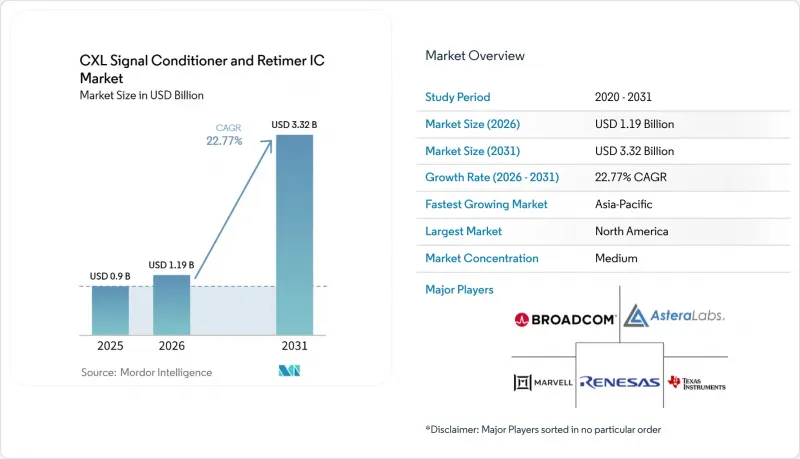
根據 Mordor Intelligence 預測,CXL 訊號調節器和重定時器 IC 市場規模預計在 2025 年達到 9 億美元,2026 年達到 11.9 億美元,到 2031 年達到 33.2 億美元,2026 年至 2031 年的複合年成長率為 22.77%。
本報告按產品類型(例如,CXL相容的重定時器IC)、PCIe/CXL版本相容性(例如,PCIe 6.0/CXL 3.X相容)、部署模式(例如,整合在轉接卡和擴充板上的IC)、應用(例如,AI和GPU加速伺服器)、最終用戶(例如,超大規模資料中心業者)和地區進行細分。市場預測以美元(USD)計價。
全球CXL訊號調理器及重定時器IC市場趨勢及洞察
AI伺服器機架密度的增加導致頻道損耗容忍度的提高。
到2025年,最新的AI加速器機架(每個機架可容納72個GPU系統)的功耗將超過150千瓦。微軟的研究表明,加速器機架的功耗成長速度遠遠超過典型的運算和儲存機架。這種功耗變化對CXL訊號調理器和重定時器IC市場具有重大影響,因為更高密度的機架需要在更緊湊的散熱和物理佈局中實現更多的高速鏈路。隨著PCIe 6.0速度的提升,標準基板材料的承載能力限制日益嚴峻,在許多伺服器路徑中,訊號恢復已不再可行。因此,不僅對CXL訊號調理器和重定時器IC的需求量會增加,而且它們在高階AI系統中GPU-CPU、GPU-記憶體和GPU-網路連結中的部署也將進一步擴展。隨著機架架構在未來幾年向更大的功耗範圍發展,對確定性鏈路完整性的需求預計將在新一代平台上持續推動CXL訊號調理器和重定時器IC市場的發展。
PCIe 6.0 和 CXL 3.0 的採用使得協定感知訊號恢復成為必要。
從 PCIe 5.0 到 PCIe 6.0 的過渡改變了重定時器的要求。這是因為 PAM4 訊號和基於 FLIT 的操作增加了鏈路恢復裝置的技術負擔。這項變更正在推動 CXL 訊號調理器重定時器 IC 市場的發展,因為供應商現在必須在整個 AI 和儲存架構中實現更嚴格的延遲、合規性和互通性目標。 2026 年 6 月,Microchip Technology 推出了符合 PCIe 6.0 和 CXL 3.1 標準的重定時器,其引腳間延遲小於 12 ns,這表明低延遲合規性是高級部署中的一個重要採購因素。 CXL 聯盟也在 2025 年 11 月發布了 CXL 4.0 規範,這意味著即使 CXL 3.x 的部署範圍更廣,產品週期也在縮短。這個標準開發週期的縮短將使供應商受益,他們可以快速完成從設計到認證再到量產的整個過程。此外,隨著伺服器平台繼續向第六代過渡並為下一代做準備,協定感知訊號恢復技術將繼續在 CXL 訊號調節器和重定時器 IC 市場中佔據中心地位。
PCI-SIG 和 CXL 合規性所需的高檢驗負擔導致設計採用延遲。
PCI-SIG 和 CXL 合規性要求為重定時器從晶片上市到最終獲得商業化應用認證的整個流程增加了多個測試階段。 CXL 聯盟的合規性框架採用結構化的測試活動和互通性階段,要求供應商使用生態系統硬體和參考系統進行檢驗。這項流程延長了產品從完成到商業部署的時間,縮小了 CXL 訊號調理器重定時器 IC 市場中每一代產品的獲利機會。對於中小供應商而言,這項負擔更為沉重,因為他們通常缺乏專門的合規團隊和有限的實驗室能力來縮短迭代周期。這種情況往往會進一步鞏固那些已經累積了多代認證經驗和客戶信任的供應商的地位。因此,儘管技術性能至關重要,但誰能率先實現量產往往取決於誰為這個市場的認證做好了充分的準備。
細分市場分析
2025年,符合CXL標準的重定時器IC佔據了產品類型細分市場的84.12%,在CXL訊號調理器和重定時器IC的需求中保持著穩固的核心地位。如此高的市場佔有率反映了這些IC在AI伺服器基板、線纜組件和記憶體擴展硬體中的關鍵作用,這些應用需要以第五代和第六代速度進行完全協議感知的重整化。此外,由於超大規模資料中心業者通常會對重定時器供應商進行長期檢驗,一旦平台進入量產階段,就很難更換已通過核准的裝置,因此該市場的基礎仍然保持穩定。從實際角度來看,2025年如此高的市場佔有率表明,CXL訊號調理器和重定時器IC產業仍然優先考慮完全重整化,而非更簡單的調理方法。這也表明,該市場的產品領先地位不僅與通道性能密切相關,還與認證的深度密切相關。
訊號調理器和重驅動器 IC 在短距離應用中仍然發揮著至關重要的作用,例如在擴展卡、儲存背板和企業級附加板等無需完整重定時器功能的應用中。預計到 2031 年,主動式訊號調節IC 的複合年成長率將達到 23.37%,使其成為 CXL 訊號調理器和重定時器 IC 市場細分領域中成長最快的產品類型。這一成長主要得益於它們在主動電纜組件和智慧電纜模組中的應用,這些組件和模組透過機架之間的銅纜鏈路傳輸 PCIe 6.0 訊號。 2026 年 1 月,Montage Technology 擴展了其產品策略,推出了與一家中國電纜製造商共同開發的、符合 PCIe 6.x 和 CXL 3.x 標準的主動電纜解決方案,該方案已通過 CPU、xPU、PCIe 交換器和網路卡的檢驗。此舉意義重大,因為部分商機正從基板插槽轉向基於電纜的互連層。此外,這將擴大 CXL 訊號調理器/重定時器 IC 市場的產品陣容,而不會影響重定時器在性能至關重要的鏈路中的核心作用。
截至2025年,PCIe 5.0和CXL 1.x-2.0相容的積體電路佔據了該細分市場66.83%的佔有率,這意味著儘管傳統平台正不斷向新一代平台遷移,但傳統平台仍佔據出貨量的主導地位。這種情況反映了Hopper一代人工智慧伺服器的持續生產,以及超大規模和新雲端資料中心中已存在的大規模部署基礎。因此,即使新平台正在為向第六代伺服器過渡做準備,CXL訊號調理器和重定時器積體電路市場在進入2026年時仍然受益於現有伺服器的強勁需求。如此龐大的部署基礎意義重大,因為大規模雲端環境的更新週期並非瞬時完成,經過檢驗的系統會持續產生數季的需求。這也解釋了為什麼市場在新規範發布後並沒有立即完全過渡到最新的兼容級別。
預計到 2031 年,PCIe 6.0 和 CXL 3.x 相容 IC 的複合年成長率將達到 23.54%,使其成為 CXL 訊號調理器重定時器 IC 市場中成長最快的相容性類別。這一成長主要由將於 2026 年全面投產的新型 AI 伺服器平台以及 64 GT/s 更高訊號恢復精度的技術需求所驅動。英特爾的「PCIe 6.0 重定時器補充封裝」支援跨代引腳相容的重定時器遷移,從而簡化了升級路徑,減輕了伺服器開發人員重新設計的負擔。博通的重定時器產品概述「BCM85667」強調了與此封裝的兼容性,顯示供應商在產品定位上既注重平台連續性,也注重效能。因此,對於希望在多個產品週期內延長認證有效期的 ODM 和 OEM 而言,多代設計是一種切實可行的採購選擇。因此,在相容性方面,目前的出貨量仍然嚴重偏向第五代產品,但未來的成長將越來越取決於第六代產品的採用以及具有更廣泛向下相容性的設計策略。
區域分析
到2025年,北美將佔全球需求的49.07%,佔據CXL訊號調理器重定時器IC市場的最大佔有率。該地區仍然是建構超大規模AI資料中心的關鍵樞紐,並保持著重定時器消費量的領先地位。此外,該地區在架構方面也具有顯著影響力,因為總部位於美國的超大規模資料中心業者通常會制定平台需求,這些需求隨後會影響到亞洲各地的OEM和ODM供應鏈。這意味著北美的需求不僅影響當地的出貨量,也影響全球供應商的認證流程和產品優先順序。
歐洲,尤其是德國、英國和法國,發揮了重要作用。超級運算中心、大規模私有雲端環境和伺服器設計營運支撐著對先進組合式基礎架構。這為CXL訊號調理器和重定時器IC市場創造了穩定的歐洲需求基礎,該需求與架構採用密切相關,而不僅僅是雲端建構量。歐洲在認證和平台工程方面也至關重要,設計中心和基礎設施營運商在伺服器平台的配置方面發揮著舉足輕重的作用,並始終將效能和效率放在首位。
預計到2031年,亞太地區將以23.77%的複合年成長率(CAGR)實現最高成長,成為CXL訊號調理器和重定時器IC市場規模成長最快的地區。在中國,當地企業正積極進軍重定時器市場,例如,蒙太奇科技已提供相容於PCIe 6.x和CXL 3.x的重定時器樣品,並推出用於下一代資料中心互連的主動電纜解決方案。台灣憑藉其ODM和IC設計生態系統繼續發揮核心作用,而韓國也因其記憶體和模組生態系統支援下游CXL應用而至關重要。日本也憑藉其在更廣泛的伺服器連接鏈中的訊號調理和定時組件方面的技術能力做出貢獻。南美、中東和非洲雖然目前規模較小,但隨著這些地區雲端運算和國家主導的人工智慧基礎設施的普及,對高速伺服器硬體的需求將進一步刺激,因此它們將在預測期內繼續佔據重要的結構性地位。隨著平台成本趨於正常化,認證能力也更加普及,預計這些地區將在 CXL 伺服器和記憶體架構部署的後期階段發揮更大的作用。
其他好處:
- Excel格式的市場預測(ME)表
- 3個月的分析師支持
目錄
第1章:引言
- 研究假設和市場定義
- 調查範圍
第2章:調查方法
第3章執行摘要
第4章 市場狀況
- 市場概覽
- 市場促進因素
- AI伺服器機架密度的不斷增加推高了頻道損耗預算。
- 採用 PCIe 6.0 和 CXL 3.0 需要協定感知訊號恢復。
- 對超大規模記憶體池的需求正在推動對低延遲 CXL 連接的需求不斷成長。
- 相容於第六代重定時器的重定時器正成為新型人工智慧平台的設計標準。
- 基於晶片組的系統結構增加了基板之間的互連數量。
- 互通性測試的成本推高了更換認證供應商的成本。
- 市場限制因素
- 與 PCI-SIG 和 CXL 合規性相關的重大檢驗負擔導致設計採用延遲。
- 標準的快速修訂增加了產品過時的風險。
- 在高密度伺服器主機板上的部署受到功耗和散熱限制。
- 改進片上 PHY 並支援整合 CPU 可能會降低對獨立重定時器的需求。
- 供應鏈分析
- 監理情勢
- 技術展望
- 波特五力分析
第5章 市場規模與成長預測
- 依產品類型
- CXL相容型重定時器IC
- CXL相容訊號調理/重驅動積體電路
- CXL相容型主動式訊號調理積體電路
- PCIe/CXL 各代產品之間的兼容性
- 相容於 PCIe 5.0/CXL 1.x 至 2.0
- 相容於 PCIe 6.0/CXL 3.x
- 相容於 PCIe 7.0/CXL 4.0
- 具有跨多代向下相容性的積體電路
- 依部署類型
- 分離基板級重定時器/訊號調理器積體電路
- 用於轉接卡和擴充板的嵌入式積體電路
- 用於主動式電纜和智慧電纜模組的嵌入式積體電路
- 連接器整合、背板整合和底盤整合整合電路
- 透過使用
- AI 和 GPU 加速伺服器
- 高效能運算和超級運算系統
- 超大規模和雲端運算伺服器
- CXL 記憶體擴充和記憶體池平台
- 企業和私有雲端伺服器
- CXL 光纖交換器和可組合基礎設施
- 儲存、JBOF 和支援 CXL 的儲存設備
- 主動式電纜和機架級互連平台
- 最終用戶
- 超大規模資料中心業者
- 雲端服務供應商和新型雲端服務供應商
- 伺服器、儲存和網路 OEM 製造商
- ODM和系統平台製造商
- 高效能運算中心、研究機構、超級運算設施
- 大型企業和私有雲端供應商
- 通訊業者、邊緣雲端供應商、主機業者
- 按地區
- 北美洲
- 美國
- 加拿大
- 墨西哥
- 歐洲
- 德國
- 英國
- 法國
- 義大利
- 其他歐洲國家
- 亞太地區
- 中國
- 日本
- 韓國
- 印度
- 東南亞
- 其他亞太國家
- 南美洲
- 中東和非洲
- 北美洲
第6章 競爭情勢
- 市場集中度
- 策略趨勢
- Vendor Positioning Analysis
- 公司簡介
- Astera Labs, Inc.
- Broadcom Inc.
- Texas Instruments Incorporated
- Marvell Technology, Inc.
- Renesas Electronics Corporation
- Montage Technology Co., Ltd.
- Intel Corporation
- Microchip Technology Incorporated
- Diodes Incorporated
- Semtech Corporation
- Rambus Incorporated
- NXP Semiconductors NV
- Analog Devices, Inc.
- MaxLinear, Inc.
- Cadence Design Systems, Inc.
- Synopsys, Inc.
- Parade Technologies, Ltd.
- Phison Electronics Corporation
- Kandou Bus SA
- THine Electronics, Inc.
- MACOM Technology Solutions Holdings, Inc.
第7章 市場機會與未來展望
According to Mordor Intelligence, the CXL signal conditioner and retimer IC market size is projected to be USD 0.90 billion in 2025, USD 1.19 billion in 2026, and reach USD 3.32 billion by 2031, growing at a CAGR of 22.77% from 2026 to 2031.
This report is Segmented by Product Type (CXL-Compatible Retimer ICs and More), PCIe/CXL Generation Compatibility (PCIe 6. 0 / CXL 3. X Compatible, and More), Deployment Form (Riser-Card and Add-In-Board Embedded ICs, and More), Application (AI and GPU Accelerator Servers, and More), End User (Hyperscalers, and More), and Geography. The Market Forecasts are Provided in Terms of Value (USD).
Global CXL Signal Conditioner and Retimer IC Market Trends and Insights
AI Server Rack Densification Is Raising Channel Loss Budgets
Modern AI accelerator racks had already moved past 150 kW per rack for 72-GPU systems by 2025, and Microsoft Research showed that accelerator rack power was rising much faster than general compute and storage racks. That power shift matters for the CXL signal conditioner and retimer IC market because denser racks place more high-speed links in tighter thermal and physical layouts. At PCIe 6.0 speeds, reach limits on standard board materials become severe enough that signal recovery can no longer be treated as optional in many server paths. The result is not only higher unit demand, but also broader placement across GPU-to-CPU, GPU-to-memory, and GPU-to-network links inside advanced AI systems. As rack architectures move toward larger power envelopes over the next several years, the need for deterministic link integrity is expected to keep supporting the CXL signal conditioner and retimer IC market across new platform generations.
PCIe 6.0 and CXL 3.0 Adoption Is Forcing Protocol-Aware Signal Recovery
The move from PCIe 5.0 to PCIe 6.0 changed retimer requirements because PAM4 signaling and FLIT-based operation raise the technical burden on link recovery devices. That change supports the CXL signal conditioner and retimer IC market because vendors now have to meet stricter latency, compliance, and interoperability targets across AI and memory fabrics. Microchip Technology launched PCIe 6.0 and CXL 3.1 retimers in June 2026 with sub-12 ns pin-to-pin latency, which shows how low-latency compliance has become a central buying factor for advanced deployments. The CXL Consortium also released the CXL 4.0 specification in November 2025, which means product cycles are tightening even as CXL 3.x enters broader deployment. That shorter standards window favors suppliers that can move quickly from design to certification and then to volume shipment. It also keeps protocol-aware signal recovery at the center of the CXL signal conditioner and retimer IC market as server platforms move deeper into Gen 6 and prepare for later generations.
High Validation Burden for PCI-SIG and CXL Compliance Delays Design Wins
PCI-SIG and CXL compliance requirements add multiple layers of testing before a retimer can convert from silicon availability into revenue-bearing platform approval. The CXL Consortium's compliance framework uses structured test events and interoperability phases that require vendors to validate against ecosystem hardware and reference systems. That sequence extends the time between product completion and commercial deployment, which narrows the revenue window available for each generation in the CXL signal conditioner and retimer IC market. The burden is heavier for smaller vendors because they usually have fewer dedicated compliance teams and less lab capacity to shorten iteration cycles. This tends to reinforce the position of suppliers that already hold multi-generation certification experience and customer trust. The outcome is a market where technical performance matters, but qualification readiness often determines who reaches volume deployment first.
Other drivers and restraints analyzed in the detailed report include:
- Hyperscale Memory Pooling Needs are Expanding Demand for Low-Latency CXL Connectivity
- Gen 6-Capable Retimers are Becoming Design-Standard in New AI Platforms
- Rapid Standard Revisions Increase Product Obsolescence Risk
For complete list of drivers and restraints, kindly check the Table Of Contents.
Segment Analysis
CXL-compatible retimer ICs held 84.12% of the product type segment in 2025, which kept them firmly at the center of CXL signal conditioner and retimer IC market demand. That large share reflected their required role on AI server baseboards, cable assemblies, and memory expansion hardware wherever full protocol-aware regeneration was needed at Gen 5 and Gen 6 speeds. The base also remained stable because hyperscalers generally validate retimer suppliers over long cycles, which makes approved devices harder to replace once a platform enters production. In practical terms, the high 2025 share shows that the CXL signal conditioner and retimer IC industry still depended first on full retiming rather than simpler conditioning approaches. It also shows that product leadership in this market is tied closely to qualification depth, not only to raw lane performance.
Signal conditioner and redriver ICs remained relevant in shorter-reach applications such as riser cards, storage backplanes, and enterprise add-in boards where full retimer capability is not always required. Active signal-conditioning ICs are projected to grow at a 23.37% CAGR through 2031, which makes them the fastest-growing product type in the CXL signal conditioner and retimer IC market size by segment. That growth comes from their use in active electrical cable assemblies and smart cable modules that extend PCIe 6.0 signals across inter-rack copper links. Montage Technology expanded that product direction in January 2026 when it launched a PCIe 6.x and CXL 3.x active electrical cable solution developed with cable manufacturers in China and validated with CPUs, xPUs, PCIe switches, and NICs. The move matters because it shifts part of the opportunity from board sockets to cable-based interconnect layers. It also broadens the addressable product mix inside the CXL signal conditioner and retimer IC market without reducing the central role of retimers on performance-critical links.
PCIe 5.0 and CXL 1.x-2.0 compatible ICs held 66.83% of this segment in 2025, which meant legacy-to-current generation platforms still accounted for most shipment volume. That position reflected continuing production of Hopper-generation AI servers and the large installed base already present in hyperscale and neocloud data centers. The CXL signal conditioner and retimer IC market therefore entered 2026 with a strong demand tail from existing server generations even as new platforms prepared for Gen 6 transition. That installed base matters because replacement cycles in large cloud environments do not happen instantly, and validated systems keep generating demand over several quarters. It also helps explain why the market did not shift fully to the newest compatibility tier as soon as the next specification became available.
PCIe 6.0 and CXL 3.x compatible ICs are projected to grow at a 23.54% CAGR through 2031, which makes them the fastest-moving compatibility category in the CXL signal conditioner and retimer IC market. Their growth is tied to the 2026 production ramp of newer AI server platforms and to the technical need for stricter signal recovery at 64 GT/s. Intel's PCIe 6.0 Retimer Supplemental Footprint also supports a more upgrade-friendly path by enabling pin-compatible retimer transitions across generations, which lowers redesign friction for server developers. Broadcom's BCM85667 retimer product brief highlighted compliance with that footprint, which shows how vendors are positioning around platform continuity as much as performance. Multi-generation designs have therefore become a practical procurement option for ODMs and OEMs that want to extend qualification value across multiple product cycles. The result is a compatibility segment where current volume still leans toward Gen 5, but future growth is increasingly defined by Gen 6 adoption and broader backward-compatible design strategies.
Complete Report Scope:
- By Product Type
- CXL-Compatible Retimer ICs
- CXL-Compatible Signal Conditioner / Redriver ICs
- CXL-Compatible Active Signal-Conditioning ICs
- By PCIe/CXL Generation Compatibility
- PCIe 5.0 / CXL 1.x-2.0 Compatible
- PCIe 6.0 / CXL 3.x Compatible
- PCIe 7.0 / CXL 4.0 Compatible
- Multi-Generation Backward-Compatible ICs
- By Deployment Form
- Discrete Board-Level Retimer / Signal Conditioner ICs
- Riser-Card and Add-In-Board Embedded ICs
- Active Electrical Cable and Smart Cable Module Embedded ICs
- Connector-, Backplane-, and Chassis-Embedded ICs
- By Application
- AI and GPU Accelerator Servers
- High-Performance Computing and Supercomputing Systems
- Hyperscale and Cloud Compute Servers
- CXL Memory Expansion and Memory Pooling Platforms
- Enterprise and Private Cloud Servers
- CXL Fabric Switches and Composable Infrastructure
- Storage, JBOF, and CXL-Enabled Storage Appliances
- Active Electrical Cable and Rack-Scale Interconnect Platforms
- By End User
- Hyperscalers
- Cloud Service Providers and Neocloud Providers
- Server, Storage, and Networking OEMs
- ODMs and System Platform Manufacturers
- HPC Centers, Research Institutions, and Supercomputing Facilities
- Large Enterprises and Private Cloud Operators
- Telecom, Edge Cloud, and Colocation Operators
- By Geography
- North America
- United States
- Canada
- Mexico
- Europe
- Germany
- United Kingdom
- France
- Italy
- Rest of Europe
- Asia-Pacific
- China
- Japan
- South Korea
- India
- Southeast Asia
- Rest of Asia-Pacific
- South America
- Middle East and Africa
- North America
Geography Analysis
North America accounted for 49.07% of global demand in 2025, which gave the region the largest position in the CXL signal conditioner and retimer IC market share. The region remained the main center for hyperscale AI data center build-outs, and that kept it at the front of current retimer consumption. It also carried outsized architectural influence because U.S.-based hyperscalers often set platform requirements that later flow into OEM and ODM supply chains across Asia. This means North American demand affects not only local shipments, but also the qualification paths and product priorities of global suppliers.
Europe held a meaningful role through Germany, the United Kingdom, and France, where supercomputing centers, large private cloud environments, and server design operations supported demand for advanced interconnect hardware. The region did not match North America on absolute scale, but it remained relevant because composable infrastructure and memory efficiency are increasingly important in enterprise and research deployments. That gives the CXL signal conditioner and retimer IC market a stable European demand base tied more to architecture adoption than to sheer cloud build volume. Europe also matters in qualification and platform engineering because design centers and infrastructure operators influence how server platforms are configured for performance and efficiency.
Asia-Pacific is projected to post the fastest CAGR at 23.77% through 2031, which makes it the fastest-growing geography in the CXL signal conditioner and retimer IC market size by region. China is strengthening local retimer participation, and Montage Technology has already sampled PCIe 6.x and CXL 3.x retimers and launched an active electrical cable solution aimed at next-generation data center interconnects. Taiwan remains central through its ODM and IC design ecosystem, while South Korea is important because memory and module ecosystems there support downstream CXL deployment. Japan also contributes through signal-conditioning and timing component capabilities within the wider server connectivity chain. South America and Middle East and Africa remain smaller today, but both are structurally relevant over the forecast period as regional cloud and sovereign AI infrastructure deployments create additional pull for high-speed server hardware. As platform costs normalize and qualification capabilities spread, these regions are expected to take a larger role in later-stage CXL server and memory-fabric deployments.
- Astera Labs, Inc.
- Broadcom Inc.
- Texas Instruments Incorporated
- Marvell Technology, Inc.
- Renesas Electronics Corporation
- Montage Technology Co., Ltd.
- Intel Corporation
- Microchip Technology Incorporated
- Diodes Incorporated
- Semtech Corporation
- Rambus Incorporated
- NXP Semiconductors N.V.
- Analog Devices, Inc.
- MaxLinear, Inc.
- Cadence Design Systems, Inc.
- Synopsys, Inc.
- Parade Technologies, Ltd.
- Phison Electronics Corporation
- Kandou Bus S.A.
- THine Electronics, Inc.
- MACOM Technology Solutions Holdings, Inc.
Additional Benefits:
- The market estimate (ME) sheet in Excel format
- 3 months of analyst support
TABLE OF CONTENTS
1 INTRODUCTION
- 1.1 Study Assumptions and Market Definition
- 1.2 Scope of the Study
2 RESEARCH METHODOLOGY
3 EXECUTIVE SUMMARY
4 MARKET LANDSCAPE
- 4.1 Market Overview
- 4.2 Market Drivers
- 4.2.1 AI Server Rack Densification Is Raising Channel Loss Budgets
- 4.2.2 PCIe 6.0 and CXL 3.0 Adoption Is Forcing Protocol-Aware Signal Recovery
- 4.2.3 Hyperscale Memory Pooling Needs Are Expanding Demand for Low-Latency CXL Connectivity
- 4.2.4 Gen6-Capable Retimers Are Becoming Design-Standard in New AI Platforms
- 4.2.5 Chiplet-Based System Architectures Are Increasing Board-to-Board Interconnect Count
- 4.2.6 Interoperability Testing Costs Are Raising Switching Costs for Qualified Suppliers
- 4.3 Market Restraints
- 4.3.1 High Validation Burden for PCI-SIG and CXL Compliance Delays Design Wins
- 4.3.2 Rapid Standard Revisions Increase Product Obsolescence Risk
- 4.3.3 Power Dissipation and Thermal Constraints Limit Deployment in Dense Server Boards
- 4.3.4 On-Die PHY Improvement and Integrated CPU Support Can Reduce Standalone Retimer Demand
- 4.4 Supply Chain Analysis
- 4.5 Regulatory Landscape
- 4.6 Technological Outlook
- 4.7 Porter's Five Forces Analysis
- 4.7.1 Threat of New Entrants
- 4.7.2 Bargaining Power of Suppliers
- 4.7.3 Bargaining Power of Buyers
- 4.7.4 Threat of Substitutes
- 4.7.5 Competitive Rivalry
5 MARKET SIZE AND GROWTH FORECASTS (VALUE)
- 5.1 By Product Type
- 5.1.1 CXL-Compatible Retimer ICs
- 5.1.2 CXL-Compatible Signal Conditioner / Redriver ICs
- 5.1.3 CXL-Compatible Active Signal-Conditioning ICs
- 5.2 By PCIe/CXL Generation Compatibility
- 5.2.1 PCIe 5.0 / CXL 1.x-2.0 Compatible
- 5.2.2 PCIe 6.0 / CXL 3.x Compatible
- 5.2.3 PCIe 7.0 / CXL 4.0 Compatible
- 5.2.4 Multi-Generation Backward-Compatible ICs
- 5.3 By Deployment Form
- 5.3.1 Discrete Board-Level Retimer / Signal Conditioner ICs
- 5.3.2 Riser-Card and Add-In-Board Embedded ICs
- 5.3.3 Active Electrical Cable and Smart Cable Module Embedded ICs
- 5.3.4 Connector-, Backplane-, and Chassis-Embedded ICs
- 5.4 By Application
- 5.4.1 AI and GPU Accelerator Servers
- 5.4.2 High-Performance Computing and Supercomputing Systems
- 5.4.3 Hyperscale and Cloud Compute Servers
- 5.4.4 CXL Memory Expansion and Memory Pooling Platforms
- 5.4.5 Enterprise and Private Cloud Servers
- 5.4.6 CXL Fabric Switches and Composable Infrastructure
- 5.4.7 Storage, JBOF, and CXL-Enabled Storage Appliances
- 5.4.8 Active Electrical Cable and Rack-Scale Interconnect Platforms
- 5.5 By End User
- 5.5.1 Hyperscalers
- 5.5.2 Cloud Service Providers and Neocloud Providers
- 5.5.3 Server, Storage, and Networking OEMs
- 5.5.4 ODMs and System Platform Manufacturers
- 5.5.5 HPC Centers, Research Institutions, and Supercomputing Facilities
- 5.5.6 Large Enterprises and Private Cloud Operators
- 5.5.7 Telecom, Edge Cloud, and Colocation Operators
- 5.6 By Geography
- 5.6.1 North America
- 5.6.1.1 United States
- 5.6.1.2 Canada
- 5.6.1.3 Mexico
- 5.6.2 Europe
- 5.6.2.1 Germany
- 5.6.2.2 United Kingdom
- 5.6.2.3 France
- 5.6.2.4 Italy
- 5.6.2.5 Rest of Europe
- 5.6.3 Asia-Pacific
- 5.6.3.1 China
- 5.6.3.2 Japan
- 5.6.3.3 South Korea
- 5.6.3.4 India
- 5.6.3.5 Southeast Asia
- 5.6.3.6 Rest of Asia-Pacific
- 5.6.4 South America
- 5.6.5 Middle East and Africa
- 5.6.1 North America
6 COMPETITIVE LANDSCAPE
- 6.1 Market Concentration
- 6.2 Strategic Moves
- 6.3 Vendor Positioning Analysis
- 6.4 Company Profiles (includes Global Level Overview, Market Level Overview, Core Segments, Financials as available, Strategic Information, Market Rank/Share, Products and Services, Recent Developments)
- 6.4.1 Astera Labs, Inc.
- 6.4.2 Broadcom Inc.
- 6.4.3 Texas Instruments Incorporated
- 6.4.4 Marvell Technology, Inc.
- 6.4.5 Renesas Electronics Corporation
- 6.4.6 Montage Technology Co., Ltd.
- 6.4.7 Intel Corporation
- 6.4.8 Microchip Technology Incorporated
- 6.4.9 Diodes Incorporated
- 6.4.10 Semtech Corporation
- 6.4.11 Rambus Incorporated
- 6.4.12 NXP Semiconductors N.V.
- 6.4.13 Analog Devices, Inc.
- 6.4.14 MaxLinear, Inc.
- 6.4.15 Cadence Design Systems, Inc.
- 6.4.16 Synopsys, Inc.
- 6.4.17 Parade Technologies, Ltd.
- 6.4.18 Phison Electronics Corporation
- 6.4.19 Kandou Bus S.A.
- 6.4.20 THine Electronics, Inc.
- 6.4.21 MACOM Technology Solutions Holdings, Inc.
7 Market Opportunities and Future Outlook
- 7.1 White-Space and Unmet-Need Assessment

 2026-2030年全球音訊驅動IC市場
 2026年全球電子顯示器市場報告
 顯示控制器市場 - 全球產業規模、佔有率、趨勢、機會、預測:按類型、應用、地區和競爭格局分類,2021-2031年2026年第二代觸控和顯示驅動整合(TDDI)控制器全球市場報告
 電子紙顯示器控制器市場機會、成長要素、產業趨勢分析及2026-2035年預測
 電子顯示器市場:依技術、應用、終端使用者產業及地區分類
 全球顯示控制器市場規模、佔有率、趨勢和成長分析報告(2026-2034)驅動IC市場:依產品類型、應用和地區分類
 ADSL驅動器和接收器市場規模、佔有率和成長分析:按產品類型、技術、整合類型、通道類型、資料速率、電源類型、應用、地區和行業預測,2026-2033年
 顯示控制器市場分析及預測(至2035年):按類型、產品類型、技術、組件、應用、形狀、材質、設備、最終用戶和功能分類