


 |
市場調查報告書
商品編碼
2099813
二氧化矽花:市場佔有率分析、產業趨勢與統計、成長預測(2026-2031)Silica Flour - Market Share Analysis, Industry Trends & Statistics, Growth Forecasts (2026 - 2031) |
||||||

※ 本網頁內容可能與最新版本有所差異。詳細情況請與我們聯繫。
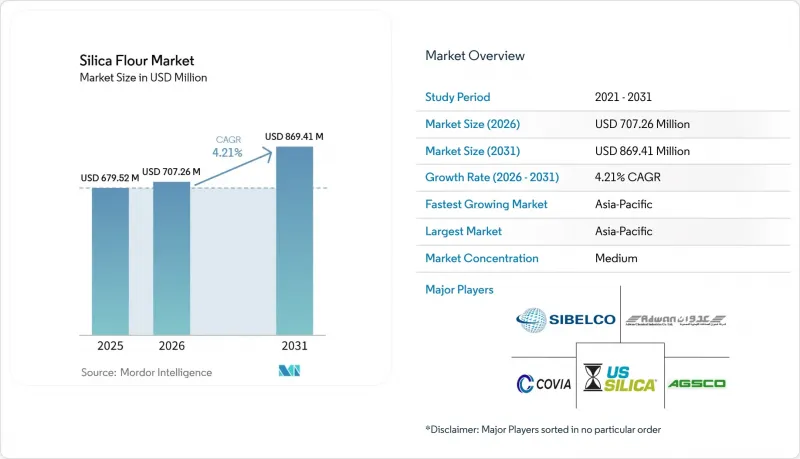
根據 Mordor Intelligence 預測,二氧化矽花市場規模將從 2025 年的 6.7952 億美元和 2026 年的 7.0726 億美元成長到 2031 年的 8.6941 億美元,2026 年至 2031 年的複合成長率為 4.21%。
本報告按類型(石英和方矽石)、終端用途產業(玻璃、鑄件、玻璃纖維、油井水泥等)和地區(亞太地區、北美、歐洲、南美以及中東和非洲)進行細分。市場預測以美元計價。
全球二氧化矽粉末市場趨勢與洞察
玻璃產業需求不斷成長
玻璃,包括平板玻璃、容器玻璃、特殊玻璃和太陽能玻璃,是二氧化矽花市場的主要需求推動要素之一。為了滿足高性能玻璃產品的需求,買家要求更嚴格的粒度控制和更低的鐵含量。這在太陽能相關應用領域尤其重要,因為這些應用對品質和認證標準的要求更高。因此,二氧化矽花市場規模不斷擴大,並向高純度產品線轉型,以增強價格競爭力。能夠透過酸浸和精細分級來提高產品品質的生產商可以獲得長期合約和更穩定的收入。另一方面,不具備此類能力的生產商則仍深受玻璃需求週期性波動的影響,並面臨標準等級產品更大的價格壓力。
玻璃纖維生產規模擴大
玻璃纖維的生產推動了隔熱材料、複合材料和風力發電設備製造領域對二氧化矽粉末的需求。玻璃纖維客戶非常重視產品的一致性、潔淨度和可控制的顆粒分佈。隨著風力發電機葉片尺寸的增大和更複雜複合材料應用的拓展,對能夠在樹脂浸潤和下游製程中穩定運行的認證二氧化矽原料的需求日益成長。這項要求限制了認證供應商的數量,並推高了品質穩定的材料的價格。因此,玻璃纖維的生產需求成長和供應商篩選流程的嚴格性,都使二氧化矽粉末市場受益。因此,即使在主導產品應用低迷時期,玻璃纖維也能穩定二氧化矽粉末市場。
接觸結晶質二氧化矽及監管合規成本
由於加工和處理過程中存在直接暴露風險,二氧化矽粉末市場受到健康和職業安全健康法規的限制,因此需要建立永久性的控制系統。美國職業安全與健康管理局 (OSHA) 規定,8 小時時間加權平均暴露限值為 50 μg/m³,並要求制定書面暴露控制計畫、採取工程措施、在 25 μg/m³ 的行為水準上進行健康監測,以及長期記錄保存。這些要求增加了生產商的初始成本和持續成本,使得合規性成為核心業務挑戰。二氧化矽粉末市場也面臨結構性利潤率限制,因為與高等級產品相比,低等級產品更難消化這些成本。美國地質調查局 (USGS) 指出,結晶質二氧化矽的暴露法規是工業砂石產業持續關注的問題,這表明該問題將貫穿整個二氧化矽價值鏈。因此,二氧化矽粉末市場可能更青睞那些擁有完善的工程措施和合規體系的企業。
細分市場分析
2025年,石英粉的銷售額佔比高達72.44%,在二氧化矽粉末市場中佔最大市場。這反映了石英粉在玻璃、鑄造、玻璃纖維等成熟應用領域的廣泛應用,在這些領域,成本效益和穩定的供應仍然是首要考慮因素。二氧化矽粉末市場繼續依賴石英粉作為關鍵原料,以滿足傳統需求和眾多高附加價值產品線的需求。然而,隨著客戶收緊雜質容差限度並要求更精確控制粒徑分佈,石英粉正面臨日益嚴格的規格要求。市場並未放棄石英粉,而是需要石英粉本身採用更先進的加工技術。
投資於乾式分級、浮選和酸浸製程的生產商正在獲得更高附加價值和更長期的供應合約。這種運作差異正逐漸在標準石英粉和用於要求更高的工業應用的高級產品之間造成差距。方矽石是成長最快的類型,預計到2031年,其二氧化矽粉市場規模將以5.18%的複合年成長率成長。由於建築塗料、建築化學品和某些鑄造應用領域的客戶看重其低方矽石,對方矽石的需求正在不斷成長。雖然方石英在特種應用領域方矽石獲得市場佔有率,但石英仍然是更廣泛的二氧化矽粉市場的主要收入來源。
區域分析
預計到2025年,亞太地區將佔據全球二氧化矽粉末市場45.27%的佔有率,並將以6.18%的複合年成長率(CAGR)保持最高增速,直至2031年。該地區的主導地位主要歸功於中國、印度、日本、韓國以及整個東南亞地區對玻璃、陶瓷、玻璃纖維和建築化學品的需求。由於下游產業叢集、出口導向以及對產品品質和規模的重視,二氧化矽粉末市場在該地區高度集中。中國仍然是重要的區域中心,但其市場角色正從單純的吸收供應轉向對純度和產品一致性制定更嚴格的規範。隨著買家尋求替代供應平台以及當地下游需求的持續成長,印度在二氧化矽粉末市場的重要性日益凸顯。
北美和歐洲是矽粉高階市場的核心,這主要得益於特種玻璃、過濾、半導體相關應用以及高性能建築應用等領域的區域需求。 Silica, Inc. 於 2025 年 9 月在伊利諾伊州開設了羅謝爾創新中心,進一步拓展了其在特種領域的業務,旨在支持過濾、可再生柴油和工業油應用領域的產品開發。 Sibelco 公司公佈 2025 年上半年銷售額為 11.53 億歐元(約 13 億美元),並指出其核心歐洲和亞太市場的強勁表現是成長要素。就銷售量、每噸售價和差異化等級產品而言,這些地區在矽粉市場仍佔有重要地位。
儘管南美洲、中東和非洲以及其他歐洲地區在二氧化矽粉市場中所佔佔有率較小,但每個地區都有其獨特的需求特徵。巴西尤其值得關注,因為建設活動和深海油井的水泥填充推動了其國內市場對特種二氧化矽的需求。在中東和非洲,玻璃、陶瓷和建築行業的需求是推動成長的主要動力,區域供應商受益於短途分銷路線和與當地客戶的良好關係。由於採購模式的改變,買家正在尋求貿易路線中斷以外的可靠供應來源,因此其他歐洲地區仍然十分重要。
其他好處:
- Excel格式的市場預測(ME)表
- 3個月的分析師支持
目錄
第1章:引言
- 研究假設和市場定義
- 調查範圍
第2章:調查方法
第3章執行摘要
第4章 市場狀況
- 市場概覽
- 市場促進因素
- 玻璃產業需求增加
- 製造地晶圓代工廠業務的擴張
- 工業和建築用玻璃纖維產量成長
- 油井對水泥組合藥物的需求增加
- 擴大陶瓷和衛浴設備生產
- 市場限制因素
- 關於接觸結晶質二氧化矽的合規要求
- 採礦和能源成本波動
- 採礦和採石的環境法規
- 價值鏈分析
- 波特五力分析
第5章 市場規模與成長預測
- 按類型
- 石英
- 方矽石
- 產業最終用途
- 玻璃
- 晶圓代工廠
- 玻璃纖維
- 油井水泥
- 陶瓷和耐火材料
- 油漆和塗料
- 建築化學品
- 其他終端用戶產業
- 按地區
- 亞太地區
- 中國
- 印度
- 日本
- 韓國
- 其他亞太國家
- 北美洲
- 美國
- 加拿大
- 墨西哥
- 歐洲
- 德國
- 英國
- 法國
- 義大利
- 俄羅斯
- 其他歐洲國家
- 南美洲
- 巴西
- 阿根廷
- 其他南美國家
- 中東和非洲
- 沙烏地阿拉伯
- 南非
- 其他中東和非洲國家
- 亞太地區
第6章 競爭情勢
- 市場集中度
- 策略趨勢
- 市佔率和排名分析
- 公司簡介
- Adwan Chemical Industries Co. Ltd.(ACIC)
- AGSCO Corp
- Australian Silica Quartz Group Ltd
- Capital Sand Company, LLC
- Covia Holdings LLC
- Delmon.co.ltd
- Euroquarz GmbH
- Fineton Industrial Minerals Limited.
- Hoben International Ltd.
- Minerali Industriali Srl
- Quarzwerke GmbH
- Sibelco
- Sil Industrial Minerals, Inc.
- US Silica
第7章 市場機會與未來展望
According to Mordor Intelligence, the silica flour market size is projected to expand from USD 679.52 million in 2025 and USD 707.26 million in 2026 to USD 869.41 million by 2031, and is expected to register a CAGR of 4.21% between 2026 and 2031.
This report is Segmented by Type (Quartz and Cristobalite), End-Use Industry (Glass, Foundry, Fiberglass, Oil Well Cement, and More), and Geography (Asia-Pacific, North America, Europe, South America, and Middle-East and Africa). The Market Forecasts are Provided in Terms of Value (USD).
Global Silica Flour Market Trends and Insights
Rising Demand from the Glass Industry
Glass is one of the key demand drivers for the silica flour market, spanning flat glass, container glass, specialty glass, and solar photovoltaic glass. Buyers are requesting tighter particle-size control and lower iron content to support higher-performance glass products. This is particularly relevant in solar-related applications, where quality thresholds and qualification standards are more stringent. As a result, the silica flour market is growing in volume and shifting toward higher-purity product lines with stronger pricing. Producers that can upgrade through acid leaching and fine classification are positioned to secure longer contracts and more stable returns. Producers without that capability remain more closely tied to cyclical glass demand and face greater price pressure in standard grades.
Growth in Fiberglass Production
Fiberglass production is driving demand for silica flour across insulation, composites, and wind energy manufacturing. Fiberglass customers place a high value on consistency, cleanliness, and controlled particle distribution. Longer wind turbine blades and more demanding composite applications are increasing the need for qualified silica inputs that perform reliably during resin wet-out and downstream processing. This requirement narrows the pool of approved suppliers and supports a price premium for consistent material. The silica flour market is therefore gaining from fiberglass through both tonnage demand and a stricter supplier selection process. This makes fiberglass a stabilizing factor for the silica flour market when commodity-driven applications weaken.
Crystalline Silica Exposure and Regulatory Compliance Costs
Health and workplace regulations constrain the silica flour market, as processing and handling create direct exposure risks requiring permanent control systems. The Occupational Safety and Health Administration (OSHA) mandates a permissible exposure limit of 50 μg/m3 as an 8-hour time-weighted average, along with written exposure control plans, engineering controls, medical surveillance at the action level of 25 μg/m3, and long-term recordkeeping obligations. These requirements raise both upfront and recurring costs for producers, making compliance a core operating issue. The silica flour market also faces a structural margin constraint, as these costs are harder to absorb in lower-value grades than in premium material. The U.S. Geological Survey (USGS) identifies crystalline silica exposure regulation as an ongoing concern for industrial sand and gravel operations, indicating that this issue will persist across the silica value chain. Consequently, the silica flour market is likely to favor operators with strong engineering controls and compliance systems.
Other drivers and restraints analyzed in the detailed report include:
- Expansion of Foundry Applications
- Increasing Demand for Oil Well Cement
- Volatility in Mining Costs and Raw Material Supply
For complete list of drivers and restraints, kindly check the Table Of Contents.
Segment Analysis
Quartz accounted for 72.44% of revenue in 2025, the largest market share by type in the silica flour market. This reflects quartz's broad applicability across glass, foundry, fiberglass, and other established applications where cost efficiency and reliable availability remain priorities. The silica flour market continues to rely on quartz as its primary source, supporting both legacy demand and many upgraded product lines. However, the quartz segment is facing increasing specification requirements, as customers tighten impurity limits and demand more controlled particle distributions. The market is not moving away from quartz, but is requiring greater processing sophistication within the quartz category itself.
Producers that have invested in dry classification, flotation, and acid leaching are gaining access to higher-value contracts and longer supply arrangements. This operational gap is gradually creating a divide between standard quartz flour and upgraded grades that serve more demanding industrial applications. Cristobalite is the fastest-growing type, with its silica flour market size projected to expand at a 5.18% CAGR through 2031. Demand for cristobalite is rising as customers in architectural coatings, construction chemicals, and selected casting applications value its lower bulk density, whiteness profile, and reduced equipment abrasion characteristics. Cristobalite is gaining ground in specialty applications, while quartz remains the core revenue foundation across the broader silica flour market.
Complete Report Scope:
- By Type
- Quartz
- Cristobalite
- By End-Use Industry
- Glass
- Foundry
- Fiberglass
- Oil Well Cement
- Ceramics and Refractory
- Paints & Coatings
- Construction Chemicals
- Other End-use Industries
- By Geography
- Asia-Pacific
- China
- India
- Japan
- South Korea
- Rest of Asia-Pacific
- North America
- United States
- Canada
- Mexico
- Europe
- Germany
- United Kingdom
- France
- Italy
- Russia
- Rest of Europe
- South America
- Brazil
- Argentina
- Rest of South America
- Middle-East and Africa
- Saudi Arabia
- South Africa
- Rest of Middle-East and Africa
- Asia-Pacific
Geography Analysis
Asia-Pacific held 45.27% of the silica flour market share in 2025 and is forecast to register the fastest CAGR of 6.18% through 2031. The region leads due to demand for glass, ceramics, fiberglass, and construction chemicals across China, India, Japan, South Korea, and Southeast Asia. The silica flour market is concentrated in this region because downstream industries are clustered, export-oriented, and focused on product quality and scale. China remains the primary regional hub, though its market role is shifting from volume absorption toward tighter specification-setting for purity and product consistency. India is growing in importance to the silica flour market, as buyers seek alternative supply platforms and local downstream demand continues to expand.
North America and Europe form the premium-value core of the silica flour market, as regional demand is driven by specialized glass, filtration, semiconductor-related, and high-performance construction applications. U.S. Silica expanded its specialty focus by opening the Rochelle Innovation Center in Illinois in September 2025, which supports product development for filtration, renewable diesel, and industrial oil applications. Sibelco reported first half (H1) 2025 revenue of EUR 1,153 million (equivalent to USD 1.3 billion), attributing growth to performance in core European markets and Asia-Pacific. These regions remain significant to the silica flour market for volume, higher revenue per ton, and a mix of differentiated grades.
South America, the Middle East and Africa, and the rest of Europe account for smaller shares of the silica flour market, with each region having a distinct demand profile. Brazil is notable because construction activity and deepwater oil well cementing support specialized silica use within a single national market. The Middle East and Africa are driven by glass, ceramics, and construction demand, with regional suppliers benefiting from shorter delivery routes and local customer relationships. The rest of Europe remains relevant as sourcing patterns shift and buyers seek dependable supply outside disrupted trade corridors.
- Adwan Chemical Industries Co. Ltd. (ACIC)
- AGSCO Corp
- Australian Silica Quartz Group Ltd
- Capital Sand Company, LLC
- Covia Holdings LLC
- Delmon.co.ltd
- Euroquarz GmbH
- Fineton Industrial Minerals Limited.
- Hoben International Ltd.
- Minerali Industriali S.r.l.
- Quarzwerke GmbH
- Sibelco
- Sil Industrial Minerals, Inc.
- U.S. Silica
Additional Benefits:
- The market estimate (ME) sheet in Excel format
- 3 months of analyst support
TABLE OF CONTENTS
1 Introduction
- 1.1 Study Assumptions and Market Definition
- 1.2 Scope of the Study
2 Research Methodology
3 Executive Summary
4 Market Landscape
- 4.1 Market Overview
- 4.2 Market Drivers
- 4.2.1 Rising Demand from Glass Industry
- 4.2.2 Expansion of Foundry Activity in Manufacturing Hubs
- 4.2.3 Growth in Fiberglass Production for Industrial and Construction Uses
- 4.2.4 Increasing Demand from Oil Well Cement Formulations
- 4.2.5 Expansion of ceramics and sanitaryware production
- 4.3 Market Restraints
- 4.3.1 Crystalline Silica Exposure Compliance Requirements
- 4.3.2 Volatility in mining and energy costs
- 4.3.3 Environmental Restrictions on Mining and Quarrying
- 4.4 Value Chain Analysis
- 4.5 Porter's Five Forces Analysis
- 4.5.1 Threat of New Entrants
- 4.5.2 Bargaining Power of Suppliers
- 4.5.3 Bargaining Power of Buyers
- 4.5.4 Threat of Substitutes
- 4.5.5 Competitive Rivalry
5 Market Size and Growth Forecasts (Value)
- 5.1 By Type
- 5.1.1 Quartz
- 5.1.2 Cristobalite
- 5.2 By End-Use Industry
- 5.2.1 Glass
- 5.2.2 Foundry
- 5.2.3 Fiberglass
- 5.2.4 Oil Well Cement
- 5.2.5 Ceramics and Refractory
- 5.2.6 Paints & Coatings
- 5.2.7 Construction Chemicals
- 5.2.8 Other End-use Industries
- 5.3 By Geography
- 5.3.1 Asia-Pacific
- 5.3.1.1 China
- 5.3.1.2 India
- 5.3.1.3 Japan
- 5.3.1.4 South Korea
- 5.3.1.5 Rest of Asia-Pacific
- 5.3.2 North America
- 5.3.2.1 United States
- 5.3.2.2 Canada
- 5.3.2.3 Mexico
- 5.3.3 Europe
- 5.3.3.1 Germany
- 5.3.3.2 United Kingdom
- 5.3.3.3 France
- 5.3.3.4 Italy
- 5.3.3.5 Russia
- 5.3.3.6 Rest of Europe
- 5.3.4 South America
- 5.3.4.1 Brazil
- 5.3.4.2 Argentina
- 5.3.4.3 Rest of South America
- 5.3.5 Middle-East and Africa
- 5.3.5.1 Saudi Arabia
- 5.3.5.2 South Africa
- 5.3.5.3 Rest of Middle-East and Africa
- 5.3.1 Asia-Pacific
6 Competitive Landscape
- 6.1 Market Concentration
- 6.2 Strategic Moves
- 6.3 Market Share (%)/Ranking Analysis
- 6.4 Company Profiles (includes Global Overview, Market Overview, Core Segments, Financials as available, Strategic Information, Products and Services, and Recent Developments)
- 6.4.1 Adwan Chemical Industries Co. Ltd. (ACIC)
- 6.4.2 AGSCO Corp
- 6.4.3 Australian Silica Quartz Group Ltd
- 6.4.4 Capital Sand Company, LLC
- 6.4.5 Covia Holdings LLC
- 6.4.6 Delmon.co.ltd
- 6.4.7 Euroquarz GmbH
- 6.4.8 Fineton Industrial Minerals Limited.
- 6.4.9 Hoben International Ltd.
- 6.4.10 Minerali Industriali S.r.l.
- 6.4.11 Quarzwerke GmbH
- 6.4.12 Sibelco
- 6.4.13 Sil Industrial Minerals, Inc.
- 6.4.14 U.S. Silica
7 Market Opportunities and Future Outlook
- 7.1 White-Space and Unmet-Need Assessment

 高純度二氧化矽市場規模:依純度、應用、終端用戶產業、地區及預測分類。全球二氧化矽市場規模、佔有率、趨勢和成長分析報告(2026-2034年)
 二氧化矽:市場佔有率分析、產業趨勢與統計、成長預測(2026-2031 年)
 二氧化矽市場-2026年至2032年全球市場預測二氧化矽粉末市場-2026-2032年全球市場預測農業矽市場規模:依產品類型、形態、應用、地區及預測分類。
 環境二氧化矽市場:依產品類型、應用、最終用途產業、市場規模及地區分類高純度二氧化矽市場:按類型、應用、終端用戶產業和地區分類。全球介孔二氧化矽市場:依產品、應用及地區分類
 球形二氧化矽市場報告:趨勢、預測與競爭分析(至2035年)