


 |
市場調查報告書
商品編碼
2099764
HBM在汽車AI處理器的應用:市場佔有率分析、產業趨勢與統計數據、成長預測(2026-2031)HBM For Automotive AI Processor - Market Share Analysis, Industry Trends & Statistics, Growth Forecasts (2026 - 2031) |
||||||

※ 本網頁內容可能與最新版本有所差異。詳細情況請與我們聯繫。
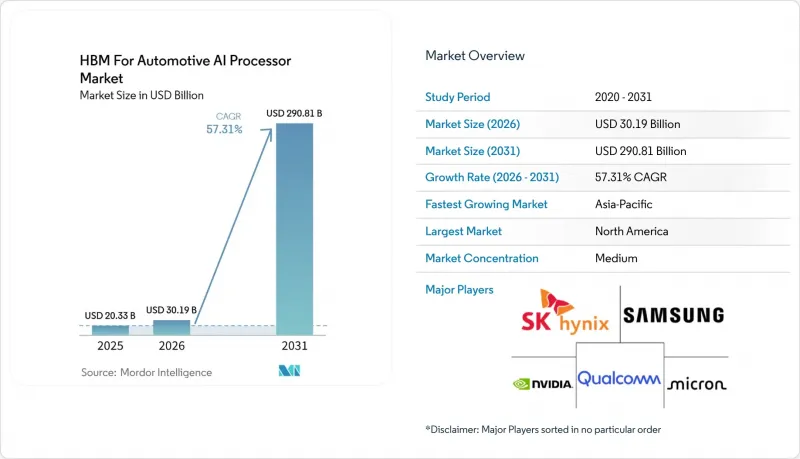
據 Mordor Intelligence 稱,汽車 AI 處理器的 HBM 市場規模預計將從 2025 年的 2033 萬美元成長到 2026 年的 3019 萬美元,到 2031 年達到 2.9081 億美元,預計 2026 年至 2031 年的複合年成長率為 57.57%。
本報告按人腦記憶體模型(HBM2E、HBM3、HBM3E、HBM4)、處理器類型(基於GPU的AI處理器、基於NPU的AI處理器等)、應用領域(高級駕駛輔助系統(L1-L2+)、自動駕駛(L3-L5)、AI座艙和乘員監控等)、車輛類型(細分用車)、車輛類型(細分用車)、車輛駕駛座(細分汽車類型)、車輛類型(細分汽車)、車輛類型(細分汽車)進行汽車類型(細分汽車)、車輛類型(細分汽車)進行汽車類型(細分汽車)、車輛類型(細分車等)、車輛類型(細分汽車)進行。市場預測以美元(USD)為單位。
全球 HBM 市場趨勢及對汽車 AI 處理器的洞察
車載計算的集中化將增加頻寬需求。
汽車人工智慧處理器的HBM市場正受到分散式ECU佈局向集中式車輛運算平台轉變的驅動,後者將更多功能整合到共用的處理域中。據NVIDIA稱,DRIVE AGX Thor將叢集、資訊娛樂、自動駕駛和泊車功能整合到單一SoC中,可擴展至2000 FP4 teraflops,這表明車輛運算密度在平台層面正以驚人的速度成長。美光指出,雖然3級系統需要100 GB/s至256 GB/s的DRAM頻寬,但在更嚴苛的感測器融合條件下,先進的4級平台將需要超過1 TB/s的頻寬。這種差異意義重大,因為目前的LPDDR5X實作已經接近高吞吐量水平,這意味著下一步的效能提升將更多地取決於記憶體架構本身的改進,而不是控制器的增加。此外,ISO 26262 標準和漫長的檢驗週期正在縮小可接受的記憶體選擇範圍,因為子系統必須在同一車輛專案中同時支援安全性和持續性能。隨著 OEM 廠商採用集中式運算,汽車 AI 處理器對 HBM 的需求將更加強勁,因為記憶體藍圖將成為平台決策的一部分,而不是後期組件的更換。
ADAS安全需求正在推動記憶體吞吐量的提升。
ADAS硬體技術最低標準的不斷提高也推動了車載AI處理器HBM市場的發展。這是因為安全系統擴大使用感測器,並向軟體依賴型運行環境發展。美光科技的汽車記憶體框架重點展示了256位至512位的記憶體匯流排寬度以及8.5 Gbps的I/O傳輸速度,以支援先進的LPDDR5X應用場景,這表明當前系統已經將傳統記憶體設計推向了極限。隨著車輛同時處理更多攝影機、雷達和LiDAR數據,挑戰也從單一功能的執行轉變為在嚴格的功耗和散熱限制下持續進行多感測器融合。 2026年1月,Mobileye宣布其未來EyeQ6H的訂單超過1,900萬套,顯示OEM廠商普遍認同採用更整合的感知和外圍ADAS架構。這一規模意義重大,因為ADAS的大規模部署將塑造未來自動駕駛程式在車載AI處理器HBM市場中建構的硬體標準。隨著安全堆疊的運算負載增加,記憶體吞吐量正成為核心設計標準,而不是次要的調整變數。
汽車認證週期延緩商業化進程
由於汽車記憶體的生產進度無法與資料中心記憶體同步,認證仍是汽車AI處理器HBM市場面臨的最大阻礙因素之一。據Weebit Nano稱,AEC-Q100認證流程要求對三個生產批次(每個批次77個樣品)進行壓力測試,並在持續1000至2000小時的加速測試中實現零故障。此認證架構還包括-55 度C至150 度C的溫度循環測試和完整的故障分析,這使得HBM等堆疊式記憶體架構的認證負擔特別沉重。這種負擔不僅限於記憶體晶片本身,還穿透矽通孔(TSV)、封裝堆疊以及處理器整合,所有這些都必須證明其在車輛環境中長期可靠運行。功能安全又提出了另一項要求:為了使該平台能夠在整個OEM專案中得到應用,基於ISO 26262的文件和安全檢驗必須與記憶體設計保持一致。因此,儘管在更廣泛的 AI 記憶體生態系統的其他領域中存在強勁的需求徵兆和現有產能,但 HBM 在汽車 AI 處理器市場的商業化進程卻相對滯後。
細分市場分析
2025年,HBM2E佔了汽車AI處理器HBM市場佔有率的75.31%。這反映出,目前的HBM已被應用於量產的汽車AI平台,且汽車設計週期較長。然而,這種情況並不意味著技術進步停滯不前,因為大部分收入來自先前的處理器選型,這些處理器在首款車型上市後仍保持著量產。這些早期合約對於汽車AI處理器HBM市場至關重要,因為汽車專案通常會在記憶體選型完成後繼續生產數年。這確保了在下一代產品進入評估和認證階段以用於未來車型上市期間,對HBM2E的需求將持續存在。因此,HBM3和HBM3E處於中間位置;雖然它們在技術上接近下一代汽車AI平台,但仍需要進行車規級檢驗才能獲得更廣泛的應用。
預計2026年至2031年間,HBM4的複合年成長率將達到57.91%,使其成為汽車AI處理器HBM市場中最具成長潛力的下一代產品。 2025年3月,SK海力士宣布完成全球首款HBM4的研發,並已做好量產準備,顯示該供應商的藍圖已與下一頻寬階段保持一致。隨後,該公司於2026年6月交付了12層HBM4E樣品,其單腳資料傳輸速率高達16 Gbps,能源效率比HBM4提升超過20%,充分展現了效能提升的迅猛速度。然而,由於AEC-Q100標準和安全要求將延長從產品發佈到汽車級應用所需的時間,預計汽車領域的進展將落後於資料中心領域。這意味著在汽車人工智慧處理器產業的 HBM 市場中,很可能出現一段較長的重疊期,在此期間 HBM2E 將繼續支援現有系統,而 HBM4 則有望贏得下一代設計採用。
到2025年,基於GPU的AI處理器將佔據汽車AI處理器HBM市場51.12%的佔有率,這與高階汽車專案中GPU運算平台的強勁普及相吻合。這項領先優勢與NVIDIA DRIVE生態系統的商業性化推廣密切相關,該生態系統已獲得全球眾多OEM廠商在高級自動駕駛專案中採用其設計方案的承諾。在汽車AI處理器HBM市場,GPU平台仍然是最明確的生產標竿。這是因為GPU平台更早被引入車輛項目,並在高階應用中建立了更廣泛的應用基礎。然而,隨著駕駛座、ADAS和集中式運算的整合不斷加深,市場需求正在轉變,OEM廠商需要用更少的晶片處理更多的功能。這種轉變正在降低獨立運算模組的吸引力,並促使廠商傾向於將多個加速器整合到統一的汽車設計中的架構。
預計從2026年到2031年,異構AI SoC將以58.29%的複合年成長率成長,成為汽車AI處理器HBM市場中成長最快的處理器類別。它們的崛起反映了更廣泛的領域整合趨勢,即處理器的價值取決於AI加速、圖形處理、連接性和記憶體存取在單一平台上的整合程度。高通與寶馬的大規模生產部署以及2026年與Stellantis擴大合作,都顯示了可擴展汽車SoC在下一代汽車架構多領域部署中的定位。基於ASIC和NPU的處理器在某些特定工作負載中仍然具有價值,在這些工作負載中,效率、成本控制或檢驗的功能比廣泛的柔軟性更為重要。雖然基於FPGA的處理器適用於原型製作和檢驗,但汽車AI處理器HBM產業越來越傾向於提供更高整合度和清晰系統可擴展性的量產就緒平台。
區域分析
到2025年,北美將佔據汽車AI處理器HBM市場佔有率的41.78%,成為當前需求的主要區域中心。該地區正受益於NVIDIA廣泛的DRIVE生態系統的部署,NVIDIA已與參與高階自動駕駛專案的公司簽署了設計協議,其中包括梅賽德斯-奔馳、豐田、通用汽車、現代、起亞、日產、比亞迪、吉利和五十鈴。美光科技和通用汽車於2026年7月1日簽署了一項策略客戶協議,確保通用汽車車輛生產的長期記憶體和儲存供應。這進一步加強了對未來汽車平臺在地採購的支持。高通公司與寶馬合作推出的「Ride Pilot」系統於2025年9月首次亮相,並在60多個國家/地區檢驗,這也表明北美平台供應商對自動駕駛項目的影響遠超其自身區域。
2025年,歐洲仍將是主要的需求中心。這主要得益於該地區與汽車人工智慧處理器市場中高頻寬記憶體(HBM)的緊密聯繫,而這種聯繫又源於眾多高階汽車製造商(OEM)和先進汽車電子系統專案的集中。據英偉達(NVIDIA)稱,下一代梅賽德斯-奔馳S級轎車正基於NVIDIA DRIVE AV平台開發,並採用L4級快取架構,這使得歐洲成為高頻寬記憶體高階設計應用的關鍵區域。 2026年5月,Stellantis和高通擴大了其多年合作關係,將「驍龍數位底盤」(Snapdragon Digital Chassis)平台部署到下一代汽車架構中,進一步加速了該地區向駕駛座、連網和高級駕駛輔助系統(ADAS)的轉型。因此,該地區發展的重點不再是記憶體本身的初始供應量,而是歐洲的高階項目如何繼續為未來的汽車計算堆疊設定技術標準。
預計亞太地區在2026年至2031年間將以58.22%的複合年成長率成長,成為汽車AI處理器用HBM市場成長最快的地區。這一成長與記憶體製造的集中化、亞洲OEM廠商在先進車輛運算領域日益重要的地位,以及越來越多自動駕駛專案落腳DRIVE生態系統密切相關。 SK海力士於2026年6月交付了其12層HBM4E的樣品,該產品在能源效率和堆疊容量方面均有所提升,凸顯了亞太地區在下一代汽車記憶體供應端的重要性。 2026年3月,現代汽車和起亞汽車擴大了與NVIDIA基於DRIVE Hyperion的下一代自動駕駛技術的策略合作,進一步鞏固了亞太地區在未來汽車平臺部署中的地位。同時,南美洲和中東及非洲地區仍處於汽車人工智慧處理器 HBM 市場的早期階段,因為先進的自動駕駛技術的應用和本地高性能平台製造尚未完全發展起來。
其他好處:
- Excel格式的市場預測(ME)表
- 3個月的分析師支持
目錄
第1章:引言
- 研究假設和市場定義
- 調查範圍
第2章:調查方法
第3章執行摘要
第4章 市場狀況
- 市場概覽
- 市場促進因素
- 車輛處理的集中化增加了頻寬消耗。
- ADAS安全需求正在推動記憶體吞吐量的提升。
- 軟體定義車輛(SDV)架構增加了車載資料負載。
- 汽車人工智慧處理器需要低延遲記憶體來進行即時推理。
- 車載生成式人工智慧正在推動對運算能力和記憶體需求的成長。
- HBM認證與採用優質平台設計相關。
- 市場限制因素
- 汽車產業的認證週期延緩了商業化進程。
- 熱學和電學方面的限制阻礙了高密度金屬薄膜(HBM)在大規模生產車輛的應用。
- HBM 的成本溢價限制了其在高階市場以外的市場滲透。
- 供應集中度給汽車製造商和一級供應商帶來了分配風險。
- 產業價值鏈分析
- 監理情勢
- 技術展望
- 波特五力分析
第5章 市場規模與成長預測
- 按世代分類的 HBM
- HBM2E
- HBM3
- HBM3E
- HBM4
- 依處理器類型
- 基於GPU的AI處理器
- 基於ASIC的AI處理器
- 基於NPU的AI處理器
- 基於FPGA的AI處理器
- 異質人工智慧SoC
- 透過使用
- ADAS(L1~L2+)
- 自動駕駛(L3-L5)
- 人工智慧駕駛座和機組人員監控
- 車載資訊系統、互聯互通、車聯網
- 汽車邊緣人工智慧運算
- 車輛類型
- 搭乘用車
- 輕型商用車
- 大型商用車輛
- 按地區
- 北美洲
- 美國
- 加拿大
- 墨西哥
- 歐洲
- 德國
- 英國
- 法國
- 義大利
- 其他歐洲國家
- 亞太地區
- 中國
- 日本
- 韓國
- 台灣
- 印度
- 其他亞太國家
- 南美洲
- 中東和非洲
- 北美洲
第6章 競爭情勢
- 市場集中度
- 策略趨勢
- 市佔率分析
- 公司簡介
- SK hynix Inc.
- Samsung Electronics Co., Ltd.
- Micron Technology, Inc.
- NVIDIA Corporation
- Qualcomm Technologies, Inc.
- Intel Corporation
- Mobileye Global Inc.
- Renesas Electronics Corporation
- NXP Semiconductors NV
- Infineon Technologies AG
- STMicroelectronics NV
- Ambarella, Inc.
- Marvell Technology, Inc.
- Broadcom Inc.
- AMD(Advanced Micro Devices, Inc.)
- Arm Holdings plc
- TSMC
- Cadence Design Systems, Inc.
- Synopsys, Inc.
- Rambus Inc.
第7章 市場機會與未來展望
According to Mordor Intelligence, the HBM for automotive AI processor market size is expected to increase from USD 20.33 million in 2025 to USD 30.19 million in 2026 and reach USD 290.81 million by 2031, growing at a CAGR of 57.31% over 2026-2031.
This report is Segmented by HBM Generation (HBM2E, HBM3, HBM3E, and HBM4), Processor Type (GPU Based AI Processors, NPU Based AI Processors, and More), Application (ADAS (L1-L2+), Autonomous Driving (L3-L5), AI Cockpit and Occupant Monitoring, and More), Vehicle Type (Passenger Cars, Light Commercial, and Morel), and Geography. The Market Forecasts are Provided in Terms of Value (USD).
Global HBM For Automotive AI Processor Market Trends and Insights
Centralized Vehicle Compute Increases Bandwidth Intensity
The HBM for automotive AI processor market is being pushed by the move from distributed ECU layouts to centralized vehicle compute platforms that pull more functions into a shared processing domain. NVIDIA said DRIVE AGX Thor consolidates cluster, infotainment, automated driving, and parking into one SoC and scales up to 2,000 FP4 teraflops, which shows how quickly vehicle compute density is rising at the platform level. Micron stated that Level 3 systems require 100 GB/s to 256 GB/s of DRAM bandwidth, while advanced Level 4 platforms can move beyond 1 TB/s under heavier sensor fusion conditions. That gap matters because current LPDDR5X implementations already stretch toward high throughput levels, so the next step in performance depends less on adding controllers and more on changing the memory architecture itself. ISO 26262 and long validation cycles also narrow the range of acceptable memory choices because the subsystem has to support both safety and sustained performance inside the same vehicle program. Once an OEM commits to centralized compute, the HBM for automotive AI processors market gains a stronger demand base because the memory roadmap becomes part of the platform decision rather than a late-stage component swap.
ADAS Safety Requirements Push Higher Memory Throughput
The HBM for automotive AI processor market is also benefiting from the rising technical floor for ADAS hardware as safety systems move into more sensor-rich and software-heavy operating conditions. Micron's automotive memory framework highlighted 256-bit to 512-bit memory bus widths and 8.5 Gbps I/O signaling rates for advanced LPDDR5X use cases, which shows how far current systems already push conventional memory designs. As vehicles process more camera, radar, and lidar data at the same time, the problem shifts from isolated feature execution toward sustained multi-sensor fusion under strict power and thermal limits. Mobileye said in January 2026 that future EyeQ6H commitments exceeded 19 million systems, which points to broad OEM alignment behind more integrated perception and surround ADAS architectures. That scale matters because high-volume ADAS deployments shape the hardware baseline that future autonomy programs build on top of in the HBM for automotive AI processors market. As the safety stack becomes more compute-intensive, memory throughput moves closer to a core design criterion instead of a secondary tuning variable.
Automotive Qualification Cycles Slow Commercialization
Qualification remains one of the strongest limits on the HBM for automotive AI processor market because automotive memory cannot move on the same timetable as data-center memory. Weebit Nano described the AEC-Q100 path as requiring stress testing across 3 production lots with 77 samples per lot and zero failures over 1,000 to 2,000 hours of accelerated testing. The same framework also includes temperature cycling from -55°C to 150°C and full failure analysis, which makes the qualification burden especially heavy for a stacked memory architecture such as HBM. That burden extends beyond the memory die because the base die, through-silicon vias, packaging stack, and processor integration all have to prove long-cycle reliability in vehicle conditions. Functional safety adds a second layer because ISO 26262 documentation and safety validation must align with the memory design before the platform can scale across OEM programs. This slows commercialization in the HBM for automotive AI processor market even when demand signals are strong and capacity exists elsewhere in the broader AI memory ecosystem.
Other drivers and restraints analyzed in the detailed report include:
- Software-Defined Vehicle Architectures Raise In-Vehicle Data Loads
- Automotive AI Processors Need Low Latency Memory for Real-Time Inference
- Thermal And Power Constraints Limit HBM Adoption in Mass Market Vehicles
For complete list of drivers and restraints, kindly check the Table Of Contents.
Segment Analysis
HBM2E held 75.31% of the HBM for automotive AI processor market share in 2025, which reflected the generation already tied to production automotive AI platforms and long vehicle design cycles. That position did not signal a pause in technology progress, because much of the revenue base came from earlier processor selections that stayed locked into production after initial vehicle launch. In the HBM for automotive AI processor market, those earlier commitments matter because automotive programs usually stay in production for several years after the memory choice is finalized. That creates a durable tail for HBM2E even while newer generations move into evaluation and qualification for future vehicle launches. HBM3 and HBM3E therefore sit in an intermediate position, where they are technically closer to the next wave of automotive AI platforms but still depend on automotive-grade validation before broader adoption can follow.
HBM4 is projected to expand at a 57.91% CAGR from 2026 to 2031, which makes it the strongest forward generation in the HBM for automotive AI processor market. SK Hynix said in March 2025 that it completed the world's first HBM4 development and prepared for mass production, which confirms that supplier roadmaps are already aligned around the next bandwidth step. The company later shipped 12-layer HBM4E samples in June 2026 with 16 Gbps per pin data transfer speed and more than 20% better power efficiency than HBM4, showing how quickly the performance ladder is moving. Even so, the automotive path will remain slower than the data-center path because AEC-Q100 and safety requirements stretch the timing between initial product release and vehicle-grade availability. This means the HBM for automotive AI processor industry is likely to see a long overlap period where HBM2E supports the installed base while HBM4 builds the next round of design wins.
GPU-based AI processors accounted for 51.12% of the HBM for automotive AI processor market size in 2025, which matched the strong deployment base of GPU-centered compute platforms in premium automotive programs. That lead is closely tied to the commercial reach of NVIDIA's DRIVE ecosystem, which has secured design commitments from a broad list of global OEMs for advanced automated driving programs. In the HBM for automotive AI processor market, GPU platforms still offer the clearest production reference point because they entered vehicle programs earlier and built a wider installed base across premium applications. At the same time, the center of demand is starting to shift because OEMs want fewer chips handling more domains, especially as cockpit, ADAS, and centralized compute begin to converge. That shift reduces the appeal of discrete compute blocks and supports architectures that combine multiple accelerators inside a unified automotive design.
Heterogeneous AI SoCs are projected to expand at a 58.29% CAGR from 2026 to 2031, which makes them the fastest-growing processor group in the HBM for automotive AI processor market. Their rise reflects a broader move toward domain convergence, where the value of the processor depends on how well it combines AI acceleration, graphics, connectivity, and memory access within one platform. Qualcomm's production deployment with BMW and its expanded 2026 collaboration with Stellantis show how scalable automotive SoCs are being positioned for multi-domain deployment across next-generation vehicle architectures. ASIC-based and NPU-based processors still hold value for focused workloads where efficiency, cost control, or validated function matter more than broad flexibility. FPGA-based processors remain useful in prototyping and validation, but the HBM for automotive AI processor industry is increasingly favoring production-ready platforms that offer higher integration and cleaner system scaling.
Complete Report Scope:
- By HBM Generation
- HBM2E
- HBM3
- HBM3E
- HBM4
- By Processor Type
- GPU Based AI Processors
- ASIC Based AI Processors
- NPU Based AI Processors
- FPGA Based AI Processors
- Heterogeneous AI SoCs
- By Application
- ADAS (L1-L2+)
- Autonomous Driving (L3-L5)
- AI Cockpit and Occupant Monitoring
- Telematics, Connectivity, and V2X
- Automotive Edge AI Computing
- By Vehicle Type
- Passenger Cars
- Light Commercial Vehicles
- Heavy Commercial Vehicles
- By Geography
- North America
- United States
- Canada
- Mexico
- Europe
- Germany
- United Kingdom
- France
- Italy
- Rest of Europe
- Asia-Pacific
- China
- Japan
- South Korea
- Taiwan
- India
- Rest of Asia-Pacific
- South America
- Middle East and Africa
- North America
Geography Analysis
North America held 41.78% of HBM for automotive AI processor market share in 2025, which made it the leading regional base for current demand. The region benefits from NVIDIA's broad DRIVE ecosystem footprint, with design commitments spanning Mercedes-Benz, Toyota, GM, Hyundai, Kia, Nissan, BYD, Geely, Isuzu, and others across high-end automated driving programs. Micron and General Motors signed a Strategic Customer Agreement on July 1, 2026 to secure long-term memory and storage supply for GM vehicle production, which strengthens the local sourcing case for future automotive platforms. Qualcomm's Ride Pilot debut with BMW in September 2025 and its validation across more than 60 countries also show how North American platform suppliers are influencing automated driving programs well beyond their home region.
Europe remained a major demand center in 2025 because premium OEM concentration and advanced vehicle electronics programs kept the region tightly linked to the HBM for automotive AI processor market. NVIDIA said Mercedes-Benz's upcoming S-Class is being built on NVIDIA DRIVE AV with an L4-ready architecture, which makes Europe an important premium design-win region for high-bandwidth memory adoption. Stellantis and Qualcomm expanded their multi-year collaboration in May 2026 to deploy Snapdragon Digital Chassis platforms across next-generation vehicle architectures, which added scale to the region's cockpit, connectivity, and ADAS transition. The regional pattern is therefore less about early memory volume on its own and more about how premium programs in Europe keep setting the technical baseline for future vehicle compute stacks.
Asia-Pacific is projected to expand at a 58.22% CAGR from 2026 to 2031, which makes it the fastest-growing region in the HBM for automotive AI processor market. Growth in the region is tied to the concentration of memory manufacturing, the rising role of Asian OEMs in advanced vehicle compute, and the widening number of automated driving programs that now sit inside the DRIVE ecosystem. SK Hynix shipped 12-layer HBM4E samples in June 2026 and highlighted better power efficiency and larger stack capacity, which underscores the region's importance on the supply side of next-generation automotive memory. Hyundai Motor and Kia also expanded their strategic partnership with NVIDIA in March 2026 for next-generation autonomous driving technology based on DRIVE Hyperion, which reinforces Asia-Pacific's role in future vehicle platform rollouts. South America and Middle East and Africa remained earlier-stage regions for the HBM for automotive AI processors market because high-autonomy deployment and local high-performance platform manufacturing are still less developed there.
- SK hynix Inc.
- Samsung Electronics Co., Ltd.
- Micron Technology, Inc.
- NVIDIA Corporation
- Qualcomm Technologies, Inc.
- Intel Corporation
- Mobileye Global Inc.
- Renesas Electronics Corporation
- NXP Semiconductors N.V.
- Infineon Technologies AG
- STMicroelectronics N.V.
- Ambarella, Inc.
- Marvell Technology, Inc.
- Broadcom Inc.
- AMD (Advanced Micro Devices, Inc.)
- Arm Holdings plc
- TSMC
- Cadence Design Systems, Inc.
- Synopsys, Inc.
- Rambus Inc.
Additional Benefits:
- The market estimate (ME) sheet in Excel format
- 3 months of analyst support
TABLE OF CONTENTS
1 INTRODUCTION
- 1.1 Study Assumptions and Market Definition
- 1.2 Scope of the Study
2 RESEARCH METHODOLOGY
3 EXECUTIVE SUMMARY
4 MARKET LANDSCAPE
- 4.1 Market Overview
- 4.2 Market Drivers
- 4.2.1 Centralized Vehicle Compute Increases Bandwidth Intensity
- 4.2.2 ADAS Safety Requirements Push Higher Memory Throughput
- 4.2.3 Software Defined Vehicle Architectures Raise In-Vehicle Data Loads
- 4.2.4 Automotive AI Processors Need Low Latency Memory for Real-Time Inference
- 4.2.5 In-Cabin Generative AI Expands Compute and Memory Demand
- 4.2.6 HBM Qualification Tied to Premium Platform Design Wins
- 4.3 Market Restraints
- 4.3.1 Automotive Qualification Cycles Slow Commercialization
- 4.3.2 Thermal and Power Constraints Limit HBM Adoption in Mass Market Vehicles
- 4.3.3 HBM Cost Premium Restricts Penetration Beyond Premium Segments
- 4.3.4 Supply Concentration Creates Allocation Risk for Automakers and Tier 1 Suppliers
- 4.4 Industry Value Chain Analysis
- 4.5 Regulatory Landscape
- 4.6 Technological Outlook
- 4.7 Porter's Five Forces Analysis
- 4.7.1 Bargaining Power of Suppliers
- 4.7.2 Bargaining Power of Buyers
- 4.7.3 Threat of New Entrants
- 4.7.4 Threat of Substitutes
- 4.7.5 Intensity of Competitive Rivalry
5 MARKET SIZE AND GROWTH FORECASTS (VALUE)
- 5.1 By HBM Generation
- 5.1.1 HBM2E
- 5.1.2 HBM3
- 5.1.3 HBM3E
- 5.1.4 HBM4
- 5.2 By Processor Type
- 5.2.1 GPU Based AI Processors
- 5.2.2 ASIC Based AI Processors
- 5.2.3 NPU Based AI Processors
- 5.2.4 FPGA Based AI Processors
- 5.2.5 Heterogeneous AI SoCs
- 5.3 By Application
- 5.3.1 ADAS (L1-L2+)
- 5.3.2 Autonomous Driving (L3-L5)
- 5.3.3 AI Cockpit and Occupant Monitoring
- 5.3.4 Telematics, Connectivity, and V2X
- 5.3.5 Automotive Edge AI Computing
- 5.4 By Vehicle Type
- 5.4.1 Passenger Cars
- 5.4.2 Light Commercial Vehicles
- 5.4.3 Heavy Commercial Vehicles
- 5.5 By Geography
- 5.5.1 North America
- 5.5.1.1 United States
- 5.5.1.2 Canada
- 5.5.1.3 Mexico
- 5.5.2 Europe
- 5.5.2.1 Germany
- 5.5.2.2 United Kingdom
- 5.5.2.3 France
- 5.5.2.4 Italy
- 5.5.2.5 Rest of Europe
- 5.5.3 Asia-Pacific
- 5.5.3.1 China
- 5.5.3.2 Japan
- 5.5.3.3 South Korea
- 5.5.3.4 Taiwan
- 5.5.3.5 India
- 5.5.3.6 Rest of Asia-Pacific
- 5.5.4 South America
- 5.5.5 Middle East and Africa
- 5.5.1 North America
6 COMPETITIVE LANDSCAPE
- 6.1 Market Concentration
- 6.2 Strategic Moves
- 6.3 Market Share Analysis
- 6.4 Company Profiles (includes Global Level Overview, Market Level Overview, Core Segments, Financials as available, Strategic Information, Market Rank/Share, Products and Services, Recent Developments)
- 6.4.1 SK hynix Inc.
- 6.4.2 Samsung Electronics Co., Ltd.
- 6.4.3 Micron Technology, Inc.
- 6.4.4 NVIDIA Corporation
- 6.4.5 Qualcomm Technologies, Inc.
- 6.4.6 Intel Corporation
- 6.4.7 Mobileye Global Inc.
- 6.4.8 Renesas Electronics Corporation
- 6.4.9 NXP Semiconductors N.V.
- 6.4.10 Infineon Technologies AG
- 6.4.11 STMicroelectronics N.V.
- 6.4.12 Ambarella, Inc.
- 6.4.13 Marvell Technology, Inc.
- 6.4.14 Broadcom Inc.
- 6.4.15 AMD (Advanced Micro Devices, Inc.)
- 6.4.16 Arm Holdings plc
- 6.4.17 TSMC
- 6.4.18 Cadence Design Systems, Inc.
- 6.4.19 Synopsys, Inc.
- 6.4.20 Rambus Inc.
7 MARKET OPPORTUNITIES AND FUTURE OUTLOOK
- 7.1 White-Space and Unmet Need Assessment

 汽車人工智慧市場:按產品、技術、應用和區域分類
 車載電視市場規模、佔有率和成長分析:按產品類型、顯示技術、車輛類型、銷售管道和地區分類-2026-2033年產業預測
 車載人工智慧助理市場規模、佔有率、成長、全球產業分析、區域趨勢及2026-2034年預測
 汽車人工智慧 (AI) 市場預測至 2034 年——按組件、車輛類型、動力系統、部署模式、應用、最終用戶和地區分類的全球分析汽車人工智慧 (AI) 市場:預測至 2034 年——全球分析(按產品、技術、車輛類型、驅動系統、自動駕駛等級、應用、部署狀態、最終用戶和地區分類)汽車語音助理市場預測至2034年—全球技術、功能、部署模式、連接方式、應用、最終用戶和區域分析汽車邊緣人工智慧硬體市場預測至2034年-全球分析(按硬體類型、車輛類型、處理架構、部署等級、自動駕駛等級、最終用戶和地區分類)
 汽車人工智慧市場:按服務類型、核心技術、車輛類型、應用和最終用戶分類-2026-2032年全球市場預測
 汽車人工智慧加速器:市場佔有率分析、產業趨勢與統計及成長預測(2026-2031 年)
 汽車應用生命週期管理 (ALM) 軟體市場機會、成長要素、產業趨勢分析及 2026-2035 年預測