


 |
市場調查報告書
商品編碼
2098539
汽車人工智慧加速器:市場佔有率分析、產業趨勢與統計及成長預測(2026-2031 年)Automotive AI Accelerator - Market Share Analysis, Industry Trends & Statistics, Growth Forecasts (2026 - 2031) |
||||||

※ 本網頁內容可能與最新版本有所差異。詳細情況請與我們聯繫。
根據 Mordor Intelligence 預測,汽車 AI 加速器市場規模將從 2025 年的 109.6 億美元成長到 2026 年的 148.5 億美元,然後在 2031 年達到 632.1 億美元,2026 年至 2031 年的複合年成長率為 33.60%。
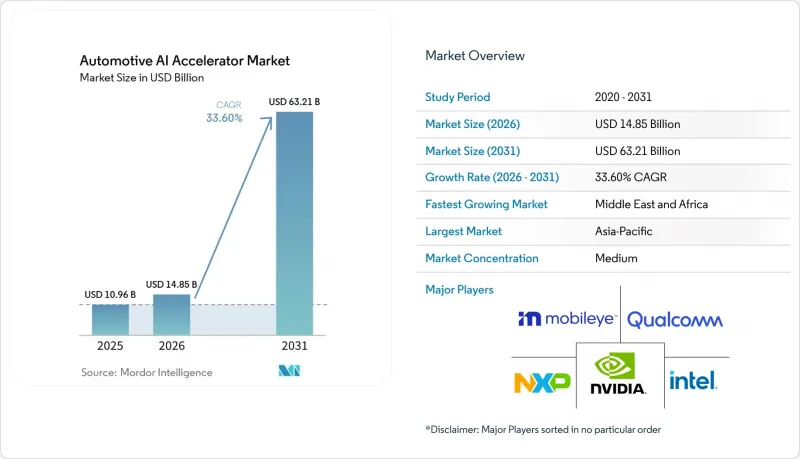
本報告按產品(硬體和軟體)、處理器類型(基於GPU的加速器、NPU/AI ASIC加速器等)、應用(ADAS和主動安全、自動駕駛和無人駕駛計程車的計算處理、智慧駕駛座和車載AI等)、車輛類型(乘用車和商用車)以及地區進行細分。市場預測以美元計價。
全球汽車人工智慧加速器市場趨勢及洞察
擴大ADAS和主動安全功能的應用
2026年歐洲新車安全評估協會(Euro NCAP)的修訂改變了新車的評估方法,引入了100分制的「安全駕駛」類別。這提高了歐洲主流安全程序實際運算能力的閾值。因此,諸如煞車輔助、車道維持輔助和駕駛監控等功能在量產車的認證中權重更高,推動汽車人工智慧加速器市場朝向大規模的ADAS採購專案邁進。 2026年1月,Mobileye宣布,預計到2025年底,其未來八年的銷售額將達到245億美元,顯示其設計在主要OEM專案中的應用範圍正在擴大。該公司還宣布計劃向排名前十的汽車製造商中的兩家提供超過1900萬套基於EyeQ6H的環繞式ADAS系統,這表明人工智慧驅動的安全硬體正在進入大規模量產階段。隨著這些功能從高階產品走向更廣泛的產品線,汽車人工智慧加速器市場正在擴張,但供應商面臨著在每個運算平台中整合更多功能的壓力,以維持利潤率。
車載即時推理的需求日益成長
在汽車人工智慧加速器市場,隨著安全性、反應速度和功能可靠性依賴於本地處理而非延遲的遠端執行,對車載推理的需求正在不斷成長。據Horizon Robotics公司稱,其「Journey 6」系列產品預計將在100多種車型上安裝,到2025年累計機量將達到1000萬台。這顯示大規模量產計畫越來越重視本地人工智慧執行。此外,高通和Leapmotor於2026年1月宣布推出一款中央電腦,將驍龍Cockpit Elite和Ride Elite整合到單一架構中。這清晰地反映了汽車領域向即時、多域處理發展的趨勢。這種轉變對汽車人工智慧加速器市場具有重大意義,因為本地推理不僅增加了運算需求,而且改變了這種需求的本質,使得那些能夠在汽車特有的嚴格的功耗、封裝和安全限制下支援人工智慧任務的平台成為優先考慮的對象。此外,由於這種配置使 OEM 能夠實現低延遲和簡化軟體整合,因此能夠同時處理駕駛座、感測和主動安全工作負載的處理器的價值也隨之增加。
嚴格的熱設計和能源效率限制
熱設計仍然是汽車人工智慧加速器市場面臨的一大限制因素。這是因為計算密度的提高對車輛內部的冷卻、封裝和能源管理提出了更高的要求。在電動車專案中,這個問題特別突出,因為額外的運算負載,特別是當多個人工智慧功能同時運作時,會直接影響續航里程和熱穩定性目標的實現。 2026年2月,義法半導體(STMicroelectronics)發表了Stellar P3E,這是首款整合Neural-ART加速器的汽車級微控制器。該產品定位於邊緣人工智慧應用場景,其熱負載需求低於大型中央處理器(CPU)。該產品的發展方向表明,汽車人工智慧加速器市場不僅重視每秒處理數(TOPS)的成長,也重視更高的效率和特定任務的晶片。即使運算能力在技術上更勝一籌,如果供應商無法在效能和汽車功耗預算之間取得平衡,則可能在大規模生產專案中失去市場佔有率。
細分市場分析
2025年,硬體銷售額佔比達到64.46%。這表明,在汽車人工智慧加速器市場,在軟體獲利模式擴展之前,晶片、記憶體存取、封裝和基板級整合仍然是重中之重。這一構成比,因為原始設備製造商(OEM)必須先確保高級駕駛輔助系統(ADAS)、駕駛座和未來自動駕駛程序所需的運算基礎設施。硬體層仍然是整個技術堆疊中最昂貴的初始組件。這是因為汽車級認證、較長的產品生命週期要求以及車輛整合等因素推動了對成熟半導體平台的投入。即使軟體在汽車人工智慧加速器市場未來利潤中佔據越來越重要的地位,這種情況仍將使硬體支出保持在高位。此細分市場的定位也反映出,只有先建構運算能力,以更新主導的經營模式才能持續創造價值。
軟體仍是成長最快的細分市場,預計到2031年將以33.88%的複合年成長率成長。這一趨勢表明,價值來源正逐漸從一次性的晶片銷售擴展到更廣泛的領域。汽車人工智慧加速器產業正朝著這樣的系統方向發展:在車輛底層運算能力部署完畢後,可以透過軟體更新來啟用、改進或擴展功能。高通的混合域中央運算方案和意法半導體推出的邊緣人工智慧控制器都旨在建構多個軟體工作負載可以共用相同矽基礎設施的平台。這意味著在汽車人工智慧加速器市場,軟體的成長並非取代硬體的成長,而是透過延長每個已部署運算平台的經濟壽命來增強硬體的成長。隨著車輛架構日益集中化,軟體也越來越難以與硬體選擇分離,這導致更高的轉換成本,並提升了平台生態系統的重要性。
到2025年,基於GPU的加速器將佔37.22%的銷售額,這表明汽車AI加速器市場仍將依賴成熟的高效能運算平台及其成熟的軟體環境。 GPU憑藉其對大規模神經網路工作負載的支援、豐富的工具選擇以及從研發到量產的便利擴展能力,在自動駕駛開發領域展現出明顯的優勢。這項應用基礎依然十分重要,因為許多OEM廠商和自動駕駛計程車專案已經在圍繞GPU相容環境建立其感知和規劃堆疊。在汽車AI加速器市場,這使得GPU供應商在高階域控制器和複雜的自動駕駛專案中擁有優勢,因為在這些專案中,軟體的連續性與純粹的性能同樣重要。這也解釋了為什麼儘管其他類型的處理器發展更為迅速,GPU在高階市場的領先地位仍可能得以維持。
預計到2031年,NPU和AI ASIC平台將以34.09%的複合年成長率成長,這意味著在汽車AI加速器市場的下一階段,推理效率將得到更直接的評估。 Horizon Robotics宣布其「Journey 6」系列產品已應用於超過100款車型,這表明專門設計的AI計算資源不僅可以應用於試驗計畫,還可以部署到各種量產的ADAS應用中。意法半導體(STMicroelectronics)也將其「Stellar P3E」定位為邊緣智慧任務的處理器,該處理器受益於整合的AI加速,並且與更大的多晶片配置相比,具有更低的散熱和系統負載。雖然異質SoC仍然很重要,因為許多程式需要同時使用CPU、圖形、訊號處理和AI資源,但汽車AI加速器產業顯然正在轉向在這些更廣泛的設計中採用更專業的推理模組。隨著散熱限制、功耗預算和成本壓力的不斷增加,最有價值的成果可能並非來自最高的理論效能,而是來自能夠提供更高實際本地AI處理能力(每瓦)的處理器類型。
區域分析
到2025年,亞太地區將佔全球汽車AI加速器銷售額的38.18%,成為該市場的領頭羊。中國憑藉主導地位。地平線機器人公司宣布,其「Journey 6」系列產品已安裝在超過100款車型上,凸顯了本地AI運算平台在該地區大規模生產中的重要性日益增加。日本憑藉其成熟的半導體和汽車電子技術實力,也保持著重要的市場地位。瑞薩電子持續推進其「R-Car V4H」的研發,該技術專注於NCAP碰撞測試,適用於L2+和L3級自動駕駛場景。韓國在汽車級記憶體供應方面實力雄厚,而印度正成為未來專案的重要樞紐。此前,Mobileye報告稱,馬恆達至少在六款車型上大規模採用了印度的設計。
預計到2031年,中東和非洲地區的複合年成長率將達到34.32%,成為汽車人工智慧加速器市場成長最快的區域板塊。這一成長並非依賴大規模的本土汽車製造業,而是得益於智慧運輸的快速普及、公眾對自動駕駛交通的支持以及儘早將先進服務商業化的願望。杜拜道路交通管理局(RTA)將於2026年3月透過Uber和Apollo Go推出商用自動駕駛計程車,WeRide也已與Uber合作,在杜拜推出全自動商用無人駕駛計程車。這些進展意義重大,因為它們催生了對能夠在實際運行環境中支援大規模量產級自動駕駛的運算平台的實際需求。儘管該地區目前在汽車人工智慧加速器市場的收入規模小規模,但它是未來部署模式的關鍵訊號市場。
在汽車人工智慧加速器市場,歐洲和北美構成了以下兩大區域叢集,但它們的優勢各有不同。歐洲的發展動力源自於更嚴格的安全法規和ADAS功能的快速擴展,這支撐了主流量產專案對運算能力的高需求。高通與寶馬聯合開發的系統以及英偉達與梅賽德斯-奔馳的持續合作表明,歐洲在高階車型項目以及可全球部署的軟硬體堆疊方面仍然扮演著重要角色。北美對於自動駕駛卡車和先進計算技術的應用仍然至關重要,而南美仍處於起步階段,人工智慧相關功能主要透過進口車輛引入,這些車輛在其他地區已經符合嚴格的安全標準。
其他好處:
- Excel格式的市場預測(ME)表
- 3個月的分析師支持
目錄
第1章:引言
- 研究假設和市場定義
- 調查範圍
第2章:調查方法
第3章執行摘要
第4章 市場狀況
- 市場概覽
- 市場促進因素
- ADAS和主動安全功能的廣泛應用
- 車載即時推理的需求日益成長
- 軟體定義車輛架構正在增加對集中式運算的需求。
- 擴展 L2+ 和 L3 自動駕駛計劃
- 智慧駕駛座和駕駛員監控中人工智慧含量增加
- 汽車和半導體製造商共同開發用於汽車的邊緣人工智慧平台。
- 市場限制因素
- 高熱設計和功率效率限制
- 功能安全及檢驗的複雜性
- 認證週期長和汽車等級供應風險
- 多域人工智慧架構中的網路安全風險
- 宏觀經濟因素對市場的影響
- 市場定位分析
- 監理情勢
- 技術展望
- 波特五力分析
第5章 市場規模與成長預測
- 報價
- 硬體
- 軟體
- 按處理器/加速器類型
- 基於GPU的加速器
- NPU/AI ASIC加速器
- 基於FPGA的加速器
- DSP/視覺處理加速器
- 異質人工智慧SoC
- 透過使用
- ADAS和主動安全
- 用於自動駕駛和無人計程車的計算
- 智慧駕駛座和車載人工智慧
- 車載資訊服務與聯網汽車服務
- 預測性維護和車隊智慧
- 按車輛類型
- 搭乘用車
- 商用車輛
- 按地區
- 北美洲
- 美國
- 加拿大
- 墨西哥
- 歐洲
- 德國
- 英國
- 法國
- 義大利
- 其他歐洲國家
- 亞太地區
- 中國
- 日本
- 韓國
- 印度
- 東南亞
- 其他亞太國家
- 南美洲
- 中東和非洲
- 北美洲
第6章 競爭情勢
- 市場集中度
- 策略趨勢
- 市佔率分析
- 公司簡介
- NVIDIA Corporation
- Qualcomm Technologies, Inc.
- NXP Semiconductors NV
- Renesas Electronics Corporation
- Texas Instruments Incorporated
- Intel Corporation
- Mobileye Global Inc.
- Advanced Micro Devices, Inc.
- STMicroelectronics NV
- Infineon Technologies AG
- Ambarella, Inc.
- Arm Holdings plc
- Micron Technology, Inc.
- Robert Bosch GmbH
- Aptiv PLC
- Continental AG
- Horizon Robotics
- Hailo Technologies Ltd.
- Kneron, Inc.
- SiMa.ai
第7章 市場機會與未來展望
According to Mordor Intelligence, the automotive AI accelerator market size is expected to grow from USD 10.96 billion in 2025 to USD 14.85 billion in 2026 and is forecast to reach USD 63.21 billion by 2031 at 33.60% CAGR over 2026-2031.
This report is Segmented by Offering (Hardware, and Software), Processor Type (GPU-Based Accelerators, NPU / AI ASIC Accelerators, and More), Application (ADAS and Active Safety, Autonomous Driving and Robotaxi Compute, Intelligent Cockpit and In-Cabin AI, and More), Vehicle Type (Passenger Vehicles, and Commercial Vehicles), and Geography. The Market Forecasts are Provided in Terms of Value (USD).
Global Automotive AI Accelerator Market Trends and Insights
Rising Adoption Of ADAS And Active Safety Functions
Euro NCAP's 2026 revision changed how new vehicles are assessed and introduced a 100-point Safe Driving category, which raised the practical compute threshold for mainstream safety programs in Europe. This has pushed the automotive AI accelerator market toward larger ADAS procurement programs because features such as braking support, lane assistance, and driver monitoring now carry greater approval weight in volume vehicles. Mobileye said in January 2026 that its 8-year revenue pipeline reached USD 24.5 billion at the end of 2025, showing how design wins have expanded across large OEM programs. It also announced future delivery of more than 19 million EyeQ6H-based Surround ADAS systems across 2 top-10 automaker programs, which shows that AI-enabled safety hardware is moving into very large production runs. As these functions shift from premium trims into broader lineups, the automotive AI accelerator market gains volume, while suppliers face pressure to bundle more functions on each compute platform to protect margins.
Growing Demand For On-Vehicle Real-Time Inference
The automotive AI accelerator market is seeing stronger demand for on-vehicle inference because safety, responsiveness, and feature reliability depend on local processing rather than delayed remote execution. Horizon Robotics said its Journey 6 series was being deployed across more than 100 vehicle models in 2025 and was tracking toward 10 million cumulative units, which signals that production programs are favoring local AI execution at scale. Qualcomm and Leapmotor presented a central computer in January 2026 that combines Snapdragon Cockpit Elite and Ride Elite on one architecture, which reflects a clear move toward real-time multi-domain processing inside the vehicle. This shift matters for the automotive AI accelerator market because local inference does not just add compute demand, it changes the kind of compute demand, favoring platforms that can sustain AI tasks within tight automotive power, packaging, and safety limits. It also raises the value of processors that can handle cockpit, sensing, and active safety workloads together, since OEMs gain lower latency and simpler software coordination from that setup.
High Thermal Design And Power Efficiency Constraints
Thermal design remains a real restraint for the automotive AI accelerator market because higher compute density adds cooling, packaging, and energy management burdens inside the vehicle. The issue is more visible in EV programs, where added compute draw can work directly against range and thermal stability targets, especially when several AI functions run at the same time. STMicroelectronics introduced Stellar P3E in February 2026 as the first automotive microcontroller with an integrated Neural-ART accelerator, and the product was positioned for edge AI use cases that need a lower thermal footprint than larger central processors. That product direction shows why the automotive AI accelerator market is not only rewarding raw TOPS growth, it is also rewarding better efficiency and more task-specific silicon. Vendors that cannot balance performance with automotive power budgets risk losing share in volume programs, even when their compute capability remains technically strong.
Other drivers and restraints analyzed in the detailed report include:
- Software-Defined Vehicle Architectures Increasing Centralized Compute Demand
- Expansion Of Level 2 Plus And Level 3 Automation Programs
- Functional Safety And Validation Complexity
For complete list of drivers and restraints, kindly check the Table Of Contents.
Segment Analysis
Hardware accounted for 64.46% of revenue in 2025, which shows that the automotive AI accelerator market still depends first on silicon, memory access, packaging, and board-level integration before software monetization can scale. This mix fits the current stage of the market because OEMs must first secure the compute base required for ADAS, cockpit, and future autonomy programs. The hardware layer also remains the part of the stack with the largest upfront cost, since automotive-grade qualification, long product life requirements, and vehicle integration all push spending toward proven semiconductor platforms. In the automotive AI accelerator market, this keeps hardware spending elevated even when software becomes a larger source of future margin. The segment's position also reflects the fact that compute capability must be installed before update-led business models can generate recurring value.
Software is still the fastest-growing offering segment, with a 33.88% CAGR expected through 2031, and that direction says the value pool is gradually broadening beyond one-time chip sales. The automotive AI accelerator industry is shifting toward systems where features can be activated, refined, or extended through software updates once the underlying compute has already been placed in the vehicle. Qualcomm's mixed-domain central compute approach and STMicroelectronics' edge AI controller launch both point to platforms where multiple software workloads can share the same silicon foundation. That means software growth is not replacing hardware growth inside the automotive AI accelerator market, it is building on top of it by making each installed compute platform economically useful for longer. As vehicle architectures centralize, software also becomes harder to separate from hardware choice, which raises switching costs and makes platform ecosystems more important.
GPU-based accelerators held 37.22% of revenue in 2025, which shows that the automotive AI accelerator market still leans on established high-compute platforms and their mature software environments. GPUs entered the category with a clear advantage in autonomous driving development because they supported large neural workloads, broad tool access, and easier scaling from research into production. That installed base still matters because many OEM and robotaxi programs have already built perception and planning stacks around GPU-compatible environments. In the automotive AI accelerator market, this gives GPU suppliers an advantage in high-end domain controllers and complex autonomy programs where software continuity matters as much as raw performance. It also explains why leadership at the top end can remain durable even as other processor types expand faster.
NPU and AI ASIC platforms are projected to grow at a 34.09% CAGR through 2031, which shows that the next phase of the automotive AI accelerator market is likely to reward inference efficiency more directly. Horizon Robotics said its Journey 6 family was being deployed across more than 100 models, which shows how purpose-built AI compute can move beyond pilot programs into broad production ADAS volumes. STMicroelectronics also positioned its Stellar P3E for edge intelligence tasks that benefit from integrated AI acceleration with a smaller thermal and system burden than larger multi-chip setups. Heterogeneous SoCs will still matter because many programs need CPU, graphics, signal, and AI resources together, but the automotive AI accelerator industry is clearly moving toward more specialized inference blocks within those broader designs. As thermal limits, power budgets, and cost pressure become tighter, the fastest gains are likely to come from processor types that can deliver more useful local AI per watt rather than the highest theoretical performance.
Complete Report Scope:
- By Offering
- Hardware
- Software
- By Processor / Accelerator Type
- GPU-Based Accelerators
- NPU / AI ASIC Accelerators
- FPGA-Based Accelerators
- DSP / Vision Processing Accelerators
- Heterogeneous AI SoCs
- By Application
- ADAS and Active Safety
- Autonomous Driving and Robotaxi Compute
- Intelligent Cockpit and In-Cabin AI
- Telematics and Connected Vehicle Services
- Predictive Maintenance and Fleet Intelligence
- By Vehicle Type
- Passenger Vehicles
- Commercial Vehicles
- By Geography
- North America
- United States
- Canada
- Mexico
- Europe
- Germany
- United Kingdom
- France
- Italy
- Rest of Europe
- Asia-Pacific
- China
- Japan
- South Korea
- India
- Southeast Asia
- Rest of Asia-Pacific
- South America
- Middle East and Africa
- North America
Geography Analysis
Asia-Pacific accounted for 38.18% of revenue in 2025, giving the region the leading position in the automotive AI accelerator market. China remains central to that lead because the region combines strong EV production, active ADAS rollout, and growing interest in closer chip and automaker coordination. Horizon Robotics said its Journey 6 series was being deployed across more than 100 vehicle models, which highlights how local AI compute platforms are gaining broad production relevance in the region. Japan also remains important through established semiconductor and vehicle electronics capability, and Renesas continues to position the R-Car V4H for Level 2 Plus and Level 3 use cases with NCAP-focused functionality. South Korea adds strength through automotive-grade memory supply, while India is becoming a more visible destination for future programs after Mobileye reported a major Mahindra design win covering at least 6 vehicle models.
The Middle East and Africa are expected to grow at a 34.32% CAGR through 2031, making it the fastest-growing regional block in the automotive AI accelerator market. This growth does not rest on broad domestic vehicle manufacturing, but on fast-moving smart mobility deployment, public backing for autonomous transport, and a willingness to commercialize advanced services early. Dubai's Roads and Transport Authority launched commercial autonomous taxi operations through Uber and Apollo Go in March 2026, and WeRide also began fully driverless commercial robotaxi operations in Dubai with Uber. Those moves matter because they create live demand for compute platforms that can support production-grade autonomy in real operating conditions. In the automotive AI accelerator market, this makes the region a smaller revenue base today, but an important signal market for future deployment models.
Europe and North America form the next major regional cluster in the automotive AI accelerator market, though their strengths are different. Europe is being pushed by tighter safety frameworks and faster ADAS content expansion, which supports higher compute needs in mainstream production programs. Qualcomm's jointly developed system with BMW and NVIDIA's work with Mercedes-Benz show how Europe remains important for premium vehicle programs and globally deployable software-hardware stacks. North America remains highly relevant in autonomous trucking and advanced compute deployment, while South America is still an early-stage market where AI content mainly enters through imported vehicles that already meet stricter safety expectations elsewhere.
- NVIDIA Corporation
- Qualcomm Technologies, Inc.
- NXP Semiconductors N.V.
- Renesas Electronics Corporation
- Texas Instruments Incorporated
- Intel Corporation
- Mobileye Global Inc.
- Advanced Micro Devices, Inc.
- STMicroelectronics N.V.
- Infineon Technologies AG
- Ambarella, Inc.
- Arm Holdings plc
- Micron Technology, Inc.
- Robert Bosch GmbH
- Aptiv PLC
- Continental AG
- Horizon Robotics
- Hailo Technologies Ltd.
- Kneron, Inc.
- SiMa.AI
Additional Benefits:
- The market estimate (ME) sheet in Excel format
- 3 months of analyst support
TABLE OF CONTENTS
1 INTRODUCTION
- 1.1 Study Assumptions and Market Definition
- 1.2 Scope of the Study
2 RESEARCH METHODOLOGY
3 EXECUTIVE SUMMARY
4 MARKET LANDSCAPE
- 4.1 Market Overview
- 4.2 Market Drivers
- 4.2.1 Rising Adoption of ADAS and Active Safety Functions
- 4.2.2 Growing Demand for On-Vehicle Real-Time Inference
- 4.2.3 Software-Defined Vehicle Architectures Increasing Centralized Compute Demand
- 4.2.4 Expansion of Level 2 Plus and Level 3 Automation Programs
- 4.2.5 Increasing AI Content in Intelligent Cockpits and Driver Monitoring
- 4.2.6 Automaker and Semiconductor Co-Development of Automotive Edge AI Platforms
- 4.3 Market Restraints
- 4.3.1 High Thermal Design and Power Efficiency Constraints
- 4.3.2 Functional Safety and Validation Complexity
- 4.3.3 Long Qualification Cycles and Automotive Grade Supply Risk
- 4.3.4 Cybersecurity Exposure in Multi-Domain AI Architectures
- 4.4 Impact of Macroeconomic Factors on the Market
- 4.5 Market Positioning Analysis
- 4.6 Regulatory Landscape
- 4.7 Technological Outlook
- 4.8 Porter's Five Forces Analysis
- 4.8.1 Bargaining Power of Suppliers
- 4.8.2 Bargaining Power of Buyers
- 4.8.3 Threat of New Entrants
- 4.8.4 Threat of Substitutes
- 4.8.5 Intensity of Competitive Rivalry
5 MARKET SIZE AND GROWTH FORECASTS (VALUE)
- 5.1 By Offering
- 5.1.1 Hardware
- 5.1.2 Software
- 5.2 By Processor / Accelerator Type
- 5.2.1 GPU-Based Accelerators
- 5.2.2 NPU / AI ASIC Accelerators
- 5.2.3 FPGA-Based Accelerators
- 5.2.4 DSP / Vision Processing Accelerators
- 5.2.5 Heterogeneous AI SoCs
- 5.3 By Application
- 5.3.1 ADAS and Active Safety
- 5.3.2 Autonomous Driving and Robotaxi Compute
- 5.3.3 Intelligent Cockpit and In-Cabin AI
- 5.3.4 Telematics and Connected Vehicle Services
- 5.3.5 Predictive Maintenance and Fleet Intelligence
- 5.4 By Vehicle Type
- 5.4.1 Passenger Vehicles
- 5.4.2 Commercial Vehicles
- 5.5 By Geography
- 5.5.1 North America
- 5.5.1.1 United States
- 5.5.1.2 Canada
- 5.5.1.3 Mexico
- 5.5.2 Europe
- 5.5.2.1 Germany
- 5.5.2.2 United Kingdom
- 5.5.2.3 France
- 5.5.2.4 Italy
- 5.5.2.5 Rest of Europe
- 5.5.3 Asia-Pacific
- 5.5.3.1 China
- 5.5.3.2 Japan
- 5.5.3.3 South Korea
- 5.5.3.4 India
- 5.5.3.5 Southeast Asia
- 5.5.3.6 Rest of Asia-Pacific
- 5.5.4 South America
- 5.5.5 Middle East and Africa
- 5.5.1 North America
6 COMPETITIVE LANDSCAPE
- 6.1 Market Concentration
- 6.2 Strategic Moves
- 6.3 Market Share Analysis
- 6.4 Company Profiles (includes Global Level Overview, Market Level Overview, Core Segments, Financials as available, Strategic Information, Market Rank/Share, Products and Services, Recent Developments)
- 6.4.1 NVIDIA Corporation
- 6.4.2 Qualcomm Technologies, Inc.
- 6.4.3 NXP Semiconductors N.V.
- 6.4.4 Renesas Electronics Corporation
- 6.4.5 Texas Instruments Incorporated
- 6.4.6 Intel Corporation
- 6.4.7 Mobileye Global Inc.
- 6.4.8 Advanced Micro Devices, Inc.
- 6.4.9 STMicroelectronics N.V.
- 6.4.10 Infineon Technologies AG
- 6.4.11 Ambarella, Inc.
- 6.4.12 Arm Holdings plc
- 6.4.13 Micron Technology, Inc.
- 6.4.14 Robert Bosch GmbH
- 6.4.15 Aptiv PLC
- 6.4.16 Continental AG
- 6.4.17 Horizon Robotics
- 6.4.18 Hailo Technologies Ltd.
- 6.4.19 Kneron, Inc.
- 6.4.20 SiMa.ai
7 MARKET OPPORTUNITIES AND FUTURE OUTLOOK
- 7.1 White-Space and Unmet-Need Assessment

 汽車人工智慧市場:按產品、技術、應用和區域分類
 車載電視市場規模、佔有率和成長分析:按產品類型、顯示技術、車輛類型、銷售管道和地區分類-2026-2033年產業預測
 車載人工智慧助理市場規模、佔有率、成長、全球產業分析、區域趨勢及2026-2034年預測
 HBM在汽車AI處理器的應用:市場佔有率分析、產業趨勢與統計數據、成長預測(2026-2031)
 汽車人工智慧 (AI) 市場預測至 2034 年——按組件、車輛類型、動力系統、部署模式、應用、最終用戶和地區分類的全球分析汽車人工智慧 (AI) 市場:預測至 2034 年——全球分析(按產品、技術、車輛類型、驅動系統、自動駕駛等級、應用、部署狀態、最終用戶和地區分類)汽車語音助理市場預測至2034年—全球技術、功能、部署模式、連接方式、應用、最終用戶和區域分析汽車邊緣人工智慧硬體市場預測至2034年-全球分析(按硬體類型、車輛類型、處理架構、部署等級、自動駕駛等級、最終用戶和地區分類)
 汽車人工智慧市場:按服務類型、核心技術、車輛類型、應用和最終用戶分類-2026-2032年全球市場預測
 汽車應用生命週期管理 (ALM) 軟體市場機會、成長要素、產業趨勢分析及 2026-2035 年預測