


 |
市場調查報告書
商品編碼
2099533
GPU雲端:市佔率分析、產業趨勢與統計、成長預測(2026-2031年)GPU Cloud - Market Share Analysis, Industry Trends & Statistics, Growth Forecasts (2026 - 2031) |
||||||

※ 本網頁內容可能與最新版本有所差異。詳細情況請與我們聯繫。
根據 Mordor Intelligence 預測,GPU 雲端市場預計將從 2025 年的 77.3 億美元成長到 2026 年的 156.2 億美元,到 2031 年達到 376.9 億美元,2026 年至 2031 年的複合年預計成長率為 19.26%。
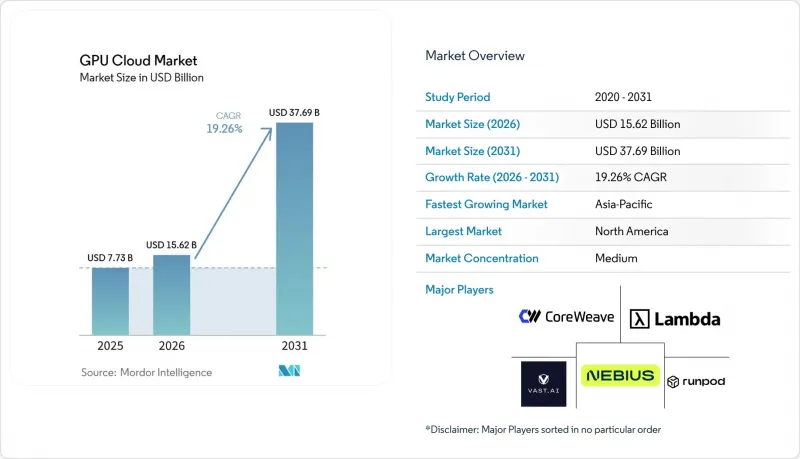
本報告按服務模式(IaaS、PaaS)、GPU工作負載類別(AI訓練、大規模HPC GPU實例等)、託管模式(託管私有GPU雲等)、組織規模(中小企業等)、應用領域(AI訓練和微調等)、最終用戶(IT、電信、軟體和網際網路平台等)以及地區進行細分。市場預測以美元(USD)為單位。
全球GPU雲端市場趨勢與洞察
對生成式人工智慧和LLM訓練的需求日益成長
生成式人工智慧和大規模語言模式的發展持續推動GPU雲端市場的需求。隨著每一代新模型的出現,對訓練大規模、網路密度和單次配置記憶體容量的需求也隨之增加,這迫使服務提供者更早鎖定資源,並簽訂更長期的合約。這種情況使得那些已經擁有大規模GPU資源並能提供緊密整合訓練環境的業者佔據了優勢。此外,由於建構超大規模模型需要專門的基礎設施,而只有少數服務供應商能夠大規模建置此類基礎設施,因此GPU雲端市場在訓練堆疊的上游環節也日益集中。 CoreWeave的公開文件和業務揭露表明,對於專注於訓練的服務提供者而言,獲得大規模GPU叢集和保障大規模資料中心的使用權是一項決定性的競爭優勢。 CoreWeave於2025年3月宣布的IPO計畫進一步證實,投資人將大規模人工智慧運算能力視為一個永續成長的領域,而非短期建設週期。
基於代理的人工智慧推理工作負載的成長
GPU雲端市場的發展也受到基於代理的AI推理工作負載快速成長的推動。生產代理的功能遠不止於回應指令;它們會規劃行動、獲取上下文資訊、呼叫工具,並在多個週期內評估單一任務的輸出。這種模式使得推理叢集能夠運作更長時間,從而提升了低延遲服務能力在GPU雲端市場的價值。 NVIDIA經營團隊在2025年表示,基於代理的推理可能需要比早期生成式AI系統更高的運算能力,這預示著未來對服務的需求將更加旺盛。 CoreWeave於2026年5月推出的統一的基於代理的AI平台表明,服務提供者正在將強化學習、生產推理、可觀測性和持續改進整合到一個統一的管理工作流程中。隨著這種營運模式的普及,GPU雲端市場的使用率曲線正從純粹的訓練主導曲線轉向更持續的推理需求。
HBM 和先進封裝的供應限制
高頻寬記憶體 (HBM) 仍然是 GPU 雲端市場最突出的實體瓶頸。這是因為現代 AI 加速器依賴 HBM 來實現大規模的性能。當記憶體供應緊張時,即使資料中心空間和買家需求依然旺盛,雲端服務供應商也無法以與需求同步的速度擴展其部署容量。複雜的封裝限制進一步加劇了這種壓力,減緩了晶片需求轉化為可執行系統的過程。一份關於 AMD 在 2026 年的領導地位的報告指出,儘管 HBM 的需求成長速度超過了供應,但主要供應商的 2026 年 HBM3E 產量已經售罄。因此,在 GPU 雲端市場,擁有長期配額關係的供應商具有優勢,因為供應管道更像是競爭壁壘,而非普通的採購因素。這種限制也限制了新參與企業在 GPU 雲端市場最有價值的細分領域挑戰現有參與者的速度。
細分市場分析
到2025年,基礎設施即服務(IaaS)將佔據GPU雲端市場78.66%的佔有率,成為那些希望直接掌控運算、網路和記憶體策略的買家的首選服務層。這種情況反映出GPU雲端市場仍處於發展初期,許多大型客戶仍傾向於自行建置和配置環境。對於那些需要在框架、叢集設計和擴展規則方面擁有柔軟性的訓練密集型使用者而言,直接存取GPU仍然具有吸引力。從服務配置的角度來看,儘管買家的預期發生了變化,但大部分支出仍集中在最接近基礎設施層的部分。
平台即服務 (PaaS) 預計到 2031 年將以 19.32% 的複合年成長率成長,這表明原始容量與託管式 AI 環境之間的差距正在穩步縮小。隨著企業越來越需要在單一營運層內編配、可觀測性、強化學習工作流程和模式服務,GPU 雲端市場正朝著這個方向發展。 CoreWeave 於 2026 年 5 月發布的統一的基於代理的 AI 功能表明,服務提供者正在超越單純提供運算能力,轉而將訓練和推理操作整合到一個閉迴路改進系統中。這意味著 GPU 雲端市場並非取代 IaaS,而是在其基礎上增添更多價值,因為客戶需要更快的部署速度和更低的工程開銷。從長遠來看,將強大的基礎設施與可操作的平台工具相結合的服務提供者將比那些僅提供 GPU 存取的服務提供者更具優勢。
按工作負載分類,在2025年GPU雲端市場中,「AI訓練和大規模HPC GPU執行個體」佔了62.34%的佔有率。這一領先地位反映了資金集中用於前沿模型開發、大型企業程式微調以及仍需大規模訓練叢集的研究計算項目。在GPU雲端市場的早期階段,訓練需求決定了服務供應商如何建構資料中心規模、互連設計和容量規劃模型。這些工作負載仍然佔據核心地位,因為它們仍然需要在既定的專案週期內消耗高密度、高價值的運算資源。此外,訓練仍然是服務提供者聲譽的基石,因為客戶通常會根據平台支援高要求模型開發任務的能力來判斷其實力。
用於人工智慧推理和通用加速運算的GPU實例預計到2031年將以19.41%的複合年成長率成長,這表明GPU雲市場未來將把更多的時間和容量投入到哪些領域。隨著模型進入生產環境,持續服務需求日益成長,對延遲的要求也更加嚴格,利用週期也更長。這將改變GPU雲端市場的經濟格局,因為推理在模型的整個運行生命週期中累積的總計算時間可能比單次訓練運行更長。在ECRTS 2025上發表的一項關於NVIDIA GPU硬體運算分區的研究表明,更有效率的調度技術可以提高各種工作負載的利用率。隨著人工智慧擴展到生產環境,GPU雲端市場供應商需要在訓練的可靠性、強大的推理架構和嚴格的調度之間取得平衡。
區域分析
預計到2025年,北美將佔據GPU雲端市場72.76%的佔有率,鞏固其作為當前全球需求中心的地位。該地區受惠於眾多尖端人工智慧實驗室、大型超大規模資料中心業者、充裕的私人資本以及大量採用人工智慧技術的企業。在GPU雲端市場,這形成了一個良性循環:供應商、買家和技術人才地理位置接近,縮短了從基礎設施建設到商業應用的路徑。加拿大和墨西哥也透過資料中心擴張、跨國服務交付以及與美國需求模式的接近性,進一步鞏固了該地區的地位。
歐洲在全球GPU雲市場佔據第二大佔有率,其成長軌跡更受到主權要求而非簡單規模擴張的影響。該地區的需求主要由與資料居住要求相關的合規性預期、受監管人工智慧的應用以及對基礎設施更強力的本地控制的需求所驅動。這有利於那些在該地區擁有充足容量和值得信賴的認證地位的供應商。德國電信的慕尼黑人工智慧工廠專案展示了歐洲現有營運商如何在國內建構大規模GPU基礎設施,以支援工業和受監管的應用場景。 Nevius也在2026年6月宣布,將在英國投資約17億英鎊(約21.6億美元)用於部署基於NVIDIA技術的全新基礎設施。這些發展表明,歐洲GPU雲端市場的發展並非基於規模,而是基於本地容量的重要性。
預計到2031年,亞太地區將以19.68%的複合年成長率成長,成為GPU雲市場成長最快的區域市場。這一成長主要得益於國內人工智慧專案的擴展、企業採用率的提高以及對能夠滿足國家和地區數據需求的本地基礎設施的需求。微軟於2026年4月宣佈在日本投資100億美元,凸顯了目前該地區在人工智慧基礎設施、網路安全和人才培育方面的投資規模。雖然南美洲和中東及非洲地區的GPU雲端市場仍處於起步階段,但它們正在發展成為重點成長區域,而本地託管需求和國家級運算策略開始促使人們關注基礎設施建設。
其他好處:
- Excel格式的市場預測(ME)表
- 3個月的分析師支持
目錄
第1章:引言
- 研究假設和市場定義
- 調查範圍
第2章:調查方法
第3章執行摘要
第4章 市場狀況
- 市場概覽
- 宏觀經濟因素對市場的影響
- 市場促進因素
- 對生成式人工智慧和LLM培訓的需求日益成長
- 基於代理的人工智慧推理工作負載的成長
- 雲端遊戲和大量利用GPU的即時渲染技術的擴展
- 企業向靈活的隨選計量收費GPU容量遷移
- 主權人工智慧和資料居住要求
- GPU 分數調度與可組合 GPU 架構
- 市場限制因素
- HBM 和先進封裝的供應限制
- GPU現貨價格波動與供應囤積
- 高密度GPU機架的能耗與冷卻負荷
- 客戶對專用人工智慧工具鏈的鎖定
- 產業價值鏈分析
- 監理情勢
- 技術展望
- 波特五力分析
第5章 市場規模與成長預測
- 按服務模式
- Infrastructure as a Service
- Platform as a Service
- 按GPU工作負載類型分類
- 用於人工智慧訓練和大規模高效能運算的GPU實例。
- 用於人工智慧推理和通用加速運算的GPU實例
- 圖形、視覺化、渲染和 VDI GPU 實例
- 成本最佳化型與傳統 GPU 執行個體
- 透過託管模式
- 共用的多租戶公有GPU雲
- 專用單一租戶 GPU 雲
- 託管私有GPU雲
- 主權和受監管的GPU雲
- 按組織規模
- 大公司
- 小型企業
- 研究機構、學術機構和公共部門組織
- 透過使用
- AI訓練與微調
- 人工智慧推理和模型服務
- 高效能運算和科學模擬
- 渲染、動畫、視覺特效、虛擬製作
- 雲端遊戲
- 其他(視覺化、虛擬工作站、數位孿生)
- 按最終用戶行業分類
- 資訊科技、電信、軟體、網際網路平台
- 媒體、娛樂、遊戲、廣告
- BFSI
- 汽車、移動出行和自動駕駛系統
- 醫療保健、生命科學、製藥
- 製造業、半導體、工業
- 其他終端用戶產業(零售/電子商務、能源/公共產業)
- 按地區
- 北美洲
- 美國
- 加拿大
- 墨西哥
- 歐洲
- 德國
- 英國
- 法國
- 義大利
- 其他歐洲國家
- 亞太地區
- 中國
- 日本
- 韓國
- 印度
- 東南亞
- 其他亞太國家
- 南美洲
- 中東和非洲
- 北美洲
第6章 競爭情勢
- 市場集中度
- 策略趨勢
- Market Positioning Analysis
- 公司簡介
- CoreWeave, Inc.
- Lambda, Inc.
- RunPod, Inc.
- Vast.ai, Inc.
- Nebius Group NV
- Crusoe Energy Systems LLC
- FluidStack Limited
- Voltage Park, Inc.
- WhiteFiber LLC
- Denvr Dataworks Corp.
- Genesis Cloud GmbH
- Scaleway SAS
- OVH SAS
- The Constant Company, LLC
- Northern Data AG
- DigitalOcean, LLC
- Cirrascale Cloud Services, Inc.
- TensorWave, Inc.
- NexGen Cloud Limited
- Jarvislabs.ai Private Limited
第7章 市場機會與未來展望
According to Mordor Intelligence, the GPU cloud market size is expected to increase from USD 7.73 billion in 2025 to USD 15.62 billion in 2026 and reach USD 37.69 billion by 2031, growing at a CAGR of 19.26% over 2026-2031.
This report is Segmented by Service Model (IaaS, and PaaS), GPU Workload Class (AI Training and Large-Scale HPC GPU Instances, and More), Hosting Model (Hosted Private GPU Cloud, and More), Organization Size (SMEs, and More), Application (AI Training and Fine-Tuning, and More), End-User (IT, Telecom, Software and Internet Platforms, and More), and Geography. The Market Forecasts are Provided in Terms of Value (USD).
Global GPU Cloud Market Trends and Insights
Rising Generative AI And LLM Training Demand
Generative AI and large language model development remain the central demand engine for the GPU cloud market. Each new model generation requires larger training clusters, denser networking, and more memory per deployment, which pushes providers to secure capacity earlier and on longer terms. This has increased the advantage of operators that already control large GPU estates and can deliver tightly integrated training environments. The GPU cloud market is also becoming more concentrated at the top of the training stack because very large model builds need specialized infrastructure that only a limited number of providers can assemble at scale. CoreWeave's public filings and operating disclosures showed how access to large GPU fleets and large data center commitments became a defining competitive asset for training-focused providers in this market. CoreWeave's March 2025 IPO announcement further showed that investors viewed large-scale AI compute capacity as a durable growth category rather than a short-lived build cycle.
Growth In Agentic AI Inference Workloads
The GPU cloud market is also being pushed forward by a rapid increase in agentic AI inference workloads. Production agents do more than answer prompts because they plan actions, retrieve context, invoke tools, and evaluate outputs across multiple cycles for a single task. That pattern keeps inference clusters active for longer periods and raises the value of low-latency serving capacity inside the GPU cloud market. NVIDIA leadership stated in 2025 that agentic inference can require far more compute than early generative AI systems, which supports the expectation of heavier serving demand over time. CoreWeave's May 2026 launch of a unified agentic AI platform showed how providers are linking reinforcement learning, production inference, observability, and continuous improvement into one managed workflow. As this operating model spreads, the GPU cloud market is shifting toward more persistent inference demand and away from a purely training-led utilization curve.
HBM And Advanced Packaging Supply Constraints
High-bandwidth memory remains the clearest physical bottleneck for the GPU cloud market because modern AI accelerators depend on it for performance at scale. When memory supply tightens, cloud providers cannot expand deployable capacity at the same pace as demand, even if data center space and buyer interest remain strong. This pressure is amplified by advanced packaging constraints, which slow the conversion of chip demand into usable systems. Reporting tied to AMD leadership in 2026 noted that HBM demand growth was outpacing supply growth, while major suppliers had already sold through their 2026 HBM3E output. The GPU cloud market, therefore, rewards providers with long-term allocation relationships because supply access is functioning as a competitive moat rather than a normal procurement input. This constraint also limits how quickly new entrants can challenge established operators in the highest-value parts of the GPU cloud market.
Other drivers and restraints analyzed in the detailed report include:
- Enterprise Shift Toward Elastic Pay-Per-Use GPU Capacity
- Sovereign AI And Data Residency Requirements
- GPU Spot Price Volatility And Capacity Hoarding
For complete list of drivers and restraints, kindly check the Table Of Contents.
Segment Analysis
Infrastructure as a Service accounted for 78.66% of the GPU cloud market in 2025, which made it the dominant service layer for buyers that wanted direct control over compute, networking, and memory policies. That position reflected the early maturity of the GPU cloud market, where many large customers still preferred to assemble and tune environments themselves. Raw GPU access remained attractive for training-heavy users who needed flexibility across frameworks, cluster designs, and scaling rules. The service mix also showed that most spending still sat closest to the infrastructure layer, even as buyer expectations were beginning to change.
Platform as a Service is projected to grow at a 19.32% CAGR through 2031, which points to a steady narrowing between raw capacity and managed AI environments. The GPU cloud market is moving in this direction because enterprises increasingly need orchestration, observability, reinforcement learning workflows, and model serving within one operating layer. CoreWeave's May 2026 rollout of unified agentic AI capabilities illustrated how providers are folding training and inference operations into a closed improvement loop rather than offering compute alone. This means the GPU cloud market is not replacing IaaS, but it is adding more value above it as customers push for faster deployment and lower engineering overhead. Over time, providers that combine strong infrastructure with usable platform tooling should hold a more durable position than providers that compete on GPU access alone.
AI Training and Large-Scale HPC GPU Instances held a 62.34% share of the GPU cloud market by workload class in 2025. That lead reflected the heavy concentration of spending around frontier model development, large enterprise fine-tuning programs, and research computing projects that still required large training clusters. In the earlier phase of the GPU cloud market, training demand shaped how providers built data center footprints, interconnect designs, and capacity planning models. Those workloads remain central because they still consume dense, high-value compute over defined project windows. Training also continues to anchor provider reputation because customers often judge platform strength by how well it supports demanding model development tasks.
AI Inference and General Accelerated Compute GPU Instances are projected to grow at a 19.41% CAGR through 2031, which marks a clear change in where the GPU cloud market will spend more time and capacity. Once models move into production, they create continuous serving demand with tighter latency requirements and longer utilization cycles. That changes the economics of the GPU cloud market because inference can accumulate more total compute-hours over a model's operating life than a single training run. Research presented at ECRTS in 2025 on hardware compute partitioning for NVIDIA GPUs pointed to more efficient scheduling approaches that can improve utilization across varied workload profiles. As production AI expands, providers in the GPU cloud market will need to balance training credibility with strong inference architecture and scheduling discipline.
Complete Report Scope:
- By Service Model
- Infrastructure as a Service
- Platform as a Service
- By GPU Workload Class
- AI Training and Large-Scale HPC GPU Instances
- AI Inference and General Accelerated Compute GPU Instances
- Graphics, Visualization, Rendering, and VDI GPU Instances
- Cost-Optimized and Legacy GPU Instances
- By Hosting Model
- Shared Multi-Tenant Public GPU Cloud
- Dedicated Single-Tenant GPU Cloud
- Hosted Private GPU Cloud
- Sovereign and Regulated GPU Cloud
- By Organization Size
- Large Enterprises
- Small and Medium Enterprises
- Research Institutions, Academia, and Public-Sector Organizations
- By Application
- AI Training and Fine-Tuning
- AI Inference and Model Serving
- High-Performance Computing and Scientific Simulation
- Rendering, Animation, VFX, and Virtual Production
- Cloud Gaming
- Others (Visualization, Virtual Workstations, and Digital Twins)
- By End-User Industry
- IT, Telecom, Software, and Internet Platforms
- Media, Entertainment, Gaming, and Advertising
- BFSI
- Automotive, Mobility, and Autonomous Systems
- Healthcare, Life Sciences, and Pharmaceuticals
- Manufacturing, Semiconductor, and Industrial
- Other End-User Industries (Retail and E-Commerce, Energy and Utilities)
- By Geography
- North America
- United States
- Canada
- Mexico
- Europe
- Germany
- United Kingdom
- France
- Italy
- Rest of Europe
- Asia-Pacific
- China
- Japan
- South Korea
- India
- Southeast Asia
- Rest of Asia-Pacific
- South America
- Middle East and Africa
- North America
Geography Analysis
North America held 72.76% of the GPU cloud market in 2025, which made it the clear center of current global demand. The region benefits from the concentration of frontier AI labs, major hyperscalers, deep private capital pools, and a large base of enterprise AI adopters. In the GPU cloud market, this creates a reinforcing cycle where providers, buyers, and technical talent remain close to one another and shorten the path from infrastructure buildout to commercial use. Canada and Mexico also support the regional position through data center expansion, cross-border provisioning, and adjacency to the United States demand patterns.
Europe held the second-largest share of the GPU cloud market, and its growth path is being shaped less by raw scale and more by sovereignty requirements. Demand in the region is being pulled by compliance expectations tied to data residency, regulated AI use, and the need for stronger local control over infrastructure. This favors providers that can combine meaningful capacity with regional trust and certification positioning. Deutsche Telekom's Munich AI factory plan showed how European incumbents are building large domestic GPU estates to support industrial and regulated use cases. Nebius also announced in June 2026 that it would invest approximately GBP 1.7 billion, approximately USD 2.16 billion, in new NVIDIA-powered infrastructure deployments in the United Kingdom. These moves show that the GPU cloud market in Europe is being built around local capacity relevance rather than volume alone.
Asia-Pacific is projected to grow at a 19.68% CAGR through 2031, which makes it the fastest-growing regional segment in the GPU cloud market. Growth is being supported by expanding domestic AI programs, rising enterprise adoption, and the need for local infrastructure that can support national and regional data requirements. Microsoft's USD 10 billion commitment in Japan in April 2026 underscored the scale of regional investment now flowing into AI infrastructure, cybersecurity, and talent capacity. South America and the Middle East and Africa remain earlier-stage parts of the GPU cloud market, but they are developing as selective growth zones where local hosting demand and sovereign compute ambitions are starting to attract more infrastructure attention.
- CoreWeave, Inc.
- Lambda, Inc.
- RunPod, Inc.
- Vast.ai, Inc.
- Nebius Group N.V.
- Crusoe Energy Systems LLC
- FluidStack Limited
- Voltage Park, Inc.
- WhiteFiber LLC
- Denvr Dataworks Corp.
- Genesis Cloud GmbH
- Scaleway S.A.S.
- OVH SAS
- The Constant Company, LLC
- Northern Data AG
- DigitalOcean, LLC
- Cirrascale Cloud Services, Inc.
- TensorWave, Inc.
- NexGen Cloud Limited
- Jarvislabs.ai Private Limited
Additional Benefits:
- The market estimate (ME) sheet in Excel format
- 3 months of analyst support
TABLE OF CONTENTS
1 INTRODUCTION
- 1.1 Study Assumptions and Market Definition
- 1.2 Scope of the Study
2 RESEARCH METHODOLOGY
3 EXECUTIVE SUMMARY
4 MARKET LANDSCAPE
- 4.1 Market Overview
- 4.2 Impact of Macroeconomic Factors on the Market
- 4.3 Market Drivers
- 4.3.1 Rising Generative AI and LLM Training Demand
- 4.3.2 Growth in Agentic AI Inference Workloads
- 4.3.3 Expansion of GPU-Heavy Cloud Gaming and Real-Time Rendering
- 4.3.4 Enterprise Shift Toward Elastic Pay-Per-Use GPU Capacity
- 4.3.5 Sovereign AI and Data Residency Requirements
- 4.3.6 Fractional GPU Scheduling and Composable GPU Fabrics
- 4.4 Market Restraints
- 4.4.1 HBM and Advanced Packaging Supply Constraints
- 4.4.2 GPU Spot Price Volatility and Capacity Hoarding
- 4.4.3 Energy and Cooling Intensity of Dense GPU Racks
- 4.4.4 Customer Lock-In Around Specialized AI Toolchains
- 4.5 Industry Value Chain Analysis
- 4.6 Regulatory Landscape
- 4.7 Technological Outlook
- 4.8 Porter's Five Forces Analysis
- 4.8.1 Threat of New Entrants
- 4.8.2 Bargaining Power of Suppliers
- 4.8.3 Bargaining Power of Buyers
- 4.8.4 Threat of Substitutes
- 4.8.5 Competitive Rivalry
5 MARKET SIZE AND GROWTH FORECASTS (VALUE)
- 5.1 By Service Model
- 5.1.1 Infrastructure as a Service
- 5.1.2 Platform as a Service
- 5.2 By GPU Workload Class
- 5.2.1 AI Training and Large-Scale HPC GPU Instances
- 5.2.2 AI Inference and General Accelerated Compute GPU Instances
- 5.2.3 Graphics, Visualization, Rendering, and VDI GPU Instances
- 5.2.4 Cost-Optimized and Legacy GPU Instances
- 5.3 By Hosting Model
- 5.3.1 Shared Multi-Tenant Public GPU Cloud
- 5.3.2 Dedicated Single-Tenant GPU Cloud
- 5.3.3 Hosted Private GPU Cloud
- 5.3.4 Sovereign and Regulated GPU Cloud
- 5.4 By Organization Size
- 5.4.1 Large Enterprises
- 5.4.2 Small and Medium Enterprises
- 5.4.3 Research Institutions, Academia, and Public-Sector Organizations
- 5.5 By Application
- 5.5.1 AI Training and Fine-Tuning
- 5.5.2 AI Inference and Model Serving
- 5.5.3 High-Performance Computing and Scientific Simulation
- 5.5.4 Rendering, Animation, VFX, and Virtual Production
- 5.5.5 Cloud Gaming
- 5.5.6 Others (Visualization, Virtual Workstations, and Digital Twins)
- 5.6 By End-User Industry
- 5.6.1 IT, Telecom, Software, and Internet Platforms
- 5.6.2 Media, Entertainment, Gaming, and Advertising
- 5.6.3 BFSI
- 5.6.4 Automotive, Mobility, and Autonomous Systems
- 5.6.5 Healthcare, Life Sciences, and Pharmaceuticals
- 5.6.6 Manufacturing, Semiconductor, and Industrial
- 5.6.7 Other End-User Industries (Retail and E-Commerce, Energy and Utilities)
- 5.7 By Geography
- 5.7.1 North America
- 5.7.1.1 United States
- 5.7.1.2 Canada
- 5.7.1.3 Mexico
- 5.7.2 Europe
- 5.7.2.1 Germany
- 5.7.2.2 United Kingdom
- 5.7.2.3 France
- 5.7.2.4 Italy
- 5.7.2.5 Rest of Europe
- 5.7.3 Asia-Pacific
- 5.7.3.1 China
- 5.7.3.2 Japan
- 5.7.3.3 South Korea
- 5.7.3.4 India
- 5.7.3.5 Southeast Asia
- 5.7.3.6 Rest of Asia-Pacific
- 5.7.4 South America
- 5.7.5 Middle East and Africa
- 5.7.1 North America
6 COMPETITIVE LANDSCAPE
- 6.1 Market Concentration
- 6.2 Strategic Moves
- 6.3 Market Positioning Analysis
- 6.4 Company Profiles (includes Global Level Overview, Market Level Overview, Core Segments, Financials as available, Strategic Information, Market Rank/Share, Products and Services, Recent Developments)
- 6.4.1 CoreWeave, Inc.
- 6.4.2 Lambda, Inc.
- 6.4.3 RunPod, Inc.
- 6.4.4 Vast.ai, Inc.
- 6.4.5 Nebius Group N.V.
- 6.4.6 Crusoe Energy Systems LLC
- 6.4.7 FluidStack Limited
- 6.4.8 Voltage Park, Inc.
- 6.4.9 WhiteFiber LLC
- 6.4.10 Denvr Dataworks Corp.
- 6.4.11 Genesis Cloud GmbH
- 6.4.12 Scaleway S.A.S.
- 6.4.13 OVH SAS
- 6.4.14 The Constant Company, LLC
- 6.4.15 Northern Data AG
- 6.4.16 DigitalOcean, LLC
- 6.4.17 Cirrascale Cloud Services, Inc.
- 6.4.18 TensorWave, Inc.
- 6.4.19 NexGen Cloud Limited
- 6.4.20 Jarvislabs.ai Private Limited
7 MARKET OPPORTUNITIES AND FUTURE OUTLOOK
- 7.1 White-space and Unmet-Need Assessment

 2026年全球國防雲端運算市場報告2026年全球軍用雲端運算市場報告
 雲端運算市場:按服務模式、部署模式、組織規模、應用程式和產業分類-2026-2032年全球市場預測
 2034年航太航太雲端運算市場預測-按服務模式、部署模式、功能、應用、最終用戶和區域分類的全球分析工業IoT市場中的雲端運算:2026-2032年全球市場預測(按組件、連接方式、設備類型、部署模式、組織規模、應用程式和最終用戶產業分類)計算服務市場:2026-2032年全球市場預測(依服務類型、服務交付模式、部署模式、組織規模、應用程式、最終用戶產業和定價模式分類)雲端運算和儲存市場:按服務模式、可用性配置、部署模式、產業和組織規模分類-2026-2032年全球市場預測
 碳感知計算平台:市場佔有率分析、產業趨勢與統計及成長預測(2026-2031 年)
 雲端運算市場:按服務類型、部署方式、工作負載類型、最終用戶和區域分類雲端運算市場預測至2034年-按服務模式、部署模式、組織規模、工作負載類型、最終用戶和地區分類的全球分析