


 |
市場調查報告書
商品編碼
2073096
碳感知計算平台:市場佔有率分析、產業趨勢與統計及成長預測(2026-2031 年)Carbon-Aware Computing Platform - Market Share Analysis, Industry Trends & Statistics, Growth Forecasts (2026 - 2031) |
||||||

※ 本網頁內容可能與最新版本有所差異。詳細情況請與我們聯繫。
根據 Mordor Intelligence 預測,碳感知運算平台市場規模預計將在 2025 年達到 13.8 億美元,2026 年達到 15.6 億美元,到 2031 年達到 29.5 億美元,2026 年至 2031 年的複合年成長率為 13.58%。
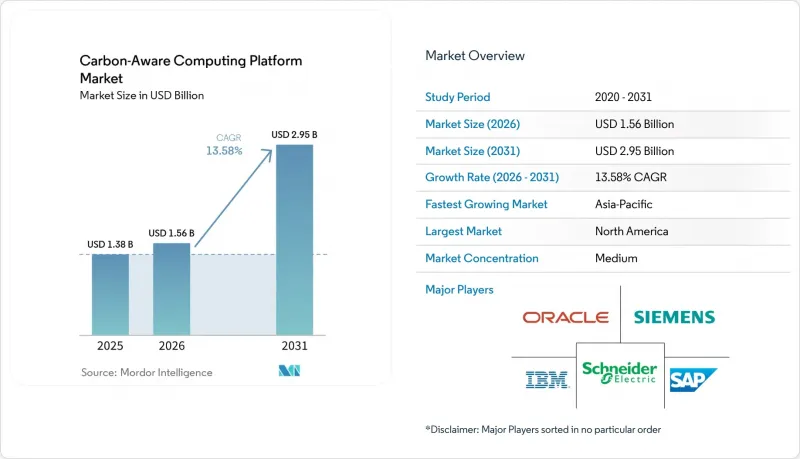
本報告按元件(軟體和服務)、應用程式(雲端工作負載調度、雲端基礎設施監控和最佳化等)、部署類型(雲端、混合、其他)、組織規模(大型企業、其他)、最終用戶(IT和電信、其他)以及地區進行細分。市場預測以美元(USD)為單位。
全球碳感知運算平台市場趨勢及洞察
人工智慧和GPU工作負載正變得越來越耗能。
碳感知運算平台市場直接受到人工智慧基礎設施功耗模式的驅動,因為GPU叢集決定了現代運算環境的運作能耗。用戶草案中引用的研究表明,GPU佔多GPU伺服器功耗的60%,佔整個人工智慧叢集功耗的41%,這意味著相當一部分排放源自一小部分運算資產。針對H100系統的研究發現,額定熱設計假設可能會高估實際運作高達24%,這表示基於規格的計算不如生產遙測資料可靠。這種差異對碳感知運算平台市場影響重大,因為買家越來越需要能夠反映實際工作負載的平台效能,而不是靜態的硬體標籤。谷歌也表示,其Ironwood TPU的單次運算碳排放強度比上一代產品降低了3.7倍,這凸顯了軟體平台為何必須隨著基礎設施的更新換代而跟上晶片效率曲線的變化。
淨零排放和ESG報告要求
更嚴格的報告要求也推動了碳感知運算平台市場的成長,因為企業現在需要能夠經受內部控制和外部審計的排放記錄。 「軟體碳強度」標準(正式確立為 ISO/IEC 21031:2024)為組織提供了一種系統化的方法來衡量軟體相關的排放,並增強了碳數據在管治流程中的可用性。 SAP 於 2026 年宣布,將向 SAP Sustainability Control Tower 整合一個新的“永續性 AI 代理”,該代理將自動完成範圍對齊、排放因子映射和披露文件的創建。這表示企業採購負責人正在從手動報告轉向基於系統的報告工作流程。 AWS 也發布了一個獨立的、具有範圍 1、範圍 2 和範圍 3 報告功能的永續性主機。這表明工作負載排放數據正在成為採購中的一項標準要求,而不是一項小眾功能。在碳感知運算平台市場,這增加了對能夠整合測量、歸因和揭露結果而無需建立平行報告流程的供應商的需求。
碳排放強度預測準確性的局限性
碳感知運算平台市場仍面臨根本性的數據限制,因為調度品質取決於未來碳強度訊號的可靠性。由於擔心其準確性和檢驗,Electricity Maps 已於 2025 年停止提供邊際碳強度訊號。這使得用於精細調度的較為精確的訊號選項之一受到限制。使用者草案中引用的 CarbonX 的一項研究也指出,撒哈拉以南非洲和東南亞部分地區仍然缺乏年度以下層級的電力配置數據,這限制了預測在全球大多數計算中心的適用性。此外,牛津大學的研究表明,如何在預測準確性和預測創建相關的碳成本之間取得平衡仍然是一個尚未解決的問題,這表明預測層在技術上仍不成熟。在碳感知運算平台市場,一些公司仍然保持謹慎,因為低預測準確度可能導致工作負載轉移,但無法帶來明顯的實際減碳效果。
細分市場分析
到2025年,軟體將佔碳感知計算平台市場69.41%的佔有率,而這一細分市場仍然是當前收入成長的核心。軟體如此高的佔比反映了碳感知運算平台市場的商業結構,其中基於訂閱的產品負責處理持續的監控、報告和調度邏輯。買家優先考慮軟體,因為排放追蹤必須持續運行,不受工作負載、地區或報告週期的限制,而不能僅在年度審查時更新。這也符合那些希望將工作負載遙測、永續性儀表板和管治記錄整合到單一系統中的公司的需求。因此,軟體仍然是在大規模雲端環境中部署碳感知運算平台的基礎控制層。
預計2026年至2031年,服務領域的複合年成長率將達到15.49%,這表明隨著部署規模的擴大,實施的深度變得日益重要。這種需求主要源自於將最初設計時並未考慮協同工作的調度API與雲端成本管理工具、ERP系統中的永續性模組以及溫室氣體清單系統整合。 SAP宣布,新的永續性AI代理將於2026年底前在「SAP永續控制塔」中正式發布,這印證了隨著自動化能力在大型企業環境中的普及,整合工作將會增加的觀點。此外,隨著規則和資料來源的變化,因子、區域映射和報告範本也需要更新,因此服務仍然發揮著至關重要的作用。即使核心軟體標準化不斷推進,託管服務和支援營運在碳感知運算平台產業中仍然扮演著至關重要的角色。
到 2025 年,雲端基礎設施監控和最佳化將佔碳感知運算平台市場 38.65% 的佔有率,成為目前收入最高的應用領域。這一領先地位合情合理,因為在採取乾預措施之前需要可視性,而大多數公司首先需要可靠的數據,以了解排放在各個地區、服務和工作負載中的位置。領先的雲端服務供應商已經將基於儀錶板的排放歸因分析標準化,這意味著碳感知運算平台市場建立在可視性的基準上,而不是從零開始進行測量。這使得差異化重點轉向更詳細的遙測數據、更強大的工作負載建議以及對成本和碳排放權衡的更有效控制。因此,即使更進階的最佳化用例不斷擴展,監控仍然是一項核心應用。
預計到2031年,人工智慧和高效能運算領域的排放最佳化將以14.55%的複合年成長率成長,使其成為碳感知運算平台市場中最具活力的應用領域。微軟研究院已證明,最佳化不再局限於簡單的時間調整,而是提出了一個框架,用於在碳預算約束下整合人工智慧訓練作業調度、推理工作負載路由、電池儲存和現場電力分配。開放運算計畫(OCP)也於2025年發布了碳揭露的基礎規範,這將推動更廣泛的轉型,用於標準化整個資料中心供應鏈的碳資訊。這意義重大,因為以更一致的結構管理來運作碳數據和嵌入產品中的碳數據,將有助於更快地擴展報告和合規工具。在碳感知運算平台市場,關注點正逐漸從被動可見性轉向對人工智慧密集型工作負載的主動控制。
區域分析
預計到2025年,北美將佔據36.71%的市場佔有率,使其在當前區域收入方面處於碳感知計算平台市場的領先地位。該地區擁有最大的超大規模雲端基礎設施,在人工智慧基礎設施和企業軟體方面的支出也十分集中。根據美國電力研究院(EPRI)的數據顯示,資料中心目前占美國電力消耗量的4%至5%,到2030年這一比例可能達到17%,凸顯了與計算相關的電源管理的重要性。 2026年2月,微軟確認其全球電力消耗量將100%來自可再生能源,顯示主要供應商正在努力平衡基礎設施擴張與綠能供應。 2026年3月,AWS推出了獨立的「永續發展主機」,進一步提高了人們對其商業雲區域原生排放可見性的預期。
歐洲仍然是第二大區域市場,其碳排放感知計算平台市場受到強烈的資訊揭露壓力和對更嚴格管治的期望的影響。根據FinOps基金會的報告,歐洲53%的FinOps實踐機構目前會報告雲碳排放,這表明與其他許多地區相比,歐洲在碳責任制擁有更成熟的營運方法。此外,AWS於2026年1月在德國推出了“歐洲主權雲”,這表明在遷移具有排放意識的工作負載時,居住要求正逐漸成為實際設計邊界的一部分。結合報告的成熟度和司法管轄的考量,歐洲在碳排放感知計算平台市場中繼續佔據重要地位,無論是在平台採用方面還是在部署模式創新方面。
預計到2031年,亞太地區將以14.24%的複合年成長率成長,成為碳感知運算平台市場成長最快的地區。這一成長主要得益於超大規模資料中心業者資料中心容量的擴張、人工智慧工作負載的增加以及旨在提高資料中心效率的區域性措施的推廣。 2025年12月,富士通和東京大學啟動了日本首個基於即時電網狀況的跨區域雲端連接工作負載遷移測試。這直接體現了碳感知營運從概念階段邁向概念驗證階段的歷程。合規性主導的需求在日本和澳洲更為顯著,而在印度和東南亞,市場成長則主要受基礎設施擴張和應對日益成長的計算負載的需求所驅動。南美洲和中東及非洲仍處於早期市場階段,但這些地區具有重要的戰略意義,因為未來雲端建置和利用可再生能源擴展資料中心容量可望拓寬碳感知運算平台市場的潛在範圍。
其他好處
- Excel格式的市場預測(ME)表
- 3個月的分析師支持
目錄
第1章:引言
- 研究假設和市場定義
- 調查範圍
第2章:調查方法
第3章執行摘要
第4章 市場狀況
- 市場概覽
- 市場促進因素
- 人工智慧和GPU工作負載的能耗日益增加。
- 淨零排放和ESG報告要求
- 透過降低碳排放的調度方式來降低雲端營運成本。
- 利用可再生能源擴展雲端區域
- 金融營運與永續性的融合
- 對符合審計要求的排放的需求
- 市場限制因素
- 碳排放強度預測準確性的局限性
- 混合環境中整合的複雜性
- 資料居住要求限制了工作負載在不同區域之間的遷移。
- 主動延後招募政策帶來的績效風險
- 產業價值鏈分析
- 監理情勢
- 技術展望
- 波特五力分析
- 宏觀經濟因素對市場的影響
第5章 市場規模與成長預測
- 按組件
- 軟體
- 服務
- 實施整合服務
- 支援和維護服務
- 透過使用
- 雲端工作負載調度
- 雲端基礎設施監控與最佳化
- 人工智慧和高效能運算中的排放最佳化
- 永續發展報告與合規性
- 其他
- 按實現類型
- 基於雲端的
- 現場
- 混合
- 按組織規模
- 大公司
- 小型企業
- 最終用戶
- IT/通訊
- 銀行業、金融服務業及保險業
- 醫療保健和生命科學
- 製造業
- 政府/公共部門
- 零售與電子商務
- 其他
- 按地區
- 北美洲
- 美國
- 加拿大
- 墨西哥
- 南美洲
- 巴西
- 阿根廷
- 其他南美國家
- 歐洲
- 德國
- 英國
- 法國
- 義大利
- 西班牙
- 俄羅斯
- 其他歐洲國家
- 亞太地區
- 中國
- 印度
- 日本
- 韓國
- 澳洲
- 其他亞太國家
- 中東
- 沙烏地阿拉伯
- 阿拉伯聯合大公國
- 土耳其
- 其他中東國家
- 非洲
- 南非
- 奈及利亞
- 其他非洲地區
- 北美洲
第6章 競爭情勢
- 市場集中度
- 策略趨勢
- 市佔率分析
- 公司簡介
- Microsoft Corporation
- Google LLC
- Amazon Web Services, Inc.
- IBM Corporation
- Schneider Electric SE
- Siemens AG
- Hewlett Packard Enterprise Company
- Cisco Systems, Inc.
- Oracle Corporation
- SAP SE
- Salesforce, Inc.
- VMware, Inc.
- Accenture plc
- Carbon Aware Cloud Limited
- Electricity Maps ApS
- WattTime, Inc.
- NTT DATA Group Corporation
- Dell Technologies Inc.
- ServiceNow, Inc.
- Cloud Bolt Software, Inc.
- Flexera Holdings LLC
第7章 市場機會與未來展望
According to Mordor Intelligence, the carbon-aware computing platform market size is projected to be USD 1.38 billion in 2025, USD 1.56 billion in 2026, and reach USD 2.95 billion by 2031, growing at a CAGR of 13.58% from 2026 to 2031.
This report is Segmented by Component (Software, and Services), Application (Cloud Workload Scheduling, Cloud Infrastructure Monitoring and Optimization, and More), Deployment Mode (Cloud-Based, Hybrid, and More), Organization Size (Large Enterprises, and More), End-User (Information Technology and Telecom, and More), and Geography. The Market Forecasts are Provided in Terms of Value (USD).
Global Carbon-Aware Computing Platform Market Trends and Insights
AI and GPU Workload Energy Intensity Rising
The carbon-aware computing platform market is gaining direct support from the power profile of AI infrastructure, because GPU clusters now shape the operating footprint of modern compute estates. Research cited in the user draft showed that GPUs accounted for 60% of power in multi-GPU servers and 41% of total power across AI clusters, which means a large share of emissions now comes from a narrow set of compute assets. Separate work on H100 systems found that nameplate thermal design assumptions can overstate actual production power draw by up to 24%, making specification-based accounting less reliable than live telemetry. That gap matters for the carbon-aware computing platform market because buyers increasingly need platform outputs that reflect real workloads rather than static hardware labels. Google also stated that its Ironwood TPUs delivered a 3.7x improvement in compute carbon intensity compared to the prior generation, underscoring why software platforms must keep pace with changing chip efficiency curves as fleets refresh.
Net Zero and ESG Reporting Requirements
Tighter reporting requirements are also boosting the carbon-aware computing platform market, as enterprises now need emissions records that can withstand internal control and external review. The Software Carbon Intensity standard, formalized as ISO/IEC 21031:2024, provides organizations with a structured way to measure software-related emissions, making carbon data more usable in governance processes. SAP stated in 2026 that new Sustainability AI Agents in the SAP Sustainability Control Tower would automate scope alignment, emissions factor mapping, and disclosure preparation, indicating that enterprise buyers are moving from manual reporting to system-based reporting workflows. AWS also launched a standalone Sustainability console with Scope 1, Scope 2, and Scope 3 reporting, which indicates that workload emissions data is becoming a standard procurement expectation rather than a niche feature. In the carbon-aware computing platform market, this shifts demand toward vendors that can connect measurement, attribution, and disclosure outputs without creating parallel reporting processes.
Limited Carbon Intensity Forecast Accuracy
The carbon-aware computing platform market still faces a fundamental data limitation, as scheduling quality depends on confidence in forward carbon-intensity signals. Electricity Maps discontinued its marginal carbon intensity signal in 2025 due to concerns about its veracity and verifiability, narrowing one of the more precise signal options used for fine-grained scheduling. The CarbonX research cited in the user draft also noted that parts of sub-Saharan Africa and Southeast Asia still lack usable source-mix data at the sub-annual level, which restricts forecast applicability across a large share of global compute locations. Oxford research further showed that balancing forecast accuracy with the carbon cost of producing the forecast remains unresolved, indicating the prediction layer is still technically immature. In the carbon-aware computing platform market, this keeps some enterprises cautious because a weak forecast can shift workloads without delivering a clear real-world carbon benefit.
Other drivers and restraints analyzed in the detailed report include:
- Carbon-Aware Scheduling Reduces Cloud Opex
- Renewable-Powered Cloud Region Expansion
- Integration Complexity Across Hybrid Estates
For complete list of drivers and restraints, kindly check the Table Of Contents.
Segment Analysis
Software accounted for 69.41% of the carbon-aware computing platform market in 2025, keeping this segment at the center of current revenue growth. The software-heavy mix reflects the commercial structure of the carbon-aware computing platform market, where subscription products handle continuous monitoring, reporting, and scheduling logic. Buyers prefer software first because emissions tracking must run continuously across workloads, regions, and reporting periods, rather than being refreshed only during annual reviews. This also suits enterprises that want one system to connect workload telemetry with sustainability dashboards and governance records. As a result, software remains the basic control layer through which the carbon-aware computing platform market is being deployed across large cloud estates.
The services segment is projected to grow at a 15.49% CAGR from 2026 to 2031, indicating that implementation depth is becoming increasingly valuable as deployments scale. Much of that demand comes from connecting scheduling APIs with cloud cost tools, ERP sustainability modules, and greenhouse gas inventory systems that were not designed together at the start. SAP stated that new Sustainability AI Agents will become generally available within SAP Sustainability Control Tower by the end of 2026, and that announcement supports the view that integration work will rise as automation features spread into large enterprise environments. Services also remain important because factor libraries, region mappings, and reporting templates must be updated as rules and data sources change. Within the carbon-aware computing platform industry, managed services and support work play a durable role even as core software becomes more standardized.
Cloud infrastructure monitoring and optimization accounted for 38.65% of the carbon-aware computing platform market in 2025, making it the largest application by current revenue. This lead is logical because visibility comes before intervention, and most enterprises first need reliable data on where emissions sit across regions, services, and workloads. The large cloud providers have already normalized dashboard-based attribution, meaning the carbon-aware computing platform market now builds on a visibility baseline rather than starting from zero measurement. That pushes differentiation toward deeper telemetry, stronger workload recommendations, and more usable cost-carbon trade-off controls. Monitoring, therefore, remains the anchor application even as more advanced optimization use cases expand.
AI and high-performance compute emissions optimization is projected to grow at a 14.55% CAGR through 2031, which makes it the most dynamic application area in the carbon-aware computing platform market. Microsoft Research described a framework that jointly schedules AI training jobs, routes inference workloads, and dispatches battery storage and on-site generation under carbon-budget constraints, demonstrating that optimization is moving beyond simple time shifting. The Open Compute Project also released a carbon disclosure base specification in 2025, which supports a broader shift toward standardized carbon information across the data center supply chain. That matters because reporting and compliance tools can expand more quickly when operational and embodied carbon data are structured more consistently. In the carbon-aware computing platform market, the center of gravity is slowly moving from passive visibility to active control over AI-heavy workloads.
Complete Report Scope:
- By Component
- Software
- Services
- Implementation and Integration Services
- Support and Maintenance Services
- By Application
- Cloud Workload Scheduling
- Cloud Infrastructure Monitoring and Optimization
- AI and High-Performance Compute Emissions Optimization
- Sustainability Reporting and Compliance
- Other Applications
- By Deployment Mode
- Cloud-Based
- On-Premises
- Hybrid
- By Organization Size
- Large Enterprises
- Small and Medium Enterprises
- By End-User
- Information Technology and Telecom
- Banking, Financial Services, and Insurance
- Healthcare and Life Sciences
- Manufacturing
- Government and Public Sector
- Retail and E-Commerce
- Other End-Users
- By Geography
- North America
- United States
- Canada
- Mexico
- South America
- Brazil
- Argentina
- Rest of South America
- Europe
- Germany
- United Kingdom
- France
- Italy
- Spain
- Russia
- Rest of Europe
- Asia-Pacific
- China
- India
- Japan
- South Korea
- Australia
- Rest of Asia-Pacific
- Middle East
- Saudi Arabia
- United Arab Emirates
- Turkey
- Rest of Middle East
- Africa
- South Africa
- Nigeria
- Rest of Africa
- North America
Geography Analysis
North America held a 36.71% share in 2025, ranking it at the forefront of the carbon-aware computing platform market by current regional revenue. The region combines the largest installed hyperscale cloud base with a high concentration of AI infrastructure and enterprise software spending. EPRI stated that data centers currently consume 4% to 5% of U.S. electricity and could reach 17% by 2030, underscoring the importance of compute-related power management. Microsoft also confirmed in February 2026 that it had matched 100% of its global electricity consumption with renewable energy, showing how major vendors are aligning infrastructure expansion with cleaner power sourcing. AWS added a standalone Sustainability console in March 2026, further raising expectations for native emissions visibility across its commercial cloud regions.
Europe remained the second-largest regional market, and the carbon-aware computing platform market there is shaped by strong disclosure pressure and tighter governance expectations. The FinOps Foundation reported that 53% of European FinOps practices now report cloud carbon, suggesting a more mature operating approach to carbon accountability than in many other regions. AWS also launched the European Sovereign Cloud in Germany in January 2026, which shows that residency requirements are becoming part of the practical design boundary for emissions-aware workload movement. This combination of reporting maturity and jurisdiction sensitivity keeps Europe important for both platform adoption and deployment model innovation in the carbon-aware computing platform market.
Asia-Pacific is projected to grow at a 14.24% CAGR through 2031, making it the fastest-growing regional market for carbon-aware computing platforms. Growth is supported by new hyperscaler capacity, expanding AI workloads, and a wider regional push to improve data center efficiency. Fujitsu and the University of Tokyo started Japan's first cloud-connected inter-regional workload shift trial in December 2025 based on real-time grid conditions, which provides a direct example of carbon-aware operations moving from concept to live testing. Japan and Australia show stronger compliance-led demand, while India and Southeast Asia are being lifted more by infrastructure expansion and the need to manage rising compute intensity. South America, the Middle East, and Africa remain earlier-stage markets, but they are strategically relevant because future cloud build-outs and renewable-backed data center capacity can widen the addressable footprint of the carbon-aware computing platform market.
- Microsoft Corporation
- Google LLC
- Amazon Web Services, Inc.
- IBM Corporation
- Schneider Electric SE
- Siemens AG
- Hewlett Packard Enterprise Company
- Cisco Systems, Inc.
- Oracle Corporation
- SAP SE
- Salesforce, Inc.
- VMware, Inc.
- Accenture plc
- Carbon Aware Cloud Limited
- Electricity Maps ApS
- WattTime, Inc.
- NTT DATA Group Corporation
- Dell Technologies Inc.
- ServiceNow, Inc.
- Cloud Bolt Software, Inc.
- Flexera Holdings LLC
Additional Benefits:
- The market estimate (ME) sheet in Excel format
- 3 months of analyst support
TABLE OF CONTENTS
1 INTRODUCTION
- 1.1 Study Assumptions and Market Definition
- 1.2 Scope of the Study
2 RESEARCH METHODOLOGY
3 EXECUTIVE SUMMARY
4 MARKET LANDSCAPE
- 4.1 Market Overview
- 4.2 Market Drivers
- 4.2.1 AI and GPU Workload Energy Intensity Rising
- 4.2.2 Net Zero and ESG Reporting Requirements
- 4.2.3 Carbon-Aware Scheduling Reduces Cloud Opex
- 4.2.4 Renewable-Powered Cloud Region Expansion
- 4.2.5 FinOps and Sustainability Convergence
- 4.2.6 Demand for Audit-Ready Emissions Attribution
- 4.3 Market Restraints
- 4.3.1 Limited Carbon Intensity Forecast Accuracy
- 4.3.2 Integration Complexity Across Hybrid Estates
- 4.3.3 Data Residency Constraints Limit Cross-Region Workload Shifting
- 4.3.4 Performance Risk from Aggressive Job Deferral Policies
- 4.4 Industry Value Chain Analysis
- 4.5 Regulatory Landscape
- 4.6 Technological Outlook
- 4.7 Porter's Five Forces Analysis
- 4.7.1 Bargaining Power of Buyers
- 4.7.2 Bargaining Power of Suppliers
- 4.7.3 Threat of New Entrants
- 4.7.4 Threat of Substitutes
- 4.7.5 Intensity of Competitive Rivalry
- 4.8 Impact of Macroeconomic Factors on the Market
5 MARKET SIZE AND GROWTH FORECASTS (VALUE)
- 5.1 By Component
- 5.1.1 Software
- 5.1.2 Services
- 5.1.2.1 Implementation and Integration Services
- 5.1.2.2 Support and Maintenance Services
- 5.2 By Application
- 5.2.1 Cloud Workload Scheduling
- 5.2.2 Cloud Infrastructure Monitoring and Optimization
- 5.2.3 AI and High-Performance Compute Emissions Optimization
- 5.2.4 Sustainability Reporting and Compliance
- 5.2.5 Other Applications
- 5.3 By Deployment Mode
- 5.3.1 Cloud-Based
- 5.3.2 On-Premises
- 5.3.3 Hybrid
- 5.4 By Organization Size
- 5.4.1 Large Enterprises
- 5.4.2 Small and Medium Enterprises
- 5.5 By End-User
- 5.5.1 Information Technology and Telecom
- 5.5.2 Banking, Financial Services, and Insurance
- 5.5.3 Healthcare and Life Sciences
- 5.5.4 Manufacturing
- 5.5.5 Government and Public Sector
- 5.5.6 Retail and E-Commerce
- 5.5.7 Other End-Users
- 5.6 By Geography
- 5.6.1 North America
- 5.6.1.1 United States
- 5.6.1.2 Canada
- 5.6.1.3 Mexico
- 5.6.2 South America
- 5.6.2.1 Brazil
- 5.6.2.2 Argentina
- 5.6.2.3 Rest of South America
- 5.6.3 Europe
- 5.6.3.1 Germany
- 5.6.3.2 United Kingdom
- 5.6.3.3 France
- 5.6.3.4 Italy
- 5.6.3.5 Spain
- 5.6.3.6 Russia
- 5.6.3.7 Rest of Europe
- 5.6.4 Asia-Pacific
- 5.6.4.1 China
- 5.6.4.2 India
- 5.6.4.3 Japan
- 5.6.4.4 South Korea
- 5.6.4.5 Australia
- 5.6.4.6 Rest of Asia-Pacific
- 5.6.5 Middle East
- 5.6.5.1 Saudi Arabia
- 5.6.5.2 United Arab Emirates
- 5.6.5.3 Turkey
- 5.6.5.4 Rest of Middle East
- 5.6.6 Africa
- 5.6.6.1 South Africa
- 5.6.6.2 Nigeria
- 5.6.6.3 Rest of Africa
- 5.6.1 North America
6 COMPETITIVE LANDSCAPE
- 6.1 Market Concentration
- 6.2 Strategic Moves
- 6.3 Market Share Analysis
- 6.4 Company Profiles (includes Global Level Overview, Market Level Overview, Core Segments, Financials as available, Strategic Information, Market Rank/Share, Products and Services, Recent Developments)
- 6.4.1 Microsoft Corporation
- 6.4.2 Google LLC
- 6.4.3 Amazon Web Services, Inc.
- 6.4.4 IBM Corporation
- 6.4.5 Schneider Electric SE
- 6.4.6 Siemens AG
- 6.4.7 Hewlett Packard Enterprise Company
- 6.4.8 Cisco Systems, Inc.
- 6.4.9 Oracle Corporation
- 6.4.10 SAP SE
- 6.4.11 Salesforce, Inc.
- 6.4.12 VMware, Inc.
- 6.4.13 Accenture plc
- 6.4.14 Carbon Aware Cloud Limited
- 6.4.15 Electricity Maps ApS
- 6.4.16 WattTime, Inc.
- 6.4.17 NTT DATA Group Corporation
- 6.4.18 Dell Technologies Inc.
- 6.4.19 ServiceNow, Inc.
- 6.4.20 Cloud Bolt Software, Inc.
- 6.4.21 Flexera Holdings LLC
7 MARKET OPPORTUNITIES AND FUTURE OUTLOOK
- 7.1 White-space and Unmet-Need Assessment

 2026年全球國防雲端運算市場報告2026年全球軍用雲端運算市場報告
 雲端運算市場:按服務模式、部署模式、組織規模、應用程式和產業分類-2026-2032年全球市場預測
 2034年航太航太雲端運算市場預測-按服務模式、部署模式、功能、應用、最終用戶和區域分類的全球分析
 GPU雲端:市佔率分析、產業趨勢與統計、成長預測(2026-2031年)工業IoT市場中的雲端運算:2026-2032年全球市場預測(按組件、連接方式、設備類型、部署模式、組織規模、應用程式和最終用戶產業分類)計算服務市場:2026-2032年全球市場預測(依服務類型、服務交付模式、部署模式、組織規模、應用程式、最終用戶產業和定價模式分類)雲端運算和儲存市場:按服務模式、可用性配置、部署模式、產業和組織規模分類-2026-2032年全球市場預測
 雲端運算市場:按服務類型、部署方式、工作負載類型、最終用戶和區域分類雲端運算市場預測至2034年-按服務模式、部署模式、組織規模、工作負載類型、最終用戶和地區分類的全球分析