


 |
市場調查報告書
商品編碼
2099509
身分解析軟體:市場佔有率分析、產業趨勢與統計、成長預測(2026-2031)Identity Resolution Software - Market Share Analysis, Industry Trends & Statistics, Growth Forecasts (2026 - 2031) |
||||||

※ 本網頁內容可能與最新版本有所差異。詳細情況請與我們聯繫。
據 Mordor Intelligence 稱,2025 年身分解析軟體市場價值 15.4 億美元,預計到 2031 年將達到 44.8 億美元,2026 年至 2031 年的複合年成長率為 20%。
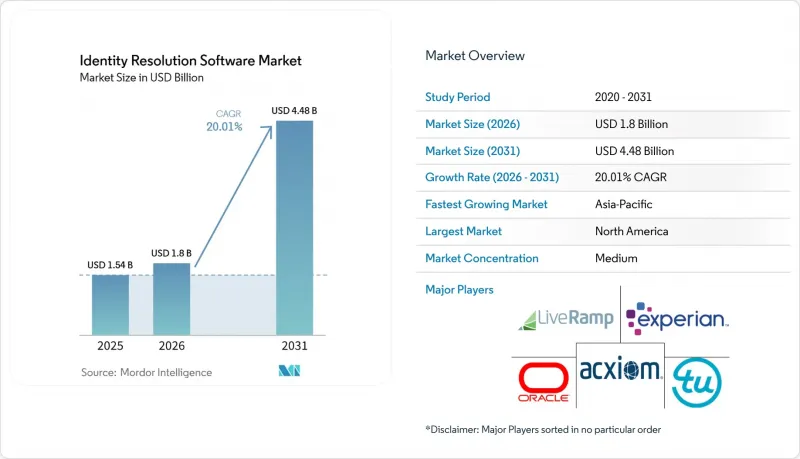
本報告按組件(軟體和服務)、部署類型(雲端、本地部署、混合部署)、企業規模(大型企業和中小企業)、最終用戶行業(零售和電子商務、銀行、金融服務和保險、醫療保健和生命科學、IT和電信、媒體和娛樂等)以及地區進行細分。市場預測以價值(美元)表示。
全球身分解析軟體市場趨勢與洞察
無 Cookie 數位廣告正在推動對第一方 ID 整合的需求不斷成長。
隨著第三方 Cookie 在主流瀏覽器中的重要性下降,對身分解析軟體的需求日益成長。零售媒體網路現在要求品牌將客戶群與確定性識別碼關聯起來,而不是依賴第三方資料仲介。這種轉變使得身分相關任務不再由獨立工具處理,而是成為商業和廣告基礎設施的一部分。 2026 年 4 月,LiveRamp 將其 RampID 產品擴展到 Unity Exchange,使基於身分的廣告購買覆蓋全球 29 億月活躍行動裝置和美國 2.56 億月活躍行動裝置。程序化環境中對亞毫秒匹配的需求也在影響身分解析軟體市場的格局,迫使供應商從批次轉向串流和邊緣運算架構。
日益成長的整合各觸點分散客戶資料的需求
身分解析軟體市場正受惠於客戶關係管理 (CRM)、會員忠誠度計畫、電商、行動端和線下通路中日益分散的客戶系統所帶來的負擔。許多企業仍然管理 5 到 15 個系統,同一個人卻被分配了不同的識別碼。 Amperity 在 2025 年 4 月的發布資料中引用了《麻省理工科技評論》的洞察報告,指出全球 78% 的企業尚未準備好部署人工智慧代理,而客戶資料的分散性和不準確性是主要障礙。身分解析軟體透過創建持久且注重隱私的識別碼來解決此問題,從而支援跨團隊和應用程式的統一客戶記錄。 Amperity 還報告稱,一家大型零售商利用其身份解析功能,成功識別出 350 萬個以前無法訪問的客戶電子郵件地址。這表明,身分解析軟體市場正在獲得行銷團隊以外的商業性支援。
資料隱私限制了圖的持久性和匹配率。
由於隱私法規可能會減少可用於匹配和啟動的個人資料量,因此身分解析軟體市場面臨結構性限制。如今,當消費者行使這些權利時,公司必須刪除、更正或排除相關數據,這導致身分圖譜的持久性隨時間推移而減弱。加州修訂後的《加州消費者隱私法案》(CCPA) 框架於 2026 年 1 月 1 日生效,新增了關於自動化決策、網路安全審計和風險評估的規則。這些要求增加了建置和維護大規模身分圖譜的成本,因此買家越來越重視同意管治、可審計架構和隱私設計控制。因此,與被動追蹤法規不那麼嚴格時相比,身分解析軟體市場現在必須在準確性、規模和合法啟動之間尋求更加謹慎的平衡。
細分市場分析
到2025年,軟體收入將佔總收入的71.24%,並繼續保持其在身分解析軟體市場的領先地位。這反映出買家更傾向於平台部署而非專案主導型方案。訂閱式定價模式鞏固了這一地位,因為它使企業的支出模式更具可預測性。雲端原生軟體也因其能夠快速整合到企業內部已有的資料湖、客戶資料平台 (CDP) 和活化平台而日益普及。在身分解析軟體市場,能夠為人工智慧驅動的用例維護可審計且基於使用者許可的管理記錄的平台仍然備受青睞。 Acxiom在Databricks中強化「真實身分」認證,以及其在Databricks CustomerLake代理型CDP中的作用,都顯示軟體供應商正透過與平台的深度整合來拓展收入潛力。
服務是身分解析軟體市場中成長最快的細分領域,預計到2031年將以22.83%的複合年成長率成長。這一成長速度反映了圖設計、機率調優和共識框架配置等部署方面的複雜性。許多企業仍需要外部支持,才能將多個雲端平台、業務部門和司法管轄區整合到一個功能完善的身份層中。託管服務在醫療保健和金融服務用戶中越來越受歡迎,這些用戶需要更嚴格的資料處理歷程、存取控制和審計追蹤監管。服務的快速成長並沒有降低軟體的價值;相反,它顯示隨著部署方式從獨立配對轉向管治的企業基礎設施,身分解析軟體市場正變得更加複雜。
到 2025 年,基於雲端的採用將佔銷售額的 68.41%,成為身分解析軟體市場最大的組成部分。採用速度最快的是那些已經運行雲端優先資料環境的數位原生零售商、媒體公司和科技公司。雲端交付支援即時 API 訪問,這對於響應時間要求嚴格的程序化廣告和網站個性化至關重要。它還能在身分查詢激增的購物高峰期為企業提供強大的處理能力。隨著 LiveRamp 於 2026 年 3 月發布的平台,原生身分解析功能擴展到了 Snowflake 和 AWS,進一步加強了身分解析軟體市場與環境內圖管理之間的連結。
在身分解析軟體市場,混合部署預計到2031年將以21.69%的複合年成長率成長。這種模式正受到受監管用戶的青睞,他們希望在私有環境中保留敏感記錄,同時利用雲端連結進行搜尋、資料豐富和啟動。銀行、金融和保險(BFSI)以及醫療保健行業的負責人尤其青睞這種方法,因為它使他們能夠在不犧牲響應速度的情況下滿足居住和主權要求。在策略仍然限制資料傳輸到外部來源的傳統環境中,本地部署仍然至關重要。然而,隨著內建雲端控制功能緩解了控制和柔軟性之間的傳統權衡,身分解析軟體市場正逐漸轉向混合和雲端模式。
區域分析
到2025年,北美將佔全球銷售額的34.62%,成為身分解析軟體市場的領頭羊,並佔據最大的區域市場佔有率。該地區受益於企業軟體的高額支出、強大的廣告技術基礎設施以及推動合規的第一方身分工具需求並削弱傳統追蹤方式的法規環境。此外,美國買家可以利用成熟的信用機構和擁有大規模確定性身分資產的平台供應商,加速在行銷、分析和活化等各種應用情境中的普及。加拿大和墨西哥也在身分解析軟體市場中發揮重要作用,不斷完善的隱私法規和資料管治要求推動了對可審計匹配系統的需求成長。
在歐洲,德國、英國和法國是身分解析軟體最大的各國市場。該地區的需求仍然集中在銀行、金融和保險(BFSI)、零售以及媒體和娛樂產業,這些公司需要在日益嚴格的隱私要求下,跨通路匹配資料。 Experian 於 2026 年 7 月在英國發布了 Identity Connect,這是一款以合規性為導向的產品,它透過單一 API 整合了生物識別、文件驗證、詐欺檢測資訊和信用局數據。雖然規模較小,但隨著金融數據互通性的增強以及基於同意的數據使用方式的重要性日益凸顯,巴西和阿根廷正在推動南美市場的發展。
亞太地區是身分解析軟體市場成長最快的地區,預計到2031年將以24.19%的複合年成長率成長,成為對市場成長貢獻最大的地區。行動優先商務和數位服務的蓬勃發展,推動了全部區域對即時身份驗證和匹配的需求不斷成長。在中國,金融、電信、電子商務和社交平臺等產業廣泛推行的實名認證要求,持續支持市場需求。在日本和韓國,由於隱私和資料管治的不斷變化,對基於用戶許可的識別系統的需求也在不斷成長。根據Trulioo預測,到2025年,亞太地區的企業身分驗證需求預計將年增51%,顯示全部區域身分識別相關技術的普及速度正在加快。雖然中東和非洲地區的市場規模相對較小,但阿拉伯聯合大公國和沙烏地阿拉伯正在加強對身分解析軟體市場的支持力度,因為它們正在製定國家級數位身分框架,而這些框架需要相容的企業基礎設施。
其他好處:
- Excel格式的市場預測(ME)表
- 3個月的分析師支持
目錄
第1章:引言
- 研究假設和市場定義
- 調查範圍
第2章:調查方法
第3章執行摘要
第4章 市場狀況
- 市場概覽
- 市場促進因素
- 無 cookie 數位廣告的興起增加了對第一方 ID 整合的需求。
- 日益成長的整合各觸點分散客戶資料的需求
- 企業中即時個人化和最佳行動引擎的實施
- 跨裝置和跨通路解決方案的身份圖譜的成長
- 隱私保護資料共享和擴展的無塵室工作流程
- 詐欺偵測和重複記錄消除的應用場景日益增多。
- 市場限制因素
- 由於資料隱私限制,圖的持久性和匹配率受到限制。
- 歷史數據的品質差降低了解析度的準確性。
- CRM、CDP 和廣告技術堆疊之間整合的複雜性。
- 對第三方資料的依賴程度高,且同意範圍有限
- 宏觀經濟因素對市場的影響
- 產業價值鏈分析
- 科技趨勢
- 監理情勢
- 波特五力分析
第5章 市場規模與成長預測
- 按組件
- 軟體
- 服務
- 部署模式
- 基於雲端的
- 現場
- 混合
- 按公司規模
- 大公司
- 小型企業
- 按最終用戶行業分類
- 零售與電子商務
- BFSI
- 醫療保健和生命科學
- 資訊科技/通訊
- 媒體與娛樂
- 工業製造
- 政府和公共行政
- 其他終端用戶產業
- 按地區
- 北美洲
- 美國
- 加拿大
- 墨西哥
- 南美洲
- 巴西
- 阿根廷
- 其他南美國家
- 歐洲
- 德國
- 英國
- 法國
- 義大利
- 西班牙
- 俄羅斯
- 其他歐洲國家
- 亞太地區
- 中國
- 印度
- 日本
- 韓國
- 澳洲
- 其他亞太國家
- 中東和非洲
- 中東
- 沙烏地阿拉伯
- 阿拉伯聯合大公國
- 其他中東國家
- 非洲
- 南非
- 奈及利亞
- 其他非洲國家
- 中東
- 北美洲
第6章 競爭情勢
- 市場集中度
- 策略趨勢
- 市佔率分析
- 公司簡介
- LiveRamp Holdings, Inc.
- Experian plc
- TransUnion LLC
- Equifax Inc.
- Acxiom Holdings, Inc.
- Oracle Corporation
- Salesforce, Inc.
- Adobe Inc.
- SAP SE
- Tealium Inc.
- Amperity, Inc.
- Segments.ai, Inc.
- Dun and Bradstreet Holdings, Inc.
- The Nielsen Company(US), LLC
- IBM Corporation
- SAS Institute Inc.
- Neustar, Inc.
- Microsoft Corporation
- Cisco Systems, Inc.
- Pega Systems Inc.
第7章 市場機會與未來展望
According to Mordor Intelligence, the identity resolution software market size was valued at USD 1.54 billion in 2025 and is forecast to reach USD 4.48 billion by 2031, growing at a CAGR of 20% from 2026 to 2031.
This report is Segmented by Component (Software, and Services), Deployment Mode (Cloud-Based, On-Premise, and Hybrid), Enterprise Size (Large Enterprises, and Small and Medium Enterprises), End-User Industry (Retail and E-Commerce, BFSI, Healthcare and Life Sciences, IT and Telecom, Media and Entertainment, and More), and Geography. The Market Forecasts are Provided in Terms of Value (USD).
Global Identity Resolution Software Market Trends and Insights
Cookieless Digital Advertising Intensifies Demand for First-Party Identity Stitching
The identity resolution software market is seeing stronger demand as third-party cookies lose relevance across major browsers. Retail media networks now expect brands to match customer segments to deterministic identifiers rather than rely on third-party data brokers. That shift is moving more identity work into commerce and advertising infrastructure rather than leaving it with stand-alone tools. LiveRamp expanded RampID across Unity Exchange in April 2026, extending identity-based buying across 2.9 billion monthly active mobile devices globally and 256 million in the United States. The identity resolution software market is also being shaped by the need for sub-100 millisecond matching in programmatic environments, which is pushing vendors from batch processing toward streaming and edge-enabled architectures.
Rising Need to Unify Fragmented Customer Data Across Touchpoints
The identity resolution software market is benefiting from the growing burden of disconnected customer systems across CRM, loyalty, commerce, mobile, and offline channels. Many organizations still manage between 5 and 15 systems of record that assign different identifiers to the same person. Amperity's April 2025 launch material, citing MIT Technology Review Insights, said 78% of global companies were not very ready to deploy AI agents, with disconnected and inaccurate customer data named as the main barrier. Identity resolution software addresses that issue by creating a persistent, privacy-safe identifier that supports a unified customer record across teams and applications. Amperity also said one large retailer uncovered 3.5 million previously unreachable customer email addresses after using its identity resolution capabilities, which shows why the identity resolution software market is gaining commercial support beyond marketing teams.
Data Privacy Constraints Limit Graph Persistence and Match Rates
The identity resolution software market faces a structural limit because privacy regulations can reduce the amount of personal data available for matching and activation. Enterprises now have to delete, correct, or exclude data when consumers exercise those rights, which weakens graph persistence over time. California's updated CCPA framework took effect on January 1, 2026, and added rules on automated decision-making, cybersecurity audits, and risk assessments. Those requirements raise the cost of building and maintaining large identity graphs and increase buyer focus on consent governance, audit readiness, and privacy-by-design controls. The identity resolution software market must therefore balance accuracy, scale, and lawful activation more carefully than it did when passive tracking was subject to fewer restrictions.
Other drivers and restraints analyzed in the detailed report include:
- Enterprise Adoption of Real-Time Personalization and Next-Best-Action Engines
- Growth of Identity Graphs for Cross-Device and Cross-Channel Resolution
- Integration Complexity Across CRM, CDP, and Ad Tech Stacks
For complete list of drivers and restraints, kindly check the Table Of Contents.
Segment Analysis
Software held a 71.24% revenue share in 2025, giving it the lead in the identity resolution software market and reflecting buyer preference for platform deployment over project-led engagement. Subscription pricing has supported that position because it gives enterprises more predictable spending patterns. Cloud-native software has also gained favor because it integrates more quickly with data lakes, CDPs, and activation platforms already used across the business. The identity resolution software market continues to reward platforms that can maintain auditable and consent-governed records for AI-driven use cases. Acxiom's enhanced Real ID presence in Databricks and its role in the Databricks CustomerLake agentic CDP showed how software vendors are extending revenue potential through deeper platform integration.
Services are the fastest-growing component of the identity resolution software market and are projected to expand at a 22.83% CAGR through 2031. That pace reflects the implementation burden tied to graph design, probabilistic tuning, and consent framework setup. Many enterprises still need outside help to connect multiple clouds, business units, and jurisdictions into a usable identity layer. Managed services are gaining traction among healthcare and financial services users who need stronger oversight of data lineage, access controls, and audit trails. The faster growth of services does not weaken the software case; instead, it shows that the identity resolution software market is becoming more complex as deployments move from stand-alone matching to governed enterprise infrastructure.
Cloud-based deployment accounted for 68.41% of revenue in 2025, which made it the largest configuration in the identity resolution software market. Adoption has been strongest among digital-native retailers, media companies, and technology firms that already run cloud-first data environments. Cloud delivery supports real-time API access, which is critical for programmatic advertising and on-site personalization, where response times are tightly constrained. It also provides enterprises with elastic capacity during peak shopping periods, when identity queries can rise rapidly. LiveRamp's March 2026 platform release extended native identity resolution across Snowflake and AWS, reinforcing the alignment of the identity resolution software market with in-environment graph management.
Hybrid deployment is projected to grow at a 21.69% CAGR through 2031 in the identity resolution software market. This model is gaining ground among regulated users who want to keep sensitive records in private environments while still using cloud links for lookup, enrichment, and activation. BFSI and healthcare buyers are particularly aligned with that approach because it helps them address residency and sovereignty requirements without giving up response speed. On-premise deployment still matters in legacy estates where external data transfer remains restricted by policy. Even so, the identity resolution software market is gradually shifting toward hybrid, cloud-based models as embedded cloud controls reduce the historical trade-off between control and flexibility.
Complete Report Scope:
- By Component
- Software
- Services
- By Deployment Mode
- Cloud-Based
- On-Premise
- Hybrid
- By Enterprise Size
- Large Enterprises
- Small And Medium Enterprises
- By End-User Industry
- Retail and E-Commerce
- BFSI
- Healthcare and Life Sciences
- IT and Telecom
- Media and Entertainment
- Industrial Manufacturing
- Government and Public Administration
- Other End-User Industries
- By Geography
- North America
- United States
- Canada
- Mexico
- South America
- Brazil
- Argentina
- Rest of South America
- Europe
- Germany
- United Kingdom
- France
- Italy
- Spain
- Russia
- Rest of Europe
- Asia-Pacific
- China
- India
- Japan
- South Korea
- Australia
- Rest of Asia-Pacific
- Middle East and Africa
- Middle East
- Saudi Arabia
- United Arab Emirates
- Rest of Middle East
- Africa
- South Africa
- Nigeria
- Rest of Africa
- Middle East
- North America
Geography Analysis
North America accounted for 34.62% of revenue in 2025, giving it the lead in the identity resolution software market and the largest regional market share. The region benefits from high enterprise software spending, deep advertising technology infrastructure, and a regulatory setting that weakens traditional tracking while increasing demand for compliant first-party identity tools. U.S. buyers also have access to established bureau and platform providers with large deterministic identity assets, which support faster adoption across marketing, analytics, and activation use cases. Canada and Mexico are also contributing to the identity resolution software market, as privacy modernization and data governance requirements drive greater demand for auditable matching systems.
Germany, the United Kingdom, and France represented the largest country markets in Europe for identity resolution software. Demand in the region remains centered on BFSI, retail, and media and entertainment, where firms must match data across channels while operating under tighter privacy expectations. Experian launched Identity Connect in the United Kingdom in July 2026, combining biometric verification, document checks, fraud intelligence, and bureau data through a single API in a compliance-led product design. South America is smaller, but Brazil and Argentina are adding demand to the identity resolution software market as financial data interoperability expands and consent-linked data use becomes more important.
Asia-Pacific is the fastest-growing region in the identity resolution software market and is projected to expand at a 24.19% CAGR through 2031, making it the strongest regional contributor to market growth. Mobile-first commerce and digital service growth are increasing the need for real-time identity matching across the region. China continues to support demand through broad real-name verification requirements across finance, telecom, e-commerce, and social platforms. Japan and South Korea are also raising the need for consent-governed identity systems through ongoing privacy and data governance changes. Trulioo reported 51% year-over-year growth in Asia-Pacific business verification volume in 2025, which signals the pace of identity-related adoption across the region. The Middle East and Africa remain smaller, but the identity resolution software market is gaining support there as the UAE and Saudi Arabia move ahead with national digital identity frameworks that will require compatible enterprise infrastructure.
- LiveRamp Holdings, Inc.
- Experian plc
- TransUnion LLC
- Equifax Inc.
- Acxiom Holdings, Inc.
- Oracle Corporation
- Salesforce, Inc.
- Adobe Inc.
- SAP SE
- Tealium Inc.
- Amperity, Inc.
- Segments.ai, Inc.
- Dun and Bradstreet Holdings, Inc.
- The Nielsen Company (US), LLC
- IBM Corporation
- SAS Institute Inc.
- Neustar, Inc.
- Microsoft Corporation
- Cisco Systems, Inc.
- Pega Systems Inc.
Additional Benefits:
- The market estimate (ME) sheet in Excel format
- 3 months of analyst support
TABLE OF CONTENTS
1 INTRODUCTION
- 1.1 Study Assumptions and Market Definition
- 1.2 Scope of the Study
2 RESEARCH METHODOLOGY
3 EXECUTIVE SUMMARY
4 MARKET LANDSCAPE
- 4.1 Market Overview
- 4.2 Market Drivers
- 4.2.1 Cookieless Digital Advertising Intensifies Demand for First-Party Identity Stitching
- 4.2.2 Rising Need to Unify Fragmented Customer Data Across Touchpoints
- 4.2.3 Enterprise Adoption of Real-Time Personalization and Next-Best-Action Engines
- 4.2.4 Growth of Identity Graphs for Cross-Device and Cross-Channel Resolution
- 4.2.5 Expansion of Privacy-Safe Data Collaboration and Clean Room Workflows
- 4.2.6 Increasing Fraud Detection and Duplicate Record Suppression Use Cases
- 4.3 Market Restraints
- 4.3.1 Data Privacy Constraints Limit Graph Persistence and Match Rates
- 4.3.2 Poor Legacy Data Quality Reduces Resolution Accuracy
- 4.3.3 Integration Complexity Across CRM, CDP, and Ad Tech Stacks
- 4.3.4 High Dependency on Third-Party Data and Consent Coverage
- 4.4 Impact of Macroeconomic Factors on the Market
- 4.5 Industry Value Chain Analysis
- 4.6 Technology Outlook
- 4.7 Regulatory Landscape
- 4.8 Porter's Five Forces Analysis
- 4.8.1 Threat of New Entrants
- 4.8.2 Bargaining Power of Suppliers
- 4.8.3 Bargaining Power of Buyers
- 4.8.4 Threat of Substitutes
- 4.8.5 Intensity of Competitive Rivalry
5 MARKET SIZE AND GROWTH FORECASTS (VALUE)
- 5.1 By Component
- 5.1.1 Software
- 5.1.2 Services
- 5.2 By Deployment Mode
- 5.2.1 Cloud-Based
- 5.2.2 On-Premise
- 5.2.3 Hybrid
- 5.3 By Enterprise Size
- 5.3.1 Large Enterprises
- 5.3.2 Small And Medium Enterprises
- 5.4 By End-User Industry
- 5.4.1 Retail and E-Commerce
- 5.4.2 BFSI
- 5.4.3 Healthcare and Life Sciences
- 5.4.4 IT and Telecom
- 5.4.5 Media and Entertainment
- 5.4.6 Industrial Manufacturing
- 5.4.7 Government and Public Administration
- 5.4.8 Other End-User Industries
- 5.5 By Geography
- 5.5.1 North America
- 5.5.1.1 United States
- 5.5.1.2 Canada
- 5.5.1.3 Mexico
- 5.5.2 South America
- 5.5.2.1 Brazil
- 5.5.2.2 Argentina
- 5.5.2.3 Rest of South America
- 5.5.3 Europe
- 5.5.3.1 Germany
- 5.5.3.2 United Kingdom
- 5.5.3.3 France
- 5.5.3.4 Italy
- 5.5.3.5 Spain
- 5.5.3.6 Russia
- 5.5.3.7 Rest of Europe
- 5.5.4 Asia-Pacific
- 5.5.4.1 China
- 5.5.4.2 India
- 5.5.4.3 Japan
- 5.5.4.4 South Korea
- 5.5.4.5 Australia
- 5.5.4.6 Rest of Asia-Pacific
- 5.5.5 Middle East and Africa
- 5.5.5.1 Middle East
- 5.5.5.1.1 Saudi Arabia
- 5.5.5.1.2 United Arab Emirates
- 5.5.5.1.3 Rest of Middle East
- 5.5.5.2 Africa
- 5.5.5.2.1 South Africa
- 5.5.5.2.2 Nigeria
- 5.5.5.2.3 Rest of Africa
- 5.5.5.1 Middle East
- 5.5.1 North America
6 COMPETITIVE LANDSCAPE
- 6.1 Market Concentration
- 6.2 Strategic Moves
- 6.3 Market Share Analysis
- 6.4 Company Profiles (includes Global Level Overview, Market Level Overview, Core Segments, Financials as available, Strategic Information, Market Rank/Share, Products and Services, Recent Developments)
- 6.4.1 LiveRamp Holdings, Inc.
- 6.4.2 Experian plc
- 6.4.3 TransUnion LLC
- 6.4.4 Equifax Inc.
- 6.4.5 Acxiom Holdings, Inc.
- 6.4.6 Oracle Corporation
- 6.4.7 Salesforce, Inc.
- 6.4.8 Adobe Inc.
- 6.4.9 SAP SE
- 6.4.10 Tealium Inc.
- 6.4.11 Amperity, Inc.
- 6.4.12 Segments.ai, Inc.
- 6.4.13 Dun and Bradstreet Holdings, Inc.
- 6.4.14 The Nielsen Company (US), LLC
- 6.4.15 IBM Corporation
- 6.4.16 SAS Institute Inc.
- 6.4.17 Neustar, Inc.
- 6.4.18 Microsoft Corporation
- 6.4.19 Cisco Systems, Inc.
- 6.4.20 Pega Systems Inc.
7 MARKET OPPORTUNITIES AND FUTURE OUTLOOK
- 7.1 White-Space and Unmet-Need Assessment

 行動識別:市場佔有率分析、行業趨勢和統計數據、成長預測(2026-2031 年)
 行動身分管理市場規模、佔有率和成長分析:按組件、部署模式、身分驗證類型、組織規模、企業行動類型、應用領域和地區分類-2026-2033年產業預測
 個人身分管理市場報告:按元件、部署模式、資料類型、產業和地區分類(2026-2034 年)
 2026年全球行動識別市場報告
 個人身分管理市場:按元件、部署模式、應用程式、身分類型和最終用戶分類-2026-2032年全球市場預測行動身分管理市場:依組織規模、元件、部署模式、身分驗證方法和產業分類-2026-2032年全球市場預測
 病患識別軟體市場規模、佔有率和成長分析:按組件、部署模式、應用、最終用戶、地區和行業預測,2026-2033 年
 個人身分管理市場規模、佔有率和成長分析(按組件、部署類型、身分類型、身分驗證方法、最終用戶產業和地區分類)-2026-2033年產業預測
 行動身分管理市場 - 全球產業規模、佔有率、趨勢、機會及預測(按解決方案、服務、部署、公司規模、產業、地區和競爭格局分類),2021-2031年雙模身分管理解決方案市場-全球產業規模、佔有率、趨勢、機會和預測,按垂直產業、組織規模、部署方式、地區和競爭格局分類,2020-2030 年預測