


 |
市場調查報告書
商品編碼
2125324
行動識別:市場佔有率分析、行業趨勢和統計數據、成長預測(2026-2031 年)Mobile Identification - Market Share Analysis, Industry Trends & Statistics, Growth Forecasts (2026 - 2031) |
||||||

※ 本網頁內容可能與最新版本有所差異。詳細情況請與我們聯繫。
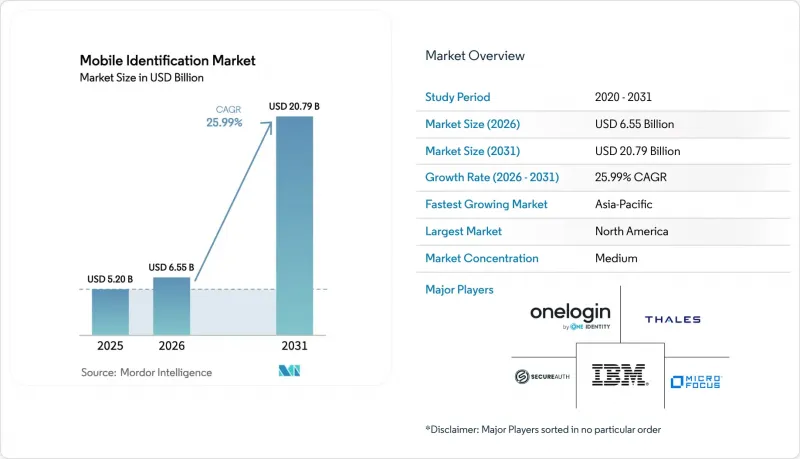
根據 Mordor Intelligence 預測,行動身分識別市場規模將從 2025 年的 52 億美元成長到 2026 年的 65.5 億美元,到 2031 年將達到 207.9 億美元,2026 年至 2031 年的複合年成長率為 25.99%。
本報告依身份驗證方式(單一因素身份驗證、多因素身份驗證)、組件(生物識別、非生物識別、服務)、部署方式(雲端、本地部署)、應用領域(金融、保險與證券、IT與電信、零售、醫療保健、政府與國防、旅遊與酒店)以及地區進行細分。市場預測以美元計價。
全球行動識別市場趨勢與洞察
銀行、金融服務和保險 (BFSI) 行業的強制性電子身份驗證 (eKYC)
美國和加拿大的金融服務監管機構正在收緊身份驗證標準,迫使銀行將生物識別驗證整合到其行動應用程式中。預計2021年詐欺損失將增加560億美元,加速了多因素身分驗證在信貸發放、數位錢包和P2P轉帳領域的應用。同時,KYC(了解你的客戶)指南也在不斷簡化,在印度等市場,用戶現在可以透過自我聲明的方式進行身份驗證,這不僅減少了新用戶註冊的麻煩,又不會影響風險管理。產業工作小組目前正在對人工智慧驅動的文件檢驗的準確性進行基準測試,而使用者對「便捷登入」的期望正在推動在高風險工作流程中試點實施無密碼登入方式。
各國數位身分項目
在亞洲的大規模身分識別系統中,尤其是在擁有13億筆記錄的印度Aadhaar平台和新加坡Singpass生態系統中,行動身分資訊已整合到支付、醫療保健和公共福利等領域。這些項目支撐著數位支付交易量的廣泛成長,亞太地區新興經濟體的複合年成長率高達43%,並推動了私部門電子錢包、貸款和保險等應用情境的發展。馬來西亞和印尼的早期部署凸顯了推廣應用的障礙——低選擇率和整合差距——但也展現了其在促進民眾參與正規經濟活動方面的長期潛力。全球供應商將這些政府競標視為進入基於雲端的編配層和特定國家信任框架的切入點。
資料居住規定正在引發跨境摩擦。
歐盟的《數位市場法案》和《數位服務法案》對在地化設定了嚴格的安全隔離網閘規定,推高了美國雲端身分平台的合規成本。同時,美國新規限制向指定國家出口敏感個人資料。這迫使營運跨區域錢包的服務提供者複製資料儲存、繞過API呼叫並與子處理商協商契約,從而延長了部署週期並削弱了其成本優勢。
細分市場分析
到2025年,隨著金融服務、醫療保健和政府入口網站對高價值交易的安全性要求不斷提高,多因素身分驗證框架將佔據行動身分市場61.37%的佔有率。這一成長與監管機構要求加強客戶身份驗證以及企業轉向風險自適應策略(將設備、生物識別和上下文訊號以多層方式結合)的需求不謀而合。預計到2031年,包含四個或更多因素的模型將以28.74%的複合年成長率成長,這主要得益於國家級方案對數位簽章和基於硬體的身份驗證憑證的整合。雖然一次性密碼(OTP)仍然廣泛應用,但標準化機構正在推廣符合FIDO標準的公開金鑰加密,以遏制SIM卡交換和網路釣魚攻擊,而簡訊驗證碼在西方市場也正逐步被取代。
採用趨勢存在細微差別。零售銀行應用程式主要在開戶時進行自拍驗證,而加密貨幣錢包則會在每次法幣存款時即時更新 KYC 資訊。行為生物辨識技術(例如測量打字節奏和裝置握持方式)可在不影響使用者體驗的前提下實現持續身份驗證。為了兼顧安全性和便利性,企業正在透過 ID API 整合這些層級,這些 API 可標準化不同供應商的訊號,從而降低供應商鎖定風險,並加快策略更新以應對不斷變化的安全威脅。
預計到2025年,生物識別模組將佔總收入的67.92%,這證實了臉部認證和指紋辨識已成為消費者應用程式事實上的「安全隔離網閘」。更小的感測器、改進的匹配演算法以及設備內建的AI加速器正在降低延遲、提高生物識別檢測的準確性,並鞏固用戶信任。隨著政府監管的不斷完善,後端編配服務(文件檢驗、風險評分和行為分析)預計將以26.35%的複合年成長率(CAGR)超過硬體的成長速度。
服務層面的差異化關鍵在於聯邦學習模型,該模型能夠改進詐欺偵測啟發式演算法,同時避免集中管理生物識別資料。此外,供應商透過提供諸如持續身份驗證完整性檢查、資料外洩通知推送以及可快速整合到行動應用的 UI 級 SDK 等附加元件功能,將服務貨幣化為高利潤且永續的收入來源。
區域分析
預計到2025年,北美將維持36.22%的收入佔有率,這得益於其強大的金融科技生態系統、全球最高的行動銀行普及率之一,以及財富500強企業廣泛採用零信任架構。此外,授權監管的明確、開放銀行API的推出以及數位政府服務的擴展,都在推動公共和私營部門的需求成長。
亞太地區是成長最快的市場,預計到2031年複合年成長率將達到28.05%。 UPI系統與印度的Aadhaar系統、新加坡的Singpass整合以及中國省級身分證試點計畫正在產生網路效應,吸引私人數位借貸、共乘和保險科技營運商加入共用的身份驗證平台。中階行動電話的普及正在加速先進生物識別技術的應用,縮小都市區安全差距,提高普惠性。
儘管歐洲的成長受到在地化強制規定的抑制,但即將訂定的歐盟數位身分錢包法規仍將帶來數十億美元的採購熱潮,該法規要求所有成員國在2026年之前頒發可互通的憑證。供應商需要獲得基於eIDAS 2.0保證等級的認證,並整合選擇性屬性揭露以滿足隱私設計要求。
在中東和非洲,電信業者與銀行之間的夥伴關係正在取得進展,這些合作將SIM卡註冊與即時KYC(了解你的客戶)流程相結合。跨區域電信業者聯盟正在使用GSMA開放閘道器API來打擊A2P詐騙,而波灣合作理事會(GCC)成員國正在試點將居住證與銀行服務結合的行動駕駛執照系統。廣大農村地區固網基礎設施的匱乏導致人們對行動邊緣網路的依賴性日益增強,這也凸顯了針對間歇性連接最佳化的輕量級SDK的重要性。
其他好處:
- Excel格式的市場預測(ME)表
- 3個月的分析師支持
目錄
第1章:引言
- 研究假設和市場定義
- 調查範圍
第2章:調查方法
第3章執行摘要
第4章 市場狀況
- 市場概覽
- 市場促進因素
- 北美金融、保險和證券(BFSI)行業擴大電子身份驗證(eKYC)要求。
- 亞洲各國正加速推動國家數位身分計畫(印度的 Aadhaar、新加坡的 Singpass)。
- 遠距辦公的激增正在推動對零信任認證的投資(歐洲和美國)。
- 電信營運商與金融機構合作,在非洲和中東地區實現基於SIM卡的身份識別
- 將生物識別硬體整合到中階智慧型手機(亞洲)
- 需要即時行動 ID 的金融科技和加密貨幣交易所(全球)
- 市場限制因素
- 歐盟資料居住要求阻礙了跨境行動身分識別技術的廣泛應用。
- 光線昏暗地區(非洲)臉部辨識欺騙率高
- 設備作業系統安全標準的不一致正在減緩企業採用速度。
- 中小型零售連鎖店實施多因素身份驗證 (MFA) 的預算限制(南美洲)
- 供應鏈分析
- 監理展望
- 波特五力分析
- 宏觀經濟趨勢對行動識別普及的影響
第5章 市場規模與成長預測
- 按類型進行身份驗證
- 單因素身份驗證
- 多因素身份驗證
- 按組件
- 生物識別
- 非生物識別
- 服務
- 不同的發展
- 雲
- 現場
- 透過使用
- 銀行、金融服務和保險(BFSI)
- IT/通訊
- 零售與電子商務
- 醫療保健和生命科學
- 政府/國防
- 旅遊與飯店
- 按地區
- 北美洲
- 美國
- 加拿大
- 墨西哥
- 南美洲
- 巴西
- 阿根廷
- 智利
- 哥倫比亞
- 歐洲
- 英國
- 德國
- 法國
- 義大利
- 西班牙
- 中東和非洲
- 中東
- 沙烏地阿拉伯
- 阿拉伯聯合大公國
- 土耳其
- 卡達
- 非洲
- 南非
- 奈及利亞
- 肯亞
- 埃及
- 中東
- 亞太地區
- 中國
- 日本
- 印度
- 韓國
- 其他亞太國家
- 北美洲
第6章 競爭情勢
- 市場集中度
- 策略趨勢
- 市佔率分析
- 公司簡介
- IDEMIA
- Thales Group
- Okta, Inc.
- OneLogin(One Identity LLC)
- IBM Corporation
- Micro Focus
- SecureAuth Corp.
- Trend Micro
- F-Secure
- Sophos Ltd.
- Telesign
- Regula
- Ping Identity
- Cisco Systems
- RSA Security
- NEC Corporation
- HID Global
- Duo Security(Cisco)
- ForgeRock
- Entrust Datacard
- Nok Nok Labs
- 42Gears Mobility Systems
第7章 市場機會與未來展望
According to Mordor Intelligence, the mobile identification market size is expected to grow from USD 5.20 billion in 2025 to USD 6.55 billion in 2026 and is forecast to reach USD 20.79 billion by 2031 at 25.99% CAGR over 2026-2031.
This report is Segmented by Authentication (Single-Factor Authentication, Multi-Factor Authentication), Component (Biometric, Non-Biometric, Services), Deployment (Cloud, On-Premise), Application (BFSI, IT and Telecom, Retail, Healthcare, Government and Defense, Travel and Hospitality), and Geography. The Market Forecasts are Provided in Terms of Value (USD).
Global Mobile Identification Market Trends and Insights
eKYC Mandates Across BFSI
Financial-services regulators in the United States and Canada are tightening identity-proofing standards, prompting banks to embed real-time biometric checks into mobile apps. Rising fraud losses, estimated at USD 56 billion in 2021, are accelerating multi-factor authentication adoption across credit issuance, digital wallets, and P2P transfers. A parallel wave of streamlined KYC guidance allows self-declarations in markets such as India, cutting onboarding friction without diluting risk controls. Industry working groups now benchmark AI-scored document verification accuracy, and user expectations for frictionless login are driving passwordless pilots in high-risk workflows.
National Digital ID Projects
Asia's large-scale identity schemes, most notably India's 1.3 billion-record Aadhaar platform and Singapore's Singpass ecosystem, embed mobile credentials into payments, healthcare, and public subsidies. These programs anchor a broader 43% CAGR in digital-payment volumes across emerging APAC economies, catalyzing private-sector wallet, lending, and insurance use cases. Early-stage roll-outs in Malaysia and Indonesia highlight implementation hurdles - low opt-in rates and integration gaps - but also reveal long-run capacity to uplift formal economic participation. Global vendors view these government tenders as entry points for cloud-based orchestration layers and country-specific trust frameworks.
Data-residency Regulations Create Cross-border Friction
The EU Digital Markets Act and Digital Services Act impose strict localisation and gatekeeper provisions that raise compliance costs for U.S.-headquartered cloud-ID platforms. Simultaneously, new U.S. rules restrict the export of sensitive personal data to designated countries of concern. Providers operating pan-regional wallets must therefore replicate data stores, reroute API calls, and negotiate sub-processor arrangements, stretching deployment timelines and eroding cost advantages.
Other drivers and restraints analyzed in the detailed report include:
- Remote Workforce Zero-trust Roll-outs
- Telco-bank SIM-based ID Alliances
- High Spoofing in Low-light Environments
For complete list of drivers and restraints, kindly check the Table Of Contents.
Segment Analysis
Multi-factor frameworks held 61.37% of the mobile identification market share in 2025 as financial services, healthcare, and government portals elevated assurance requirements for high-value transactions. The surge coincides with regulators urging stronger customer authentication and enterprises migrating toward risk-adaptive policies that layer device, biometric, and contextual signals. Four-factor and higher models are projected to grow at a 28.74% CAGR through 2031, driven by national schemes embedding digital signatures and hardware-rooted credentials. While OTP remains widespread, standards bodies champion FIDO-aligned, public-key cryptography to curb SIM-swap and phishing exploits, gradually displacing SMS codes in Western markets.
Adoption dynamics are nuanced: retail-banking apps embed selfie checks mainly during account opening, whereas crypto wallets perform real-time KYC refreshes at each fiat on-ramp. Behavioral-biometric overlays - gauging typing cadence or device grip - offer continuous authentication without undermining user experience. Enterprises balancing security with usability orchestrate these layers via identity APIs that normalise signals across vendors, reducing vendor-lock risk and accelerating policy updates in response to evolving threat taxa.
Biometric modules generated 67.92% of 2025 revenue, confirming facial and fingerprint modalities as the de facto gatekeepers for consumer apps. Sensor miniaturisation, improved matching algorithms, and on-device AI accelerators have shortened latency and elevated liveness-detection accuracy, consolidating user trust. As government mandates expand, backend orchestration services-document verification, risk scoring, and behavioural analytics - are forecast to outpace hardware at a 26.35% CAGR.
Service-layer differentiation rests on federated-learning models that avoid centralising raw biometrics while still improving fraud-detection heuristics. In addition, vendors monetise add-ons such as continuous credential-health checks, breach-notification feeds, and UI-level SDKs for rapid mobile-app integration, positioning services as high-margin, recurring-revenue streams.
Complete Report Scope:
- By Authentication
- Single-Factor Authentication
- Multi-Factor Authentication
- By Component
- Biometric
- Non-Biometric
- Services
- By Deployment
- Cloud
- On-Premise
- By Application
- Banking, Financial Services and Insurance (BFSI)
- IT and Telecom
- Retail and E-commerce
- Healthcare and Life Sciences
- Government and Defense
- Travel and Hospitality
- By Geography
- North America
- United States
- Canada
- Mexico
- South America
- Brazil
- Argentina
- Chile
- Colombia
- Europe
- United Kingdom
- Germany
- France
- Italy
- Spain
- Middle East and Africa
- Middle East
- Saudi Arabia
- United Arab Emirates
- Turkey
- Qatar
- Africa
- South Africa
- Nigeria
- Kenya
- Egypt
- Middle East
- Asia-Pacific
- China
- Japan
- India
- South Korea
- Rest of Asia-Pacific
- North America
Geography Analysis
North America maintained a 36.22% revenue share in 2025, supported by robust fintech ecosystems, the world's highest mobile-banking penetration, and pervasive zero-trust architectures in Fortune 500 enterprises. Regulatory clarity around consent, open-banking APIs, and digital-government service expansion sustains demand across public and private verticals.
Asia-Pacific represents the fastest-growing theatre, with a 28.05% CAGR projected through 2031. India's Aadhaar-linked UPI rails, Singapore's Singpass integrations, and China's provincial ID pilots generate network effects that entice private digital-lending, ride-sharing, and insure-tech players onto shared credential backbones. Mid-tier handset proliferation makes advanced biometrics ubiquitous, narrowing the urban-rural security divide and broadening inclusion.
Europe's growth is tempered by localisation mandates; nevertheless, the forthcoming EU digital identity wallet regulation obliges all member states to issue interoperable credentials by 2026, creating a multi-billion-dollar procurement wave. Vendors must certify against eIDAS 2.0 assurance levels and integrate selective-attribute disclosure to meet privacy-by-design prescriptions.
Africa and the Middle East advance through telco-bank partnerships that align SIM registration with real-time KYC. Pan-regional operator consortia leverage GSMA Open Gateway APIs to counter A2P fraud, while Gulf Cooperation Council states pilot mobile-driver-licence schemes that couple residency permits with banking access. Skeletal fixed-line infrastructure in vast rural zones pushes reliance on mobile edge networks, amplifying the importance of lightweight SDKs optimised for intermittent connectivity.
- IDEMIA
- Thales Group
- Okta, Inc.
- OneLogin (One Identity LLC)
- IBM Corporation
- Micro Focus
- SecureAuth Corp.
- Trend Micro
- F-Secure
- Sophos Ltd.
- Telesign
- Regula
- Ping Identity
- Cisco Systems
- RSA Security
- NEC Corporation
- HID Global
- Duo Security (Cisco)
- ForgeRock
- Entrust Datacard
- Nok Nok Labs
- 42Gears Mobility Systems
Additional Benefits:
- The market estimate (ME) sheet in Excel format
- 3 months of analyst support
TABLE OF CONTENTS
1 INTRODUCTION
- 1.1 Study Assumptions and Market Definition
- 1.2 Scope of the Study
2 RESEARCH METHODOLOGY
3 EXECUTIVE SUMMARY
4 MARKET LANDSCAPE
- 4.1 Market Overview
- 4.2 Market Drivers
- 4.2.1 Growing eKYC Mandates Across BFSI in North America
- 4.2.2 National Digital ID Projects Accelerating Adoption in Asia (India Aadhaar, Singapore Singpass)
- 4.2.3 Surge in Remote Workforce Drives Zero-Trust Authentication Spend (Europe and U.S.)
- 4.2.4 Telco Banking Partnerships for SIM-Based ID in Africa and Middle East
- 4.2.5 Biometric Hardware Integration in Mid-Tier Smartphones (Asia)
- 4.2.6 Fintech and Crypto Exchanges Requiring Real-Time Mobile ID Verification (Global)
- 4.3 Market Restraints
- 4.3.1 Data-Residency Barriers in EU Impeding Cross-Border Mobile ID
- 4.3.2 High Spoofing Rates on Face-Recognition in Low-Light Regions (Africa)
- 4.3.3 Fragmented Device OS Security Standards Slowing Enterprise Roll-outs
- 4.3.4 Budget Limitations for MFA Roll-outs in SME Retail Chains (South America)
- 4.4 Supply Chain Analysis
- 4.5 Regulatory Outlook
- 4.6 Porter's Five Forces Analysis
- 4.6.1 Bargaining Power of Suppliers
- 4.6.2 Bargaining Power of Buyers
- 4.6.3 Threat of New Entrants
- 4.6.4 Threat of Substitutes
- 4.6.5 Intensity of Competitive Rivalry
- 4.7 Impact of Macroeconomic Trends on Mobile Identification Adoption
5 MARKET SIZE AND GROWTH FORECASTS (VALUE)
- 5.1 By Authentication
- 5.1.1 Single-Factor Authentication
- 5.1.2 Multi-Factor Authentication
- 5.2 By Component
- 5.2.1 Biometric
- 5.2.2 Non-Biometric
- 5.2.3 Services
- 5.3 By Deployment
- 5.3.1 Cloud
- 5.3.2 On-Premise
- 5.4 By Application
- 5.4.1 Banking, Financial Services and Insurance (BFSI)
- 5.4.2 IT and Telecom
- 5.4.3 Retail and E-commerce
- 5.4.4 Healthcare and Life Sciences
- 5.4.5 Government and Defense
- 5.4.6 Travel and Hospitality
- 5.5 By Geography
- 5.5.1 North America
- 5.5.1.1 United States
- 5.5.1.2 Canada
- 5.5.1.3 Mexico
- 5.5.2 South America
- 5.5.2.1 Brazil
- 5.5.2.2 Argentina
- 5.5.2.3 Chile
- 5.5.2.4 Colombia
- 5.5.3 Europe
- 5.5.3.1 United Kingdom
- 5.5.3.2 Germany
- 5.5.3.3 France
- 5.5.3.4 Italy
- 5.5.3.5 Spain
- 5.5.4 Middle East and Africa
- 5.5.4.1 Middle East
- 5.5.4.1.1 Saudi Arabia
- 5.5.4.1.2 United Arab Emirates
- 5.5.4.1.3 Turkey
- 5.5.4.1.4 Qatar
- 5.5.4.2 Africa
- 5.5.4.2.1 South Africa
- 5.5.4.2.2 Nigeria
- 5.5.4.2.3 Kenya
- 5.5.4.2.4 Egypt
- 5.5.4.1 Middle East
- 5.5.5 Asia-Pacific
- 5.5.5.1 China
- 5.5.5.2 Japan
- 5.5.5.3 India
- 5.5.5.4 South Korea
- 5.5.5.5 Rest of Asia-Pacific
- 5.5.1 North America
6 COMPETITIVE LANDSCAPE
- 6.1 Market Concentration
- 6.2 Strategic Moves
- 6.3 Market Share Analysis
- 6.4 Company Profiles (includes Global level Overview, Market level overview, Core Segments, Financials as available, Strategic Information, Market Rank/Share for key companies, Products and Services, and Recent Developments)
- 6.4.1 IDEMIA
- 6.4.2 Thales Group
- 6.4.3 Okta, Inc.
- 6.4.4 OneLogin (One Identity LLC)
- 6.4.5 IBM Corporation
- 6.4.6 Micro Focus
- 6.4.7 SecureAuth Corp.
- 6.4.8 Trend Micro
- 6.4.9 F-Secure
- 6.4.10 Sophos Ltd.
- 6.4.11 Telesign
- 6.4.12 Regula
- 6.4.13 Ping Identity
- 6.4.14 Cisco Systems
- 6.4.15 RSA Security
- 6.4.16 NEC Corporation
- 6.4.17 HID Global
- 6.4.18 Duo Security (Cisco)
- 6.4.19 ForgeRock
- 6.4.20 Entrust Datacard
- 6.4.21 Nok Nok Labs
- 6.4.22 42Gears Mobility Systems
7 MARKET OPPORTUNITIES AND FUTURE OUTLOOK
- 7.1 White-Space and Unmet-Need Assessment

 身分解析軟體:市場佔有率分析、產業趨勢與統計、成長預測(2026-2031)
 行動身分管理市場規模、佔有率和成長分析:按組件、部署模式、身分驗證類型、組織規模、企業行動類型、應用領域和地區分類-2026-2033年產業預測
 個人身分管理市場報告:按元件、部署模式、資料類型、產業和地區分類(2026-2034 年)
 2026年全球行動識別市場報告
 個人身分管理市場:按元件、部署模式、應用程式、身分類型和最終用戶分類-2026-2032年全球市場預測行動身分管理市場:依組織規模、元件、部署模式、身分驗證方法和產業分類-2026-2032年全球市場預測
 病患識別軟體市場規模、佔有率和成長分析:按組件、部署模式、應用、最終用戶、地區和行業預測,2026-2033 年
 個人身分管理市場規模、佔有率和成長分析(按組件、部署類型、身分類型、身分驗證方法、最終用戶產業和地區分類)-2026-2033年產業預測
 行動身分管理市場 - 全球產業規模、佔有率、趨勢、機會及預測(按解決方案、服務、部署、公司規模、產業、地區和競爭格局分類),2021-2031年雙模身分管理解決方案市場-全球產業規模、佔有率、趨勢、機會和預測,按垂直產業、組織規模、部署方式、地區和競爭格局分類,2020-2030 年預測