


 |
市場調查報告書
商品編碼
2099500
實驗室設備及服務:市場佔有率分析、產業趨勢及統計、成長預測(2026-2031)Laboratory Equipment Services - Market Share Analysis, Industry Trends & Statistics, Growth Forecasts (2026 - 2031) |
||||||

※ 本網頁內容可能與最新版本有所差異。詳細情況請與我們聯繫。
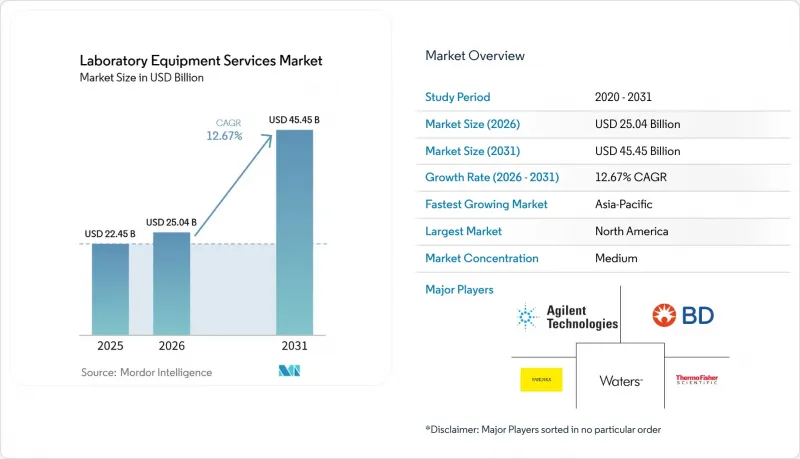
根據 Mordor Intelligence 預測,實驗室設備和服務市場規模預計將在 2025 年達到 224.5 億美元,2026 年達到 250.4 億美元,到 2031 年達到 454.5 億美元,2026 年至 2031 年的複合年成長率為 12.67%。
本報告按服務類型(維修、校準、驗證、預防性保養、託管服務、培訓)、服務供應商(OEM、第三方、分銷商)、設備(分析儀器、通用儀器、專用儀器、輔助設備)、合約類型(標準合約、客製化合約)、最終用戶(製藥和生物技術、臨床、學術、政府、工業)以及地區(北美、歐洲、其他)進行細分。市場預測以美元計價。
全球實驗室設備及服務市場趨勢及洞察
提高實驗室運轉率和避免停機時間的需求日益成長。
製藥和臨床檢查室意外停機成本的不斷攀升正推動實驗室設備服務市場的發展。對於遵循嚴格工作流程的檢查室而言,運作難以承受,因為分析缺失、結果延遲以及品管程序中斷都可能迅速擾亂營運。這些壓力正促使服務合約從可選購轉變為固定營運要求。此外,設備日益複雜化也擴大了計畫維護和緊急應變之間的成本差距,從而導致實驗室設備服務市場對預防性保養和管理服務的需求不斷成長。擁有多種設備的大規模機構對多供應商服務方案表現出越來越濃厚的興趣,因為單一供應商可以協調多個平台的運作。這意味著,支援運作的服務正成為一項切實可行的採購重點,而不僅僅是輔助性的售後服務。
製藥、生物技術和診斷實驗室基礎設施的成長
實驗室設備服務市場持續受到製藥、生物技術和診斷基礎設施產業擴張的推動。隨著每套新的分析系統、驗證流程和專用平台的部署,設備安裝後都會產生長期的定期維護、校準和合規支援需求。在受監管的環境中,此趨勢更為顯著,因為服務貫穿設備的整個運作生命週期,而非止於初始銷售。據丹納赫公司(Danaher)稱,2026年第一季生物程序設備的訂單年增超過30%,顯示已部署設備的數量不斷成長,需要未來的服務支援。此外,安捷倫科技(Agilent Technologies)和維達生命科學(Vida Lifesciences)於2026年5月在班加羅爾聯合開設了一家“分析卓越中心”,這反映出印度實驗室基礎設施的技術深度不斷提升,以及由此產生的對高階支援服務的需求。因此,實驗室設備服務市場的成長不僅源自於設備銷售量的增加,更在於每台已安裝的設備都會產生持續的服務需求,例如維修、合格和效能保證。
先進設備的高額服務合約費用
當先進設備的年度維護成本居高不下時,實驗室設備服務市場仍面臨阻力。質譜儀、流式細胞儀和多維層析法平台等複雜系統的服務合約費用可能高達每台設備每年 2 萬至 8 萬美元,這可能佔營運預算的很大一部分。小規模實驗室和中型機構通常會透過縮小服務範圍、延遲升級或選擇按工時和材料計費的服務而非簽訂綜合合約來應對。雖然這些措施並不能消除服務需求,但它們會延緩對成本敏感的客戶採用綜合合約的進程。當採購規模有限,買家無法就更廣泛的設備範圍協商更優惠的價格時,這種抑制趨勢尤其明顯。這也迫使供應商提供更模組化、基於結果的契約,以便更有效地適應有限的預算。
細分市場分析
2025年,維修和維護服務佔據了42.83%的市場佔有率,而驗證服務預計到2031年將以14.71%的複合年成長率成長。收入成長的最大貢獻者仍然是設備大規模部署需要持續維護以維持生產力和合規性這一簡單事實。在製藥和臨床檢查室環境中,核心維修工作不能長時間推遲,因為設備運作直接影響測試處理能力、產品發佈時間和報告義務。驗證服務成長更快的原因在於,每次安裝、搬遷、升級或進行大規模維護時都需要進行合格工作。因此,驗證不再只是可選項,而是融入受監管工作流程的強制性要求。
在實驗室設備服務市場中,基礎支援和合規性服務之間的平衡正日趨均衡。校準仍然是一項穩定的收入來源,因為在法規環境中,精度直接影響產品發布、測試有效性和審計準備。隨著客戶從被動式服務轉向計畫性維護,預防性保養服務的重要性也穩定提升。由於許多實驗室傾向於選擇能夠協調跨多個地點和供應商支援的單一供應商,託管服務和合約服務正在不斷擴展。培訓、教育和認證服務的規模仍然較小,但其重要性日益凸顯,因為內部技能短缺使得正確使用設備和進行日常維護變得困難。
預計到2025年,目的地設備製造商 (OEM) 將佔據46.38%的市場佔有率,並在2031年之前以13.32%的複合年成長率成長。這一地位反映了OEM在專有軟體、原廠配件、廠商培訓的工程師以及支援規範維護服務的文件方面的主導地位。在實驗室設備服務市場,當客戶購買技術複雜的新設備並在銷售時簽訂服務合約時,OEM仍然具有明顯的優勢。對於那些未經製造商直接授權難以複製服務存取權限的設備類別而言,這一趨勢尤其顯著。這也解釋了為什麼OEM儘管通常需要支付更高的合約價格,但仍能持續成長。
實驗室設備服務產業仍然為獨立服務商提供了發展空間,尤其是在買家需要在低成本環境下或使用多家製造商的設備時。第三方服務供應商在中型企業市場繼續發揮至關重要的作用,因為在這些市場中,柔軟性至關重要,並且需要一份涵蓋多個品牌的單一合約。雖然分銷商主導的服務供應商的作用有限,但他們可以填補新興市場和原始設備製造商 (OEM) 現場支援不足地區的技術空白。老舊型號的設備,在過了 OEM 支援期後,為獨立服務專家創造了新的商機。多廠商管理服務合約仍然是第三方可以競爭的最明確領域之一,他們不僅在獨特的進入許可權方面,而且在協調能力和柔軟性方面也競爭。
區域分析
到2025年,北美將佔據實驗室設備服務市場40.63%的佔有率,成為最大的區域市場。該地區受益於製藥和生物技術研究中心的高度集中、完善的臨床診斷基礎設施以及成熟的多供應商生態系統。美國仍然是驗證、校準和維護需求的核心,因為常規服務與受監管的生產和實驗室運作密切相關。賽默飛世爾科技宣布將於2025年投資20億美元,以增強其在美國的生產和實驗室服務能力,其中包括15億美元的資本支出和5億美元的研發投入,以支持其未來部署規模的擴大以及相關服務需求的成長。
歐洲憑藉其成熟的製藥基礎、科研活動和專業製造地,在實驗室設備服務市場中仍佔有重要佔有率。根據草案,德國是該地區最大的實驗室服務市場,這得益於其強大的國內分析、生物技術和實驗室技術製造商基礎。英國、法國和義大利也做出了重要貢獻,活躍的科學研究活動和受監管的診斷活動持續支撐著服務需求。臨床和實驗室環境中的合規要求進一步推動了整個歐洲的需求,確保了即使在整體支出環境日益嚴格的情況下,驗證和校準活動仍然至關重要。
亞太地區是實驗室設備服務市場成長最快的地區,預計到2031年將以12.91%的複合年成長率成長。中國、印度、韓國、澳洲和日本都在不斷提升其製藥生產、合約研究和診斷能力,從而擴大了該地區的實驗室設備裝機量。安捷倫科技和維達生命科學將於2026年5月在班加羅爾聯合開設一家“分析卓越中心”,這凸顯了印度生物分析基礎設施的進步以及圍繞先進質譜系統不斷擴大的服務機遇。此外,許多實驗室正在快速擴容,需要外部支援來維持設備的運作運作並做好審計準備,這也推動了亞太地區實驗室設備服務市場的發展。中東、非洲和南美洲仍處於發展初期,目前的需求主要集中在臨床診斷、石油化學品管以及某些跨國公司的服務網路方面。
其他好處:
- Excel格式的市場預測(ME)表
- 3個月的分析師支持
目錄
第1章:引言
- 研究假設和市場定義
- 調查範圍
第2章:調查方法
第3章執行摘要
第4章 市場狀況
- 市場概覽
- 市場促進因素
- 確保實驗室運作和避免停機的需求日益成長。
- 多供應商服務管理的外包
- 擴大製藥、生物技術和診斷檢查室基礎設施
- 實施遠距離診斷和預測性維護
- 受監管研究實驗室的多元資產合規負擔
- 高階設備維修技能不足的情況未被充分通報
- 市場限制因素
- 先進測量儀器的服務合約成本高昂
- OEM廠商的壟斷以及專有組件獲取的限制
- 學術和公共研究機構的預算限制
- 在涉及多家供應商的部署平台中,數位化整合存在風險。
- 價值供應鏈分析
- 監理情勢
- 技術展望
- 波特五力分析
第5章 市場規模與成長預測
- 按服務類型
- 維修和保養服務
- 校對服務
- 檢驗服務
- 預防性維護服務
- 託管服務和合約服務
- 培訓、教育和認證服務
- 透過服務供應商
- 目的地設備製造商
- 第三方服務供應商
- 銷售代理商主導的服務供應商
- 透過裝置
- 分析設備
- 一般裝置
- 特殊設備
- 輔助設備
- 按合約類型
- 標準服務協議
- 客製化服務合約
- 最終用戶
- 製藥和生物技術公司
- 臨床和診斷檢查室
- 學術和研究機構
- 政府附屬研究機構
- 工業研究院
- 按地區
- 北美洲
- 美國
- 加拿大
- 墨西哥
- 歐洲
- 德國
- 英國
- 法國
- 義大利
- 西班牙
- 其他歐洲國家
- 亞太地區
- 中國
- 日本
- 印度
- 澳洲
- 韓國
- 其他亞太國家
- 中東和非洲
- GCC
- 南非
- 其他中東和非洲國家
- 南美洲
- 巴西
- 阿根廷
- 其他南美國家
- 北美洲
第6章 競爭情勢
- 市場集中度
- 市佔率分析
- 公司簡介
- Agilent Technologies, Inc.
- Becton, Dickinson and Company
- Bio-Rad Laboratories, Inc.
- Bruker Corporation
- Calibre Scientific, Inc.
- CBRE Group, Inc.
- Danaher Corporation
- Eppendorf SE
- Esco Lifesciences Group
- Fisher Scientific International, Inc.
- Flagship Facility Services, Inc.
- Laboratory Advanced Solutions, Inc.
- Mettler-Toledo International Inc.
- PerkinElmer, Inc.
- Sartorius AG
- Siemens Healthineers AG
- Solvd, Inc.
- Technical Safety Services, LLC
- Thermo Fisher Scientific Inc.
- Waters Corporation
第7章 市場機會與未來展望
According to Mordor Intelligence, the laboratory equipment services market size is projected to be USD 22.45 billion in 2025, USD 25.04 billion in 2026, and reach USD 45.45 billion by 2031, growing at a CAGR of 12.67% from 2026 to 2031.
This report is Segmented by Service Type (Repair, Calibration, Validation, Preventive, Managed, Training), Provider (OEM, Third-Party, Distributor), Equipment (Analytical, General, Specialty, Support), Contract (Standard, Customized), End User (Pharma/Biotech, Clinical, Academic, Government, Industrial), and Geography (North America, Europe, and More). The Market Forecasts are Provided in Value (USD).
Global Laboratory Equipment Services Market Trends and Insights
Rising Need For Lab Uptime and Downtime Avoidance
The laboratory equipment services market is benefiting from the higher cost of unplanned downtime in pharmaceutical and clinical laboratories. Laboratories that run regulated workflows cannot easily absorb outages because missed runs, delayed results, and interrupted quality control steps can quickly disrupt operations. That pressure is pushing service contracts closer to a fixed operating requirement instead of a discretionary purchase. The laboratory equipment services market is also seeing stronger demand for preventive and managed coverage because the cost gap between planned maintenance and emergency intervention keeps widening as instruments become more complex. Large campuses with mixed instrument fleets are especially open to multi-vendor service programs because a single provider can coordinate uptime across several platforms. This makes uptime support a practical purchasing priority rather than a secondary after-sales consideration.
Growth In Pharma, Biotech, and Diagnostic Lab Infrastructure
The laboratory equipment services market continues to gain support from expanding pharmaceutical, biotechnology, and diagnostics infrastructure. Every new analytical system, validation workflow, and specialized platform adds a long-tail need for recurring service, calibration, and compliance support once the equipment is installed. That effect is stronger in regulated settings because servicing does not end with the original sale and instead follows the asset through its full operating life. Danaher reported that bioprocessing equipment orders grew more than 30% year over year in Q1 2026, which points to a larger installed base that will require future service coverage. Agilent Technologies and Veeda Lifesciences also launched a joint Analytical Center of Excellence in Bengaluru in May 2026, which reflects the rising technical depth of laboratory infrastructure in India and the related need for high-end support services. The laboratory equipment services market therefore, grows not only because more instruments are sold, but because each placement creates recurring obligations for repair, qualification, and performance assurance.
High Service Contract Cost for Advanced Instruments
The laboratory equipment services market still faces resistance when advanced instruments carry high annual service costs. Service contracts for complex systems such as mass spectrometers, flow cytometers, and multi-dimensional chromatography platforms can range from USD 20,000 to USD 80,000 per instrument each year, which can consume a meaningful share of operating budgets. Smaller laboratories and mid-sized organizations often respond by narrowing coverage, delaying upgrades, or choosing time-and-material service instead of comprehensive agreements. That behavior does not remove service demand, but it can slow the adoption of full-scope contracts in cost-sensitive accounts. The restraint is strongest where procurement scale is limited and buyers cannot negotiate better pricing across a broader instrument fleet. It also pushes providers to offer more modular and outcome-linked contracts that can fit constrained budgets more effectively.
Other drivers and restraints analyzed in the detailed report include:
- Remote Diagnostics and Predictive Maintenance Adoption
- Under-Reported Skill Shortage For High-End Instrument Servicing
- OEM Lock-In and Proprietary Parts Access Constraints
For complete list of drivers and restraints, kindly check the Table Of Contents.
Segment Analysis
Repair and maintenance services held 42.83% share in 2025, while Validation Services are projected to grow at 14.71% CAGR through 2031. The largest revenue contribution still comes from the simple fact that large installed bases need ongoing upkeep to remain productive and compliant. Laboratories in pharmaceutical and clinical settings cannot defer core repair activity for long because instrument availability directly affects test throughput, release timelines, and reporting commitments. Validation Services are growing faster because qualification work becomes necessary whenever an instrument is installed, moved, upgraded, or materially serviced. That makes validation an embedded requirement in regulated workflows rather than an optional extension.
The laboratory equipment services market is also seeing a more balanced mix between basic support and compliance-heavy service work within this segment group. Calibration remains a stable revenue stream because accuracy directly affects product release, test validity, and audit readiness in regulated environments. Preventive Maintenance Services are gaining steady relevance as customers shift from reactive service calls toward planned upkeep. Managed and Contract Services are expanding because many laboratories prefer a single provider that can coordinate multi-site and multi-vendor support. Training, Education, and Certification Services remain smaller, but they matter more where internal skill gaps make correct instrument use and routine upkeep harder to sustain.
Original equipment manufacturers held 46.38% share in 2025 and are also projected to grow at 13.32% CAGR through 2031. This position reflects their control over proprietary software, original parts, factory-trained engineers, and documentation that supports regulated servicing. The laboratory equipment services market still gives OEMs a clear advantage when customers buy new, technically complex instruments and attach service coverage at the point of sale. That pattern is especially visible in instrument categories where service access is hard to replicate without direct manufacturer authorization. It also explains why OEMs can keep growing despite the price premium that often accompanies their contracts.
The laboratory equipment services industry still leaves room for independent providers, especially where buyers need lower cost structures and mixed-fleet support. Third-party Service Providers remain relevant in mid-market accounts that value flexibility and want a single contract across several brands. Distributor-Led Service Providers hold a narrower role, but they can fill technical gaps in emerging markets and underserved locations where OEM field coverage is thinner. Legacy instrument fleets that have moved beyond active OEM support create another opening for independent service specialists. Multi-vendor managed service agreements also remain one of the clearest spaces where third parties can compete on coordination and response flexibility rather than on proprietary access alone.
Complete Report Scope:
- By Service Type
- Repair and Maintenance Services
- Calibration Services
- Validation Services
- Preventive Maintenance Services
- Managed and Contract Services
- Training, Education, and Certification Services
- By Service Provider
- Original Equipment Manufacturers
- Third-Party Service Providers
- Distributor-Led Service Providers
- By Equipment Type
- Analytical Equipment
- General Equipment
- Specialty Equipment
- Support Equipment
- By Contract Type
- Standard Service Contract
- Customized Service Contract
- By End User
- Pharmaceutical and Biotechnology Companies
- Clinical and Diagnostic Laboratories
- Academic and Research Institutions
- Government Research Facilities
- Industrial Laboratories
- By Geography
- North America
- United States
- Canada
- Mexico
- Europe
- Germany
- United Kingdom
- France
- Italy
- Spain
- Rest of Europe
- Asia-Pacific
- China
- Japan
- India
- Australia
- South Korea
- Rest of Asia-Pacific
- Middle East & Africa
- GCC
- South Africa
- Rest of Middle East & Africa
- South America
- Brazil
- Argentina
- Rest of South America
- North America
Geography Analysis
North America held 40.63% of the laboratory equipment services market share in 2025, making it the largest regional contributor. The region benefits from a dense concentration of pharmaceutical and biotechnology research campuses, strong clinical diagnostics infrastructure, and mature multi-vendor support ecosystems. The United States remains central to demand for validation, calibration, and maintenance because recurring service is closely tied to regulated manufacturing and laboratory operations. Thermo Fisher Scientific announced a USD 2 billion investment in U.S. manufacturing and laboratory services capacity in 2025, including USD 1.5 billion in capital expenditures and USD 500 million in R&D, which supports future installed-base growth and related service demand.
Europe remains a substantial part of the laboratory equipment services market because of its established pharmaceutical base, research activity, and specialized manufacturing footprint. Germany stands out as the region's largest national laboratory services economy in the source draft, supported by a strong domestic base of analysis, biotechnology, and laboratory technology manufacturers. The United Kingdom, France, and Italy also contribute meaningfully because research intensity and regulated diagnostic activity continue to support recurring service needs. Demand across Europe is further reinforced by compliance expectations in clinical and testing environments, which keep validation and calibration activity important even when broader spending conditions become less favorable.
Asia-Pacific is the fastest-growing geography in the laboratory equipment services market at 12.91% CAGR through 2031. China, India, South Korea, Australia, and Japan are all adding pharmaceutical manufacturing, contract research, and diagnostics capacity that expands the regional installed instrument base. Agilent Technologies and Veeda Lifesciences launch a joint Analytical Center of Excellence in Bengaluru in May 2026, which underlines the rising sophistication of India's bioanalytical infrastructure and the service opportunity around advanced mass spectrometry systems. The laboratory equipment services market in Asia-Pacific also benefits from the fact that many laboratories are building capability quickly and need outside support to maintain uptime and audit readiness. Middle East and Africa, along with South America, remain earlier-stage opportunities, with demand concentrated more heavily in clinical diagnostics, petrochemical quality control, and selected multinational coverage networks.
- Agilent Technologies
- Beckton Dickinson
- Bio-Rad Laboratories
- Bruker
- Calibre Scientific, Inc.
- CBRE Group, Inc.
- Danaher
- Eppendorf
- Esco Lifesciences
- Fisher Scientific International, Inc.
- Flagship Facility Services, Inc.
- Laboratory Advanced Solutions, Inc.
- Mettler Toledo
- PerkinElmer
- Sartorius
- Siemens Healthineers
- Solvd, Inc.
- Technical Safety Services, LLC
- Thermo Fisher Scientific
- Waters Corporation
Additional Benefits:
- The market estimate (ME) sheet in Excel format
- 3 months of analyst support
TABLE OF CONTENTS
1 Introduction
- 1.1 Study Assumptions & Market Definition
- 1.2 Scope of the Study
2 Research Methodology
3 Executive Summary
4 Market Landscape
- 4.1 Market Overview
- 4.2 Market Drivers
- 4.2.1 Rising Need For Lab Uptime and Downtime Avoidance
- 4.2.2 Outsourcing of Multi-Vendor Service Management
- 4.2.3 Growth in Pharma, Biotech, and Diagnostic Lab Infrastructure
- 4.2.4 Remote Diagnostics and Predictive Maintenance Adoption
- 4.2.5 Multi-Asset Compliance Burden in Regulated Laboratories
- 4.2.6 Under-Reported Skill Shortage For High-End Instrument Servicing
- 4.3 Market Restraints
- 4.3.1 High Service Contract Cost for Advanced Instruments
- 4.3.2 OEM Lock-In and Proprietary Parts Access Constraints
- 4.3.3 Budget Pressure In Academic and Public Research Labs
- 4.3.4 Digital Integration Risk Across Mixed-Vendor Installed Base
- 4.4 Value / Supply-Chain Analysis
- 4.5 Regulatory Landscape
- 4.6 Technological Outlook
- 4.7 Porter's Five Forces Analysis
- 4.7.1 Threat of New Entrants
- 4.7.2 Bargaining Power of Suppliers
- 4.7.3 Bargaining Power of Buyers
- 4.7.4 Threat of Substitutes
- 4.7.5 Industry Rivalry
5 Market Size & Growth Forecasts
- 5.1 By Service Type
- 5.1.1 Repair and Maintenance Services
- 5.1.2 Calibration Services
- 5.1.3 Validation Services
- 5.1.4 Preventive Maintenance Services
- 5.1.5 Managed and Contract Services
- 5.1.6 Training, Education, and Certification Services
- 5.2 By Service Provider
- 5.2.1 Original Equipment Manufacturers
- 5.2.2 Third-Party Service Providers
- 5.2.3 Distributor-Led Service Providers
- 5.3 By Equipment Type
- 5.3.1 Analytical Equipment
- 5.3.2 General Equipment
- 5.3.3 Specialty Equipment
- 5.3.4 Support Equipment
- 5.4 By Contract Type
- 5.4.1 Standard Service Contract
- 5.4.2 Customized Service Contract
- 5.5 By End User
- 5.5.1 Pharmaceutical and Biotechnology Companies
- 5.5.2 Clinical and Diagnostic Laboratories
- 5.5.3 Academic and Research Institutions
- 5.5.4 Government Research Facilities
- 5.5.5 Industrial Laboratories
- 5.6 By Geography
- 5.6.1 North America
- 5.6.1.1 United States
- 5.6.1.2 Canada
- 5.6.1.3 Mexico
- 5.6.2 Europe
- 5.6.2.1 Germany
- 5.6.2.2 United Kingdom
- 5.6.2.3 France
- 5.6.2.4 Italy
- 5.6.2.5 Spain
- 5.6.2.6 Rest of Europe
- 5.6.3 Asia-Pacific
- 5.6.3.1 China
- 5.6.3.2 Japan
- 5.6.3.3 India
- 5.6.3.4 Australia
- 5.6.3.5 South Korea
- 5.6.3.6 Rest of Asia-Pacific
- 5.6.4 Middle East & Africa
- 5.6.4.1 GCC
- 5.6.4.2 South Africa
- 5.6.4.3 Rest of Middle East & Africa
- 5.6.5 South America
- 5.6.5.1 Brazil
- 5.6.5.2 Argentina
- 5.6.5.3 Rest of South America
- 5.6.1 North America
6 Competitive Landscape
- 6.1 Market Concentration
- 6.2 Market Share Analysis
- 6.3 Company Profiles (includes Global Level Overview, Market-level Overview, Core Segments, Financials, Strategic Information, Market Rank/Share, Products & Services, Recent Developments)
- 6.3.1 Agilent Technologies, Inc.
- 6.3.2 Becton, Dickinson and Company
- 6.3.3 Bio-Rad Laboratories, Inc.
- 6.3.4 Bruker Corporation
- 6.3.5 Calibre Scientific, Inc.
- 6.3.6 CBRE Group, Inc.
- 6.3.7 Danaher Corporation
- 6.3.8 Eppendorf SE
- 6.3.9 Esco Lifesciences Group
- 6.3.10 Fisher Scientific International, Inc.
- 6.3.11 Flagship Facility Services, Inc.
- 6.3.12 Laboratory Advanced Solutions, Inc.
- 6.3.13 Mettler-Toledo International Inc.
- 6.3.14 PerkinElmer, Inc.
- 6.3.15 Sartorius AG
- 6.3.16 Siemens Healthineers AG
- 6.3.17 Solvd, Inc.
- 6.3.18 Technical Safety Services, LLC
- 6.3.19 Thermo Fisher Scientific Inc.
- 6.3.20 Waters Corporation
7 Market Opportunities & Future Outlook
- 7.1 White-space & Unmet-need Assessment

 實驗室培養板處理系統市場:全球市場預測,2026-2032年實驗室瓶蓋分配器市場-2026-2032年全球市場預測實驗室一次性用品市場:2026-2032年全球市場預測(按產品類型、材料、滅菌類型、應用和分銷管道分類)
 實驗室設備市場(2025-2030年):市場概覽實驗室設備及服務市場:2026-2032年全球市場預測(依服務類型、設備類型、定價模式、最終用途及銷售管道)
 翻新實驗室設備:市場佔有率分析、產業趨勢與統計、成長預測(2026-2031)
 實驗室設備市場規模、佔有率和成長分析:按產品類型、應用、技術、採購方式、最終用戶和地區分類-2026-2033年產業預測
 實驗室配件市場:按產品類型、應用、最終用戶和地區分類
 實驗室設備及耗材市場報告:依產品類型、最終用途及地區分類,2026-2034年實驗室設備市場:全球市場按產品類型、最終用戶、設備類型和應用分類的預測,2026-2032年