


 |
市場調查報告書
商品編碼
2099334
面向人工智慧PC和輕薄筆記型電腦的LPDDR5X DRAM:市場佔有率分析、產業趨勢與統計數據以及成長預測(2026-2031年)LPDDR5X DRAM For AI PC and Thin-and-Light Laptop - Market Share Analysis, Industry Trends & Statistics, Growth Forecasts (2026 - 2031) |
||||||

※ 本網頁內容可能與最新版本有所差異。詳細情況請與我們聯繫。
根據 Mordor Intelligence 預測,用於 AI PC 和輕薄筆記型電腦的 LPDDR5X DRAM 市場規模預計將在 2025 年達到 27.4 億美元,到 2031 年達到 58.2 億美元,2026 年至 2031 年的複合年成長率為 8.06%。
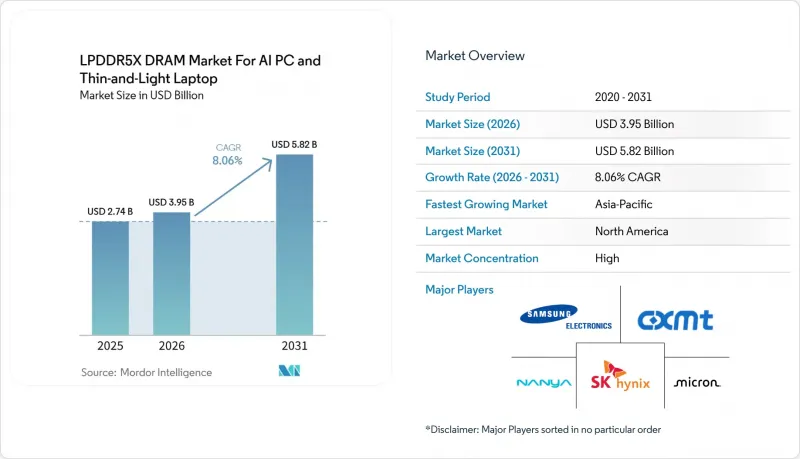
本報告按處理器平台(x86 和 ARM)、記憶體容量(16 GB、24 GB、32 GB、48 GB 及以上)、最終用戶(高階消費者、創新專業人士和開發人員、企業/商業用戶、教育和公共部門以及中小企業/專業消費用戶)和地區進行細分。市場預測以美元 (USD) 為單位。
面向人工智慧PC和輕薄筆記型電腦的LPDDR5X DRAM市場洞察與趨勢
Copilot+ 的 16 GB 記憶體需求為 DRAM 需求樹立了結構性基準。
微軟的 Copilot+ PC 認證已將 16 GB DDR5 或 LPDDR5 記憶體作為 AI 筆記型電腦認證的最低配置要求,使記憶體從可選升級變為平台必備配置。在採購實務中,16 GB 不再是最終目標,而是一個起點。許多企業負責人傾向於選擇 24 GB 或 32 GB 的配置。這是因為本地 AI 功能現在與日常生產力工作負載並行使用。微軟的 Copilot+ 功能集,包括「回憶」、「點擊執行」和即時翻譯等功能,在裝置上處理了更多 AI 工作負載,隨著時間的推移,對更大記憶體容量的需求也隨之增加。因此,在 AI PC 和輕薄筆記型電腦的 LPDDR5X DRAM 市場中,對 LPDDR5X 的基準需求與每台符合要求的筆記型電腦進入更新週期密切相關。
人工智慧筆記型電腦的普及將增加每台裝置安裝的DRAM記憶體量。
面向人工智慧PC和輕薄筆記型電腦的LPDDR5X DRAM市場成長不僅得益於筆記型電腦出貨量的成長,也得益於單機記憶體容量的提升。 NVIDIA的RTX Spark平台透過支援高達128GB的整合LPDDR5X內存,提高了高階Windows筆記型電腦本地人工智慧工作負載的標準。這遠遠超過了「Copilot+」的最低16GB標準,使得高容量配置成為高階用戶更現實的選擇。創新專業人士和開發人員對這項轉變感受最為深刻,因為大規模情境視窗、程式碼助理和內容工具都需要同時佔用本地記憶體。即使系統定價限制了其廣泛應用,單機記憶體容量的提升也能確保收入成長。
DRAM 和 CPU 價格上漲給 OEM 和消費級筆記型電腦的預算帶來了壓力。
記憶體和處理器成本的上漲直接推高了筆記型電腦的組件成本,縮小了其進行大幅配置升級的空間。隨著從16GB到32GB LPDDR5X記憶體的過渡越來越難以消化,OEM廠商可能會將更多機型維持在最低Copilot+配置要求水平,而不是追求更高的規格。三星表示,儘管計劃在2026年對設備進行大規模投資以加速向1c DRAM的過渡,但短期內緩解供應壓力仍然困難。教育機構和公共部門的負責人尤其容易受到影響,因為他們固定的採購預算限制了他們承受組件價格飆升的能力。雖然這種壓力不會消除需求,但可能會減緩人工智慧PC和輕薄筆記型電腦市場向LPDDR5X DRAM高容量配置的轉變。
細分市場分析
到2025年,面向AI PC和輕薄筆記型電腦的LPDDR5X DRAM市場中,16GB規格的記憶體將佔據44.78%的市場佔有率,而64GB及以上規格的記憶體預計將在2031年前以9.44%的複合年成長率成長。這一趨勢表明,高階工作負載的最低需求和最高需求之間存在著明顯的差距。 16GB配置仍然是銷售量的主要支柱,既符合Copilot+的要求,也符合筆記型電腦有限的預算。同時,隨著OEM廠商努力平衡AI效能、功耗和售價,24GB、32GB和48GB規格的記憶體正在滿足中階市場的需求。
JEDEC 的 LPDDR5X 標準支援高晶片密度,無需成比例增加基板面積即可實現高容量多晶片封裝。這使得中高階設計能夠更有效率地擴展。 NVIDIA 的 RTX Spark 平台整合了高達 128 GB 的 LPDDR5X 內存,突破了筆記型電腦記憶體的容量限制,並為高階 AI 筆記型電腦樹立了新的容量標竿。此外,Framework 的「Laptop 13 Pro」展示了 LPCAMM2 技術允許使用者將可更換的 LPDDR5X 記憶體整合到輕薄筆記型電腦設計中。預計這將進一步推動高容量內存在整個系統生命週期中的應用。因此,面向 AI PC 和輕薄筆記型電腦的 LPDDR5X DRAM 記憶體配置在入門級和高階市場都變得越來越多樣化。
區域分析
2025年,北美地區在全球LPDDR5X DRAM(用於AI PC和輕薄筆記型電腦)的銷售額中佔比高達62.28%,佔據最大市場佔有率。該地區的早期普及得益於企業對配備Copilot+技術的筆記型電腦的快速採用,以及許多組織由於向Windows 10過渡而縮短了設備升級週期。此外,美國聯邦政府於2025年3月發布的《終端指令》鼓勵私人企業遷移到AI系統,進一步推動了公共部門的發展動能。該地區的高階消費者和創新用戶也加快了向32GB或更大記憶體配置的過渡,提高了每台筆記型電腦的平均記憶體容量。加拿大進一步加強了其結構性支持,在2026會計年度累計4.5億加元(約3.33億美元)用於AI PC的採購。
預計到2031年,亞太地區LPDDR5X DRAM市場將以9.89%的複合年成長率成長,成為AI PC和輕薄筆記型電腦LPDDR5X DRAM市場規模成長最快的地區。該地區扮演兩大關鍵角色:既是先進記憶體的主要生產基地,也是AI筆記型電腦需求不斷成長的中心。韓國和台灣地區仍是供應鏈的核心,三星、SK海力士和南亞等廠商都在其中扮演重要角色。同時,中國正在建造以CXMT和本土筆記型電腦OEM廠商為核心的、更主導的LPDDR5X供應鏈。 CXMT於2025年10月開始量產LPDDR5X,後續報告顯示,其產品已開始被中國筆記型電腦廠商試用,進一步鞏固了該地區的供應系統。日本和韓國在需求方面也舉足輕重,因為這兩個市場的企業設備升級和高階消費市場的滲透仍然活躍。
歐洲和世界其他地區雖然目前市場佔有率較小,但對未來產品組合的品質具有重要的戰略意義。在歐洲,金融服務、汽車和專業服務等受監管產業越來越重視設備端人工智慧處理,因此更傾向於選擇配備高容量LPDDR5X記憶體的筆記型電腦。中東、非洲和南美洲的需求仍然較小,波灣合作理事會)國家的政府採購和高階消費者購買是短期內最重要的需求來源。南美洲對價格仍然比較敏感,因此儘管預計高容量記憶體的普及率會上升,但構成比可能仍落後於北美和歐洲部分地區。
其他好處:
- Excel格式的市場預測(ME)表
- 3個月的分析師支持
目錄
第1章:引言
- 研究假設和市場定義
- 調查範圍
第2章:調查方法
第3章執行摘要
第4章 市場狀況
- 市場概覽
- 市場促進因素
- Copilot+ 最低 16GB 內存
- 人工智慧筆記型電腦的普及推動了其內部DRAM容量的成長。
- LPDDR5X 在頻寬和功耗方面比 DDR5 具有優勢。
- 專為 x86 和 ARM 平台的全新高階 AI 筆記型電腦機型
- LPCAMM2:提高PC中LPDDR的可維護性。
- 封裝內記憶體可以節省電池電量和散熱預算。
- 市場限制因素
- DRAM 和 CPU 價格上漲導致筆記型電腦的物料清單 (BOM) 增加。
- 由於 HBM主導的產能轉移,LPDDR5X 的供應對客戶而言變得緊張。
- 焊接和封裝內存儲器限制了可升級性。
- 基於 ARM 的 Windows 和 AI 軟體的碎片化風險
- 產業供應鏈分析
- 監理情勢
- 技術展望
- 宏觀經濟因素的影響
- 波特五力分析
第5章 市場規模與成長預測
- 按處理器平台
- x86平台
- ARM平台
- 按內存容量
- 16 GB
- 24 GB
- 32 GB
- 48 GB
- 64 GB 或更多
- 最終用戶
- 高階消費者
- 企業/商業用戶
- 創新專業人士和開發人員
- 教育和公共部門
- 中小企業/產消者
- 按地區
- 北美洲
- 歐洲
- 亞太地區
- 中國
- 日本
- 韓國
- 台灣
- 其他亞太國家
- 世界其他地區
第6章 競爭情勢
- 市場集中度
- 策略趨勢
- 市佔率分析
- 公司簡介
- Samsung Electronics Co., Ltd.
- SK hynix Inc.
- Micron Technology, Inc.
- Nanya Technology Corporation
- ChangXin Memory Technologies, Inc.
- ADATA Technology Co., Ltd.
- Innodisk Corporation
- BIWIN Storage Technology Co., Ltd.
- Team Group Inc.
- Longsys Electronics Co., Ltd./FORESEE
- Framework Computer Inc.
- Integrated Silicon Solution, Inc.
第7章 市場機會與未來展望
According to Mordor Intelligence, the LPDDR5X DRAM market for AI PC and thin-and-light laptop industry size stood at USD 2.74 billion in 2025 and is projected to reach USD 5.82 billion by 2031, advancing at a CAGR of 8.06% from 2026 to 2031.
This report is Segmented by Processor Platform (x86 Platform, and ARM Platform), Memory Capacity (16 GB, 24 GB, 32 GB, 48 GB, and More), End User (Premium Consumers, Creative Professionals and Developers, Enterprise/Commercial Users, Education and Public Sector, and Small Business/Prosumer User), and Geography. The Market Forecasts are Provided in Terms of Value (USD).
Insights and Trends of LPDDR5X DRAM Market For AI PC and Thin-and-Light Laptop
Copilot+ 16 GB Memory Floor Creates A Structural DRAM Demand Baseline
Microsoft's Copilot+ PC certification made 16 GB of DDR5 or LPDDR5 memory a hard minimum for qualifying AI notebooks, and that shifted memory from an optional upgrade into a platform requirement. In procurement practice, 16 GB now works as the starting point instead of the final destination. Many enterprise buyers are already leaning toward 24 GB and 32 GB configurations because local AI features now sit beside regular productivity workloads throughout the day. Microsoft's Copilot+ feature set, including experiences such as Recall, Click to Do, and live translation, keeps more of the AI workload on the device and strengthens the case for higher memory footprints over time. This keeps baseline LPDDR5X demand tied to every compliant notebook that enters the refresh cycle in the LPDDR5X DRAM market for AI PC and thin-and-light laptop industry.
AI Notebook Penetration Lifting DRAM Content Per Device
The LPDDR5X DRAM market for AI PC and thin-and-light laptops is being lifted by rising memory content per device, not only by the number of notebooks shipped. NVIDIA's RTX Spark platform raised the ceiling by supporting up to 128 GB of unified LPDDR5X for local AI workloads in premium Windows laptops. That pushed the upper boundary far beyond the 16 GB Copilot+ floor and made high-capacity configurations more relevant to premium buyers. Creative professionals and developers are the clearest expression of this shift because large context windows, code assistants, and content tools all compete for local memory at the same time. This content-per-unit expansion helps revenue hold up even when system pricing limits broader volume adoption.
DRAM And CPU Price Spikes Compressing OEM And Consumer Notebook Budgets
Rising memory and processor costs are putting direct pressure on notebook bills of materials and narrowing the room for aggressive configuration upgrades. When the jump from 16 GB to 32 GB LPDDR5X becomes harder to absorb, OEMs may hold more models at the Copilot+ minimum instead of pushing higher specifications. Samsung indicated that near-term supply relief remains difficult even as it planned to invest heavily in facilities in 2026 and accelerate the move toward 1c DRAM. Education and public sector buyers are especially exposed because fixed procurement budgets leave less room to absorb component inflation. This pressure does not erase demand, but it can slow the mix shift toward higher-capacity notebooks in the LPDDR5X DRAM market for AI PC and thin-and-light laptop industry.
Other drivers and restraints analyzed in the detailed report include:
- LPDDR5X Bandwidth And Power Edge Over DDR5
- Premium AI Notebook Refresh Across x86 And ARM Platforms
- HBM-Led Capacity Reallocation Constraining Client LPDDR5X Availability
For complete list of drivers and restraints, kindly check the Table Of Contents.
Segment Analysis
The 16 GB tier held 44.78% share of the LPDDR5X DRAM market for AI PC and thin-and-light laptop industry in 2025, while the 64 GB and above tier is projected to expand at a 9.44% CAGR through 2031. That pattern shows a clear split between the compliance floor and the premium workload ceiling. The 16 GB configuration remains the main volume anchor because it satisfies Copilot+ requirements and still fits tighter notebook budgets. At the same time, 24 GB, 32 GB, and 48 GB options are filling the middle of the range as OEMs try to balance AI performance, power use, and selling price.
JEDEC's LPDDR5X standard supports per-die densities that make higher-capacity multi-chip packages possible without a matching increase in board footprint, which helps mid-tier and premium designs scale up more efficiently. NVIDIA's RTX Spark platform, with up to 128 GB of unified LPDDR5X, widened the upper end of the notebook memory envelope and gave premium AI laptops a new capacity reference point. Framework's Laptop 13 Pro also showed that LPCAMM2 can bring user-replaceable LPDDR5X into thin notebook designs, which supports wider adoption of higher capacities over a system's life cycle. The memory mix inside the LPDDR5X DRAM market for AI PC and thin-and-light laptop is therefore widening at both the baseline tier and the premium tier.
Complete Report Scope:
- By Processor Platform
- x86 Platforms
- ARM Platforms
- By Memory Capacity
- 16 GB
- 24 GB
- 32 GB
- 48 GB
- 64 GB and Above
- By End User
- Premium Consumers
- Enterprise / Commercial Users
- Creative Professionals and Developers
- Education and Public Sector
- Small Business / Prosumer Users
- By Geography
- North America
- Europe
- Asia-Pacific
- China
- Japan
- South Korea
- Taiwan
- Rest of Asia-Pacific
- Rest of the World
Geography Analysis
North America held 62.28% of global revenue in 2025, giving it the largest position in the LPDDR5X DRAM market for AI PC and thin-and-light laptop. The region moved early because enterprise fleets adopted Copilot+ notebooks sooner and because the Windows 10 support transition narrowed the refresh window for many organizations. A U.S. federal endpoint directive issued in March 2025 also added public-sector momentum by pushing civilian agencies toward AI-capable systems. Premium consumers and creative users in the region also moved faster into 32 GB and above configurations, which raised average memory content per notebook. Canada added another layer of structural support through a fiscal 2026 AI PC procurement allocation of CAD 450 million, which was equivalent to USD 333 million.
Asia-Pacific is projected to expand at a 9.89% CAGR through 2031, making it the fastest-growing geography within the LPDDR5X DRAM market for AI PC and thin-and-light laptop industry size by region. The region combines two powerful roles because it is both the main production base for advanced memory and a rising demand center for AI notebooks. South Korea and Taiwan remain central to supply through Samsung, SK hynix, and Nanya, while China is building a more domestic LPDDR5X chain around CXMT and local notebook OEMs. CXMT began mass production of LPDDR5X in October 2025, and later reporting indicated that its parts were being sampled by Chinese notebook makers, which strengthened the regional supply story. Japan and South Korea are also important on the demand side because enterprise refresh activity and premium consumer adoption remain active in both markets.
Europe and the Rest of the World represent smaller shares today, but they remain strategically important for future mix quality. In Europe, regulated sectors such as financial services, automotive, and professional services have a stronger reason to favor on-device AI processing, which supports notebooks with larger LPDDR5X configurations. The Middle East and Africa and South America still form a smaller demand pool, with government procurement and premium consumer purchases in Gulf Cooperation Council countries standing out as the clearest near-term pockets. South America is likely to remain more price sensitive, which means adoption can rise while higher-capacity memory mixes still lag North America and parts of Europe.
- Samsung Electronics Co., Ltd.
- SK hynix Inc.
- Micron Technology, Inc.
- Nanya Technology Corporation
- ChangXin Memory Technologies, Inc.
- ADATA Technology Co., Ltd.
- Innodisk Corporation
- BIWIN Storage Technology Co., Ltd.
- Team Group Inc.
- Longsys Electronics Co., Ltd. / FORESEE
- Framework Computer Inc.
- Integrated Silicon Solution, Inc.
Additional Benefits:
- The market estimate (ME) sheet in Excel format
- 3 months of analyst support
TABLE OF CONTENTS
1 INTRODUCTION
- 1.1 Study Assumptions and Market Definition
- 1.2 Scope of the Study
2 RESEARCH METHODOLOGY
3 EXECUTIVE SUMMARY
4 MARKET LANDSCAPE
- 4.1 Market Overview
- 4.2 Market Drivers
- 4.2.1 Copilot+ 16GB Memory Floor
- 4.2.2 AI Notebook Penetration Lifting DRAM Content
- 4.2.3 LPDDR5X Bandwidth and Power Edge Over DDR5
- 4.2.4 Premium AI Notebook Refresh Across x86 and ARM Platforms
- 4.2.5 LPCAMM2 Making LPDDR More Serviceable in PCs
- 4.2.6 On-Package Memory Freeing Battery and Thermal Budget
- 4.3 Market Restraints
- 4.3.1 DRAM and CPU Price Spikes Inflating Notebook BOMs
- 4.3.2 HBM-Led Capacity Shifts Tightening Client LPDDR5X Supply
- 4.3.3 Soldered and On-Package Memory Limits Upgradeability
- 4.3.4 Windows on ARM and AI Software Fragmentation Risk
- 4.4 Industry Supply Chain Analysis
- 4.5 Regulatory Landscape
- 4.6 Technological Outlook
- 4.7 Impact of Macroeconomic Factors
- 4.8 Porter's Five Forces Analysis
- 4.8.1 Threat of New Entrants
- 4.8.2 Bargaining Power of Suppliers
- 4.8.3 Bargaining Power of Buyers
- 4.8.4 Threat of Substitutes
- 4.8.5 Competitive Rivalry
5 MARKET SIZE AND GROWTH FORECASTS (VALUE)
- 5.1 By Processor Platform
- 5.1.1 x86 Platforms
- 5.1.2 ARM Platforms
- 5.2 By Memory Capacity
- 5.2.1 16 GB
- 5.2.2 24 GB
- 5.2.3 32 GB
- 5.2.4 48 GB
- 5.2.5 64 GB and Above
- 5.3 By End User
- 5.3.1 Premium Consumers
- 5.3.2 Enterprise / Commercial Users
- 5.3.3 Creative Professionals and Developers
- 5.3.4 Education and Public Sector
- 5.3.5 Small Business / Prosumer Users
- 5.4 By Geography
- 5.4.1 North America
- 5.4.2 Europe
- 5.4.3 Asia-Pacific
- 5.4.3.1 China
- 5.4.3.2 Japan
- 5.4.3.3 South Korea
- 5.4.3.4 Taiwan
- 5.4.3.5 Rest of Asia-Pacific
- 5.4.4 Rest of the World
6 COMPETITIVE LANDSCAPE
- 6.1 Market Concentration
- 6.2 Strategic Moves
- 6.3 Market Share Analysis
- 6.4 Company Profiles (includes Global level Overview, Market level overview, Core Segments, Financials as available, Strategic Information, Market Rank/Share for key companies, Products and Services, and Recent Developments)
- 6.4.1 Samsung Electronics Co., Ltd.
- 6.4.2 SK hynix Inc.
- 6.4.3 Micron Technology, Inc.
- 6.4.4 Nanya Technology Corporation
- 6.4.5 ChangXin Memory Technologies, Inc.
- 6.4.6 ADATA Technology Co., Ltd.
- 6.4.7 Innodisk Corporation
- 6.4.8 BIWIN Storage Technology Co., Ltd.
- 6.4.9 Team Group Inc.
- 6.4.10 Longsys Electronics Co., Ltd. / FORESEE
- 6.4.11 Framework Computer Inc.
- 6.4.12 Integrated Silicon Solution, Inc.
7 MARKET OPPORTUNITIES AND FUTURE OUTLOOK
- 7.1 White-space and unmet-need assessment

 工業用電腦市場:依類型、外形規格、安裝方式、作業系統、性能等級、連接方式及最終用戶產業分類-2026-2032年全球市場預測
 全球工業用電腦市場規模、佔有率、趨勢和成長分析報告(2026-2034年)
 工業用電腦(IPC):市場佔有率分析、行業趨勢和統計數據、成長預測(2026-2031 年)
 DIN連接器市場分析及預測(至2035年):按類型、產品類型、服務、技術、組件、應用、材質、安裝方法、最終用戶和功能分類工業用電腦市場分析及預測(至2035年):依類型、產品類型、服務、技術、組件、應用、外形、最終用戶、安裝類型及設備分類
 工業用電腦市場機會、成長要素、產業趨勢分析及2026年至2035年預測
 工業用電腦市場規模、佔有率、趨勢及預測(按類型、顯示類型、銷售管道、最終用途產業及地區分類),2026-2034年
 2026年全球工業用電腦市場報告
 2026-2030年全球工業用電腦市場工業用電腦市場 - 預測2025-2030