


 |
市場調查報告書
商品編碼
2073118
工業用電腦(IPC):市場佔有率分析、行業趨勢和統計數據、成長預測(2026-2031 年)Industrial PC (IPC) - Market Share Analysis, Industry Trends & Statistics, Growth Forecasts (2026 - 2031) |
||||||

※ 本網頁內容可能與最新版本有所差異。詳細情況請與我們聯繫。
根據 Mordor Intelligence 預測,工業用電腦市場預計將從 2025 年的 54.9 億美元成長到 2026 年的 58.7 億美元,到 2031 年達到 84.4 億美元,2026 年至 2031 年的複合年成長率預計為 7.53%。
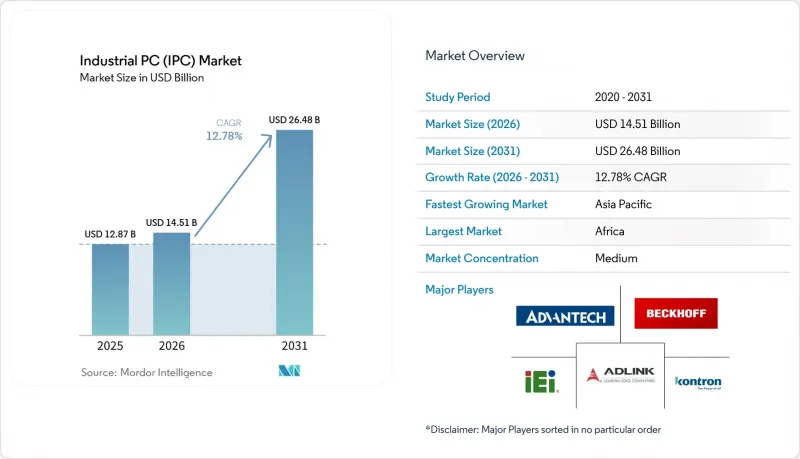
本報告按工業處理器類型(面板式、機架式、嵌入式、導軌式、精簡型用戶端)、終端用戶行業(汽車、電子半導體等)、組件(CPU、GPU、存儲、I/O 等)、外形規格(無風扇、風冷、緊湊型、可擴展、面板安裝、機架安裝)、銷售管道(直銷、間接銷售、電子商務)和地區進行地區銷售、機架安裝)、地區銷售管道(直銷、間接銷售管道。市場預測以美元計價。
全球工業用電腦(IPC)市場趨勢與洞察
擴大工業4.0在個體生產領域的應用
為了實現精確的週期時間,製造商正在將指令處理器 (IPC) 整合到工具機控制器、自動導引運輸車(AGV)數位雙胞胎閘道中。雙冗餘電源、三防膠PCB 和 OPC UA 伺服器正逐漸成為標準配置,將試運行週期從數週縮短至數天。調查數據顯示,數位化成熟度達到 3 級的營運商每個生產單元的 IPC 數量約為 1 級營運商的四倍,這證實了自動化深度與控制器密度之間存在直接關聯。艾默生於 2025 年初推出了 PACSystems RXi2工業用電腦,該產品配備雙英特爾酷睿處理器和支援 TSN 的乙太網路連接埠。其目標客戶是汽車車身車間生產線,這些生產線需要在 10 毫秒的窗口期內同步 40 台機器人的焊槍序列。提供承包時間敏感網路和 MQTT仲介的供應商更受青睞,因為它們與企業的雲端策略相符。隨著離散製造企業整合其操作技術和資訊技術堆疊,對能夠支援數控機床 15 年生命週期的可擴展計算模組的需求也在穩步成長。
在惡劣環境下,對邊緣端強大運算能力的需求日益成長。
煉油廠、礦場和戶外變電站需要能夠承受-40 度C至70 度C溫度波動、50G衝擊負荷以及IP66防塵防水等級的控制器。這款無風扇鎂合金底盤能夠散發高達65W的熱量,而不會降低GPU在煉鐵爐和鑽頭附近進行視覺分析的性能。 ARBOR Technology於2025年中期發布了ARTS-7670,這是一款符合MIL-STD-810H振動標準的無風扇盒式PC。該產品透過其鎂合金機殼被動散熱65瓦,使其適用於海上鑽探平臺,在這些平台上,灰塵和鹽霧會在幾個月內腐蝕傳統的機殼。投射式電容觸控螢幕即使戴著厚手套也能操作,消除了化工廠長期存在的人體工學障礙。 ATEX和IECEx認證是中東石化聯合企業的標準要求。邊緣推理正在加速這一趨勢,因為設備端分析消除了延遲,從而避免了機器人在爆炸性環境中運行時可能發生的安全故障。
中小企業初始投資成本高
中小企業 (SME) 需要超過 25% 的內部收益率 (IRR) 才能證明購買控制器的合理性,但其貸款利率通常是大型製造商的兩倍。實施整合產品控制 (IPC) 的平均成本為每條生產線 87,000 美元,這相當於一家擁有 50 名員工的契約製造工廠一年的毛利。在印度、墨西哥和東南亞進行的調查一致表明,資金成本是採用 IPC 的最大障礙,甚至超過了技能不足和網路安全方面的擔憂。雖然計量型的租賃模式正在興起,但僅限於擁有經審計的財務報表和長期購買協議的借款人。因此,目前北美三分之二年產量低於 50,000 件的契約製造製造商仍不在目標客戶群之內。
細分市場分析
預計在2026年至2031年的預測期內,嵌入式控制器將推動工業用電腦市場以8.53%的複合年成長率成長。這一成長凸顯了市場對模組化「計算模組」(Compute-on-Modules)日益成長的需求,這些模組旨在將工業用電腦的運作延長10年以上。在那些對長期可靠性和適應性要求極高的行業中,這些控制器尤其受到重視。此外,面板系統在工業用電腦市場中也佔據重要地位,預計到2025年將佔據34.29%的市場佔有率。其主導地位源自於整合式觸控螢幕在各種工業應用中的適用性,例如包裝線、間歇式反應器和可清洗食品加工廠。面板系統能夠在惡劣環境下運行,同時提供方便用戶使用的介面,這正是它們在這些領域備受青睞的原因。
在集中式公用設施控制室中,機架式配置仍然是首選,因為熱插拔硬碟托架和基於 IPMI 的遠端管理簡化了維護工作。 DIN 導軌安裝式 IPC 繼續應用於建築自動化項目,最大限度地減少了電氣櫃內的面板空間。同時,精簡型用戶端在製藥業的無塵室中佔據了一席之地,因為無塵室對移動部件的使用有嚴格限制。具有多個計算模組的模組化機架式設計正在推動對可擴展底盤的需求,因為製造商可以為配方控制、審計追蹤和分析分配專用硬體,從而防止交叉污染。
預計到2025年,電子和半導體製造業將佔全球出貨量的24.18%。這主要得益於晶圓廠升級到需要亞微米級運動控制的先進封裝生產線。高性能晶片需求的成長以及製造製程精度要求的提高是推動這一成長的主要因素。相較之下,可再生能源和公共產業產業預計將以8.13%的複合年成長率成長,這主要得益於電池儲能編配的進步,從而提高了能源效率和永續性;微電網控制器的引入;以及用於氫電解的輔助設備(BOP)系統的整合。
汽車、製藥以及食品飲料製造廠分別約佔工業用電腦市場的5.5%。在這些行業中,控制器被整合到各種應用中,例如汽車製造中的焊接單元、製藥生產中的無塵室以及食品飲料加工中的滅菌迴路。航太與國防、工業機械和製程工業也擴大採用符合嚴格認證標準(例如MIL-STD-461和ATEX 2區)的工業PC。這一趨勢正逐步增加對專用組件的需求,例如三防膠基板和寬溫域組件,以確保即使在嚴苛且監管嚴格的環境中也能保證可靠性和性能。
區域分析
2025年,亞太地區在工業用電腦市場銷售中貢獻顯著,這主要得益於幾個關鍵因素。中國計劃在2027年前升級數百萬台人工智慧工業終端,日本在機器人密度方面處於領先地位,韓國則大力投資先進封裝工廠,這些都鞏固了該地區的市場主導地位。各地區的OEM廠商目的地對RISC-V處理器的採用力度,以降低x86授權成本並規避出口限制帶來的風險。此外,耐高溫控制器在日本和韓國的生產線上也得到越來越廣泛的應用,尤其是在對精度要求日益嚴格的異構晶片組裝製程。
儘管非洲整體市場規模較小,但由於對能夠在極端溫度和惡劣環境下運行的無風扇工業用電腦的需求不斷成長,預計在預測期內將實現顯著成長。這項需求主要由微電網和綠色氫能區的擴張所驅動,這些區域需要具備耐高溫、防塵防水等功能的強大可靠系統。撒哈拉以南非洲各國政府正積極透過稅收優惠和生態工業園區內的電力補貼來支持這項成長。這些措施正在加速工業控制器在電池組裝、農產品加工和離網通訊基礎設施等領域的應用。諸如非洲自動化展等行業盛會也發揮著至關重要的作用,吸引了眾多面向採礦和行動電源系統應用的原始設備製造參展。
到2025年,北美和歐洲合計將佔據工業用電腦市場相當大的佔有率。這主要得益於改裝項目,這些項目用現代化的貨櫃式邊緣控制器取代了老舊的可程式邏輯控制器(PLC)。這些地區正致力於升級舊有系統,以提高營運效率並滿足不斷變化的工業需求。同時,南美洲也看到了成長機遇,尤其是在巴西的汽車產業和阿根廷的食品加工廠。然而,外匯波動和進口關稅等挑戰仍然阻礙著該地區的市場擴張步伐。在中東,推動工業PC市場普及的主要因素是石化產業監控與資料收集(SCADA)系統的升級以及海水淡化廠先進控制室的引入。這些設施擴大採用符合ATEX 2區標準的系統,並配備阿拉伯語人機介面(HMI),以滿足區域需求。
其他好處:
- Excel格式的市場預測(ME)表
- 3個月的分析師支持
目錄
第1章:引言
- 研究假設和市場定義
- 調查範圍
第2章:調查方法
第3章執行摘要
第4章 市場狀況
- 市場概覽
- 市場促進因素
- 擴大工業4.0在各製造企業的應用
- 在惡劣環境下,對邊緣加固型運算的需求日益成長
- 人工智慧影像檢查系統的擴展
- 5G 的普及性和時間敏感型網路在即時控制的應用
- 可再生能源微電網的發展需要強大的控制能力。
- 模組化、可升級的IPC平台的出現旨在延長其生命週期。
- 市場限制因素
- 中小企業初始投資成本高
- 半導體元件供應鏈的波動
- 傳統工業網路中的網路安全漏洞
- 激烈的競爭給利潤率帶來了壓力。
- 宏觀經濟因素對市場的影響
- 產業價值鏈分析
- 監理情勢
- 技術展望
- 波特五力分析
第5章 市場規模與成長預測
- 工業用電腦類型
- 面板式工業用電腦
- 機架式工業用電腦
- 嵌入式盒式工業用電腦
- DIN導軌式工業用電腦
- 精簡型用戶端型工業用電腦
- 按最終用戶行業分類
- 汽車和運輸設備製造
- 電子和半導體
- 食品/飲料加工
- 製藥和生物技術
- 能源公用事業
- 航太/國防
- 工業機械
- 石油和天然氣
- 化學品
- 金屬和採礦
- 按組件
- CPU
- GPU
- 貯存
- I/O模組
- 網路元件
- 顯示和人機介面
- 作業系統軟體
- 中介軟體和工業軟體
- 其他規則
- 按外形規格
- 無風扇
- 風冷型
- 袖珍的
- 可擴充
- 面板安裝
- 機架式安裝
- 按銷售管道
- 直銷
- 間接銷售
- 電子商務
- 按地區
- 北美洲
- 美國
- 加拿大
- 墨西哥
- 南美洲
- 巴西
- 阿根廷
- 其他南美國家
- 歐洲
- 英國
- 德國
- 法國
- 義大利
- 西班牙
- 其他歐洲國家
- 亞太地區
- 中國
- 日本
- 印度
- 韓國
- 其他亞太國家
- 中東和非洲
- 中東
- 阿拉伯聯合大公國
- 沙烏地阿拉伯
- 其他中東國家
- 非洲
- 南非
- 埃及
- 其他非洲國家
- 中東
- 北美洲
第6章 競爭情勢
- 市場集中度
- 策略趨勢
- 市佔率分析
- 公司簡介
- Advantech Co., Ltd.
- Beckhoff Automation GmbH and Co. KG
- Kontron AG
- IEI Integration Corp.
- ADLINK Technology Inc.
- AAEON Technology Inc.
- OnLogic Inc.
- Avalue Technology Inc.
- NEXCOM International Co., Ltd.
- ARBOR Technology Corp.
- B and R Industrial Automation GmbH
- DFI Inc.
- ACROSSER Technology Co., Ltd.
- Cybernet Manufacturing Inc.
- WinSystems, Inc.
- Neousys Technology Inc.
- Premio Inc.
- Portwell, Inc.
- Sintrones Technology Corp.
- Logic Instrument SA
第7章 市場機會與未來展望
According to Mordor Intelligence, the industrial pc market size is expected to increase from USD 5.49 billion in 2025 to USD 5.87 billion in 2026 and reach USD 8.44 billion by 2031, growing at a CAGR of 7.53% over 2026-2031.
This report is Segmented by IPC Type (Panel, Rackmount, Embedded Box, DIN-Rail, and Thin Client), End-User Industry (Automotive, Electronics and Semiconductor, and More), Component (CPU, GPU, Storage, I/O, and More), Form Factor (Fanless, Fan-Cooled, Compact, Expandable, Panel Mount, and Rack Mount), Sales Channel (Direct, Indirect, and E-Commerce), and Geography. Market Forecasts are Provided in Terms of Value (USD).
Global Industrial PC (IPC) Market Trends and Insights
Increasing Adoption of Industry 4.0 in Discrete Manufacturing
Manufacturers are embedding IPCs into machine-tool controllers, automated guided vehicles, and digital-twin gateways to achieve deterministic cycle times. Dual-redundant power supplies, conformal-coated PCBs, and OPC UA servers are now pre-installed, cutting commissioning time from weeks to days. Survey data show that operators at Level 3 digital maturity deploy nearly 4 times as many IPCs per production cell as those at Level 1, confirming a direct link between automation depth and controller density. Emerson launched its PACSystems RXi2 industrial PC in early 2025 with dual Intel Core processors and TSN-ready Ethernet ports, targeting automotive body-shop lines where weld-gun sequencing must coordinate across 40 robots within a 10-millisecond window. Vendors that offer turnkey time-sensitive networking and MQTT brokers gain preference because they align with enterprise cloud strategies. As discrete manufacturers converge their operational and information technology stacks, demand for scalable compute modules that match the 15-year lifecycle of CNC machines is steadily rising.
Rising Demand for Rugged Computing at the Edge in Harsh Environments
Oil refineries, mining pits, and outdoor substations require controllers that withstand temperature swings from -40 °C to 70 °C, 50G shock loads, and IP66 ingress protection. Fanless magnesium-alloy chassis dissipate up to 65 W without throttling GPUs that run vision analytics next to blast furnaces or drilling heads. ARBOR Technology introduced its ARTS-7670 fanless box PC in mid-2025, certified to MIL-STD-810H for vibration and featuring a magnesium-alloy chassis that dissipates 65 watts passively, enabling deployment on offshore drilling platforms where dust and salt spray corrode conventional enclosures within months. Projected-capacitive touchscreens usable with heavy gloves remove a long-standing ergonomics barrier in chemical plants. Compliance with ATEX and IECEx certification is a baseline specification across Middle East petrochemical complexes. Edge inference accelerates the trend because on-device analysis eliminates latency that can trigger safety trips when robotics operate inside explosive atmospheres.
High Upfront Capital Costs for SMEs
Small and medium enterprises require internal rates of return above 25% to justify controller purchases, yet financing often carries interest rates double those available to large manufacturers. A median IPC deployment costs USD 87,000 per line, or more than a year of gross profit for a 50-employee contract plant. Surveys across India, Mexico, and Southeast Asia consistently rank capital cost as the primary adoption barrier, surpassing skills gaps and cybersecurity fears. Pay-per-use leasing models are emerging but remain limited to borrowers with audited statements and long-term offtake contracts. Consequently, two-thirds of North American job shops processing under 50,000 units annually remain outside the immediate addressable base.
Other drivers and restraints analyzed in the detailed report include:
- Expanding Deployment of AI-Enabled Vision Inspection Systems
- Proliferation of 5G and Time-Sensitive Networking for Real-Time Control
- Supply Chain Volatility in Semiconductor Components
For complete list of drivers and restraints, kindly check the Table Of Contents.
Segment Analysis
Embedded box controllers contributed an 8.53% compound annual growth rate (CAGR) to the industrial PC market during the forecast period from 2026 to 2031. This growth highlights the increasing demand for modular compute-on-modules, designed to extend the operational lifecycles of industrial PCs beyond 10 years. These controllers are particularly valued in industries where long-term reliability and adaptability are critical. Additionally, panel systems maintained a significant position in the industrial PC market, holding 34.29% of the market share in 2025. This dominance is attributed to the suitability of integrated touchscreens for various industrial applications, including packaging lines, batch reactors, and wash-down food processing plants. The ability of panel systems to withstand harsh environments while providing user-friendly interfaces makes them a preferred choice in these sectors.
Rackmount configurations remain favored in centralized utility control rooms where hot-swap drive bays and IPMI remote management simplify maintenance. DIN-rail IPCs occupy minimal panel space in electrical cabinets and continue to win building automation projects, while thin-client units hold niche positions in pharmaceutical cleanrooms that restrict the use of moving parts. Modular rackmount designs that host multiple compute modules let manufacturers dedicate separate hardware to recipe control, audit trails, and analytics without cross-contamination, reinforcing demand for scalable chassis.
Electronics and semiconductor fabrication accounted for 24.18% of 2025 shipments as fabs upgraded to advanced packaging lines that require sub-micron motion control. This growth is driven by rising demand for high-performance chips and the need for greater precision in manufacturing processes. Renewable energy and utilities, in contrast, are projected to grow at an 8.13% CAGR, supported by advancements in battery-storage orchestration, the adoption of microgrid controllers, and the integration of hydrogen-electrolyzer balance-of-plant systems to enhance energy efficiency and sustainability.
Automotive, pharmaceutical, and food-and-beverage plants each account for mid-single-digit shares of the industrial pc market size. These industries are embedding controllers in various applications, such as welding cells in automotive manufacturing, cleanrooms in pharmaceutical production, and pasteurization loops in food and beverage processing. Aerospace and defense, industrial machinery, and process industries are increasingly adopting IPCs that meet stringent certifications such as MIL-STD-461 or ATEX Zone 2. This trend is driving incremental demand for specialized components, including conformal-coated boards and wide-temperature components, to ensure reliability and performance in harsh and regulated environments.
Complete Report Scope:
- By Industrial PC Type
- Panel Industrial PC
- Rackmount Industrial PC
- Embedded Box Industrial PC
- DIN-rail Industrial PC
- Thin Client Industrial PC
- By End-User Industry
- Automotive and Transportation Manufacturing
- Electronics and Semiconductor
- Food and Beverage Processing
- Pharmaceutical and Biotechnology
- Energy and Utilities
- Aerospace and Defense
- Industrial Machinery
- Oil and Gas
- Chemical
- Metals and Mining
- By Component
- CPU
- GPU
- Storage
- I/O Modules
- Networking Components
- Displays and Human Machine Interfaces
- Operating System Software
- Middleware and Industrial Software
- Other Components
- By Form Factor
- Fanless
- Fan-cooled
- Compact
- Expandable
- Panel Mount
- Rack Mount
- By Sales Channel
- Direct Sales
- Indirect Sales
- E-commerce
- By Geography
- North America
- United States
- Canada
- Mexico
- South America
- Brazil
- Argentina
- Rest of South America
- Europe
- United Kingdom
- Germany
- France
- Italy
- Spain
- Rest of Europe
- Asia-Pacific
- China
- Japan
- India
- South Korea
- Rest of Asia-Pacific
- Middle East and Africa
- Middle East
- United Arab Emirates
- Saudi Arabia
- Rest of Middle East
- Africa
- South Africa
- Egypt
- Rest of Africa
- Middle East
- North America
Geography Analysis
Asia-Pacific contributed significantly to the industrial PC market revenue in 2025, driven by several key factors. China's mandate to upgrade millions of AI-capable industrial terminals by 2027, Japan's leadership in robotics density, and South Korea's substantial investment in advanced packaging fabs collectively bolstered the region's dominance. Regional original equipment manufacturers (OEMs) increasingly adopted RISC-V processors to reduce costs associated with x86 licensing and to mitigate risks stemming from export controls. Additionally, high-temperature-grade controllers gained traction in Japanese and Korean manufacturing lines, where precision requirements have become increasingly stringent, particularly for heterogeneous chiplet assembly processes.
Africa, while smaller in overall market size, is projected to experience notable growth over the forecast period due to rising demand for fanless industrial PCs capable of operating in extreme temperatures and harsh environments. This demand is driven by the expansion of microgrids and green-hydrogen zones, which require robust and reliable systems rated for high temperatures and ingress protection. Sub-Saharan governments are actively supporting this growth by offering tax incentives and subsidized power within eco-industrial parks. These measures are accelerating the adoption of industrial controllers in sectors such as battery-cell assembly, agricultural processing, and off-grid telecommunications infrastructure. Industry events, such as the Africa Automation Fair, are also playing a pivotal role by attracting numerous OEM exhibitors targeting applications in mining and mobile power systems.
North America and Europe collectively accounted for a significant share of the industrial PC market revenue in 2025, primarily driven by retrofit projects to replace outdated programmable logic controllers (PLCs) with modern, containerized edge controllers. These regions are focusing on upgrading legacy systems to enhance operational efficiency and meet evolving industrial requirements. Meanwhile, South America presents growth opportunities, particularly in Brazil's automotive sector and Argentina's food processing plants. However, challenges such as currency fluctuations and import tariffs continue to hinder the pace of market expansion in the region. In the Middle East, adoption is centered around upgrading petrochemical supervisory control and data acquisition (SCADA) systems and implementing advanced control rooms for desalination plants. These facilities increasingly specify ATEX Zone 2-compliant systems equipped with Arabic-language human-machine interfaces (HMIs) to meet regional needs.
- Advantech Co., Ltd.
- Beckhoff Automation GmbH and Co. KG
- Kontron AG
- IEI Integration Corp.
- ADLINK Technology Inc.
- AAEON Technology Inc.
- OnLogic Inc.
- Avalue Technology Inc.
- NEXCOM International Co., Ltd.
- ARBOR Technology Corp.
- B and R Industrial Automation GmbH
- DFI Inc.
- ACROSSER Technology Co., Ltd.
- Cybernet Manufacturing Inc.
- WinSystems, Inc.
- Neousys Technology Inc.
- Premio Inc.
- Portwell, Inc.
- Sintrones Technology Corp.
- Logic Instrument S.A.
Additional Benefits:
- The market estimate (ME) sheet in Excel format
- 3 months of analyst support
TABLE OF CONTENTS
1 INTRODUCTION
- 1.1 Study Assumptions and Market Definition
- 1.2 Scope of the Study
2 RESEARCH METHODOLOGY
3 EXECUTIVE SUMMARY
4 MARKET LANDSCAPE
- 4.1 Market Overview
- 4.2 Market Drivers
- 4.2.1 Increasing Adoption of Industry 4.0 in Discrete Manufacturing
- 4.2.2 Rising Demand for Rugged Computing at the Edge in Harsh Environments
- 4.2.3 Expanding Deployment of AI-Enabled Vision Inspection Systems
- 4.2.4 Proliferation of 5G and Time-Sensitive Networking for Real-Time Control
- 4.2.5 Growth of Renewable Energy Microgrids Requiring Robust Control
- 4.2.6 Emergence of Modular, Upgradeable IPC Platforms for Lifecycle Extension
- 4.3 Market Restraints
- 4.3.1 High Upfront Capital Costs for SMEs
- 4.3.2 Supply Chain Volatility in Semiconductor Components
- 4.3.3 Cybersecurity Vulnerabilities in Legacy Industrial Networks
- 4.3.4 Intense Price Competition Driving Margin Compression
- 4.4 Impact of Macroeconomic Factors on the Market
- 4.5 Industry Value Chain Analysis
- 4.6 Regulatory Landscape
- 4.7 Technological Outlook
- 4.8 Porter's Five Forces Analysis
- 4.8.1 Bargaining Power of Suppliers
- 4.8.2 Bargaining Power of Buyers
- 4.8.3 Threat of New Entrants
- 4.8.4 Threat of Substitutes
- 4.8.5 Intensity of Competitive Rivalry
5 MARKET SIZE AND GROWTH FORECASTS (VALUE)
- 5.1 By Industrial PC Type
- 5.1.1 Panel Industrial PC
- 5.1.2 Rackmount Industrial PC
- 5.1.3 Embedded Box Industrial PC
- 5.1.4 DIN-rail Industrial PC
- 5.1.5 Thin Client Industrial PC
- 5.2 By End-User Industry
- 5.2.1 Automotive and Transportation Manufacturing
- 5.2.2 Electronics and Semiconductor
- 5.2.3 Food and Beverage Processing
- 5.2.4 Pharmaceutical and Biotechnology
- 5.2.5 Energy and Utilities
- 5.2.6 Aerospace and Defense
- 5.2.7 Industrial Machinery
- 5.2.8 Oil and Gas
- 5.2.9 Chemical
- 5.2.10 Metals and Mining
- 5.3 By Component
- 5.3.1 CPU
- 5.3.2 GPU
- 5.3.3 Storage
- 5.3.4 I/O Modules
- 5.3.5 Networking Components
- 5.3.6 Displays and Human Machine Interfaces
- 5.3.7 Operating System Software
- 5.3.8 Middleware and Industrial Software
- 5.3.9 Other Components
- 5.4 By Form Factor
- 5.4.1 Fanless
- 5.4.2 Fan-cooled
- 5.4.3 Compact
- 5.4.4 Expandable
- 5.4.5 Panel Mount
- 5.4.6 Rack Mount
- 5.5 By Sales Channel
- 5.5.1 Direct Sales
- 5.5.2 Indirect Sales
- 5.5.3 E-commerce
- 5.6 By Geography
- 5.6.1 North America
- 5.6.1.1 United States
- 5.6.1.2 Canada
- 5.6.1.3 Mexico
- 5.6.2 South America
- 5.6.2.1 Brazil
- 5.6.2.2 Argentina
- 5.6.2.3 Rest of South America
- 5.6.3 Europe
- 5.6.3.1 United Kingdom
- 5.6.3.2 Germany
- 5.6.3.3 France
- 5.6.3.4 Italy
- 5.6.3.5 Spain
- 5.6.3.6 Rest of Europe
- 5.6.4 Asia-Pacific
- 5.6.4.1 China
- 5.6.4.2 Japan
- 5.6.4.3 India
- 5.6.4.4 South Korea
- 5.6.4.5 Rest of Asia-Pacific
- 5.6.5 Middle East and Africa
- 5.6.5.1 Middle East
- 5.6.5.1.1 United Arab Emirates
- 5.6.5.1.2 Saudi Arabia
- 5.6.5.1.3 Rest of Middle East
- 5.6.5.2 Africa
- 5.6.5.2.1 South Africa
- 5.6.5.2.2 Egypt
- 5.6.5.2.3 Rest of Africa
- 5.6.5.1 Middle East
- 5.6.1 North America
6 COMPETITIVE LANDSCAPE
- 6.1 Market Concentration
- 6.2 Strategic Moves
- 6.3 Market Share Analysis
- 6.4 Company Profiles (includes Global Level Overview, Market Level Overview, Core Segments, Financials as available, Strategic Information, Market Rank/Share, Products and Services, Recent Developments)
- 6.4.1 Advantech Co., Ltd.
- 6.4.2 Beckhoff Automation GmbH and Co. KG
- 6.4.3 Kontron AG
- 6.4.4 IEI Integration Corp.
- 6.4.5 ADLINK Technology Inc.
- 6.4.6 AAEON Technology Inc.
- 6.4.7 OnLogic Inc.
- 6.4.8 Avalue Technology Inc.
- 6.4.9 NEXCOM International Co., Ltd.
- 6.4.10 ARBOR Technology Corp.
- 6.4.11 B and R Industrial Automation GmbH
- 6.4.12 DFI Inc.
- 6.4.13 ACROSSER Technology Co., Ltd.
- 6.4.14 Cybernet Manufacturing Inc.
- 6.4.15 WinSystems, Inc.
- 6.4.16 Neousys Technology Inc.
- 6.4.17 Premio Inc.
- 6.4.18 Portwell, Inc.
- 6.4.19 Sintrones Technology Corp.
- 6.4.20 Logic Instrument S.A.
7 MARKET OPPORTUNITIES AND FUTURE OUTLOOK
- 7.1 White-Space and Unmet-Need Assessment

 工業用電腦市場:依類型、外形規格、安裝方式、作業系統、性能等級、連接方式及最終用戶產業分類-2026-2032年全球市場預測
 面向人工智慧PC和輕薄筆記型電腦的LPDDR5X DRAM:市場佔有率分析、產業趨勢與統計數據以及成長預測(2026-2031年)
 全球工業用電腦市場規模、佔有率、趨勢和成長分析報告(2026-2034年)
 DIN連接器市場分析及預測(至2035年):按類型、產品類型、服務、技術、組件、應用、材質、安裝方法、最終用戶和功能分類工業用電腦市場分析及預測(至2035年):依類型、產品類型、服務、技術、組件、應用、外形、最終用戶、安裝類型及設備分類
 工業用電腦市場機會、成長要素、產業趨勢分析及2026年至2035年預測
 工業用電腦市場規模、佔有率、趨勢及預測(按類型、顯示類型、銷售管道、最終用途產業及地區分類),2026-2034年
 2026年全球工業用電腦市場報告
 2026-2030年全球工業用電腦市場工業用電腦市場 - 預測2025-2030